Towards Sliced Alloy
Vajih Montaghami
University of Waterloo
Program slicing
• Program Slicing: Automatically decompose
program by analyzing their data flow, control
flow, and graph dependency
• Comprehend slice: debugging, testing
• Comprehend slices: parallelization
• Alloy is a logic specification language
• Slicing based on the Alloy type-system.
2
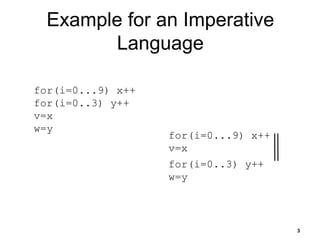
Example for an Imperative
Language
3
for(i=0...9) x++
for(i=0..3) y++
v=x
w=y
for(i=0...9) x++
v=x
for(i=0..3) y++
w=y
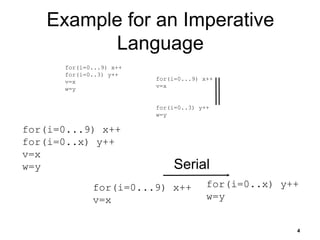
Example for an Imperative
Language
4
for(i=0...9) x++
for(i=0..3) y++
v=x
w=y
for(i=0...9) x++
v=x
for(i=0..3) y++
w=y
for(i=0...9) x++
for(i=0..x) y++
v=x
w=y
for(i=0...9) x++
v=x
for(i=0..x) y++
w=y
Serial
Poker: a motivating example
5
sig Suit{}
sig Number{gt:lone Number}
sig Card{suit: one Suit,
number: one Number}
fact Card_Set{
all disjoint c1,c2:Card|
c1.number!=c2.number and
c1.suit !=c2.suit
--card set does not include Joker
all c: Card | c.number != Joker
}
There are 56 Possible Cards, but 52 Cards are Valid.
Poker: a motivation example
6
fact playing_rules{
--Nobody plays by himself
all p:Player | p.successor != p
--Playing in a circular order
all p:Player | p.^successor = Player
--each player have exactly two cards
all p:Player | #p.cards = 2
--Pocket cards are not shared
all disjoint p1,p2:Player | no (p1.cards & p2.cards )
}
sig Player{
cards: set Card,
chips: one Int,
successor: one Player}
sig Suit{}
sig Number{gt:lone Number}
sig Card{suit: one Suit,
number: one Number}
fact Card_Set{
all disjoint c1,c2:Card |
c1.number=c2.number and c1.suit =c2.suit
--card set does not include Joker
all c: Card | c.number != Joker
}
Idea
• Preventing exponential growing of the state
space.
• Alloy creates an upper bound for solution
• Solve smaller slices such that
8
Σcost(slicei) ≪cost(whole)
cost: Memory+Time
Approach
• Which part of possible instances should be
generated first?
• Which part of a model can be solved first?
9
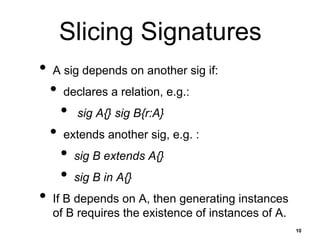
Slicing Signatures
• A sig depends on another sig if:
• declares a relation, e.g.:
• sig A{} sig B{r:A}
• extends another sig, e.g. :
• sig B extends A{}
• sig B in A{}
• If B depends on A, then generating instances
of B requires the existence of instances of A.
10
Dependency Graph
• Dependency class: All sigs that does not have
input edge in the dependency graph
• Remove all dependent sigs from the dependency
graph and find other dependent sigs
• A dependency class
• Depends on predecessors
• Not depend on successors
11
Example of Dependency Graph
12
The most
independent class
The most
dependent class
Predicates slicing
• Find a predicates such that:
• The instances of relations in the predicate is
already in a sig class and its predecessors.
• Example:
13
--No Joker in Deck
all c: Card | c.number != Joker
Card.(Card->Number) != Number
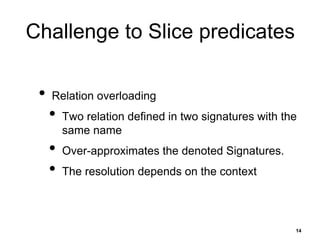
Challenge to Slice predicates
• Relation overloading
• Two relation defined in two signatures with the
same name
• Over-approximates the denoted Signatures.
• The resolution depends on the context
14
Alloy type system
15
• Relation overloading
• Example
sig Player{
cards: set Card,
chips: one Int,
successor: one Player}
sig Round{
cards: set Card,
dealer: one Player,
blind: one Player}
Player.(cards+cards) = 2
Player.(Player→Card+Round→Ca
rd)
{Player,Card,Round}SigIn(φ) =
φ :
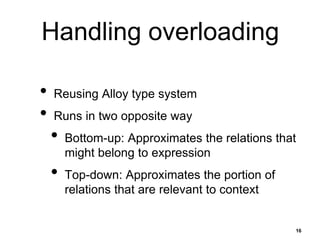
Handling overloading
• Reusing Alloy type system
• Runs in two opposite way
• Bottom-up: Approximates the relations that
might belong to expression
• Top-down: Approximates the portion of
relations that are relevant to context
16
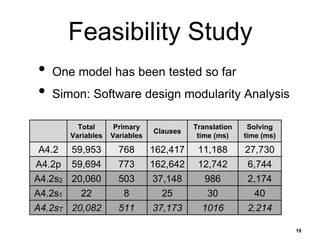
Feasibility Study
• One model has been tested so far
• Simon: Software design modularity Analysis
19
Total
Variables
Primary
Variables
Clauses
Translation
time (ms)
Solving
time (ms)
A4.2 59,953 768 162,417 11,188 27,730
A4.2p 59,694 773 162,642 12,742 6,744
A4.2s2 20,060 503 37,148 986 2,174
A4.2s1 22 8 25 30 40
A4.2sT 20,082 511 37,173 1016 2,214
Conclusion
• Alloy is not imperative, but we still need
Static Analyzer
• Typed-system
• Optimizer Execution
• Slicing does always improve performance
• More benchmarking
20

Sliced Alloy

  • 1.
    Towards Sliced Alloy VajihMontaghami University of Waterloo
  • 2.
    Program slicing • ProgramSlicing: Automatically decompose program by analyzing their data flow, control flow, and graph dependency • Comprehend slice: debugging, testing • Comprehend slices: parallelization • Alloy is a logic specification language • Slicing based on the Alloy type-system. 2
  • 3.
    Example for anImperative Language 3 for(i=0...9) x++ for(i=0..3) y++ v=x w=y for(i=0...9) x++ v=x for(i=0..3) y++ w=y
  • 4.
    Example for anImperative Language 4 for(i=0...9) x++ for(i=0..3) y++ v=x w=y for(i=0...9) x++ v=x for(i=0..3) y++ w=y for(i=0...9) x++ for(i=0..x) y++ v=x w=y for(i=0...9) x++ v=x for(i=0..x) y++ w=y Serial
  • 5.
    Poker: a motivatingexample 5 sig Suit{} sig Number{gt:lone Number} sig Card{suit: one Suit, number: one Number} fact Card_Set{ all disjoint c1,c2:Card| c1.number!=c2.number and c1.suit !=c2.suit --card set does not include Joker all c: Card | c.number != Joker } There are 56 Possible Cards, but 52 Cards are Valid.
  • 6.
    Poker: a motivationexample 6 fact playing_rules{ --Nobody plays by himself all p:Player | p.successor != p --Playing in a circular order all p:Player | p.^successor = Player --each player have exactly two cards all p:Player | #p.cards = 2 --Pocket cards are not shared all disjoint p1,p2:Player | no (p1.cards & p2.cards ) } sig Player{ cards: set Card, chips: one Int, successor: one Player} sig Suit{} sig Number{gt:lone Number} sig Card{suit: one Suit, number: one Number} fact Card_Set{ all disjoint c1,c2:Card | c1.number=c2.number and c1.suit =c2.suit --card set does not include Joker all c: Card | c.number != Joker }
  • 7.
    Idea • Preventing exponentialgrowing of the state space. • Alloy creates an upper bound for solution • Solve smaller slices such that 8 Σcost(slicei) ≪cost(whole) cost: Memory+Time
  • 8.
    Approach • Which partof possible instances should be generated first? • Which part of a model can be solved first? 9
  • 9.
    Slicing Signatures • Asig depends on another sig if: • declares a relation, e.g.: • sig A{} sig B{r:A} • extends another sig, e.g. : • sig B extends A{} • sig B in A{} • If B depends on A, then generating instances of B requires the existence of instances of A. 10
  • 10.
    Dependency Graph • Dependencyclass: All sigs that does not have input edge in the dependency graph • Remove all dependent sigs from the dependency graph and find other dependent sigs • A dependency class • Depends on predecessors • Not depend on successors 11
  • 11.
    Example of DependencyGraph 12 The most independent class The most dependent class
  • 12.
    Predicates slicing • Finda predicates such that: • The instances of relations in the predicate is already in a sig class and its predecessors. • Example: 13 --No Joker in Deck all c: Card | c.number != Joker Card.(Card->Number) != Number
  • 13.
    Challenge to Slicepredicates • Relation overloading • Two relation defined in two signatures with the same name • Over-approximates the denoted Signatures. • The resolution depends on the context 14
  • 14.
    Alloy type system 15 •Relation overloading • Example sig Player{ cards: set Card, chips: one Int, successor: one Player} sig Round{ cards: set Card, dealer: one Player, blind: one Player} Player.(cards+cards) = 2 Player.(Player→Card+Round→Ca rd) {Player,Card,Round}SigIn(φ) = φ :
  • 15.
    Handling overloading • ReusingAlloy type system • Runs in two opposite way • Bottom-up: Approximates the relations that might belong to expression • Top-down: Approximates the portion of relations that are relevant to context 16
  • 16.
    Feasibility Study • Onemodel has been tested so far • Simon: Software design modularity Analysis 19 Total Variables Primary Variables Clauses Translation time (ms) Solving time (ms) A4.2 59,953 768 162,417 11,188 27,730 A4.2p 59,694 773 162,642 12,742 6,744 A4.2s2 20,060 503 37,148 986 2,174 A4.2s1 22 8 25 30 40 A4.2sT 20,082 511 37,173 1016 2,214
  • 17.
    Conclusion • Alloy isnot imperative, but we still need Static Analyzer • Typed-system • Optimizer Execution • Slicing does always improve performance • More benchmarking 20

Editor's Notes

  • #6 Introduce Sig as Class
  • #15 Even worse if we have subetyping