EE2401POWER SYSTEM OPERATION AND CONTROLL T P C
3 0 0 3UNIT I INTRODUCTION
System load – variation - load characteristics - load curves and load-duration curve (daily,
weekly and annual) - load factor - diversity factor. Importance of load forecasting and simple
techniques of forecasting. An overview of power system operation and control and the role of
computers in the implementation. (Qualitative treatment with block diagram).
UNIT IIREAL POWER - FREQUENCY CONTROL
Basics of speed governing mechanism and modeling - speed-load characteristics – load
sharingbetween two synchronous machines in parallel. Control area concept LFC control of a
singleareasystem. Static and dynamic analysis of uncontrolled and controlled
cases.Integration ofeconomic dispatch control with LFC.Two-area system – modeling - static
analysis of uncontrolledcase - tie line with frequency bias control of two-area system - state
variable model.
UNIT III REACTIVE POWER–VOLTAGE CONTROL
Basics of reactive power control. Excitation systems – modeling.Static and dynamic analysis
-stability compensation - generation and absorption of reactive power. Relation between
voltage,power and reactive power at a node - method of voltage control - tap-changing
transformer. Systemlevel control using generator voltage magnitude setting, tap setting of
OLTC transformer andMVAR injection of switched capacitors to maintain acceptable voltage
profile and to minimizetransmission loss.
UNIT IV UNIT COMMITMENT AND ECONOMIC DISPATCH
Statement of economic dispatch problem – cost of generation – incremental cost curve co-
ordinationequations without loss and with loss, solution by direct method and λ-iteration
method. (Noderivation of loss coefficients). Statement of Unit Commitment problem –
constraints; spinningreserve, thermal unit constraints, hydro constraints, fuel constraints and
other constraints. Solutionmethods - Priority-list methods - forward dynamic programming
approach. Numericalproblems only in priority-list method using full-load average production
cost.
UNIT V COMPUTER CONTROL OF POWER SYSTEMS
Need of computer control of power systems. Concept of energy control centre (or) load
dispatchcentre and the functions - system monitoring - data acquisition and control. System
hardwareconfiguration – SCADA and EMS functions. Network topology - state estimation -
security analysisand control.Various operating states (Normal, alert, emergency, in-extremis
and restorative).Statetransition diagram showing various state transitions and control
strategies.
TEXT BOOKS
1. Allen. J. Wood and Bruce F. Wollenberg, ‘Power Generation, Operation and Control’,
John Wiley& Sons, Inc., 2003.
2. Chakrabarti&Halder, “Power System Analysis: Operation and Control”, Prentice Hall of
India,2004 Edition.
REFERENCES
1. D.P. Kothari and I.J. Nagrath, ‘Modern Power System Analysis’, Third Edition, Tata
McGraw HillPublishing Company Limited, New Delhi, 2003. (For Chapters 1, 2 & 3)
2. L.L. Grigsby, ‘The Electric Power Engineering, Hand Book’, CRC Press& IEEE
Press,2001.
3. HadiSaadat, “Power System Analysis”, (For the chapters 1, 2, 3 and 4)11th Reprint2007.
4. P.Kundur, ‘Power System Stability and Control’ MC Craw Hill Publisher, USA, 1994.
5. Olle.I.Elgerd, ‘Electric Energy Systems theory An introduction’ Tata McGraw Hill
Publishing Company Ltd. New Delhi, Second Edition 2003.
EE2402PROTECTION AND SWITCHGEARL T P C3 0 0 3
UNIT I INTRODUCTION
Importance of protective schemes for electrical apparatus and power system. Qualitative
review offaults and fault currents - relay terminology – definitions - and essential qualities of
protection.Protection against over voltages due to lightning and switching - arcing grounds -
Peterson Coil -ground wires - surge absorber and divertersPower System earthing –
neutral Earthing - basic ideas of insulation coordination.
UNIT IIOPERATING PRINCIPLES AND RELAY CHARACTERISTICS
Electromagnetic relays – over current, directional and non-directional, distance, negative
sequence,differential and under frequency relays – Introduction to static relays.
UNIT IIIAPPARATUS PROTECTION
Main considerations in apparatus protection - transformer, generator and motor protection -
protection of busbars. Transmission line protection - zones of protection. CTs and PTs and
theirapplications in protection schemes.
UNIT IVTHEORY OF CIRCUIT INTERRUPTION
Physics of arc phenomena and arc interruption.DC and AC circuit breaking - restriking
voltage and recovery voltage - rate of rise of recovery voltage- resistance switching - current
chopping - interruption of capacitive current.
UNIT V CIRCUIT BREAKERS
Types of circuit breakers – air blast, air break, oil, SF6 and vacuum circuit breakers –
comparativemerits of different circuit breakers – testing of circuit breakers.
TEXT BOOKS:
1. M.L. Soni, P.V. Gupta, V.S. Bhatnagar, A. Chakrabarti, ‘A Text Book on Power System
Engineering’, DhanpatRai& Co., 1998.(For All Chapters 1, 2, 3, 4 and 5).
2. R.K.Rajput, A Tex book of Power System Engineering. Laxmi Publications, First
Edition Reprint 2007.
REFERENCES:
1. Sunil S. Rao, ‘Switchgear and Protection’, Khanna publishers, New Delhi, 1986.
2. C.L. Wadhwa, ‘Electrical Power Systems’, Newage International (P) Ltd., 2000.
3. B. Ravindranath, and N. Chander, ‘Power System Protection & Switchgear’, Wiley Eastern
Ltd.,1977.
4. Badri Ram, Vishwakarma, ‘Power System Protection and Switchgear’, Tata McGraw Hill, 2001.
5. Y.G. Paithankar and S.R. Bhide, ‘Fundamentals of Power System Protection’, Prentice Hall ofIndia
Pvt. Ltd., New Delhi–110001, 2003
EE 2403 SPECIAL ELECTRICAL MACHINES L T P C3 0 0 3
UNIT I SYNCHRONOUS RELUCTANCE MOTORS
Constructional features – Types – Axial and Radial flux motors – Operating principles –
VariableReluctance and Hybrid Motors – SYNREL Motors – Voltage and Torque Equations
- Phasor diagram- Characteristics.
UNIT II STEPPING MOTORS
Constructional features – Principle of operation – Variable reluctance motor – Hybrid motor
– Singleand multi stack configurations – Torque equations – Modes of excitations -
Characteristics – Drivecircuits – Microprocessor control of stepping motors – Closed loop
control.
UNIT III SWITCHED RELUCTANCE MOTORS
Constructional features – Rotary and Linear SRMs - Principle of operation – Torque
production –Steady state performance prediction- Analytical method -Power Converters and
their controllers –Methods of Rotor position sensing – Sensorless operation – Closed loop
control of SRM -Characteristics.
UNIT IV PERMANENT MAGNET BRUSHLESS D.C. MOTORS
Permanent Magnet materials – Magnetic Characteristics – Permeance coefficient -Principle
ofoperation – Types – Magnetic circuit analysis – EMF and torque equations –Commutation
– Powercontrollers – Motor characteristics and control.
UNIT V PERMANENT MAGNET SYNCHRONOUS MOTORS
Principle of operation – Ideal PMSM – EMF and Torque equations – Armature reaction
MMF –Synchronous Reactance – Sinewave motor with practical windings - Phasor diagram
–Torque/speed characteristics - Power controllers - Converter Volt-ampere requirements.
TEXT BOOKS:
1. T.J.E. Miller, ‘Brushless Permanent Magnet and Reluctance Motor Drives’, Clarendon
Press,Oxford, 1989.
2. T. Kenjo, ‘Stepping Motors and Their Microprocessor Controls’, Clarendon Press London, 1984.
REFERENCES:
1. R.Krishnan, ‘Switched Reluctance Motor Drives – Modeling, Simulation, Analysis, Design
andApplication’, CRC Press, New York, 2001.
2. P.P. Aearnley, ‘Stepping Motors – A Guide to Motor Theory and Practice’, Peter
PerengrinusLondon, 1982.
3. T. Kenjo and S. Nagamori, ‘Permanent Magnet and Brushless DC Motors’, Clarendon
Press,London, 1988.
MG2351PRINCIPLES OF MANAGEMENT L T P C
3 0 0 3
UNIT I OVERVIEW OF MANAGEMENT
Organization - Management - Role of managers - Evolution of Management thought –
Organizationand the environmental factors - Managing globally - Strategies for International
Business.
UNIT II PLANNING
Nature and purpose of planning - Planning process - Types of plans – Objectives - Managing
byobjective (MBO) Strategies - Types of strategies - Policies - Decision Making - Types of
decision -Decision Making Process - Rational Decision Making Process - Decision Making
under differentconditions.
UNIT III ORGANIZING
Nature and purpose of organizing - Organization structure - Formal and informal groups I
organization - Line and Staff authority - Departmentation - Span of control - Centralization
andDecentralization - Delegation of authority - Staffing - Selection and Recruitment -
Orientation -Career Development - Career stages – Training - Performance Appraisal.
UNIT IV DIRECTING
Creativity and Innovation - Motivation and Satisfaction - Motivation Theories Leadership –
Leadershiptheories - Communication - Hurdles to effective communication - Organization
Culture – Elementsand types of culture - Managing cultural diversity.
UNIT V CONTROLLING
Process of controlling - Types of control - Budgetary and non-budgetary control techniques -
Managing Productivity - Cost Control - Purchase Control - Maintenance Control - Quality
Control -Planning operations.
TEXT BOOKS:
1. Stephen P. Robbins and Mary Coulter, 'Management', Prentice Hall of India, 8th edition.
2. Charles W L Hill, Steven L McShane, 'Principles of Management', Mcgraw Hill
Education, SpecialIndian Edition, 2007.
REFERENCES:
1. Hellriegel, Slocum & Jackson, ' Management - A Competency Based Approach', Thomson
South Western, 10th edition, 2007.
2. Harold Koontz, Heinz Weihrich and Mark V Cannice, ‘Management – A global &
Entrepreneurial Perspective’, Tata Mcgraw Hill, 12th edition, 2007.
3. Andrew J. Dubrin, 'Essentials of Management', Thomson Southwestern, 7thedition, 2007.
CS2411 OPERATING SYSTEMS L T P C
3 0 0 3
UNIT I PROCESSES AND THREADS
Introduction to operating systems – review of computer organization – operating system
structures –system calls – system programs – system structure – virtual machines. Processes:
Process concept– Process scheduling – Operations on processes – Cooperating processes –
Interprocesscommunication – Communication in client-server systems. Case study: IPC in
Linux. Threads: Multithreadingmodels – Threading issues. Case Study: Pthreads library
UNIT II PROCESS SCHEDULING AND SYNCHRONIZATION
CPU Scheduling: Scheduling criteria – Scheduling algorithms – Multiple-
processor scheduling –Real time scheduling – Algorithm Evaluation. Case study:
Process scheduling in Linux. ProcessSynchronization: The critical-section problem –
Synchronization hardware – Semaphores – Classicproblems of synchronization – critical
regions – Monitors. Deadlock: System model – Deadlockcharacterization – Methods for
handling deadlocks – Deadlock prevention – Deadlock avoidance –Deadlock detection –
Recovery from deadlock.
UNIT III STORAGE MANAGEMENT
Memory Management: Background – Swapping – Contiguous memory allocation – Paging –
Segmentation – Segmentation with paging. Virtual Memory:Background – Demand paging –
Processcreation – Page replacement –Allocation of frames – Thrashing. Case Study: Memory
managementin Linux
UNIT IV FILE SYSTEMS
File-System Interface: File concept – Access methods – Directory structure –File-system
mounting –Protection. File-System Implementation : Directory implementation – Allocation
methods – Freespacemanagement – efficiency and performance – recovery – log-structured
file systems. Casestudies: File system in Linux – file system in Windows XP
UNIT V I/O SYSTEMS
I/O Systems – I/O Hardware – Application I/O interface – kernel I/O subsystem – streams –
performance. Mass-Storage Structure: Disk scheduling – Disk management – Swap-space
management – RAID – disk attachment – stable storage – tertiary storage. Case study: I/O in
Linux
TEXT BOOKS
1. Silberschatz, Galvin, and Gagne, “Operating System Concepts”, Sixth Edition, Wiley India
PvtLtd, 2003.
2. D. M. Dhamdhere, “Operating Systems: A concepts based approach”, Second Edition, Tata
McGraw-Hill Publishing Company Ltd., 2006.
REFERENCES
1. Andrew S. Tanenbaum, “Modern Operating Systems”, Second Edition, Pearson
Education/PHI, 2001.
2. Harvey M. Deital, “Operating Systems”, Third Edition, Pearson Education, 2004.
EI2311 BIOMEDICAL INSTRUMENTATION L T P C3 0 0 3
UNIT I PHYSIOLOGY AND TRANSDUCERS
Cell and its structure – Resting and Action Potential – Nervous system: Functional
organisation ofthe nervous system – Structure of nervous system, neurons - synapse –
transmitters and neuralcommunication – Cardiovascular system – respiratory system – Basic
components of a biomedicalsystem - Transducers – selection criteria – Piezo electric,
ultrasonic transducers – Temperaturemeasurements - Fibre optic temperature sensors.
UNIT II ELECTRO – PHYSIOLOGICAL MEASUREMENTS
Electrodes –Limb electrodes –floating electrodes – pregelled disposable electrodes - Micro,
needleand surface electrodes – Amplifiers: Preamplifiers, differential amplifiers, chopper
amplifiers –Isolation amplifier.ECG – EEG – EMG – ERG – Lead systems and recording
methods – Typical waveforms.Electrical safety in medical environment: shock hazards –
leakage current-Instruments for checkingsafety parameters of biomedical equipments
UNIT III NON-ELECTRICAL PARAMETER MEASUREMENTS
Measurement of blood pressure – Cardiac output – Heart rate – Heart sound –Pulmonary
functionmeasurements – spirometer – Photo Plethysmography, Body Plethysmography –
Blood Gasanalysers : pH of blood –measurement of blood pCO2, pO2, finger-tip oxymeter -
ESR, GSRmeasurements .
UNIT IV MEDICAL IMAGING
Radio graphic and fluoroscopic techniques – Computer tomography – MRI –
Ultrasonography –Endoscopy – Thermography – Different types of biotelemetry systems and
patient monitoring –Introduction to Biometric systems
UNIT V ASSISTING AND THERAPEUTIC EQUIPMENTS
Pacemakers – Defibrillators – Ventilators – Nerve and muscle stimulators – Diathermy –
Heart –Lung machine – Audio meters – Dialysers – Lithotripsy
TEXT BOOKS
1. R.S.Khandpur, ‘Hand Book of Bio-Medical instrumentation’, Tata McGraw Hill
Publishing Co Ltd.,2003.
2. Leslie Cromwell, Fred J.Weibell, Erich A.Pfeiffer, ‘Bio-Medical Instrumentation and
Measurements’, II edition, Pearson Education, 2002 / PHI.
REFERENCES
1. M.Arumugam, ‘Bio-Medical Instrumentation’, Anuradha Agencies, 2003.
2. L.A. Geddes and L.E.Baker, ‘Principles of Applied Bio-Medical Instrumentation’, John
Wiley &Sons, 1975.
3. J.Webster, ‘Medical Instrumentation’, John Wiley & Sons, 1995.
4. C.Rajarao and S.K. Guha, ‘Principles of Medical Electronics and Bio-medical
Instrumentation’,Universities press (India) Ltd, Orient Longman ltd, 2000.
GE2022 TOTAL QUALITY MANAGEMENT L T P C3 0 0 3
UNIT I INTRODUCTION
Introduction - Need for quality - Evolution of quality - Definition of quality - Dimensions of
manufacturing and service quality - Basic concepts of TQM - Definition of TQM – TQM
Framework -Contributions of Deming, Juran and Crosby – Barriers to TQM.
UNIT II TQM PRINCIPLES
Leadership – Strategic quality planning, Quality statements - Customer focus – Customer
orientation, Customer satisfaction, Customer complaints, Customer retention - Employee
involvement – Motivation, Empowerment, Team and Teamwork, Recognition and Reward,
Performance appraisal - Continuous process improvement – PDSA cycle, 5s, Kaizen –
Supplierpartnership – Partnering, Supplier selection, Supplier Rating.
UNIT III TQM TOOLS & TECHNIQUES I
The seven traditional tools of quality – New management tools – Six-sigma: Concepts,
methodology,applications to manufacturing, service sector including IT – Bench marking –
Reason to bench mark,Bench marking process – FMEA – Stages, Types.
UNIT IV TQM TOOLS & TECHNIQUES II
Quality circles – Quality Function Deployment (QFD) – Taguchi quality loss function – TPM
–Concepts, improvement needs – Cost of Quality – Performance measures.
UNIT V QUALITY SYSTEMS
Need for ISO 9000- ISO 9000-2000 Quality System – Elements, Documentation, Quality
auditing-QS 9000 – ISO 14000 – Concepts, Requirements and Benefits – Case studies of
TQMimplementation in manufacturing and service sectors including IT.
TEXT BOOK
1. Dale H.Besterfiled, et at., “Total Quality Management”, Pearson Education Asia,
Third Edition, Indian Reprint (2006).
REFERENCES
1. James R. Evans and William M. Lindsay, “The Management and Control of Quality”,
(6th Edition),South-Western (Thomson Learning), 2005.
2. Oakland, J.S. “TQM – Text with Cases”, Butterworth – Heinemann Ltd., Oxford, Third
Edition(2003).
3. Suganthi,L and Anand Samuel, “Total Quality Management”, Prentice Hall (India) Pvt.
Ltd.(2006)
4. Janakiraman,B and Gopal, R.K, “Total Quality Management – Text and Cases”, Prentice
Hall(India) Pvt. Ltd. (2006)
EE2025 INTELLIGENT CONTROL L T P C3 0 0 3
UNIT I INTRODUCTION
Approaches to intelligent control.Architecture for intelligent control. Symbolic reasoning
system,rule-based systems, the AI approach. Knowledge representation.Expert systems.
UNIT II ARTIFICIAL NEURAL NETWORKS
Concept of Artificial Neural Networks and its basic mathematical model, McCulloch-Pitts
neuronmodel, simple perceptron, Adaline and Madaline, Feed-forward Multilayer
Perceptron.Learning andTraining the neural network. Data Processing: Scaling, Fourier
transformation, principal-componentanalysis and wavelet transformations. Hopfield network,
Self-organizing network and Recurrentnetwork. Neural Network based controller
UNIT III GENETIC ALGORITHM
Basic concept of Genetic algorithm and detail algorithmic steps, adjustment of free
parameters.Solution of typical control problems using genetic algorithm. Concept on some
other searchtechniques like tabu search and ant-colony search techniques for
solving optimization problems.
UNIT IV FUZZY LOGIC SYSTEM
Introduction to crisp sets and fuzzy sets, basic fuzzy set operation and approximate reasoning.
Introduction to fuzzy logic modeling and control.Fuzzification, inferencing and
defuzzification.Fuzzyknowledge and rule bases. Fuzzy modeling and control schemes for
nonlinear systems. Selforganizingfuzzy logic control.Fuzzy logic control for nonlinear time-
delay system.
UNIT V APPLICATIONS
GA application to power system optimisation problem, Case studies: Identification and
control oflinear and nonlinear dynamic systems using Matlab-Neural Network toolbox.
Stability analysis of Neural-Network interconnection systems.Implementation of fuzzy logic
controllerusing Matlab fuzzy-logic toolbox.Stability analysis of fuzzy control systems.
TEXT BOOKS
1. Padhy.N.P.(2005), Artificial Intelligence and Intelligent System, Oxford University Press.
2. KOSKO,B. "Neural Networks And Fuzzy Systems", Prentice-Hall of India Pvt. Ltd., 1994.
REFERENCES
1. Jacek.M.Zurada, "Introduction to Artificial Neural Systems", Jaico Publishing House,
1999.
2. KLIR G.J. & FOLGER T.A. "Fuzzy sets, uncertainty and Information", Prentice-Hall of
India Pvt.Ltd., 1993.
3. Zimmerman H.J. "Fuzzy set theory-and its Applications"-Kluwer Academic
Publishers,1994.
4. Driankov, Hellendroon, "Introduction to Fuzzy Control", Narosa Publishers.
5. Goldberg D.E. (1989) Genetic algorithms in Search, Optimization and Machine
learning, Addison Wesley.
EE2026POWER SYSTEM DYNAMICS L T P C3 0 0 3
UNIT I INTRODUCTION
Basics of system dynamics – numerical techniques – introduction to software packages to
study theresponses.Concept and importance of power system stability in the operation and
design - distinction betweentransient and dynamic stability - complexity of stability problem
in large system – necessity forreduced models - stability of interconnected systems.
UNIT II SYNCHRONOUS MACHINE MODELLING
Synchronous machine - flux linkage equations - Park’s transformation - per unit conversion -
normalizing the equations - equivalent circuit - current space model - flux linkage state space
model.Sub-transient and transient inductances - time constants.Simplified models (one axis
and constant flux linkage) - steady state equations and phasordiagrams.
UNIT III MACHINE CONTROLLERS
Exciter and voltage regulators - function and types of excitation systems - typical excitation
systemconfiguration - block diagram and state space representation of IEEE type 1 excitation
system -saturation function - stabilizing circuit.Function of speed governing systems - block
diagram and state space representation of IEEEmechanical hydraulic governor and electrical
hydraulic governors for hydro turbines and steamturbines.
UNIT IV TRANSIENT STABILITY
State equation for multimachine system with one axis model and simulation – modelling of
multimachine power system with one axis machine model including excitation system and
speedgoverning system and simulation using R-K method of fourth order (Gill’s technique)
for transientstability analysis - power system stabilizer. For all simulations, the algorithm and
flow chart have tobe discussed.
UNIT V DYNAMIC STABILITY
System response to small disturbances - linear model of the unregulated synchronous
machine andits modes of oscillation - regulated synchronous machine - distribution of power
impact – linearizationof the load equation for the one machine problem – simplified linear
model - effect of excitation ondynamic stability - approximate system representation -
supplementary stabilizing signals – dynamicperformance measure - small signal performance
measures.
TEXT BOOKS
1. P.M. Anderson and A.A.Fouad, ‘Power System Control and Stability’,
GalgotiaPublications,New Delhi, 2003.
2. P. Kundur, ‘Power System Stability and Control’, McGraw Hill Inc., USA, 1994.
REFERENCES
1. M.A.Pai and W.Sauer, ‘Power System Dynamics and Stability’, Pearson Education Asia,
India,2002.
2. James A.Momoh, Mohamed.E. EI-Hawary.“ Electric Systems, Dynamics and stability
withArtificial Intelligence applications”, Marcel Dekker, USA First
Edition 2000
CS2071 COMPUTER ARCHITECTURE L T P C
3 0 0 3
UNIT I INSTRUCTION SET ARCHITECTURE
Introduction to computer architecture - Review of digital design – Instructions and addressing
–procedures and data – assembly language programs – instruction set variations
UNIT II ARITHMETIC/LOGIC UNIT
Number representation – design of adders – design of simple ALUs – design of Multipliers
anddividers – design of floating point arithmetic unit
UNIT III DATA PATH AND CONTROL
Instruction execution steps – control unit synthesis – microprogramming – pipelining –
pipelineperformance
UNIT IV MEMORY SYSTEM
Main Memory concepts – types of memory – cache memory organization – secondary
storage –virtual memory – paging
UNIT V I/O AND INTERFACES
I/O devices – I/O programming – polling – interrupts – DMA – buses – links – interfacing –
contextswitching – threads and multithreading
TEXT BOOKS:
1. B. Parhami, “Computer Architecture”, Oxford University Press, 2005.
2. Carl Hamacher, ZvonkoVranesic and SafwatZaky, “Computer Organization”, Fifth
Edition, Tata McGraw Hill, 2002.
REFERENCES:
1. David A. Patterson and John L. Hennessy, “Computer Organization and Design: The
Hardware/Software interface”, Third Edition, Elsevier, 2004.
2. William Stallings, “Computer Organization and Architecture – Designing for
Performance”,Seventh Edition, Pearson Education, 2006.
3. Miles Murdocca “Computers Architecture and Organization An Integrated approach”,
WileycIndiapvt Ltd, 2007
4. John D. Carpinelli, “Computer systems organization and Architecture”,
Pearson Education, 2001.
MG2452 ENGINEERING ECONOMICS AND FINANCIAL ACCOUNTING
UNIT I INTRODUCTION
Managerial Economics - Relationship with other disciplines - Firms: Types, objectives
and goals - Managerial decisions - Decision analysis.
UNIT II DEMAND & SUPPLY ANALYSIS
Demand - Types of demand - Determinants of demand - Demand function -
Demand elasticity - Demandforecasting - Supply - Determinants of supply -Supply function -
Supply elasticity.
UNIT III PRODUCTION AND COST ANALYSIS
Production function - Returns to scale - Production optimization - Least cost input -
Isoquants - Managerialuses of production function.Cost Concepts - Cost function -
Determinants of cost - Short run and Long run cost curves - Cost OutputDecision -
Estimation of Cost.
UNIT IV PRICING
Determinants of Price - Pricing under different objectives and different market structures
- Price discrimination - Pricing methods in practice.
UNIT V FINANCIAL ACCOUNTING (ELEMENTARY TREATMENT)
Balance sheet and related concepts - Profit & Loss Statement and related concepts - -
Financial RatioAnalysis - Cash flow analysis - Funds flow analysis - Comparative financial
statements - Analysis &Interpretation of financial statements.
UNIT VI CAPITAL BUDGETING (ELEMENTARY TREATMENT)
Investments - Risks and return evaluation of investment decision - Average rate of return
- Payback Period - Net Present Value - Internal rate of return.
REFERENCES:
1. Samuelson. Paul A and Nordhaus W.D., 'Economics', Tata Mcgraw Hill
Publishing Company Limited, New Delhi, 2004.
2. McGuigan, Moyer and Harris, 'Managerial Economics; Applications, Strategy and
Tactics', Thomson South Western, 10th Edition, 2005.
3. Paresh Shah, 'Basic Financial Accounting for Management', Oxford University Press, Ne
w Delhi, 2007.
4. Salvatore Dominick, 'Managerial Economics in a global economy'. Thomson South
Western, 4th Edition, 2001.
5. Prasanna Chandra. 'Fundamentals of Financial Management', Tata Mcgraw Hill
Publishing Ltd., 4th edition, 2005.
CS2401 COMPUTER GRAPHICS L T P C
3 0 0 3
UNIT I 2D PRIMITIVES
outputprimitives Line, Circle and Ellipse drawing algorithms Attributes of output primitives
– Two dimensionalGeometric transformation - Two dimensional viewing –
Line, Polygon, Curve and Text clipping algorithms
UNIT II 3D CONCEPTS
Parallel and Perspective projections - Three dimensional object representation –
Polygons, Curved lines,Splines, Quadric Surfaces,- Visualization of data sets -
3D transformations – Viewing -Visible surfaceidentification.
UNIT III GRAPHICS PROGRAMMING
Color Models RGB, YIQ, CMY, HSV Animations General Computer Animation, Raster,
Keyframe - Graphics programming using OPENGL – Basic graphics primitives –
Drawing three dimensional objects -Drawing three dimensional scenes
UNIT IV RENDERING
Introduction to Shading models – Flat and Smooth shading – Adding texture to faces –
Adding shadows ofobjects – Building a camera in a program – Creating shaded objects
– Rendering texture – Drawing Shadows.
UNIT V FRACTALS
Fractals and Self similarity – Peano curves – Creating image by iterated functions –
Mandelbrot sets – Julia Sets – Random Fractals – Overview of Ray Tracing –
Intersecting rays with other primitives – AddingSurface texture – Reflections and
Transparency – Boolean operations on Objects.
TEXT BOOKS:
1. Donald Hearn, Pauline Baker, Computer Graphics C Version, second edition, Pearso
nEducation,2004.
2. F.S. Hill, Computer Graphics using OPENGL, Second edition, Pearson Education,
2003.
REFERENCE:
1. James D. Foley, Andries Van Dam, Steven K. Feiner, John F. Hughes, Computer
Graphics- Principles and practice, Second Edition in C, Pearson Education, 2007.
CS2402 MOBILE AND PERVASIVE COMPUTING L T P C
3 0 0 3
UNIT I MOBILE NETWORKS
Cellular Wireless Networks – GSM – Architecture – Protocols Connection Establishment –
FrequencyAllocation – Routing – Mobility Management – Security – GPRS.
UNIT II WIRELESS NETWORKS
Wireless LANs and PANs – IEEE 802.11 Standard – Architecture – Services –Network –
HiperLAN – BlueTooth- Wi-Fi – WiMAX
UNIT III ROUTING
Mobile IP – DHCP – AdHoc– Proactive and Reactive Routing Protocols – Multicast
Routing.
UNIT IV TRANSPORT AND APPLICATION LAYERS
Mobile TCP– WAP – Architecture – WWW Programming Model– WDP – WTLS – WTP –
WSP – WAE –WTA Architecture – WML – WMLScripts.
UNIT V PERVASIVE COMPUTING
Pervasive computing infrastructure –applications Device Technology
Hardware, HumanmachineInterfaces, Biometrics, and Operating systems–
Device Connectivity -Protocols, Security, and DeviceManagement-
Pervasive Web Application architecture-Access from PCs and PDAs - Access via WAP
TEXT BOOKS:
1. Jochen Schiller, “Mobile Communications”, PHI, Second Edition, 2003.
2. Jochen Burkhardt, Pervasive Computing: Technology and Architecture of Mobile
Internet Applications, Addison-Wesley Professional; 3rd edition, 2007
REFERENCES:
1. Frank Adelstein, Sandeep KS Gupta, Golden Richard, Fundamentals of Mobile and
Pervasive Computing, McGraw-Hill 2005
2. Debashis Saha, Networking Infrastructure for Pervasive Computing: Enabling
Technologies, Kluwer Academic Publisher, Springer; First edition, 2002
3. Introduction to Wireless and Mobile Systems by Agrawal and Zeng, Brooks/ Cole
(Thomson Learning), First edition, 2002
4. Uwe Hansmann, Lothar Merk, Martin S. Nicklons and Thomas Stober, Principles of
Mobile Computing, Springer, New York, 2003.
CS2403 DIGITAL SIGNAL PROCESSING L T P C
3 0 0 3
UNIT I SIGNALS AND SYSTEMS
Basic elements of DSP concepts of frequency in Analog and Digital Signals sampling
theorem – Discrete– time signals, systems Analysis of discrete time LTI systems –
Z transform –Convolution (linear andcircular) – Correlation.
UNIT II FREQUENCY TRANSFORMATIONS
Introduction to DFT – Properties of DFT – Filtering methods based on DFT –
FFT Algorithms Decimation –in – time Algorithms, Decimation – in –
frequency Algorithms – Use of FFT in Linear Filtering – DCT.
UNIT III IIR FILTER DESIGN
Structures of IIR – Analog filter design – Discrete time IIR filter from analog filter – IIR
filter design by Impulse Invariance, Bilinear transformation, Approximation of derivatives
– (HPF, BPF, BRF) filter design using frequency translation
UNIT IV FIR FILTER DESIGN
Structures of FIR – Linear phase FIR filter – Filter design using windowing techniques,
Frequency samplingtechniques – Finite word length effects in digital Filters
UNIT V APPLICATIONS
Multirate signal processing – Speech compression – Adaptive filter –
Musical sound processing – Imageenhancement.
TEXT BOOKS:
1. John G. Proakis & Dimitris G.Manolakis, “Digital Signal Processing Principles,
Algorithms &Applications”, Fourth edition, Pearson education / Prentice Hall, 2007.
2. Emmanuel C..Ifeachor, & Barrie.W.Jervis, “Digital Signal Processing”, Second
edition, PearsonEducation / Prentice Hall, 2002.
REFERENCES:
1. Alan V.Oppenheim, Ronald W. Schafer & Hohn. R.Back, “Discrete Time Signal
Processing”, Pearson Education, 2nd edition, 2005.
2. Andreas Antoniou, “Digital Signal Processing”, Tata McGraw Hill, 2001
CS2032 DATA WAREHOUSING AND DATA MINING L T P C
3 0 0 3
UNIT I DATA WAREHOUSING
Data warehousing Components –Building a Data warehouse -
Mapping the Data Warehouse to aMultiprocessor Architecture -
DBMS Schemas for Decision Support -
Data Extraction, Cleanup, andTransformation Tools –Metadata.
UNIT II BUSINESS ANALYSIS
Reporting and Query tools and Applications – Tool Categories –
The Need for Applications – CognosImpromptu – Online Analytical Processing (OLAP) –
Need – Multidimensional Data Model – OLAPGuidelines –
Multidimensional versus Multirelational OLAP – Categories of Tools –
OLAP Tools and theInternet.
UNIT III DATA MINING
Introduction – Data – Types of Data – Data Mining Functionalities –
Interestingness of Patterns –Classification of Data Mining Systems –
Data Mining Task Primitives Integration of a Data Mining Systemwith a Data Warehouse –
Issues –Data Preprocessing.
UNIT IV ASSOCIATION RULE MINING AND CLASSIFICATION
Mining Frequent Patterns, Associations and Correlations – Mining Methods –
Mining Various Kinds of Association Rules – Correlation Analysis –
Constraint Based Association Mining – Classification andPrediction - Basic Concepts -
Decision Tree Induction - Bayesian Classification – Rule Based Classification–
Classification by Backpropagation – Support Vector Machines –
Associative Classification – LazyLearners – Other Classification Methods - Prediction
UNIT V CLUSTERING AND APPLICATIONS AND TRENDS IN DATA MINING
Cluster Analysis - Types of Data – Categorization of Major Clustering Methods - K-means –
PartitioningMethods – Hierarchical Methods - Density-Based Methods –
Grid Based Methods – Model-BasedClustering Methods –
Clustering High Dimensional Data- Constraint – Based Cluster Analysis – Outlier Analysis –
Data Mining Applications.
TEXT BOOKS:
1. Alex Berson and Stephen J. Smith, “ Data Warehousing, Data Mining & OLAP”, Tata
McGraw – Hill Edition, Tenth Reprint 2007.
2. Jiawei Han and Micheline Kamber, “Data Mining Concepts and Techniques”, Second
Edition, Elsevier, 2007.
REFERENCES:
1. PangNing Tan, Michael Steinbach and Vipin Kumar, “ Introduction To Data Mining”, P
erson Education,2007.
2. K.P. Soman, Shyam Diwakar and V. Ajay “, Insight into Data mining Theory and
Practice”, Easter Economy Edition, Prentice Hall of India, 2006.
3. G. K. Gupta, “ Introduction to Data Mining with Case Studies”, Easter Economy
Edition, Prentice Hall of India, 2006.
4. Daniel T.Larose, “Data Mining Methods and Models”, Wile-Interscience, 2006.
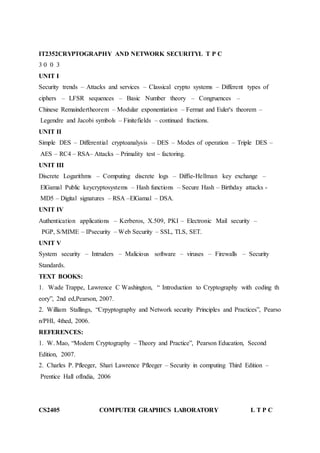
IT2352CRYPTOGRAPHY AND NETWORK SECURITYL T P C
3 0 0 3
UNIT I
Security trends – Attacks and services – Classical crypto systems – Different types of
ciphers – LFSR sequences – Basic Number theory – Congruences –
Chinese Remaindertheorem – Modular exponentiation – Fermat and Euler's theorem –
Legendre and Jacobi symbols – Finitefields – continued fractions.
UNIT II
Simple DES – Differential cryptoanalysis – DES – Modes of operation – Triple DES –
AES – RC4 – RSA– Attacks – Primality test – factoring.
UNIT III
Discrete Logarithms – Computing discrete logs – Diffie-Hellman key exchange –
ElGamal Public keycryptosystems – Hash functions – Secure Hash – Birthday attacks -
MD5 – Digital signatures – RSA –ElGamal – DSA.
UNIT IV
Authentication applications – Kerberos, X.509, PKI – Electronic Mail security –
PGP, S/MIME – IPsecurity – Web Security – SSL, TLS, SET.
UNIT V
System security – Intruders – Malicious software – viruses – Firewalls – Security
Standards.
TEXT BOOKS:
1. Wade Trappe, Lawrence C Washington, “ Introduction to Cryptography with coding th
eory”, 2nd ed,Pearson, 2007.
2. William Stallings, “Crpyptography and Network security Principles and Practices”, Pearso
n/PHI, 4thed, 2006.
REFERENCES:
1. W. Mao, “Modern Cryptography – Theory and Practice”, Pearson Education, Second
Edition, 2007.
2. Charles P. Pfleeger, Shari Lawrence Pfleeger – Security in computing Third Edition –
Prentice Hall ofIndia, 2006
CS2405 COMPUTER GRAPHICS LABORATORY L T P C
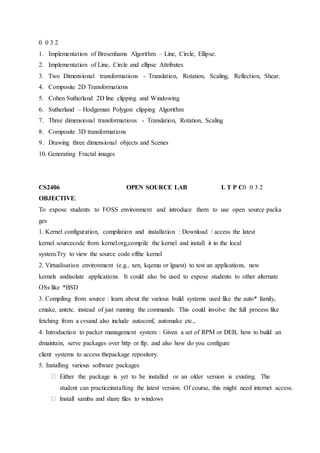
0 0 3 2
1. Implementation of Bresenhams Algorithm – Line, Circle, Ellipse.
2. Implementation of Line, Circle and ellipse Attributes
3. Two Dimensional transformations - Translation, Rotation, Scaling, Reflection, Shear.
4. Composite 2D Transformations
5. Cohen Sutherland 2D line clipping and Windowing
6. Sutherland – Hodgeman Polygon clipping Algorithm
7. Three dimensional transformations - Translation, Rotation, Scaling
8. Composite 3D transformations
9. Drawing three dimensional objects and Scenes
10. Generating Fractal images
CS2406 OPEN SOURCE LAB L T P C0 0 3 2
OBJECTIVE:
To expose students to FOSS environment and introduce them to use open source packa
ges
1. Kernel configuration, compilation and installation : Download / access the latest
kernel sourcecode from kernel.org,compile the kernel and install it in the local
system.Try to view the source code ofthe kernel
2. Virtualisation environment (e.g., xen, kqemu or lguest) to test an applications, new
kernels andisolate applications. It could also be used to expose students to other alternate
OSs like *BSD
3. Compiling from source : learn about the various build systems used like the auto* family,
cmake, antetc. instead of just running the commands. This could involve the full process like
fetching from a cvsand also include autoconf, automake etc.,
4. Introduction to packet management system : Given a set of RPM or DEB, how to build an
dmaintain, serve packages over http or ftp. and also how do you configure
client systems to access thepackage repository.
5. Installing various software packages
Either the package is yet to be installed or an older version is existing. The
student can practiceinstalling the latest version. Of course, this might need internet access.
Install samba and share files to windows
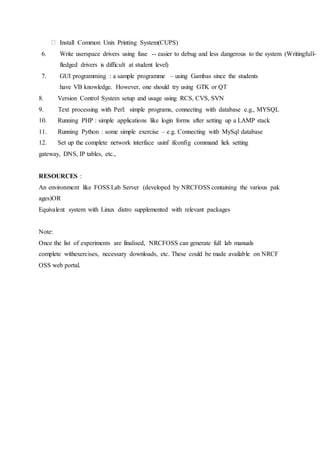
Install Common Unix Printing System(CUPS)
6. Write userspace drivers using fuse -- easier to debug and less dangerous to the system (Writingfull-
fledged drivers is difficult at student level)
7. GUI programming : a sample programme – using Gambas since the students
have VB knowledge. However, one should try using GTK or QT
8. Version Control System setup and usage using RCS, CVS, SVN
9. Text processing with Perl: simple programs, connecting with database e.g., MYSQL
10. Running PHP : simple applications like login forms after setting up a LAMP stack
11. Running Python : some simple exercise – e.g. Connecting with MySql database
12. Set up the complete network interface usinf ifconfig command liek setting
gateway, DNS, IP tables, etc.,
RESOURCES :
An environment like FOSS Lab Server (developed by NRCFOSS containing the various pak
ages)OR
Equivalent system with Linux distro supplemented with relevant packages
Note:
Once the list of experiments are finalised, NRCFOSS can generate full lab manuals
complete withexercises, necessary downloads, etc. These could be made available on NRCF
OSS web portal.

Slb

  • 1.
    EE2401POWER SYSTEM OPERATIONAND CONTROLL T P C 3 0 0 3UNIT I INTRODUCTION System load – variation - load characteristics - load curves and load-duration curve (daily, weekly and annual) - load factor - diversity factor. Importance of load forecasting and simple techniques of forecasting. An overview of power system operation and control and the role of computers in the implementation. (Qualitative treatment with block diagram). UNIT IIREAL POWER - FREQUENCY CONTROL Basics of speed governing mechanism and modeling - speed-load characteristics – load sharingbetween two synchronous machines in parallel. Control area concept LFC control of a singleareasystem. Static and dynamic analysis of uncontrolled and controlled cases.Integration ofeconomic dispatch control with LFC.Two-area system – modeling - static analysis of uncontrolledcase - tie line with frequency bias control of two-area system - state variable model. UNIT III REACTIVE POWER–VOLTAGE CONTROL Basics of reactive power control. Excitation systems – modeling.Static and dynamic analysis -stability compensation - generation and absorption of reactive power. Relation between voltage,power and reactive power at a node - method of voltage control - tap-changing transformer. Systemlevel control using generator voltage magnitude setting, tap setting of OLTC transformer andMVAR injection of switched capacitors to maintain acceptable voltage profile and to minimizetransmission loss. UNIT IV UNIT COMMITMENT AND ECONOMIC DISPATCH Statement of economic dispatch problem – cost of generation – incremental cost curve co- ordinationequations without loss and with loss, solution by direct method and λ-iteration method. (Noderivation of loss coefficients). Statement of Unit Commitment problem – constraints; spinningreserve, thermal unit constraints, hydro constraints, fuel constraints and other constraints. Solutionmethods - Priority-list methods - forward dynamic programming approach. Numericalproblems only in priority-list method using full-load average production cost.
  • 2.
    UNIT V COMPUTERCONTROL OF POWER SYSTEMS Need of computer control of power systems. Concept of energy control centre (or) load dispatchcentre and the functions - system monitoring - data acquisition and control. System hardwareconfiguration – SCADA and EMS functions. Network topology - state estimation - security analysisand control.Various operating states (Normal, alert, emergency, in-extremis and restorative).Statetransition diagram showing various state transitions and control strategies. TEXT BOOKS 1. Allen. J. Wood and Bruce F. Wollenberg, ‘Power Generation, Operation and Control’, John Wiley& Sons, Inc., 2003. 2. Chakrabarti&Halder, “Power System Analysis: Operation and Control”, Prentice Hall of India,2004 Edition. REFERENCES 1. D.P. Kothari and I.J. Nagrath, ‘Modern Power System Analysis’, Third Edition, Tata McGraw HillPublishing Company Limited, New Delhi, 2003. (For Chapters 1, 2 & 3) 2. L.L. Grigsby, ‘The Electric Power Engineering, Hand Book’, CRC Press& IEEE Press,2001. 3. HadiSaadat, “Power System Analysis”, (For the chapters 1, 2, 3 and 4)11th Reprint2007. 4. P.Kundur, ‘Power System Stability and Control’ MC Craw Hill Publisher, USA, 1994. 5. Olle.I.Elgerd, ‘Electric Energy Systems theory An introduction’ Tata McGraw Hill Publishing Company Ltd. New Delhi, Second Edition 2003.
  • 3.
    EE2402PROTECTION AND SWITCHGEARLT P C3 0 0 3 UNIT I INTRODUCTION Importance of protective schemes for electrical apparatus and power system. Qualitative review offaults and fault currents - relay terminology – definitions - and essential qualities of protection.Protection against over voltages due to lightning and switching - arcing grounds - Peterson Coil -ground wires - surge absorber and divertersPower System earthing – neutral Earthing - basic ideas of insulation coordination. UNIT IIOPERATING PRINCIPLES AND RELAY CHARACTERISTICS Electromagnetic relays – over current, directional and non-directional, distance, negative sequence,differential and under frequency relays – Introduction to static relays. UNIT IIIAPPARATUS PROTECTION Main considerations in apparatus protection - transformer, generator and motor protection - protection of busbars. Transmission line protection - zones of protection. CTs and PTs and theirapplications in protection schemes. UNIT IVTHEORY OF CIRCUIT INTERRUPTION Physics of arc phenomena and arc interruption.DC and AC circuit breaking - restriking voltage and recovery voltage - rate of rise of recovery voltage- resistance switching - current chopping - interruption of capacitive current. UNIT V CIRCUIT BREAKERS Types of circuit breakers – air blast, air break, oil, SF6 and vacuum circuit breakers – comparativemerits of different circuit breakers – testing of circuit breakers. TEXT BOOKS: 1. M.L. Soni, P.V. Gupta, V.S. Bhatnagar, A. Chakrabarti, ‘A Text Book on Power System Engineering’, DhanpatRai& Co., 1998.(For All Chapters 1, 2, 3, 4 and 5). 2. R.K.Rajput, A Tex book of Power System Engineering. Laxmi Publications, First Edition Reprint 2007. REFERENCES: 1. Sunil S. Rao, ‘Switchgear and Protection’, Khanna publishers, New Delhi, 1986. 2. C.L. Wadhwa, ‘Electrical Power Systems’, Newage International (P) Ltd., 2000. 3. B. Ravindranath, and N. Chander, ‘Power System Protection & Switchgear’, Wiley Eastern Ltd.,1977. 4. Badri Ram, Vishwakarma, ‘Power System Protection and Switchgear’, Tata McGraw Hill, 2001. 5. Y.G. Paithankar and S.R. Bhide, ‘Fundamentals of Power System Protection’, Prentice Hall ofIndia Pvt. Ltd., New Delhi–110001, 2003
  • 4.
    EE 2403 SPECIALELECTRICAL MACHINES L T P C3 0 0 3 UNIT I SYNCHRONOUS RELUCTANCE MOTORS Constructional features – Types – Axial and Radial flux motors – Operating principles – VariableReluctance and Hybrid Motors – SYNREL Motors – Voltage and Torque Equations - Phasor diagram- Characteristics. UNIT II STEPPING MOTORS Constructional features – Principle of operation – Variable reluctance motor – Hybrid motor – Singleand multi stack configurations – Torque equations – Modes of excitations - Characteristics – Drivecircuits – Microprocessor control of stepping motors – Closed loop control. UNIT III SWITCHED RELUCTANCE MOTORS Constructional features – Rotary and Linear SRMs - Principle of operation – Torque production –Steady state performance prediction- Analytical method -Power Converters and their controllers –Methods of Rotor position sensing – Sensorless operation – Closed loop control of SRM -Characteristics. UNIT IV PERMANENT MAGNET BRUSHLESS D.C. MOTORS Permanent Magnet materials – Magnetic Characteristics – Permeance coefficient -Principle ofoperation – Types – Magnetic circuit analysis – EMF and torque equations –Commutation – Powercontrollers – Motor characteristics and control. UNIT V PERMANENT MAGNET SYNCHRONOUS MOTORS Principle of operation – Ideal PMSM – EMF and Torque equations – Armature reaction MMF –Synchronous Reactance – Sinewave motor with practical windings - Phasor diagram –Torque/speed characteristics - Power controllers - Converter Volt-ampere requirements. TEXT BOOKS: 1. T.J.E. Miller, ‘Brushless Permanent Magnet and Reluctance Motor Drives’, Clarendon Press,Oxford, 1989. 2. T. Kenjo, ‘Stepping Motors and Their Microprocessor Controls’, Clarendon Press London, 1984. REFERENCES: 1. R.Krishnan, ‘Switched Reluctance Motor Drives – Modeling, Simulation, Analysis, Design andApplication’, CRC Press, New York, 2001. 2. P.P. Aearnley, ‘Stepping Motors – A Guide to Motor Theory and Practice’, Peter PerengrinusLondon, 1982. 3. T. Kenjo and S. Nagamori, ‘Permanent Magnet and Brushless DC Motors’, Clarendon Press,London, 1988.
  • 5.
    MG2351PRINCIPLES OF MANAGEMENTL T P C 3 0 0 3 UNIT I OVERVIEW OF MANAGEMENT Organization - Management - Role of managers - Evolution of Management thought – Organizationand the environmental factors - Managing globally - Strategies for International Business. UNIT II PLANNING Nature and purpose of planning - Planning process - Types of plans – Objectives - Managing byobjective (MBO) Strategies - Types of strategies - Policies - Decision Making - Types of decision -Decision Making Process - Rational Decision Making Process - Decision Making under differentconditions. UNIT III ORGANIZING Nature and purpose of organizing - Organization structure - Formal and informal groups I organization - Line and Staff authority - Departmentation - Span of control - Centralization andDecentralization - Delegation of authority - Staffing - Selection and Recruitment - Orientation -Career Development - Career stages – Training - Performance Appraisal. UNIT IV DIRECTING Creativity and Innovation - Motivation and Satisfaction - Motivation Theories Leadership – Leadershiptheories - Communication - Hurdles to effective communication - Organization Culture – Elementsand types of culture - Managing cultural diversity. UNIT V CONTROLLING Process of controlling - Types of control - Budgetary and non-budgetary control techniques - Managing Productivity - Cost Control - Purchase Control - Maintenance Control - Quality Control -Planning operations. TEXT BOOKS: 1. Stephen P. Robbins and Mary Coulter, 'Management', Prentice Hall of India, 8th edition. 2. Charles W L Hill, Steven L McShane, 'Principles of Management', Mcgraw Hill Education, SpecialIndian Edition, 2007. REFERENCES: 1. Hellriegel, Slocum & Jackson, ' Management - A Competency Based Approach', Thomson South Western, 10th edition, 2007. 2. Harold Koontz, Heinz Weihrich and Mark V Cannice, ‘Management – A global & Entrepreneurial Perspective’, Tata Mcgraw Hill, 12th edition, 2007. 3. Andrew J. Dubrin, 'Essentials of Management', Thomson Southwestern, 7thedition, 2007.
  • 6.
    CS2411 OPERATING SYSTEMSL T P C 3 0 0 3 UNIT I PROCESSES AND THREADS Introduction to operating systems – review of computer organization – operating system structures –system calls – system programs – system structure – virtual machines. Processes: Process concept– Process scheduling – Operations on processes – Cooperating processes – Interprocesscommunication – Communication in client-server systems. Case study: IPC in Linux. Threads: Multithreadingmodels – Threading issues. Case Study: Pthreads library UNIT II PROCESS SCHEDULING AND SYNCHRONIZATION CPU Scheduling: Scheduling criteria – Scheduling algorithms – Multiple- processor scheduling –Real time scheduling – Algorithm Evaluation. Case study: Process scheduling in Linux. ProcessSynchronization: The critical-section problem – Synchronization hardware – Semaphores – Classicproblems of synchronization – critical regions – Monitors. Deadlock: System model – Deadlockcharacterization – Methods for handling deadlocks – Deadlock prevention – Deadlock avoidance –Deadlock detection – Recovery from deadlock. UNIT III STORAGE MANAGEMENT Memory Management: Background – Swapping – Contiguous memory allocation – Paging – Segmentation – Segmentation with paging. Virtual Memory:Background – Demand paging – Processcreation – Page replacement –Allocation of frames – Thrashing. Case Study: Memory managementin Linux UNIT IV FILE SYSTEMS File-System Interface: File concept – Access methods – Directory structure –File-system mounting –Protection. File-System Implementation : Directory implementation – Allocation methods – Freespacemanagement – efficiency and performance – recovery – log-structured file systems. Casestudies: File system in Linux – file system in Windows XP UNIT V I/O SYSTEMS I/O Systems – I/O Hardware – Application I/O interface – kernel I/O subsystem – streams – performance. Mass-Storage Structure: Disk scheduling – Disk management – Swap-space management – RAID – disk attachment – stable storage – tertiary storage. Case study: I/O in Linux
  • 7.
    TEXT BOOKS 1. Silberschatz,Galvin, and Gagne, “Operating System Concepts”, Sixth Edition, Wiley India PvtLtd, 2003. 2. D. M. Dhamdhere, “Operating Systems: A concepts based approach”, Second Edition, Tata McGraw-Hill Publishing Company Ltd., 2006. REFERENCES 1. Andrew S. Tanenbaum, “Modern Operating Systems”, Second Edition, Pearson Education/PHI, 2001. 2. Harvey M. Deital, “Operating Systems”, Third Edition, Pearson Education, 2004.
  • 8.
    EI2311 BIOMEDICAL INSTRUMENTATIONL T P C3 0 0 3 UNIT I PHYSIOLOGY AND TRANSDUCERS Cell and its structure – Resting and Action Potential – Nervous system: Functional organisation ofthe nervous system – Structure of nervous system, neurons - synapse – transmitters and neuralcommunication – Cardiovascular system – respiratory system – Basic components of a biomedicalsystem - Transducers – selection criteria – Piezo electric, ultrasonic transducers – Temperaturemeasurements - Fibre optic temperature sensors. UNIT II ELECTRO – PHYSIOLOGICAL MEASUREMENTS Electrodes –Limb electrodes –floating electrodes – pregelled disposable electrodes - Micro, needleand surface electrodes – Amplifiers: Preamplifiers, differential amplifiers, chopper amplifiers –Isolation amplifier.ECG – EEG – EMG – ERG – Lead systems and recording methods – Typical waveforms.Electrical safety in medical environment: shock hazards – leakage current-Instruments for checkingsafety parameters of biomedical equipments UNIT III NON-ELECTRICAL PARAMETER MEASUREMENTS Measurement of blood pressure – Cardiac output – Heart rate – Heart sound –Pulmonary functionmeasurements – spirometer – Photo Plethysmography, Body Plethysmography – Blood Gasanalysers : pH of blood –measurement of blood pCO2, pO2, finger-tip oxymeter - ESR, GSRmeasurements . UNIT IV MEDICAL IMAGING Radio graphic and fluoroscopic techniques – Computer tomography – MRI – Ultrasonography –Endoscopy – Thermography – Different types of biotelemetry systems and patient monitoring –Introduction to Biometric systems UNIT V ASSISTING AND THERAPEUTIC EQUIPMENTS Pacemakers – Defibrillators – Ventilators – Nerve and muscle stimulators – Diathermy – Heart –Lung machine – Audio meters – Dialysers – Lithotripsy TEXT BOOKS 1. R.S.Khandpur, ‘Hand Book of Bio-Medical instrumentation’, Tata McGraw Hill Publishing Co Ltd.,2003. 2. Leslie Cromwell, Fred J.Weibell, Erich A.Pfeiffer, ‘Bio-Medical Instrumentation and Measurements’, II edition, Pearson Education, 2002 / PHI. REFERENCES 1. M.Arumugam, ‘Bio-Medical Instrumentation’, Anuradha Agencies, 2003. 2. L.A. Geddes and L.E.Baker, ‘Principles of Applied Bio-Medical Instrumentation’, John Wiley &Sons, 1975. 3. J.Webster, ‘Medical Instrumentation’, John Wiley & Sons, 1995. 4. C.Rajarao and S.K. Guha, ‘Principles of Medical Electronics and Bio-medical Instrumentation’,Universities press (India) Ltd, Orient Longman ltd, 2000.
  • 9.
    GE2022 TOTAL QUALITYMANAGEMENT L T P C3 0 0 3 UNIT I INTRODUCTION Introduction - Need for quality - Evolution of quality - Definition of quality - Dimensions of manufacturing and service quality - Basic concepts of TQM - Definition of TQM – TQM Framework -Contributions of Deming, Juran and Crosby – Barriers to TQM. UNIT II TQM PRINCIPLES Leadership – Strategic quality planning, Quality statements - Customer focus – Customer orientation, Customer satisfaction, Customer complaints, Customer retention - Employee involvement – Motivation, Empowerment, Team and Teamwork, Recognition and Reward, Performance appraisal - Continuous process improvement – PDSA cycle, 5s, Kaizen – Supplierpartnership – Partnering, Supplier selection, Supplier Rating. UNIT III TQM TOOLS & TECHNIQUES I The seven traditional tools of quality – New management tools – Six-sigma: Concepts, methodology,applications to manufacturing, service sector including IT – Bench marking – Reason to bench mark,Bench marking process – FMEA – Stages, Types. UNIT IV TQM TOOLS & TECHNIQUES II Quality circles – Quality Function Deployment (QFD) – Taguchi quality loss function – TPM –Concepts, improvement needs – Cost of Quality – Performance measures. UNIT V QUALITY SYSTEMS Need for ISO 9000- ISO 9000-2000 Quality System – Elements, Documentation, Quality auditing-QS 9000 – ISO 14000 – Concepts, Requirements and Benefits – Case studies of TQMimplementation in manufacturing and service sectors including IT. TEXT BOOK 1. Dale H.Besterfiled, et at., “Total Quality Management”, Pearson Education Asia, Third Edition, Indian Reprint (2006). REFERENCES 1. James R. Evans and William M. Lindsay, “The Management and Control of Quality”, (6th Edition),South-Western (Thomson Learning), 2005. 2. Oakland, J.S. “TQM – Text with Cases”, Butterworth – Heinemann Ltd., Oxford, Third Edition(2003). 3. Suganthi,L and Anand Samuel, “Total Quality Management”, Prentice Hall (India) Pvt. Ltd.(2006) 4. Janakiraman,B and Gopal, R.K, “Total Quality Management – Text and Cases”, Prentice Hall(India) Pvt. Ltd. (2006)
  • 10.
    EE2025 INTELLIGENT CONTROLL T P C3 0 0 3 UNIT I INTRODUCTION Approaches to intelligent control.Architecture for intelligent control. Symbolic reasoning system,rule-based systems, the AI approach. Knowledge representation.Expert systems. UNIT II ARTIFICIAL NEURAL NETWORKS Concept of Artificial Neural Networks and its basic mathematical model, McCulloch-Pitts neuronmodel, simple perceptron, Adaline and Madaline, Feed-forward Multilayer Perceptron.Learning andTraining the neural network. Data Processing: Scaling, Fourier transformation, principal-componentanalysis and wavelet transformations. Hopfield network, Self-organizing network and Recurrentnetwork. Neural Network based controller UNIT III GENETIC ALGORITHM Basic concept of Genetic algorithm and detail algorithmic steps, adjustment of free parameters.Solution of typical control problems using genetic algorithm. Concept on some other searchtechniques like tabu search and ant-colony search techniques for solving optimization problems. UNIT IV FUZZY LOGIC SYSTEM Introduction to crisp sets and fuzzy sets, basic fuzzy set operation and approximate reasoning. Introduction to fuzzy logic modeling and control.Fuzzification, inferencing and defuzzification.Fuzzyknowledge and rule bases. Fuzzy modeling and control schemes for nonlinear systems. Selforganizingfuzzy logic control.Fuzzy logic control for nonlinear time- delay system. UNIT V APPLICATIONS GA application to power system optimisation problem, Case studies: Identification and control oflinear and nonlinear dynamic systems using Matlab-Neural Network toolbox. Stability analysis of Neural-Network interconnection systems.Implementation of fuzzy logic controllerusing Matlab fuzzy-logic toolbox.Stability analysis of fuzzy control systems. TEXT BOOKS 1. Padhy.N.P.(2005), Artificial Intelligence and Intelligent System, Oxford University Press. 2. KOSKO,B. "Neural Networks And Fuzzy Systems", Prentice-Hall of India Pvt. Ltd., 1994. REFERENCES 1. Jacek.M.Zurada, "Introduction to Artificial Neural Systems", Jaico Publishing House, 1999. 2. KLIR G.J. & FOLGER T.A. "Fuzzy sets, uncertainty and Information", Prentice-Hall of India Pvt.Ltd., 1993. 3. Zimmerman H.J. "Fuzzy set theory-and its Applications"-Kluwer Academic Publishers,1994. 4. Driankov, Hellendroon, "Introduction to Fuzzy Control", Narosa Publishers. 5. Goldberg D.E. (1989) Genetic algorithms in Search, Optimization and Machine learning, Addison Wesley.
  • 11.
    EE2026POWER SYSTEM DYNAMICSL T P C3 0 0 3 UNIT I INTRODUCTION Basics of system dynamics – numerical techniques – introduction to software packages to study theresponses.Concept and importance of power system stability in the operation and design - distinction betweentransient and dynamic stability - complexity of stability problem in large system – necessity forreduced models - stability of interconnected systems. UNIT II SYNCHRONOUS MACHINE MODELLING Synchronous machine - flux linkage equations - Park’s transformation - per unit conversion - normalizing the equations - equivalent circuit - current space model - flux linkage state space model.Sub-transient and transient inductances - time constants.Simplified models (one axis and constant flux linkage) - steady state equations and phasordiagrams. UNIT III MACHINE CONTROLLERS Exciter and voltage regulators - function and types of excitation systems - typical excitation systemconfiguration - block diagram and state space representation of IEEE type 1 excitation system -saturation function - stabilizing circuit.Function of speed governing systems - block diagram and state space representation of IEEEmechanical hydraulic governor and electrical hydraulic governors for hydro turbines and steamturbines. UNIT IV TRANSIENT STABILITY State equation for multimachine system with one axis model and simulation – modelling of multimachine power system with one axis machine model including excitation system and speedgoverning system and simulation using R-K method of fourth order (Gill’s technique) for transientstability analysis - power system stabilizer. For all simulations, the algorithm and flow chart have tobe discussed. UNIT V DYNAMIC STABILITY System response to small disturbances - linear model of the unregulated synchronous machine andits modes of oscillation - regulated synchronous machine - distribution of power impact – linearizationof the load equation for the one machine problem – simplified linear model - effect of excitation ondynamic stability - approximate system representation - supplementary stabilizing signals – dynamicperformance measure - small signal performance measures. TEXT BOOKS 1. P.M. Anderson and A.A.Fouad, ‘Power System Control and Stability’, GalgotiaPublications,New Delhi, 2003. 2. P. Kundur, ‘Power System Stability and Control’, McGraw Hill Inc., USA, 1994. REFERENCES 1. M.A.Pai and W.Sauer, ‘Power System Dynamics and Stability’, Pearson Education Asia, India,2002. 2. James A.Momoh, Mohamed.E. EI-Hawary.“ Electric Systems, Dynamics and stability withArtificial Intelligence applications”, Marcel Dekker, USA First Edition 2000
  • 12.
    CS2071 COMPUTER ARCHITECTUREL T P C 3 0 0 3 UNIT I INSTRUCTION SET ARCHITECTURE Introduction to computer architecture - Review of digital design – Instructions and addressing –procedures and data – assembly language programs – instruction set variations UNIT II ARITHMETIC/LOGIC UNIT Number representation – design of adders – design of simple ALUs – design of Multipliers anddividers – design of floating point arithmetic unit UNIT III DATA PATH AND CONTROL Instruction execution steps – control unit synthesis – microprogramming – pipelining – pipelineperformance UNIT IV MEMORY SYSTEM Main Memory concepts – types of memory – cache memory organization – secondary storage –virtual memory – paging UNIT V I/O AND INTERFACES I/O devices – I/O programming – polling – interrupts – DMA – buses – links – interfacing – contextswitching – threads and multithreading TEXT BOOKS: 1. B. Parhami, “Computer Architecture”, Oxford University Press, 2005. 2. Carl Hamacher, ZvonkoVranesic and SafwatZaky, “Computer Organization”, Fifth Edition, Tata McGraw Hill, 2002. REFERENCES: 1. David A. Patterson and John L. Hennessy, “Computer Organization and Design: The Hardware/Software interface”, Third Edition, Elsevier, 2004. 2. William Stallings, “Computer Organization and Architecture – Designing for Performance”,Seventh Edition, Pearson Education, 2006. 3. Miles Murdocca “Computers Architecture and Organization An Integrated approach”, WileycIndiapvt Ltd, 2007 4. John D. Carpinelli, “Computer systems organization and Architecture”, Pearson Education, 2001.
  • 13.
    MG2452 ENGINEERING ECONOMICSAND FINANCIAL ACCOUNTING UNIT I INTRODUCTION Managerial Economics - Relationship with other disciplines - Firms: Types, objectives and goals - Managerial decisions - Decision analysis. UNIT II DEMAND & SUPPLY ANALYSIS Demand - Types of demand - Determinants of demand - Demand function - Demand elasticity - Demandforecasting - Supply - Determinants of supply -Supply function - Supply elasticity. UNIT III PRODUCTION AND COST ANALYSIS Production function - Returns to scale - Production optimization - Least cost input - Isoquants - Managerialuses of production function.Cost Concepts - Cost function - Determinants of cost - Short run and Long run cost curves - Cost OutputDecision - Estimation of Cost. UNIT IV PRICING Determinants of Price - Pricing under different objectives and different market structures - Price discrimination - Pricing methods in practice. UNIT V FINANCIAL ACCOUNTING (ELEMENTARY TREATMENT) Balance sheet and related concepts - Profit & Loss Statement and related concepts - - Financial RatioAnalysis - Cash flow analysis - Funds flow analysis - Comparative financial statements - Analysis &Interpretation of financial statements. UNIT VI CAPITAL BUDGETING (ELEMENTARY TREATMENT) Investments - Risks and return evaluation of investment decision - Average rate of return - Payback Period - Net Present Value - Internal rate of return. REFERENCES: 1. Samuelson. Paul A and Nordhaus W.D., 'Economics', Tata Mcgraw Hill Publishing Company Limited, New Delhi, 2004. 2. McGuigan, Moyer and Harris, 'Managerial Economics; Applications, Strategy and Tactics', Thomson South Western, 10th Edition, 2005. 3. Paresh Shah, 'Basic Financial Accounting for Management', Oxford University Press, Ne w Delhi, 2007. 4. Salvatore Dominick, 'Managerial Economics in a global economy'. Thomson South Western, 4th Edition, 2001. 5. Prasanna Chandra. 'Fundamentals of Financial Management', Tata Mcgraw Hill Publishing Ltd., 4th edition, 2005.
  • 14.
    CS2401 COMPUTER GRAPHICSL T P C 3 0 0 3 UNIT I 2D PRIMITIVES outputprimitives Line, Circle and Ellipse drawing algorithms Attributes of output primitives – Two dimensionalGeometric transformation - Two dimensional viewing – Line, Polygon, Curve and Text clipping algorithms UNIT II 3D CONCEPTS Parallel and Perspective projections - Three dimensional object representation – Polygons, Curved lines,Splines, Quadric Surfaces,- Visualization of data sets - 3D transformations – Viewing -Visible surfaceidentification. UNIT III GRAPHICS PROGRAMMING Color Models RGB, YIQ, CMY, HSV Animations General Computer Animation, Raster, Keyframe - Graphics programming using OPENGL – Basic graphics primitives – Drawing three dimensional objects -Drawing three dimensional scenes UNIT IV RENDERING Introduction to Shading models – Flat and Smooth shading – Adding texture to faces – Adding shadows ofobjects – Building a camera in a program – Creating shaded objects – Rendering texture – Drawing Shadows. UNIT V FRACTALS Fractals and Self similarity – Peano curves – Creating image by iterated functions – Mandelbrot sets – Julia Sets – Random Fractals – Overview of Ray Tracing – Intersecting rays with other primitives – AddingSurface texture – Reflections and Transparency – Boolean operations on Objects. TEXT BOOKS: 1. Donald Hearn, Pauline Baker, Computer Graphics C Version, second edition, Pearso nEducation,2004. 2. F.S. Hill, Computer Graphics using OPENGL, Second edition, Pearson Education, 2003. REFERENCE: 1. James D. Foley, Andries Van Dam, Steven K. Feiner, John F. Hughes, Computer Graphics- Principles and practice, Second Edition in C, Pearson Education, 2007.
  • 15.
    CS2402 MOBILE ANDPERVASIVE COMPUTING L T P C 3 0 0 3 UNIT I MOBILE NETWORKS Cellular Wireless Networks – GSM – Architecture – Protocols Connection Establishment – FrequencyAllocation – Routing – Mobility Management – Security – GPRS. UNIT II WIRELESS NETWORKS Wireless LANs and PANs – IEEE 802.11 Standard – Architecture – Services –Network – HiperLAN – BlueTooth- Wi-Fi – WiMAX UNIT III ROUTING Mobile IP – DHCP – AdHoc– Proactive and Reactive Routing Protocols – Multicast Routing. UNIT IV TRANSPORT AND APPLICATION LAYERS Mobile TCP– WAP – Architecture – WWW Programming Model– WDP – WTLS – WTP – WSP – WAE –WTA Architecture – WML – WMLScripts. UNIT V PERVASIVE COMPUTING Pervasive computing infrastructure –applications Device Technology Hardware, HumanmachineInterfaces, Biometrics, and Operating systems– Device Connectivity -Protocols, Security, and DeviceManagement- Pervasive Web Application architecture-Access from PCs and PDAs - Access via WAP TEXT BOOKS: 1. Jochen Schiller, “Mobile Communications”, PHI, Second Edition, 2003. 2. Jochen Burkhardt, Pervasive Computing: Technology and Architecture of Mobile Internet Applications, Addison-Wesley Professional; 3rd edition, 2007 REFERENCES: 1. Frank Adelstein, Sandeep KS Gupta, Golden Richard, Fundamentals of Mobile and Pervasive Computing, McGraw-Hill 2005 2. Debashis Saha, Networking Infrastructure for Pervasive Computing: Enabling Technologies, Kluwer Academic Publisher, Springer; First edition, 2002 3. Introduction to Wireless and Mobile Systems by Agrawal and Zeng, Brooks/ Cole (Thomson Learning), First edition, 2002 4. Uwe Hansmann, Lothar Merk, Martin S. Nicklons and Thomas Stober, Principles of Mobile Computing, Springer, New York, 2003.
  • 16.
    CS2403 DIGITAL SIGNALPROCESSING L T P C 3 0 0 3 UNIT I SIGNALS AND SYSTEMS Basic elements of DSP concepts of frequency in Analog and Digital Signals sampling theorem – Discrete– time signals, systems Analysis of discrete time LTI systems – Z transform –Convolution (linear andcircular) – Correlation. UNIT II FREQUENCY TRANSFORMATIONS Introduction to DFT – Properties of DFT – Filtering methods based on DFT – FFT Algorithms Decimation –in – time Algorithms, Decimation – in – frequency Algorithms – Use of FFT in Linear Filtering – DCT. UNIT III IIR FILTER DESIGN Structures of IIR – Analog filter design – Discrete time IIR filter from analog filter – IIR filter design by Impulse Invariance, Bilinear transformation, Approximation of derivatives – (HPF, BPF, BRF) filter design using frequency translation UNIT IV FIR FILTER DESIGN Structures of FIR – Linear phase FIR filter – Filter design using windowing techniques, Frequency samplingtechniques – Finite word length effects in digital Filters UNIT V APPLICATIONS Multirate signal processing – Speech compression – Adaptive filter – Musical sound processing – Imageenhancement. TEXT BOOKS: 1. John G. Proakis & Dimitris G.Manolakis, “Digital Signal Processing Principles, Algorithms &Applications”, Fourth edition, Pearson education / Prentice Hall, 2007. 2. Emmanuel C..Ifeachor, & Barrie.W.Jervis, “Digital Signal Processing”, Second edition, PearsonEducation / Prentice Hall, 2002. REFERENCES: 1. Alan V.Oppenheim, Ronald W. Schafer & Hohn. R.Back, “Discrete Time Signal Processing”, Pearson Education, 2nd edition, 2005. 2. Andreas Antoniou, “Digital Signal Processing”, Tata McGraw Hill, 2001
  • 17.
    CS2032 DATA WAREHOUSINGAND DATA MINING L T P C 3 0 0 3 UNIT I DATA WAREHOUSING Data warehousing Components –Building a Data warehouse - Mapping the Data Warehouse to aMultiprocessor Architecture - DBMS Schemas for Decision Support - Data Extraction, Cleanup, andTransformation Tools –Metadata. UNIT II BUSINESS ANALYSIS Reporting and Query tools and Applications – Tool Categories – The Need for Applications – CognosImpromptu – Online Analytical Processing (OLAP) – Need – Multidimensional Data Model – OLAPGuidelines – Multidimensional versus Multirelational OLAP – Categories of Tools – OLAP Tools and theInternet. UNIT III DATA MINING Introduction – Data – Types of Data – Data Mining Functionalities – Interestingness of Patterns –Classification of Data Mining Systems – Data Mining Task Primitives Integration of a Data Mining Systemwith a Data Warehouse – Issues –Data Preprocessing. UNIT IV ASSOCIATION RULE MINING AND CLASSIFICATION Mining Frequent Patterns, Associations and Correlations – Mining Methods – Mining Various Kinds of Association Rules – Correlation Analysis – Constraint Based Association Mining – Classification andPrediction - Basic Concepts - Decision Tree Induction - Bayesian Classification – Rule Based Classification– Classification by Backpropagation – Support Vector Machines – Associative Classification – LazyLearners – Other Classification Methods - Prediction UNIT V CLUSTERING AND APPLICATIONS AND TRENDS IN DATA MINING Cluster Analysis - Types of Data – Categorization of Major Clustering Methods - K-means – PartitioningMethods – Hierarchical Methods - Density-Based Methods – Grid Based Methods – Model-BasedClustering Methods – Clustering High Dimensional Data- Constraint – Based Cluster Analysis – Outlier Analysis – Data Mining Applications. TEXT BOOKS: 1. Alex Berson and Stephen J. Smith, “ Data Warehousing, Data Mining & OLAP”, Tata McGraw – Hill Edition, Tenth Reprint 2007. 2. Jiawei Han and Micheline Kamber, “Data Mining Concepts and Techniques”, Second Edition, Elsevier, 2007. REFERENCES: 1. PangNing Tan, Michael Steinbach and Vipin Kumar, “ Introduction To Data Mining”, P erson Education,2007. 2. K.P. Soman, Shyam Diwakar and V. Ajay “, Insight into Data mining Theory and Practice”, Easter Economy Edition, Prentice Hall of India, 2006. 3. G. K. Gupta, “ Introduction to Data Mining with Case Studies”, Easter Economy Edition, Prentice Hall of India, 2006. 4. Daniel T.Larose, “Data Mining Methods and Models”, Wile-Interscience, 2006.
  • 18.
    IT2352CRYPTOGRAPHY AND NETWORKSECURITYL T P C 3 0 0 3 UNIT I Security trends – Attacks and services – Classical crypto systems – Different types of ciphers – LFSR sequences – Basic Number theory – Congruences – Chinese Remaindertheorem – Modular exponentiation – Fermat and Euler's theorem – Legendre and Jacobi symbols – Finitefields – continued fractions. UNIT II Simple DES – Differential cryptoanalysis – DES – Modes of operation – Triple DES – AES – RC4 – RSA– Attacks – Primality test – factoring. UNIT III Discrete Logarithms – Computing discrete logs – Diffie-Hellman key exchange – ElGamal Public keycryptosystems – Hash functions – Secure Hash – Birthday attacks - MD5 – Digital signatures – RSA –ElGamal – DSA. UNIT IV Authentication applications – Kerberos, X.509, PKI – Electronic Mail security – PGP, S/MIME – IPsecurity – Web Security – SSL, TLS, SET. UNIT V System security – Intruders – Malicious software – viruses – Firewalls – Security Standards. TEXT BOOKS: 1. Wade Trappe, Lawrence C Washington, “ Introduction to Cryptography with coding th eory”, 2nd ed,Pearson, 2007. 2. William Stallings, “Crpyptography and Network security Principles and Practices”, Pearso n/PHI, 4thed, 2006. REFERENCES: 1. W. Mao, “Modern Cryptography – Theory and Practice”, Pearson Education, Second Edition, 2007. 2. Charles P. Pfleeger, Shari Lawrence Pfleeger – Security in computing Third Edition – Prentice Hall ofIndia, 2006 CS2405 COMPUTER GRAPHICS LABORATORY L T P C
  • 19.
    0 0 32 1. Implementation of Bresenhams Algorithm – Line, Circle, Ellipse. 2. Implementation of Line, Circle and ellipse Attributes 3. Two Dimensional transformations - Translation, Rotation, Scaling, Reflection, Shear. 4. Composite 2D Transformations 5. Cohen Sutherland 2D line clipping and Windowing 6. Sutherland – Hodgeman Polygon clipping Algorithm 7. Three dimensional transformations - Translation, Rotation, Scaling 8. Composite 3D transformations 9. Drawing three dimensional objects and Scenes 10. Generating Fractal images CS2406 OPEN SOURCE LAB L T P C0 0 3 2 OBJECTIVE: To expose students to FOSS environment and introduce them to use open source packa ges 1. Kernel configuration, compilation and installation : Download / access the latest kernel sourcecode from kernel.org,compile the kernel and install it in the local system.Try to view the source code ofthe kernel 2. Virtualisation environment (e.g., xen, kqemu or lguest) to test an applications, new kernels andisolate applications. It could also be used to expose students to other alternate OSs like *BSD 3. Compiling from source : learn about the various build systems used like the auto* family, cmake, antetc. instead of just running the commands. This could involve the full process like fetching from a cvsand also include autoconf, automake etc., 4. Introduction to packet management system : Given a set of RPM or DEB, how to build an dmaintain, serve packages over http or ftp. and also how do you configure client systems to access thepackage repository. 5. Installing various software packages Either the package is yet to be installed or an older version is existing. The student can practiceinstalling the latest version. Of course, this might need internet access. Install samba and share files to windows
  • 20.
    Install Common UnixPrinting System(CUPS) 6. Write userspace drivers using fuse -- easier to debug and less dangerous to the system (Writingfull- fledged drivers is difficult at student level) 7. GUI programming : a sample programme – using Gambas since the students have VB knowledge. However, one should try using GTK or QT 8. Version Control System setup and usage using RCS, CVS, SVN 9. Text processing with Perl: simple programs, connecting with database e.g., MYSQL 10. Running PHP : simple applications like login forms after setting up a LAMP stack 11. Running Python : some simple exercise – e.g. Connecting with MySql database 12. Set up the complete network interface usinf ifconfig command liek setting gateway, DNS, IP tables, etc., RESOURCES : An environment like FOSS Lab Server (developed by NRCFOSS containing the various pak ages)OR Equivalent system with Linux distro supplemented with relevant packages Note: Once the list of experiments are finalised, NRCFOSS can generate full lab manuals complete withexercises, necessary downloads, etc. These could be made available on NRCF OSS web portal.