


How online video
messaging came to fruition


             By,
       StéphaneRoque
Origin
• Founded in 2003 by Janus Friis and
  NiklasZennstrom.
  – Cofounders of music-sharing software Kazaa.
  – “Service allows users to communicate with peers
    by using a microphone, video by using a
    webcam, and instant messaging over the internet”
    (2013 Skype Wikipedia page ).
  – Also allows file sharing between users.
Development
• Friis and Zennstrom later aided by Estonian
  developers AhtiHeinla, PriitKasesalu and Jaan
  Tallinn in development of basic Skype
  software.
• Skype begins to blossom with the increased
  efficiency of broadband strength, raising
  nearly $20 million in 2003 to help company
  grow.
Development
• Every new version of the software offers
  various different features.
  – Instant messaging.
  – File sharing.
  – Group video messaging.
  – Video calls through HDTV sets (Comcast/Skype
    partnership beginning in 2011).
Development
• Software restrictions:
  – Not able to call emergency numbers in any part of
    the world.
  – FCC ruled that Skype is not considered “an
    interconnected VoIP provider” (2013 Skype
    Wikipedia page).
Marketing
• Ebay acquires Skype in 2005 for $2.6 billion.
• In 2006, Skype adds video calling capabilities
  to enhance marketing approach.
• 37% of all Skype calls are business related.
Marketing
• “Most of Skype's traffic consists of personal
  communications between family members
  and friends, who pay little--often nothing--to
  use the service” (Elizabeth Woyke “Skype’s
  Growth Strategy”).
• In theory the marketing is primarily aimed at a
  community using the free software.
Marketing
• “Business customers bring in 20% to 30%
  more revenue than regular consumers”
  (Woyke).
• In 2010, Panasonic and Samsung teamed with
  Skype to create high definition video chatting
  from the living room.
  – TV webcams rose in popularity during this time.
Marketing
• Skype provides serviceable communications
  solutions for both older and younger
  consumers.
  – Older consumers intimidated by computers can
    rely on TV webcams for easy video chats.
  – Younger consumers can continue to adapt to new
    changes within the Skype software.
Adoption


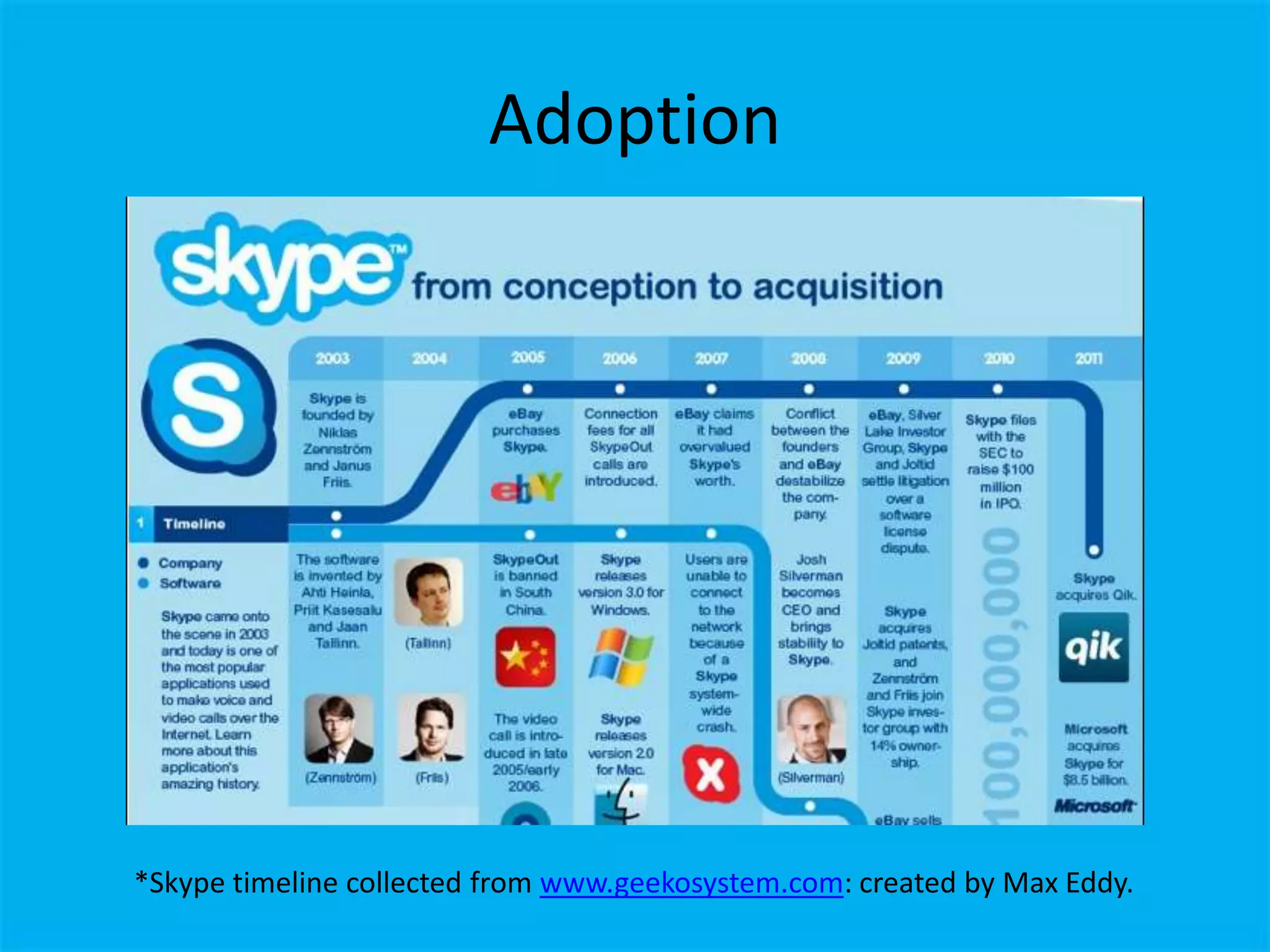
*Skype timeline collected from www.geekosystem.com: created by Max Eddy.
Adoption
• In 2009, Ebay sells 70% of Skype shares
  because of a nearly $1 billion loss.
• Skype files for an IPO in 2010, but later
  decides against it.
• In 2011, Microsoft purchases Skype for $8.5
  billion.
Competition
• Beginning in 2005, Skype saw a rise in
  competition to its services.
  – Google Talk is introduced as a similar platform to
    Skype.
  – ooVoo was introduced in 2007.
     • Supports 12-way video chatting.
     • Video call recording.
     • Desktop sharing.
Competition
• In 2011, Apple Facetime is created.
  • only functioning on Wi-Fi (not 3G capable).
  • Allows users to video chat with other Iphone users via
     phone calls.

  •   Vbuzzer introduced in 2012.
      –   “Voice over IP and instant messaging software and service”
          (2013 Vbuzzer Wikipedia page).
      –   Offers free voicemail and caller ID.
Success
• At the end of 2010, Skype had 663 million
  users (63 million more users than Facebook).
  – “40% of all minutes talked are now using video
    chat” (pcmag.com).
  – Total number of Skype users has steadily
    increased every year since 2005.
Success


*Skype statistics collected from pcmag.com.
Success
• Integration of Skype with Windows.
  – Skype app available for Windows smartphones
    (Androids and Iphones also).
     • “Skype now accounts for 12% of all long distance calls”
       (TeleGeography study).
  – Xbox Live and Microsoft Office also compatible
    with Skype software.
Conclusion
• Based on research, Skype tends to be most
  popular choice for video chat users.
• Other competitors popping up have pushed
  Skype to produce effective new features on a
  consistent basis.
• After going through a “mid-life crisis” with
  ownership, Skype rebounded positively.
Conclusion
• Skype has “recently announced a software
  development kit (SDK) that will enable third
  parties to embed Skype in new types of
  devices” (RikFairlie “Chatting Over Skype, This
  Time From The Sofa).
• Skype’s ability to embed in every OS makes it
  a universally accepted software.
Works Cited
• Eddy, Max. The History of Skype: Infographic.
  www.geekosystem.com. May 16, 2011.
• Fairlie, Rik. Chatting Over Skype, This Time
  From The Sofa. The New York Times; p10.
  July 8, 2010.
• Keane, Meghan. The Secret to Skype’s
  Success: Growing the Online Phone Market.
  January 19, 2010.
Works Cited
• Woyke, Elizabeth. Skype’s Growth Strategy.
  Forbes. May 21, 2010.
• Yin, Sara. Infographic: Skype Goes From Rags
  to Microsoft. Pcmag.com. May 26, 2011.
• Wikipedia pages for:
  – Skype
  – Vbuzzer.

Skype project new

  • 1.
    How online video messagingcame to fruition By, StéphaneRoque
  • 2.
    Origin • Founded in2003 by Janus Friis and NiklasZennstrom. – Cofounders of music-sharing software Kazaa. – “Service allows users to communicate with peers by using a microphone, video by using a webcam, and instant messaging over the internet” (2013 Skype Wikipedia page ). – Also allows file sharing between users.
  • 3.
    Development • Friis andZennstrom later aided by Estonian developers AhtiHeinla, PriitKasesalu and Jaan Tallinn in development of basic Skype software. • Skype begins to blossom with the increased efficiency of broadband strength, raising nearly $20 million in 2003 to help company grow.
  • 4.
    Development • Every newversion of the software offers various different features. – Instant messaging. – File sharing. – Group video messaging. – Video calls through HDTV sets (Comcast/Skype partnership beginning in 2011).
  • 5.
    Development • Software restrictions: – Not able to call emergency numbers in any part of the world. – FCC ruled that Skype is not considered “an interconnected VoIP provider” (2013 Skype Wikipedia page).
  • 6.
    Marketing • Ebay acquiresSkype in 2005 for $2.6 billion. • In 2006, Skype adds video calling capabilities to enhance marketing approach. • 37% of all Skype calls are business related.
  • 7.
    Marketing • “Most ofSkype's traffic consists of personal communications between family members and friends, who pay little--often nothing--to use the service” (Elizabeth Woyke “Skype’s Growth Strategy”). • In theory the marketing is primarily aimed at a community using the free software.
  • 8.
    Marketing • “Business customersbring in 20% to 30% more revenue than regular consumers” (Woyke). • In 2010, Panasonic and Samsung teamed with Skype to create high definition video chatting from the living room. – TV webcams rose in popularity during this time.
  • 9.
    Marketing • Skype providesserviceable communications solutions for both older and younger consumers. – Older consumers intimidated by computers can rely on TV webcams for easy video chats. – Younger consumers can continue to adapt to new changes within the Skype software.
  • 10.
    Adoption *Skype timeline collectedfrom www.geekosystem.com: created by Max Eddy.
  • 11.
    Adoption • In 2009,Ebay sells 70% of Skype shares because of a nearly $1 billion loss. • Skype files for an IPO in 2010, but later decides against it. • In 2011, Microsoft purchases Skype for $8.5 billion.
  • 12.
    Competition • Beginning in2005, Skype saw a rise in competition to its services. – Google Talk is introduced as a similar platform to Skype. – ooVoo was introduced in 2007. • Supports 12-way video chatting. • Video call recording. • Desktop sharing.
  • 13.
    Competition • In 2011,Apple Facetime is created. • only functioning on Wi-Fi (not 3G capable). • Allows users to video chat with other Iphone users via phone calls. • Vbuzzer introduced in 2012. – “Voice over IP and instant messaging software and service” (2013 Vbuzzer Wikipedia page). – Offers free voicemail and caller ID.
  • 14.
    Success • At theend of 2010, Skype had 663 million users (63 million more users than Facebook). – “40% of all minutes talked are now using video chat” (pcmag.com). – Total number of Skype users has steadily increased every year since 2005.
  • 15.
  • 16.
    Success • Integration ofSkype with Windows. – Skype app available for Windows smartphones (Androids and Iphones also). • “Skype now accounts for 12% of all long distance calls” (TeleGeography study). – Xbox Live and Microsoft Office also compatible with Skype software.
  • 17.
    Conclusion • Based onresearch, Skype tends to be most popular choice for video chat users. • Other competitors popping up have pushed Skype to produce effective new features on a consistent basis. • After going through a “mid-life crisis” with ownership, Skype rebounded positively.
  • 18.
    Conclusion • Skype has“recently announced a software development kit (SDK) that will enable third parties to embed Skype in new types of devices” (RikFairlie “Chatting Over Skype, This Time From The Sofa). • Skype’s ability to embed in every OS makes it a universally accepted software.
  • 19.
    Works Cited • Eddy,Max. The History of Skype: Infographic. www.geekosystem.com. May 16, 2011. • Fairlie, Rik. Chatting Over Skype, This Time From The Sofa. The New York Times; p10. July 8, 2010. • Keane, Meghan. The Secret to Skype’s Success: Growing the Online Phone Market. January 19, 2010.
  • 20.
    Works Cited • Woyke,Elizabeth. Skype’s Growth Strategy. Forbes. May 21, 2010. • Yin, Sara. Infographic: Skype Goes From Rags to Microsoft. Pcmag.com. May 26, 2011. • Wikipedia pages for: – Skype – Vbuzzer.