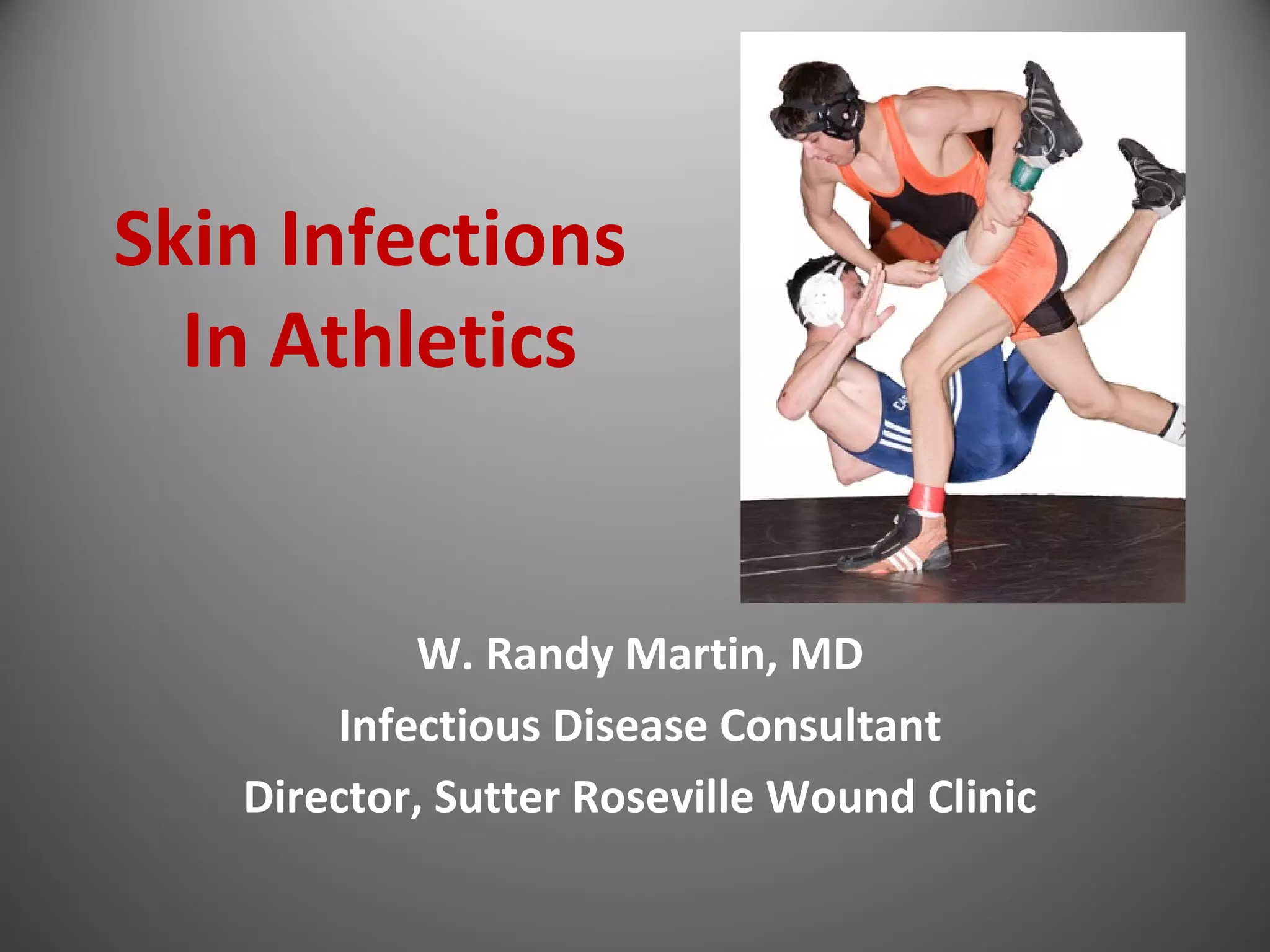
Skin Infections 
In Athletics 
W. Randy Martin, MD 
Infectious Disease Consultant 
Director, Sutter Roseville Wound Clinic
Skin Infections 
• The skin always has some amount of 
bacteria, fungus, and viruses living on it 
• Skin infections occur when there are 
breaks in the skin and the organisms 
have uncontrolled growth
How Infectious?? 
• It is more important to understand the 
potential for infection rather than 
placing a name on a skin problem 
• The priority is the health of the athlete 
• When in doubt, err on the side of safety 
and well-being
Problem Skin Lesions 
• Always worry about lesions that 
have an irregular border 
• Worry about raised skin lesions 
• Worry about “wet” or “moist” 
lesions
Problem Skin Lesions 
• Worry about skin lesions that have 
different colors within the lesion 
• Bright red colored lesions are more of a 
problem compared to faded lesions 
• Lesions that are warmer compared to 
other skin are more likely to be infected.
Problem Skin Lesions 
• Patterns of skin lesions help determine 
how infectious the lesions have 
become 
• Inflammation and irritation around the 
skin lesions increase the chance the 
lesions are infectious
Problem Skin Lesions 
• An athlete with a prior history of 
infectious skin lesions has a higher risk of 
recurrent skin infections 
• Skin abrasions increase the risk of skin 
infection. The deeper or more traumatic 
the break in the skin, the higher the risk 
for a subsequent infection
Expertise 
• In some situations an experienced athletic 
trainer or referee may have more expertise 
compared to a physician who has limited 
experience – but this problem is difficult to 
objectively document 
• The best situation is qualified physicians, 
trainers and referees working together for the 
benefit of the athletes.
Skin Infections - Highlights 
• Bacteria (can be cured) 
– Staphlococcus including MRSA & Impetigo 
– Streptococcus 
• Fungal (can be cured) 
– Ringworm 
• Viral (can’t be cured but can be treated) 
– Herpes 
– Warts 
– Molluscum contagiosum
Skin Infections 
• The right antibiotic is required to cure a 
specific bacterial skin infection 
• Antibiotics for bacteria will not improve 
fungal or viral infections 
• Bacterial infections can be the fastest 
growing infections and for this reason are the 
most easily spread among athletes
Skin Infections 
• The faster the bacteria grows, the more likely 
the correct antibiotic will cure the infection. 
• Herpes gladitorium (Herpes simplex) 
responds the best to antiviral medication. 
Other virus infections are relatively resistant 
to current medications
Folliculitis 
• Inflammation of hair follicle 
• Frequently caused by infection 
• Physical injury can cause problem 
• Painless or tender pustule
What is Sraph? 
• The official Staphylococcus aureus. 
• “Staph” and “Strep” bacteria often cause skin 
infections. 
• MRSA is resistant to many of the traditional 
“Staph” antibiotics
Staph 
• May or may not have 
surrounding cellulitis 
• Athlete may or may not have risk 
factors for infection
Stop Spreading Staph! 
• Do not share personal hygiene items (bar 
soap, towels, razors) or clothing 
• Wear practice clothes/ uniforms only once, 
wash with soap and hot water, dry in hot 
dryer 
• Cover all wounds with a clean, dry bandage 
taped on all four sides
Stop Spreading Staph! 
• Avoid contact with other people’s skin 
infections 
• Report skin infections to coach/ trainer/ 
nurse 
• Clean and disinfect athletic/wrestling gear 
and practice surfaces (mats, benches, weight 
lifting equipment) after each use
General Treatment of Bacterial 
Infections with Antibiotics 
• You need to take the right medicine. 
Antibiotics are not all the same. 
• Even if you start to feel better, you need to 
take all of the pills, to help the infection go 
away. Taking a few pills will not kill all of the 
bacteria, and may make the ones that remain 
stronger.
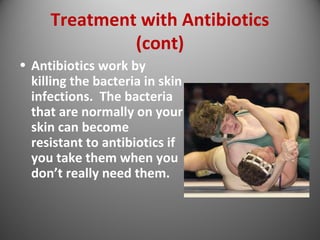
Treatment with Antibiotics 
(cont) 
• Antibiotics work by 
killing the bacteria in skin 
infections. The bacteria 
that are normally on your 
skin can become 
resistant to antibiotics if 
you take them when you 
don’t really need them.
Treatment with Antibiotics 
(cont) 
• Go back to the doctor if you are taking your 
antibiotics and are not getting better after 
two or three days of treatment. You 
may need a 
different kind 
of antibiotic.
Ringworm (fungus) 
• Also known as Tinea corporis (fungus) 
• Common among wrestlers 
• Treatment should include a topical agent 
(such as clotrimazole twice a day for three 
weeks) as well as an oral antifungal agent 
(such as fluconazole for three weeks). 
• May return to competition after five, but 
ideally after 10 days of treatment
Treatment of Ringworm 
• Be sure to take the anti-fungal medicine for 
the full duration of time. Failure to do so may 
result in the ringworm returning.
Disinfection Guidelines 
• All hard environmental surfaces that may come in 
contact with body fluids should be cleaned (i.e., 
visible dirt removed) and sanitized (i.e., disinfected, 
or removal of bacteria) daily, if area is in use. Many 
commonly available cleaning products are effective 
against MRSA - a complete list of EPA-approved 
disinfectants for MRSA is available at 
www.epa.gov/oppad001/list_h_mrsa_vre.pdf. 
Refer to the manufacturer's directions for 
recommended contact times for various 
disinfectants. Always wear gloves when using 
disinfectants.
Disinfection Guidelines 
• All floor and wall padding in athletic area(s) 
should be washed daily (if the athletic area is 
used) 
• Separate mop heads/ buckets should be used 
for each activity area, locker room, and 
restroom. Mop heads and buckets should be 
cleaned regularly. (Washable micro-fiber 
heads or disposable mop cloths may be more 
convenient)
Disinfection Guidelines 
• Towels/ linens laundered on 
premises should be washed with 
detergent at a minimum of 160 F 
and dried in a hot dryer.
Disinfection Guidelines 
• CAUTION!! If clean athletic gear 
is dumped into a dirty laundry 
bag or gym bag, the gear 
immediately becomes a source 
of infection!
Wrestling Rooms and Mats 
• Wall padding and benches should be wiped-down 
with an EPA-approved disinfectant 
such as a quaternary ammonium (quat) or 
1:9 bleach solution after each practice and 
meet. 
• Mat surfaces with small holes or tears should 
be repaired with mat tape. When mat sides 
are in poor condition, mats should be taped 
together for meets and for practice.
Wrestling Room and Mats 
• Mat surfaces should be replaced promptly 
when there are large holes or surfaces are 
excessively worn. 
• Both sides of the mats should be cleaned 
thoroughly before and after each use for 
practices and meets. 
• In rooms with multiple 40x40 foot mats, it 
may not be practical to clean the mat 
underside everyday but this cleaning should 
be perform as frequent as possible.
Wrestling Room And Mats 
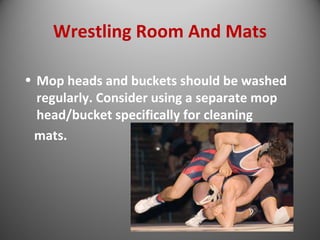
• Mop heads and buckets should be washed 
regularly. Consider using a separate mop 
head/bucket specifically for cleaning 
mats.
Locker Rooms/ Shower Rooms 
• Liquid, not bar, soap should be readily 
available and provided by wall dispensers 
close to sinks and next to showers. 
Safeguard or Dial brands are two of the 
more effective brands of soap 
• Chlorhexidine is much more effective 
compared to soap in reducing infection
Locker Rooms/ Shower Rooms 
• Soap dispensers should be checked 
regularly to ensure that soap is 
present 
• Soap dispensers should have “unit” 
refills
Locker Rooms/ Shower Rooms 
• Shower with soap or chlorhexidine 
(recommended) and water 
immediately after each practice, 
game, match, or other event. Use a 
clean, dry towel
Locker Rooms/ Shower Rooms 
• All shower and locker room areas 
should be cleaned daily (if used) 
• Towels should not be shared. If 
they are washed at school, they 
should be washed in soap and 
water at 160 F minimum and dried 
in a hot dryer.
Sports Equipment 
• Whenever possible, equipment and clothing 
should not be shared. 
• All shared equipment that comes in direct 
contact with the skin of an athlete (wrestling 
head gear, football helmets, and fencing 
wires) should be cleaned and sanitized after 
each use. 
• Sports equipment (balls, racket grips, bats, 
gloves) should be cleaned regularly
Disinfectant 
• A bleach solution of 1 part bleach in 9 
parts water (e.g., 1 3/4 cups bleach to 1 
gallon of water) will kill Staphylococcus 
aureus, as well as other (tougher to kill) 
disease-causing organisms such as 
norovirus and Clostridium difficile, and 
should be used when possible.
Disinfectant 
• In situations where this is impractical, a more 
dilute solution (e.g., 1 part bleach in 64 parts 
water, such as 1/4 cup bleach in 1 gallon of 
water) may be used to disinfect surfaces that 
may be contaminated with S. aureus. 
However, it should be noted that bleach 
solutions more dilute than 1 part bleach in 9 
parts water may not kill some disease 
causing organisms.
Disinfectant 
• Another option is to use a 1 part bleach 
in 9 parts water solution, followed by a 
rinse with water to remove residual 
bleach. 
• Bleach solutions should be mixed fresh 
daily to ensure effectiveness. 
• Bleach solutions should NOT be used to 
sanitize hands or for cleaning wounds.
Disinfectants 
• Make your own solution of bleach and 
water: Mix one tablespoon bleach into 
one quart of water in a spray bottle and 
label it “bleach solution.” Make it fresh 
each time you plan to clean because the 
bleach evaporates out of the water 
making it less effective 
• Never mix bleach with other cleaners, 
especially ammonia.
Cleaning Frequency 
• MRSA bacteria and other 
organisms can live on surfaces 
for days, weeks and months 
• It is important to clean regularly. 
• Clean daily frequently touched 
items and surfaces.
First Aid 
• Include alcohol-based hand 
sanitizer (60% or greater) in coach’s 
first aid kit so that coaches/ trainers 
will always be able to sanitize 
hands before and after caring for 
each injured player when soap and 
water is not readily available.
First Aid 
• Have disposable gloves readily available in first 
aid kit for use when caring for the scrapes and 
cuts of players. Use gloves once and then 
discard; wash hands or use hand sanitizer 
immediately after removing gloves. 
• Scoops (not hands) must be used to take ice 
out of cooler to make ice packs for injuries. 
Scoops should be cleaned daily when in use 
and NOT stored in the ice container.
First Aid 
• Single-use portions of antibiotics, 
salves, and other ointments should 
be removed from any larger 
dispensing unit prior to application. 
Any un-used product must NOT be 
returned to the original dispenser, 
but discarded.
First Aid 
• Athletes should be prohibited from 
participating until wounds have healed-even 
if wounds are covered – if extensive skin-to-skin 
contact may occur (e.g., wrestlers). 
• Athletes with potential skin infections should 
be referred to the team physician or their 
own medical provider. Culturing wounds that 
appear to be infected should be encouraged.
Key Points 
• Athletes should be regularly encouraged to 
follow good hygiene practices, including 
frequent hand washing, showering 
immediately following each practice or 
competition, and NOT sharing “drinking” 
water bottles 
• Do NOT touch other peoples’ skin infections. 
Any draining wound should be considered a 
potential skin infection
Key Points 
• Do NOT share personal hygiene items (e.g., 
bar soap, razors, nail clippers, etc.), or topical 
ointments, antibiotics, deodorants, and 
salves. 
• Promptly report abrasions, lacerations, or 
skin infections to a coach/ team trainer, or 
school nurse 
• Cosmetic shaving should be discouraged
Key Points 
• Athletes with open wounds should be 
discouraged from using whirlpools or 
common tubs. Individuals with scratches or 
open wound can infect others or become 
infected in this kind of environment. 
• Wash practice clothes/ uniforms with soap 
and warm water and dry in a hot dryer after 
every use
Acknowledgements 
• Center for Disease Control 
• Tacoma-Pierce County Health 
Department 
• Sutter Roseville Medical Center 
Infection Control Department 
• Virginia Department of Health

Skininfection%20osage

  • 1.
    Skin Infections InAthletics W. Randy Martin, MD Infectious Disease Consultant Director, Sutter Roseville Wound Clinic
  • 2.
    Skin Infections •The skin always has some amount of bacteria, fungus, and viruses living on it • Skin infections occur when there are breaks in the skin and the organisms have uncontrolled growth
  • 3.
    How Infectious?? •It is more important to understand the potential for infection rather than placing a name on a skin problem • The priority is the health of the athlete • When in doubt, err on the side of safety and well-being
  • 4.
    Problem Skin Lesions • Always worry about lesions that have an irregular border • Worry about raised skin lesions • Worry about “wet” or “moist” lesions
  • 5.
    Problem Skin Lesions • Worry about skin lesions that have different colors within the lesion • Bright red colored lesions are more of a problem compared to faded lesions • Lesions that are warmer compared to other skin are more likely to be infected.
  • 6.
    Problem Skin Lesions • Patterns of skin lesions help determine how infectious the lesions have become • Inflammation and irritation around the skin lesions increase the chance the lesions are infectious
  • 7.
    Problem Skin Lesions • An athlete with a prior history of infectious skin lesions has a higher risk of recurrent skin infections • Skin abrasions increase the risk of skin infection. The deeper or more traumatic the break in the skin, the higher the risk for a subsequent infection
  • 8.
    Expertise • Insome situations an experienced athletic trainer or referee may have more expertise compared to a physician who has limited experience – but this problem is difficult to objectively document • The best situation is qualified physicians, trainers and referees working together for the benefit of the athletes.
  • 9.
    Skin Infections -Highlights • Bacteria (can be cured) – Staphlococcus including MRSA & Impetigo – Streptococcus • Fungal (can be cured) – Ringworm • Viral (can’t be cured but can be treated) – Herpes – Warts – Molluscum contagiosum
  • 10.
    Skin Infections •The right antibiotic is required to cure a specific bacterial skin infection • Antibiotics for bacteria will not improve fungal or viral infections • Bacterial infections can be the fastest growing infections and for this reason are the most easily spread among athletes
  • 11.
    Skin Infections •The faster the bacteria grows, the more likely the correct antibiotic will cure the infection. • Herpes gladitorium (Herpes simplex) responds the best to antiviral medication. Other virus infections are relatively resistant to current medications
  • 12.
    Folliculitis • Inflammationof hair follicle • Frequently caused by infection • Physical injury can cause problem • Painless or tender pustule
  • 13.
    What is Sraph? • The official Staphylococcus aureus. • “Staph” and “Strep” bacteria often cause skin infections. • MRSA is resistant to many of the traditional “Staph” antibiotics
  • 14.
    Staph • Mayor may not have surrounding cellulitis • Athlete may or may not have risk factors for infection
  • 15.
    Stop Spreading Staph! • Do not share personal hygiene items (bar soap, towels, razors) or clothing • Wear practice clothes/ uniforms only once, wash with soap and hot water, dry in hot dryer • Cover all wounds with a clean, dry bandage taped on all four sides
  • 16.
    Stop Spreading Staph! • Avoid contact with other people’s skin infections • Report skin infections to coach/ trainer/ nurse • Clean and disinfect athletic/wrestling gear and practice surfaces (mats, benches, weight lifting equipment) after each use
  • 17.
    General Treatment ofBacterial Infections with Antibiotics • You need to take the right medicine. Antibiotics are not all the same. • Even if you start to feel better, you need to take all of the pills, to help the infection go away. Taking a few pills will not kill all of the bacteria, and may make the ones that remain stronger.
  • 18.
    Treatment with Antibiotics (cont) • Antibiotics work by killing the bacteria in skin infections. The bacteria that are normally on your skin can become resistant to antibiotics if you take them when you don’t really need them.
  • 19.
    Treatment with Antibiotics (cont) • Go back to the doctor if you are taking your antibiotics and are not getting better after two or three days of treatment. You may need a different kind of antibiotic.
  • 20.
    Ringworm (fungus) •Also known as Tinea corporis (fungus) • Common among wrestlers • Treatment should include a topical agent (such as clotrimazole twice a day for three weeks) as well as an oral antifungal agent (such as fluconazole for three weeks). • May return to competition after five, but ideally after 10 days of treatment
  • 21.
    Treatment of Ringworm • Be sure to take the anti-fungal medicine for the full duration of time. Failure to do so may result in the ringworm returning.
  • 22.
    Disinfection Guidelines •All hard environmental surfaces that may come in contact with body fluids should be cleaned (i.e., visible dirt removed) and sanitized (i.e., disinfected, or removal of bacteria) daily, if area is in use. Many commonly available cleaning products are effective against MRSA - a complete list of EPA-approved disinfectants for MRSA is available at www.epa.gov/oppad001/list_h_mrsa_vre.pdf. Refer to the manufacturer's directions for recommended contact times for various disinfectants. Always wear gloves when using disinfectants.
  • 23.
    Disinfection Guidelines •All floor and wall padding in athletic area(s) should be washed daily (if the athletic area is used) • Separate mop heads/ buckets should be used for each activity area, locker room, and restroom. Mop heads and buckets should be cleaned regularly. (Washable micro-fiber heads or disposable mop cloths may be more convenient)
  • 24.
    Disinfection Guidelines •Towels/ linens laundered on premises should be washed with detergent at a minimum of 160 F and dried in a hot dryer.
  • 25.
    Disinfection Guidelines •CAUTION!! If clean athletic gear is dumped into a dirty laundry bag or gym bag, the gear immediately becomes a source of infection!
  • 26.
    Wrestling Rooms andMats • Wall padding and benches should be wiped-down with an EPA-approved disinfectant such as a quaternary ammonium (quat) or 1:9 bleach solution after each practice and meet. • Mat surfaces with small holes or tears should be repaired with mat tape. When mat sides are in poor condition, mats should be taped together for meets and for practice.
  • 27.
    Wrestling Room andMats • Mat surfaces should be replaced promptly when there are large holes or surfaces are excessively worn. • Both sides of the mats should be cleaned thoroughly before and after each use for practices and meets. • In rooms with multiple 40x40 foot mats, it may not be practical to clean the mat underside everyday but this cleaning should be perform as frequent as possible.
  • 28.
    Wrestling Room AndMats • Mop heads and buckets should be washed regularly. Consider using a separate mop head/bucket specifically for cleaning mats.
  • 29.
    Locker Rooms/ ShowerRooms • Liquid, not bar, soap should be readily available and provided by wall dispensers close to sinks and next to showers. Safeguard or Dial brands are two of the more effective brands of soap • Chlorhexidine is much more effective compared to soap in reducing infection
  • 30.
    Locker Rooms/ ShowerRooms • Soap dispensers should be checked regularly to ensure that soap is present • Soap dispensers should have “unit” refills
  • 31.
    Locker Rooms/ ShowerRooms • Shower with soap or chlorhexidine (recommended) and water immediately after each practice, game, match, or other event. Use a clean, dry towel
  • 32.
    Locker Rooms/ ShowerRooms • All shower and locker room areas should be cleaned daily (if used) • Towels should not be shared. If they are washed at school, they should be washed in soap and water at 160 F minimum and dried in a hot dryer.
  • 33.
    Sports Equipment •Whenever possible, equipment and clothing should not be shared. • All shared equipment that comes in direct contact with the skin of an athlete (wrestling head gear, football helmets, and fencing wires) should be cleaned and sanitized after each use. • Sports equipment (balls, racket grips, bats, gloves) should be cleaned regularly
  • 34.
    Disinfectant • Ableach solution of 1 part bleach in 9 parts water (e.g., 1 3/4 cups bleach to 1 gallon of water) will kill Staphylococcus aureus, as well as other (tougher to kill) disease-causing organisms such as norovirus and Clostridium difficile, and should be used when possible.
  • 35.
    Disinfectant • Insituations where this is impractical, a more dilute solution (e.g., 1 part bleach in 64 parts water, such as 1/4 cup bleach in 1 gallon of water) may be used to disinfect surfaces that may be contaminated with S. aureus. However, it should be noted that bleach solutions more dilute than 1 part bleach in 9 parts water may not kill some disease causing organisms.
  • 36.
    Disinfectant • Anotheroption is to use a 1 part bleach in 9 parts water solution, followed by a rinse with water to remove residual bleach. • Bleach solutions should be mixed fresh daily to ensure effectiveness. • Bleach solutions should NOT be used to sanitize hands or for cleaning wounds.
  • 37.
    Disinfectants • Makeyour own solution of bleach and water: Mix one tablespoon bleach into one quart of water in a spray bottle and label it “bleach solution.” Make it fresh each time you plan to clean because the bleach evaporates out of the water making it less effective • Never mix bleach with other cleaners, especially ammonia.
  • 38.
    Cleaning Frequency •MRSA bacteria and other organisms can live on surfaces for days, weeks and months • It is important to clean regularly. • Clean daily frequently touched items and surfaces.
  • 39.
    First Aid •Include alcohol-based hand sanitizer (60% or greater) in coach’s first aid kit so that coaches/ trainers will always be able to sanitize hands before and after caring for each injured player when soap and water is not readily available.
  • 40.
    First Aid •Have disposable gloves readily available in first aid kit for use when caring for the scrapes and cuts of players. Use gloves once and then discard; wash hands or use hand sanitizer immediately after removing gloves. • Scoops (not hands) must be used to take ice out of cooler to make ice packs for injuries. Scoops should be cleaned daily when in use and NOT stored in the ice container.
  • 41.
    First Aid •Single-use portions of antibiotics, salves, and other ointments should be removed from any larger dispensing unit prior to application. Any un-used product must NOT be returned to the original dispenser, but discarded.
  • 42.
    First Aid •Athletes should be prohibited from participating until wounds have healed-even if wounds are covered – if extensive skin-to-skin contact may occur (e.g., wrestlers). • Athletes with potential skin infections should be referred to the team physician or their own medical provider. Culturing wounds that appear to be infected should be encouraged.
  • 43.
    Key Points •Athletes should be regularly encouraged to follow good hygiene practices, including frequent hand washing, showering immediately following each practice or competition, and NOT sharing “drinking” water bottles • Do NOT touch other peoples’ skin infections. Any draining wound should be considered a potential skin infection
  • 44.
    Key Points •Do NOT share personal hygiene items (e.g., bar soap, razors, nail clippers, etc.), or topical ointments, antibiotics, deodorants, and salves. • Promptly report abrasions, lacerations, or skin infections to a coach/ team trainer, or school nurse • Cosmetic shaving should be discouraged
  • 45.
    Key Points •Athletes with open wounds should be discouraged from using whirlpools or common tubs. Individuals with scratches or open wound can infect others or become infected in this kind of environment. • Wash practice clothes/ uniforms with soap and warm water and dry in a hot dryer after every use
  • 46.
    Acknowledgements • Centerfor Disease Control • Tacoma-Pierce County Health Department • Sutter Roseville Medical Center Infection Control Department • Virginia Department of Health