SEMINAR ON
“SKELETAL SYSTEM”
Presented by
Mr. Arvind Joshi
Embryology
 Major parts arise from mesoderm of embryo
 Osteoprogenitor cells become differentiated into
osteoblasts
 Surrounded by the bone matrix, osteoblasts becum
mature bone cells (osteocytes)
 Vertebrae & ribs are 1st to form( 4th & 6th wk)
 Buds of upper & lower limbs (5th wk)
 Cartilagenous skeleton gets replaced by bone(8th
wk)
 Primitive joint cavities develop (10th wk)
Anatomy
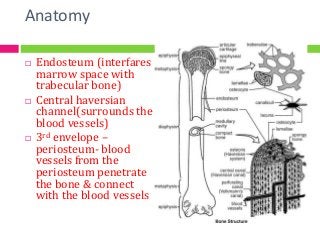
 Endosteum (interfares
marrow space with
trabecular bone)
 Central haversian
channel(surrounds the
blood vessels)
 3rd envelope –
periosteum- blood
vessels from the
periosteum penetrate
the bone & connect
with the blood vessels
Classification of bones:
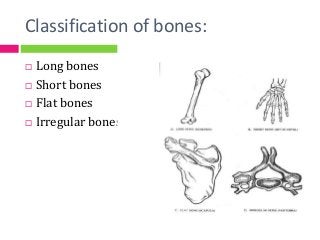
 Long bones
 Short bones
 Flat bones
 Irregular bones
Physiology
Functions of bone:
 Give rigid support to the spinal cord,extremities &
movable joints
 They supply the points of attachment for locomotive
muscles
 They protect the neural structures blood forming
elementsof the bone marrow
 Bone undergoes 2 physiological processes:
Modelling & remodelling
Diagnostic criteria:
 Sr. tests helps in assessing skeletal problems
 CPK,SGOT,SGPT,LDH are elevated in muscular disease
 WBC & Hb levels are elevated in traumatic injury
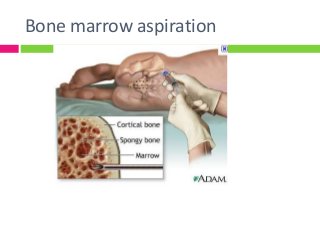
 Bone marrow aspiration
 Bone scan (scintigraphy)
 Computerized axial tomography
 Electromyography
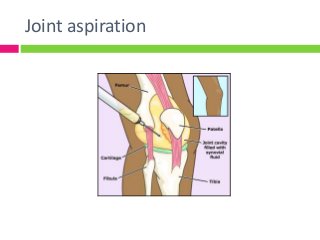
 Joint aspiration
 Radiography
 ESR
 CRP
 Blood culture
Bone marrow aspiration
Joint aspiration
Common medical treatments
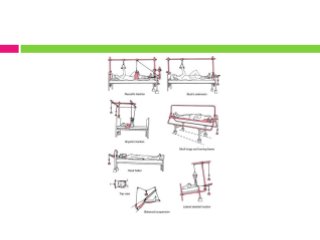
 Traction
Explanation: application of a pulling force on an
extremity or body part
Indications: fracture reduction, dislocation,
correction of deformities
Nsg implications:
 Ensure wt hang free
 Maintain prescribed weights
 Elevate head/foot of bed only with physical
order
 Monitor for complications
 Casting – application of plaster or fiber glass
material to form a rigid material to immobilise a
body part
Indication: same
Nsg implications:
 Assess frequently
 Protect cast from moisture
 Teach family how to care for cast at home
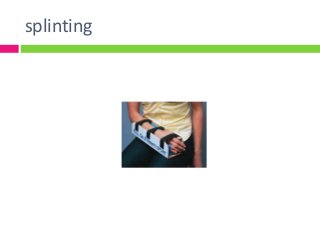
3) Splinting- temporary stiff support of injured
area
Indication- fracture reduction, immobilisation &
support of sprains
Nsg care in casts
1. Apply plastic wraps to the perineal area
2. Use a bedpan
3. Tuck 2 diapers
 Nsg care in traction:
1. Pad bony prominences
2. Gently massage the back
4) Fixation – surgical reduction of a fracure/skeletal
deformitywith an int/ext pin or fixation device
Indication: fracture,skeletal deformities
Nsg implications:
 Assess for excess drainage
 No additional care
5) Cold therapy- application of ice bags,commercial cold
packsor cold compress
Indication – in ac injuries for vasoconstriction, thereby
decreasing pain & swelling
Nsg implications:
 Apply for 20 – 30 mins
 Discontinue when numb
 Place a towel
splinting
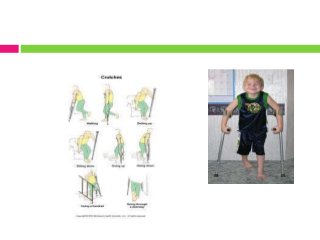
6)Crutches- ambulatory devices that transfer body
weight from lower to upper extremities
Indication: whenever weight is contraindicated
Nsg implications:
 Teach child appropraite ambulation
 Top of crutch should reach 2 – 3 fingers below
the axillae
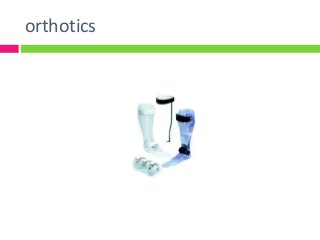
7) Orthotics, braces:- adaptive positioning devices
specially fitted for each child ( used to maintain
proper body allignment)
Indication- treat developmental dysplasia of the
hip,scoliosis
Nsg implications:
 Provide frequent assessments
 Cotton undergarments worn under the brace
 Encourage family
orthotics
9)Physical therapy,occupational therapy-focusses
on attainment or improvement of gross motor
skills
Focusses on refinement of fine motor skills,feeding
,ADLs
Indication:
 Promote developmental activities
 Restore function after injury/surgery
Nsg implications:
 Provide follow up
 Ensure adequate communication
Club foot
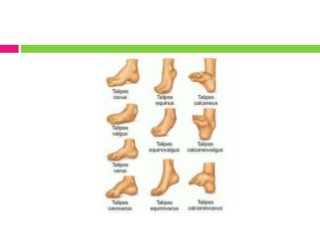
 Refers to the congenital deformities involving
the bones,muscles,ligaments & tendons of the
foot.
 Club foot consists of:
 Talipus varus
 Talipus equinus
 Cavus
 Talipus calcanus
 Talipus valgus
 Talipus varus
Etiology:
 Unknown
Classification:
 Postural
 Neurogenic
 Syndromic
 Idiopathic
Medical therapy
 Treatment starts
with birth
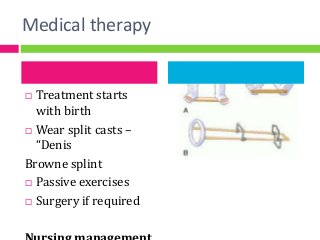
 Wear split casts –
“Denis
Browne splint
 Passive exercises
 Surgery if required
Nsg management
 Family members need to know the cast care
 Imporatnce of dennis browne splint
 Not to change the angle of the shoes
 Give daily passive exercises,schedule the specific
time
Complications:
 Residual deformity
 Awkward gait
 Wt bearing
 Disturbance to the epiphysis
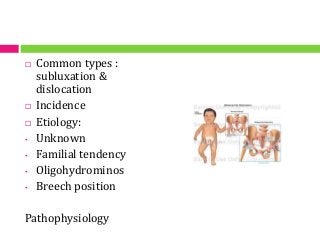
Congenital hip dysplasia
 Common types :
subluxation &
dislocation
 Incidence
 Etiology:
• Unknown
• Familial tendency
• Oligohydrominos
• Breech position
Pathophysiology
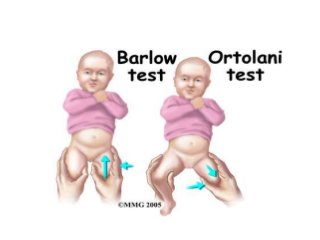
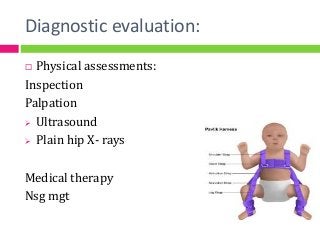
Diagnostic evaluation:
 Physical assessments:
Inspection
Palpation
 Ultrasound
 Plain hip X- rays
Medical therapy
Nsg mgt
Nsg mgt
 Correct application of diapers
& splints
 Specific guidelines to be told for removal
 Cast care to be explained
 Prevent skin breakdown
 Use of plastic drapes
 Change wet diapers
 Elevate 30 40 degrees
 Keep a roll under the limb arch to dec stress on
the cast
Complications
 Avascular necrosis
 Loss of ROM
 Femoral nerve palsy
 Early osteoarthritis
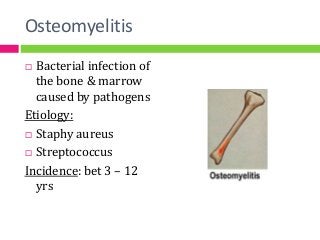
Osteomyelitis
 Bacterial infection of
the bone & marrow
caused by pathogens
Etiology:
 Staphy aureus
 Streptococcus
Incidence: bet 3 – 12
yrs
 DE:
a) Elevated WBC,ESR,CRP
b) Positive blood cultures
c) Deep soft swelling(tissue) on X-Ray
d) Changes on ultrasound or CT scan
Medical therapy:
a) Antibiotics
b) Drainage of infected site
c) Immobilization – splint,cast,traction
Nursing management
 Detailed history
 Inspect extremity
 Palpate
 Maintain bed rest
 Administer antipyretics
 Skin care
 Teach parents
 Encourage use of unaffected extremities
Fracture
 Trauma resulting in the break in the continuity
of the bone
Incidence:
 40% boys & 25% girls suffer by age 16
Etiology:
 Accidental trauma
 Non – accidental trauma
 Other disease process
 Repair of a fracture;
a) Inflamatory phase
b) Reparative phase
c) Remodelling phase
DE:
a) X- Rays
b) CT scan
c) MRI
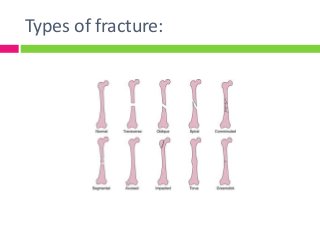
Types of fracture:
Management
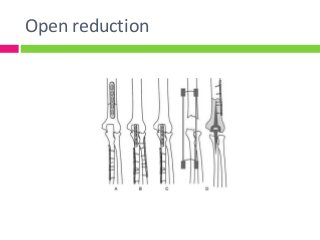
 Repositioning: reduction- open & closed
 Traction- skin & skeletal

Open reduction
Nursing management:
a) Immobilise the limb
b) Use of cold therapy
c) Elevate the injured limb
d) Administer TT
e) Assess for 5 P’s – pain ,pulseness, pallor,
paresthesia, paralysis
f) Administer analgesics
g) Advise parents- preventing fracture, family
education
Complications:
 Infection
 Avascular necrosis
 Bone shortening
 Compartment syndrome
 Vascular/nerve injuries
 Later - osteoarthritis
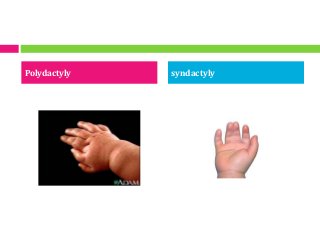
Polydactyly syndactyly
Polydactyly/syndactyly
 Polydactyly – is the presence of extra digits on
the hand/foot
 Syndactyly – is webbing of fingers /toes
 Treatment –
a) Tying off the additional digit
b) Or surgical removal
c) No t/t for syndactyly
 Management –
If tied – observe for necrosis of tissue.
Nursing diagnosis
1. Impaired physical related to
injury,pain,weaknessas evidenced by inability
to move an extremity or ambulate.
2. Risk for constipation related to immobility
3. Self care deficit related to immobility as
evidenced by inability to perform hygiene
care.
4. Risk for impaired skin integrity related to
immobility,casting,traction,use of braces
5. Risk for delayed devptrelated alteration in
extremities
Recent advances
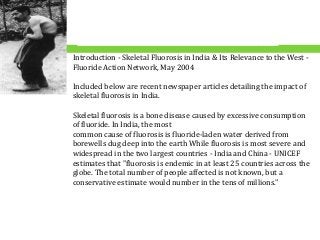
Introduction - Skeletal Fluorosis in India & Its Relevance to the West -
Fluoride Action Network, May 2004
Included below are recent newspaper articles detailing the impact of
skeletal fluorosis in India.
Skeletal fluorosis is a bone disease caused by excessive consumption
of fluoride. In India, the most
common cause of fluorosis is fluoride-laden water derived from
borewells dug deep into the earth While fluorosis is most severe and
widespread in the two largest countries - India and China - UNICEF
estimates that "fluorosis is endemic in at least 25 countries across the
globe. The total number of people affected is not known, but a
conservative estimate would number in the tens of millions."
 Common causes of fluorosis include: inhalation of fluoride dusts/fumes
by workers in industry, use of coal as an indoor
 fuel source (a common practice in China), and consumption of fluoride
from drinking water.
 In China, the World Health Organization recently estimated that 2.7
million people have the crippling form of skeletal fluorosis, while in
India, 17 of its 32 states have been identified as "endemic" areas, with
an estimated 66 million people at risk and 6 million people seriously
afflicted.
 According to scientific surveys, skeletal fluorosis in India and China
occurs when the fluoride concentration in water exceeds 1 part per
million (ppm), and has been found to occur in communities with only
0.7 part per million (SOURCE: Singh 1961; Singh 1963; Jolly 1970;
Siddiqui 1970; Susheela 1993; Choubisa 1997; Xu 1997; Bo 2003).
 The Chinese government now considers any water supply containing
over 1 ppm fluoride a risk for skeletal fluorosis (SOURCE: Bo 2003).
 Thankyou

skeletal system disorders

  • 1.
  • 2.
    Embryology  Major partsarise from mesoderm of embryo  Osteoprogenitor cells become differentiated into osteoblasts  Surrounded by the bone matrix, osteoblasts becum mature bone cells (osteocytes)  Vertebrae & ribs are 1st to form( 4th & 6th wk)  Buds of upper & lower limbs (5th wk)  Cartilagenous skeleton gets replaced by bone(8th wk)  Primitive joint cavities develop (10th wk)
  • 3.
    Anatomy  Endosteum (interfares marrowspace with trabecular bone)  Central haversian channel(surrounds the blood vessels)  3rd envelope – periosteum- blood vessels from the periosteum penetrate the bone & connect with the blood vessels
  • 4.
    Classification of bones: Long bones  Short bones  Flat bones  Irregular bones
  • 5.
    Physiology Functions of bone: Give rigid support to the spinal cord,extremities & movable joints  They supply the points of attachment for locomotive muscles  They protect the neural structures blood forming elementsof the bone marrow  Bone undergoes 2 physiological processes: Modelling & remodelling
  • 6.
    Diagnostic criteria:  Sr.tests helps in assessing skeletal problems  CPK,SGOT,SGPT,LDH are elevated in muscular disease  WBC & Hb levels are elevated in traumatic injury  Bone marrow aspiration  Bone scan (scintigraphy)  Computerized axial tomography  Electromyography  Joint aspiration  Radiography  ESR  CRP  Blood culture
  • 7.
  • 8.
  • 9.
    Common medical treatments Traction Explanation: application of a pulling force on an extremity or body part Indications: fracture reduction, dislocation, correction of deformities Nsg implications:  Ensure wt hang free  Maintain prescribed weights  Elevate head/foot of bed only with physical order  Monitor for complications
  • 11.
     Casting –application of plaster or fiber glass material to form a rigid material to immobilise a body part Indication: same Nsg implications:  Assess frequently  Protect cast from moisture  Teach family how to care for cast at home 3) Splinting- temporary stiff support of injured area Indication- fracture reduction, immobilisation & support of sprains
  • 12.
    Nsg care incasts 1. Apply plastic wraps to the perineal area 2. Use a bedpan 3. Tuck 2 diapers  Nsg care in traction: 1. Pad bony prominences 2. Gently massage the back
  • 13.
    4) Fixation –surgical reduction of a fracure/skeletal deformitywith an int/ext pin or fixation device Indication: fracture,skeletal deformities Nsg implications:  Assess for excess drainage  No additional care 5) Cold therapy- application of ice bags,commercial cold packsor cold compress Indication – in ac injuries for vasoconstriction, thereby decreasing pain & swelling Nsg implications:  Apply for 20 – 30 mins  Discontinue when numb  Place a towel
  • 14.
  • 15.
    6)Crutches- ambulatory devicesthat transfer body weight from lower to upper extremities Indication: whenever weight is contraindicated Nsg implications:  Teach child appropraite ambulation  Top of crutch should reach 2 – 3 fingers below the axillae
  • 17.
    7) Orthotics, braces:-adaptive positioning devices specially fitted for each child ( used to maintain proper body allignment) Indication- treat developmental dysplasia of the hip,scoliosis Nsg implications:  Provide frequent assessments  Cotton undergarments worn under the brace  Encourage family
  • 18.
  • 19.
    9)Physical therapy,occupational therapy-focusses onattainment or improvement of gross motor skills Focusses on refinement of fine motor skills,feeding ,ADLs Indication:  Promote developmental activities  Restore function after injury/surgery Nsg implications:  Provide follow up  Ensure adequate communication
  • 20.
    Club foot  Refersto the congenital deformities involving the bones,muscles,ligaments & tendons of the foot.  Club foot consists of:  Talipus varus  Talipus equinus  Cavus  Talipus calcanus  Talipus valgus  Talipus varus
  • 22.
  • 23.
  • 24.
    Medical therapy  Treatmentstarts with birth  Wear split casts – “Denis Browne splint  Passive exercises  Surgery if required
  • 25.
    Nsg management  Familymembers need to know the cast care  Imporatnce of dennis browne splint  Not to change the angle of the shoes  Give daily passive exercises,schedule the specific time
  • 26.
    Complications:  Residual deformity Awkward gait  Wt bearing  Disturbance to the epiphysis
  • 27.
    Congenital hip dysplasia Common types : subluxation & dislocation  Incidence  Etiology: • Unknown • Familial tendency • Oligohydrominos • Breech position Pathophysiology
  • 29.
    Diagnostic evaluation:  Physicalassessments: Inspection Palpation  Ultrasound  Plain hip X- rays Medical therapy Nsg mgt
  • 30.
    Nsg mgt  Correctapplication of diapers & splints  Specific guidelines to be told for removal  Cast care to be explained  Prevent skin breakdown  Use of plastic drapes  Change wet diapers  Elevate 30 40 degrees  Keep a roll under the limb arch to dec stress on the cast
  • 31.
    Complications  Avascular necrosis Loss of ROM  Femoral nerve palsy  Early osteoarthritis
  • 32.
    Osteomyelitis  Bacterial infectionof the bone & marrow caused by pathogens Etiology:  Staphy aureus  Streptococcus Incidence: bet 3 – 12 yrs
  • 33.
     DE: a) ElevatedWBC,ESR,CRP b) Positive blood cultures c) Deep soft swelling(tissue) on X-Ray d) Changes on ultrasound or CT scan Medical therapy: a) Antibiotics b) Drainage of infected site c) Immobilization – splint,cast,traction
  • 34.
    Nursing management  Detailedhistory  Inspect extremity  Palpate  Maintain bed rest  Administer antipyretics  Skin care  Teach parents  Encourage use of unaffected extremities
  • 35.
    Fracture  Trauma resultingin the break in the continuity of the bone Incidence:  40% boys & 25% girls suffer by age 16 Etiology:  Accidental trauma  Non – accidental trauma  Other disease process
  • 36.
     Repair ofa fracture; a) Inflamatory phase b) Reparative phase c) Remodelling phase DE: a) X- Rays b) CT scan c) MRI
  • 37.
  • 38.
    Management  Repositioning: reduction-open & closed  Traction- skin & skeletal 
  • 39.
  • 40.
    Nursing management: a) Immobilisethe limb b) Use of cold therapy c) Elevate the injured limb d) Administer TT e) Assess for 5 P’s – pain ,pulseness, pallor, paresthesia, paralysis f) Administer analgesics g) Advise parents- preventing fracture, family education
  • 41.
    Complications:  Infection  Avascularnecrosis  Bone shortening  Compartment syndrome  Vascular/nerve injuries  Later - osteoarthritis
  • 42.
  • 43.
    Polydactyly/syndactyly  Polydactyly –is the presence of extra digits on the hand/foot  Syndactyly – is webbing of fingers /toes  Treatment – a) Tying off the additional digit b) Or surgical removal c) No t/t for syndactyly  Management – If tied – observe for necrosis of tissue.
  • 44.
    Nursing diagnosis 1. Impairedphysical related to injury,pain,weaknessas evidenced by inability to move an extremity or ambulate. 2. Risk for constipation related to immobility 3. Self care deficit related to immobility as evidenced by inability to perform hygiene care. 4. Risk for impaired skin integrity related to immobility,casting,traction,use of braces 5. Risk for delayed devptrelated alteration in extremities
  • 45.
  • 46.
    Introduction - SkeletalFluorosis in India & Its Relevance to the West - Fluoride Action Network, May 2004 Included below are recent newspaper articles detailing the impact of skeletal fluorosis in India. Skeletal fluorosis is a bone disease caused by excessive consumption of fluoride. In India, the most common cause of fluorosis is fluoride-laden water derived from borewells dug deep into the earth While fluorosis is most severe and widespread in the two largest countries - India and China - UNICEF estimates that "fluorosis is endemic in at least 25 countries across the globe. The total number of people affected is not known, but a conservative estimate would number in the tens of millions."
  • 47.
     Common causesof fluorosis include: inhalation of fluoride dusts/fumes by workers in industry, use of coal as an indoor  fuel source (a common practice in China), and consumption of fluoride from drinking water.  In China, the World Health Organization recently estimated that 2.7 million people have the crippling form of skeletal fluorosis, while in India, 17 of its 32 states have been identified as "endemic" areas, with an estimated 66 million people at risk and 6 million people seriously afflicted.  According to scientific surveys, skeletal fluorosis in India and China occurs when the fluoride concentration in water exceeds 1 part per million (ppm), and has been found to occur in communities with only 0.7 part per million (SOURCE: Singh 1961; Singh 1963; Jolly 1970; Siddiqui 1970; Susheela 1993; Choubisa 1997; Xu 1997; Bo 2003).  The Chinese government now considers any water supply containing over 1 ppm fluoride a risk for skeletal fluorosis (SOURCE: Bo 2003).
  • 48.