Sizing And Selection of Cable
Systems
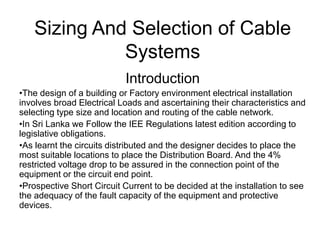
Introduction
•The design of a building or Factory environment electrical installation
involves broad Electrical Loads and ascertaining their characteristics and
selecting type size and location and routing of the cable network.
•In Sri Lanka we Follow the IEE Regulations latest edition according to
legislative obligations.
•As learnt the circuits distributed and the designer decides to place the
most suitable locations to place the Distribution Board. And the 4%
restricted voltage drop to be assured in the connection point of the
equipment or the circuit end point.
•Prospective Short Circuit Current to be decided at the installation to see
the adequacy of the fault capacity of the equipment and protective
devices.
Cost Considerations
• Minimum cross section conductor to be
determined (However this method is not
the cost optimization on a specific period
of operations)
• Switchgear positioning will play a overall
cost optimization.
• Selection of PVC and XLPE also plays a
role in cost optimization.
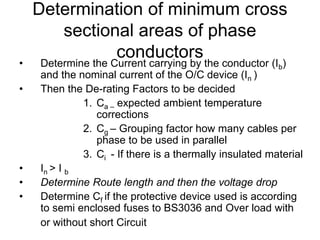
Determination of minimum cross
sectional areas of phase
conductors
• Determine the Current carrying by the conductor (Ib)
and the nominal current of the O/C device (In )
• Then the De-rating Factors to be decided
1. Ca – expected ambient temperature
corrections
2. Cg – Grouping factor how many cables per
phase to be used in parallel
3. Ci - If there is a thermally insulated material
• In > I b
• Determine Route length and then the voltage drop
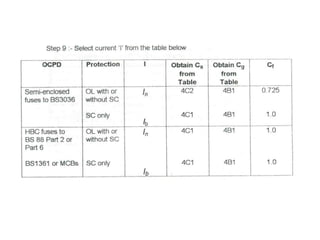
• Determine Cf if the protective device used is according
to semi enclosed fuses to BS3036 and Over load with
or without short Circuit
• Then
• Calculate 1 / Ca Cg Ci Cf
• Then Select the cable I t from the tables
which is greater than 1 / Ca Cg Ci Cf
• Reiterating methods can be used in vise
versa steps on calculation .

Sizing And Selection of Cable Systems.ppt

  • 1.
    Sizing And Selectionof Cable Systems Introduction •The design of a building or Factory environment electrical installation involves broad Electrical Loads and ascertaining their characteristics and selecting type size and location and routing of the cable network. •In Sri Lanka we Follow the IEE Regulations latest edition according to legislative obligations. •As learnt the circuits distributed and the designer decides to place the most suitable locations to place the Distribution Board. And the 4% restricted voltage drop to be assured in the connection point of the equipment or the circuit end point. •Prospective Short Circuit Current to be decided at the installation to see the adequacy of the fault capacity of the equipment and protective devices.
  • 2.
    Cost Considerations • Minimumcross section conductor to be determined (However this method is not the cost optimization on a specific period of operations) • Switchgear positioning will play a overall cost optimization. • Selection of PVC and XLPE also plays a role in cost optimization.
  • 3.
    Determination of minimumcross sectional areas of phase conductors • Determine the Current carrying by the conductor (Ib) and the nominal current of the O/C device (In ) • Then the De-rating Factors to be decided 1. Ca – expected ambient temperature corrections 2. Cg – Grouping factor how many cables per phase to be used in parallel 3. Ci - If there is a thermally insulated material • In > I b • Determine Route length and then the voltage drop • Determine Cf if the protective device used is according to semi enclosed fuses to BS3036 and Over load with or without short Circuit
  • 5.
    • Then • Calculate1 / Ca Cg Ci Cf • Then Select the cable I t from the tables which is greater than 1 / Ca Cg Ci Cf • Reiterating methods can be used in vise versa steps on calculation .