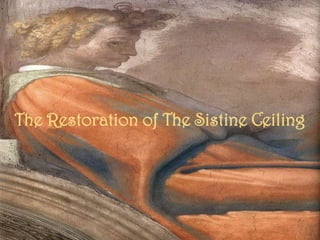
The Restoration of The Sistine Ceiling
History of the Sistine CeilingSistine Chapel built 1477-1480 by Pope Sixtus IVCeiling originally decorated with starry firmament in gold and ultramarinePope Julis II commissions new ceiling decoration from Michelangelo in 1508Work begins July 1508 and finishes October 1512Pope Julius II Ordering Bramante, Michelangelo and Rapahel to Construct the Vatican and St Peter’s, Horace Vernet, 1827, www.1st-art-gallery.com
Buon Fresco: Plaster PreparationProduce lime (CaO) by burning calcium carbonate (CaCO3) with wood in a kilnSlake lime with water to form calcium hydroxide (Ca(OH)2)Mix lime with sand or pozzolana (volcanic ash) to form intonacoSpread intonacoover arricciolayerCa(OH)2 reacts with CO2 and lime reverts to CaCO3From top: CaO (product-image.tradeindia.com), slaked lime (www.shivamchemicals.in), and pozzolana (www.easybonzai.it)
Buon Fresco: Wall PaintingWhile intonacois still wet, cartoon of design is transferred onto the wallPigments mixed with water applied and allowed to dry with plasterPentimenti(corrections) applied a secco(dry)Pigments mixed with animal glue, egg yolk or resin Detail, ‘The Creation of Adam,’ 1510,  http://msopal29.myweb.uga.edu/BeforeandAfter.html
Early DeteriorationUnstable underlying soil1504, South wall bows outGiulianoda Sangallo inserts iron rods into vault and under floorSalt efflorescence and mould outbreak in 1509 (‘The Flood’)Candles, incense burners, braziers, etc used during and immediately after completionGiovio describes lunettes darkening in 1525 and further salt efflorescence in 1546
The Deterioration Continues Nearly 500 years of burning candles and Papal electionsPast conservation / cleaning effortsInner-city pollutants (sulphur, nitrogen, chlorides)Thousands of daily visitorsMicroclimate rises by around 5°CConvective current carries dust to fresco surface‘Daniel,’ 1511, upload.wikimedia.org
Conservation Prior to 19801543, office of mundator(cleaner) created by Vatican1565-71, DomenicoCarnevale plasters and repaints sections1625, SimaneLagi dusts and scrubs with slices of bread1710-12, AnnibaleMazzuoli cleans with Greek wine and sponges	1904, Louis Seitz seals and consolidates plaster1920s-30s BiagioBiagetti undertakes further consolidation1964-74, DeoclecioRedig de Campos cleans frescoes on side walls1975, vault made water proof
The Vatican Restoration: PreparationAround April 1980, Papal Museums, Monuments and Galleries’ Laboratory for the Restoration of Paintings begins study of frescoSurface explored with daylight, quartz lamp, UV, IR and sodium monochromatic lightPlaster samples tested at Vatican’s Scientific Research Laboratory using IR spectrometry, thin-layer chromatography, liquid chromatography and absorption spectrophotometry (pigments)
Conservation Procedure, 1980-1989Wet cleaning with AB57, ammonium bicarbonate, sodium bicarbonate and 10% solution of Desogen suspended in a carboxymethyl cellulose gel. Applied for three minutes, rinsed with distilled water. 24 hours later the process was repeated.Salt efflorescence treated with AB57 to which dimethylformamide was added, then rinsed with distilled waterDetail, ‘Joel,’ 1509, http://msopal29.myweb.uga.edu/BeforeandAfter.html
More Conservation Procedure Consolidation of loose intonacowith Vinnapas (PVA-PVC terpolymer of ethylene) and of a seccopassages with Paraloid B72 3% in organic solventInfilling of gaps and cracks with stucco romano (mixture of lime, marble dust or grit)Inpainting of missing passages with watercolours applied in vertical brushstrokes Detail, ‘The Creation of Adam,’ 1510,  http://msopal29.myweb.uga.edu/BeforeandAfter.html
Controversy Writ LargeThe Vatican Conservators Team The James Beck CornerJames Beck, www.artsjournal.comVatican conservator cleaning ‘Jonah’ (1511), photograph by VittorianoRastelli,  media-2.web.britannica.com
Primary IssuesEurope vs AmericaScience vs Art HistoryMannerist colourvsterribilitáBeck claims glue layer was original, l’ultimamanoFeldman claims chiaroscuro and definition was removedMancinelli and Colalucci claim a seccotouches limited to the lunettesGlue layer added during prior restorationsDetail, ‘Azor and Zadok,’ 1512, lunette, www.students.sbc.edu
‘Ancestors of Christ,’ 1511, upload.wikimedia.org
Detail, ‘Ignudi,’ 1510, http://msopal29.myweb.uga.edu/BeforeandAfter.html
Not at all. Paint the back wall next, will you, old chap?That wasn’t so hard…T H A N K   Y O U

Sistine Ceiling Restoration Seminar

  • 1.
    The Restoration ofThe Sistine Ceiling
  • 2.
    History of theSistine CeilingSistine Chapel built 1477-1480 by Pope Sixtus IVCeiling originally decorated with starry firmament in gold and ultramarinePope Julis II commissions new ceiling decoration from Michelangelo in 1508Work begins July 1508 and finishes October 1512Pope Julius II Ordering Bramante, Michelangelo and Rapahel to Construct the Vatican and St Peter’s, Horace Vernet, 1827, www.1st-art-gallery.com
  • 3.
    Buon Fresco: PlasterPreparationProduce lime (CaO) by burning calcium carbonate (CaCO3) with wood in a kilnSlake lime with water to form calcium hydroxide (Ca(OH)2)Mix lime with sand or pozzolana (volcanic ash) to form intonacoSpread intonacoover arricciolayerCa(OH)2 reacts with CO2 and lime reverts to CaCO3From top: CaO (product-image.tradeindia.com), slaked lime (www.shivamchemicals.in), and pozzolana (www.easybonzai.it)
  • 4.
    Buon Fresco: WallPaintingWhile intonacois still wet, cartoon of design is transferred onto the wallPigments mixed with water applied and allowed to dry with plasterPentimenti(corrections) applied a secco(dry)Pigments mixed with animal glue, egg yolk or resin Detail, ‘The Creation of Adam,’ 1510, http://msopal29.myweb.uga.edu/BeforeandAfter.html
  • 5.
    Early DeteriorationUnstable underlyingsoil1504, South wall bows outGiulianoda Sangallo inserts iron rods into vault and under floorSalt efflorescence and mould outbreak in 1509 (‘The Flood’)Candles, incense burners, braziers, etc used during and immediately after completionGiovio describes lunettes darkening in 1525 and further salt efflorescence in 1546
  • 6.
    The Deterioration ContinuesNearly 500 years of burning candles and Papal electionsPast conservation / cleaning effortsInner-city pollutants (sulphur, nitrogen, chlorides)Thousands of daily visitorsMicroclimate rises by around 5°CConvective current carries dust to fresco surface‘Daniel,’ 1511, upload.wikimedia.org
  • 7.
    Conservation Prior to19801543, office of mundator(cleaner) created by Vatican1565-71, DomenicoCarnevale plasters and repaints sections1625, SimaneLagi dusts and scrubs with slices of bread1710-12, AnnibaleMazzuoli cleans with Greek wine and sponges 1904, Louis Seitz seals and consolidates plaster1920s-30s BiagioBiagetti undertakes further consolidation1964-74, DeoclecioRedig de Campos cleans frescoes on side walls1975, vault made water proof
  • 8.
    The Vatican Restoration:PreparationAround April 1980, Papal Museums, Monuments and Galleries’ Laboratory for the Restoration of Paintings begins study of frescoSurface explored with daylight, quartz lamp, UV, IR and sodium monochromatic lightPlaster samples tested at Vatican’s Scientific Research Laboratory using IR spectrometry, thin-layer chromatography, liquid chromatography and absorption spectrophotometry (pigments)
  • 9.
    Conservation Procedure, 1980-1989Wetcleaning with AB57, ammonium bicarbonate, sodium bicarbonate and 10% solution of Desogen suspended in a carboxymethyl cellulose gel. Applied for three minutes, rinsed with distilled water. 24 hours later the process was repeated.Salt efflorescence treated with AB57 to which dimethylformamide was added, then rinsed with distilled waterDetail, ‘Joel,’ 1509, http://msopal29.myweb.uga.edu/BeforeandAfter.html
  • 10.
    More Conservation ProcedureConsolidation of loose intonacowith Vinnapas (PVA-PVC terpolymer of ethylene) and of a seccopassages with Paraloid B72 3% in organic solventInfilling of gaps and cracks with stucco romano (mixture of lime, marble dust or grit)Inpainting of missing passages with watercolours applied in vertical brushstrokes Detail, ‘The Creation of Adam,’ 1510, http://msopal29.myweb.uga.edu/BeforeandAfter.html
  • 11.
    Controversy Writ LargeTheVatican Conservators Team The James Beck CornerJames Beck, www.artsjournal.comVatican conservator cleaning ‘Jonah’ (1511), photograph by VittorianoRastelli, media-2.web.britannica.com
  • 12.
    Primary IssuesEurope vsAmericaScience vs Art HistoryMannerist colourvsterribilitáBeck claims glue layer was original, l’ultimamanoFeldman claims chiaroscuro and definition was removedMancinelli and Colalucci claim a seccotouches limited to the lunettesGlue layer added during prior restorationsDetail, ‘Azor and Zadok,’ 1512, lunette, www.students.sbc.edu
  • 13.
    ‘Ancestors of Christ,’1511, upload.wikimedia.org
  • 14.
    Detail, ‘Ignudi,’ 1510,http://msopal29.myweb.uga.edu/BeforeandAfter.html
  • 15.
    Not at all.Paint the back wall next, will you, old chap?That wasn’t so hard…T H A N K Y O U

Editor's Notes

  • #6 1. Salt outbreak due to drying difference between pozzolana and travertine limestone (lime). Excess water remained in the intonaco. 2. Mould outbreak possibly due to animal glue (keratin) used to apply a seccopentimenti.
  • #7 1. Subflorescences cause damage to the mortar during repeated cycles of crystallization and hydration of salts as a result of climatic changes. Salts are often already present in the building materials themselves, as is the case with concrete and Portland cement. The porosity of material—such as the brick of the support walls and marble tesserae—encourage capillary action, so that soluble salts are extracted from the material and deposited on the surface. As the temperature fluctuates, the salts migrate towards the warm regions (the surface) while the water retreats toward the cooler regions (within the materials). This guarantees that moisture remains within the material, and the cycle of crystallization—as the salts dry—and hydration—as they take in new moisture—continues until the stress and strain produced push the mortar beyond its yield point or critical damage threshold and it cracks.2. Salts deposited on the surface may also react with other dissolved compounds or atmospheric pollutants such as sulphur dioxide, nitrogen and chlorides to form insoluble deposits or incrustations. 3. White stains usually mean sulphates and CaCO3. Silicates create “irreversible” dark circles.
  • #8 Carnavale repaints sections of ‘The Creation of Adam’ and ‘The Sacrifice of Noah.’ Re-paints Adam’s fampus fingertip. Vatican records are allegedly unclear as to whether cleaning was of ceiling, lunettes or entire fresco cycle.Mazzuolis wine was “resinous.” Pietrangeli claims the “moisture and alcoholic sugar ‘nourish’ the colours.” Also claims they added black to “eyes, mouths, nostrils” and shadowsDuring 64-74 cleaning glue is identified on ceiling fresco.