SIR EDWARD DEMING’S
WORK ON QUALITY
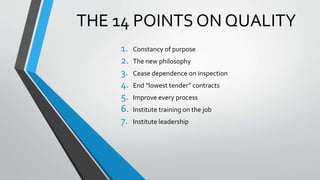
THE 14 POINTS ON QUALITY
1. Constancy of purpose
2. The new philosophy
3. Cease dependence on inspection
4. End “lowest tender” contracts
5. Improve every process
6. Institute training on the job
7. Institute leadership
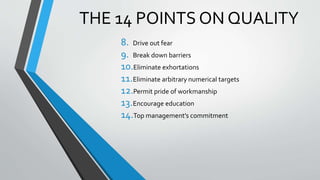
THE 14 POINTS ON QUALITY
8. Drive out fear
9. Break down barriers
10.Eliminate exhortations
11.Eliminate arbitrary numerical targets
12.Permit pride of workmanship
13.Encourage education
14.Top management’s commitment
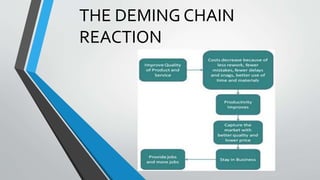
THE DEMING CHAIN
REACTION
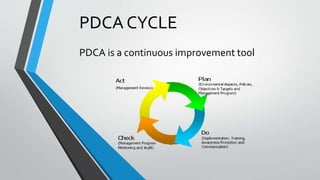
PDCA CYCLE
PDCA is a continuous improvement tool
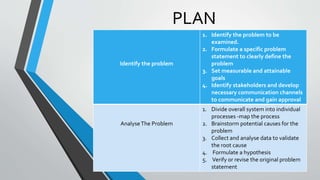
PLAN
Identify the problem
1. Identify the problem to be
examined.
2. Formulate a specific problem
statement to clearly define the
problem
3. Set measurable and attainable
goals
4. Identify stakeholders and develop
necessary communication channels
to communicate and gain approval
AnalyseThe Problem
1. Divide overall system into individual
processes -map the process
2. Brainstorm potential causes for the
problem
3. Collect and analyse data to validate
the root cause
4. Formulate a hypothesis
5. Verify or revise the original problem
statement
TOOLS USED FOR
PLANNING
1. Direct observation of process
2. Process mapping
3. Flowcharting
4. Cause and Effect diagrams
5. Pareto analysis
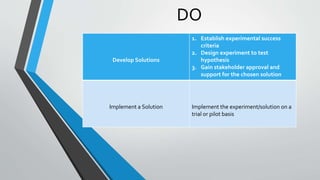
DO
Develop Solutions
1. Establish experimental success
criteria
2. Design experiment to test
hypothesis
3. Gain stakeholder approval and
support for the chosen solution
Implement a Solution Implement the experiment/solution on a
trial or pilot basis
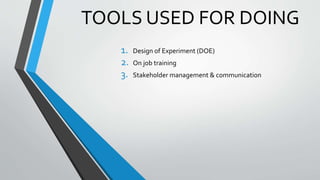
TOOLS USED FOR DOING
1. Design of Experiment (DOE)
2. On job training
3. Stakeholder management & communication
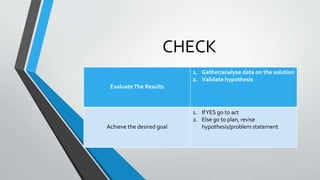
CHECK
EvaluateThe Results
1. Gather/analyse data on the solution
2. Validate hypothesis
Achieve the desired goal
1. IfYES go to act
2. Else go to plan, revise
hypothesis/problem statement
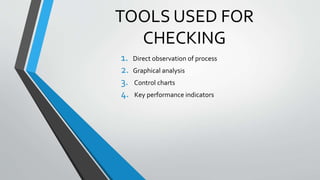
TOOLS USED FOR
CHECKING
1. Direct observation of process
2. Graphical analysis
3. Control charts
4. Key performance indicators
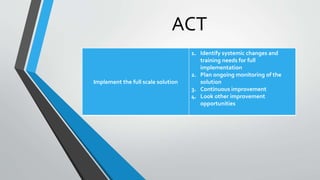
ACT
Implement the full scale solution
1. Identify systemic changes and
training needs for full
implementation
2. Plan ongoing monitoring of the
solution
3. Continuous improvement
4. Look other improvement
opportunities
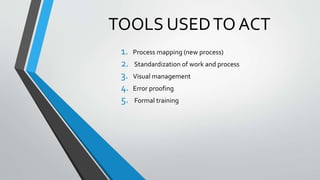
TOOLS USEDTO ACT
1. Process mapping (new process)
2. Standardization of work and process
3. Visual management
4. Error proofing
5. Formal training
THANKYOU

SIR EDWARD DEMING’S WORK ON QUALITY

  • 1.
  • 3.
    THE 14 POINTSON QUALITY 1. Constancy of purpose 2. The new philosophy 3. Cease dependence on inspection 4. End “lowest tender” contracts 5. Improve every process 6. Institute training on the job 7. Institute leadership
  • 4.
    THE 14 POINTSON QUALITY 8. Drive out fear 9. Break down barriers 10.Eliminate exhortations 11.Eliminate arbitrary numerical targets 12.Permit pride of workmanship 13.Encourage education 14.Top management’s commitment
  • 5.
  • 6.
    PDCA CYCLE PDCA isa continuous improvement tool
  • 7.
    PLAN Identify the problem 1.Identify the problem to be examined. 2. Formulate a specific problem statement to clearly define the problem 3. Set measurable and attainable goals 4. Identify stakeholders and develop necessary communication channels to communicate and gain approval AnalyseThe Problem 1. Divide overall system into individual processes -map the process 2. Brainstorm potential causes for the problem 3. Collect and analyse data to validate the root cause 4. Formulate a hypothesis 5. Verify or revise the original problem statement
  • 8.
    TOOLS USED FOR PLANNING 1.Direct observation of process 2. Process mapping 3. Flowcharting 4. Cause and Effect diagrams 5. Pareto analysis
  • 9.
    DO Develop Solutions 1. Establishexperimental success criteria 2. Design experiment to test hypothesis 3. Gain stakeholder approval and support for the chosen solution Implement a Solution Implement the experiment/solution on a trial or pilot basis
  • 10.
    TOOLS USED FORDOING 1. Design of Experiment (DOE) 2. On job training 3. Stakeholder management & communication
  • 11.
    CHECK EvaluateThe Results 1. Gather/analysedata on the solution 2. Validate hypothesis Achieve the desired goal 1. IfYES go to act 2. Else go to plan, revise hypothesis/problem statement
  • 12.
    TOOLS USED FOR CHECKING 1.Direct observation of process 2. Graphical analysis 3. Control charts 4. Key performance indicators
  • 13.
    ACT Implement the fullscale solution 1. Identify systemic changes and training needs for full implementation 2. Plan ongoing monitoring of the solution 3. Continuous improvement 4. Look other improvement opportunities
  • 14.
    TOOLS USEDTO ACT 1.Process mapping (new process) 2. Standardization of work and process 3. Visual management 4. Error proofing 5. Formal training
  • 15.