DEMING PHILOSOPHY
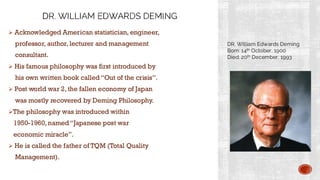
DR. WILLIAM EDWARDS DEMING
➢ Acknowledged American statistician, engineer,
professor, author, lecturer and management
consultant.
➢ His famous philosophy was first introduced by
his own written book called “Out of the crisis”.
➢ Post world war 2, the fallen economy of Japan
was mostly recovered by Deming Philosophy.
➢The philosophy was introduced within
1950-1960, named “Japanese post war
economic miracle”.
➢ He is called the father of TQM (Total Quality
Management).
DR. William Edwards Deming
Born: 14th October, 1900
Died: 20th December, 1993
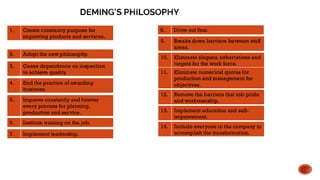
DEMING’S PHILOSOPHY
1. Create constancy purpose for
improving products and services.
2. Adopt the new philosophy.
3. Cease dependence on inspection
to achieve quality.
4. End the practice of awarding
business.
5. Improve constantly and forever
every process for planning,
production and service.
6. Institute training on the job.
7. Implement leadership.
8. Drive out fear.
9. Breaks down barriers between staff
areas.
10. Eliminate slogans, exhortations and
targets for the work force.
11. Eliminate numerical quotas for
production and management for
objectives.
12. Remove the barriers that rob pride
and workmanship.
13. Implement education and self-
improvement.
14. Include everyone in the company to
accomplish the transformation.
CREATE CONSTANCY OF PURPOSE FOR
IMPROVING PRODUCTS AND SERVICES. ❖ Plan for quality in the long
term
❖ Don’t just do the same
things,find better
things to do.
Rule # 1
ADOPT THE NEW PHILOSOPHY.
• Embrace quality
throughout the
organization.
• Create your quality vision
and implement it.
Rule # 2
CEASE DEPENDENCE ON INSPECTION TO
ACHIEVE QUALITY.
o Inspection are costly and
unreliable – and they don’t
improve quality, they merely
find a lack of quality.
Rule # 3
END THE PRACTICE OF AWARDING BUSINESS ON
THE BASIS OF PRICE TAG ALONE.
▪ Look at suppliers as
your partners in quality.
Encourage them to
spend time improving
their own quality – they
shouldn’t compete for
your business based on
price alone.
Rule # 4
IMPROVE CONSTANTLY AND FOREVER EVERY
PROCESS FOR
PLANNING, PRODUCTION AND SERVICE.
✓ To improve quality
and productivity, and
thus constantly
decrease costs.
Rule # 5
INSTITUTE TRAINING ON THE JOB
➢ Build a foundation of
common knowledge.
➢Allow workers to
understand their roles
in the“big plan”.
Rule # 6
IMPLEMENT LEADERSHIP
• Don’t apply
supervise – provide
support and
resources so that
each stuff member
can do his or her
best. Be a coach
instead of a
policeman.
Rule # 7
DRIVE OUT FEAR
o Allow people to perform at their
best by ensuring that they’re not
afraid to express ideas or
concerns.
o Make workers feel valued, and
encourage them to look for better
ways to do things.
Rule # 8
BREAK DOWN BARRIERS BETWEEN STAFF AREAS.
▪ People in research, design, sales
and production must work as a team,
to foresee problems of production
and in use that may be encountered
with the product or service.
Rule # 9
ELIMINATE SLOGANS, EXHORTATIONS AND
TARGETS
FOR THE WORKFORCE
❖ Let people know
exactly what you want
– don’t make them
guess.
❖ Don’t let words and
nice-sounding
phrases replace
effective leadership.
Rule # 10
ELIMINATE NUMERICAL QUOTAS FOR THE
WORKFORCE
AND MANAGEMENT BY OBJECTIVES
❖ Look at how the process
is carried out, not just
numerical targets.
❖ Measure the process
rather than the people
behind the process.
Rule # 11
REMOVE THE BARRIERS THAT ROB THE PRIDE
AND WORKMANSHIP
❖ This means, inter alia,
abolishment of the
annual or merit rating
and of management by
objective.
Rule # 12
IMPLEMENT EDUCATION AND SELF-
IMPROVEMENT
❖ Improve the current
skills of workers.
❖ Encourage people to
learn new skills to
prepare for future
changes and
challenges.
Rule # 13
INCLUDE EVERYONE IN THE COMPANY TO
ACCOMPLISH THE TRANSFORMATION
• The transformation is
everybody's job.
• Improve your overall
organization by having
each person take a step
toward quality.
Rule # 14
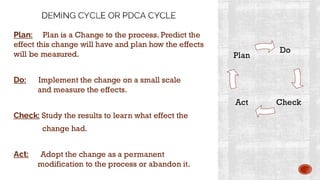
DEMING CYCLE OR PDCA CYCLE
Do
Check
Act
Plan
Plan: Plan is a Change to the process. Predict the
effect this change will have and plan how the effects
will be measured.
Do: Implement the change on a small scale
and measure the effects.
Check: Study the results to learn what effect the
change had.
Act: Adopt the change as a permanent
modification to the process or abandon it.
THE DEMING SYSTEM OF PROFOUND KNOWLEDGE
Deming advocated that all managers need to have this, consisting of four parts
❖Appreciation of a System : Understanding the overall process of goods and
services involving suppliers, producers and
customers.
❖Knowledge of Variation : Range and causes of variation in quality. Use of
statistical sampling in measurements.
❖Theory of Knowledge : Concepts explaining knowledge and the limits of what
can be known.
❖Knowledge of Psychology : Concepts of human nature.
7 DEADLY DISEASES
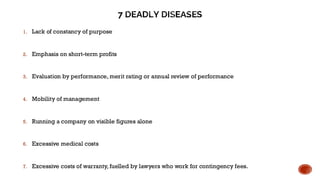
1. Lack of constancy of purpose
2. Emphasis on short-term profits
3. Evaluation by performance, merit rating or annual review of performance
4. Mobility of management
5. Running a company on visible figures alone
6. Excessive medical costs
7. Excessive costs of warranty, fuelled by lawyers who work for contingency fees.
DEMING CHAIN REACTION
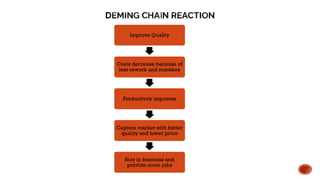
Improve Quality
Costs decrease because of
less rework and mistakes
Productivity improves
Capture market with better
quality and lower price
Stay in business and
provide more jobs
DEMING PHILOSOPHY SYNOPSIS
The whole Philosophy is summarized as follows :
▪ He taught that An organization can increase quality and simultaneously reduce costs by :
✓ Adopting Appropriate principles of management.
✓ Practice continual improvement.
✓ Think of manufacturing as a system not as bits and pieces.
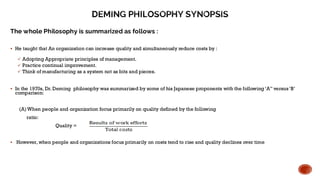
▪ In the 1970s, Dr. Deming philosophy was summarized by some of his Japanese proponents with the following ‘A” versus‘B’
comparison:
(A)When people and organization focus primarily on quality defined by the following
ratio:
Quality =
▪ However, when people and organizations focus primarily on costs tend to rise and quality declines over time

Deming Philosophy definitions and rules.

  • 1.
  • 2.
    DR. WILLIAM EDWARDSDEMING ➢ Acknowledged American statistician, engineer, professor, author, lecturer and management consultant. ➢ His famous philosophy was first introduced by his own written book called “Out of the crisis”. ➢ Post world war 2, the fallen economy of Japan was mostly recovered by Deming Philosophy. ➢The philosophy was introduced within 1950-1960, named “Japanese post war economic miracle”. ➢ He is called the father of TQM (Total Quality Management). DR. William Edwards Deming Born: 14th October, 1900 Died: 20th December, 1993
  • 3.
    DEMING’S PHILOSOPHY 1. Createconstancy purpose for improving products and services. 2. Adopt the new philosophy. 3. Cease dependence on inspection to achieve quality. 4. End the practice of awarding business. 5. Improve constantly and forever every process for planning, production and service. 6. Institute training on the job. 7. Implement leadership. 8. Drive out fear. 9. Breaks down barriers between staff areas. 10. Eliminate slogans, exhortations and targets for the work force. 11. Eliminate numerical quotas for production and management for objectives. 12. Remove the barriers that rob pride and workmanship. 13. Implement education and self- improvement. 14. Include everyone in the company to accomplish the transformation.
  • 4.
    CREATE CONSTANCY OFPURPOSE FOR IMPROVING PRODUCTS AND SERVICES. ❖ Plan for quality in the long term ❖ Don’t just do the same things,find better things to do. Rule # 1
  • 5.
    ADOPT THE NEWPHILOSOPHY. • Embrace quality throughout the organization. • Create your quality vision and implement it. Rule # 2
  • 6.
    CEASE DEPENDENCE ONINSPECTION TO ACHIEVE QUALITY. o Inspection are costly and unreliable – and they don’t improve quality, they merely find a lack of quality. Rule # 3
  • 7.
    END THE PRACTICEOF AWARDING BUSINESS ON THE BASIS OF PRICE TAG ALONE. ▪ Look at suppliers as your partners in quality. Encourage them to spend time improving their own quality – they shouldn’t compete for your business based on price alone. Rule # 4
  • 8.
    IMPROVE CONSTANTLY ANDFOREVER EVERY PROCESS FOR PLANNING, PRODUCTION AND SERVICE. ✓ To improve quality and productivity, and thus constantly decrease costs. Rule # 5
  • 9.
    INSTITUTE TRAINING ONTHE JOB ➢ Build a foundation of common knowledge. ➢Allow workers to understand their roles in the“big plan”. Rule # 6
  • 10.
    IMPLEMENT LEADERSHIP • Don’tapply supervise – provide support and resources so that each stuff member can do his or her best. Be a coach instead of a policeman. Rule # 7
  • 11.
    DRIVE OUT FEAR oAllow people to perform at their best by ensuring that they’re not afraid to express ideas or concerns. o Make workers feel valued, and encourage them to look for better ways to do things. Rule # 8
  • 12.
    BREAK DOWN BARRIERSBETWEEN STAFF AREAS. ▪ People in research, design, sales and production must work as a team, to foresee problems of production and in use that may be encountered with the product or service. Rule # 9
  • 13.
    ELIMINATE SLOGANS, EXHORTATIONSAND TARGETS FOR THE WORKFORCE ❖ Let people know exactly what you want – don’t make them guess. ❖ Don’t let words and nice-sounding phrases replace effective leadership. Rule # 10
  • 14.
    ELIMINATE NUMERICAL QUOTASFOR THE WORKFORCE AND MANAGEMENT BY OBJECTIVES ❖ Look at how the process is carried out, not just numerical targets. ❖ Measure the process rather than the people behind the process. Rule # 11
  • 15.
    REMOVE THE BARRIERSTHAT ROB THE PRIDE AND WORKMANSHIP ❖ This means, inter alia, abolishment of the annual or merit rating and of management by objective. Rule # 12
  • 16.
    IMPLEMENT EDUCATION ANDSELF- IMPROVEMENT ❖ Improve the current skills of workers. ❖ Encourage people to learn new skills to prepare for future changes and challenges. Rule # 13
  • 17.
    INCLUDE EVERYONE INTHE COMPANY TO ACCOMPLISH THE TRANSFORMATION • The transformation is everybody's job. • Improve your overall organization by having each person take a step toward quality. Rule # 14
  • 18.
    DEMING CYCLE ORPDCA CYCLE Do Check Act Plan Plan: Plan is a Change to the process. Predict the effect this change will have and plan how the effects will be measured. Do: Implement the change on a small scale and measure the effects. Check: Study the results to learn what effect the change had. Act: Adopt the change as a permanent modification to the process or abandon it.
  • 19.
    THE DEMING SYSTEMOF PROFOUND KNOWLEDGE Deming advocated that all managers need to have this, consisting of four parts ❖Appreciation of a System : Understanding the overall process of goods and services involving suppliers, producers and customers. ❖Knowledge of Variation : Range and causes of variation in quality. Use of statistical sampling in measurements. ❖Theory of Knowledge : Concepts explaining knowledge and the limits of what can be known. ❖Knowledge of Psychology : Concepts of human nature.
  • 20.
    7 DEADLY DISEASES 1.Lack of constancy of purpose 2. Emphasis on short-term profits 3. Evaluation by performance, merit rating or annual review of performance 4. Mobility of management 5. Running a company on visible figures alone 6. Excessive medical costs 7. Excessive costs of warranty, fuelled by lawyers who work for contingency fees.
  • 21.
    DEMING CHAIN REACTION ImproveQuality Costs decrease because of less rework and mistakes Productivity improves Capture market with better quality and lower price Stay in business and provide more jobs
  • 22.
    DEMING PHILOSOPHY SYNOPSIS Thewhole Philosophy is summarized as follows : ▪ He taught that An organization can increase quality and simultaneously reduce costs by : ✓ Adopting Appropriate principles of management. ✓ Practice continual improvement. ✓ Think of manufacturing as a system not as bits and pieces. ▪ In the 1970s, Dr. Deming philosophy was summarized by some of his Japanese proponents with the following ‘A” versus‘B’ comparison: (A)When people and organization focus primarily on quality defined by the following ratio: Quality = ▪ However, when people and organizations focus primarily on costs tend to rise and quality declines over time