Technical Seminar
Single-packet hybrid IP traceback for IPv4 and IPv6 networks
Nagarjun T N 1BG14CS128
Contents
1. Introduction
2. Problem Statement
3. Literature Survey
4. Algorithm and Implementation
5. Comparative Study
6. Conclusion
“True cybersecurity is preparing for
what's next ,not what was last .”
-Neil Rerup,Cybersecurity Expert
Introduction
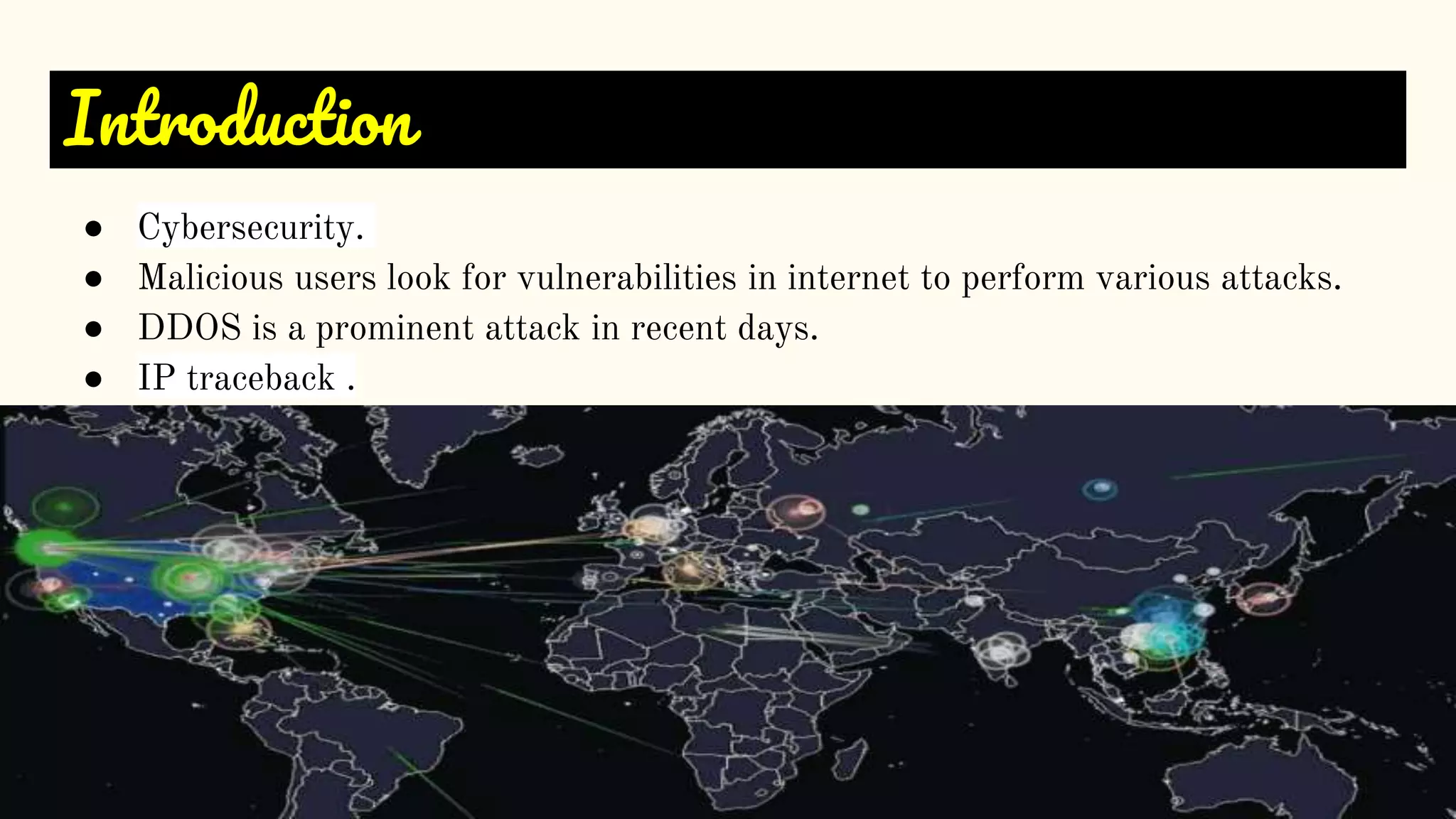
● Cybersecurity.
● Malicious users look for vulnerabilities in internet to perform various attacks.
● DDOS is a prominent attack in recent days.
● IP traceback .
Problem Statement
To develop a single packet hybrid techniques that have
advantages of being storage-efficient and accurate traceback
mechanism to track the source of attacher in both IPv4 and
IPv6 schemes.
Literature Survey
1. An Implementation of IP Traceback in IPv6 Using
Probabilistic Packet Marking
2. IP Traceback based on Packet Logging and Marking
3. Network Support for IP Traceback
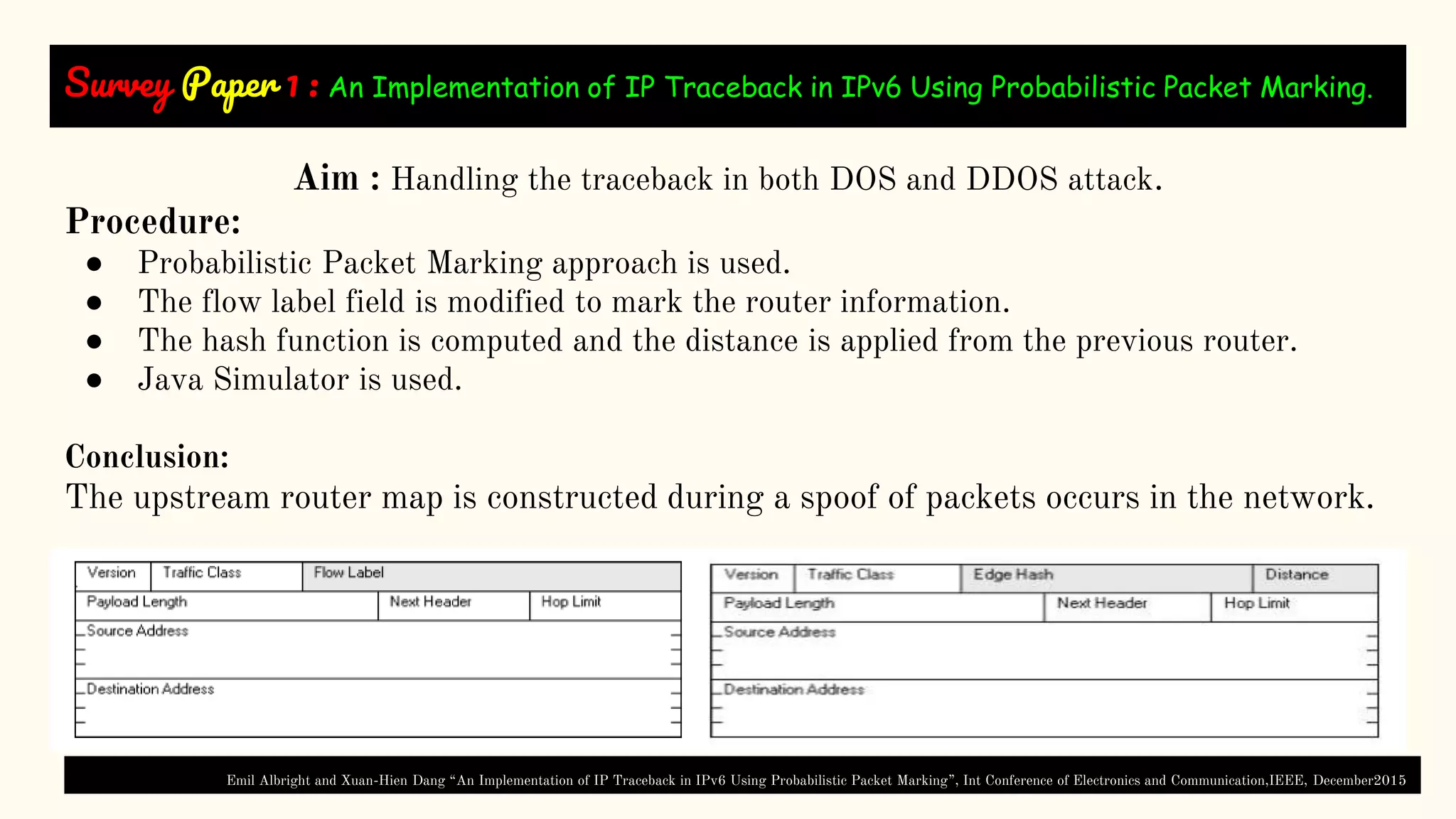
Survey Paper 1 : An Implementation of IP Traceback in IPv6 Using Probabilistic Packet Marking.
Aim : Handling the traceback in both DOS and DDOS attack.
Procedure:
● Probabilistic Packet Marking approach is used.
● The flow label field is modified to mark the router information.
● The hash function is computed and the distance is applied from the previous router.
● Java Simulator is used.
Conclusion:
The upstream router map is constructed during a spoof of packets occurs in the network.
Emil Albright and Xuan-Hien Dang “An Implementation of IP Traceback in IPv6 Using Probabilistic Packet Marking”, Int Conference of Electronics and Communication,IEEE, December2015
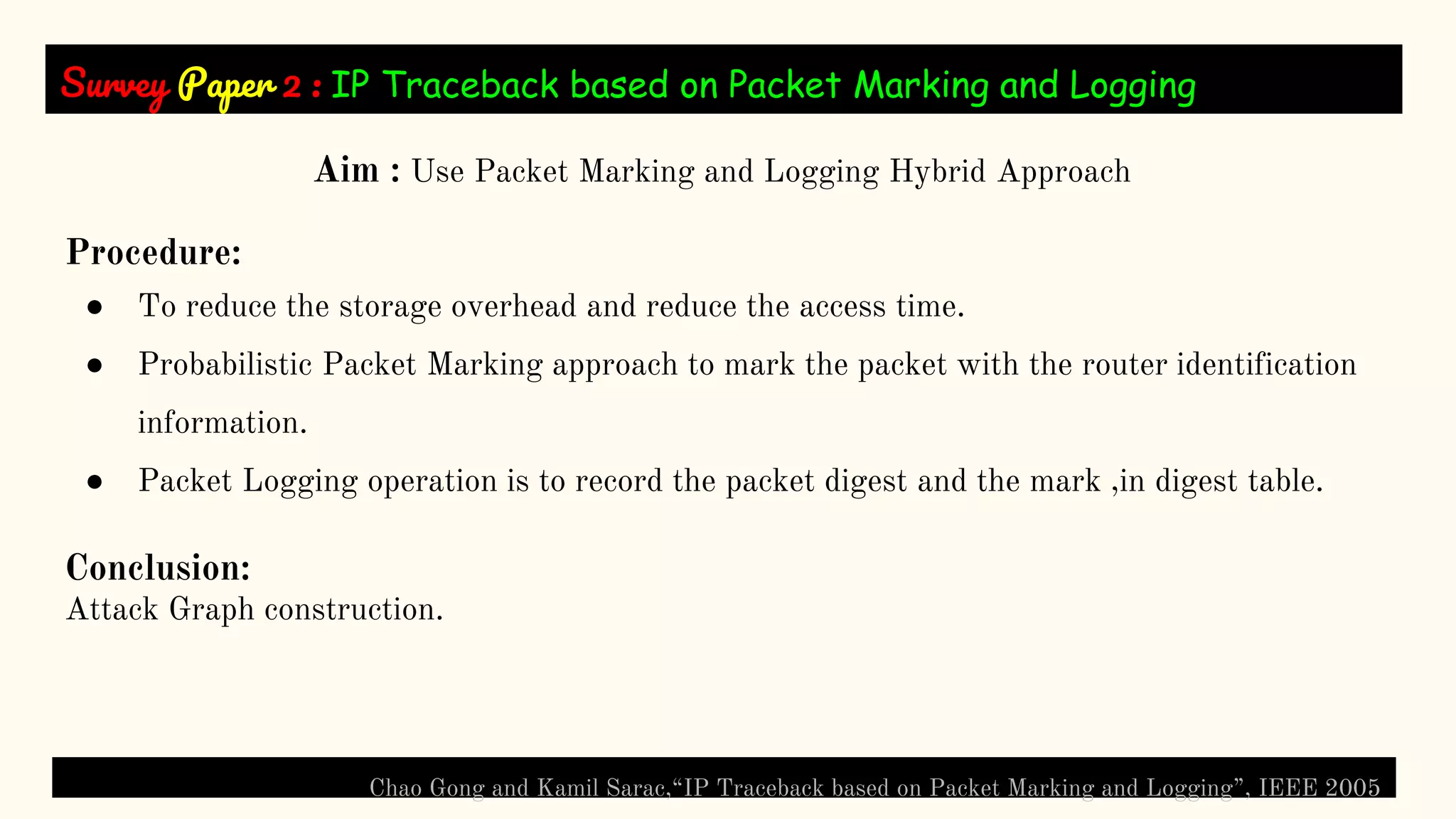
Survey Paper 2 : IP Traceback based on Packet Marking and Logging
Chao Gong and Kamil Sarac,“IP Traceback based on Packet Marking and Logging”, IEEE 2005
Aim : Use Packet Marking and Logging Hybrid Approach
Procedure:
● To reduce the storage overhead and reduce the access time.
● Probabilistic Packet Marking approach to mark the packet with the router identification
information.
● Packet Logging operation is to record the packet digest and the mark ,in digest table.
Conclusion:
Attack Graph construction.
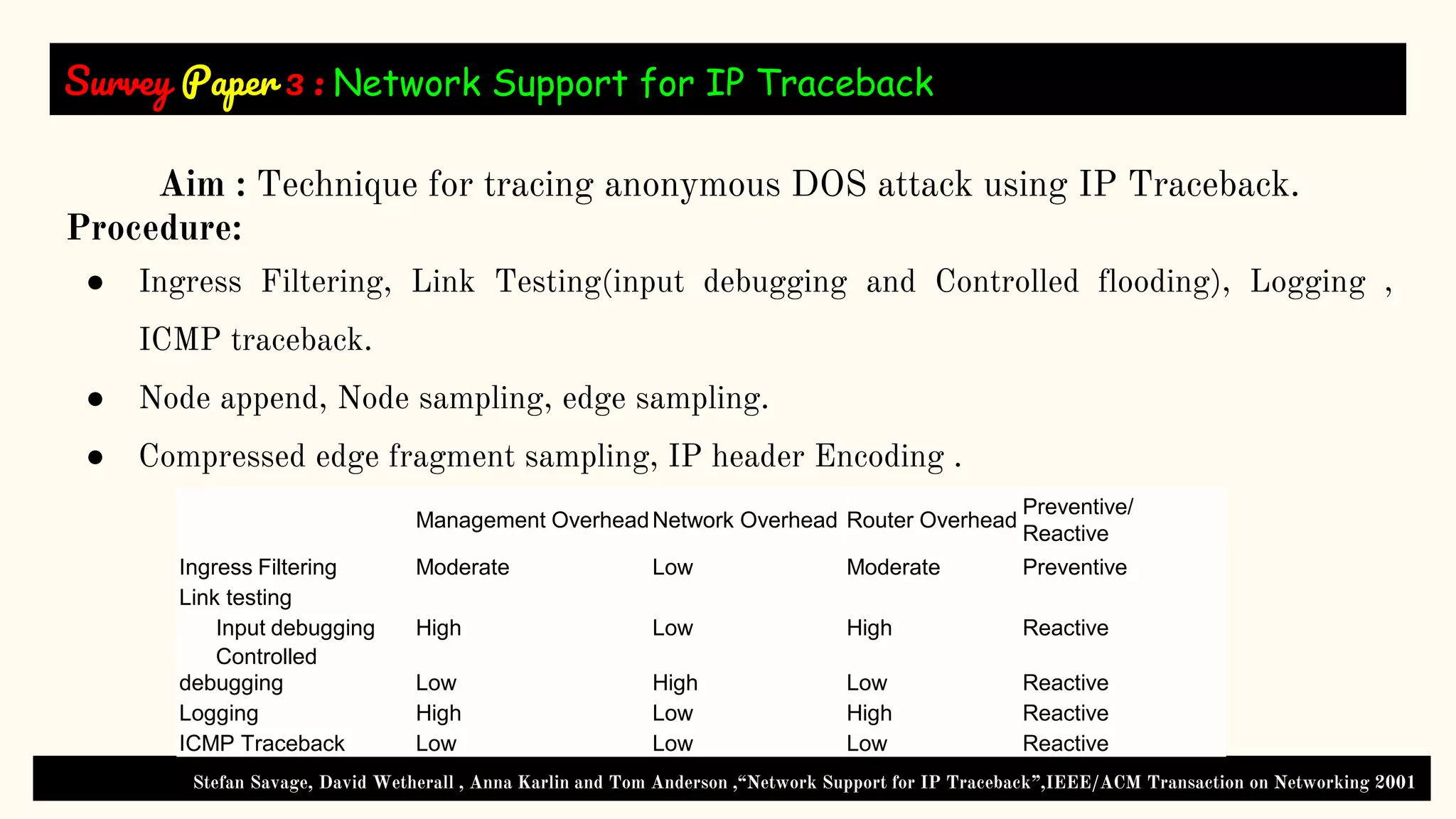
Survey Paper 3 : Network Support for IP Traceback
Stefan Savage, David Wetherall , Anna Karlin and Tom Anderson ,“Network Support for IP Traceback”,IEEE/ACM Transaction on Networking 2001
Aim : Technique for tracing anonymous DOS attack using IP Traceback.
Procedure:
● Ingress Filtering, Link Testing(input debugging and Controlled flooding), Logging ,
ICMP traceback.
● Node append, Node sampling, edge sampling.
● Compressed edge fragment sampling, IP header Encoding .
Management OverheadNetwork Overhead Router Overhead
Preventive/
Reactive
Ingress Filtering Moderate Low Moderate Preventive
Link testing
Input debugging High Low High Reactive
Controlled
debugging Low High Low Reactive
Logging High Low High Reactive
ICMP Traceback Low Low Low Reactive
ALGORITHMS
1. Marking and Logging Scheme
1. Path Reconstruction
MARK_AND_LOG (Pi , UIK)
1. Begin
2. marknew <- Pi.mark X (D(Rk)+1)+UIk+1
3. first <-Pi.mark % m;
4. if marknew > 65535
5. l<- Pi.mark % m;
6. Skip<-1+(Pi.mark % (m-1));
7. Probe<-0;
8. While (HT[l] != null OR HT[l]!=Pi.mark AND Probe<m)
9. Increment probe by 1;
10. L<-(first +probe*skip)%m;
11. End while
12. If HT[l]= null then
13. HT[l]<-Pi.mark;
14. Endif
15. marknew<-l*(D(RK)+1)
16. Endif
17. Pi.mark<-marknew ;
18. Forward packet to next router with packet marked as Pi.mark
19. End
PATH_RECONSTRUCT (marknew)
1. Begin
2. UIk <- markreq%(D(Rk)+1)-1
3. If UIk = -1 then
4. L<- markreq/ (D(Rk)+1)
5. If l!=0 then
6. Set markold to HT[l].mark and UIk to HT[l].UIk
7. CALL PATH_RECONSTRUCT (markold) on adjacent router linked via UIk
8. Else
9. The current router is attacker’s source
router
10. Endif
11. Else
12. Markold<- markreq/(D(Rk)+1)
13. CALL PATH_RECONSTRUCT(markold) on adjacent router linked via UIk
14. Endif
15. end
Comparative Study
IPv4 Implementation
IPv6 Implementation
IPv4 Analysis
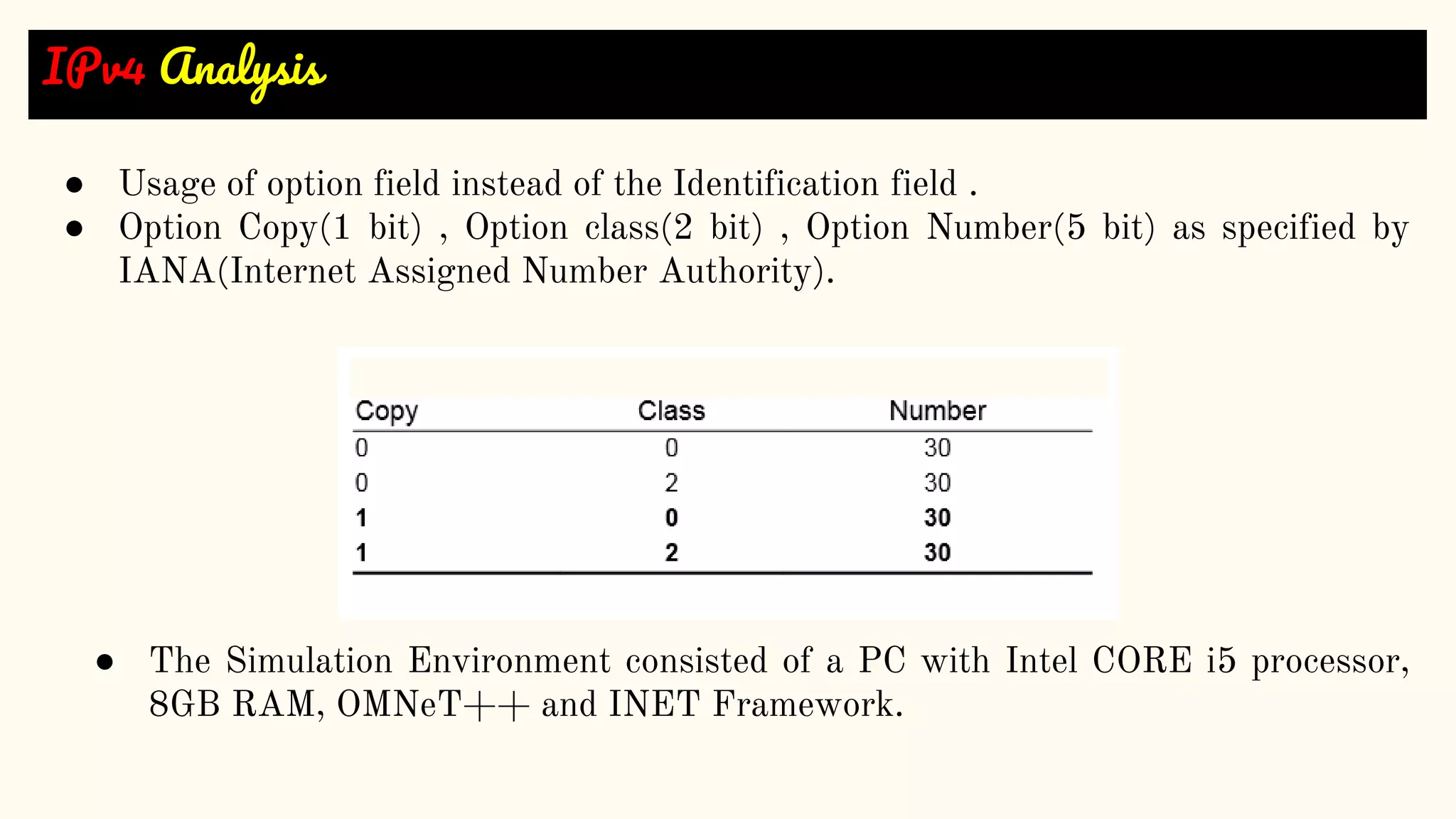
● Usage of option field instead of the Identification field .
● Option Copy(1 bit) , Option class(2 bit) , Option Number(5 bit) as specified by
IANA(Internet Assigned Number Authority).
● The Simulation Environment consisted of a PC with Intel CORE i5 processor,
8GB RAM, OMNeT++ and INET Framework.
Analysis of Average Logging Time
● Logging time .
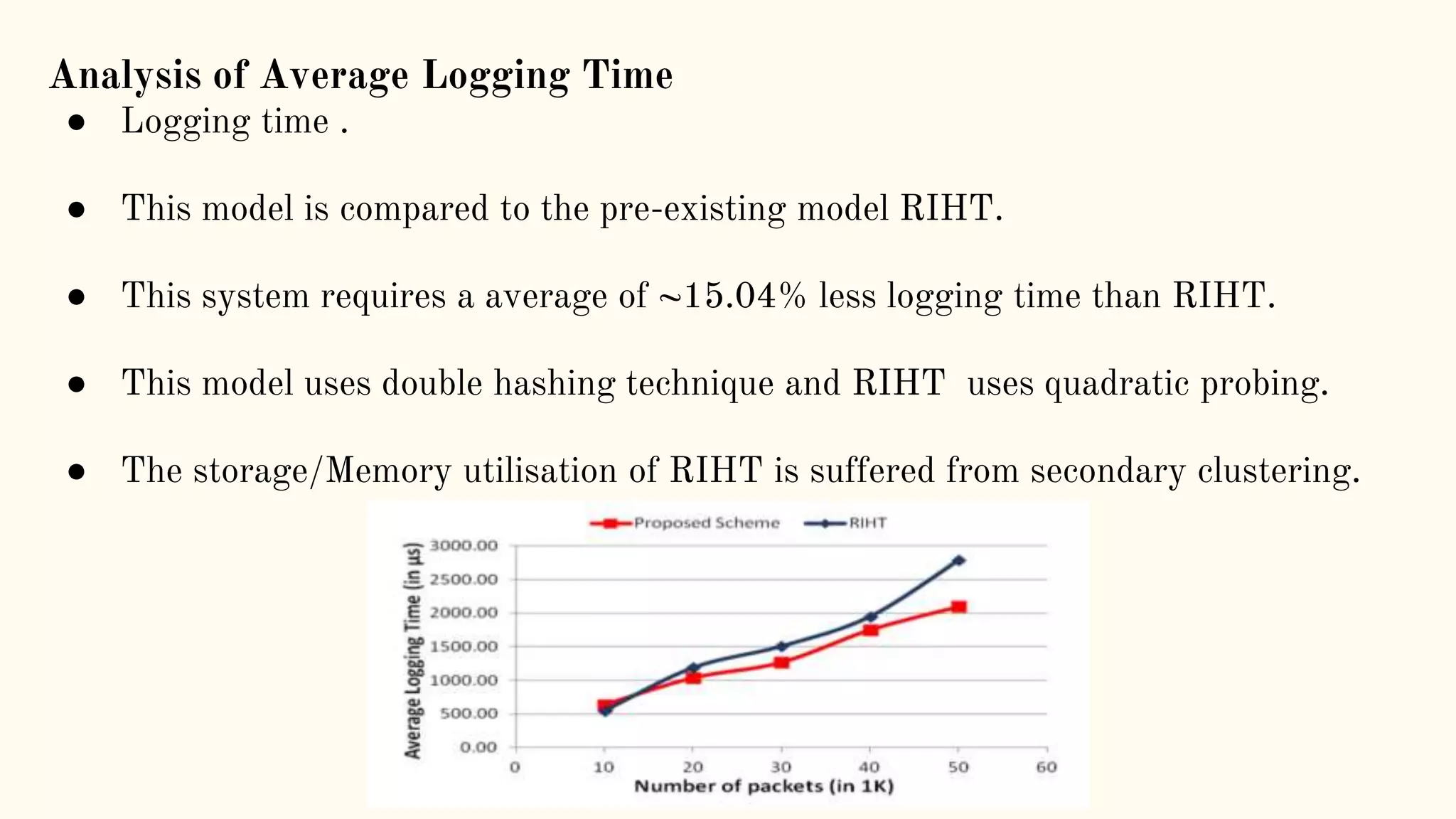
● This model is compared to the pre-existing model RIHT.
● This system requires a average of ~15.04% less logging time than RIHT.
● This model uses double hashing technique and RIHT uses quadratic probing.
● The storage/Memory utilisation of RIHT is suffered from secondary clustering.
Accuracy Analysis
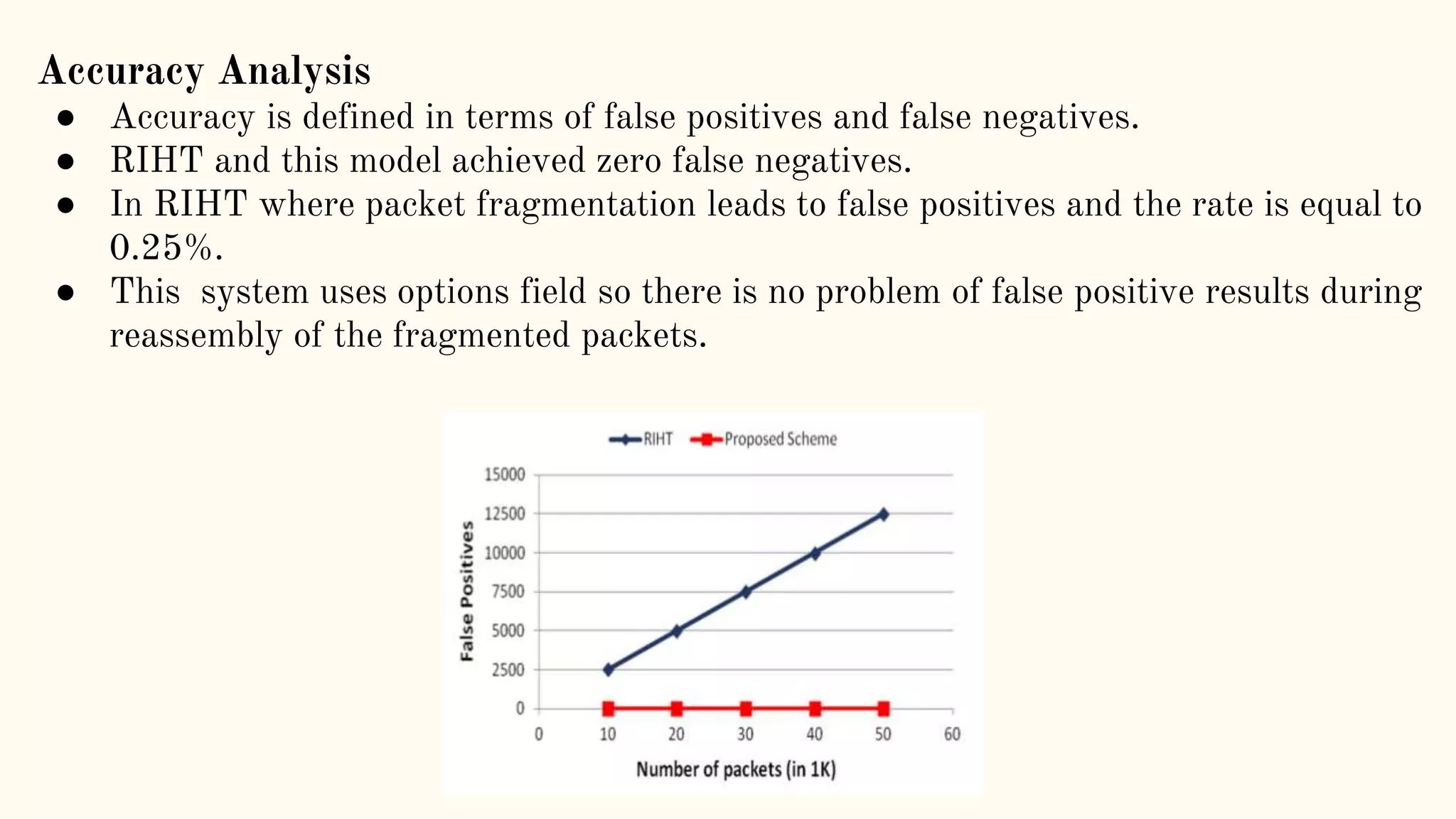
● Accuracy is defined in terms of false positives and false negatives.
● RIHT and this model achieved zero false negatives.
● In RIHT where packet fragmentation leads to false positives and the rate is equal to
0.25%.
● This system uses options field so there is no problem of false positive results during
reassembly of the fragmented packets.
IPv6 Analysis
● This model uses hop-by-hop extension header for marking.
● The model was simulated in the IPv6 environment in OMNeT++ and INET
Framework.
● The existing model that are compared are PPM-IPv6 and PHIT-IPv6.
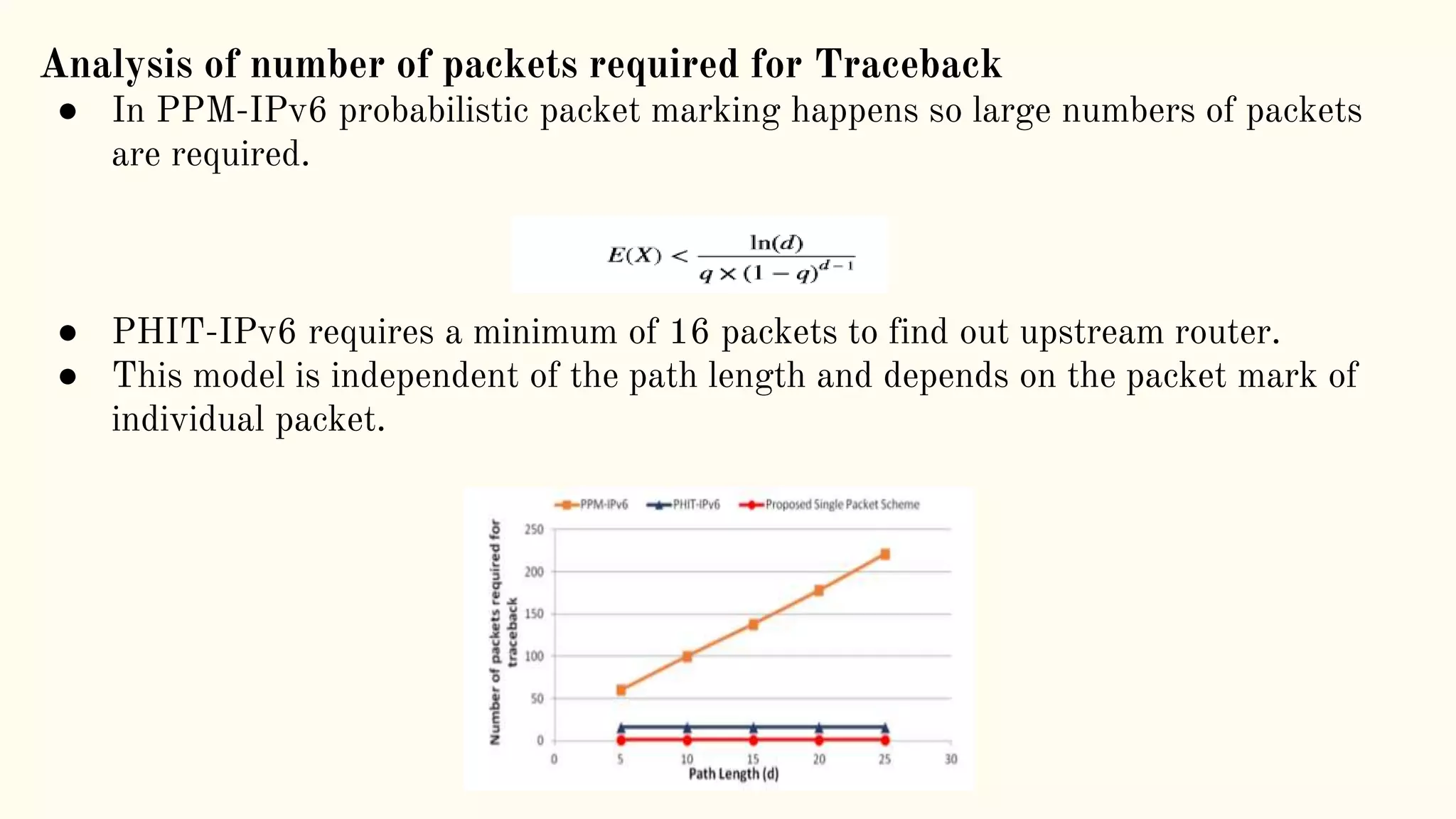
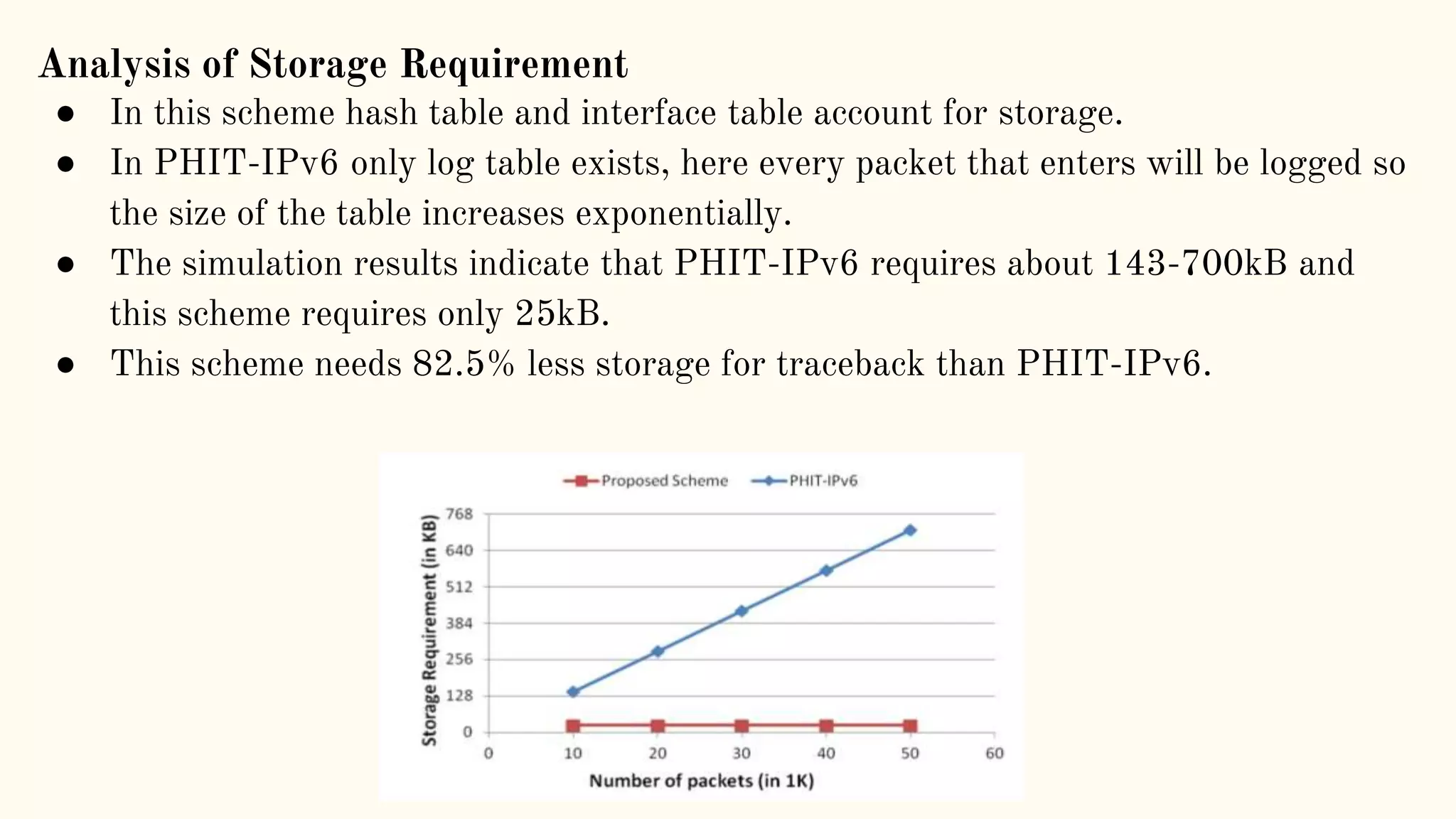
Analysis of number of packets required for Traceback
● In PPM-IPv6 probabilistic packet marking happens so large numbers of packets
are required.
● PHIT-IPv6 requires a minimum of 16 packets to find out upstream router.
● This model is independent of the path length and depends on the packet mark of
individual packet.
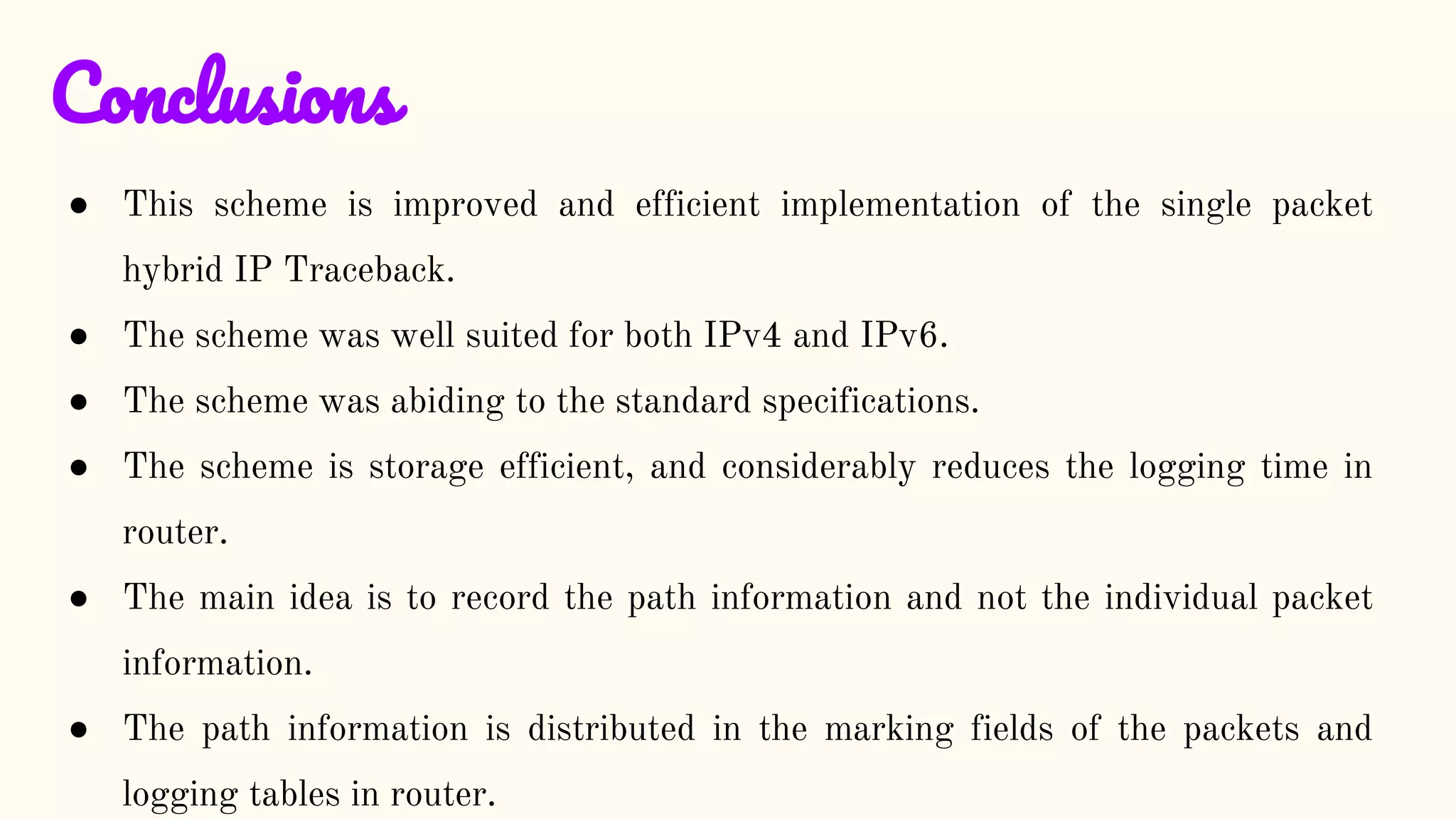
Analysis of Storage Requirement
● In this scheme hash table and interface table account for storage.
● In PHIT-IPv6 only log table exists, here every packet that enters will be logged so
the size of the table increases exponentially.
● The simulation results indicate that PHIT-IPv6 requires about 143-700kB and
this scheme requires only 25kB.
● This scheme needs 82.5% less storage for traceback than PHIT-IPv6.
Conclusions
● This scheme is improved and efficient implementation of the single packet
hybrid IP Traceback.
● The scheme was well suited for both IPv4 and IPv6.
● The scheme was abiding to the standard specifications.
● The scheme is storage efficient, and considerably reduces the logging time in
router.
● The main idea is to record the path information and not the individual packet
information.
● The path information is distributed in the marking fields of the packets and
logging tables in router.
References
1. Stefan savage,David Wetherall, Anna KArlin and Tom Anderson,
“Network Support for IP Traceback”, IEEE/ACM Transaction on
Networking,2001
2. Emil Albright and Xuan-Hien Dang, “An Implementation of IP Traceback
in IPv6 using probabilistic Packet Marking”, Int Conference of Electronics
and Communication,IEEE ,2015.
3. Chao Gong and Kamil Sarac, “IP Traceback based on Packet Marking and
Logging”, IEEE,2005.
4. Kamaldeep,Manisha Malik and Maitreyee Dutta, “Implementation of single
packet hybrid IP traceback for IPv4 and IPv6 networks”, IET Journals,
2017.
5. C. Vaiyapuri and R.Mohandas, “IP Traceback scheme using Packet
Logging and Packet Marking using RIHT”, IJCSMC, 2013.
Thank you!

Single-packet hybrid IP traceback for IPv4 and IPv6 networks.

  • 1.
    Technical Seminar Single-packet hybridIP traceback for IPv4 and IPv6 networks Nagarjun T N 1BG14CS128
  • 2.
    Contents 1. Introduction 2. ProblemStatement 3. Literature Survey 4. Algorithm and Implementation 5. Comparative Study 6. Conclusion
  • 3.
    “True cybersecurity ispreparing for what's next ,not what was last .” -Neil Rerup,Cybersecurity Expert
  • 4.
    Introduction ● Cybersecurity. ● Malicioususers look for vulnerabilities in internet to perform various attacks. ● DDOS is a prominent attack in recent days. ● IP traceback .
  • 5.
    Problem Statement To developa single packet hybrid techniques that have advantages of being storage-efficient and accurate traceback mechanism to track the source of attacher in both IPv4 and IPv6 schemes.
  • 6.
    Literature Survey 1. AnImplementation of IP Traceback in IPv6 Using Probabilistic Packet Marking 2. IP Traceback based on Packet Logging and Marking 3. Network Support for IP Traceback
  • 7.
    Survey Paper 1: An Implementation of IP Traceback in IPv6 Using Probabilistic Packet Marking. Aim : Handling the traceback in both DOS and DDOS attack. Procedure: ● Probabilistic Packet Marking approach is used. ● The flow label field is modified to mark the router information. ● The hash function is computed and the distance is applied from the previous router. ● Java Simulator is used. Conclusion: The upstream router map is constructed during a spoof of packets occurs in the network. Emil Albright and Xuan-Hien Dang “An Implementation of IP Traceback in IPv6 Using Probabilistic Packet Marking”, Int Conference of Electronics and Communication,IEEE, December2015
  • 8.
    Survey Paper 2: IP Traceback based on Packet Marking and Logging Chao Gong and Kamil Sarac,“IP Traceback based on Packet Marking and Logging”, IEEE 2005 Aim : Use Packet Marking and Logging Hybrid Approach Procedure: ● To reduce the storage overhead and reduce the access time. ● Probabilistic Packet Marking approach to mark the packet with the router identification information. ● Packet Logging operation is to record the packet digest and the mark ,in digest table. Conclusion: Attack Graph construction.
  • 9.
    Survey Paper 3: Network Support for IP Traceback Stefan Savage, David Wetherall , Anna Karlin and Tom Anderson ,“Network Support for IP Traceback”,IEEE/ACM Transaction on Networking 2001 Aim : Technique for tracing anonymous DOS attack using IP Traceback. Procedure: ● Ingress Filtering, Link Testing(input debugging and Controlled flooding), Logging , ICMP traceback. ● Node append, Node sampling, edge sampling. ● Compressed edge fragment sampling, IP header Encoding . Management OverheadNetwork Overhead Router Overhead Preventive/ Reactive Ingress Filtering Moderate Low Moderate Preventive Link testing Input debugging High Low High Reactive Controlled debugging Low High Low Reactive Logging High Low High Reactive ICMP Traceback Low Low Low Reactive
  • 10.
    ALGORITHMS 1. Marking andLogging Scheme 1. Path Reconstruction
  • 11.
    MARK_AND_LOG (Pi ,UIK) 1. Begin 2. marknew <- Pi.mark X (D(Rk)+1)+UIk+1 3. first <-Pi.mark % m; 4. if marknew > 65535 5. l<- Pi.mark % m; 6. Skip<-1+(Pi.mark % (m-1)); 7. Probe<-0; 8. While (HT[l] != null OR HT[l]!=Pi.mark AND Probe<m) 9. Increment probe by 1; 10. L<-(first +probe*skip)%m; 11. End while 12. If HT[l]= null then 13. HT[l]<-Pi.mark; 14. Endif 15. marknew<-l*(D(RK)+1) 16. Endif 17. Pi.mark<-marknew ; 18. Forward packet to next router with packet marked as Pi.mark 19. End PATH_RECONSTRUCT (marknew) 1. Begin 2. UIk <- markreq%(D(Rk)+1)-1 3. If UIk = -1 then 4. L<- markreq/ (D(Rk)+1) 5. If l!=0 then 6. Set markold to HT[l].mark and UIk to HT[l].UIk 7. CALL PATH_RECONSTRUCT (markold) on adjacent router linked via UIk 8. Else 9. The current router is attacker’s source router 10. Endif 11. Else 12. Markold<- markreq/(D(Rk)+1) 13. CALL PATH_RECONSTRUCT(markold) on adjacent router linked via UIk 14. Endif 15. end
  • 12.
  • 13.
    IPv4 Analysis ● Usageof option field instead of the Identification field . ● Option Copy(1 bit) , Option class(2 bit) , Option Number(5 bit) as specified by IANA(Internet Assigned Number Authority). ● The Simulation Environment consisted of a PC with Intel CORE i5 processor, 8GB RAM, OMNeT++ and INET Framework.
  • 14.
    Analysis of AverageLogging Time ● Logging time . ● This model is compared to the pre-existing model RIHT. ● This system requires a average of ~15.04% less logging time than RIHT. ● This model uses double hashing technique and RIHT uses quadratic probing. ● The storage/Memory utilisation of RIHT is suffered from secondary clustering.
  • 15.
    Accuracy Analysis ● Accuracyis defined in terms of false positives and false negatives. ● RIHT and this model achieved zero false negatives. ● In RIHT where packet fragmentation leads to false positives and the rate is equal to 0.25%. ● This system uses options field so there is no problem of false positive results during reassembly of the fragmented packets.
  • 16.
    IPv6 Analysis ● Thismodel uses hop-by-hop extension header for marking. ● The model was simulated in the IPv6 environment in OMNeT++ and INET Framework. ● The existing model that are compared are PPM-IPv6 and PHIT-IPv6.
  • 17.
    Analysis of numberof packets required for Traceback ● In PPM-IPv6 probabilistic packet marking happens so large numbers of packets are required. ● PHIT-IPv6 requires a minimum of 16 packets to find out upstream router. ● This model is independent of the path length and depends on the packet mark of individual packet.
  • 18.
    Analysis of StorageRequirement ● In this scheme hash table and interface table account for storage. ● In PHIT-IPv6 only log table exists, here every packet that enters will be logged so the size of the table increases exponentially. ● The simulation results indicate that PHIT-IPv6 requires about 143-700kB and this scheme requires only 25kB. ● This scheme needs 82.5% less storage for traceback than PHIT-IPv6.
  • 19.
    Conclusions ● This schemeis improved and efficient implementation of the single packet hybrid IP Traceback. ● The scheme was well suited for both IPv4 and IPv6. ● The scheme was abiding to the standard specifications. ● The scheme is storage efficient, and considerably reduces the logging time in router. ● The main idea is to record the path information and not the individual packet information. ● The path information is distributed in the marking fields of the packets and logging tables in router.
  • 20.
    References 1. Stefan savage,DavidWetherall, Anna KArlin and Tom Anderson, “Network Support for IP Traceback”, IEEE/ACM Transaction on Networking,2001 2. Emil Albright and Xuan-Hien Dang, “An Implementation of IP Traceback in IPv6 using probabilistic Packet Marking”, Int Conference of Electronics and Communication,IEEE ,2015. 3. Chao Gong and Kamil Sarac, “IP Traceback based on Packet Marking and Logging”, IEEE,2005. 4. Kamaldeep,Manisha Malik and Maitreyee Dutta, “Implementation of single packet hybrid IP traceback for IPv4 and IPv6 networks”, IET Journals, 2017. 5. C. Vaiyapuri and R.Mohandas, “IP Traceback scheme using Packet Logging and Packet Marking using RIHT”, IJCSMC, 2013.
  • 21.