SIMULATION
       Presented by
      Sunaina Dubey
       Mba 3rd sem
 Definition
 Steps in simulation
 Singnificance of simulation
 Techniques of simulation
 Example –problem of Monte carlo
  simulation and its solution
“Simulation is the process of designing a
  model of a real system and conducting
  experiments with the model for the
  purpose of understanding the behaviour
  for the operation of the system”
In general terms simulation involves
   developing a model of some real
   phenomenon and then performing an
   experiment on the model evolved.It is a
   descriptive and not optimisting
   techniques.
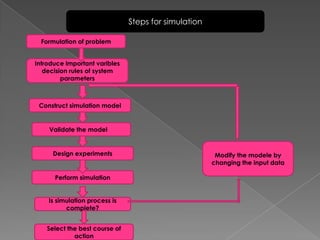
Steps for simulation

  Formulation of problem


Introduce important varibles
   decision rules of system
         parameters


 Construct simulation model


    Validate the model


      Design experiments                                Modify the modele by
                                                       changing the input data

      Perform simulation


    Is simulation process is
          complete?


    Select the best course of
             action
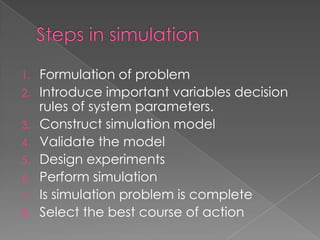
1. Formulation of problem
2. Introduce important variables decision
   rules of system parameters.
3. Construct simulation model
4. Validate the model
5. Design experiments
6. Perform simulation
7. Is simulation problem is complete
8. Select the best course of action
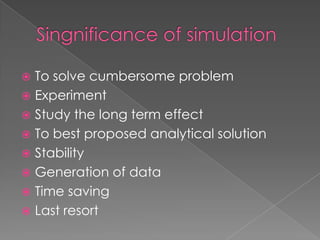
 To solve cumbersome problem
 Experiment
 Study the long term effect
 To best proposed analytical solution
 Stability
 Generation of data
 Time saving
 Last resort
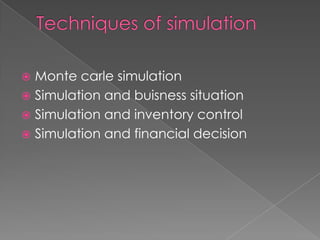
 Monte carle simulation
 Simulation and buisness situation
 Simulation and inventory control
 Simulation and financial decision
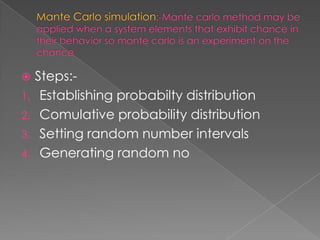
 Steps:-
1. Establishing probabilty distribution
2. Comulative probability distribution
3. Setting random number intervals
4. Generating random no
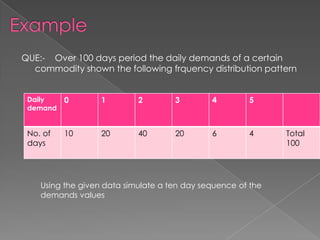
QUE:- Over 100 days period the daily demands of a certain
  commodity shown the following frquency distribution pattern


 Daily    0        1        2        3        4        5
 demand


 No. of   10       20       40       20       6        4      Total
 days                                                         100


    Using the given data simulate a ten day sequence of the
    demands values
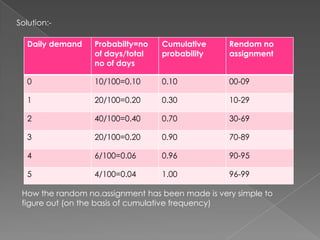
Solution:-

   Daily demand   Probabilty=no   Cumulative      Rendom no
                  of days/total   probability     assignment
                  no of days

   0              10/100=0.10     0.10            00-09

   1              20/100=0.20     0.30            10-29

   2              40/100=0.40     0.70            30-69

   3              20/100=0.20     0.90            70-89

   4              6/100=0.06      0.96            90-95

   5              4/100=0.04      1.00            96-99

 How the random no.assignment has been made is very simple to
 figure out (on the basis of cumulative frequency)
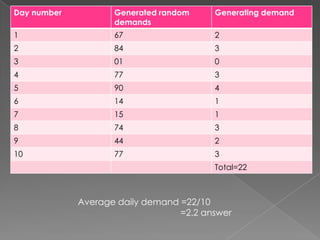
Day number          Generated random     Generating demand
                    demands
1                   67                   2
2                   84                   3
3                   01                   0
4                   77                   3
5                   90                   4
6                   14                   1
7                   15                   1
8                   74                   3
9                   44                   2
10                  77                   3
                                         Total=22


             Average daily demand =22/10
                                  =2.2 answer
THANK YOU

Simulation by Sunaina Dubey

  • 1.
    SIMULATION Presented by Sunaina Dubey Mba 3rd sem
  • 2.
     Definition  Stepsin simulation  Singnificance of simulation  Techniques of simulation  Example –problem of Monte carlo simulation and its solution
  • 3.
    “Simulation is theprocess of designing a model of a real system and conducting experiments with the model for the purpose of understanding the behaviour for the operation of the system”
  • 4.
    In general termssimulation involves developing a model of some real phenomenon and then performing an experiment on the model evolved.It is a descriptive and not optimisting techniques.
  • 5.
    Steps for simulation Formulation of problem Introduce important varibles decision rules of system parameters Construct simulation model Validate the model Design experiments Modify the modele by changing the input data Perform simulation Is simulation process is complete? Select the best course of action
  • 6.
    1. Formulation ofproblem 2. Introduce important variables decision rules of system parameters. 3. Construct simulation model 4. Validate the model 5. Design experiments 6. Perform simulation 7. Is simulation problem is complete 8. Select the best course of action
  • 7.
     To solvecumbersome problem  Experiment  Study the long term effect  To best proposed analytical solution  Stability  Generation of data  Time saving  Last resort
  • 8.
     Monte carlesimulation  Simulation and buisness situation  Simulation and inventory control  Simulation and financial decision
  • 9.
     Steps:- 1. Establishingprobabilty distribution 2. Comulative probability distribution 3. Setting random number intervals 4. Generating random no
  • 10.
    QUE:- Over 100days period the daily demands of a certain commodity shown the following frquency distribution pattern Daily 0 1 2 3 4 5 demand No. of 10 20 40 20 6 4 Total days 100 Using the given data simulate a ten day sequence of the demands values
  • 11.
    Solution:- Daily demand Probabilty=no Cumulative Rendom no of days/total probability assignment no of days 0 10/100=0.10 0.10 00-09 1 20/100=0.20 0.30 10-29 2 40/100=0.40 0.70 30-69 3 20/100=0.20 0.90 70-89 4 6/100=0.06 0.96 90-95 5 4/100=0.04 1.00 96-99 How the random no.assignment has been made is very simple to figure out (on the basis of cumulative frequency)
  • 12.
    Day number Generated random Generating demand demands 1 67 2 2 84 3 3 01 0 4 77 3 5 90 4 6 14 1 7 15 1 8 74 3 9 44 2 10 77 3 Total=22 Average daily demand =22/10 =2.2 answer
  • 13.