Simulation Applications in Logistics & Transportation systems
Contents 1.  Introduction to Logistics & Transportation Systems 2.  Classification of Logistics & Transportation Simulation models  3.  Inputs / Outputs of the Simulation Model
Introduction Definition : Logistics & Transport (L&T) can be defined as  a network composed of one or more terminals / hubs connected by a set of traffic lanes  Major elements of L&T system : Direct Resources : Resources used in physical transportation of freight (goods) from one geographical location to another e.g.: Trucks, Aircrafts, Cargo Ships, Drivers, Pilots etc. Indirect Resources : Resources used  in sorting, storing, handling, retrieving and consolidating at the various transit locations  e.g.: Forklifts, Docks, Carts, Storage-bins and Racks inside warehouse etc.
Direct (moving) and Indirect resources must operate together in the most efficient manner for smooth and balanced operation of L&T network. Which would reduce  amount of delays  at hubs /  Maximum availability & utilization  of resources /  On time pick-up and delivery  of physical goods Right Part  at the  Right Place  at the  Right Time
Classification of Logistics & Transportation Simulation models
Simulation models in L&T are built for the following purposes: Models for strategic planning Models for tactical planning Models for network/traffic control: Offline control Models for scheduling and dispatching: Off-line scheduling Exception handling Real-time monitoring Classification of simulation models
L&T Problems appropriate for simulation studies are divided into three major categories: New design Evaluation of alternative designs  Refinement and redesign of existing operations Problems in new design domain are solved generally by optimization / heuristic approaches. Simulation models are often used for validating purposes on case to case basis but not mandatory  Classification of simulation models
A. New Design Network design : validation of Hub/Spoke design and  Direct move Terminal / Hub planning  :Identifying  No. of terminals, Location, Size (dock dimensions, number of doors) Fleet Planning Route Planning Least- cost transportation modes Simulation works through an iterative approach and does not generate alternatives as such
B. Evaluation of alternative designs Transportation mode alternatives:  On-the-road (trucks) – Relay / Sleeper Rail (trains) : Single / Double stacked  Air : Planes / Helicopters Ocean : Ship / Barges  Inter-modal alternatives: Combine sleeper with rail Combine relay with sleeper Combine rail with relay Combine trucks with air Combines trucks/air with ocean
Service performance alternatives: Overnight service Two – day service Premium service B. Evaluation of alternative designs
C. Refinement and redesign of existing operations Operational performance analysis On-the-road movements Line-haul, regional and group operations Terminal operations Operating rules Hooking, unhooking, hostling and fueling Trailer loading and trailer off-loading Dock operations Dispatching
Rail movements: Loading strategies at the rail yard Train timetables Capacity requirements Air transportation: Origin terminal operations End - of- line operations Central / distributed hub operations C. Refinement and redesign of existing operations
2. Inputs / Outputs of the Simulation Model
Simulation of warehousing and distribution systems Simulation of trucking operations Simulation of truck docks Simulation of ramp operations in air-cargo hubs Case Studies  Factors to be considered in each of the case studies: Purpose of building the model Entities, resources and critical processes that need special attention What- if scenarios Input data required Output data from simulation
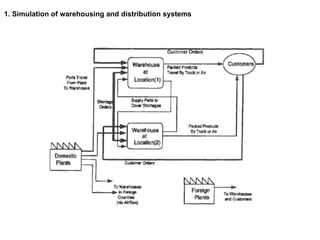
1. Simulation of warehousing and distribution systems
Purpose of the simulation model: To evaluate the performance of individual value adding (indirect) resources,facilities and operations as well as the flow of transportation entities (direct resources) between the plants, warehouses and customers. To evaluate strategic decisions Warehouse location and allocation Warehouse / Distribution center designs Transportation mode analysis To test tactical solutions  Inventory management policies Pull ordering between customers and plants Push ordering between warehouses Service levels Simulation of warehousing and distribution systems
To identify operation problems on an ongoing basis Changes in transportation modes Changes in warehouse operation parameters Changes in parts and finished products Customer demand fluctuations Simulation of warehousing and distribution systems
Entities:  Product related entities Primary and non primary parts : Produced in-house / Vendor supplied Products (Semi-finished / Finished )  Palletized Items Parts  Semi- Finished Products Finished Products  Information oriented entities Orders from customers Orders for shortage Simulation of warehousing and distribution systems
Resources: Trucks  Between plants and warehouses Between warehouses Between warehouses and customers Airplanes Between plants and warehouses Between warehouses Between warehouses and customers Simulation of warehousing and distribution systems
Ships / Barges Between domestic (foreign) plants and foreign (domestic) warehouses Between foreign warehouses Between domestic (foreign) warehouses and foreign (domestic) customers Internal (warehouse / plants / distribution centers / customer sites) equipment Forklifts Carts Pallet Trucks Conveyors AS/RS Systems Guided Vehicles Simulation of warehousing and distribution systems
Processes / Activities: Order processing at the warehouse (manual ,automated ) Pull ordering system Push ordering system Terminal operations at plants, warehouse and customers (domestic/ foreign) Grouping / Palletizing At a production plant before shipping to a warehouse At a warehouse before shipping to a customer Ungrouping At a warehouse once the parts arrive from a plant Transportation mode selection At production plants At warehouses Simulation of warehousing and distribution systems
Handling shortages (or surplus inventory) Creation at a warehouse (domestic / foreign) Send an order message to another warehouse Movement of parts (raw materials, semi-finished) From domestic plants to domestic warehouses From foreign plants to foreign warehouses From domestic plants to foreign warehouses From foreign plants to domestic warehouses Movement of finished products From domestic warehouse to domestic customers From foreign warehouse to customers abroad Between domestic warehouses Between foreign warehouses Between domestic and foreign warehouses Simulation of warehousing and distribution systems
Customer orders From foreign customers to domestic warehouses From foreign customers to warehouses abroad From domestic customers to domestic warehouses Transportation mode selection Based on a specified service level Based on the availability of resources Based on shipment priorities Based on customer location Direct shipment from plant to customers In case of Items in shortage Incase of Emergency items OEM Products Simulation of warehousing and distribution systems
Data requirements (inputs for the simulation model) Number of plants Number and location of warehouses Number of customers Customer demand to warehouses Part number produced at different plants Bill of materials Transportation times  Between plants and warehouses Between warehouses and customers Simulation of warehousing and distribution systems
Simulation Outputs and Responses ( Outputs from the Simulation) Average utilization Warehouse Trucks Airplanes Other resources inside a warehouse Inventory Levels Production plants Warehouses Transportation delays Between the plant and a warehouse Between a warehouse and customers Customer orders Average waiting times at a warehouse Number waiting at a warehouse Simulation of warehousing and distribution systems
2. Simulation of trucking operations
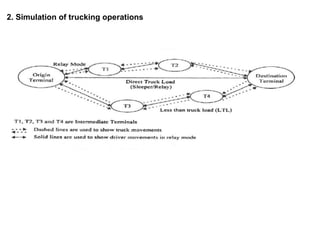
System Description Freight may be transported directly or via several intermediate terminals LTL (less than truckload) or DL (direct load) mode Straight truck / Tractor – Trailer combination – in latter case one, two or three trailers are hooked to the tractor by hooking persons (hostlers) at the yard in a terminal Truck drivers arrive at the terminal at pre-specified time as per the schedule Number of trailers hooked to a tractor may vary depending on the amount of freight Set number of loaded trailers are transported by relay, by sleeper, by meet-and-turn drivers, or by rail from each terminal, hub or consolidation center Occasionally empty trailers in case of load imbalance – when more freight moves in one direction than in another direction Simulation of trucking operations
Driver pool is divided into following three types:  Pick-up and delivery drivers : who stay within a city zone Relay drivers : who drive trucks from one terminal to the next for a shorter period and return back to the original terminal which is their domicile location Sleeper drivers : where two drivers alternate driving and drive to farther destinations with minimum number of stops for a longer period When a truck driver is at a terminal location that is not his or her domicile point – he is referred to as  foreign driver .  At the foreign location the drivers will be provided accommodation to rest for a period of time (say 8 to 10 hours) before driving back to the domicile location – as per the schedule.  Foreign drivers have higher priority – so as to reduce the cost of managing them Once the drivers return to their domicile location, they go home and wait until their next assignment Simulation of trucking operations
To reduce the cost of managing drivers when they are at foreign terminals, trucking companies set up a pool of  meet-and-turn  drivers  These drivers are used to exchange trucks from two terminals moving towards each other when the total transport time is within 8 to 10 hours Meet-and-turn drivers at a central point, swap their trucks and turn back to their domicile terminals Meet-and-turn drivers start from a domicile terminal and end up at their domicile location On arrival straight trucks waits at the yard to wait for its turn to offload  Tractor- trailer pair – set is unhooked and waits at the yard for offloading, unhooked tractor maybe taken for maintenance checks, refueling etc. Simulation of trucking operations
Each terminal has a dock with sufficient doors for the loaded trailers or trucks to arrive at a pre-specified door and offload Off-loading may involve use of manual handling or forklifts or other material handling equipment Truck docks are divided into areas specifically for offloading trucks (or trailers) and reloading trucks or trailers Some may have same areas for offloading / reloading to take down the time required for the freight to be staged before it is reloaded for transportation to its final destination Simulations can be applied to several areas of trucking operations as follows :  Dock Simulation – modeling and analysis of truck docks Terminal Simulation – modeling and analysis of activities taking place inside a terminal Line-haul Simulation - combines dock operations and terminal operations network, more complex  Simulation  of trucking operations
Simulation model is built to address a variety of problems such as  : Current methods of hooking trailers Current procedures used to assign drivers to schedules Load imbalances within any lane at any terminal  Equipment needs at any terminal in the lane Driver needs at any terminal within the lane Management of resources within the lane  Simulation of trucking operations
Entities Empty trailers at terminals Loaded trailers: Waiting to be grouped with other trailers Waiting to be sent by relay, sleeper, or meet-and-turn mode Transport Operators (sleepers, relay and meet-and-turn drivers) Tractors Trains at the railway station (if rail mode is activated) Simulation of trucking operations
Resources Hostlers Dispatchers Fuelers  Activities / Processes that require special attention :  If only sleeper, relay and meet-turn operations are considered, the following activities are performed in a model: Off load the loaded trailers after a trip at the dock Load the empty trailers at the dock Unhook trailers at a terminal  Prepare (hostler) equipment at a terminal : Get service from hostler to hook / unhook trailers with tractors / Get service at the fueling land or the inspection area Drive the truck to the next location via sleeper mode sleeper / relay / meet-and-turn mode  Simulation of trucking operations
If the rail mode needs to be modeled, the following activities are performed: Movement of trailers to the rail-yard Transportation of  the trailers from the rail –yard to the terminal  At the destination terminal, split trailers at the rail-yard and dispatch to the terminal Simulation of trucking operations
Inputs Required for simulation Trailer information  Trailer arrival process information  Scheduled arrival time distribution Trailer information for each schedule : Lane destination, Load destination Empty trailer availability information Sleeper team arrival process at the origin terminals Relay ( or meet and turn) driver arrival process at the original terminals Tractor availability information Other pertinent information related to any other dynamic process Hostling times A set of intermediate locations where sleeper (or relay) trucks stop for unhooking and or hooking or refueling  Fueling / Inspection times at a terminal  Simulation of trucking operations
Fueling / Inspection times at a third party vendor location  Tractor service times at terminals Current number of hostlers per shift at each of the terminals under consideration Current number of sleeper, relay and meet-and-turn drivers Standard driver roster: Arrival times at the terminal Number of drivers Assigned destination Extra driver roster Number of drivers Driver work rules and DOT regulations associated with sleepers, relay and meet-and-turn drivers Simulation of trucking operations
Outputs from the simulation Utilization of empty trailers at each terminal  Empty trailer build-up rate and its usage rate over a period of time Utilization of drivers at each terminal over a period of time Tractor utilization at each terminal and tractor buildup rate and usage rate at a terminal over a period of time Number of trailers transported by sleeper teams, relay teams, or meet-and-turn drivers separately at all destination terminals for each day  Number of trucks on the road over a period of time Number of trailers delayed due to unavailability of tractors at the terminals Delay times for trailers at each terminal due to unavailability of tractors Number of drivers delayed due to the unavailability of schedules at all terminals Delay times for the drivers at each terminal due to unavailability of schedules Number of tractors delayed due to the unavailability of trailers at each terminal Delay times for tractors at each terminal due to unavailability of trailers Hostler utilization Simulation of trucking operations
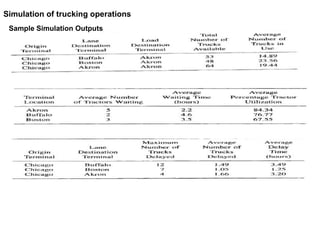
Sample Simulation Outputs Simulation of trucking operations
3. Simulation of Truck Dock Operations
Objective of Simulation  In case of truck dock operation simulations two fundamental objectives are set forth for the simulation study : Studying the ways and means of increasing the throughput of a truck dock Studying the impact of changes in a facility design before implementing it, to avoid making very costly errors Generally following what-if scenarios are analyzed in this simulation: To be able to show existing operations, trouble spots and changes in behavior of the existing truck dock as it undergoes changes in terms of new equipment, facility and operations To study the impact of changes in processes and policies within each area of the truck dock To change the distances traveled and capacity/size/number of forklifts and determine the impact on performance at the truck dock area Simulation  of Truck Dock Operations
Entities and Resources Yard – where trucks arrive and wait for an empty door Doors  Transporters working at a dock such as forklifts and conveyors Staging areas where the freight is temporarily stored prior to sorting and shipping Sorting systems Simulation of Truck Dock Operations
Processes Determine door assignments to trucks (based on arrival behavior) at the unloading doors Assign trucks to doors starting from left to right Assign trucks based on origin or destination terminal to the pre-assigned doors Determine door assignments to trucks (based on departure process) at the loading (outbound doors) Employ a round- robin method of door assignment, if not waiting at the yard Send trucks directly to next- available door, if not waiting at the yard Send trucks to doors based on origin or destination terminal Send trucks to a common waiting area and to next available door Capture door arrival process Enter the dock area for offloading Consider truck / dock preparation time Read the information pertaining to type of truck Read the information pertaining to type of contents of the truck Simulation of Truck Dock Operations
Specify doors to forklifts Assign, schedule and move and control forklifts for offloading trucks Assign , schedule , move and control forklifts for loading trucks Pickup and drop-off times for truck forklifts Select a sortation conveyor Simulation of Truck Dock Operations
Inputs Data for Truck-dock Simulation Two types of data inputs are required. The first types involves freight types, door information, resources used and equipment specifications as follows: Door information ( number of doors, door size ,door locations) Freight types (containerized, bulk [sorted/unsorted], loose freight) Resources (doors, forklifts, sorting conveyors) Operators Queue locations  Forklift specifications (number and types, length and width, loaded/unloaded speed, park locations, work assignment, turning rules, pickup and deposit rules) Conveyor specifications (conveyor types, number of segments, input station characteristics, output station characteristics, segment speed, conveyor selection rules, freight movements) Simulation of Truck Dock Operations
Second type of input data involves rigorous data collection at the truck dock as follows: Arrival process Type of trucks based on freight carried Frequency of truck arrivals Truck contents (freight type and statistical distribution w/ parameters) Truck hostling time distributions Door preparation time before offloading Door occupancy time by trucks after off-loading Loading / Offloading times Fork-lift pick up time by freight type Fork-lift set down time by freight type at destination points Simulation of Truck Dock Operations
Outputs from simulation Measure the impact of eliminating certain truck types at inbound dock Measure the Impact of additional doors Measure the Impact of fork-lift assignment policies to doors Determine optimum Number of doors required and forklift assignment policies Time window to complete off-loading, staging and reloading all the trucks Amount of work load expected at all areas that may receive freight during a time period Simulation of Truck Dock Operations
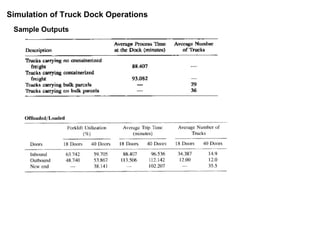
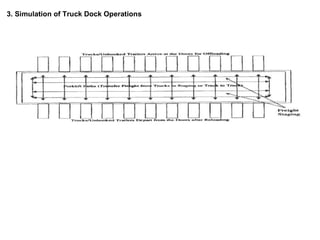
Sample Outputs Simulation of Truck Dock Operations
4. Simulation of ramp operations in air cargo hubs Purpose of simulation model: To develop a simulation model that has the ability to show ramp operations crew the problems, trouble spots, and changes in behavior of the existing ramp operations as the air-cargo hub undergoes changes To study the impact of changes in operations and policies within each area of the ramp To perform a comparative analysis, current versus new layout of aircraft parking, current versus new communication procedures, current new tug and dolly assignment rules and so on. To study the impact of additional aircrafts and gates on the ramp and determine the number of K- loaders and tug and dollies To study the impact of changing the number of dollies per tug and number of tugs per plane on the average time required to offload a plane. Study the impact of these operation parameters on the varying number of planes that arrive at the hub during a night
Entities, Resources and Activities Number of planes Flight profile Plane arrival time distributions Total number of tugs Number of tugs per plane  Number of dollies per tug Number of K- loaders Simulation of ramp operations in air cargo hubs
Inputs for simulation model Number of gates Ramp maps Technical specifications of sort-line conveyors,tugs, dollies and forklifts Plane types Flight information  Tail sheet and arrival/ departure information Number of container positions that each plane type can carry  Number of bellies Number of containers each belly fills up by plane type Number of dollies per tug Team make-up for offloading and reloading container from/to a plane Number of tugs/ dollies/ forklifts Conveyor location and characteristics Plane parking location rules Runway behavior Simulation of ramp operations in air cargo hubs
What – if Scenarios Changes in number of tugs per plane Changes in number of dollies hooked to each tug Changes in total number of tugs used on the ramp Changes in aircraft arrival process / departure process Changes in number of K loaders Changes in number of transfer forklifts Changes in work rules Impact of changes in the tug assignment to the aircraft Simulation of ramp operations in air cargo hubs
Outputs for the simulation model Total number of containers offloaded during an hour, total number of planes offloaded during an hour, average time to offload a plane, and completion time for offloading all the planes that arrived during night/ day Offloading / Reloading times for 10 planes,20 planes, 30 planes and so on. Determine number of gates for all arriving planes as created by the simulation model  Actual time at which the aircraft is fully offloaded or loaded Offloading time for each aircraft that arrived during the night/day Simulation of ramp operations in air cargo hubs
THANK YOU

Simulation Applications In Logistics And Transportation

  • 1.
    Simulation Applications inLogistics & Transportation systems
  • 2.
    Contents 1. Introduction to Logistics & Transportation Systems 2. Classification of Logistics & Transportation Simulation models 3. Inputs / Outputs of the Simulation Model
  • 3.
    Introduction Definition :Logistics & Transport (L&T) can be defined as a network composed of one or more terminals / hubs connected by a set of traffic lanes Major elements of L&T system : Direct Resources : Resources used in physical transportation of freight (goods) from one geographical location to another e.g.: Trucks, Aircrafts, Cargo Ships, Drivers, Pilots etc. Indirect Resources : Resources used in sorting, storing, handling, retrieving and consolidating at the various transit locations e.g.: Forklifts, Docks, Carts, Storage-bins and Racks inside warehouse etc.
  • 4.
    Direct (moving) andIndirect resources must operate together in the most efficient manner for smooth and balanced operation of L&T network. Which would reduce amount of delays at hubs / Maximum availability & utilization of resources / On time pick-up and delivery of physical goods Right Part at the Right Place at the Right Time
  • 5.
    Classification of Logistics& Transportation Simulation models
  • 6.
    Simulation models inL&T are built for the following purposes: Models for strategic planning Models for tactical planning Models for network/traffic control: Offline control Models for scheduling and dispatching: Off-line scheduling Exception handling Real-time monitoring Classification of simulation models
  • 7.
    L&T Problems appropriatefor simulation studies are divided into three major categories: New design Evaluation of alternative designs Refinement and redesign of existing operations Problems in new design domain are solved generally by optimization / heuristic approaches. Simulation models are often used for validating purposes on case to case basis but not mandatory Classification of simulation models
  • 8.
    A. New DesignNetwork design : validation of Hub/Spoke design and Direct move Terminal / Hub planning :Identifying No. of terminals, Location, Size (dock dimensions, number of doors) Fleet Planning Route Planning Least- cost transportation modes Simulation works through an iterative approach and does not generate alternatives as such
  • 9.
    B. Evaluation ofalternative designs Transportation mode alternatives: On-the-road (trucks) – Relay / Sleeper Rail (trains) : Single / Double stacked Air : Planes / Helicopters Ocean : Ship / Barges Inter-modal alternatives: Combine sleeper with rail Combine relay with sleeper Combine rail with relay Combine trucks with air Combines trucks/air with ocean
  • 10.
    Service performance alternatives:Overnight service Two – day service Premium service B. Evaluation of alternative designs
  • 11.
    C. Refinement andredesign of existing operations Operational performance analysis On-the-road movements Line-haul, regional and group operations Terminal operations Operating rules Hooking, unhooking, hostling and fueling Trailer loading and trailer off-loading Dock operations Dispatching
  • 12.
    Rail movements: Loadingstrategies at the rail yard Train timetables Capacity requirements Air transportation: Origin terminal operations End - of- line operations Central / distributed hub operations C. Refinement and redesign of existing operations
  • 13.
    2. Inputs /Outputs of the Simulation Model
  • 14.
    Simulation of warehousingand distribution systems Simulation of trucking operations Simulation of truck docks Simulation of ramp operations in air-cargo hubs Case Studies Factors to be considered in each of the case studies: Purpose of building the model Entities, resources and critical processes that need special attention What- if scenarios Input data required Output data from simulation
  • 15.
    1. Simulation ofwarehousing and distribution systems
  • 16.
    Purpose of thesimulation model: To evaluate the performance of individual value adding (indirect) resources,facilities and operations as well as the flow of transportation entities (direct resources) between the plants, warehouses and customers. To evaluate strategic decisions Warehouse location and allocation Warehouse / Distribution center designs Transportation mode analysis To test tactical solutions Inventory management policies Pull ordering between customers and plants Push ordering between warehouses Service levels Simulation of warehousing and distribution systems
  • 17.
    To identify operationproblems on an ongoing basis Changes in transportation modes Changes in warehouse operation parameters Changes in parts and finished products Customer demand fluctuations Simulation of warehousing and distribution systems
  • 18.
    Entities: Productrelated entities Primary and non primary parts : Produced in-house / Vendor supplied Products (Semi-finished / Finished ) Palletized Items Parts Semi- Finished Products Finished Products Information oriented entities Orders from customers Orders for shortage Simulation of warehousing and distribution systems
  • 19.
    Resources: Trucks Between plants and warehouses Between warehouses Between warehouses and customers Airplanes Between plants and warehouses Between warehouses Between warehouses and customers Simulation of warehousing and distribution systems
  • 20.
    Ships / BargesBetween domestic (foreign) plants and foreign (domestic) warehouses Between foreign warehouses Between domestic (foreign) warehouses and foreign (domestic) customers Internal (warehouse / plants / distribution centers / customer sites) equipment Forklifts Carts Pallet Trucks Conveyors AS/RS Systems Guided Vehicles Simulation of warehousing and distribution systems
  • 21.
    Processes / Activities:Order processing at the warehouse (manual ,automated ) Pull ordering system Push ordering system Terminal operations at plants, warehouse and customers (domestic/ foreign) Grouping / Palletizing At a production plant before shipping to a warehouse At a warehouse before shipping to a customer Ungrouping At a warehouse once the parts arrive from a plant Transportation mode selection At production plants At warehouses Simulation of warehousing and distribution systems
  • 22.
    Handling shortages (orsurplus inventory) Creation at a warehouse (domestic / foreign) Send an order message to another warehouse Movement of parts (raw materials, semi-finished) From domestic plants to domestic warehouses From foreign plants to foreign warehouses From domestic plants to foreign warehouses From foreign plants to domestic warehouses Movement of finished products From domestic warehouse to domestic customers From foreign warehouse to customers abroad Between domestic warehouses Between foreign warehouses Between domestic and foreign warehouses Simulation of warehousing and distribution systems
  • 23.
    Customer orders Fromforeign customers to domestic warehouses From foreign customers to warehouses abroad From domestic customers to domestic warehouses Transportation mode selection Based on a specified service level Based on the availability of resources Based on shipment priorities Based on customer location Direct shipment from plant to customers In case of Items in shortage Incase of Emergency items OEM Products Simulation of warehousing and distribution systems
  • 24.
    Data requirements (inputsfor the simulation model) Number of plants Number and location of warehouses Number of customers Customer demand to warehouses Part number produced at different plants Bill of materials Transportation times Between plants and warehouses Between warehouses and customers Simulation of warehousing and distribution systems
  • 25.
    Simulation Outputs andResponses ( Outputs from the Simulation) Average utilization Warehouse Trucks Airplanes Other resources inside a warehouse Inventory Levels Production plants Warehouses Transportation delays Between the plant and a warehouse Between a warehouse and customers Customer orders Average waiting times at a warehouse Number waiting at a warehouse Simulation of warehousing and distribution systems
  • 26.
    2. Simulation oftrucking operations
  • 27.
    System Description Freightmay be transported directly or via several intermediate terminals LTL (less than truckload) or DL (direct load) mode Straight truck / Tractor – Trailer combination – in latter case one, two or three trailers are hooked to the tractor by hooking persons (hostlers) at the yard in a terminal Truck drivers arrive at the terminal at pre-specified time as per the schedule Number of trailers hooked to a tractor may vary depending on the amount of freight Set number of loaded trailers are transported by relay, by sleeper, by meet-and-turn drivers, or by rail from each terminal, hub or consolidation center Occasionally empty trailers in case of load imbalance – when more freight moves in one direction than in another direction Simulation of trucking operations
  • 28.
    Driver pool isdivided into following three types: Pick-up and delivery drivers : who stay within a city zone Relay drivers : who drive trucks from one terminal to the next for a shorter period and return back to the original terminal which is their domicile location Sleeper drivers : where two drivers alternate driving and drive to farther destinations with minimum number of stops for a longer period When a truck driver is at a terminal location that is not his or her domicile point – he is referred to as foreign driver . At the foreign location the drivers will be provided accommodation to rest for a period of time (say 8 to 10 hours) before driving back to the domicile location – as per the schedule. Foreign drivers have higher priority – so as to reduce the cost of managing them Once the drivers return to their domicile location, they go home and wait until their next assignment Simulation of trucking operations
  • 29.
    To reduce thecost of managing drivers when they are at foreign terminals, trucking companies set up a pool of meet-and-turn drivers These drivers are used to exchange trucks from two terminals moving towards each other when the total transport time is within 8 to 10 hours Meet-and-turn drivers at a central point, swap their trucks and turn back to their domicile terminals Meet-and-turn drivers start from a domicile terminal and end up at their domicile location On arrival straight trucks waits at the yard to wait for its turn to offload Tractor- trailer pair – set is unhooked and waits at the yard for offloading, unhooked tractor maybe taken for maintenance checks, refueling etc. Simulation of trucking operations
  • 30.
    Each terminal hasa dock with sufficient doors for the loaded trailers or trucks to arrive at a pre-specified door and offload Off-loading may involve use of manual handling or forklifts or other material handling equipment Truck docks are divided into areas specifically for offloading trucks (or trailers) and reloading trucks or trailers Some may have same areas for offloading / reloading to take down the time required for the freight to be staged before it is reloaded for transportation to its final destination Simulations can be applied to several areas of trucking operations as follows : Dock Simulation – modeling and analysis of truck docks Terminal Simulation – modeling and analysis of activities taking place inside a terminal Line-haul Simulation - combines dock operations and terminal operations network, more complex Simulation of trucking operations
  • 31.
    Simulation model isbuilt to address a variety of problems such as : Current methods of hooking trailers Current procedures used to assign drivers to schedules Load imbalances within any lane at any terminal Equipment needs at any terminal in the lane Driver needs at any terminal within the lane Management of resources within the lane Simulation of trucking operations
  • 32.
    Entities Empty trailersat terminals Loaded trailers: Waiting to be grouped with other trailers Waiting to be sent by relay, sleeper, or meet-and-turn mode Transport Operators (sleepers, relay and meet-and-turn drivers) Tractors Trains at the railway station (if rail mode is activated) Simulation of trucking operations
  • 33.
    Resources Hostlers DispatchersFuelers Activities / Processes that require special attention : If only sleeper, relay and meet-turn operations are considered, the following activities are performed in a model: Off load the loaded trailers after a trip at the dock Load the empty trailers at the dock Unhook trailers at a terminal Prepare (hostler) equipment at a terminal : Get service from hostler to hook / unhook trailers with tractors / Get service at the fueling land or the inspection area Drive the truck to the next location via sleeper mode sleeper / relay / meet-and-turn mode Simulation of trucking operations
  • 34.
    If the railmode needs to be modeled, the following activities are performed: Movement of trailers to the rail-yard Transportation of the trailers from the rail –yard to the terminal At the destination terminal, split trailers at the rail-yard and dispatch to the terminal Simulation of trucking operations
  • 35.
    Inputs Required forsimulation Trailer information Trailer arrival process information Scheduled arrival time distribution Trailer information for each schedule : Lane destination, Load destination Empty trailer availability information Sleeper team arrival process at the origin terminals Relay ( or meet and turn) driver arrival process at the original terminals Tractor availability information Other pertinent information related to any other dynamic process Hostling times A set of intermediate locations where sleeper (or relay) trucks stop for unhooking and or hooking or refueling Fueling / Inspection times at a terminal Simulation of trucking operations
  • 36.
    Fueling / Inspectiontimes at a third party vendor location Tractor service times at terminals Current number of hostlers per shift at each of the terminals under consideration Current number of sleeper, relay and meet-and-turn drivers Standard driver roster: Arrival times at the terminal Number of drivers Assigned destination Extra driver roster Number of drivers Driver work rules and DOT regulations associated with sleepers, relay and meet-and-turn drivers Simulation of trucking operations
  • 37.
    Outputs from thesimulation Utilization of empty trailers at each terminal Empty trailer build-up rate and its usage rate over a period of time Utilization of drivers at each terminal over a period of time Tractor utilization at each terminal and tractor buildup rate and usage rate at a terminal over a period of time Number of trailers transported by sleeper teams, relay teams, or meet-and-turn drivers separately at all destination terminals for each day Number of trucks on the road over a period of time Number of trailers delayed due to unavailability of tractors at the terminals Delay times for trailers at each terminal due to unavailability of tractors Number of drivers delayed due to the unavailability of schedules at all terminals Delay times for the drivers at each terminal due to unavailability of schedules Number of tractors delayed due to the unavailability of trailers at each terminal Delay times for tractors at each terminal due to unavailability of trailers Hostler utilization Simulation of trucking operations
  • 38.
    Sample Simulation OutputsSimulation of trucking operations
  • 39.
    3. Simulation ofTruck Dock Operations
  • 40.
    Objective of Simulation In case of truck dock operation simulations two fundamental objectives are set forth for the simulation study : Studying the ways and means of increasing the throughput of a truck dock Studying the impact of changes in a facility design before implementing it, to avoid making very costly errors Generally following what-if scenarios are analyzed in this simulation: To be able to show existing operations, trouble spots and changes in behavior of the existing truck dock as it undergoes changes in terms of new equipment, facility and operations To study the impact of changes in processes and policies within each area of the truck dock To change the distances traveled and capacity/size/number of forklifts and determine the impact on performance at the truck dock area Simulation of Truck Dock Operations
  • 41.
    Entities and ResourcesYard – where trucks arrive and wait for an empty door Doors Transporters working at a dock such as forklifts and conveyors Staging areas where the freight is temporarily stored prior to sorting and shipping Sorting systems Simulation of Truck Dock Operations
  • 42.
    Processes Determine doorassignments to trucks (based on arrival behavior) at the unloading doors Assign trucks to doors starting from left to right Assign trucks based on origin or destination terminal to the pre-assigned doors Determine door assignments to trucks (based on departure process) at the loading (outbound doors) Employ a round- robin method of door assignment, if not waiting at the yard Send trucks directly to next- available door, if not waiting at the yard Send trucks to doors based on origin or destination terminal Send trucks to a common waiting area and to next available door Capture door arrival process Enter the dock area for offloading Consider truck / dock preparation time Read the information pertaining to type of truck Read the information pertaining to type of contents of the truck Simulation of Truck Dock Operations
  • 43.
    Specify doors toforklifts Assign, schedule and move and control forklifts for offloading trucks Assign , schedule , move and control forklifts for loading trucks Pickup and drop-off times for truck forklifts Select a sortation conveyor Simulation of Truck Dock Operations
  • 44.
    Inputs Data forTruck-dock Simulation Two types of data inputs are required. The first types involves freight types, door information, resources used and equipment specifications as follows: Door information ( number of doors, door size ,door locations) Freight types (containerized, bulk [sorted/unsorted], loose freight) Resources (doors, forklifts, sorting conveyors) Operators Queue locations Forklift specifications (number and types, length and width, loaded/unloaded speed, park locations, work assignment, turning rules, pickup and deposit rules) Conveyor specifications (conveyor types, number of segments, input station characteristics, output station characteristics, segment speed, conveyor selection rules, freight movements) Simulation of Truck Dock Operations
  • 45.
    Second type ofinput data involves rigorous data collection at the truck dock as follows: Arrival process Type of trucks based on freight carried Frequency of truck arrivals Truck contents (freight type and statistical distribution w/ parameters) Truck hostling time distributions Door preparation time before offloading Door occupancy time by trucks after off-loading Loading / Offloading times Fork-lift pick up time by freight type Fork-lift set down time by freight type at destination points Simulation of Truck Dock Operations
  • 46.
    Outputs from simulationMeasure the impact of eliminating certain truck types at inbound dock Measure the Impact of additional doors Measure the Impact of fork-lift assignment policies to doors Determine optimum Number of doors required and forklift assignment policies Time window to complete off-loading, staging and reloading all the trucks Amount of work load expected at all areas that may receive freight during a time period Simulation of Truck Dock Operations
  • 47.
    Sample Outputs Simulationof Truck Dock Operations
  • 48.
    4. Simulation oframp operations in air cargo hubs Purpose of simulation model: To develop a simulation model that has the ability to show ramp operations crew the problems, trouble spots, and changes in behavior of the existing ramp operations as the air-cargo hub undergoes changes To study the impact of changes in operations and policies within each area of the ramp To perform a comparative analysis, current versus new layout of aircraft parking, current versus new communication procedures, current new tug and dolly assignment rules and so on. To study the impact of additional aircrafts and gates on the ramp and determine the number of K- loaders and tug and dollies To study the impact of changing the number of dollies per tug and number of tugs per plane on the average time required to offload a plane. Study the impact of these operation parameters on the varying number of planes that arrive at the hub during a night
  • 49.
    Entities, Resources andActivities Number of planes Flight profile Plane arrival time distributions Total number of tugs Number of tugs per plane Number of dollies per tug Number of K- loaders Simulation of ramp operations in air cargo hubs
  • 50.
    Inputs for simulationmodel Number of gates Ramp maps Technical specifications of sort-line conveyors,tugs, dollies and forklifts Plane types Flight information Tail sheet and arrival/ departure information Number of container positions that each plane type can carry Number of bellies Number of containers each belly fills up by plane type Number of dollies per tug Team make-up for offloading and reloading container from/to a plane Number of tugs/ dollies/ forklifts Conveyor location and characteristics Plane parking location rules Runway behavior Simulation of ramp operations in air cargo hubs
  • 51.
    What – ifScenarios Changes in number of tugs per plane Changes in number of dollies hooked to each tug Changes in total number of tugs used on the ramp Changes in aircraft arrival process / departure process Changes in number of K loaders Changes in number of transfer forklifts Changes in work rules Impact of changes in the tug assignment to the aircraft Simulation of ramp operations in air cargo hubs
  • 52.
    Outputs for thesimulation model Total number of containers offloaded during an hour, total number of planes offloaded during an hour, average time to offload a plane, and completion time for offloading all the planes that arrived during night/ day Offloading / Reloading times for 10 planes,20 planes, 30 planes and so on. Determine number of gates for all arriving planes as created by the simulation model Actual time at which the aircraft is fully offloaded or loaded Offloading time for each aircraft that arrived during the night/day Simulation of ramp operations in air cargo hubs
  • 53.