Simple Present Tense
What is simple present tense?
• Simple Present Tense is the tense used to
express an action or activity taking place or
happening at the present time in a simple
form, or activities performed repeatedly, or
daily habits, or acts that have nothing to do
with time.
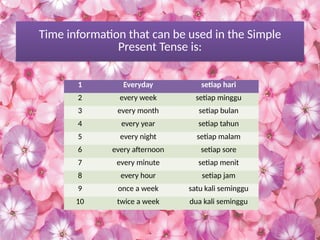
Time information that can be used in the Simple
Present Tense is:
1 Everyday setiap hari
2 every week setiap minggu
3 every month setiap bulan
4 every year setiap tahun
5 every night setiap malam
6 every afternoon setiap sore
7 every minute setiap menit
8 every hour setiap jam
9 once a week satu kali seminggu
10 twice a week dua kali seminggu
1.Positive form
• For I, you, we, they subject
we used :
• For she, he, it subject
we used:
Subject + infinitive
(Verb 1)
Subject + infinitive
(Verb 1) + s/es
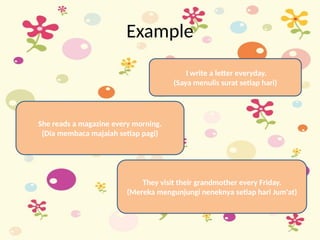
Example
They visit their grandmother every Friday.
(Mereka mengunjungi neneknya setiap hari Jum'at)
She reads a magazine every morning.
(Dia membaca majalah setiap pagi)
I write a letter everyday.
(Saya menulis surat setiap hari)
There are several rules that must be observed
when adding s/es on a verb (infinitive), as follows:
No
Verb 1
(infinitive)
The addition of the suffix "-s" Meaning
1 read reads membaca
2 work works bekerja
3 write writes menulis
4 set sets terbenam
5 shine shines bersinar
6 sing sings menyanyi
7 bring brings membawa
8 eat eats makan
9 help helps menolong
10 give gives memberi
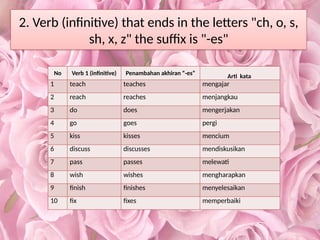
2. Verb (infinitive) that ends in the letters "ch, o, s,
sh, x, z" the suffix is "-es"
No Verb 1 (infinitive) Penambahan akhiran “-es” Arti kata
1 teach teaches mengajar
2 reach reaches menjangkau
3 do does mengerjakan
4 go goes pergi
5 kiss kisses mencium
6 discuss discusses mendiskusikan
7 pass passes melewati
8 wish wishes mengharapkan
9 finish finishes menyelesaikan
10 fix fixes memperbaiki
3. verb (infinitive) that ends with the letter "y" and is preceded
by a consonant (consonants), then the suffix "-y" was changed to
"i" and then added "-es".
No
Verb 1
(infinitive)
Penambahan akhiran
“-es” Arti kata
1 Cry Cries Menangis
2 Carry Carries Membawa
3 Fly Flies Terbang
4 Study Studies Belajar
5 Reply Replies Menjawab
6 Try tries Berusaha
4. The verb (infinitive) that ends with the letter "y"
is preceded by a vowel (vocals), plus enough with
the suffix "-s'.
No
Verb 1
(infinitive)
Penambahan
akhiran “-s” Arti kata
1 Buy Buys Membeli
2 Play Plays Bermain
3 Lay Lays Berbaring
4 Say says Berkata
2. Negative Form
• For I, you, we, they subject
we used :
• For she, he, it subject
we used :
• Information :
In the form of negative verbal sentence, the additional "s /
es" to the verb does not exist.
Subject + do + not +
infinitive (Verb1)
Subject + does + not +
infinitive (Verb1)
Example
They do not/ don’t visit their grandmother every Friday.
(Mereka mengunjungi neneknya setiap hari Jum'at)
I do not/ don’t write a letter everyday.
(Saya tidak menulis surat setiap hari)
She does not/doesn’t read a magazine every
morning.
(Dia tidak membaca majalah setiap pagi)
• Nancy and James are good friends .They speak
good German . Nancy works in a restaurant
downtown and James is a librarian . The
children play in the garden every weekend .
James and Nancy visit church together every
Friday.
• Yang mana saja merupakan kalimat simple
present tense?
READ THE BELOW PARAGRAPH
3. Introgative Form
Information :
Kalimat nominal ini dibentuk dengan to be di awal kalimat.
To be + Subyek + Noun Adjective/Adverb
Example :
Are you sad? (Apakah kamu sedih?)
Are you in the library? (Apakah kami ada di perpustakaan?)
Is she a teacher? (Apakah dia seorang guru?)
Example
• Do I write a letter everyday?
(Apakah saya menulis surat setiap hari?)
• Does She read a magazine every morning?
(Apakah dia membaca majalah setiap pagi?)
• Do they visit their grandmother every Friday?
(Apakah mereka mengunjungi neneknya setiap hari
Jum'at?)
# And the answer is yes i do or no I don’t.
1. She always ________ in dance competitions.(participate/participates)
2. Mohan ________ every morning.(jog/jogs)
3. I _______ in France.(live/lives)
4. Jane ______ in a multinational company.(work/works)
5. Doctors ______ that junk food be avoided.(recommend/recommends)
6. He _____ angry very quickly.(get/gets)
CHOOSE THE CORRECT OPTION
FILL IN THE BLANKS
a)My mother is a teacher. She _______ English.
b)Rohan is my best friend. He _______ soccer.
c) _____ you know the way out of this building?
d) What ______ your father do?
e) You can't ______ without water.
THANK YOU
GOOD BYE 

Simple_Present_Tense_PPT_50.pptx class p

  • 1.
  • 2.
    What is simplepresent tense? • Simple Present Tense is the tense used to express an action or activity taking place or happening at the present time in a simple form, or activities performed repeatedly, or daily habits, or acts that have nothing to do with time.
  • 3.
    Time information thatcan be used in the Simple Present Tense is: 1 Everyday setiap hari 2 every week setiap minggu 3 every month setiap bulan 4 every year setiap tahun 5 every night setiap malam 6 every afternoon setiap sore 7 every minute setiap menit 8 every hour setiap jam 9 once a week satu kali seminggu 10 twice a week dua kali seminggu
  • 4.
    1.Positive form • ForI, you, we, they subject we used : • For she, he, it subject we used: Subject + infinitive (Verb 1) Subject + infinitive (Verb 1) + s/es
  • 5.
    Example They visit theirgrandmother every Friday. (Mereka mengunjungi neneknya setiap hari Jum'at) She reads a magazine every morning. (Dia membaca majalah setiap pagi) I write a letter everyday. (Saya menulis surat setiap hari)
  • 6.
    There are severalrules that must be observed when adding s/es on a verb (infinitive), as follows: No Verb 1 (infinitive) The addition of the suffix "-s" Meaning 1 read reads membaca 2 work works bekerja 3 write writes menulis 4 set sets terbenam 5 shine shines bersinar 6 sing sings menyanyi 7 bring brings membawa 8 eat eats makan 9 help helps menolong 10 give gives memberi
  • 7.
    2. Verb (infinitive)that ends in the letters "ch, o, s, sh, x, z" the suffix is "-es" No Verb 1 (infinitive) Penambahan akhiran “-es” Arti kata 1 teach teaches mengajar 2 reach reaches menjangkau 3 do does mengerjakan 4 go goes pergi 5 kiss kisses mencium 6 discuss discusses mendiskusikan 7 pass passes melewati 8 wish wishes mengharapkan 9 finish finishes menyelesaikan 10 fix fixes memperbaiki
  • 8.
    3. verb (infinitive)that ends with the letter "y" and is preceded by a consonant (consonants), then the suffix "-y" was changed to "i" and then added "-es". No Verb 1 (infinitive) Penambahan akhiran “-es” Arti kata 1 Cry Cries Menangis 2 Carry Carries Membawa 3 Fly Flies Terbang 4 Study Studies Belajar 5 Reply Replies Menjawab 6 Try tries Berusaha
  • 9.
    4. The verb(infinitive) that ends with the letter "y" is preceded by a vowel (vocals), plus enough with the suffix "-s'. No Verb 1 (infinitive) Penambahan akhiran “-s” Arti kata 1 Buy Buys Membeli 2 Play Plays Bermain 3 Lay Lays Berbaring 4 Say says Berkata
  • 10.
    2. Negative Form •For I, you, we, they subject we used : • For she, he, it subject we used : • Information : In the form of negative verbal sentence, the additional "s / es" to the verb does not exist. Subject + do + not + infinitive (Verb1) Subject + does + not + infinitive (Verb1)
  • 11.
    Example They do not/don’t visit their grandmother every Friday. (Mereka mengunjungi neneknya setiap hari Jum'at) I do not/ don’t write a letter everyday. (Saya tidak menulis surat setiap hari) She does not/doesn’t read a magazine every morning. (Dia tidak membaca majalah setiap pagi)
  • 12.
    • Nancy andJames are good friends .They speak good German . Nancy works in a restaurant downtown and James is a librarian . The children play in the garden every weekend . James and Nancy visit church together every Friday. • Yang mana saja merupakan kalimat simple present tense? READ THE BELOW PARAGRAPH
  • 13.
    3. Introgative Form Information: Kalimat nominal ini dibentuk dengan to be di awal kalimat. To be + Subyek + Noun Adjective/Adverb Example : Are you sad? (Apakah kamu sedih?) Are you in the library? (Apakah kami ada di perpustakaan?) Is she a teacher? (Apakah dia seorang guru?)
  • 14.
    Example • Do Iwrite a letter everyday? (Apakah saya menulis surat setiap hari?) • Does She read a magazine every morning? (Apakah dia membaca majalah setiap pagi?) • Do they visit their grandmother every Friday? (Apakah mereka mengunjungi neneknya setiap hari Jum'at?) # And the answer is yes i do or no I don’t.
  • 15.
    1. She always________ in dance competitions.(participate/participates) 2. Mohan ________ every morning.(jog/jogs) 3. I _______ in France.(live/lives) 4. Jane ______ in a multinational company.(work/works) 5. Doctors ______ that junk food be avoided.(recommend/recommends) 6. He _____ angry very quickly.(get/gets) CHOOSE THE CORRECT OPTION
  • 16.
    FILL IN THEBLANKS a)My mother is a teacher. She _______ English. b)Rohan is my best friend. He _______ soccer. c) _____ you know the way out of this building? d) What ______ your father do? e) You can't ______ without water.
  • 17.