SIMPLE PAST TENSE
REGULARS VERBS
POR: ENILSA PINTO Y MEIBIS BONILLA
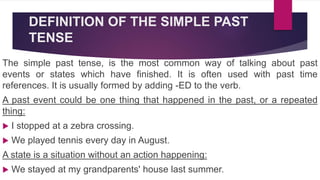
DEFINITION OF THE SIMPLE PAST
TENSE
The simple past tense, is the most common way of talking about past
events or states which have finished. It is often used with past time
references. It is usually formed by adding -ED to the verb.
A past event could be one thing that happened in the past, or a repeated
thing:
 I stopped at a zebra crossing.
 We played tennis every day in August.
A state is a situation without an action happening:
 We stayed at my grandparents' house last summer.
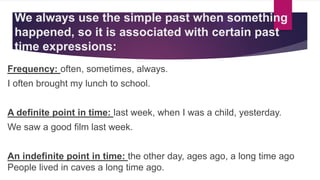
We always use the simple past when something
happened, so it is associated with certain past
time expressions:
Frequency: often, sometimes, always.
I often brought my lunch to school.
A definite point in time: last week, when I was a child, yesterday.
We saw a good film last week.
An indefinite point in time: the other day, ages ago, a long time ago
People lived in caves a long time ago.
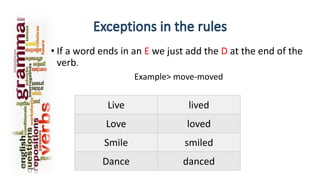
• If a word ends in an E we just add the D at the end of the
verb.
Example> move-moved
Live lived
Love loved
Smile smiled
Dance danced
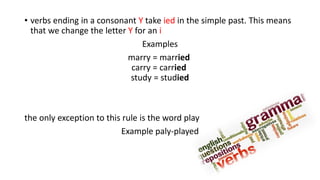
• verbs ending in a consonant Y take ied in the simple past. This means
that we change the letter Y for an i
Examples
marry = married
carry = carried
study = studied
the only exception to this rule is the word play
Example paly-played
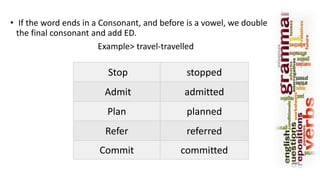
• If the word ends in a Consonant, and before is a vowel, we double
the final consonant and add ED.
Example> travel-travelled
Stop stopped
Admit admitted
Plan planned
Refer referred
Commit committed
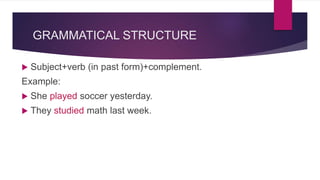
GRAMMATICAL STRUCTURE
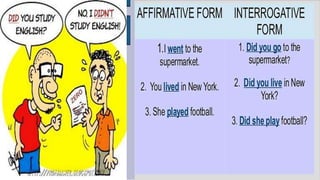
 Subject+verb (in past form)+complement.
Example:
 She played soccer yesterday.
 They studied math last week.
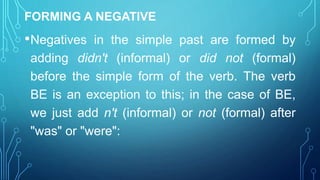
FORMING A NEGATIVE
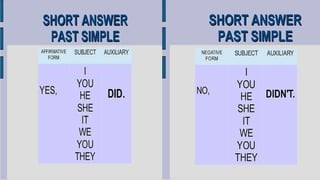
•Negatives in the simple past are formed by
adding didn't (informal) or did not (formal)
before the simple form of the verb. The verb
BE is an exception to this; in the case of BE,
we just add n't (informal) or not (formal) after
"was" or "were":
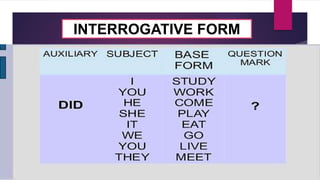
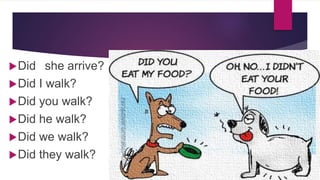
INTERROGATIVE FORM
Did she arrive?
Did I walk?
Did you walk?
Did he walk?
Did we walk?
Did they walk?
 https://es.slideshare.net/EnilsaPinto1/simple-past-tense-75555964

Simple past tense

  • 1.
    SIMPLE PAST TENSE REGULARSVERBS POR: ENILSA PINTO Y MEIBIS BONILLA
  • 2.
    DEFINITION OF THESIMPLE PAST TENSE The simple past tense, is the most common way of talking about past events or states which have finished. It is often used with past time references. It is usually formed by adding -ED to the verb. A past event could be one thing that happened in the past, or a repeated thing:  I stopped at a zebra crossing.  We played tennis every day in August. A state is a situation without an action happening:  We stayed at my grandparents' house last summer.
  • 3.
    We always usethe simple past when something happened, so it is associated with certain past time expressions: Frequency: often, sometimes, always. I often brought my lunch to school. A definite point in time: last week, when I was a child, yesterday. We saw a good film last week. An indefinite point in time: the other day, ages ago, a long time ago People lived in caves a long time ago.
  • 4.
    • If aword ends in an E we just add the D at the end of the verb. Example> move-moved Live lived Love loved Smile smiled Dance danced
  • 5.
    • verbs endingin a consonant Y take ied in the simple past. This means that we change the letter Y for an i Examples marry = married carry = carried study = studied the only exception to this rule is the word play Example paly-played
  • 6.
    • If theword ends in a Consonant, and before is a vowel, we double the final consonant and add ED. Example> travel-travelled Stop stopped Admit admitted Plan planned Refer referred Commit committed
  • 7.
    GRAMMATICAL STRUCTURE  Subject+verb(in past form)+complement. Example:  She played soccer yesterday.  They studied math last week.
  • 8.
    FORMING A NEGATIVE •Negativesin the simple past are formed by adding didn't (informal) or did not (formal) before the simple form of the verb. The verb BE is an exception to this; in the case of BE, we just add n't (informal) or not (formal) after "was" or "were":
  • 9.
  • 10.
    Did she arrive? DidI walk? Did you walk? Did he walk? Did we walk? Did they walk?
  • 13.