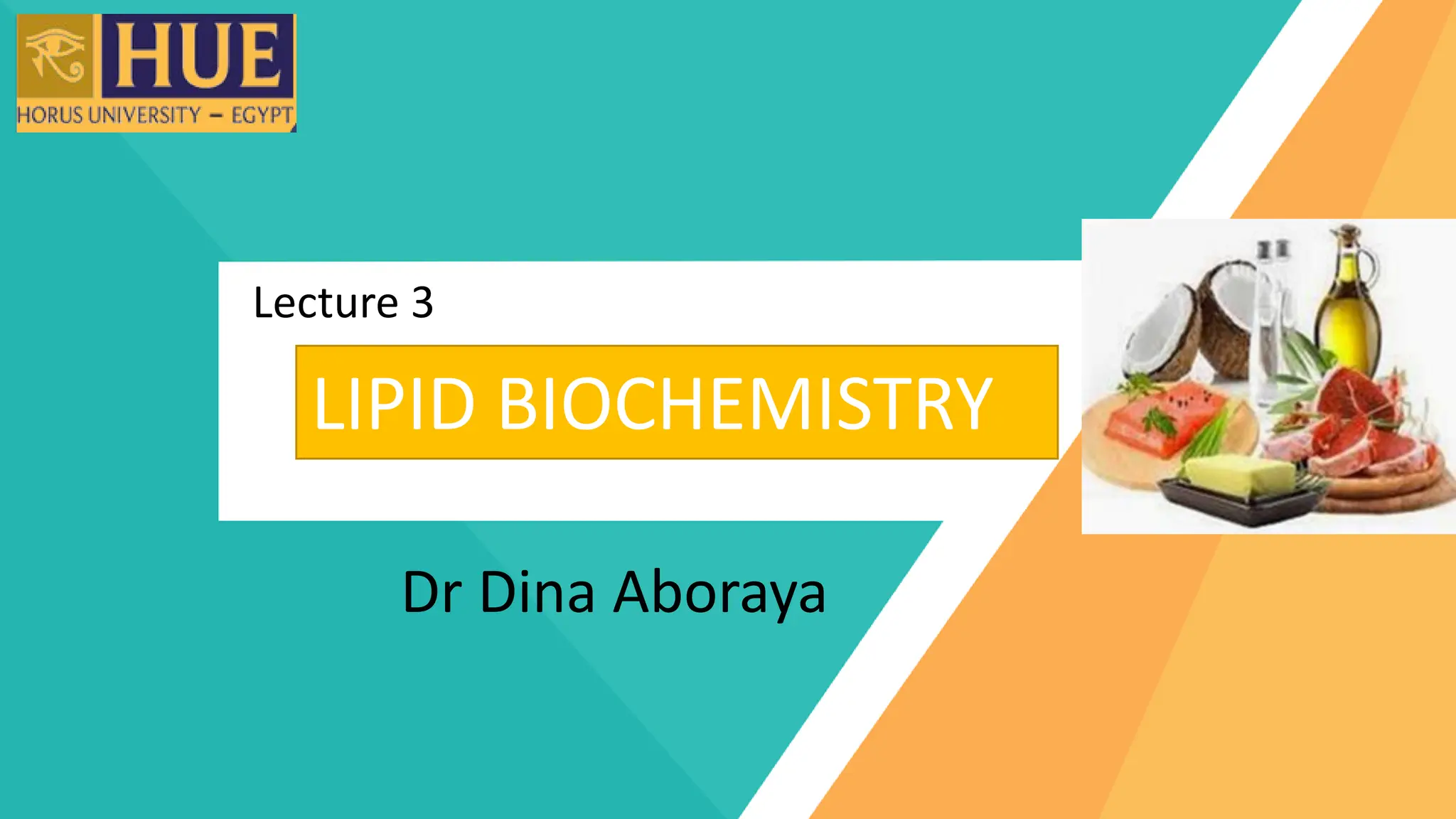
LIPID BIOCHEMISTRY
Dr Dina Aboraya
Lecture 3
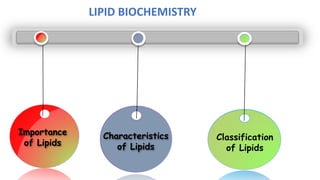
Importance
of Lipids
Characteristics
of Lipids
Classification
of Lipids
LIPID BIOCHEMISTRY
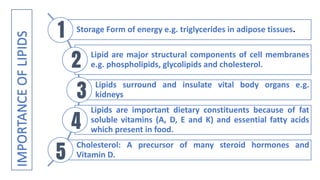
Storage Form of energy e.g. triglycerides in adipose tissues.
Lipid are major structural components of cell membranes
e.g. phospholipids, glycolipids and cholesterol.
Lipids surround and insulate vital body organs e.g.
kidneys
Lipids are important dietary constituents because of fat
soluble vitamins (A, D, E and K) and essential fatty acids
which present in food.
Cholesterol: A precursor of many steroid hormones and
Vitamin D.
2
1
3
4
IMPORTANCE
OF
LIPIDS
5
CHARACTERISTICS OF LIPIDS
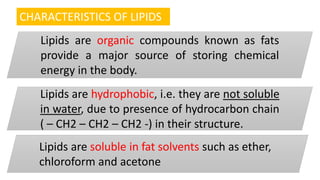
Lipids are organic compounds known as fats
provide a major source of storing chemical
energy in the body.
Lipids are hydrophobic, i.e. they are not soluble
in water, due to presence of hydrocarbon chain
( – CH2 – CH2 – CH2 -) in their structure.
Lipids are soluble in fat solvents such as ether,
chloroform and acetone
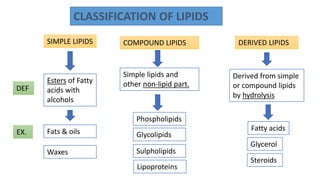
CLASSIFICATION OF LIPIDS
SIMPLE LIPIDS COMPOUND LIPIDS DERIVED LIPIDS
Esters of Fatty
acids with
alcohols
Simple lipids and
other non-lipid part.
Derived from simple
or compound lipids
by hydrolysis
Fats & oils
Waxes
Phospholipids
Glycolipids
Sulpholipids
Lipoproteins
Fatty acids
Glycerol
Steroids
DEF
EX.
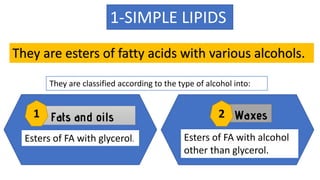
1-SIMPLE LIPIDS
They are esters of fatty acids with various alcohols.
Fats and oils Waxes
1
Esters of FA with glycerol. Esters of FA with alcohol
other than glycerol.
They are classified according to the type of alcohol into:
2
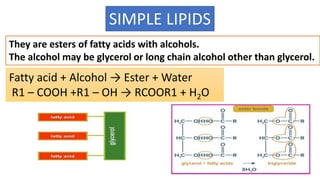
SIMPLE LIPIDS
They are esters of fatty acids with alcohols.
The alcohol may be glycerol or long chain alcohol other than glycerol.
Fatty acid + Alcohol → Ester + Water
R1 – COOH +R1 – OH → RCOOR1 + H2O
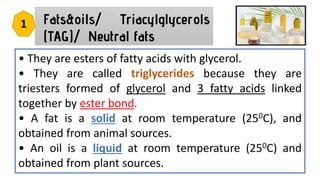
1 Fats&oils/ Triacylglycerols
(TAG)/ Neutral fats
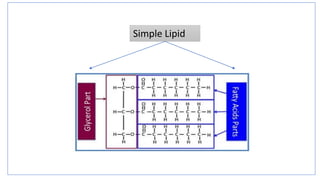
• They are esters of fatty acids with glycerol.
• They are called triglycerides because they are
triesters formed of glycerol and 3 fatty acids linked
together by ester bond.
• A fat is a solid at room temperature (250C), and
obtained from animal sources.
• An oil is a liquid at room temperature (250C) and
obtained from plant sources.
Storage form of fats and stored in adipose tissue.
Types of TG:
A- Simple TG:
Esterification of 3 -OH groups of glycerol with the 3 same fatty
acid.
E.g. palmitic acid or stearic acid forming tripalmitate or tristearate
respectively.
B- Mixed TG:
Esterification of 3 -OH groups of glycerol with the 3 different fatty
acids.
Fats & oils/ Triacylglycerols (TAG)/ Neutral fats
1
Waxes
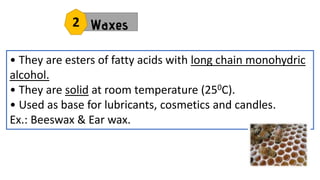
• They are esters of fatty acids with long chain monohydric
alcohol.
• They are solid at room temperature (250C).
• Used as base for lubricants, cosmetics and candles.
Ex.: Beeswax & Ear wax.
2
Simple Lipid
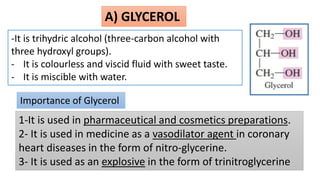
A) GLYCEROL
-It is trihydric alcohol (three-carbon alcohol with
three hydroxyl groups).
- It is colourless and viscid fluid with sweet taste.
- It is miscible with water.
Importance of Glycerol
1-It is used in pharmaceutical and cosmetics preparations.
2- It is used in medicine as a vasodilator agent in coronary
heart diseases in the form of nitro-glycerine.
3- It is used as an explosive in the form of trinitroglycerine
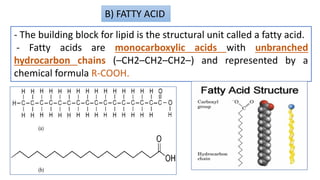
B) FATTY ACID
- The building block for lipid is the structural unit called a fatty acid.
- Fatty acids are monocarboxylic acids with unbranched
hydrocarbon chains (–CH2–CH2–CH2–) and represented by a
chemical formula R-COOH.
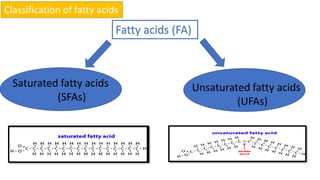
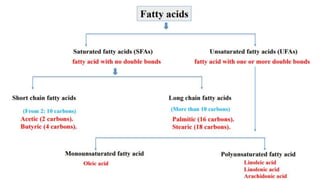
Classification of fatty acids
Fatty acids (FA)
Saturated fatty acids
(SFAs)
Unsaturated fatty acids
(UFAs)
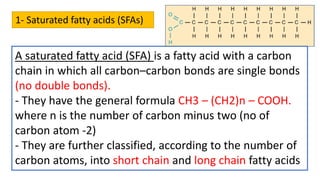
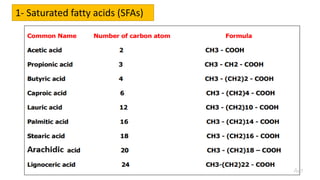
1- Saturated fatty acids (SFAs)
A saturated fatty acid (SFA) is a fatty acid with a carbon
chain in which all carbon–carbon bonds are single bonds
(no double bonds).
- They have the general formula CH3 – (CH2)n – COOH.
where n is the number of carbon minus two (no of
carbon atom -2)
- They are further classified, according to the number of
carbon atoms, into short chain and long chain fatty acids
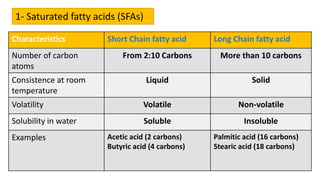
1- Saturated fatty acids (SFAs)
Characteristics Short Chain fatty acid Long Chain fatty acid
Number of carbon
atoms
From 2:10 Carbons More than 10 carbons
Consistence at room
temperature
Liquid Solid
Volatility Volatile Non-volatile
Solubility in water Soluble Insoluble
Examples Acetic acid (2 carbons)
Butyric acid (4 carbons)
Palmitic acid (16 carbons)
Stearic acid (18 carbons)
1- Saturated fatty acids (SFAs)
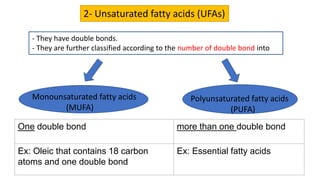
2- Unsaturated fatty acids (UFAs)
- They have double bonds.
- They are further classified according to the number of double bond into
Monounsaturated fatty acids
(MUFA)
Polyunsaturated fatty acids
(PUFA)
One double bond more than one double bond
Ex: Oleic that contains 18 carbon
atoms and one double bond
Ex: Essential fatty acids
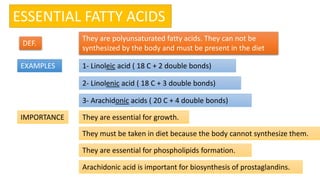
ESSENTIAL FATTY ACIDS
DEF.
EXAMPLES
IMPORTANCE
1- Linoleic acid ( 18 C + 2 double bonds)
2- Linolenic acid ( 18 C + 3 double bonds)
3- Arachidonic acids ( 20 C + 4 double bonds)
They are essential for growth.
They must be taken in diet because the body cannot synthesize them.
They are essential for phospholipids formation.
Arachidonic acid is important for biosynthesis of prostaglandins.
They are polyunsaturated fatty acids. They can not be
synthesized by the body and must be present in the diet
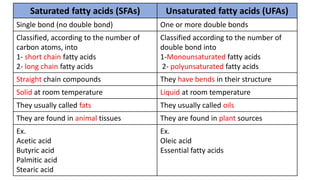
Saturated fatty acids (SFAs) Unsaturated fatty acids (UFAs)
Single bond (no double bond) One or more double bonds
Classified, according to the number of
carbon atoms, into
1- short chain fatty acids
2- long chain fatty acids
Classified according to the number of
double bond into
1-Monounsaturated fatty acids
2- polyunsaturated fatty acids
Straight chain compounds They have bends in their structure
Solid at room temperature Liquid at room temperature
They usually called fats They usually called oils
They are found in animal tissues They are found in plant sources
Ex.
Acetic acid
Butyric acid
Palmitic acid
Stearic acid
Ex.
Oleic acid
Essential fatty acids
Questions
simple lipid biochemistry by dina aborya.pdf

simple lipid biochemistry by dina aborya.pdf

  • 1.
    LIPID BIOCHEMISTRY Dr DinaAboraya Lecture 3
  • 2.
  • 3.
    Storage Form ofenergy e.g. triglycerides in adipose tissues. Lipid are major structural components of cell membranes e.g. phospholipids, glycolipids and cholesterol. Lipids surround and insulate vital body organs e.g. kidneys Lipids are important dietary constituents because of fat soluble vitamins (A, D, E and K) and essential fatty acids which present in food. Cholesterol: A precursor of many steroid hormones and Vitamin D. 2 1 3 4 IMPORTANCE OF LIPIDS 5
  • 4.
    CHARACTERISTICS OF LIPIDS Lipidsare organic compounds known as fats provide a major source of storing chemical energy in the body. Lipids are hydrophobic, i.e. they are not soluble in water, due to presence of hydrocarbon chain ( – CH2 – CH2 – CH2 -) in their structure. Lipids are soluble in fat solvents such as ether, chloroform and acetone
  • 5.
    CLASSIFICATION OF LIPIDS SIMPLELIPIDS COMPOUND LIPIDS DERIVED LIPIDS Esters of Fatty acids with alcohols Simple lipids and other non-lipid part. Derived from simple or compound lipids by hydrolysis Fats & oils Waxes Phospholipids Glycolipids Sulpholipids Lipoproteins Fatty acids Glycerol Steroids DEF EX.
  • 6.
    1-SIMPLE LIPIDS They areesters of fatty acids with various alcohols. Fats and oils Waxes 1 Esters of FA with glycerol. Esters of FA with alcohol other than glycerol. They are classified according to the type of alcohol into: 2
  • 7.
    SIMPLE LIPIDS They areesters of fatty acids with alcohols. The alcohol may be glycerol or long chain alcohol other than glycerol. Fatty acid + Alcohol → Ester + Water R1 – COOH +R1 – OH → RCOOR1 + H2O
  • 8.
    1 Fats&oils/ Triacylglycerols (TAG)/Neutral fats • They are esters of fatty acids with glycerol. • They are called triglycerides because they are triesters formed of glycerol and 3 fatty acids linked together by ester bond. • A fat is a solid at room temperature (250C), and obtained from animal sources. • An oil is a liquid at room temperature (250C) and obtained from plant sources.
  • 9.
    Storage form offats and stored in adipose tissue. Types of TG: A- Simple TG: Esterification of 3 -OH groups of glycerol with the 3 same fatty acid. E.g. palmitic acid or stearic acid forming tripalmitate or tristearate respectively. B- Mixed TG: Esterification of 3 -OH groups of glycerol with the 3 different fatty acids. Fats & oils/ Triacylglycerols (TAG)/ Neutral fats 1
  • 10.
    Waxes • They areesters of fatty acids with long chain monohydric alcohol. • They are solid at room temperature (250C). • Used as base for lubricants, cosmetics and candles. Ex.: Beeswax & Ear wax. 2
  • 11.
  • 12.
    A) GLYCEROL -It istrihydric alcohol (three-carbon alcohol with three hydroxyl groups). - It is colourless and viscid fluid with sweet taste. - It is miscible with water. Importance of Glycerol 1-It is used in pharmaceutical and cosmetics preparations. 2- It is used in medicine as a vasodilator agent in coronary heart diseases in the form of nitro-glycerine. 3- It is used as an explosive in the form of trinitroglycerine
  • 13.
    B) FATTY ACID -The building block for lipid is the structural unit called a fatty acid. - Fatty acids are monocarboxylic acids with unbranched hydrocarbon chains (–CH2–CH2–CH2–) and represented by a chemical formula R-COOH.
  • 14.
    Classification of fattyacids Fatty acids (FA) Saturated fatty acids (SFAs) Unsaturated fatty acids (UFAs)
  • 15.
    1- Saturated fattyacids (SFAs) A saturated fatty acid (SFA) is a fatty acid with a carbon chain in which all carbon–carbon bonds are single bonds (no double bonds). - They have the general formula CH3 – (CH2)n – COOH. where n is the number of carbon minus two (no of carbon atom -2) - They are further classified, according to the number of carbon atoms, into short chain and long chain fatty acids
  • 16.
    1- Saturated fattyacids (SFAs) Characteristics Short Chain fatty acid Long Chain fatty acid Number of carbon atoms From 2:10 Carbons More than 10 carbons Consistence at room temperature Liquid Solid Volatility Volatile Non-volatile Solubility in water Soluble Insoluble Examples Acetic acid (2 carbons) Butyric acid (4 carbons) Palmitic acid (16 carbons) Stearic acid (18 carbons)
  • 17.
    1- Saturated fattyacids (SFAs)
  • 18.
    2- Unsaturated fattyacids (UFAs) - They have double bonds. - They are further classified according to the number of double bond into Monounsaturated fatty acids (MUFA) Polyunsaturated fatty acids (PUFA) One double bond more than one double bond Ex: Oleic that contains 18 carbon atoms and one double bond Ex: Essential fatty acids
  • 19.
    ESSENTIAL FATTY ACIDS DEF. EXAMPLES IMPORTANCE 1-Linoleic acid ( 18 C + 2 double bonds) 2- Linolenic acid ( 18 C + 3 double bonds) 3- Arachidonic acids ( 20 C + 4 double bonds) They are essential for growth. They must be taken in diet because the body cannot synthesize them. They are essential for phospholipids formation. Arachidonic acid is important for biosynthesis of prostaglandins. They are polyunsaturated fatty acids. They can not be synthesized by the body and must be present in the diet
  • 20.
    Saturated fatty acids(SFAs) Unsaturated fatty acids (UFAs) Single bond (no double bond) One or more double bonds Classified, according to the number of carbon atoms, into 1- short chain fatty acids 2- long chain fatty acids Classified according to the number of double bond into 1-Monounsaturated fatty acids 2- polyunsaturated fatty acids Straight chain compounds They have bends in their structure Solid at room temperature Liquid at room temperature They usually called fats They usually called oils They are found in animal tissues They are found in plant sources Ex. Acetic acid Butyric acid Palmitic acid Stearic acid Ex. Oleic acid Essential fatty acids
  • 22.