The document discusses how great leaders are able to inspire people to act, rather than simply motivate them through incentives or threats. It provides examples of the Wright brothers, Apple, and Martin Luther King Jr, who were able to inspire large groups of people through a shared purpose or vision. These leaders created a following of supporters who acted not because they had to, but because they wanted to. The document argues that while motivation can elicit behavior, true inspiration is more powerful and sustainable over the long term. It allows leaders to have disproportionate influence and create extremely loyal customers and employees.





![CARROTS AND STICKS
27
To quote my mother, "If your friends put their head in the oven,
would you do that too?" Sadly, if Michael Jordan or Tiger Woods
was paid to do just that, it might actually start a trend.
Novelty (a.k.a. Innovation)
"In a major innovation in design and engineering, [Motorola] has
created a phone of firsts," read a 2004 press release that announced
the launch of the mobile phone manufacturer's newest entry to the
ultracompetitive mobile phone market. "The combination of metals,
such as aircraft-grade aluminum, with new advances, such as an
internal antenna and a chemically-etched keypad, led to the for-
mation of a device that measures just 13.9mm thin."
And it worked. Millions of people rushed to get one. Celebrities
flashed their RAZRs on the red carpet. Even a prime minister or two
was seen talking on one. Having sold over 50 million units, few
could argue that the RAZR wasn't a huge success. "By surpassing
current mobile expectations, the RAZR represents Motorola's his-
tory of delivering revolutionary innovations," said former Motorola
CEO Ed Zander of his new wunder-product, "while setting a new
bar for future products coming out of the wireless industry."
This one product was a huge financial success for Motorola. This
was truly an innovation of monumental proportions.
Or was it?
Less than four years later, Zander was forced out. The stock
traded at 50 percent of its average value since the launch of the
RAZR, and Motorola's competitors had easily surpassed the RAZR's
features and functionalities with equally innovative new phones.
Motorola was once again rendered just another mobile phone
manufacturer fighting for its piece of the pie. Like so many before it,
the company confused innovation with novelty.](https://image.slidesharecdn.com/simon-sinek-start-with-why-221112145815-355f2750/85/simon-sinek-start-with-why-pdf-34-320.jpg)










![STATUS BUT WHY, BUT KNOW HOW
153
was something else: he knew what it would take to realize that
dream, and he showed people HOW to do it. He gave the dream
structure. Dr. King spoke about the philosophical implications of
the movement, while Abernathy, Dr. King's onetime mentor, long-
time friend and financial secretary and treasurer of the Southern
Christian Leadership Conference, would help people understand
the specific steps they needed to take. "Now," Abernathy would tell
the audience following a rousing address by Dr. King, "let me tell
you what that means for tomorrow morning."
Dr. Martin Luther King Jr. was the leader, but he didn't change
America alone. Though Dr. King inspired the movement, to actually
move people requires organizing. As is the case with almost all
great leaders, there were others around Dr. King who knew better
HOW to do that. For every great leader, for every WHY-type, there
is an inspired HOW-type or group of HOW-types who take the
intangible cause and build the infrastructure that can give it life.
That infrastructure is what actually makes any measurable change
or success possible.
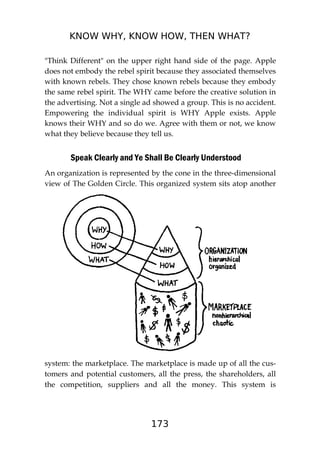
The leader sits at the top of the cone—at the start, the point of
WHY—while the HOW-types sit below and are responsible for ac-
tually making things happen. The leader imagines the destination
and the HOW-types find the route to get there. A destination
without a route leads to meandering and inefficiency, something a
great many WHY-types will experience without the help of others to
ground them. A route without a destination, however, may be
efficient, but to what end? It's all fine and good to know how to
drive, but it's more fulfilling when you have a place to go. For Dr.
King, Ralph Abernathy was one of those he inspired and who knew
HOW to make the cause actionable and tangible. "Dr. King's job was
to interpret the ideology and theology of non-violence," said
Abernathy. "My job was more simple and down-to-earth. I would
tell [people], 'Don't ride those buses."'](https://image.slidesharecdn.com/simon-sinek-start-with-why-221112145815-355f2750/85/simon-sinek-start-with-why-pdf-160-320.jpg)







![SPLIT HAPPENS
213
Feeling like WHAT she was doing was completely out of balance
with her WHY, Harbridge decided there had to be another way to
go in my head that I was going to start an agency that collected by
being nice," she said. People in the collections business though
Harbridge naive, if not crazy. And maybe she was.
In 1993, Harbridge moved to San Francisco and started her own
collections firm, Bridgeport Financial, steeped in the belief that
agents would have more success treating people with respect that
badgering them. Harbridge built her company on her WHY—that
everyone has a story and everyone deserves to be listened to Her
approach was to have her agents try to establish rapport with the
debtor on the other end of the phone in the course of a three minute
conversation. The goal was to learn everything they could about the
person's circumstances: Did they have the means to pa] the debt?
Would they honor a payment plan? Was the reason for the failure to
pay reflective of a short-term situation? "We would get people to tell
us the truth," she said. "Sure, we had a legal department, but we
tried to avoid using it." Harbridge knew, however, that no matter
her intentions, if she measured the results the same was as others,
the same awful behavior would result. So she came with an entirely
new way to incentivize her people. She found a way to measure
WHY.
At Bridgeport Financial, bonuses were not given for the amount
of money that was collected; they were given based on how many
"thank you" cards her agents sent out. This is harder than it sounds.
Sending out a card thanking someone for the time they spent talking
on the phone requires a few things. First, Harbridge had to hire
people who believed what she believed. She had to hire good fits. If
her employees didn't believe that everyone deserves to be listened
to, it wouldn't work. Only good-fit hires would be capable of creat-
ing an environment on the telephone that would actually warrant
sending a thank-you card, even though the purpose of the call was](https://image.slidesharecdn.com/simon-sinek-start-with-why-221112145815-355f2750/85/simon-sinek-start-with-why-pdf-220-320.jpg)