State Innovation Models Initiative:
     Overview for Governors

                    Centers for Medicare and
                    Medicaid Services

                    August 6, 2012
                    Webinar
Agenda


Background: CMS Innovation Center & State Innovation Models Initiative

State Health Care Innovation Plans

Model Design Planning

Model Testing

Performance Improvement and Model Evaluation

Resources Available to States

Award Timeline and Next Steps


                                                                         2
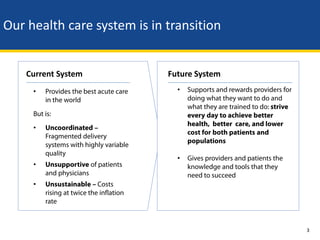
Our health care system is in transition


    Current System                       Future System
     •   Provides the best acute care      •   Supports and rewards providers for
         in the world                          doing what they want to do and
                                               what they are trained to do: strive
     But is:                                   every day to achieve better
                                               health, better care, and lower
     •   Uncoordinated –
                                               cost for both patients and
         Fragmented delivery
                                               populations
         systems with highly variable
         quality
                                           •   Gives providers and patients the
     •   Unsupportive of patients              knowledge and tools that they
         and physicians                        need to succeed
     •   Unsustainable – Costs
         rising at twice the inflation
         rate


                                                                                     3
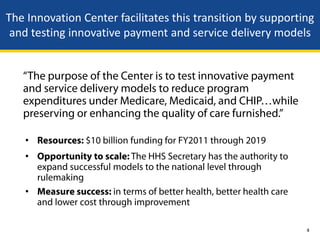
The Innovation Center facilitates this transition by supporting
 and testing innovative payment and service delivery models


   “The purpose of the Center is to test innovative payment
   and service delivery models to reduce program
   expenditures under Medicare, Medicaid, and CHIP…while
   preserving or enhancing the quality of care furnished.”

   • Resources: $10 billion funding for FY2011 through 2019
   • Opportunity to scale: The HHS Secretary has the authority to
     expand successful models to the national level through
     rulemaking
   • Measure success: in terms of better health, better health care
     and lower cost through improvement

                                                                      4
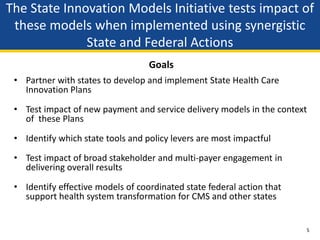
The State Innovation Models Initiative tests impact of
 these models when implemented using synergistic
              State and Federal Actions
                                   Goals
 • Partner with states to develop and implement State Health Care
   Innovation Plans

 • Test impact of new payment and service delivery models in the context
   of these Plans

 • Identify which state tools and policy levers are most impactful

 • Test impact of broad stakeholder and multi-payer engagement in
   delivering overall results

 • Identify effective models of coordinated state federal action that
   support health system transformation for CMS and other states


                                                                        5
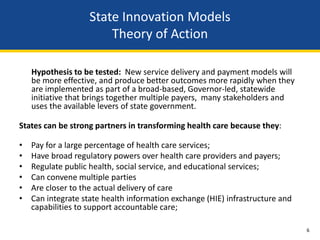
State Innovation Models
                        Theory of Action

    Hypothesis to be tested: New service delivery and payment models will
    be more effective, and produce better outcomes more rapidly when they
    are implemented as part of a broad-based, Governor-led, statewide
    initiative that brings together multiple payers, many stakeholders and
    uses the available levers of state government.

States can be strong partners in transforming health care because they:

•   Pay for a large percentage of health care services;
•   Have broad regulatory powers over health care providers and payers;
•   Regulate public health, social service, and educational services;
•   Can convene multiple parties
•   Are closer to the actual delivery of care
•   Can integrate state health information exchange (HIE) infrastructure and
    capabilities to support accountable care;

                                                                               6
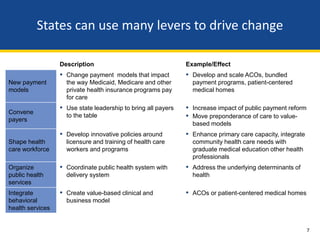
States can use many levers to drive change

Approach          Description                                  Example/Effect
                  ▪ Change payment models that impact          ▪ Develop and scale ACOs, bundled
New payment         the way Medicaid, Medicare and other         payment programs, patient-centered
models              private health insurance programs pay        medical homes
                    for care
                  ▪ Use state leadership to bring all payers   ▪ Increase impact of public payment reform
Convene
payers
                    to the table                               ▪ Move preponderance of care to value-
                                                                 based models
                  ▪ Develop innovative policies around         ▪ Enhance primary care capacity, integrate
Shape health        licensure and training of health care        community health care needs with
care workforce      workers and programs                         graduate medical education other health
                                                                 professionals
Organize          ▪ Coordinate public health system with       ▪ Address the underlying determinants of
public health       delivery system                              health
services
Integrate         ▪ Create value-based clinical and            ▪ ACOs or patient-centered medical homes
behavioral          business model
health services


                                                                                                            7
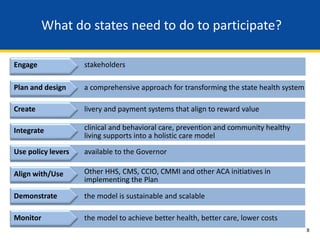
What do states need to do to participate?

Engage              stakeholders

Plan and design     a comprehensive approach for transforming the state health system

Create              livery and payment systems that align to reward value

Integrate           clinical and behavioral care, prevention and community healthy
                    living supports into a holistic care model

Use policy levers   available to the Governor

Align with/Use      Other HHS, CMS, CCIO, CMMI and other ACA initiatives in
                    implementing the Plan

Demonstrate         the model is sustainable and scalable

Monitor             the model to achieve better health, better care, lower costs
                                                                                        8
Agenda


Background: CMS Innovation Center & State Innovation Models Initiative

State Health Care Innovation Plans

Model Design Planning

Model Testing

Performance Improvement and Model Evaluation

Resources Available to States

Award Timeline and Next Steps


                                                                         9
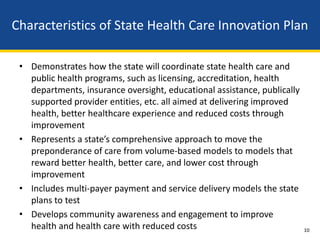
Characteristics of State Health Care Innovation Plan

 • Demonstrates how the state will coordinate state health care and
   public health programs, such as licensing, accreditation, health
   departments, insurance oversight, educational assistance, publically
   supported provider entities, etc. all aimed at delivering improved
   health, better healthcare experience and reduced costs through
   improvement
 • Represents a state’s comprehensive approach to move the
   preponderance of care from volume-based models to models that
   reward better health, better care, and lower cost through
   improvement
 • Includes multi-payer payment and service delivery models the state
   plans to test
 • Develops community awareness and engagement to improve
   health and health care with reduced costs                              10
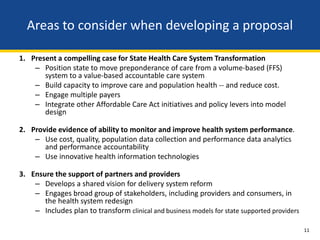
Areas to consider when developing a proposal

1. Present a compelling case for State Health Care System Transformation
    – Position state to move preponderance of care from a volume-based (FFS)
       system to a value-based accountable care system
    – Build capacity to improve care and population health -- and reduce cost.
    – Engage multiple payers
    – Integrate other Affordable Care Act initiatives and policy levers into model
       design

2. Provide evidence of ability to monitor and improve health system performance.
    – Use cost, quality, population data collection and performance data analytics
       and performance accountability
    – Use innovative health information technologies

3. Ensure the support of partners and providers
    – Develops a shared vision for delivery system reform
    – Engages broad group of stakeholders, including providers and consumers, in
       the health system redesign
    – Includes plan to transform clinical and business models for state supported providers

                                                                                              11
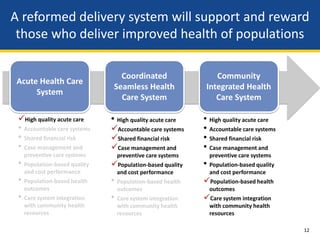
A reformed delivery system will support and reward
 those who deliver improved health of populations


                                                 12
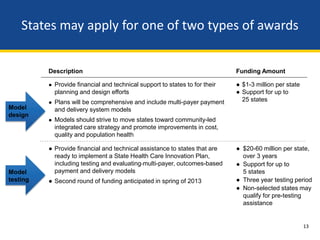
States may apply for one of two types of awards


Award Type   Description                                                        Funding Amount

             ● Provide financial and technical support to states to for their   ● $1-3 million per state
               planning and design efforts                                      ● Support for up to
             ● Plans will be comprehensive and include multi-payer payment        25 states
Model          and delivery system models
design
             ● Models should strive to move states toward community-led
               integrated care strategy and promote improvements in cost,
               quality and population health

             ● Provide financial and technical assistance to states that are    ● $20-60 million per state,
               ready to implement a State Health Care Innovation Plan,            over 3 years
               including testing and evaluating multi-payer, outcomes-based     ● Support for up to
Model          payment and delivery models                                        5 states
testing      ● Second round of funding anticipated in spring of 2013            ● Three year testing period
                                                                                ● Non-selected states may
                                                                                  qualify for pre-testing
                                                                                  assistance


                                                                                                           13
Agenda


Background: CMS Innovation Center & State Innovation Models Initiative

State Health Care Innovation Plans

Model Design Planning

Model Testing

Performance Improvement and Model Evaluation

Resources Available to States

Award Timeline and Next Steps


                                                                         14
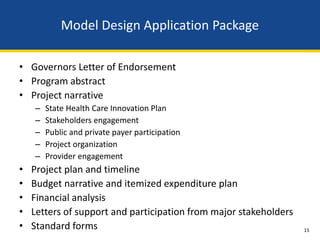
Model Design Application Package

• Governors Letter of Endorsement
• Program abstract
• Project narrative
    –   State Health Care Innovation Plan
    –   Stakeholders engagement
    –   Public and private payer participation
    –   Project organization
    –   Provider engagement
•   Project plan and timeline
•   Budget narrative and itemized expenditure plan
•   Financial analysis
•   Letters of support and participation from major stakeholders
•   Standard forms                                                 15
Agenda


Background: CMS Innovation Center & State Innovation Models Initiative

State Health Care Innovation Plans

Model Design Planning

Model Testing

Performance Improvement and Model Evaluation

Resources Available to States

Award Timeline and Next Steps


                                                                         16
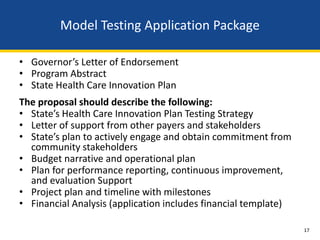
Model Testing Application Package

• Governor’s Letter of Endorsement
• Program Abstract
• State Health Care Innovation Plan
The proposal should describe the following:
• State’s Health Care Innovation Plan Testing Strategy
• Letter of support from other payers and stakeholders
• State’s plan to actively engage and obtain commitment from
  community stakeholders
• Budget narrative and operational plan
• Plan for performance reporting, continuous improvement,
  and evaluation Support
• Project plan and timeline with milestones
• Financial Analysis (application includes financial template)

                                                                 17
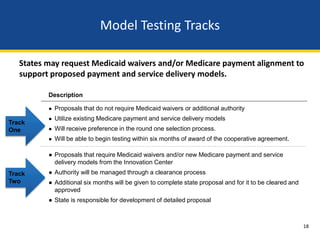
Model Testing Tracks

   States may request Medicaid waivers and/or Medicare payment alignment to
   support proposed payment and service delivery models.

Award Type   Description

             ● Proposals that do not require Medicaid waivers or additional authority
             ● Utilize existing Medicare payment and service delivery models
Track
One          ● Will receive preference in the round one selection process.
             ● Will be able to begin testing within six months of award of the cooperative agreement.

             ● Proposals that require Medicaid waivers and/or new Medicare payment and service
               delivery models from the Innovation Center
Track        ● Authority will be managed through a clearance process
Two          ● Additional six months will be given to complete state proposal and for it to be cleared and
               approved
             ● State is responsible for development of detailed proposal


                                                                                                             18
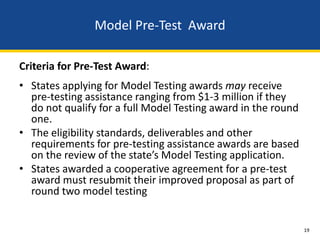
Model Pre-Test Award

Criteria for Pre-Test Award:
• States applying for Model Testing awards may receive
  pre-testing assistance ranging from $1-3 million if they
  do not qualify for a full Model Testing award in the round
  one.
• The eligibility standards, deliverables and other
  requirements for pre-testing assistance awards are based
  on the review of the state’s Model Testing application.
• States awarded a cooperative agreement for a pre-test
  award must resubmit their improved proposal as part of
  round two model testing


                                                               19
Agenda


Background: CMS Innovation Center & State Innovation Models Initiative

State Health Care Innovation Plans

Model Design Planning

Model Testing

Performance Improvement and Model Evaluation

Resources Available to States

Award Timeline and Next Steps


                                                                         20
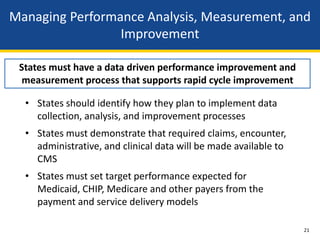
Managing Performance Analysis, Measurement, and
                 Improvement

 States must have a data driven performance improvement and
  measurement process that supports rapid cycle improvement

  • States should identify how they plan to implement data
    collection, analysis, and improvement processes
  • States must demonstrate that required claims, encounter,
    administrative, and clinical data will be made available to
    CMS
  • States must set target performance expected for
    Medicaid, CHIP, Medicare and other payers from the
    payment and service delivery models

                                                                  21
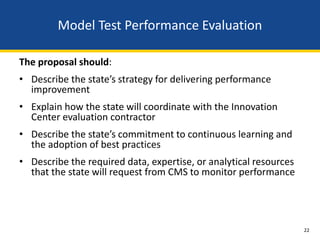
Model Test Performance Evaluation

The proposal should:
• Describe the state’s strategy for delivering performance
  improvement
• Explain how the state will coordinate with the Innovation
  Center evaluation contractor
• Describe the state’s commitment to continuous learning and
  the adoption of best practices
• Describe the required data, expertise, or analytical resources
  that the state will request from CMS to monitor performance


                                                                   22
Agenda


Background: CMS Innovation Center & State Innovation Models Initiative

State Health Care Innovation Plans

Model Design Planning

Model Testing

Performance Improvement and Model Evaluation

Resources Available to States

Award Timeline and Next Steps


                                                                         23
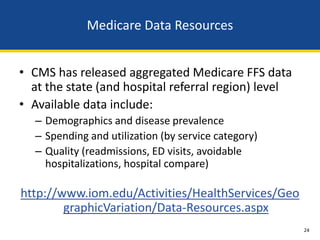
Medicare Data Resources


• CMS has released aggregated Medicare FFS data
  at the state (and hospital referral region) level
• Available data include:
  – Demographics and disease prevalence
  – Spending and utilization (by service category)
  – Quality (readmissions, ED visits, avoidable
    hospitalizations, hospital compare)

http://www.iom.edu/Activities/HealthServices/Geo
        graphicVariation/Data-Resources.aspx
                                                      24
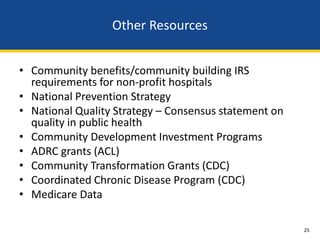
Other Resources


• Community benefits/community building IRS
  requirements for non-profit hospitals
• National Prevention Strategy
• National Quality Strategy – Consensus statement on
  quality in public health
• Community Development Investment Programs
• ADRC grants (ACL)
• Community Transformation Grants (CDC)
• Coordinated Chronic Disease Program (CDC)
• Medicare Data

                                                       25
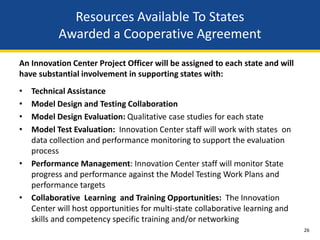
Resources Available To States
           Awarded a Cooperative Agreement
An Innovation Center Project Officer will be assigned to each state and will
have substantial involvement in supporting states with:
•   Technical Assistance
•   Model Design and Testing Collaboration
•   Model Design Evaluation: Qualitative case studies for each state
•   Model Test Evaluation: Innovation Center staff will work with states on
    data collection and performance monitoring to support the evaluation
    process
•   Performance Management: Innovation Center staff will monitor State
    progress and performance against the Model Testing Work Plans and
    performance targets
•   Collaborative Learning and Training Opportunities: The Innovation
    Center will host opportunities for multi-state collaborative learning and
    skills and competency specific training and/or networking
                                                                                26
Agenda


Background: CMS Innovation Center & State Innovation Models Initiative

State Health Care Innovation Plans

Model Design Planning

Model Testing

Performance Improvement and Model Evaluation

Resources Available to States

Award Timeline and Next Steps


                                                                         27
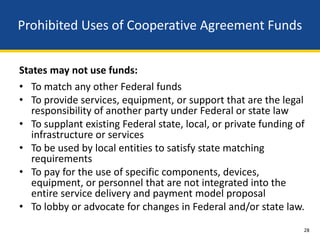
Prohibited Uses of Cooperative Agreement Funds


States may not use funds:
• To match any other Federal funds
• To provide services, equipment, or support that are the legal
   responsibility of another party under Federal or state law
• To supplant existing Federal state, local, or private funding of
   infrastructure or services
• To be used by local entities to satisfy state matching
   requirements
• To pay for the use of specific components, devices,
   equipment, or personnel that are not integrated into the
   entire service delivery and payment model proposal
• To lobby or advocate for changes in Federal and/or state law.
                                                                 28
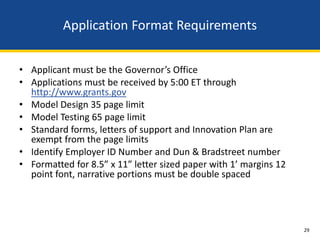
Application Format Requirements


• Applicant must be the Governor’s Office
• Applications must be received by 5:00 ET through
  http://www.grants.gov
• Model Design 35 page limit
• Model Testing 65 page limit
• Standard forms, letters of support and Innovation Plan are
  exempt from the page limits
• Identify Employer ID Number and Dun & Bradstreet number
• Formatted for 8.5” x 11” letter sized paper with 1’ margins 12
  point font, narrative portions must be double spaced


                                                                   29
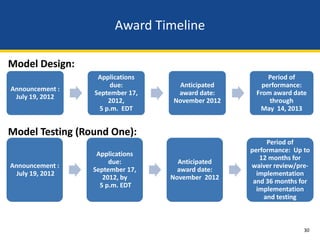
Award Timeline


                 30
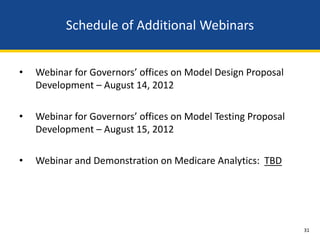
Schedule of Additional Webinars


•   Webinar for Governors’ offices on Model Design Proposal
    Development – August 14, 2012

•   Webinar for Governors’ offices on Model Testing Proposal
    Development – August 15, 2012

•   Webinar and Demonstration on Medicare Analytics: TBD


                                                               31
Additional Information and How to Contact SIM


• Additional webinars will be scheduled for state policy makers –
  these will focus on Model Design and Model Testing

• Submit questions to stateinnovations@cms.hhs.gov
  (Note: States may wish to create a similar in-box for your
  stakeholders)

• FAQ will be updated and posted to the Innovation Center website at
  innovation.cms.gov

• Additional information is available on our website:
  http://www.innovation.cms.gov/initiatives/state-innovations

                                                                       32

Webinar: State Innovation Models Initiative - Overview for State Officials

  • 1.
    State Innovation ModelsInitiative: Overview for Governors Centers for Medicare and Medicaid Services August 6, 2012 Webinar
  • 2.
    Agenda Background: CMS InnovationCenter & State Innovation Models Initiative State Health Care Innovation Plans Model Design Planning Model Testing Performance Improvement and Model Evaluation Resources Available to States Award Timeline and Next Steps 2
  • 3.
    Our health caresystem is in transition Current System Future System • Provides the best acute care • Supports and rewards providers for in the world doing what they want to do and what they are trained to do: strive But is: every day to achieve better health, better care, and lower • Uncoordinated – cost for both patients and Fragmented delivery populations systems with highly variable quality • Gives providers and patients the • Unsupportive of patients knowledge and tools that they and physicians need to succeed • Unsustainable – Costs rising at twice the inflation rate 3
  • 4.
    The Innovation Centerfacilitates this transition by supporting and testing innovative payment and service delivery models “The purpose of the Center is to test innovative payment and service delivery models to reduce program expenditures under Medicare, Medicaid, and CHIP…while preserving or enhancing the quality of care furnished.” • Resources: $10 billion funding for FY2011 through 2019 • Opportunity to scale: The HHS Secretary has the authority to expand successful models to the national level through rulemaking • Measure success: in terms of better health, better health care and lower cost through improvement 4
  • 5.
    The State InnovationModels Initiative tests impact of these models when implemented using synergistic State and Federal Actions Goals • Partner with states to develop and implement State Health Care Innovation Plans • Test impact of new payment and service delivery models in the context of these Plans • Identify which state tools and policy levers are most impactful • Test impact of broad stakeholder and multi-payer engagement in delivering overall results • Identify effective models of coordinated state federal action that support health system transformation for CMS and other states 5
  • 6.
    State Innovation Models Theory of Action Hypothesis to be tested: New service delivery and payment models will be more effective, and produce better outcomes more rapidly when they are implemented as part of a broad-based, Governor-led, statewide initiative that brings together multiple payers, many stakeholders and uses the available levers of state government. States can be strong partners in transforming health care because they: • Pay for a large percentage of health care services; • Have broad regulatory powers over health care providers and payers; • Regulate public health, social service, and educational services; • Can convene multiple parties • Are closer to the actual delivery of care • Can integrate state health information exchange (HIE) infrastructure and capabilities to support accountable care; 6
  • 7.
    States can usemany levers to drive change Approach Description Example/Effect ▪ Change payment models that impact ▪ Develop and scale ACOs, bundled New payment the way Medicaid, Medicare and other payment programs, patient-centered models private health insurance programs pay medical homes for care ▪ Use state leadership to bring all payers ▪ Increase impact of public payment reform Convene payers to the table ▪ Move preponderance of care to value- based models ▪ Develop innovative policies around ▪ Enhance primary care capacity, integrate Shape health licensure and training of health care community health care needs with care workforce workers and programs graduate medical education other health professionals Organize ▪ Coordinate public health system with ▪ Address the underlying determinants of public health delivery system health services Integrate ▪ Create value-based clinical and ▪ ACOs or patient-centered medical homes behavioral business model health services 7
  • 8.
    What do statesneed to do to participate? Engage stakeholders Plan and design a comprehensive approach for transforming the state health system Create livery and payment systems that align to reward value Integrate clinical and behavioral care, prevention and community healthy living supports into a holistic care model Use policy levers available to the Governor Align with/Use Other HHS, CMS, CCIO, CMMI and other ACA initiatives in implementing the Plan Demonstrate the model is sustainable and scalable Monitor the model to achieve better health, better care, lower costs 8
  • 9.
    Agenda Background: CMS InnovationCenter & State Innovation Models Initiative State Health Care Innovation Plans Model Design Planning Model Testing Performance Improvement and Model Evaluation Resources Available to States Award Timeline and Next Steps 9
  • 10.
    Characteristics of StateHealth Care Innovation Plan • Demonstrates how the state will coordinate state health care and public health programs, such as licensing, accreditation, health departments, insurance oversight, educational assistance, publically supported provider entities, etc. all aimed at delivering improved health, better healthcare experience and reduced costs through improvement • Represents a state’s comprehensive approach to move the preponderance of care from volume-based models to models that reward better health, better care, and lower cost through improvement • Includes multi-payer payment and service delivery models the state plans to test • Develops community awareness and engagement to improve health and health care with reduced costs 10
  • 11.
    Areas to considerwhen developing a proposal 1. Present a compelling case for State Health Care System Transformation – Position state to move preponderance of care from a volume-based (FFS) system to a value-based accountable care system – Build capacity to improve care and population health -- and reduce cost. – Engage multiple payers – Integrate other Affordable Care Act initiatives and policy levers into model design 2. Provide evidence of ability to monitor and improve health system performance. – Use cost, quality, population data collection and performance data analytics and performance accountability – Use innovative health information technologies 3. Ensure the support of partners and providers – Develops a shared vision for delivery system reform – Engages broad group of stakeholders, including providers and consumers, in the health system redesign – Includes plan to transform clinical and business models for state supported providers 11
  • 12.
    A reformed deliverysystem will support and reward those who deliver improved health of populations 12
  • 13.
    States may applyfor one of two types of awards Award Type Description Funding Amount ● Provide financial and technical support to states to for their ● $1-3 million per state planning and design efforts ● Support for up to ● Plans will be comprehensive and include multi-payer payment 25 states Model and delivery system models design ● Models should strive to move states toward community-led integrated care strategy and promote improvements in cost, quality and population health ● Provide financial and technical assistance to states that are ● $20-60 million per state, ready to implement a State Health Care Innovation Plan, over 3 years including testing and evaluating multi-payer, outcomes-based ● Support for up to Model payment and delivery models 5 states testing ● Second round of funding anticipated in spring of 2013 ● Three year testing period ● Non-selected states may qualify for pre-testing assistance 13
  • 14.
    Agenda Background: CMS InnovationCenter & State Innovation Models Initiative State Health Care Innovation Plans Model Design Planning Model Testing Performance Improvement and Model Evaluation Resources Available to States Award Timeline and Next Steps 14
  • 15.
    Model Design ApplicationPackage • Governors Letter of Endorsement • Program abstract • Project narrative – State Health Care Innovation Plan – Stakeholders engagement – Public and private payer participation – Project organization – Provider engagement • Project plan and timeline • Budget narrative and itemized expenditure plan • Financial analysis • Letters of support and participation from major stakeholders • Standard forms 15
  • 16.
    Agenda Background: CMS InnovationCenter & State Innovation Models Initiative State Health Care Innovation Plans Model Design Planning Model Testing Performance Improvement and Model Evaluation Resources Available to States Award Timeline and Next Steps 16
  • 17.
    Model Testing ApplicationPackage • Governor’s Letter of Endorsement • Program Abstract • State Health Care Innovation Plan The proposal should describe the following: • State’s Health Care Innovation Plan Testing Strategy • Letter of support from other payers and stakeholders • State’s plan to actively engage and obtain commitment from community stakeholders • Budget narrative and operational plan • Plan for performance reporting, continuous improvement, and evaluation Support • Project plan and timeline with milestones • Financial Analysis (application includes financial template) 17
  • 18.
    Model Testing Tracks States may request Medicaid waivers and/or Medicare payment alignment to support proposed payment and service delivery models. Award Type Description ● Proposals that do not require Medicaid waivers or additional authority ● Utilize existing Medicare payment and service delivery models Track One ● Will receive preference in the round one selection process. ● Will be able to begin testing within six months of award of the cooperative agreement. ● Proposals that require Medicaid waivers and/or new Medicare payment and service delivery models from the Innovation Center Track ● Authority will be managed through a clearance process Two ● Additional six months will be given to complete state proposal and for it to be cleared and approved ● State is responsible for development of detailed proposal 18
  • 19.
    Model Pre-Test Award Criteriafor Pre-Test Award: • States applying for Model Testing awards may receive pre-testing assistance ranging from $1-3 million if they do not qualify for a full Model Testing award in the round one. • The eligibility standards, deliverables and other requirements for pre-testing assistance awards are based on the review of the state’s Model Testing application. • States awarded a cooperative agreement for a pre-test award must resubmit their improved proposal as part of round two model testing 19
  • 20.
    Agenda Background: CMS InnovationCenter & State Innovation Models Initiative State Health Care Innovation Plans Model Design Planning Model Testing Performance Improvement and Model Evaluation Resources Available to States Award Timeline and Next Steps 20
  • 21.
    Managing Performance Analysis,Measurement, and Improvement States must have a data driven performance improvement and measurement process that supports rapid cycle improvement • States should identify how they plan to implement data collection, analysis, and improvement processes • States must demonstrate that required claims, encounter, administrative, and clinical data will be made available to CMS • States must set target performance expected for Medicaid, CHIP, Medicare and other payers from the payment and service delivery models 21
  • 22.
    Model Test PerformanceEvaluation The proposal should: • Describe the state’s strategy for delivering performance improvement • Explain how the state will coordinate with the Innovation Center evaluation contractor • Describe the state’s commitment to continuous learning and the adoption of best practices • Describe the required data, expertise, or analytical resources that the state will request from CMS to monitor performance 22
  • 23.
    Agenda Background: CMS InnovationCenter & State Innovation Models Initiative State Health Care Innovation Plans Model Design Planning Model Testing Performance Improvement and Model Evaluation Resources Available to States Award Timeline and Next Steps 23
  • 24.
    Medicare Data Resources •CMS has released aggregated Medicare FFS data at the state (and hospital referral region) level • Available data include: – Demographics and disease prevalence – Spending and utilization (by service category) – Quality (readmissions, ED visits, avoidable hospitalizations, hospital compare) http://www.iom.edu/Activities/HealthServices/Geo graphicVariation/Data-Resources.aspx 24
  • 25.
    Other Resources • Communitybenefits/community building IRS requirements for non-profit hospitals • National Prevention Strategy • National Quality Strategy – Consensus statement on quality in public health • Community Development Investment Programs • ADRC grants (ACL) • Community Transformation Grants (CDC) • Coordinated Chronic Disease Program (CDC) • Medicare Data 25
  • 26.
    Resources Available ToStates Awarded a Cooperative Agreement An Innovation Center Project Officer will be assigned to each state and will have substantial involvement in supporting states with: • Technical Assistance • Model Design and Testing Collaboration • Model Design Evaluation: Qualitative case studies for each state • Model Test Evaluation: Innovation Center staff will work with states on data collection and performance monitoring to support the evaluation process • Performance Management: Innovation Center staff will monitor State progress and performance against the Model Testing Work Plans and performance targets • Collaborative Learning and Training Opportunities: The Innovation Center will host opportunities for multi-state collaborative learning and skills and competency specific training and/or networking 26
  • 27.
    Agenda Background: CMS InnovationCenter & State Innovation Models Initiative State Health Care Innovation Plans Model Design Planning Model Testing Performance Improvement and Model Evaluation Resources Available to States Award Timeline and Next Steps 27
  • 28.
    Prohibited Uses ofCooperative Agreement Funds States may not use funds: • To match any other Federal funds • To provide services, equipment, or support that are the legal responsibility of another party under Federal or state law • To supplant existing Federal state, local, or private funding of infrastructure or services • To be used by local entities to satisfy state matching requirements • To pay for the use of specific components, devices, equipment, or personnel that are not integrated into the entire service delivery and payment model proposal • To lobby or advocate for changes in Federal and/or state law. 28
  • 29.
    Application Format Requirements •Applicant must be the Governor’s Office • Applications must be received by 5:00 ET through http://www.grants.gov • Model Design 35 page limit • Model Testing 65 page limit • Standard forms, letters of support and Innovation Plan are exempt from the page limits • Identify Employer ID Number and Dun & Bradstreet number • Formatted for 8.5” x 11” letter sized paper with 1’ margins 12 point font, narrative portions must be double spaced 29
  • 30.
  • 31.
    Schedule of AdditionalWebinars • Webinar for Governors’ offices on Model Design Proposal Development – August 14, 2012 • Webinar for Governors’ offices on Model Testing Proposal Development – August 15, 2012 • Webinar and Demonstration on Medicare Analytics: TBD 31
  • 32.
    Additional Information andHow to Contact SIM • Additional webinars will be scheduled for state policy makers – these will focus on Model Design and Model Testing • Submit questions to stateinnovations@cms.hhs.gov (Note: States may wish to create a similar in-box for your stakeholders) • FAQ will be updated and posted to the Innovation Center website at innovation.cms.gov • Additional information is available on our website: http://www.innovation.cms.gov/initiatives/state-innovations 32