SELF-INSTRUCTIONAL MATERIAL (SIM)/ MODULE
IN ENGLISH 6, QUARTER 1 – WEEK 1
Sound Devices:
 Analyze sound devices (onomatopoeia, alliteration, assonance, consonance)
ENGRC –Ia2.3.1; ENGRC –Ia2.3.2; ENGRC –Ia2.3.3; ENGRC –Ia2.3.9
 Identify the values suggested in the visual media (Poem, video clips)
ENGRC – IIIc – 7.12.3.1
 Show tactfulness when communicating with others
EN6A-Id-17
 Self-correct when reading
EN6F-Ia-2.9
 Show openness to criticism
EN6A-Id-18
 Observe politeness at all times
ENG. 6-Ib-5.1.2
WHAT I KNOW
Let’s Find Out What You Already Know
Before you start studying this module, take the following test first to find out how
much you already know about this topic. Encircle the letter of your choice.
1. What do we call the pieces of writing written in separate lines that usually have
figurative language, repeated and irregular rhythm or rhyme?
a. novel c. short story
b. poem d. legend
2. Which sound device uses repetition of initial consonant sounds?
a. alliteration c. consonance
b. assonance d. onomatopoeia
What I Need To Know
Did you have fun working on your previous lessons in Grade 5 English? Surely, you
enjoyed answering the tasks and did a great job.
Let us move on to another learning experience in English now that you are in
Grade 6. I know you are eager to learn more so get ready to learn new lessons and
perform challenging tasks ahead.
In this Self – Instruction Material (SIM), you will be able to:
 Enumerate sound devices read
 Self-correct when reading
 Identify and distinguish sound devices used in texts
 Give examples of sound devices
 Use sound devices in writing meaningful sentences
 Analyze sound devices (onomatopoeia, alliteration, assonance, consonance)
 Identify the values suggested in the visual media (Poem, video clips)
 Show openness to criticism
 Show tactfulness when communicating with others
 Observe politeness at all times
3. Which sound device refers to words that imitate the sounds of objects or animals?
a. alliteration c. consonance
b. assonance d. onomatopoeia
4. Which sound device focuses on the repetition of similar vowel sounds in the middle or
end words?
a. alliteration c. consonance
b. assonance d. onomatopoeia
5. Which sound device pertains to the repetition of similar consonant sounds in the
middle or end of words?
a. alliteration c. consonance
b. assonance d. onomatopoeia
6. Is this statement, “Mommy made me mash my M & Ms,” an alliteration?
a. Yes b. No c. Maybe d. I don’t know
7. Is “bang” an example of onomatopoeia?
a. Yes b. No c. Maybe d. I don’t know
8. Which word is NOT an example of onomatopoeia?
a. boom b. swat c. splash d. sneeze
9. Which of the following is an example of onomatopoeia?
a. run b. drink c. buzz d. jump
10. Onomatopoeia is the use of words that imitate sound.
a. Yes b. No c. Maybe d. I don’t know
11. Which of these sentences does NOT contain onomatopoeia?
a. The really red rose is beautiful.
b. The floor creaked as I walked across it.
c. The race car screeched down the road.
d. Roses are as red as blood.
12. “Boom, Boom, Boom! Even brighter than a moon, moon.” What is the sound device
used?
a. assonance c. onomatopoeia
b. alliteration d. consonance
13. “Joshua and Janna, juggle, jiggle, jerk and jam.” What sound device is used in this
sentence?
a. assonance c. onomatopoeia
b. alliteration d. consonance
14. “Fleet feet sweep by sleeping geese.” What is the sound device used?
a. assonance c. onomatopoeia
b. alliteration d. consonance
15. Which of the following sentences does not show onomatopoeia?
a. Sally sells seashells by the seashore.
b. Peter Piper picked a peck of pickled peppers.
c. The soul selects its own society.
d. The leaves danced their way through the lawn.
Well, how was it? Do you think you did well? Compare your answers with those
in the Answer Key on page 15 to find out.
If all your answers are correct, very good! This shows that you already know
much about the topic. You may still study the module to review what you already
know. Who knows, you might learn a few more new things as well. If you got a low
score, don’t feel bad. This means that this module is for you. It will help you
understand some important concepts that you can apply in your daily life. If you study
this module carefully you will learn the answers to all the items in the test and a lot
more! Are you ready? You may now go to the next page to begin Lesson 1.
WHAT’S IN
Well, how was it? Do you think you did well? Compare your answers with those
in the Answer Key on page 16 to find out.
If you have remembered all the sound devices and figurative language, very
good. If you missed some, then this is the right time to continue learning them.
WHAT’S NEW
1. Do you love to read poems?
2. What makes a poem different from other literary piece?
3. If you will write a poem, which material do you want to use as title of it?
4. When you hear the word “bell”, what usually comes to your mind?
Now, be ready to read the poem entitled “The Bells”.
Activity #1. Read and Learn
Let us recall the sound devices and figurative language we learned in the
previous lessons. From the set of words below, encircle the sound devices and
underline the figurative language you have remembered.
Alliteration Legend Pronoun Irony
Adjective Essay Verb Hyperbole
Noun Onomatopoeia Consonance Adverb
Metaphor Preposition Conjunction Poem
Assonance Folktale Simile Personification
Answer the following questions about the poem.
1. What is the title of the poem?
______________________________________________________________
2. Who is the author?
______________________________________________________________
3. Where could the setting of this poem be? Give your reasons.
______________________________________________________________
______________________________________________________________
4. This poem tells of the stages in the life of a person. To what stage of one’s life could
the first stanza refer?
______________________________________________________________
5. During the early years of one’s life, when do the bells first ring happily?
______________________________________________________________
6. On what other occasions in life do bells ring?
________________________________________
________________________________________
________________________________________
________________________________________
7. In one of the four stanzas of this poem or stages of life, a sad ringing of the bells
can happen. What could this ringing mean?
________________________________________
8. In what ways can we extend our help to people in distress or those experiencing
difficult times?
_______________________________________________________
_______________________________________________________
_______________________________________________________
Congratulations for answering the questions successfully. Now, let us look at
some lines in the poem and identify the sound devices used by the author to
emphasize them.
Have you noticed some repeated words like…..
How they tinkle, tinkle, tinkle…
Keeping time, time, time….
How about words with the same beginning consonant sound like…
What a world of merriment their melody foretells…
How about words with the same vowel sound in the beginning, middle or
end?
Hear the sledges of the bells…
How about repetition of consonant sounds at the middle or end of at least
two words in a line?
From the jingling and tinkling of the bells…
How about words whose sounds suggest their meanings?
bell tinkle
Let us now learn the sound devices used by authors.
Poems are pieces of writing written in separate lines that usually have figurative
language, repeated and irregular rhythm, rhyme. They convey experiences, ideas, or
emotions in a vivid and imaginative way.
Poems also have sound devices. Sound devices are tools used by poets to
convey and reinforce the meaning or experience of poetry through the skillful use of
sound. After all, poets are trying to use a concentrated blend of sound and imagery to
create an emotional response. In poetry, the words and their order should evoke
images, and the words themselves have sounds, which can emphasize or otherwise
clarify those images.
Since poetry is basically rhythmical, it heavily relies on sound devices to create a
musical effect. The following are types of sound devices:
1. Onomatopoeia. This is a sound device which refers to the use of words whose
sounds suggest their meanings.
Examples:
The bang of a gun The buzz of a bee
The hiss of a snake The pop of a firecracker
*****Note: Suggested Viewing: See Video: ONOMATOPOEIA
https://www.youtube.com/watch?v=I1GC1yWdM_c&t=19s
However, if you cannot access the internet, then let us proceed with the next
sound device.
WHAT IS IT?
Read the following sentences. Note on the highlighted letters or words in each
number.
1. Kaboom! The bite of dynamite cut deep inside the earth!
(excerpt from “Kaboom!” by Denise Rodgers)
2. Peter Piper picked a pack of pickled pepper.
3. Alone, alone, all, all alone,
Alone on a wide wide sea!
(excerpt from “The Rime of Ancient Mariner” by Samuel Taylor Coleridge)
4. Water rushing, gushing, pushing past the limits of the edge
(excerpt from “Great Lakes Rhythm & Rhyme”)
What have you noticed in each sentence?
Which word in the first sentence creates a sound which suggests its meaning?
Are there emphasized sounds in second, third, and fourth sentences?
Are there repeated sounds? Can you identify them?
What sound devices are used in each sentence?
2. Alliteration. This is the repetition of the same initial consonant sounds of at least two
words in a line of poetry.
Alliteration happens when words that start with the same sound are used close
together in a phrase or sentence. The sound is usually consonant and the words don’t
have to be always right next to one another.
Examples:
a. Mary managed to read her messages in the messenger.
b. Little skinny shoulder blades sticking through Stella’s clothes.
c. The frog frolicked frivolously on the forest floor.
d. Jona jumped happily when we played Jumping Jack.
*****Note: Suggested Viewing: See Video: ALLITERATION
https://www.youtube.com/watch?v=1t16V38gZWE&t=284s
However, if you cannot access the internet, then let us proceed with the next
sound device.
3. Assonance. This is the repetition of vowel sounds at the beginning, middle or end of
at least two words in a line of poetry.
Tongue twisters often use a combination of alliteration (repetition of same
beginning consonant sound) and two different forms of assonance-or the repetition of
two different vowel sounds. This is what makes them so difficult to say.
Assonance is used for some of the same reasons as alliteration. It can affect the
rhythm, tone, and mood of a text. The repetition of certain vowel sounds-think short
vowels sounds from the letters u or o-can create a melancholy mood.
Examples:
1. The light of the fire is a sight. (repetition of the long i sound)
2. Go slow over the road. (repetition of the long o sound)
3. Peter Piper picked a peck of pickled peppers (repetition of the short e and long i
sounds)
4. Sally sells sea shells beside the sea shore (repetition of the short e and long e
sounds)
5. Try as I might, the kite did not fly. (repetition of the long i sound)
6. Hear the mellow wedding bells (excerpt from by Edgar Allan Poe)
4. Consonance. This is the repetition of consonant sounds at the middle or end of at
least two words in a line of poetry.
Example: He fumbles at your spirit
As players at the keys
Before they drop full music on;
He stuns you by degrees (by Emily Dickinson)
WHAT’S MORE
These activities will engage you to better understand and distinguish the types of
sound devices. Answer Activity 1 and enjoy matching words to form alliterative phrases.
Good luck.
Activity #2: Alliteration
How did you find the activity? Well, you will know the result of your work later as
we go checking your mastery of the skill introduced in this module.
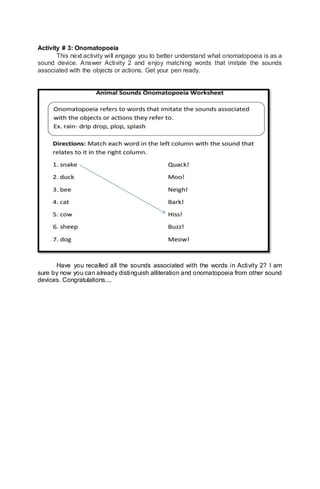
Activity # 3: Onomatopoeia
This next activity will engage you to better understand what onomatopoeia is as a
sound device. Answer Activity 2 and enjoy matching words that imitate the sounds
associated with the objects or actions. Get your pen ready.
Have you recalled all the sounds associated with the words in Activity 2? I am
sure by now you can already distinguish alliteration and onomatopoeia from other sound
devices. Congratulations....
Activity # 4: Fill Me!
This time we will do another activity to deepen our understanding of alliteration
as a sound device. Are you ready to fill the blanks in the following sentences?
Well done! You may read the completed sentences again to better understand
the messages they convey and at the same time, self-correct when reading.
Let us now proceed to the next activity. This will help us analyze the sound
device used by the animals around us. Are you ready to complete the sentences in
Activity 4? An example is done for you to guide you in accomplishing this task.
Activity # 5: Fill Me More!
Directions: Complete each sentence with the “sound word or words” that best fits the
object or animal.
Example: The bird went ___________________________________
Answer: The bird went chirp, chirp, chirp.
1. The dog went __________________________.
2. The cat went __________________________.
3. The duck went __________________________.
4. The snake went __________________________.
5. The bee went __________________________.
6. The cow went __________________________.
7. The gun went __________________________.
8. The car went __________________________.
9. The clock went __________________________.
10.The water went __________________________.
How did you find the activity? Did you enjoy accomplishing it? Well then,
congratulations for reaching this far! Before we proceed, can you now answer the
following questions based on the examples and activities we have discussed and
accomplished?
WHAT I HAVE LEARNED
What are sound devices?
What is alliteration?
What is onomatopoeia?
What is assonance?
What is consonance?
What is the importance of using sound devices in literary pieces?
Wow, that is indeed a great job. Having provided the definitions of the sound
devices we have discussed earlier proves that you learned a lot. Now, are you ready to
explore some more? There are still activities designed for you to deepen your
understanding and mastery of the sound devices. Come and explore some more! Have
fun!
WHAT I CAN DO
Activity # 6: Fill Me Up!
Read the poem below. As you read, note the words from the poem that exemplify
the following sound devices: ALLITERATION, ASSONANCE and CONSONANCE.
Write your answers in each column.
ALLITERATION ASSONANCE CONSONANCE
Great job! Did you find the activity interesting? I am indeed very happy to know
that you are learning well. Here’s another activity for you. Get your pen ready!
Activity # 7: Read, Analyze, Pick Out!
Read the following short poem titled “Running Water” by Lee Emmett. Pick out
words from the poem that exemplify onomatopoeia, alliteration, assonance, and
consonance. Write your answers inside the boxes.
An excerpt from the poem “The Bells”
by Edgar Allan Poe
Leaping higher, higher, higher,
With a desperate desire,
And a resolute endeavor
Now -- now to sit or never,
By the side of the pale-faced moon.
Oh, the bells, bells, bells!
What a tale their terror tells
Of Despair!
How they clang, and clash, and roar!
What a horror they outpour
On the bosom of the palpitating air!
Onomatopoeia
Alliteration
Assonance
Consonance
Wonderful! With this accomplishment, I am confident that you can now analyze
sound devices from literary pieces and texts. This is now the moment that we
summarize what we have learned together. Answer the assessment on the next page
so that we can measure your mastery of the lesson. Ready, Get Set and Answer…
water plops into pond
splish-splash downhill
warbling magpies in tree
trilling, melodic thrill
whoosh, passing breeze
flags flutter and flap
frog croaks, bird whistles
babbling bubbles from tap
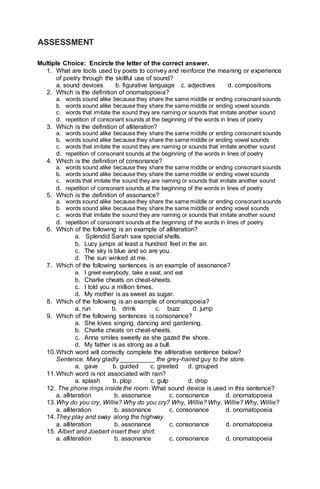
ASSESSMENT
Multiple Choice: Encircle the letter of the correct answer.
1. What are tools used by poets to convey and reinforce the meaning or experience
of poetry through the skillful use of sound?
a. sound devices b. figurative language c. adjectives d. compositions
2. Which is the definition of onomatopoeia?
a. words sound alike because they share the same middle or ending consonant sounds
b. words sound alike because they share the same middle or ending vowel sounds
c. words that imitate the sound they are naming or sounds that imitate another sound
d. repetition of consonant sounds at the beginning of the words in lines of poetry
3. Which is the definition of alliteration?
a. words sound alike because they share the same middle or ending consonant sounds
b. words sound alike because they share the same middle or ending vowel sounds
c. words that imitate the sound they are naming or sounds that imitate another sound
d. repetition of consonant sounds at the beginning of the words in lines of poetry
4. Which is the definition of consonance?
a. words sound alike because they share the same middle or ending consonant sounds
b. words sound alike because they share the same middle or ending vowel sounds
c. words that imitate the sound they are naming or sounds that imitate another sound
d. repetition of consonant sounds at the beginning of the words in lines of poetry
5. Which is the definition of assonance?
a. words sound alike because they share the same middle or ending consonant sounds
b. words sound alike because they share the same middle or ending vowel sounds
c. words that imitate the sound they are naming or sounds that imitate another sound
d. repetition of consonant sounds at the beginning of the words in lines of poetry
6. Which of the following is an example of alliteration?
a. Splendid Sarah saw special shells.
b. Lucy jumps at least a hundred feet in the air.
c. The sky is blue and so are you.
d. The sun winked at me.
7. Which of the following sentences is an example of assonance?
a. I greet everybody, take a seat, and eat
b. Charlie cheats on cheat-sheets.
c. I told you a million times.
d. My mother is as sweet as sugar.
8. Which of the following is an example of onomatopoeia?
a. run b. drink c. buzz d. jump
9. Which of the following sentences is consonance?
a. She loves singing, dancing and gardening.
b. Charlie cheats on cheat-sheets.
c. Anna smiles sweetly as she gazed the shore.
d. My father is as strong as a bull.
10.Which word will correctly complete the alliterative sentence below?
Sentence: Mary gladly __________ the grey-haired guy to the store.
a. gave b. guided c. greeted d. grouped
11.Which word is not associated with rain?
a. splash b. plop c. gulp d. drop
12. The phone rings inside the room. What sound device is used in this sentence?
a. alliteration b. assonance c. consonance d. onomatopoeia
13.Why do you cry, Willie? Why do you cry? Why, Willie? Why, Willie? Why, Willie?
a. alliteration b. assonance c. consonance d. onomatopoeia
14.They play and sway along the highway.
a. alliteration b. assonance c. consonance d. onomatopoeia
15. Albert and Joebert insert their shirt.
a. alliteration b. assonance c. consonance d. onomatopoeia
ADDITIONAL ACTIVITIES
Activity #8. Assignment:
Direction:
Answer Key:
Pretest
1. B
2. A
3. D
4. B
5. C
6. A
7. A
8. D
9. C
10.A
11.D
12.B
13.D
14.A
15.D
Review
Activity #2. Alliteration
Let us recall the sound devices and figurative language we learned in the
previous lessons. From the set of words below, encircle the sound devices and
underline the figurative language you have remembered.
Alliteration Legend Pronoun Irony
Adjective Essay Verb Hyperbole
Noun Onomatopoeia Consonance Adverb
Metaphor Preposition Conjunction Poem
Assonance Folktale Simile Personification
Activity #3. Onomatopoeia
Activity #4. Fill Me
1. friendly
2. slept
3. microphone
4. apple
5. dug
6. fed
7. straws
Activity #5. Fill Me More
Directions: Complete each sentence with the “sound word or words” that best fits the
object or animal.
Example: The bird went ___________________________________
Answer: The bird went chirp, chirp, chirp.
Answers may vary. Possible answers are:
1. The dog went bark, bark, bark.
2. The cat went meow, meow, meow.
3. The duck went quack, quack, quack.
4. The snake went hiss, hiss, hiss.
5. The bee went buzz, buzz, buzz.
6. The cow went moo, moo, moo.
7. The gun went bang, bang, bang.
8. The car went screech, screech, screech.
9. The clock went tic tac, tic tac, tic tac.
10.The water went splash, splash, splash.
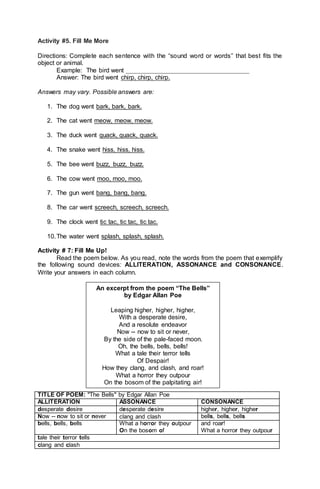
Activity # 7: Fill Me Up!
Read the poem below. As you read, note the words from the poem that exemplify
the following sound devices: ALLITERATION, ASSONANCE and CONSONANCE.
Write your answers in each column.
TITLE OF POEM: "The Bells" by Edgar Allan Poe
ALLITERATION ASSONANCE CONSONANCE
desperate desire desperate desire higher, higher, higher
Now -- now to sit or never clang and clash bells, bells, bells
bells, bells, bells What a horror they outpour
On the bosom of
and roar!
What a horror they outpour
tale their terror tells
clang and clash
An excerpt from the poem “The Bells”
by Edgar Allan Poe
Leaping higher, higher, higher,
With a desperate desire,
And a resolute endeavor
Now -- now to sit or never,
By the side of the pale-faced moon.
Oh, the bells, bells, bells!
What a tale their terror tells
Of Despair!
How they clang, and clash, and roar!
What a horror they outpour
On the bosom of the palpitating air!
Activity # 6: Read, Analyze, Pick Out!
Read the following short poem titled “Running Water” by Lee Emmett. Pick out
words from the poem that exemplify onomatopoeia, alliteration, assonance, and
consonance. Write your answers inside the boxes.
Onomatopoeia whoosh, passing breeze
Alliteration splish-splashdownhill
trilling,melodic thrill
flags flutter and flap
Assonance trilling, melodic thrill
flags flutter and flap
Consonance splish-splash downhill
frog croaks, bird whistles
Assessment:
1. A
2. C
3. D
4. A
5. B
6. A
7. A
8. C
9. A
10.B
11.C
12.D
13.A
14.B
15.C
Assignment:
Answers may vary
water plops into pond
splish-splash downhill
warbling magpies in tree
trilling, melodic thrill
whoosh, passing breeze
flags flutter and flap
frog croaks, bird whistles
babbling bubbles from tap
REFERENCES:
 https://www.helpteaching.com/search/onomatopoeia
 https://www.youtube.com/watch?v=1t16V38gZWE&t=284s
 http://englishlinx.com/cgi-bin/pdf_viewer.cgi?script_name=%2Fpdf%2FWriting-
Alliteration-Worksheet.pdf&x=127&y=23
 https://www.youtube.com/watch?v=jC6MsrRf_1k
 https://www.youtube.com/watch?v=I1GC1yWdM_c&t=19s
 https://www.proprofs.com/quiz-school/story.php?title=alliteration-quiz
 Activity Sheet in English 6, Week 1 Day 1 – 2 , LRMDS
 Using Figurative Speech, LRMDS

Sim english-wk-1

  • 1.
    SELF-INSTRUCTIONAL MATERIAL (SIM)/MODULE IN ENGLISH 6, QUARTER 1 – WEEK 1 Sound Devices:  Analyze sound devices (onomatopoeia, alliteration, assonance, consonance) ENGRC –Ia2.3.1; ENGRC –Ia2.3.2; ENGRC –Ia2.3.3; ENGRC –Ia2.3.9  Identify the values suggested in the visual media (Poem, video clips) ENGRC – IIIc – 7.12.3.1  Show tactfulness when communicating with others EN6A-Id-17  Self-correct when reading EN6F-Ia-2.9  Show openness to criticism EN6A-Id-18  Observe politeness at all times ENG. 6-Ib-5.1.2 WHAT I KNOW Let’s Find Out What You Already Know Before you start studying this module, take the following test first to find out how much you already know about this topic. Encircle the letter of your choice. 1. What do we call the pieces of writing written in separate lines that usually have figurative language, repeated and irregular rhythm or rhyme? a. novel c. short story b. poem d. legend 2. Which sound device uses repetition of initial consonant sounds? a. alliteration c. consonance b. assonance d. onomatopoeia What I Need To Know Did you have fun working on your previous lessons in Grade 5 English? Surely, you enjoyed answering the tasks and did a great job. Let us move on to another learning experience in English now that you are in Grade 6. I know you are eager to learn more so get ready to learn new lessons and perform challenging tasks ahead. In this Self – Instruction Material (SIM), you will be able to:  Enumerate sound devices read  Self-correct when reading  Identify and distinguish sound devices used in texts  Give examples of sound devices  Use sound devices in writing meaningful sentences  Analyze sound devices (onomatopoeia, alliteration, assonance, consonance)  Identify the values suggested in the visual media (Poem, video clips)  Show openness to criticism  Show tactfulness when communicating with others  Observe politeness at all times
  • 2.
    3. Which sounddevice refers to words that imitate the sounds of objects or animals? a. alliteration c. consonance b. assonance d. onomatopoeia 4. Which sound device focuses on the repetition of similar vowel sounds in the middle or end words? a. alliteration c. consonance b. assonance d. onomatopoeia 5. Which sound device pertains to the repetition of similar consonant sounds in the middle or end of words? a. alliteration c. consonance b. assonance d. onomatopoeia 6. Is this statement, “Mommy made me mash my M & Ms,” an alliteration? a. Yes b. No c. Maybe d. I don’t know 7. Is “bang” an example of onomatopoeia? a. Yes b. No c. Maybe d. I don’t know 8. Which word is NOT an example of onomatopoeia? a. boom b. swat c. splash d. sneeze 9. Which of the following is an example of onomatopoeia? a. run b. drink c. buzz d. jump 10. Onomatopoeia is the use of words that imitate sound. a. Yes b. No c. Maybe d. I don’t know 11. Which of these sentences does NOT contain onomatopoeia? a. The really red rose is beautiful. b. The floor creaked as I walked across it. c. The race car screeched down the road. d. Roses are as red as blood. 12. “Boom, Boom, Boom! Even brighter than a moon, moon.” What is the sound device used? a. assonance c. onomatopoeia b. alliteration d. consonance 13. “Joshua and Janna, juggle, jiggle, jerk and jam.” What sound device is used in this sentence? a. assonance c. onomatopoeia b. alliteration d. consonance 14. “Fleet feet sweep by sleeping geese.” What is the sound device used? a. assonance c. onomatopoeia b. alliteration d. consonance 15. Which of the following sentences does not show onomatopoeia? a. Sally sells seashells by the seashore. b. Peter Piper picked a peck of pickled peppers. c. The soul selects its own society. d. The leaves danced their way through the lawn. Well, how was it? Do you think you did well? Compare your answers with those in the Answer Key on page 15 to find out. If all your answers are correct, very good! This shows that you already know much about the topic. You may still study the module to review what you already know. Who knows, you might learn a few more new things as well. If you got a low score, don’t feel bad. This means that this module is for you. It will help you understand some important concepts that you can apply in your daily life. If you study this module carefully you will learn the answers to all the items in the test and a lot more! Are you ready? You may now go to the next page to begin Lesson 1.
  • 3.
    WHAT’S IN Well, howwas it? Do you think you did well? Compare your answers with those in the Answer Key on page 16 to find out. If you have remembered all the sound devices and figurative language, very good. If you missed some, then this is the right time to continue learning them. WHAT’S NEW 1. Do you love to read poems? 2. What makes a poem different from other literary piece? 3. If you will write a poem, which material do you want to use as title of it? 4. When you hear the word “bell”, what usually comes to your mind? Now, be ready to read the poem entitled “The Bells”. Activity #1. Read and Learn Let us recall the sound devices and figurative language we learned in the previous lessons. From the set of words below, encircle the sound devices and underline the figurative language you have remembered. Alliteration Legend Pronoun Irony Adjective Essay Verb Hyperbole Noun Onomatopoeia Consonance Adverb Metaphor Preposition Conjunction Poem Assonance Folktale Simile Personification
  • 5.
    Answer the followingquestions about the poem. 1. What is the title of the poem? ______________________________________________________________ 2. Who is the author? ______________________________________________________________ 3. Where could the setting of this poem be? Give your reasons. ______________________________________________________________ ______________________________________________________________ 4. This poem tells of the stages in the life of a person. To what stage of one’s life could the first stanza refer? ______________________________________________________________ 5. During the early years of one’s life, when do the bells first ring happily? ______________________________________________________________ 6. On what other occasions in life do bells ring? ________________________________________ ________________________________________ ________________________________________ ________________________________________ 7. In one of the four stanzas of this poem or stages of life, a sad ringing of the bells can happen. What could this ringing mean? ________________________________________ 8. In what ways can we extend our help to people in distress or those experiencing difficult times? _______________________________________________________ _______________________________________________________ _______________________________________________________ Congratulations for answering the questions successfully. Now, let us look at some lines in the poem and identify the sound devices used by the author to emphasize them. Have you noticed some repeated words like….. How they tinkle, tinkle, tinkle… Keeping time, time, time…. How about words with the same beginning consonant sound like… What a world of merriment their melody foretells… How about words with the same vowel sound in the beginning, middle or end? Hear the sledges of the bells… How about repetition of consonant sounds at the middle or end of at least two words in a line? From the jingling and tinkling of the bells… How about words whose sounds suggest their meanings? bell tinkle
  • 6.
    Let us nowlearn the sound devices used by authors. Poems are pieces of writing written in separate lines that usually have figurative language, repeated and irregular rhythm, rhyme. They convey experiences, ideas, or emotions in a vivid and imaginative way. Poems also have sound devices. Sound devices are tools used by poets to convey and reinforce the meaning or experience of poetry through the skillful use of sound. After all, poets are trying to use a concentrated blend of sound and imagery to create an emotional response. In poetry, the words and their order should evoke images, and the words themselves have sounds, which can emphasize or otherwise clarify those images. Since poetry is basically rhythmical, it heavily relies on sound devices to create a musical effect. The following are types of sound devices: 1. Onomatopoeia. This is a sound device which refers to the use of words whose sounds suggest their meanings. Examples: The bang of a gun The buzz of a bee The hiss of a snake The pop of a firecracker *****Note: Suggested Viewing: See Video: ONOMATOPOEIA https://www.youtube.com/watch?v=I1GC1yWdM_c&t=19s However, if you cannot access the internet, then let us proceed with the next sound device. WHAT IS IT? Read the following sentences. Note on the highlighted letters or words in each number. 1. Kaboom! The bite of dynamite cut deep inside the earth! (excerpt from “Kaboom!” by Denise Rodgers) 2. Peter Piper picked a pack of pickled pepper. 3. Alone, alone, all, all alone, Alone on a wide wide sea! (excerpt from “The Rime of Ancient Mariner” by Samuel Taylor Coleridge) 4. Water rushing, gushing, pushing past the limits of the edge (excerpt from “Great Lakes Rhythm & Rhyme”) What have you noticed in each sentence? Which word in the first sentence creates a sound which suggests its meaning? Are there emphasized sounds in second, third, and fourth sentences? Are there repeated sounds? Can you identify them? What sound devices are used in each sentence?
  • 7.
    2. Alliteration. Thisis the repetition of the same initial consonant sounds of at least two words in a line of poetry. Alliteration happens when words that start with the same sound are used close together in a phrase or sentence. The sound is usually consonant and the words don’t have to be always right next to one another. Examples: a. Mary managed to read her messages in the messenger. b. Little skinny shoulder blades sticking through Stella’s clothes. c. The frog frolicked frivolously on the forest floor. d. Jona jumped happily when we played Jumping Jack. *****Note: Suggested Viewing: See Video: ALLITERATION https://www.youtube.com/watch?v=1t16V38gZWE&t=284s However, if you cannot access the internet, then let us proceed with the next sound device. 3. Assonance. This is the repetition of vowel sounds at the beginning, middle or end of at least two words in a line of poetry. Tongue twisters often use a combination of alliteration (repetition of same beginning consonant sound) and two different forms of assonance-or the repetition of two different vowel sounds. This is what makes them so difficult to say. Assonance is used for some of the same reasons as alliteration. It can affect the rhythm, tone, and mood of a text. The repetition of certain vowel sounds-think short vowels sounds from the letters u or o-can create a melancholy mood. Examples: 1. The light of the fire is a sight. (repetition of the long i sound) 2. Go slow over the road. (repetition of the long o sound) 3. Peter Piper picked a peck of pickled peppers (repetition of the short e and long i sounds) 4. Sally sells sea shells beside the sea shore (repetition of the short e and long e sounds) 5. Try as I might, the kite did not fly. (repetition of the long i sound) 6. Hear the mellow wedding bells (excerpt from by Edgar Allan Poe) 4. Consonance. This is the repetition of consonant sounds at the middle or end of at least two words in a line of poetry. Example: He fumbles at your spirit As players at the keys Before they drop full music on; He stuns you by degrees (by Emily Dickinson)
  • 8.
    WHAT’S MORE These activitieswill engage you to better understand and distinguish the types of sound devices. Answer Activity 1 and enjoy matching words to form alliterative phrases. Good luck. Activity #2: Alliteration How did you find the activity? Well, you will know the result of your work later as we go checking your mastery of the skill introduced in this module.
  • 9.
    Activity # 3:Onomatopoeia This next activity will engage you to better understand what onomatopoeia is as a sound device. Answer Activity 2 and enjoy matching words that imitate the sounds associated with the objects or actions. Get your pen ready. Have you recalled all the sounds associated with the words in Activity 2? I am sure by now you can already distinguish alliteration and onomatopoeia from other sound devices. Congratulations....
  • 10.
    Activity # 4:Fill Me! This time we will do another activity to deepen our understanding of alliteration as a sound device. Are you ready to fill the blanks in the following sentences? Well done! You may read the completed sentences again to better understand the messages they convey and at the same time, self-correct when reading. Let us now proceed to the next activity. This will help us analyze the sound device used by the animals around us. Are you ready to complete the sentences in Activity 4? An example is done for you to guide you in accomplishing this task.
  • 11.
    Activity # 5:Fill Me More! Directions: Complete each sentence with the “sound word or words” that best fits the object or animal. Example: The bird went ___________________________________ Answer: The bird went chirp, chirp, chirp. 1. The dog went __________________________. 2. The cat went __________________________. 3. The duck went __________________________. 4. The snake went __________________________. 5. The bee went __________________________. 6. The cow went __________________________. 7. The gun went __________________________. 8. The car went __________________________. 9. The clock went __________________________. 10.The water went __________________________. How did you find the activity? Did you enjoy accomplishing it? Well then, congratulations for reaching this far! Before we proceed, can you now answer the following questions based on the examples and activities we have discussed and accomplished? WHAT I HAVE LEARNED What are sound devices? What is alliteration? What is onomatopoeia? What is assonance? What is consonance? What is the importance of using sound devices in literary pieces? Wow, that is indeed a great job. Having provided the definitions of the sound devices we have discussed earlier proves that you learned a lot. Now, are you ready to explore some more? There are still activities designed for you to deepen your understanding and mastery of the sound devices. Come and explore some more! Have fun!
  • 12.
    WHAT I CANDO Activity # 6: Fill Me Up! Read the poem below. As you read, note the words from the poem that exemplify the following sound devices: ALLITERATION, ASSONANCE and CONSONANCE. Write your answers in each column. ALLITERATION ASSONANCE CONSONANCE Great job! Did you find the activity interesting? I am indeed very happy to know that you are learning well. Here’s another activity for you. Get your pen ready! Activity # 7: Read, Analyze, Pick Out! Read the following short poem titled “Running Water” by Lee Emmett. Pick out words from the poem that exemplify onomatopoeia, alliteration, assonance, and consonance. Write your answers inside the boxes. An excerpt from the poem “The Bells” by Edgar Allan Poe Leaping higher, higher, higher, With a desperate desire, And a resolute endeavor Now -- now to sit or never, By the side of the pale-faced moon. Oh, the bells, bells, bells! What a tale their terror tells Of Despair! How they clang, and clash, and roar! What a horror they outpour On the bosom of the palpitating air!
  • 13.
    Onomatopoeia Alliteration Assonance Consonance Wonderful! With thisaccomplishment, I am confident that you can now analyze sound devices from literary pieces and texts. This is now the moment that we summarize what we have learned together. Answer the assessment on the next page so that we can measure your mastery of the lesson. Ready, Get Set and Answer… water plops into pond splish-splash downhill warbling magpies in tree trilling, melodic thrill whoosh, passing breeze flags flutter and flap frog croaks, bird whistles babbling bubbles from tap
  • 14.
    ASSESSMENT Multiple Choice: Encirclethe letter of the correct answer. 1. What are tools used by poets to convey and reinforce the meaning or experience of poetry through the skillful use of sound? a. sound devices b. figurative language c. adjectives d. compositions 2. Which is the definition of onomatopoeia? a. words sound alike because they share the same middle or ending consonant sounds b. words sound alike because they share the same middle or ending vowel sounds c. words that imitate the sound they are naming or sounds that imitate another sound d. repetition of consonant sounds at the beginning of the words in lines of poetry 3. Which is the definition of alliteration? a. words sound alike because they share the same middle or ending consonant sounds b. words sound alike because they share the same middle or ending vowel sounds c. words that imitate the sound they are naming or sounds that imitate another sound d. repetition of consonant sounds at the beginning of the words in lines of poetry 4. Which is the definition of consonance? a. words sound alike because they share the same middle or ending consonant sounds b. words sound alike because they share the same middle or ending vowel sounds c. words that imitate the sound they are naming or sounds that imitate another sound d. repetition of consonant sounds at the beginning of the words in lines of poetry 5. Which is the definition of assonance? a. words sound alike because they share the same middle or ending consonant sounds b. words sound alike because they share the same middle or ending vowel sounds c. words that imitate the sound they are naming or sounds that imitate another sound d. repetition of consonant sounds at the beginning of the words in lines of poetry 6. Which of the following is an example of alliteration? a. Splendid Sarah saw special shells. b. Lucy jumps at least a hundred feet in the air. c. The sky is blue and so are you. d. The sun winked at me. 7. Which of the following sentences is an example of assonance? a. I greet everybody, take a seat, and eat b. Charlie cheats on cheat-sheets. c. I told you a million times. d. My mother is as sweet as sugar. 8. Which of the following is an example of onomatopoeia? a. run b. drink c. buzz d. jump 9. Which of the following sentences is consonance? a. She loves singing, dancing and gardening. b. Charlie cheats on cheat-sheets. c. Anna smiles sweetly as she gazed the shore. d. My father is as strong as a bull. 10.Which word will correctly complete the alliterative sentence below? Sentence: Mary gladly __________ the grey-haired guy to the store. a. gave b. guided c. greeted d. grouped 11.Which word is not associated with rain? a. splash b. plop c. gulp d. drop 12. The phone rings inside the room. What sound device is used in this sentence? a. alliteration b. assonance c. consonance d. onomatopoeia 13.Why do you cry, Willie? Why do you cry? Why, Willie? Why, Willie? Why, Willie? a. alliteration b. assonance c. consonance d. onomatopoeia 14.They play and sway along the highway. a. alliteration b. assonance c. consonance d. onomatopoeia 15. Albert and Joebert insert their shirt. a. alliteration b. assonance c. consonance d. onomatopoeia
  • 15.
    ADDITIONAL ACTIVITIES Activity #8.Assignment: Direction: Answer Key: Pretest 1. B 2. A 3. D 4. B 5. C 6. A 7. A 8. D 9. C 10.A 11.D 12.B 13.D 14.A 15.D
  • 16.
    Review Activity #2. Alliteration Letus recall the sound devices and figurative language we learned in the previous lessons. From the set of words below, encircle the sound devices and underline the figurative language you have remembered. Alliteration Legend Pronoun Irony Adjective Essay Verb Hyperbole Noun Onomatopoeia Consonance Adverb Metaphor Preposition Conjunction Poem Assonance Folktale Simile Personification
  • 17.
    Activity #3. Onomatopoeia Activity#4. Fill Me 1. friendly 2. slept 3. microphone 4. apple 5. dug 6. fed 7. straws
  • 18.
    Activity #5. FillMe More Directions: Complete each sentence with the “sound word or words” that best fits the object or animal. Example: The bird went ___________________________________ Answer: The bird went chirp, chirp, chirp. Answers may vary. Possible answers are: 1. The dog went bark, bark, bark. 2. The cat went meow, meow, meow. 3. The duck went quack, quack, quack. 4. The snake went hiss, hiss, hiss. 5. The bee went buzz, buzz, buzz. 6. The cow went moo, moo, moo. 7. The gun went bang, bang, bang. 8. The car went screech, screech, screech. 9. The clock went tic tac, tic tac, tic tac. 10.The water went splash, splash, splash. Activity # 7: Fill Me Up! Read the poem below. As you read, note the words from the poem that exemplify the following sound devices: ALLITERATION, ASSONANCE and CONSONANCE. Write your answers in each column. TITLE OF POEM: "The Bells" by Edgar Allan Poe ALLITERATION ASSONANCE CONSONANCE desperate desire desperate desire higher, higher, higher Now -- now to sit or never clang and clash bells, bells, bells bells, bells, bells What a horror they outpour On the bosom of and roar! What a horror they outpour tale their terror tells clang and clash An excerpt from the poem “The Bells” by Edgar Allan Poe Leaping higher, higher, higher, With a desperate desire, And a resolute endeavor Now -- now to sit or never, By the side of the pale-faced moon. Oh, the bells, bells, bells! What a tale their terror tells Of Despair! How they clang, and clash, and roar! What a horror they outpour On the bosom of the palpitating air!
  • 19.
    Activity # 6:Read, Analyze, Pick Out! Read the following short poem titled “Running Water” by Lee Emmett. Pick out words from the poem that exemplify onomatopoeia, alliteration, assonance, and consonance. Write your answers inside the boxes. Onomatopoeia whoosh, passing breeze Alliteration splish-splashdownhill trilling,melodic thrill flags flutter and flap Assonance trilling, melodic thrill flags flutter and flap Consonance splish-splash downhill frog croaks, bird whistles Assessment: 1. A 2. C 3. D 4. A 5. B 6. A 7. A 8. C 9. A 10.B 11.C 12.D 13.A 14.B 15.C Assignment: Answers may vary water plops into pond splish-splash downhill warbling magpies in tree trilling, melodic thrill whoosh, passing breeze flags flutter and flap frog croaks, bird whistles babbling bubbles from tap
  • 20.
    REFERENCES:  https://www.helpteaching.com/search/onomatopoeia  https://www.youtube.com/watch?v=1t16V38gZWE&t=284s http://englishlinx.com/cgi-bin/pdf_viewer.cgi?script_name=%2Fpdf%2FWriting- Alliteration-Worksheet.pdf&x=127&y=23  https://www.youtube.com/watch?v=jC6MsrRf_1k  https://www.youtube.com/watch?v=I1GC1yWdM_c&t=19s  https://www.proprofs.com/quiz-school/story.php?title=alliteration-quiz  Activity Sheet in English 6, Week 1 Day 1 – 2 , LRMDS  Using Figurative Speech, LRMDS