For any help regarding Signals and Systems Assignment Help
visit : - https://www.matlabassignmentexperts.com/ ,
Email : - info@matlabassignmentexperts.com or
call us at : - +1 678 648 4277
Signals and Systems Assignment Help
The z-Transform
Recommended Problems
An LTI system has an impulse response h[n] for which the z-transform is
(a) Plot the pole-zero pattern for H(z).
(b) Using the fact that signals of the form z" are eigenfunctions of LTI systems,
determine the system output for all n if the input x[n] is
P22.2
Consider the sequence x[n] = 2"u[n].
(a) Is x[n] absolutely summable?
(b) Does the Fourier transform of x[n] converge?
(c) For what range of values of r does the Fourier transform of the sequence r-"x[n]
converge?
(d) Determine the z-transform X(z) of x[n], including a specification of the ROC.
(e) X(z) for z = 3e'a can be thought of as the Fourier transform of a sequence x,[n],
i.e.,
matlabassignmentexperts.com
Determine x1[n].
P22.3
Shown in Figure P22.3 is the pole-zero plot for the z-transform X(z) of a sequence
x[nI.
P22-2
Determine what can be inferred about the associated region of convergence from
each of the following statements.
matlabassignmentexperts.com
P22.4
(a) Determine the z-transforms of the following two signals. Note that the z-transforms
for both have the same algebraic expression and differ only in the ROC.
(i) xi[n] = (i)"u[n]
(ii) X2[n] = -(I)"n[-U - 1]
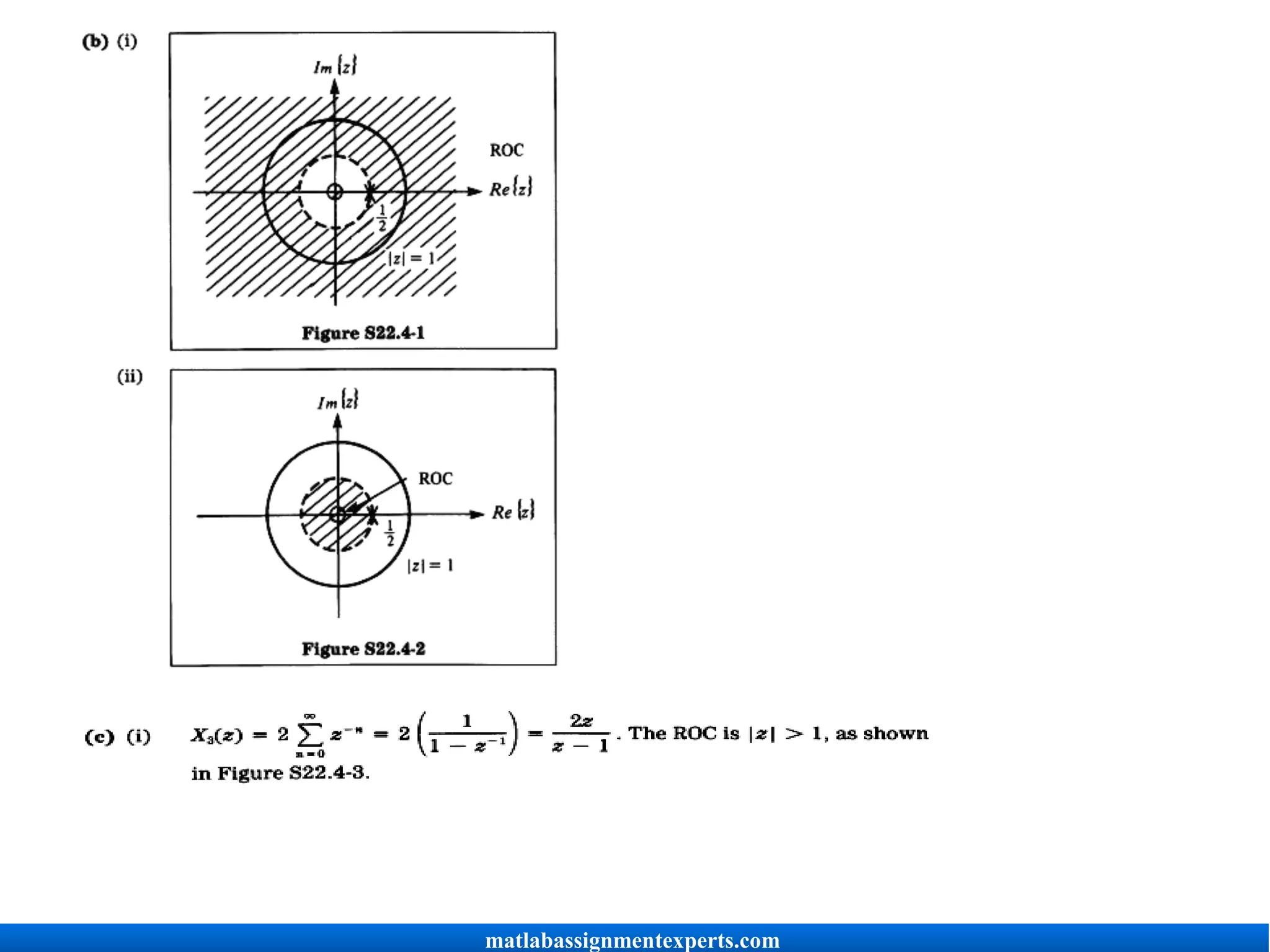
(b) Sketch the pole-zero plot and ROC for each signal in part (a).
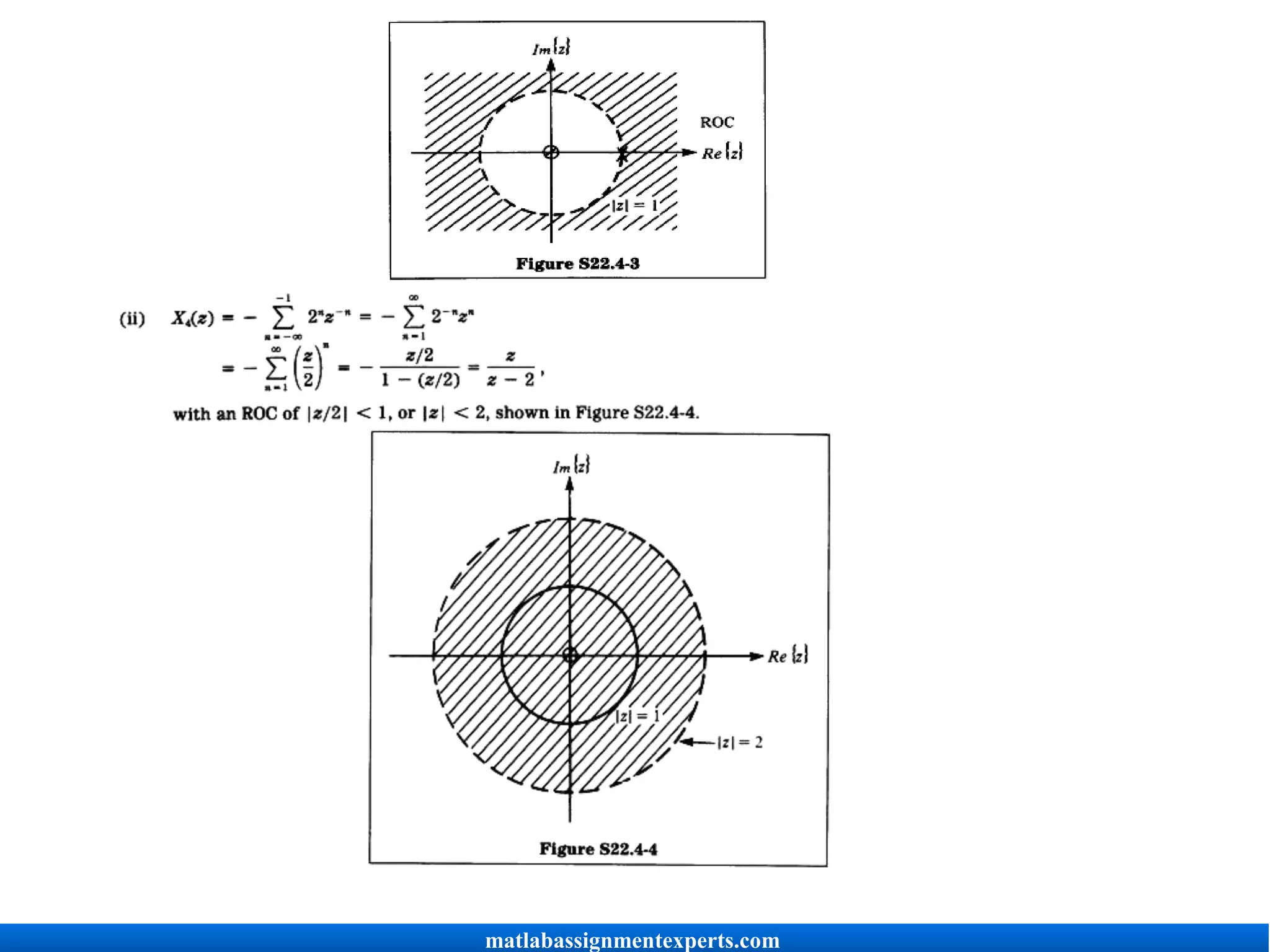
(c) Repeat parts (a) and (b) for the following two signals:
(i) x3[n] = 2u[n]
(ii) x 4 [n] = -(2)"u[-n - 1]
(d) For which of the four signals xi[n], x 2[n], xs[n], and x 4[n] in parts (a) and (c) does
the Fourier transform converge?
P22.5
Consider the pole-zero plot of H(z) given in Figure P22.5, where H(a/2) = 1.
(a) x[n] is right-sided.
(b) The Fourier transform of x[n] converges.
(c) The Fourier transform of x[n] does not converge. (d) x[n] is left-sided.
matlabassignmentexperts.com
(a) Sketch |H(e'")I as the number of zeros at z = 0 increases from 1 to 5.
(b) Does the number of zeros affect <'H(ej")? If so, specifically in what way?
(c) Find the region of the z plane where IH(z) I = 1.
P22.6
Determine the z-transform (including the ROC) of the following sequences. Also sketch
the pole-zero plots and indicate the ROC on your sketch.
(a) (I)"U [n]
(b) (b) 6[n + 1]
matlabassignmentexperts.com
P22.7
For each of the following z-transforms determine the inverse z-transform.
Optional Problems
P22.8
In this problem we study the relation between the z-transform, the Fourier transform,
and the ROC.
(a) Consider the signal x[n] = u[n]. For which values of r does r-"x[n] have a converging
Fourier transform?
(b) (b) In the lecture, we discussed the relation between X(z) and I{r-"x[nj}. For each
of the following values of r, sketch where in the z plane X(z) equals the Fourier
transform of r-x[n].
(i) r=1
(ii) r =
(iii) r=3
(c) From your observations in parts (a) and (b), sketch the ROC of the z-transform of
u[n].
matlabassignmentexperts.com
P22.9
(a) Suppose X(z) on the circle z = 2e'j is given by
Using the relation X(reju) = 5{r~"x[n]}, find 2-x[n] and then x[n], the inverse z-
transform of X(z).
(b) Find x[n] from X(z) below using partial fraction expansion, where x[n] is known
to be causal, i.e., x[n] = 0 for n < 0.
P22-4
P22.10
A discrete-time system with the pole-zero pattern shown in Figure P22.10-1 is
referred to as a first-order all-pass system because the magnitude of the frequency
response is a constant, independent of frequency.
matlabassignmentexperts.com
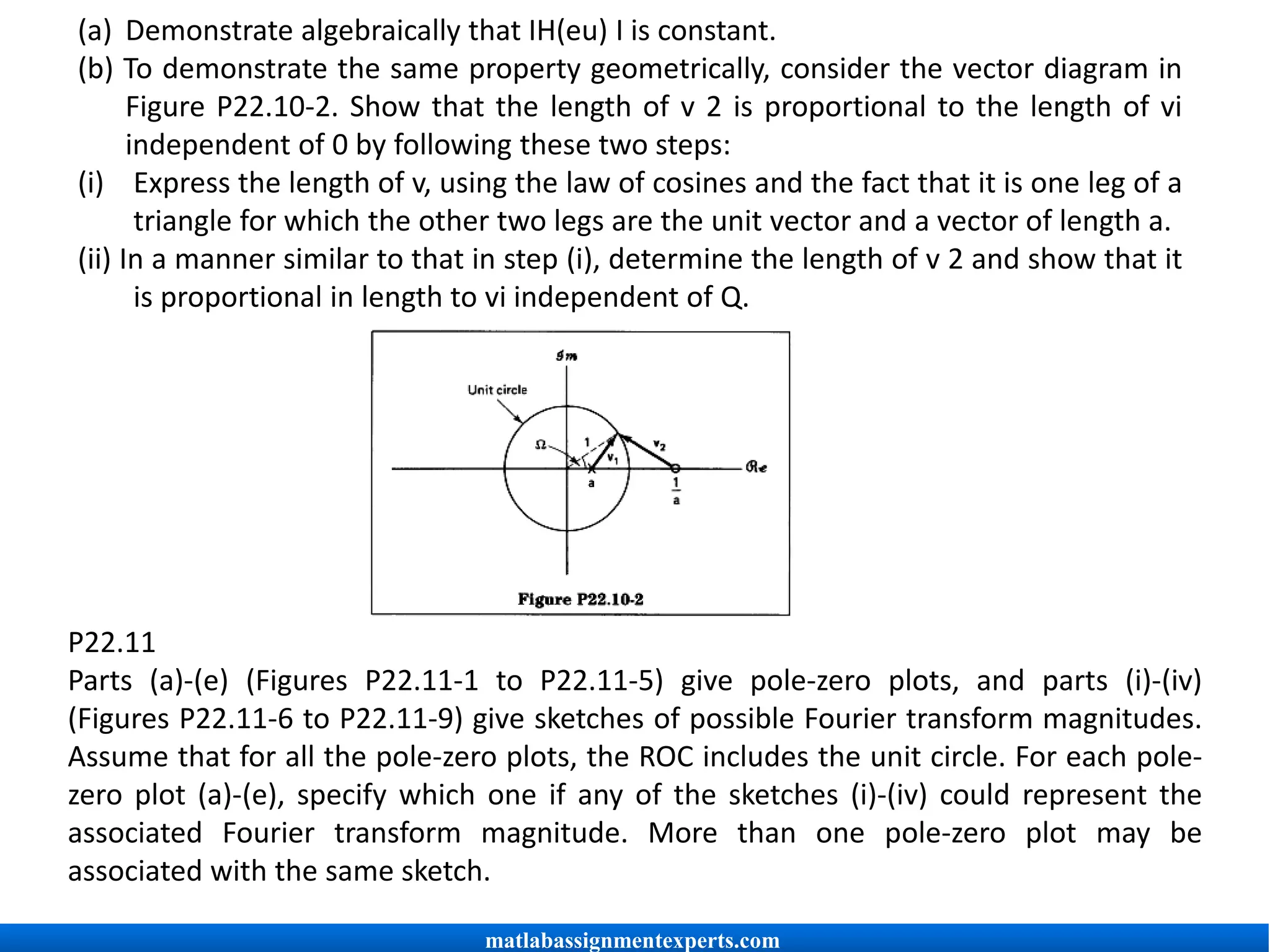
(a) Demonstrate algebraically that IH(eu) I is constant.
(b) To demonstrate the same property geometrically, consider the vector diagram in
Figure P22.10-2. Show that the length of v 2 is proportional to the length of vi
independent of 0 by following these two steps:
(i) Express the length of v, using the law of cosines and the fact that it is one leg of a
triangle for which the other two legs are the unit vector and a vector of length a.
(ii) In a manner similar to that in step (i), determine the length of v 2 and show that it
is proportional in length to vi independent of Q.
P22.11
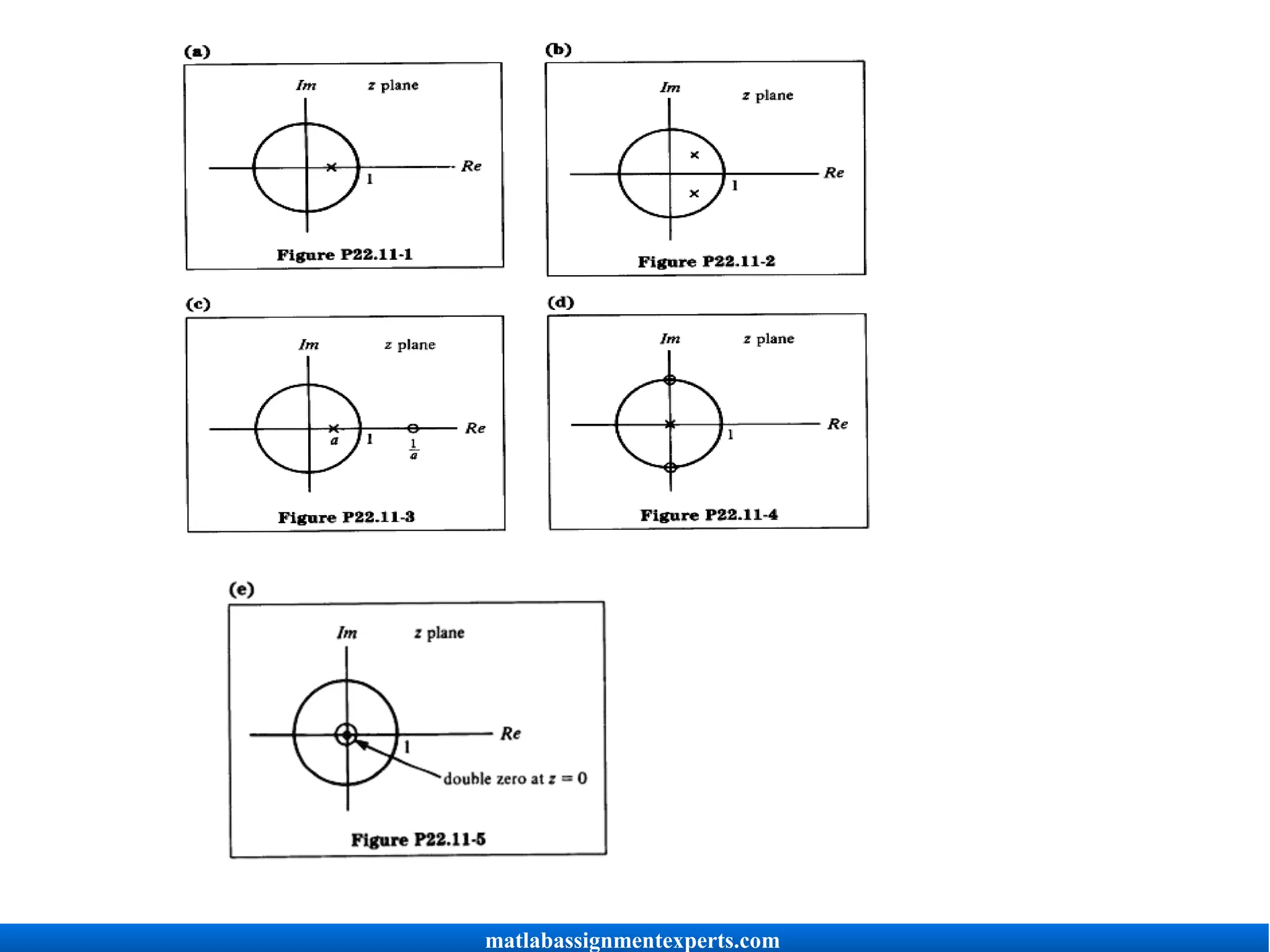
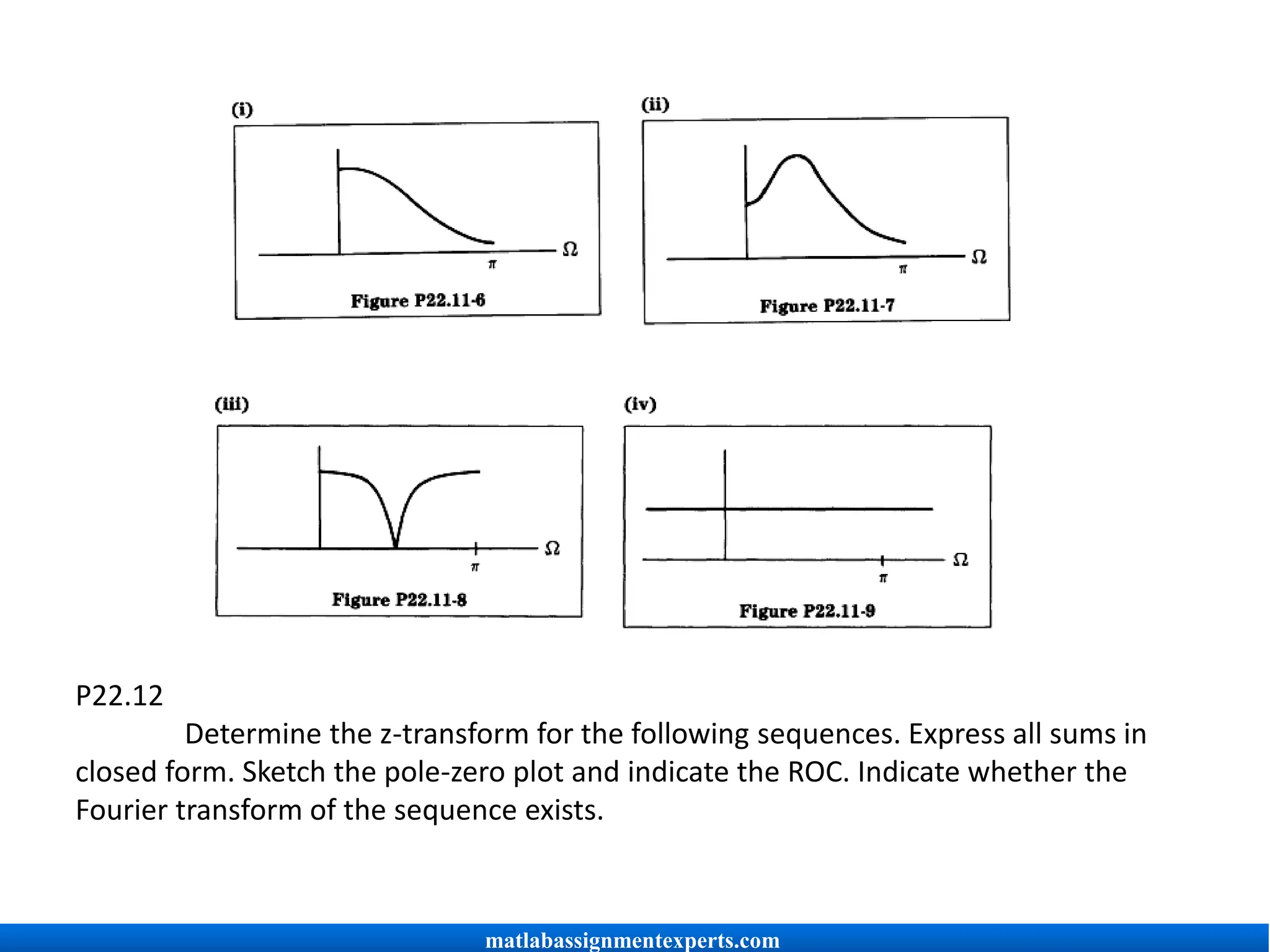
Parts (a)-(e) (Figures P22.11-1 to P22.11-5) give pole-zero plots, and parts (i)-(iv)
(Figures P22.11-6 to P22.11-9) give sketches of possible Fourier transform magnitudes.
Assume that for all the pole-zero plots, the ROC includes the unit circle. For each pole-
zero plot (a)-(e), specify which one if any of the sketches (i)-(iv) could represent the
associated Fourier transform magnitude. More than one pole-zero plot may be
associated with the same sketch.
matlabassignmentexperts.com
P22.12
Determine the z-transform for the following sequences. Express all sums in
closed form. Sketch the pole-zero plot and indicate the ROC. Indicate whether the
Fourier transform of the sequence exists.
matlabassignmentexperts.com
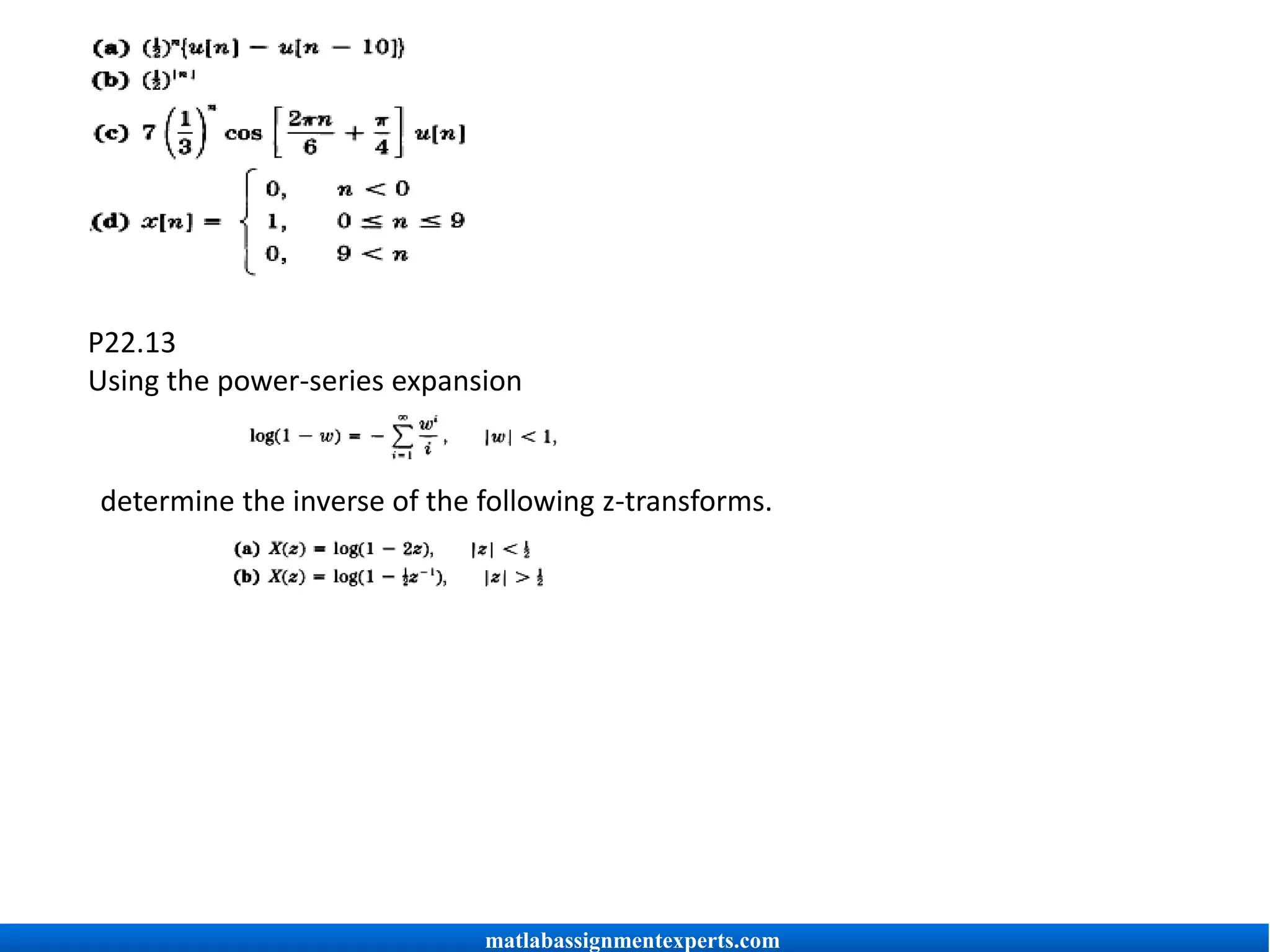
P22.13
Using the power-series expansion
determine the inverse of the following z-transforms.
matlabassignmentexperts.com
S22.1
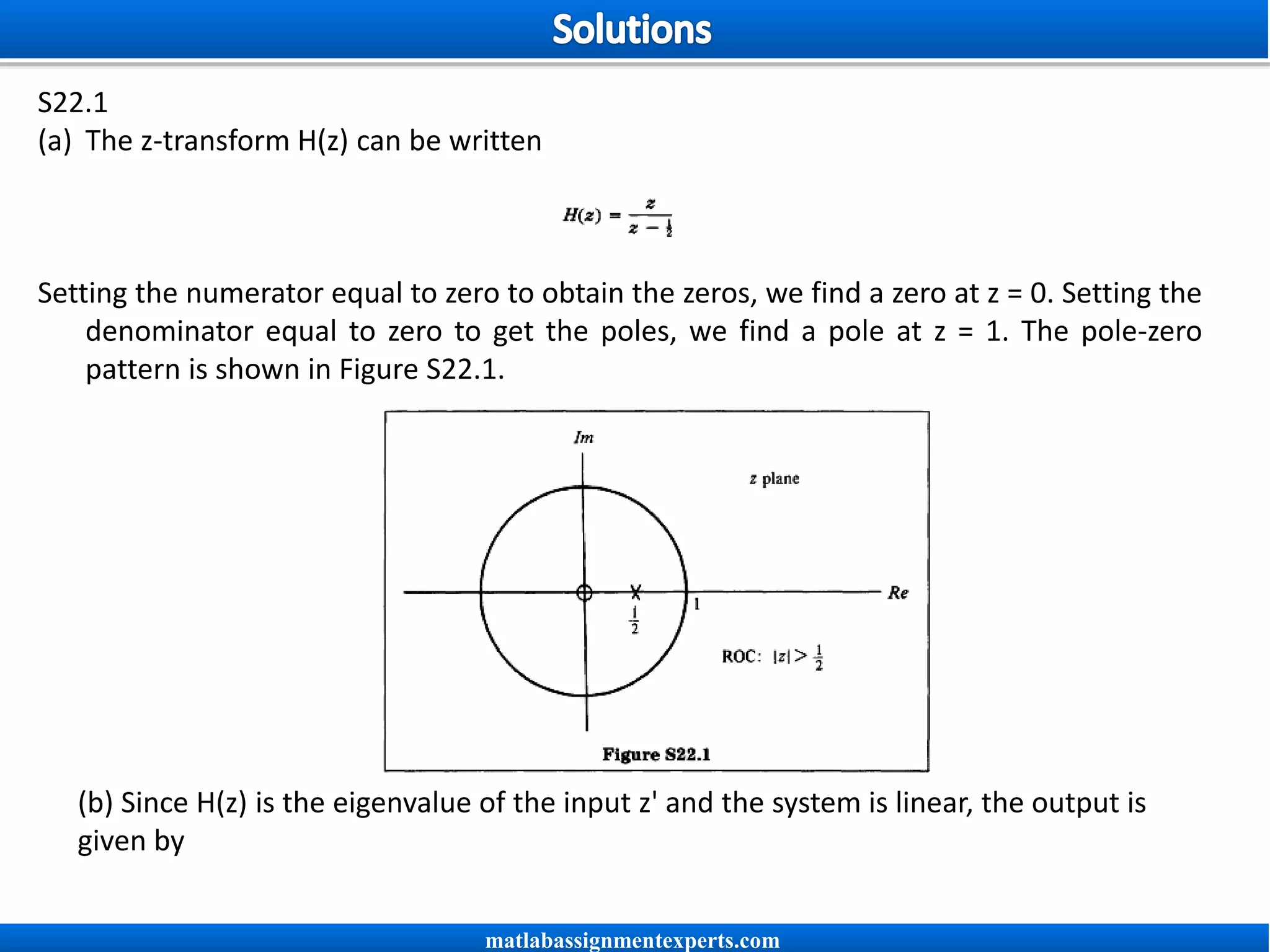
(a) The z-transform H(z) can be written
Setting the numerator equal to zero to obtain the zeros, we find a zero at z = 0. Setting the
denominator equal to zero to get the poles, we find a pole at z = 1. The pole-zero
pattern is shown in Figure S22.1.
(b) Since H(z) is the eigenvalue of the input z' and the system is linear, the output is
given by
matlabassignmentexperts.com
S22.2
(a) To see if x[n] is absolutely summable, we form the sum
Since limN-oSN diverges, x[n] is not absolutely summable. (b) Since x[n] is not
absolutely summable, the Fourier transform of x[n] does not converge.
S22-2
limN-oN is finite for Ir > 2. Therefore, the Fourier transform of r-"x[n] converges
for Ir| > 2.
matlabassignmentexperts.com
S22.3
(a) Since x[n] is right-sided, the ROC is given by Iz I > a. Since the ROC cannot include
poles, for this case the ROC is given by Iz I > 2.
(b) The statement implies that the ROC includes the unit circle Iz = 1. Since the ROC is
a connected region and bounded by poles, the ROC must be
5 < IzI < 2
(c) For this situation there are three possibilities:
(d) This statement implies that the ROC is given by |z < 1.
S22.4
matlabassignmentexperts.com
(d) For the Fourier transform to converge, the ROC of the z-transform must include
the unit circle. Therefore, for x 1[n] and x 4[n], the corresponding Fourier transforms
converge.
S22.5
Consider the pole-zero plot of H(z) given in Figure S22.5-1, where H(a/2) = 1.
(a) When H(z) = z/(z - a), i.e., the number of zeros is 1, we have
Therefore,
and we can plot IH(ejQ)I as in Figure S22.5-2.
matlabassignmentexperts.com
When H(z) =z/(z - a), i.e., the number of zeros is 2, we have
Therefore,
Hence, we see that the magnitude of H(eia) does not change as the number of
zeros increases.
(b) For one zero at z = 0, we have
We can calculate the phase of H(e ")by [Q - 4 (denominator)]. For two zeros at
0, the phase of H(ein) is [29 - 4 (denominator)]. Hence, the phase changes by a
linear factor with the number of zeros.
(c) The region of the z plane where IH(z) I = 1 is indicated in Figure S22.5-3.
matlabassignmentexperts.com
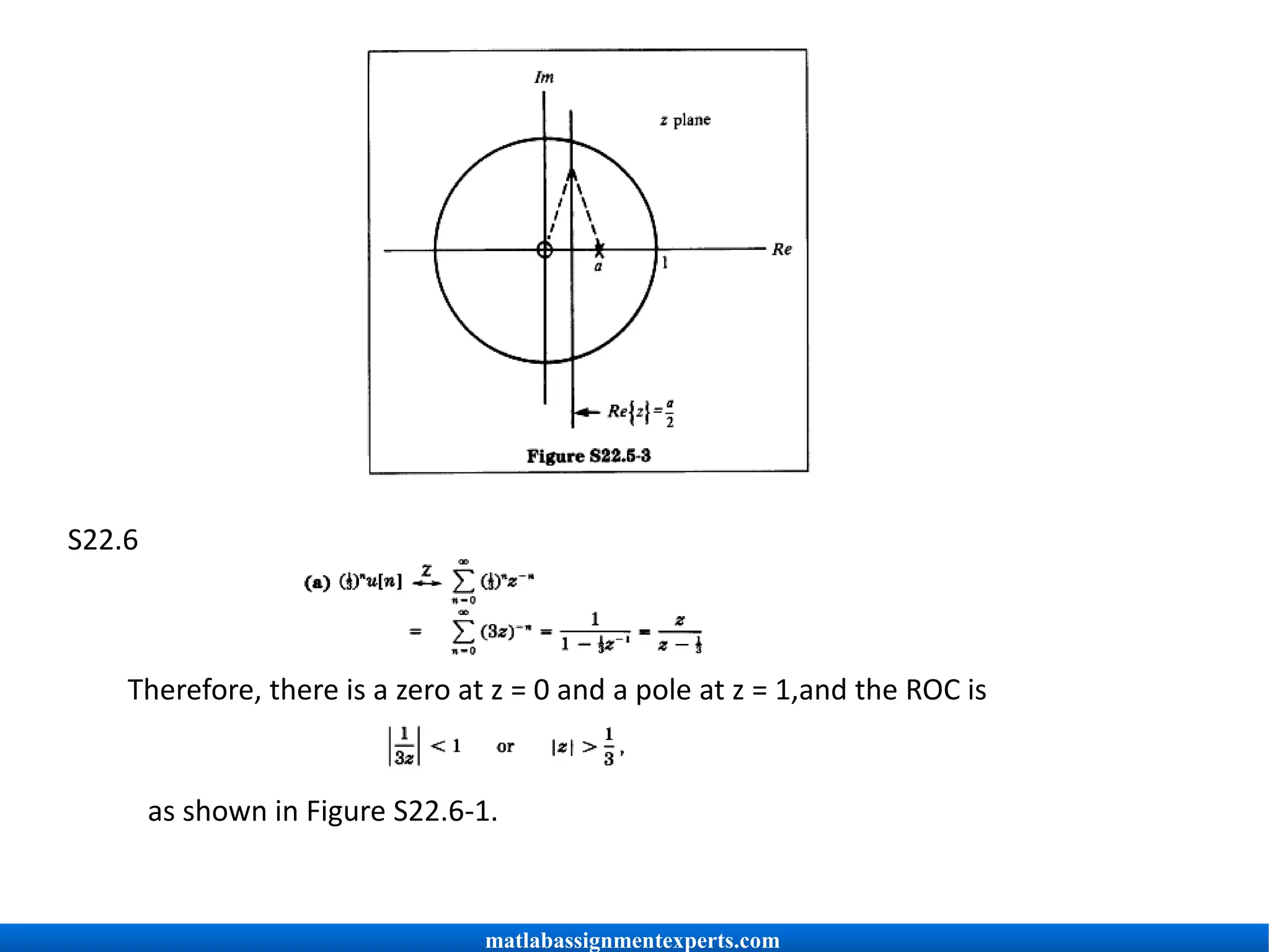
S22.6
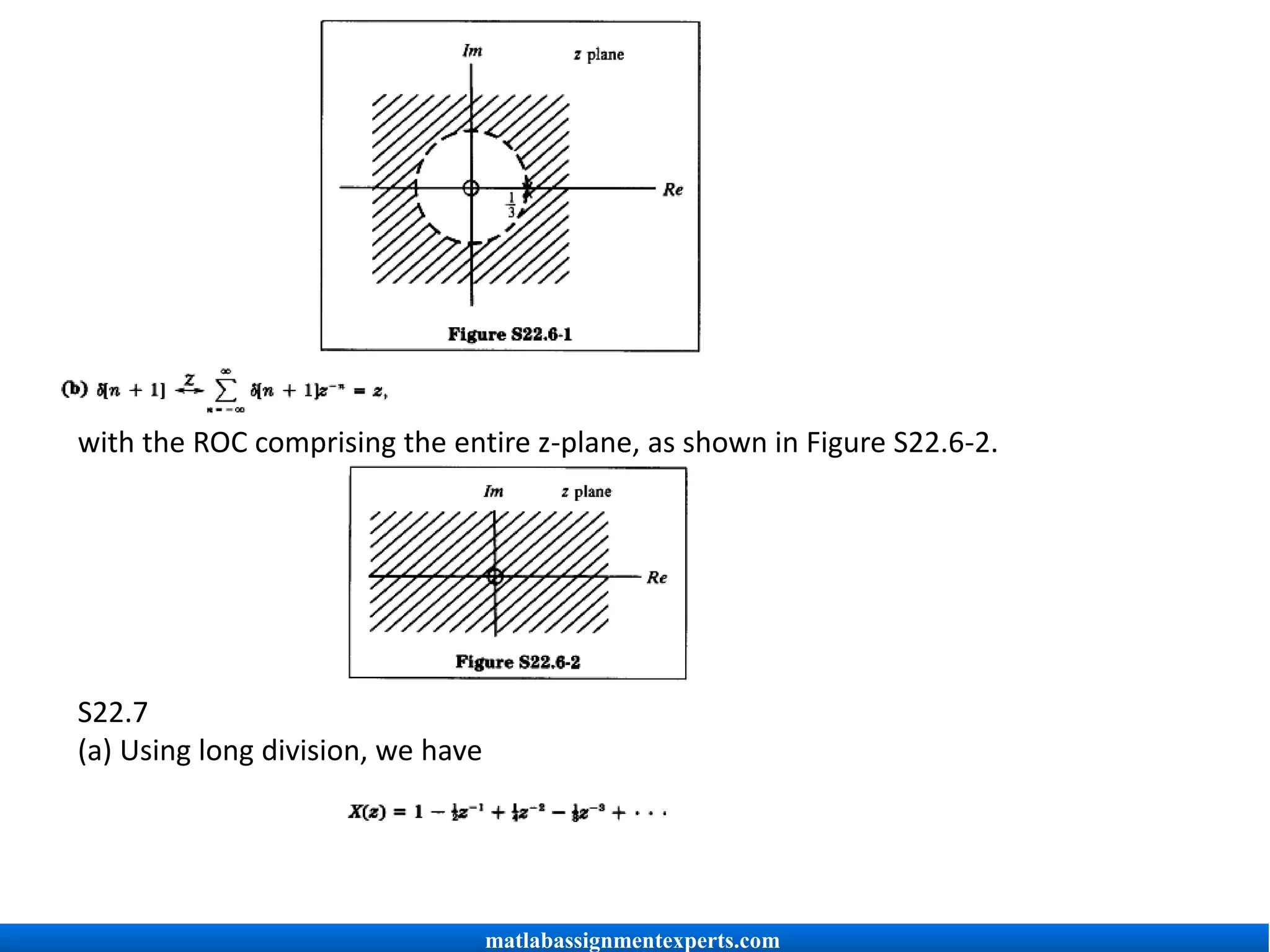
Therefore, there is a zero at z = 0 and a pole at z = 1,and the ROC is
as shown in Figure S22.6-1.
matlabassignmentexperts.com
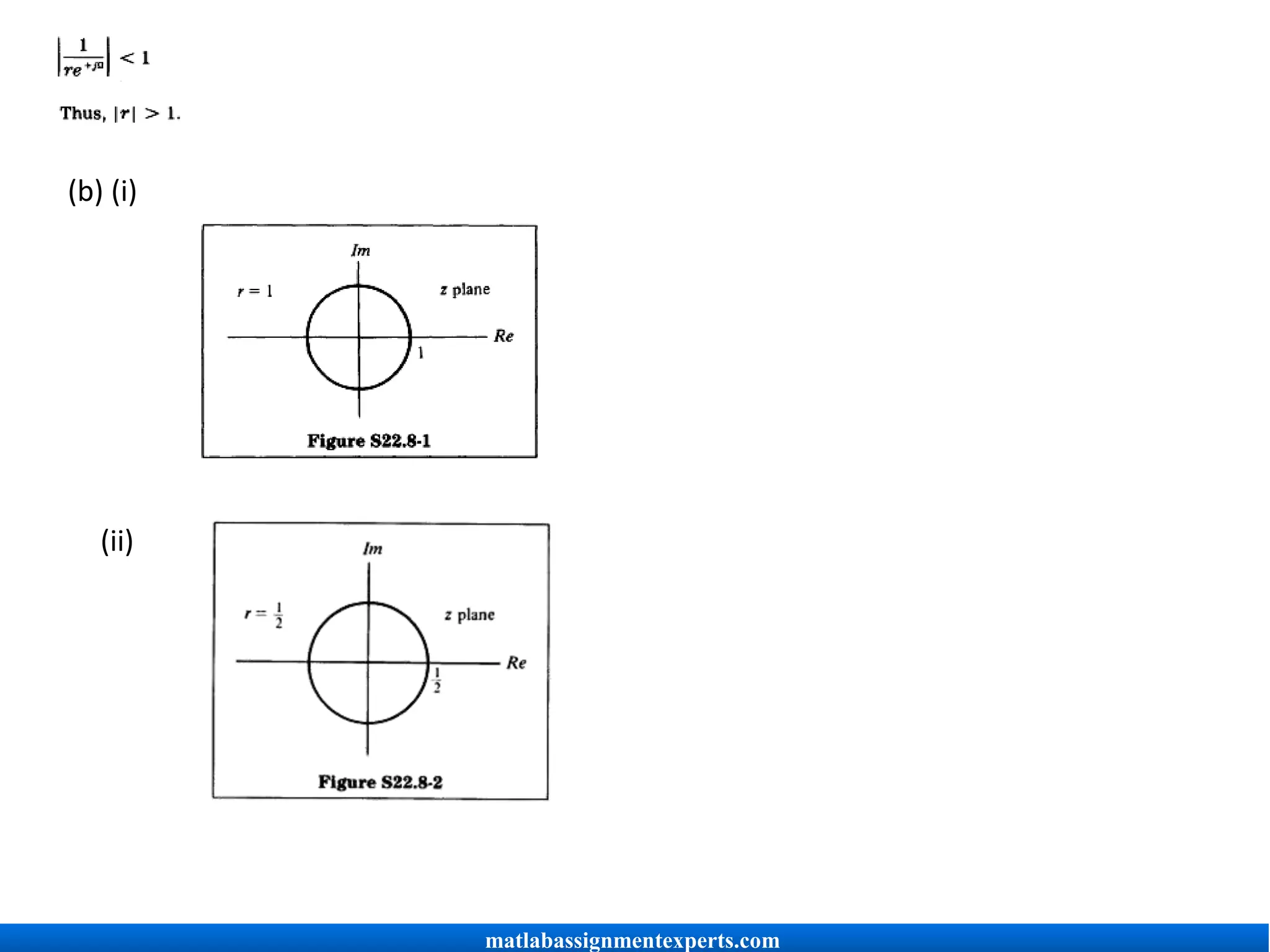
with the ROC comprising the entire z-plane, as shown in Figure S22.6-2.
S22.7
(a) Using long division, we have
matlabassignmentexperts.com
We recognize that
x[n] = (-i)"u[n]
(b) Proceeding as we did in part (a), we have
Therefore,
S22.8
For the sum to converge, we must have
matlabassignmentexperts.com
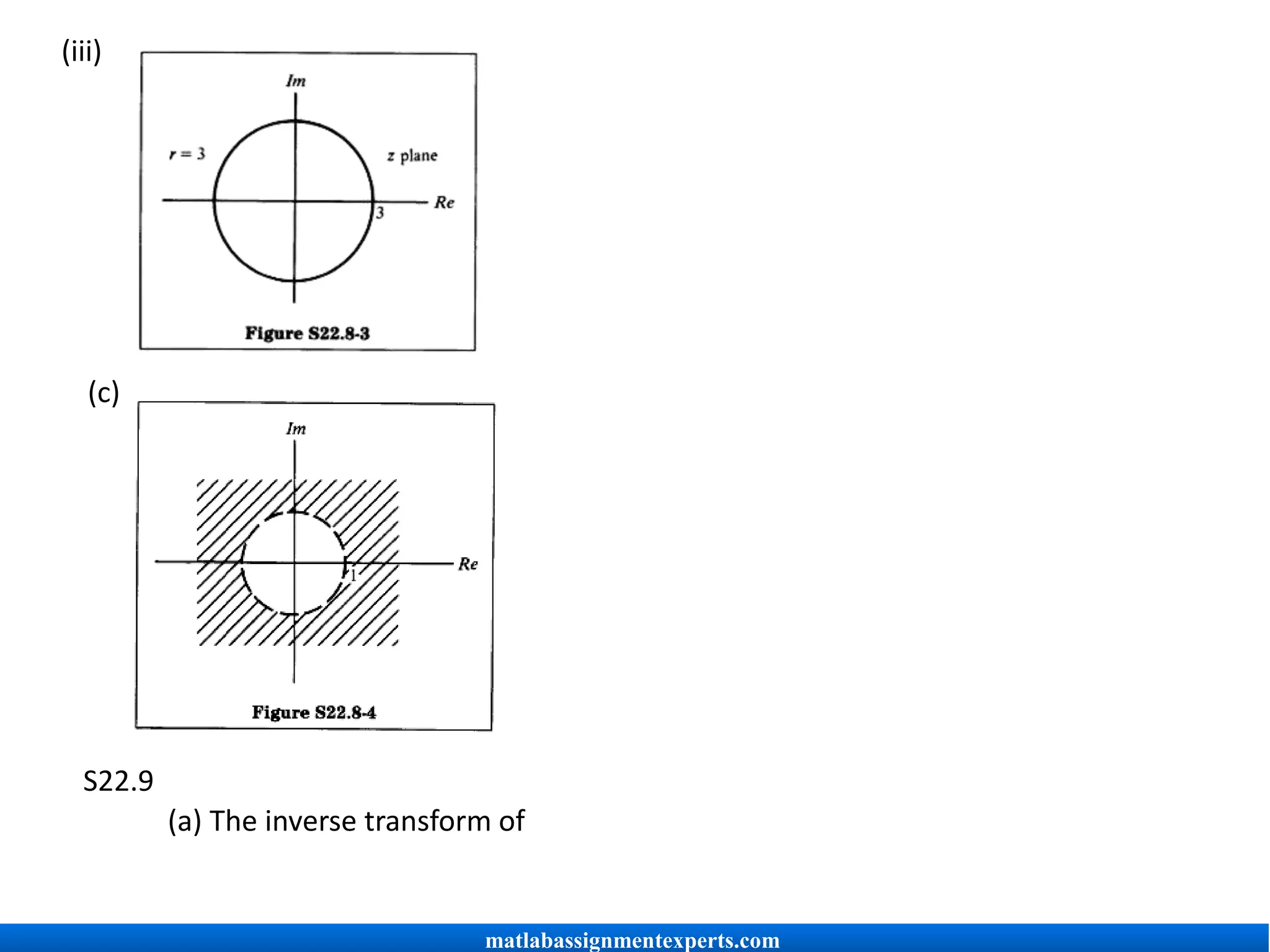
(b) (i)
(ii)
matlabassignmentexperts.com
(iii)
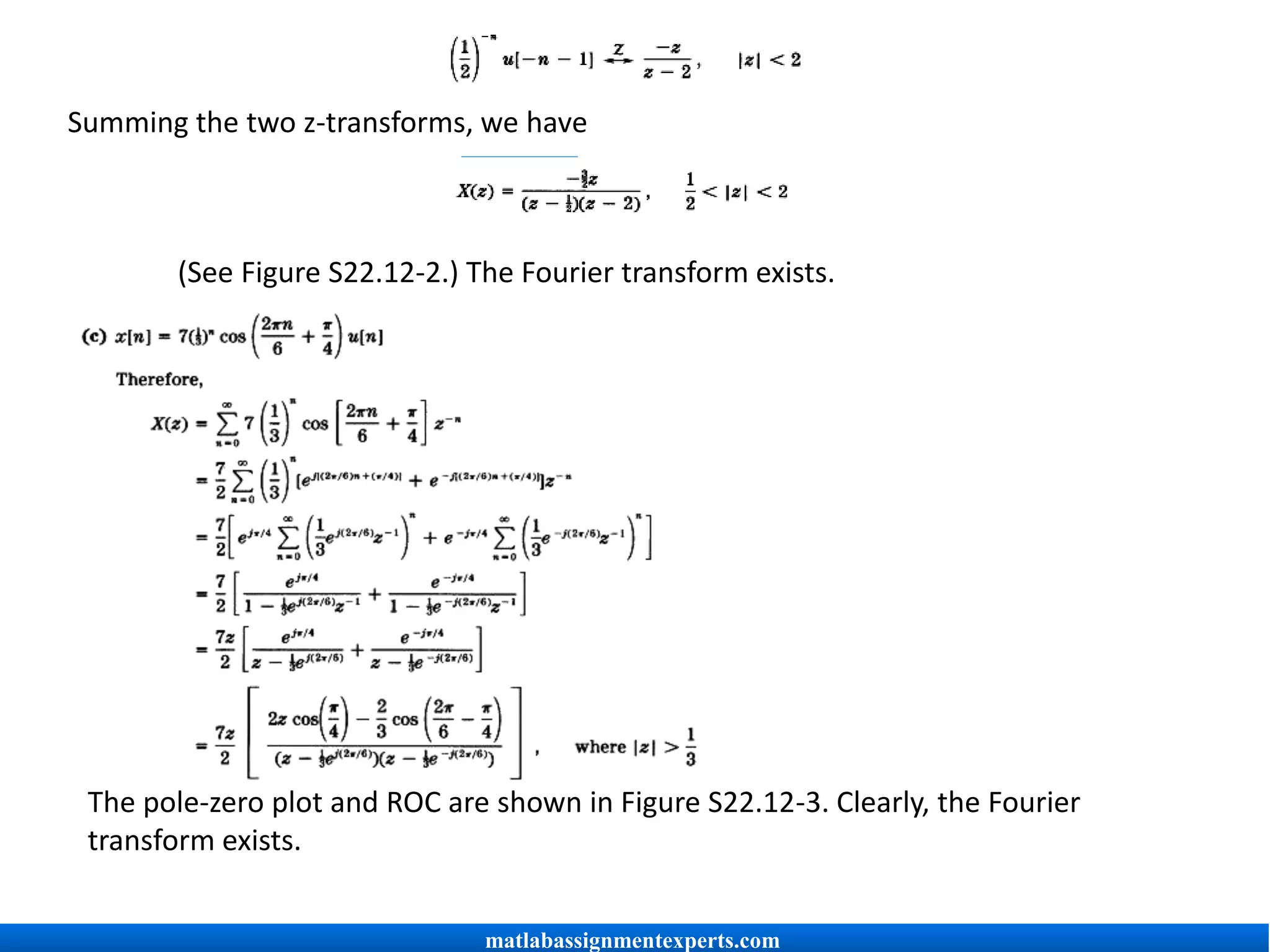
(c)
S22.9
(a) The inverse transform of
matlabassignmentexperts.com
is (i)"u[n]. But from the given relation, we have
S22.10
matlabassignmentexperts.com
S22.11
In all the parts of this problem, draw the vectors from the poles or zeros to the unit
circle. Then estimate the frequency response from the magnitudes of these vectors,
as was done in the lecture. The following rough association can be made:
S22.12
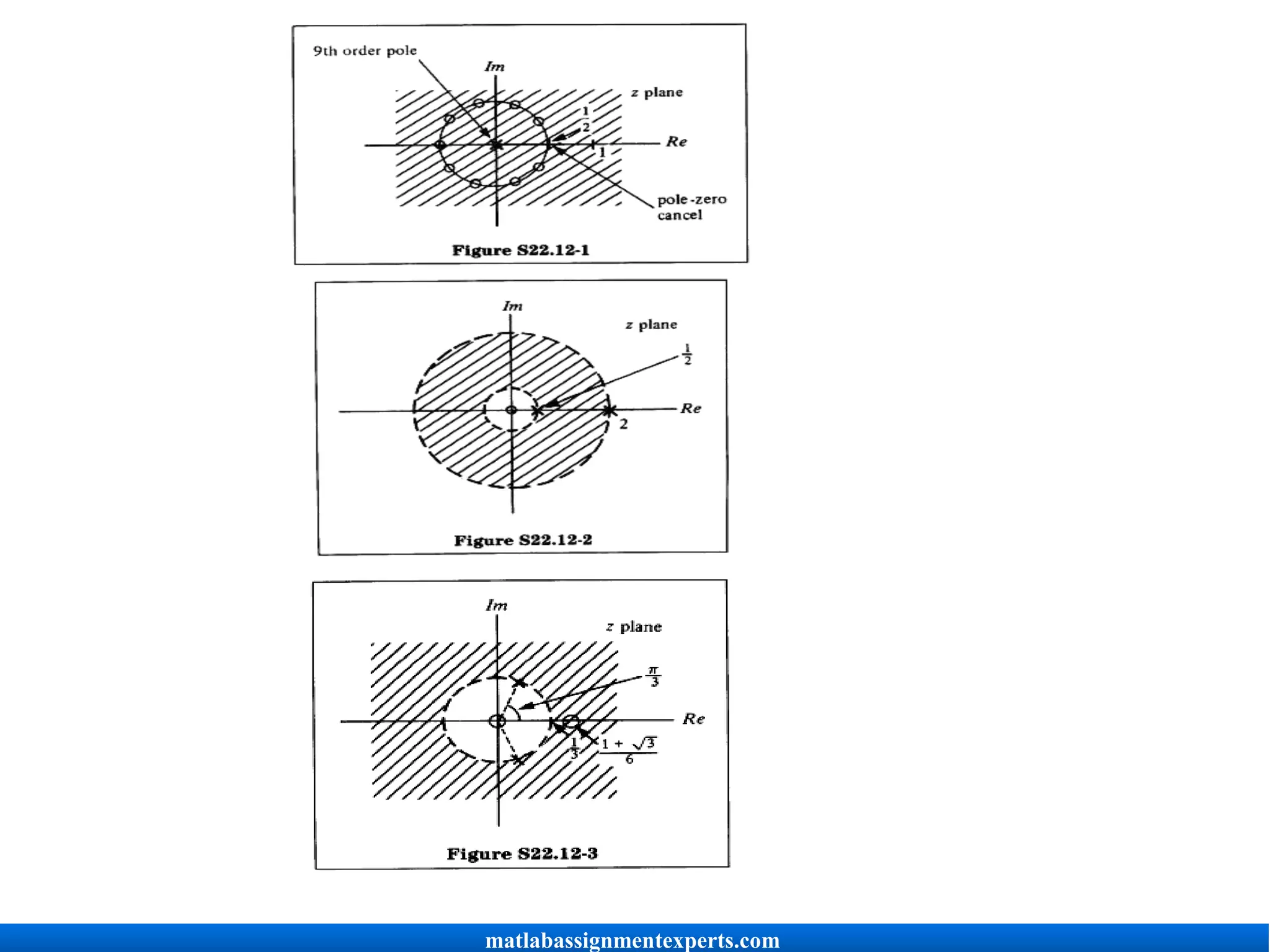
(a) x[n] = (I)"[u[n] - u[n - 101]. Therefore,
shown in Figure S22.12-1. The Fourier transform exists.
(b) x[n] = (.)In' = (I)"u[n] + (.) -u[-n - 1]. But
and
matlabassignmentexperts.com
Summing the two z-transforms, we have
(See Figure S22.12-2.) The Fourier transform exists.
The pole-zero plot and ROC are shown in Figure S22.12-3. Clearly, the Fourier
transform exists.
matlabassignmentexperts.com
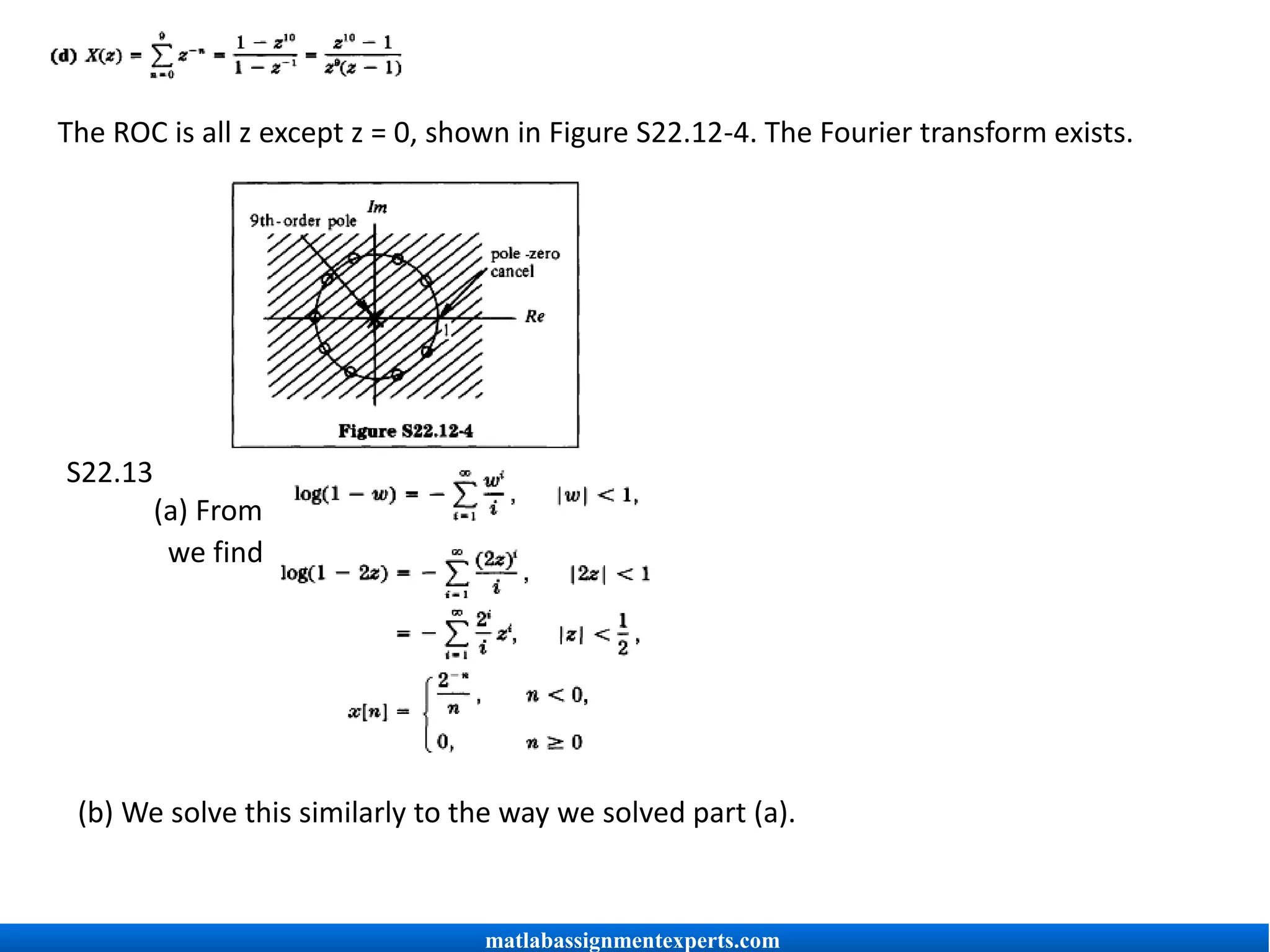
The ROC is all z except z = 0, shown in Figure S22.12-4. The Fourier transform exists.
S22.13
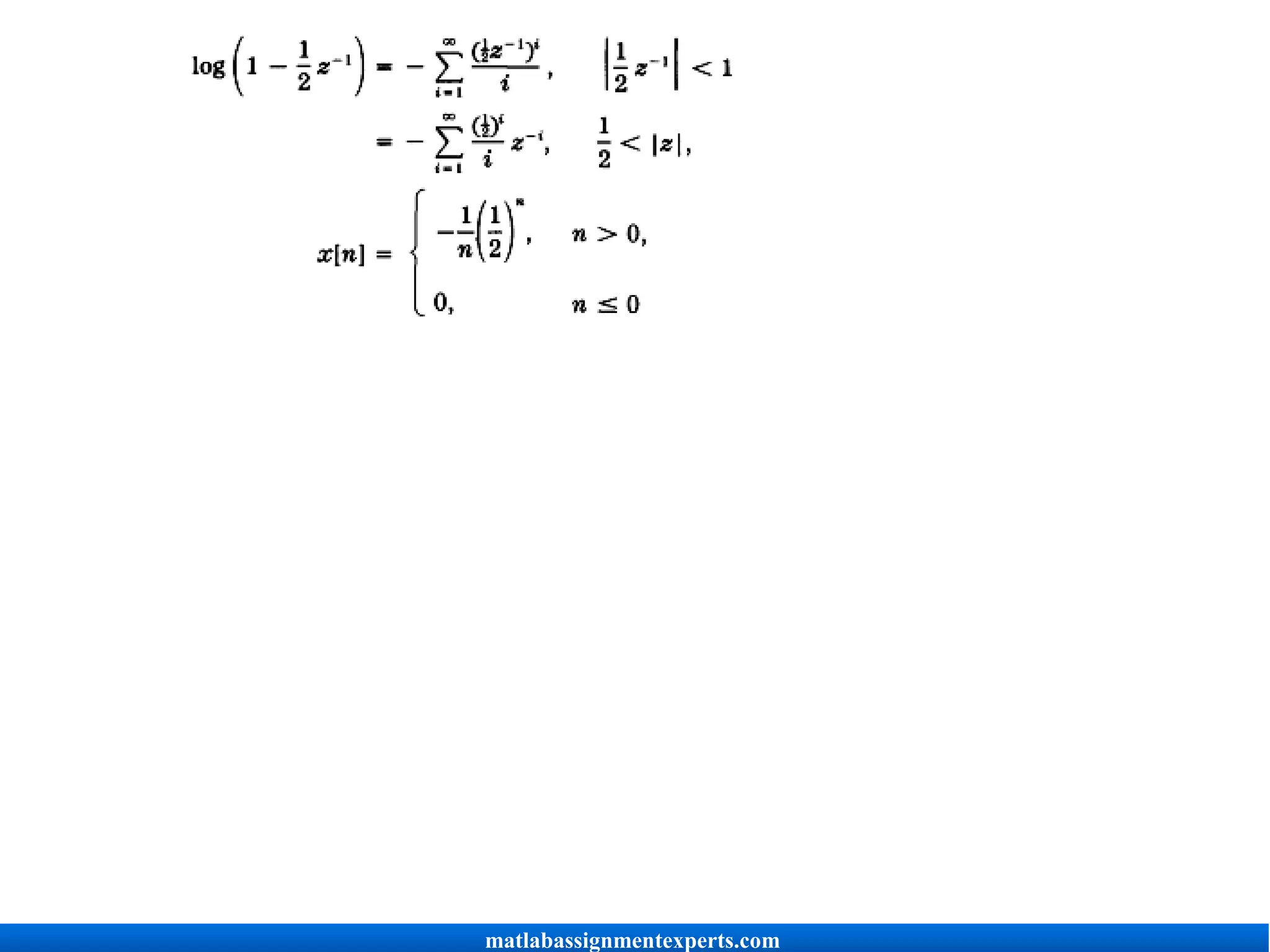
(a) From
we find
(b) We solve this similarly to the way we solved part (a).
matlabassignmentexperts.com

Signals and Systems Assignment Help

  • 1.
    For any helpregarding Signals and Systems Assignment Help visit : - https://www.matlabassignmentexperts.com/ , Email : - info@matlabassignmentexperts.com or call us at : - +1 678 648 4277 Signals and Systems Assignment Help
  • 2.
    The z-Transform Recommended Problems AnLTI system has an impulse response h[n] for which the z-transform is (a) Plot the pole-zero pattern for H(z). (b) Using the fact that signals of the form z" are eigenfunctions of LTI systems, determine the system output for all n if the input x[n] is P22.2 Consider the sequence x[n] = 2"u[n]. (a) Is x[n] absolutely summable? (b) Does the Fourier transform of x[n] converge? (c) For what range of values of r does the Fourier transform of the sequence r-"x[n] converge? (d) Determine the z-transform X(z) of x[n], including a specification of the ROC. (e) X(z) for z = 3e'a can be thought of as the Fourier transform of a sequence x,[n], i.e., matlabassignmentexperts.com
  • 3.
    Determine x1[n]. P22.3 Shown inFigure P22.3 is the pole-zero plot for the z-transform X(z) of a sequence x[nI. P22-2 Determine what can be inferred about the associated region of convergence from each of the following statements. matlabassignmentexperts.com
  • 4.
    P22.4 (a) Determine thez-transforms of the following two signals. Note that the z-transforms for both have the same algebraic expression and differ only in the ROC. (i) xi[n] = (i)"u[n] (ii) X2[n] = -(I)"n[-U - 1] (b) Sketch the pole-zero plot and ROC for each signal in part (a). (c) Repeat parts (a) and (b) for the following two signals: (i) x3[n] = 2u[n] (ii) x 4 [n] = -(2)"u[-n - 1] (d) For which of the four signals xi[n], x 2[n], xs[n], and x 4[n] in parts (a) and (c) does the Fourier transform converge? P22.5 Consider the pole-zero plot of H(z) given in Figure P22.5, where H(a/2) = 1. (a) x[n] is right-sided. (b) The Fourier transform of x[n] converges. (c) The Fourier transform of x[n] does not converge. (d) x[n] is left-sided. matlabassignmentexperts.com
  • 5.
    (a) Sketch |H(e'")Ias the number of zeros at z = 0 increases from 1 to 5. (b) Does the number of zeros affect <'H(ej")? If so, specifically in what way? (c) Find the region of the z plane where IH(z) I = 1. P22.6 Determine the z-transform (including the ROC) of the following sequences. Also sketch the pole-zero plots and indicate the ROC on your sketch. (a) (I)"U [n] (b) (b) 6[n + 1] matlabassignmentexperts.com
  • 6.
    P22.7 For each ofthe following z-transforms determine the inverse z-transform. Optional Problems P22.8 In this problem we study the relation between the z-transform, the Fourier transform, and the ROC. (a) Consider the signal x[n] = u[n]. For which values of r does r-"x[n] have a converging Fourier transform? (b) (b) In the lecture, we discussed the relation between X(z) and I{r-"x[nj}. For each of the following values of r, sketch where in the z plane X(z) equals the Fourier transform of r-x[n]. (i) r=1 (ii) r = (iii) r=3 (c) From your observations in parts (a) and (b), sketch the ROC of the z-transform of u[n]. matlabassignmentexperts.com
  • 7.
    P22.9 (a) Suppose X(z)on the circle z = 2e'j is given by Using the relation X(reju) = 5{r~"x[n]}, find 2-x[n] and then x[n], the inverse z- transform of X(z). (b) Find x[n] from X(z) below using partial fraction expansion, where x[n] is known to be causal, i.e., x[n] = 0 for n < 0. P22-4 P22.10 A discrete-time system with the pole-zero pattern shown in Figure P22.10-1 is referred to as a first-order all-pass system because the magnitude of the frequency response is a constant, independent of frequency. matlabassignmentexperts.com
  • 8.
    (a) Demonstrate algebraicallythat IH(eu) I is constant. (b) To demonstrate the same property geometrically, consider the vector diagram in Figure P22.10-2. Show that the length of v 2 is proportional to the length of vi independent of 0 by following these two steps: (i) Express the length of v, using the law of cosines and the fact that it is one leg of a triangle for which the other two legs are the unit vector and a vector of length a. (ii) In a manner similar to that in step (i), determine the length of v 2 and show that it is proportional in length to vi independent of Q. P22.11 Parts (a)-(e) (Figures P22.11-1 to P22.11-5) give pole-zero plots, and parts (i)-(iv) (Figures P22.11-6 to P22.11-9) give sketches of possible Fourier transform magnitudes. Assume that for all the pole-zero plots, the ROC includes the unit circle. For each pole- zero plot (a)-(e), specify which one if any of the sketches (i)-(iv) could represent the associated Fourier transform magnitude. More than one pole-zero plot may be associated with the same sketch. matlabassignmentexperts.com
  • 9.
  • 10.
    P22.12 Determine the z-transformfor the following sequences. Express all sums in closed form. Sketch the pole-zero plot and indicate the ROC. Indicate whether the Fourier transform of the sequence exists. matlabassignmentexperts.com
  • 11.
    P22.13 Using the power-seriesexpansion determine the inverse of the following z-transforms. matlabassignmentexperts.com
  • 12.
    S22.1 (a) The z-transformH(z) can be written Setting the numerator equal to zero to obtain the zeros, we find a zero at z = 0. Setting the denominator equal to zero to get the poles, we find a pole at z = 1. The pole-zero pattern is shown in Figure S22.1. (b) Since H(z) is the eigenvalue of the input z' and the system is linear, the output is given by matlabassignmentexperts.com
  • 13.
    S22.2 (a) To seeif x[n] is absolutely summable, we form the sum Since limN-oSN diverges, x[n] is not absolutely summable. (b) Since x[n] is not absolutely summable, the Fourier transform of x[n] does not converge. S22-2 limN-oN is finite for Ir > 2. Therefore, the Fourier transform of r-"x[n] converges for Ir| > 2. matlabassignmentexperts.com
  • 14.
    S22.3 (a) Since x[n]is right-sided, the ROC is given by Iz I > a. Since the ROC cannot include poles, for this case the ROC is given by Iz I > 2. (b) The statement implies that the ROC includes the unit circle Iz = 1. Since the ROC is a connected region and bounded by poles, the ROC must be 5 < IzI < 2 (c) For this situation there are three possibilities: (d) This statement implies that the ROC is given by |z < 1. S22.4 matlabassignmentexperts.com
  • 15.
  • 16.
  • 17.
    (d) For theFourier transform to converge, the ROC of the z-transform must include the unit circle. Therefore, for x 1[n] and x 4[n], the corresponding Fourier transforms converge. S22.5 Consider the pole-zero plot of H(z) given in Figure S22.5-1, where H(a/2) = 1. (a) When H(z) = z/(z - a), i.e., the number of zeros is 1, we have Therefore, and we can plot IH(ejQ)I as in Figure S22.5-2. matlabassignmentexperts.com
  • 18.
    When H(z) =z/(z- a), i.e., the number of zeros is 2, we have Therefore, Hence, we see that the magnitude of H(eia) does not change as the number of zeros increases. (b) For one zero at z = 0, we have We can calculate the phase of H(e ")by [Q - 4 (denominator)]. For two zeros at 0, the phase of H(ein) is [29 - 4 (denominator)]. Hence, the phase changes by a linear factor with the number of zeros. (c) The region of the z plane where IH(z) I = 1 is indicated in Figure S22.5-3. matlabassignmentexperts.com
  • 19.
    S22.6 Therefore, there isa zero at z = 0 and a pole at z = 1,and the ROC is as shown in Figure S22.6-1. matlabassignmentexperts.com
  • 20.
    with the ROCcomprising the entire z-plane, as shown in Figure S22.6-2. S22.7 (a) Using long division, we have matlabassignmentexperts.com
  • 21.
    We recognize that x[n]= (-i)"u[n] (b) Proceeding as we did in part (a), we have Therefore, S22.8 For the sum to converge, we must have matlabassignmentexperts.com
  • 22.
  • 23.
    (iii) (c) S22.9 (a) The inversetransform of matlabassignmentexperts.com
  • 24.
    is (i)"u[n]. Butfrom the given relation, we have S22.10 matlabassignmentexperts.com
  • 25.
    S22.11 In all theparts of this problem, draw the vectors from the poles or zeros to the unit circle. Then estimate the frequency response from the magnitudes of these vectors, as was done in the lecture. The following rough association can be made: S22.12 (a) x[n] = (I)"[u[n] - u[n - 101]. Therefore, shown in Figure S22.12-1. The Fourier transform exists. (b) x[n] = (.)In' = (I)"u[n] + (.) -u[-n - 1]. But and matlabassignmentexperts.com
  • 26.
    Summing the twoz-transforms, we have (See Figure S22.12-2.) The Fourier transform exists. The pole-zero plot and ROC are shown in Figure S22.12-3. Clearly, the Fourier transform exists. matlabassignmentexperts.com
  • 27.
  • 28.
    The ROC isall z except z = 0, shown in Figure S22.12-4. The Fourier transform exists. S22.13 (a) From we find (b) We solve this similarly to the way we solved part (a). matlabassignmentexperts.com
  • 29.