International Research Journal of Engineering and Technology (IRJET) e-ISSN: 2395-0056
Volume: 09 Issue: 08 | Aug 2022 www.irjet.net p-ISSN: 2395-0072
© 2022, IRJET | Impact Factor value: 7.529 | ISO 9001:2008 Certified Journal | Page 1749
Signal Classification and Identification for Cognitive Radio
Sanjay Yadav1, Dr Priyanka Jaiswal2
1- Master of Technology, Electronic and Communication Engineering, GITM, Lucknow.
Professor, Electronic and Communication Engineering, GITM, Lucknow.
---------------------------------------------------------------------***---------------------------------------------------------------------
Abstract - SDR (software-defined radio) devices have
gotten a lot of interest lately because to their low cost and
ease of use when it comes to hands-on testing. In cognitive
radio (CR), they may be utilised to create dynamic spectrum
allocation (DSA) algorithms. TheseCRsarecurrentlyunableto
determine which DSA method is most suited for a given
situation, despite much study in both machine learning and
signal processing. Machine learning and statistical signal
processing approaches may be used to compare the spectrum
sensing algorithms for CRs and spectrum observatories in
resource restricted contexts. We've decided to take on the
issues of detecting multiple transmitters and automatically
classifying modulation patterns (AMC). Multiple transmitter
identification algorithms using machine learning and
statistical signal processing are evaluated side by side. For
multi-transmitter identification, themachinelearningmethod
has an accuracy of 70 percent and 80 percent for two and five
user systems, respectively, while the statistical signal
processing technique has an accuracy of 50 percent for two
and five user systems, respectively. Machinelearningbeatsthe
signal processing techniquefor1000testsamplesinAMC, even
if both algorithms have 100% accuracy beyond 10 dB for 100
test samples (64-QAM is an exception). Signal processing
techniques in both situations take a fraction of the time
needed by machine learning algorithms, accordingtothetime
comparison.
Key Words: Signal, Cognitive, ratio, identification,SDR,DSA.
1. INTRODUCTION
The current state of wireless systems is characterised by a
radio function that is always on, a spectrumallocationthatis
always the same, and very little network coordination
between mobile devices. In this day and age, it is common
practise to utilise a remote web connection that is given bya
portable device as the main method of one-on-one
communication. This is becauseremotewebconnectionsare
more reliable than traditional dial-up connections. Because
of the developments that have been made in the web of
things (IoT) based gadgets, for example, reconnaissance
frameworks, sensor frameworks, implanted wellbeing
observing frameworks, and numerous other similar
frameworks, researchers and specialists are attempting to
relegate a range band to every one of these gadgets for the
purpose of impedance free correspondence [1]. This is a
direct result of the limitedradiospectrum,whichcameabout
as a direct result of the decision made by the administrative
commissioners to proactively allocate a significant
percentage of the available radio spectrum to a number of
different administrations. As a direct result of this decision,
there is now a limited amount of radio spectrum. Therearea
few distinct groups that are responsible for the
overwhelming bulk of the congestion, yet the great majority
of the available space is underutilised [2].
1.1. Software-Defined Radios
Figure 1-1 illustrates one of the fundamental building blocks
that comprise the digital communication system. It is
equipped with an RF front end that is connected to the
antenna. Amplification of the analogue signal that eitherhas
to be broadcast or received is performed by this block. The
conversion is carried out via the digital to analogue (DAC)
and analogue to digital (ADC) converters respectively. The
baseband signals are changed from a stop band into a pass
band and back again by the digital up-conversion (DUC) and
digital down-conversion (DDC) processes. In baseband
processing, each and every processing activity, such as
establishing a connection, frequency equalisation, and
encoding/decoding, is carried out in its entirety [4]. This
kind of technology is referred to as software-defined radio
(SDR), and it executes these tasks on software modules that
are either operating on field-programmable gate arrays
(FPGA) or digital signal processors (DSP), or a mix of the
two.
Figure-1: A basic Digital Radio Block.
International Research Journal of Engineering and Technology (IRJET) e-ISSN: 2395-0056
Volume: 09 Issue: 08 | Aug 2022 www.irjet.net p-ISSN: 2395-0072
© 2022, IRJET | Impact Factor value: 7.529 | ISO 9001:2008 Certified Journal | Page 1750
1.2. COGNITIVE RADIOS
Radios are able to alter their functions and operations
because reconfigurable characteristics supplied by SDRs
make this possible. However, the SDR is not capableofdoing
these operations on its own; more specifically, it cannot
reconfigure itself into the shape that is going to be the most
useful for its user unless that user gives it instructions to do
so. A device that is capable of self-reconfigurationinorderto
improve its performance is known as a cognitive radio (CR)
[4]. These days, CRs are becoming more popular as a result
of the perceived lack of bandwidth that is generated by the
fixed frequency allotment [2]. A CR is able to detect the
current status of the channel and adjust itself accordingly in
order to get the highest possible throughput. In the
beginning, the concept of CR was conceived with the
intention of gaining opportunistic access across the digital
TV bands in order to facilitate secondary communication
inside a wireless regional area network. However, intoday's
world, CRs are being utilised not only in the business sector
but also in the military sector. This is due to the fact that, in
comparison to conventional radios, CRs provide the extra
benefit of greater flexibility and security.
Figure-2: A basic block diagram of CR.
1.3. Dynamic Spectrum Access
Because of the rise in demand forwirelesscommunicationin
today's world, there is a significant challenge posed by the
static spectrum allotment as well as the restricted network
coordination among mobile devices [10]. Along these same
lines, a significant portion of the radiospectrumisputtouse.
The vast majority of the range is ratherlittleused,althougha
few specific groupings are extremely obstructed. The
solution to this problem is called dynamic range access
(DSA), and it may be found in [11]. The primary goal of the
DSA is to re-use recurrence groups with a low level of
participant involvement while at the same time causing the
genuine authorised customers no obstruction [12].
Figure-3: Illustration of AMC in Military applications.
2. DATA PREPARATION AND MULTISCALE
The parameter initialisation is one drawback of the mixed
model. The issue is identifying many transmitters without
prior knowledge, which cannot be done optimallyunlessthe
starting values input into the algorithms are properly
chosen. Furthermore, spectral measurements are employed
in this technique. As a result, the measured log-spectral
values should be linearized. After converting the data to
linear form, it is divided into time-frequency bins and
categorised. Multiscale isthenameforthisgroupingmethod.
Table-1: Multiscale and time-frequency bins.
Serial
Number
Multiscale
Resolution (Imax)
T-F Bins
1 Imax =1.0 4
2 Imax =2.0 16
3 Imax =3.0 64
4 Imax =4.0 128
3. RESULT DATA
The IQ samples with known number of transmitters are
required. To accomplish this, a GNU radio toolkit based on
Python programming language is used to generate the data.
The data is divided into three sets containing 500 files each.
Each set has 100 files of IQ samples with 0, 10, 20, 30, 40 dB
of additive white Gaussian noise for statistical relevance.
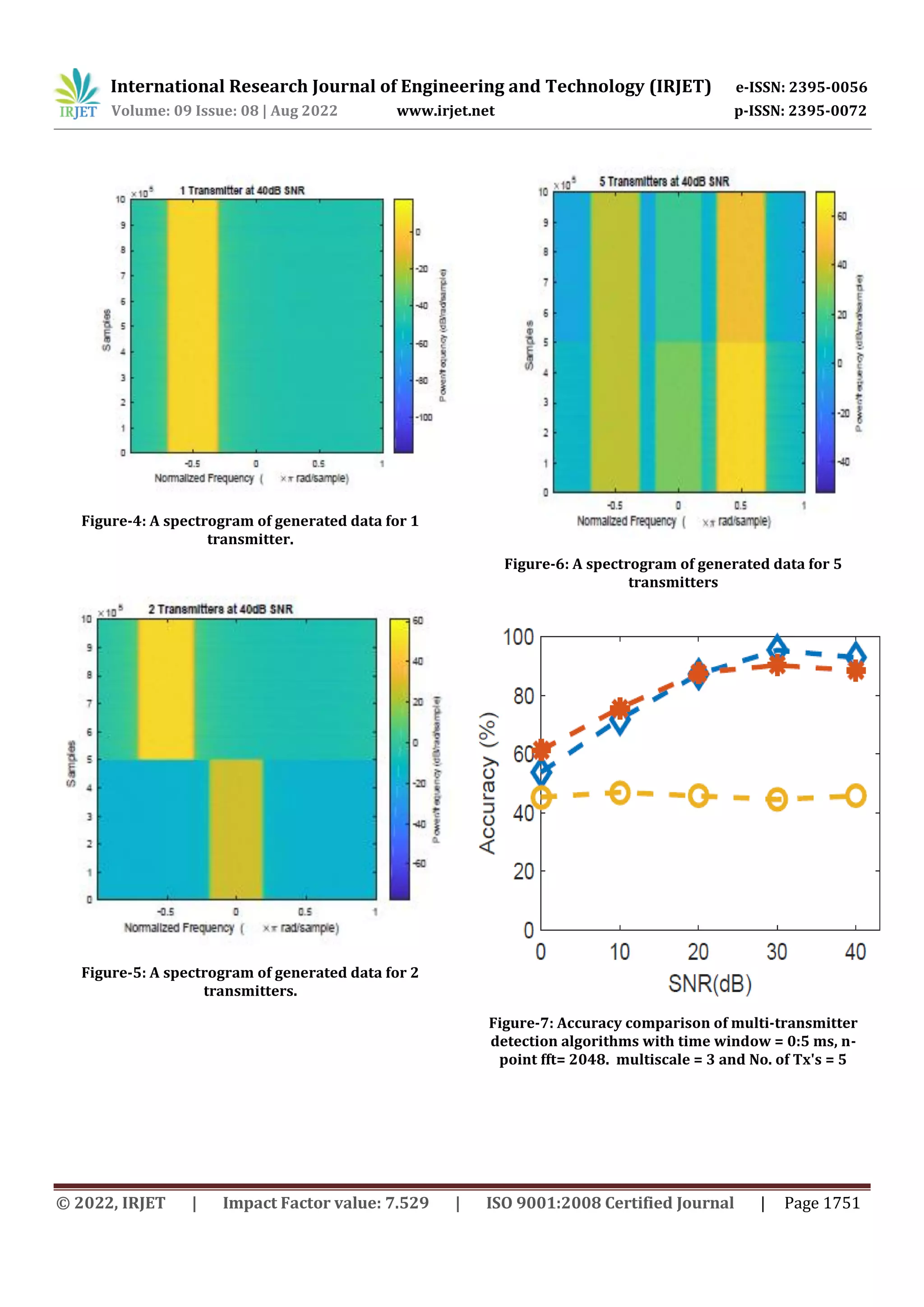
Also, each set has one, two, and five transmitters,
respectively. The waterfall plot of the data in each set is
shown in figure 4 to figure-6.
International Research Journal of Engineering and Technology (IRJET) e-ISSN: 2395-0056
Volume: 09 Issue: 08 | Aug 2022 www.irjet.net p-ISSN: 2395-0072
© 2022, IRJET | Impact Factor value: 7.529 | ISO 9001:2008 Certified Journal | Page 1751
Figure-4: A spectrogram of generated data for 1
transmitter.
Figure-5: A spectrogram of generated data for 2
transmitters.
Figure-6: A spectrogram of generated data for 5
transmitters
Figure-7: Accuracy comparison of multi-transmitter
detection algorithms with time window = 0:5 ms, n-
point fft= 2048. multiscale = 3 and No. of Tx's = 5
International Research Journal of Engineering and Technology (IRJET) e-ISSN: 2395-0056
Volume: 09 Issue: 08 | Aug 2022 www.irjet.net p-ISSN: 2395-0072
© 2022, IRJET | Impact Factor value: 7.529 | ISO 9001:2008 Certified Journal | Page 1752
Figure-8: Accuracy comparison of multi-transmitter
detection algorithms with time window = 1 ms, n-
point fft= 1024.T multiscale = 2 and No. of Tx's = 1.
Figure-9: Accuracy comparison of multi-transmitter
detection algorithms with time window = 1 ms, n-
point fft= 1024, multiscale = 3 and No. of Tx's = 5.
Figure-10: Time comparison of multi-transmitter
detection algorithm time window = 0:5 ms, n-point
fft= 1024.
Figure-11: Time comparison of multi-transmitter
detection algorithm time window = 1 ms, n-point fft =
2048.
4. CONCLUSION
CRs were the focus of this study, which compared machine
learning and statistical signal processing techniques. AMC
and multi-transmitter identification were selected as test
tasks for this study. For the comparison of two novel
methods, log-Rayleigh mixing model and normalised
threshold energy sensing techniquebasedmulti-transmitter
detection algorithm were utilised. The TxMiner algorithm
was used as a benchmark for these algorithms. K-next
International Research Journal of Engineering and Technology (IRJET) e-ISSN: 2395-0056
Volume: 09 Issue: 08 | Aug 2022 www.irjet.net p-ISSN: 2395-0072
© 2022, IRJET | Impact Factor value: 7.529 | ISO 9001:2008 Certified Journal | Page 1753
neighbour and greatest likelihood AMC are also evaluated.
According to the results ofthecomparison,machinelearning
algorithms outperform signal processing techniques. It is
possible to boost the accuracy of supervised learning (k-
nearest neighbour) by increasing the number of training
samples. A large enough number of samples is necessary for
unsupervised learningtechniques(EMalgorithm)inorderto
ensure that the results are statistically significant. It is also
possible to draw the conclusion thatthetime requiredto run
machine learning algorithms grows significantly as the
number of samples for detection/classification processes
increases. As a result, it is possible to think of algorithm
selection as a trade-off between accuracy and execution
time.
REFERENCES
[1] K. Gamacharige and M. Thilina, “On spectrum sensing,
resource allocation, and medium access control in cognitive
radio networks,” 2015. [Online]. Available:
http://mspace.lib.umanitoba.ca/xmlui/handle/1993/30650
[2] F. S. P. T. Force, “Report of the spectrum efficiency
working group,” http://www. fcc. gov/sptf/reports. html,
2002.
[3] G. Sanjeev, “Spectrum sensing techniques for cognitive
radio applications,” Ph.D. dissertation, Indian Institute of
Science, Bangalore, 2015.
[4] A. M. Wyglinski, M. Nekovee, and T. Hou, Cognitive Radio
Communications and Networks: Principles and Practice.
Academic Press, Nov. 2009, google- Books-ID:
d3HBCmFEmicC.
[5] J. Mitola, “Cognitive radio: An integrated agent
architecture for software defined radio, Doctor of
Technology,” Royal Inst. Technol, pp. 271–350, Jan. 2000.
[6] S. Kompella, “Tutorial: Cognitive Radio Network
Design and SDR Programming for Tactical
Communications.” [Online]. Avail- able:
http://events.afcea.org/milcom17/public/SessionDetails.as
px?FromPage=
Sessions.aspx&SessionID=6136&SessionDateID=480
[7] G. P. Joshi, S. Y. Nam, and S. W. Kim, “Cognitive Radio
Wireless Sensor Networks: Applications, Challenges and
Research Trends,” Sensors (Basel, Switzerland), vol. 13, no.
9, pp. 11 196–11 228, Aug. 2013. [Online]. Available:
https://www.ncbi.nlm.nih.gov/pmc/articles/PMC3821336/
[8] G. Zhou, J. A. Stankovic, and S. H. Son, “Crowdedspectrum
in wireless sensor networks,” IEEE EmNets, vol. 6, 2006.
[9] J. Borms, K. Steenhaut, and B. Lemmens, “Low-Overhead
Dynamic Multi- channel MACforWirelessSensorNetworks,”
in Wireless Sensor Networks,ser.LectureNotesinComputer
Science. Springer, Berlin, Heidelberg, Feb. 2010, pp. 81–96.
[Online]. Available: https://link.springer.com/chapter/10.
1007/978-3-642-11917-0 6
[10] I. F. Akyildiz, W.-Y. Lee, M. C. Vuran, and S. Mohanty,
“NeXt generation/- dynamic spectrum access/cognitive
Radio Wireless Networks: A Survey,” Com- puter Networks
Journal (elsevier, vol. 50, pp. 2127–2159, 2006.
[11] Z. Tian and G. B. Giannakis, “A Wavelet Approach to
Wideband Spectrum Sensing for Cognitive Radios,” in 2006
1st International Conference on Cognitive Radio Oriented
Wireless Networks and Communications, Jun. 2006,pp.1–5.
[12] S. Geirhofer, L. Tong, and B. M. Sadler, “COGNITIVE
RADIOS FOR DY- NAMIC SPECTRUM ACCESS - Dynamic
Spectrum Access in the Time Do- main: Modeling and
Exploiting White Space,” IEEE Communications Magazine,
vol. 45, no. 5, pp. 66–72, May 2007.
[13] H. C. Wu, M. Saquib, and Z. Yun, “Novel Automatic
Modulation Classification Using Cumulant Features for
Communications via MultipathChannels,”IEEETransactions
on Wireless Communications, vol. 7, no. 8, pp. 3098–3105,
Aug. 2008.
[14] Z. Zhu and A. K. Nandi, Automatic Modulation
Classification: Principles,Al-gorithmsandApplications.John
Wiley & Sons, Dec. 2014, google-Books-ID: l77eBQAAQBAJ.
[15] R. A. Poisel, Introduction to Communication Electronic
Warfare Systems, 2nd ed. Norwood, MA, USA:ArtechHouse,
Inc., 2008.
[16] B. Suseela and D. Sivakumar, “Non-cooperative
spectrum sensing techniques in cognitive radio-a survey,”in
2015 IEEE Technological Innovation in ICT for Agriculture
and Rural Development (TIAR), Jul. 2015, pp. 127–133.
[17] J. G. Proakis, Digital Communications. McGraw-Hill,
2001, google-Books-ID: sbr8QwAACAAJ.
[18] R. Tandra and A. Sahai, “Fundamental limits on
detection in low SNR un- der noise uncertainty,” in 2005
International Conference on Wireless Networks,
Communications andMobile Computing,vol.1,Jun.2005, pp.
464–469 vol.1.

Signal Classification and Identification for Cognitive Radio

  • 1.
    International Research Journalof Engineering and Technology (IRJET) e-ISSN: 2395-0056 Volume: 09 Issue: 08 | Aug 2022 www.irjet.net p-ISSN: 2395-0072 © 2022, IRJET | Impact Factor value: 7.529 | ISO 9001:2008 Certified Journal | Page 1749 Signal Classification and Identification for Cognitive Radio Sanjay Yadav1, Dr Priyanka Jaiswal2 1- Master of Technology, Electronic and Communication Engineering, GITM, Lucknow. Professor, Electronic and Communication Engineering, GITM, Lucknow. ---------------------------------------------------------------------***--------------------------------------------------------------------- Abstract - SDR (software-defined radio) devices have gotten a lot of interest lately because to their low cost and ease of use when it comes to hands-on testing. In cognitive radio (CR), they may be utilised to create dynamic spectrum allocation (DSA) algorithms. TheseCRsarecurrentlyunableto determine which DSA method is most suited for a given situation, despite much study in both machine learning and signal processing. Machine learning and statistical signal processing approaches may be used to compare the spectrum sensing algorithms for CRs and spectrum observatories in resource restricted contexts. We've decided to take on the issues of detecting multiple transmitters and automatically classifying modulation patterns (AMC). Multiple transmitter identification algorithms using machine learning and statistical signal processing are evaluated side by side. For multi-transmitter identification, themachinelearningmethod has an accuracy of 70 percent and 80 percent for two and five user systems, respectively, while the statistical signal processing technique has an accuracy of 50 percent for two and five user systems, respectively. Machinelearningbeatsthe signal processing techniquefor1000testsamplesinAMC, even if both algorithms have 100% accuracy beyond 10 dB for 100 test samples (64-QAM is an exception). Signal processing techniques in both situations take a fraction of the time needed by machine learning algorithms, accordingtothetime comparison. Key Words: Signal, Cognitive, ratio, identification,SDR,DSA. 1. INTRODUCTION The current state of wireless systems is characterised by a radio function that is always on, a spectrumallocationthatis always the same, and very little network coordination between mobile devices. In this day and age, it is common practise to utilise a remote web connection that is given bya portable device as the main method of one-on-one communication. This is becauseremotewebconnectionsare more reliable than traditional dial-up connections. Because of the developments that have been made in the web of things (IoT) based gadgets, for example, reconnaissance frameworks, sensor frameworks, implanted wellbeing observing frameworks, and numerous other similar frameworks, researchers and specialists are attempting to relegate a range band to every one of these gadgets for the purpose of impedance free correspondence [1]. This is a direct result of the limitedradiospectrum,whichcameabout as a direct result of the decision made by the administrative commissioners to proactively allocate a significant percentage of the available radio spectrum to a number of different administrations. As a direct result of this decision, there is now a limited amount of radio spectrum. Therearea few distinct groups that are responsible for the overwhelming bulk of the congestion, yet the great majority of the available space is underutilised [2]. 1.1. Software-Defined Radios Figure 1-1 illustrates one of the fundamental building blocks that comprise the digital communication system. It is equipped with an RF front end that is connected to the antenna. Amplification of the analogue signal that eitherhas to be broadcast or received is performed by this block. The conversion is carried out via the digital to analogue (DAC) and analogue to digital (ADC) converters respectively. The baseband signals are changed from a stop band into a pass band and back again by the digital up-conversion (DUC) and digital down-conversion (DDC) processes. In baseband processing, each and every processing activity, such as establishing a connection, frequency equalisation, and encoding/decoding, is carried out in its entirety [4]. This kind of technology is referred to as software-defined radio (SDR), and it executes these tasks on software modules that are either operating on field-programmable gate arrays (FPGA) or digital signal processors (DSP), or a mix of the two. Figure-1: A basic Digital Radio Block.
  • 2.
    International Research Journalof Engineering and Technology (IRJET) e-ISSN: 2395-0056 Volume: 09 Issue: 08 | Aug 2022 www.irjet.net p-ISSN: 2395-0072 © 2022, IRJET | Impact Factor value: 7.529 | ISO 9001:2008 Certified Journal | Page 1750 1.2. COGNITIVE RADIOS Radios are able to alter their functions and operations because reconfigurable characteristics supplied by SDRs make this possible. However, the SDR is not capableofdoing these operations on its own; more specifically, it cannot reconfigure itself into the shape that is going to be the most useful for its user unless that user gives it instructions to do so. A device that is capable of self-reconfigurationinorderto improve its performance is known as a cognitive radio (CR) [4]. These days, CRs are becoming more popular as a result of the perceived lack of bandwidth that is generated by the fixed frequency allotment [2]. A CR is able to detect the current status of the channel and adjust itself accordingly in order to get the highest possible throughput. In the beginning, the concept of CR was conceived with the intention of gaining opportunistic access across the digital TV bands in order to facilitate secondary communication inside a wireless regional area network. However, intoday's world, CRs are being utilised not only in the business sector but also in the military sector. This is due to the fact that, in comparison to conventional radios, CRs provide the extra benefit of greater flexibility and security. Figure-2: A basic block diagram of CR. 1.3. Dynamic Spectrum Access Because of the rise in demand forwirelesscommunicationin today's world, there is a significant challenge posed by the static spectrum allotment as well as the restricted network coordination among mobile devices [10]. Along these same lines, a significant portion of the radiospectrumisputtouse. The vast majority of the range is ratherlittleused,althougha few specific groupings are extremely obstructed. The solution to this problem is called dynamic range access (DSA), and it may be found in [11]. The primary goal of the DSA is to re-use recurrence groups with a low level of participant involvement while at the same time causing the genuine authorised customers no obstruction [12]. Figure-3: Illustration of AMC in Military applications. 2. DATA PREPARATION AND MULTISCALE The parameter initialisation is one drawback of the mixed model. The issue is identifying many transmitters without prior knowledge, which cannot be done optimallyunlessthe starting values input into the algorithms are properly chosen. Furthermore, spectral measurements are employed in this technique. As a result, the measured log-spectral values should be linearized. After converting the data to linear form, it is divided into time-frequency bins and categorised. Multiscale isthenameforthisgroupingmethod. Table-1: Multiscale and time-frequency bins. Serial Number Multiscale Resolution (Imax) T-F Bins 1 Imax =1.0 4 2 Imax =2.0 16 3 Imax =3.0 64 4 Imax =4.0 128 3. RESULT DATA The IQ samples with known number of transmitters are required. To accomplish this, a GNU radio toolkit based on Python programming language is used to generate the data. The data is divided into three sets containing 500 files each. Each set has 100 files of IQ samples with 0, 10, 20, 30, 40 dB of additive white Gaussian noise for statistical relevance. Also, each set has one, two, and five transmitters, respectively. The waterfall plot of the data in each set is shown in figure 4 to figure-6.
  • 3.
    International Research Journalof Engineering and Technology (IRJET) e-ISSN: 2395-0056 Volume: 09 Issue: 08 | Aug 2022 www.irjet.net p-ISSN: 2395-0072 © 2022, IRJET | Impact Factor value: 7.529 | ISO 9001:2008 Certified Journal | Page 1751 Figure-4: A spectrogram of generated data for 1 transmitter. Figure-5: A spectrogram of generated data for 2 transmitters. Figure-6: A spectrogram of generated data for 5 transmitters Figure-7: Accuracy comparison of multi-transmitter detection algorithms with time window = 0:5 ms, n- point fft= 2048. multiscale = 3 and No. of Tx's = 5
  • 4.
    International Research Journalof Engineering and Technology (IRJET) e-ISSN: 2395-0056 Volume: 09 Issue: 08 | Aug 2022 www.irjet.net p-ISSN: 2395-0072 © 2022, IRJET | Impact Factor value: 7.529 | ISO 9001:2008 Certified Journal | Page 1752 Figure-8: Accuracy comparison of multi-transmitter detection algorithms with time window = 1 ms, n- point fft= 1024.T multiscale = 2 and No. of Tx's = 1. Figure-9: Accuracy comparison of multi-transmitter detection algorithms with time window = 1 ms, n- point fft= 1024, multiscale = 3 and No. of Tx's = 5. Figure-10: Time comparison of multi-transmitter detection algorithm time window = 0:5 ms, n-point fft= 1024. Figure-11: Time comparison of multi-transmitter detection algorithm time window = 1 ms, n-point fft = 2048. 4. CONCLUSION CRs were the focus of this study, which compared machine learning and statistical signal processing techniques. AMC and multi-transmitter identification were selected as test tasks for this study. For the comparison of two novel methods, log-Rayleigh mixing model and normalised threshold energy sensing techniquebasedmulti-transmitter detection algorithm were utilised. The TxMiner algorithm was used as a benchmark for these algorithms. K-next
  • 5.
    International Research Journalof Engineering and Technology (IRJET) e-ISSN: 2395-0056 Volume: 09 Issue: 08 | Aug 2022 www.irjet.net p-ISSN: 2395-0072 © 2022, IRJET | Impact Factor value: 7.529 | ISO 9001:2008 Certified Journal | Page 1753 neighbour and greatest likelihood AMC are also evaluated. According to the results ofthecomparison,machinelearning algorithms outperform signal processing techniques. It is possible to boost the accuracy of supervised learning (k- nearest neighbour) by increasing the number of training samples. A large enough number of samples is necessary for unsupervised learningtechniques(EMalgorithm)inorderto ensure that the results are statistically significant. It is also possible to draw the conclusion thatthetime requiredto run machine learning algorithms grows significantly as the number of samples for detection/classification processes increases. As a result, it is possible to think of algorithm selection as a trade-off between accuracy and execution time. REFERENCES [1] K. Gamacharige and M. Thilina, “On spectrum sensing, resource allocation, and medium access control in cognitive radio networks,” 2015. [Online]. Available: http://mspace.lib.umanitoba.ca/xmlui/handle/1993/30650 [2] F. S. P. T. Force, “Report of the spectrum efficiency working group,” http://www. fcc. gov/sptf/reports. html, 2002. [3] G. Sanjeev, “Spectrum sensing techniques for cognitive radio applications,” Ph.D. dissertation, Indian Institute of Science, Bangalore, 2015. [4] A. M. Wyglinski, M. Nekovee, and T. Hou, Cognitive Radio Communications and Networks: Principles and Practice. Academic Press, Nov. 2009, google- Books-ID: d3HBCmFEmicC. [5] J. Mitola, “Cognitive radio: An integrated agent architecture for software defined radio, Doctor of Technology,” Royal Inst. Technol, pp. 271–350, Jan. 2000. [6] S. Kompella, “Tutorial: Cognitive Radio Network Design and SDR Programming for Tactical Communications.” [Online]. Avail- able: http://events.afcea.org/milcom17/public/SessionDetails.as px?FromPage= Sessions.aspx&SessionID=6136&SessionDateID=480 [7] G. P. Joshi, S. Y. Nam, and S. W. Kim, “Cognitive Radio Wireless Sensor Networks: Applications, Challenges and Research Trends,” Sensors (Basel, Switzerland), vol. 13, no. 9, pp. 11 196–11 228, Aug. 2013. [Online]. Available: https://www.ncbi.nlm.nih.gov/pmc/articles/PMC3821336/ [8] G. Zhou, J. A. Stankovic, and S. H. Son, “Crowdedspectrum in wireless sensor networks,” IEEE EmNets, vol. 6, 2006. [9] J. Borms, K. Steenhaut, and B. Lemmens, “Low-Overhead Dynamic Multi- channel MACforWirelessSensorNetworks,” in Wireless Sensor Networks,ser.LectureNotesinComputer Science. Springer, Berlin, Heidelberg, Feb. 2010, pp. 81–96. [Online]. Available: https://link.springer.com/chapter/10. 1007/978-3-642-11917-0 6 [10] I. F. Akyildiz, W.-Y. Lee, M. C. Vuran, and S. Mohanty, “NeXt generation/- dynamic spectrum access/cognitive Radio Wireless Networks: A Survey,” Com- puter Networks Journal (elsevier, vol. 50, pp. 2127–2159, 2006. [11] Z. Tian and G. B. Giannakis, “A Wavelet Approach to Wideband Spectrum Sensing for Cognitive Radios,” in 2006 1st International Conference on Cognitive Radio Oriented Wireless Networks and Communications, Jun. 2006,pp.1–5. [12] S. Geirhofer, L. Tong, and B. M. Sadler, “COGNITIVE RADIOS FOR DY- NAMIC SPECTRUM ACCESS - Dynamic Spectrum Access in the Time Do- main: Modeling and Exploiting White Space,” IEEE Communications Magazine, vol. 45, no. 5, pp. 66–72, May 2007. [13] H. C. Wu, M. Saquib, and Z. Yun, “Novel Automatic Modulation Classification Using Cumulant Features for Communications via MultipathChannels,”IEEETransactions on Wireless Communications, vol. 7, no. 8, pp. 3098–3105, Aug. 2008. [14] Z. Zhu and A. K. Nandi, Automatic Modulation Classification: Principles,Al-gorithmsandApplications.John Wiley & Sons, Dec. 2014, google-Books-ID: l77eBQAAQBAJ. [15] R. A. Poisel, Introduction to Communication Electronic Warfare Systems, 2nd ed. Norwood, MA, USA:ArtechHouse, Inc., 2008. [16] B. Suseela and D. Sivakumar, “Non-cooperative spectrum sensing techniques in cognitive radio-a survey,”in 2015 IEEE Technological Innovation in ICT for Agriculture and Rural Development (TIAR), Jul. 2015, pp. 127–133. [17] J. G. Proakis, Digital Communications. McGraw-Hill, 2001, google-Books-ID: sbr8QwAACAAJ. [18] R. Tandra and A. Sahai, “Fundamental limits on detection in low SNR un- der noise uncertainty,” in 2005 International Conference on Wireless Networks, Communications andMobile Computing,vol.1,Jun.2005, pp. 464–469 vol.1.