Presented by
S.SANTHANA MARI
MSC – I Chemistry
M.O THEORY - PI BOND,
DELTA BOND, QUADRUPLE BOND.
 One approach to understanding the electronic structure of
molecules is called Molecular Orbital Theory
MO theory
assumes that the valence electrons of the atoms within a
molecular become the valance electrons of the entire molecules
 Molecular orbitals are constructed by talking linear
combinations of atomic orbitals of the atomic within the
molecule.
M.O THEORY
 DELTA BOND are covalent chemical bonds ,
where four lobes of one involved atomic orbital
overlap four lobes of other involved atomic orbital
 This overlap of overlap lead to the formation of a
bonding molecular orbitals with two nodal planes
which contain the internuclear distance axis and go
through both atoms.
DELTA BOND
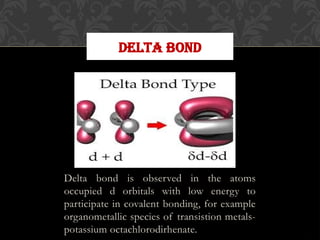
Delta bond is observed in the atoms
occupied d orbitals with low energy to
participate in covalent bonding, for example
organometallic species of transistion metals-
potassium octachlorodirhenate.
DELTA BOND
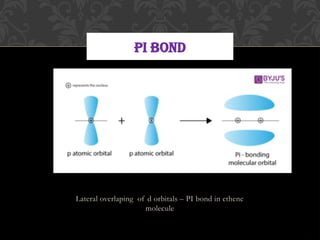
 PI bonds are the covalent bonds , in each of which
two lobes of an orbital of an orbital on one atom
overlap with two lobes of an orbital of an another
atom, and which this overlap occur laterally
PI BOND
Lateral overlaping of d orbitals – PI bond in ethene
molecule.
PI BOND
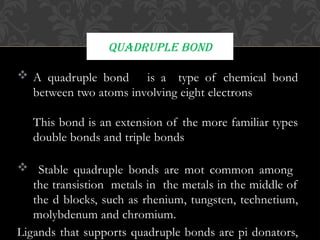
 A quadruple bond is a type of chemical bond
between two atoms involving eight electrons
This bond is an extension of the more familiar types
double bonds and triple bonds
 Stable quadruple bonds are mot common among
the transistion metals in the metals in the middle of
the d blocks, such as rhenium, tungsten, technetium,
molybdenum and chromium.
Ligands that supports quadruple bonds are pi donators,
QUADRUPLE BOND
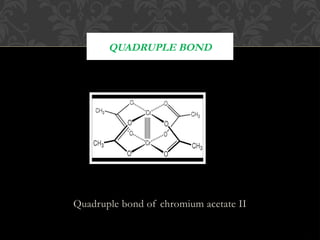
Quadruple bond of chromium acetate II
QUADRUPLE BOND
THANK YOU

SIGMA BOND ,COVALENT BONND QUADRAPOLEBOND

  • 1.
    Presented by S.SANTHANA MARI MSC– I Chemistry M.O THEORY - PI BOND, DELTA BOND, QUADRUPLE BOND.
  • 2.
     One approachto understanding the electronic structure of molecules is called Molecular Orbital Theory MO theory assumes that the valence electrons of the atoms within a molecular become the valance electrons of the entire molecules  Molecular orbitals are constructed by talking linear combinations of atomic orbitals of the atomic within the molecule. M.O THEORY
  • 3.
     DELTA BONDare covalent chemical bonds , where four lobes of one involved atomic orbital overlap four lobes of other involved atomic orbital  This overlap of overlap lead to the formation of a bonding molecular orbitals with two nodal planes which contain the internuclear distance axis and go through both atoms. DELTA BOND
  • 4.
    Delta bond isobserved in the atoms occupied d orbitals with low energy to participate in covalent bonding, for example organometallic species of transistion metals- potassium octachlorodirhenate. DELTA BOND
  • 5.
     PI bondsare the covalent bonds , in each of which two lobes of an orbital of an orbital on one atom overlap with two lobes of an orbital of an another atom, and which this overlap occur laterally PI BOND
  • 6.
    Lateral overlaping ofd orbitals – PI bond in ethene molecule. PI BOND
  • 7.
     A quadruplebond is a type of chemical bond between two atoms involving eight electrons This bond is an extension of the more familiar types double bonds and triple bonds  Stable quadruple bonds are mot common among the transistion metals in the metals in the middle of the d blocks, such as rhenium, tungsten, technetium, molybdenum and chromium. Ligands that supports quadruple bonds are pi donators, QUADRUPLE BOND
  • 8.
    Quadruple bond ofchromium acetate II QUADRUPLE BOND
  • 9.