Shot types
By Olivia Thorpe
Different shot types
Within our documentary we aim to use several different shot types in
order to be more creative and allow the audience to see the content of
our documentary is several different ways. A shot can also say a lot
about the information which is being presented to the audience as it
allows us to view different objects and people in different forms of
power. This means that during our documentary, shot types can have a
major influence on how the audience view the information which we
are giving them. For example, if our presenter is constantly filmed at a
straight angle, medium close up shot this shows that she can be viewed
at an equal level as we are looking directly to her not up or down at her
and also we can clearly see her facial expressions. Here are shot types
which we will be using within our own documentary…
Over the shoulder
An over the shoulder shot is a shot taken from the perspective from the
shoulder of another person looking directly at something or someone. This
is particularly used in documentary's when carrying out interviews as it
allows us to feel as though we are there, looking in on the conversation and
also clearly see the professionals facial expression and body langue. We will
use this when carrying out our interviews with experts as it presents the
professional in a clear format and also allows us to see the interviewer
present. Also, the professional is not directly looking at the camera, instead
the interview which is in the corner of the shot creating more realistic
constructions within our documentary.
Close up
Close up shots are used in order to gather all the emotion and detail behind
the media production which is being broadcasted. It allows one main object
to be the focus of the shot and looks directly and closely at this giving much
insight and detail to the viewers. This will be used within our documentary
on things such as alcohol bottles as alcohol is the main focus and therefore
we want to go into detail about the different types and prices available. We
aim to use close up shots on the content which is highly important and
related to alcohol as this provides detail to the viewers.
Extreme close up
Extreme close ups are used in order to look directly at something which in an
average shot would not be the main focus and allow it to become much bigger
and with more depth and detail. This can be done such as features on the face
in order to see eye rolls and lips moving. We aim to use this in our
documentary such as when panning an isle full of alcohol and deeply look at
the pricing in order to measure whether this influences teenagers to drink as it
is cheap and many to access. We want to use an extreme close up in order to
see the different price range on different types of drinks but to also gather
insight to the different reasons why teenagers typically drink and see weather
these link to the ideas presented within the vox pops.
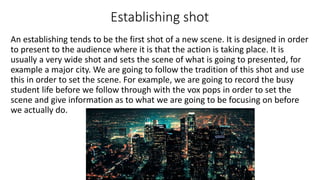
Establishing shot
An establishing tends to be the first shot of a new scene. It is designed in order
to present to the audience where it is that the action is taking place. It is
usually a very wide shot and sets the scene of what is going to presented, for
example a major city. We are going to follow the tradition of this shot and use
this in order to set the scene. For example, we are going to record the busy
student life before we follow through with the vox pops in order to set the
scene and give information as to what we are going to be focusing on before
we actually do.
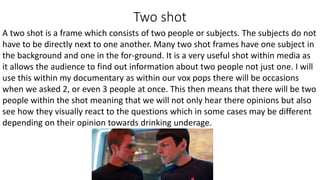
Two shot
A two shot is a frame which consists of two people or subjects. The subjects do not
have to be directly next to one another. Many two shot frames have one subject in
the background and one in the for-ground. It is a very useful shot within media as
it allows the audience to find out information about two people not just one. I will
use this within my documentary as within our vox pops there will be occasions
when we asked 2, or even 3 people at once. This then means that there will be two
people within the shot meaning that we will not only hear there opinions but also
see how they visually react to the questions which in some cases may be different
depending on their opinion towards drinking underage.
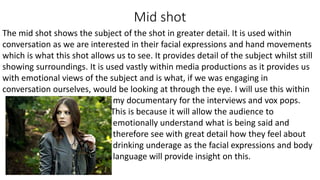
Mid shot
The mid shot shows the subject of the shot in greater detail. It is used within
conversation as we are interested in their facial expressions and hand movements
which is what this shot allows us to see. It provides detail of the subject whilst still
showing surroundings. It is used vastly within media productions as it provides us
with emotional views of the subject and is what, if we was engaging in
conversation ourselves, would be looking at through the eye. I will use this within
my documentary for the interviews and vox pops.
This is because it will allow the audience to
emotionally understand what is being said and
therefore see with great detail how they feel about
drinking underage as the facial expressions and body
language will provide insight on this.
Extreme wide shot
Within an extreme wide shot, the shot shows all of the vast surroundings
making what may be the purpose of the shot i.e the subject not visible but
instead in the distance. The whole point of using this shot within media is to
show the subjects surroundings which then allows us to feel as tough we are
visually there experiencing it to. This is closely linked to the “establishing” and is
mainly within media when introducing a new scene as it allows the audience to
know where the following action will be taking place. I don’t believe that an
extreme wide shot will be used within my documentary as there is not a vast
enough space in order to create this.
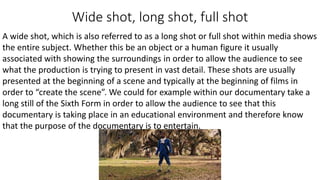
Wide shot, long shot, full shot
A wide shot, which is also referred to as a long shot or full shot within media shows
the entire subject. Whether this be an object or a human figure it usually
associated with showing the surroundings in order to allow the audience to see
what the production is trying to present in vast detail. These shots are usually
presented at the beginning of a scene and typically at the beginning of films in
order to “create the scene”. We could for example within our documentary take a
long still of the Sixth Form in order to allow the audience to see that this
documentary is taking place in an educational environment and therefore know
that the purpose of the documentary is to entertain.
Medium close up
A medium close up shot is when the subjects shoulders and face appear in the
shot. This allows us to gather information about their facial expression more
closely but still also gather sight of the surroundings and their clothing. This is
used during conversations within media and also to gather insight into how the
subject of the shot is feeling due to being able to see their facial expressions more
clearly. Within my documentary I will use this for the experts interviews as this
will allow the audience to engage with them as they are still able to see their
authority through the clothes which they are wearing but also examine their facial
expression to gain more understanding and trust.
Medium long shot
This shot is also known as a three-quarters shot which is where the frame has
the whole person/object from the knees up. It is usually used within media
between a long shot and a medium shot as it provides information about the
mise-en-scene, for example what the person is wearing which then allows us to
gather more detail about the person and the surroundings. It is usually used
when one person is in a frame but can be used for up to 2 or 3. Within our
documentary we will use this to at the beginning
in order to provide detail about Holly our on screen
presenter as it allows the audience to get a full picture
of her allowing them to feel more engaged.
To conclude
I believe that all the different shot types which I have explained will be
vitally important within my documentary as they allow different
opinions to be shared and different surroundings to be created to the
audience. They all provide information on different scales and
therefore will use a range of different shot types in order to present
different opinions which I want the audience to feel whilst watching my
documentary.

Shot types

  • 1.
  • 2.
    Different shot types Withinour documentary we aim to use several different shot types in order to be more creative and allow the audience to see the content of our documentary is several different ways. A shot can also say a lot about the information which is being presented to the audience as it allows us to view different objects and people in different forms of power. This means that during our documentary, shot types can have a major influence on how the audience view the information which we are giving them. For example, if our presenter is constantly filmed at a straight angle, medium close up shot this shows that she can be viewed at an equal level as we are looking directly to her not up or down at her and also we can clearly see her facial expressions. Here are shot types which we will be using within our own documentary…
  • 3.
    Over the shoulder Anover the shoulder shot is a shot taken from the perspective from the shoulder of another person looking directly at something or someone. This is particularly used in documentary's when carrying out interviews as it allows us to feel as though we are there, looking in on the conversation and also clearly see the professionals facial expression and body langue. We will use this when carrying out our interviews with experts as it presents the professional in a clear format and also allows us to see the interviewer present. Also, the professional is not directly looking at the camera, instead the interview which is in the corner of the shot creating more realistic constructions within our documentary.
  • 4.
    Close up Close upshots are used in order to gather all the emotion and detail behind the media production which is being broadcasted. It allows one main object to be the focus of the shot and looks directly and closely at this giving much insight and detail to the viewers. This will be used within our documentary on things such as alcohol bottles as alcohol is the main focus and therefore we want to go into detail about the different types and prices available. We aim to use close up shots on the content which is highly important and related to alcohol as this provides detail to the viewers.
  • 5.
    Extreme close up Extremeclose ups are used in order to look directly at something which in an average shot would not be the main focus and allow it to become much bigger and with more depth and detail. This can be done such as features on the face in order to see eye rolls and lips moving. We aim to use this in our documentary such as when panning an isle full of alcohol and deeply look at the pricing in order to measure whether this influences teenagers to drink as it is cheap and many to access. We want to use an extreme close up in order to see the different price range on different types of drinks but to also gather insight to the different reasons why teenagers typically drink and see weather these link to the ideas presented within the vox pops.
  • 6.
    Establishing shot An establishingtends to be the first shot of a new scene. It is designed in order to present to the audience where it is that the action is taking place. It is usually a very wide shot and sets the scene of what is going to presented, for example a major city. We are going to follow the tradition of this shot and use this in order to set the scene. For example, we are going to record the busy student life before we follow through with the vox pops in order to set the scene and give information as to what we are going to be focusing on before we actually do.
  • 7.
    Two shot A twoshot is a frame which consists of two people or subjects. The subjects do not have to be directly next to one another. Many two shot frames have one subject in the background and one in the for-ground. It is a very useful shot within media as it allows the audience to find out information about two people not just one. I will use this within my documentary as within our vox pops there will be occasions when we asked 2, or even 3 people at once. This then means that there will be two people within the shot meaning that we will not only hear there opinions but also see how they visually react to the questions which in some cases may be different depending on their opinion towards drinking underage.
  • 8.
    Mid shot The midshot shows the subject of the shot in greater detail. It is used within conversation as we are interested in their facial expressions and hand movements which is what this shot allows us to see. It provides detail of the subject whilst still showing surroundings. It is used vastly within media productions as it provides us with emotional views of the subject and is what, if we was engaging in conversation ourselves, would be looking at through the eye. I will use this within my documentary for the interviews and vox pops. This is because it will allow the audience to emotionally understand what is being said and therefore see with great detail how they feel about drinking underage as the facial expressions and body language will provide insight on this.
  • 9.
    Extreme wide shot Withinan extreme wide shot, the shot shows all of the vast surroundings making what may be the purpose of the shot i.e the subject not visible but instead in the distance. The whole point of using this shot within media is to show the subjects surroundings which then allows us to feel as tough we are visually there experiencing it to. This is closely linked to the “establishing” and is mainly within media when introducing a new scene as it allows the audience to know where the following action will be taking place. I don’t believe that an extreme wide shot will be used within my documentary as there is not a vast enough space in order to create this.
  • 10.
    Wide shot, longshot, full shot A wide shot, which is also referred to as a long shot or full shot within media shows the entire subject. Whether this be an object or a human figure it usually associated with showing the surroundings in order to allow the audience to see what the production is trying to present in vast detail. These shots are usually presented at the beginning of a scene and typically at the beginning of films in order to “create the scene”. We could for example within our documentary take a long still of the Sixth Form in order to allow the audience to see that this documentary is taking place in an educational environment and therefore know that the purpose of the documentary is to entertain.
  • 11.
    Medium close up Amedium close up shot is when the subjects shoulders and face appear in the shot. This allows us to gather information about their facial expression more closely but still also gather sight of the surroundings and their clothing. This is used during conversations within media and also to gather insight into how the subject of the shot is feeling due to being able to see their facial expressions more clearly. Within my documentary I will use this for the experts interviews as this will allow the audience to engage with them as they are still able to see their authority through the clothes which they are wearing but also examine their facial expression to gain more understanding and trust.
  • 12.
    Medium long shot Thisshot is also known as a three-quarters shot which is where the frame has the whole person/object from the knees up. It is usually used within media between a long shot and a medium shot as it provides information about the mise-en-scene, for example what the person is wearing which then allows us to gather more detail about the person and the surroundings. It is usually used when one person is in a frame but can be used for up to 2 or 3. Within our documentary we will use this to at the beginning in order to provide detail about Holly our on screen presenter as it allows the audience to get a full picture of her allowing them to feel more engaged.
  • 13.
    To conclude I believethat all the different shot types which I have explained will be vitally important within my documentary as they allow different opinions to be shared and different surroundings to be created to the audience. They all provide information on different scales and therefore will use a range of different shot types in order to present different opinions which I want the audience to feel whilst watching my documentary.