ANNUAL SHOT REPORT 2017 SUMMARY
See full SHOT Report (www.shotuk.org) for additional recommendations in the following chapters: Information Technology Incidents, Adverse Events
Related to Anti-D immunoglobulin, Immune Anti-D in Pregnancy, Transfusion-Associated Circulatory Overload, Cell Salvage and Paediatric Summary.
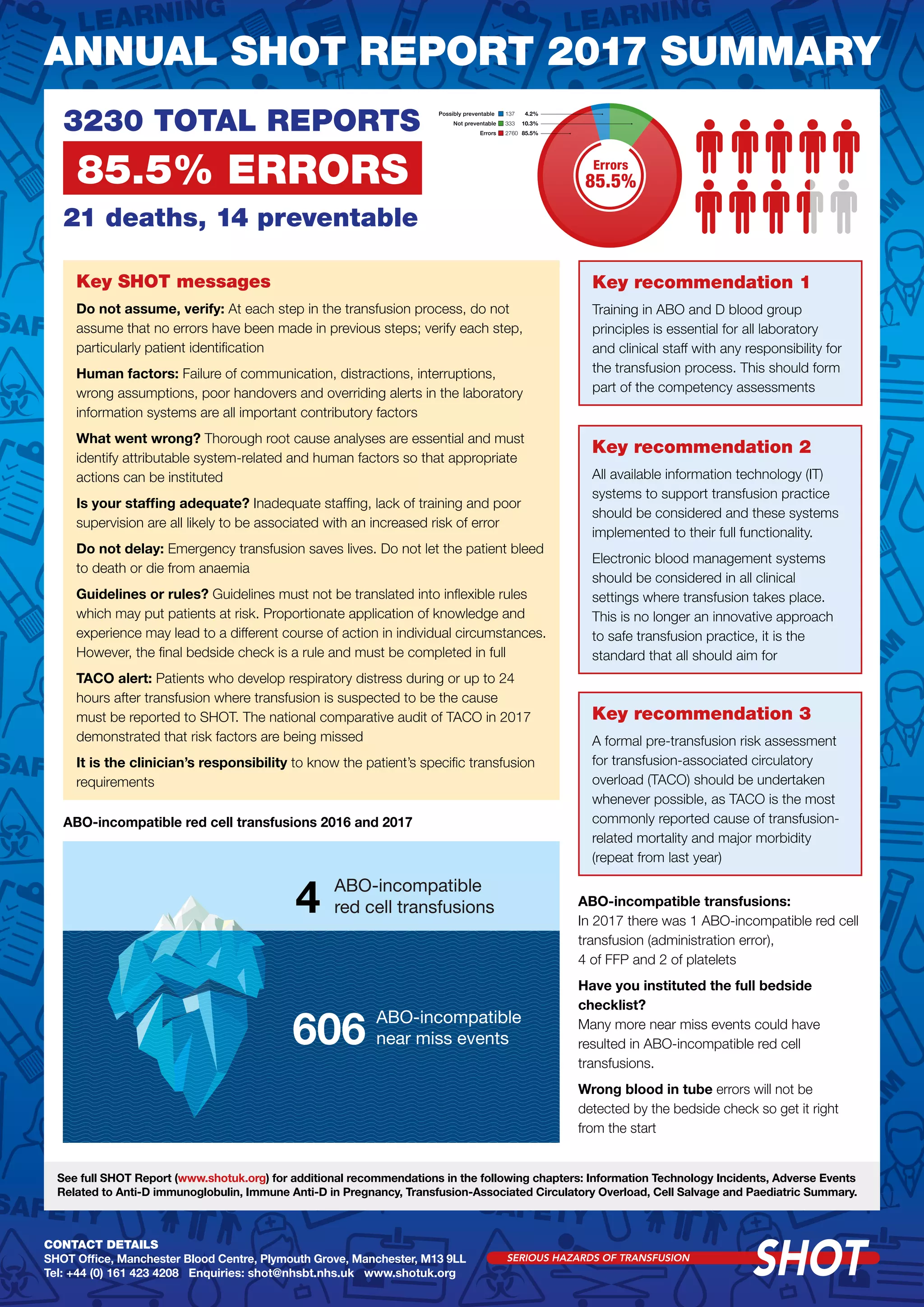
Possibly preventable 137 4.2%
Not preventable 333 10.3%
Errors 2760 85.5%
Errors
85.5%
3230 TOTAL REPORTS
85.5% ERRORS
21 deaths, 14 preventable
Key SHOT messages
Do not assume, verify: At each step in the transfusion process, do not
assume that no errors have been made in previous steps; verify each step,
particularly patient identification
Human factors: Failure of communication, distractions, interruptions,
wrong assumptions, poor handovers and overriding alerts in the laboratory
information systems are all important contributory factors
What went wrong? Thorough root cause analyses are essential and must
identify attributable system-related and human factors so that appropriate
actions can be instituted
Is your staffing adequate? Inadequate staffing, lack of training and poor
supervision are all likely to be associated with an increased risk of error
Do not delay: Emergency transfusion saves lives. Do not let the patient bleed
to death or die from anaemia
Guidelines or rules? Guidelines must not be translated into inflexible rules
which may put patients at risk. Proportionate application of knowledge and
experience may lead to a different course of action in individual circumstances.
However, the final bedside check is a rule and must be completed in full 
TACO alert: Patients who develop respiratory distress during or up to 24
hours after transfusion where transfusion is suspected to be the cause
must be reported to SHOT. The national comparative audit of TACO in 2017
demonstrated that risk factors are being missed
It is the clinician’s responsibility to know the patient’s specific transfusion
requirements
ABO-incompatible red cell transfusions 2016 and 2017
ABO-incompatible transfusions:
In 2017 there was 1 ABO-incompatible red cell
transfusion (administration error),
4 of FFP and 2 of platelets
Have you instituted the full bedside
checklist?
Many more near miss events could have
resulted in ABO-incompatible red cell
transfusions.
Wrong blood in tube errors will not be
detected by the bedside check so get it right
from the start
Key recommendation 1
Training in ABO and D blood group
principles is essential for all laboratory
and clinical staff with any responsibility for
the transfusion process. This should form
part of the competency assessments
Key recommendation 3
A formal pre-transfusion risk assessment
for transfusion-associated circulatory
overload (TACO) should be undertaken
whenever possible, as TACO is the most
commonly reported cause of transfusion-
related mortality and major morbidity
(repeat from last year)
Key recommendation 2
All available information technology (IT)
systems to support transfusion practice
should be considered and these systems
implemented to their full functionality.
Electronic blood management systems
should be considered in all clinical
settings where transfusion takes place.
This is no longer an innovative approach
to safe transfusion practice, it is the
standard that all should aim for
4
606
ABO-incompatible
red cell transfusions
ABO-incompatible
near miss events
CONTACT DETAILS
SHOT Office, Manchester Blood Centre, Plymouth Grove, Manchester, M13 9LL
Tel: +44 (0) 161 423 4208 Enquiries: shot@nhsbt.nhs.uk www.shotuk.org
www.shotuk.org
@shothv1
Febrile, allergic and hypotensive
reactions (FAHR) are the most common
serious and unpredictable reactions
•	 For febrile reactions alone, give
paracetamol
•	 For allergic reactions give an
antihistamine as first line; give
adrenaline if anaphylaxis is suspected.
The effect of steroids is delayed by
several hours, will have no immediate
effect, and should only be used to
prevent a late recurrence. The use of
steroids may further immunosuppress
already immunocompromised patients
and increase the risk of side effects
such as infection
0
0
1
3
11
17
20
29
42
92
95
101
200
243
284
307
426
TAGvHD: Transfusion-associated graft-vs-host disease
PTP: Post-transfusion purpura
TTI: Transfusion-transmitted infection
TRALI: Transfusion-related acute lung injury
UCT: Unclassifiable complications of transfusion
CS: Cell salvage
TAD: Transfusion-associated dyspnoea
ADU: Over or undertransfusion and PCC
HTR: Haemolytic transfusion reactions
TACO: Transfusion-associated circulatory overload
ADU: Delayed transfusion
ADU: Avoidable transfusion
RBRP: Right blood right patient
HSE: Handling and storage errors
FAHR: Febrile, allergic and hypotensive reactions
IBCT: Incorrect blood component transfused
Anti-D: Anti-D immunoglobulin errors
NM: Near miss 1359
Possibly preventable
Not preventable
Error
1 in
100 million
Transfusion-related deaths
(by component issued)
Risk of pulmonary
complications
Transfusion-related death
due to error
1 in
10 million
1 in
1 million 1 in 100,000 1 in 10,000 1 in 1,000 1 in 100 1 in 10
Death from TACO (2016)
Risk of febrile/allergic/hypotensive reaction
Death from transfusion (ISTARE) Road deaths
Smoking-related deaths
Preventable hospital deaths
Death from external injury
Death from lightning strike Drowning
Alcohol-related deaths
Air traffic accident deaths
HCV HIV
HIGHERRISK
LOWERRISK
HBV
2
1
4
3
1
1
1
2
5
1
0 1 2 3 4 5 6 7 8
TACO
Delays
TAD
Under and
overtransfusion
HTR
Number of cases
Definite
Imputability
Probable
PossiblePreventable deaths n=14/21 (66.7%)
Pulmonary
complications
73
22.8%
11.7%
8.1%
53.7%
3.7%
TRALI5
TACO60
TAD8
Febrile/
allergic
reactions
HTR
Other
Delays 31
16
11
5
44.1%
5.9%
3.7%
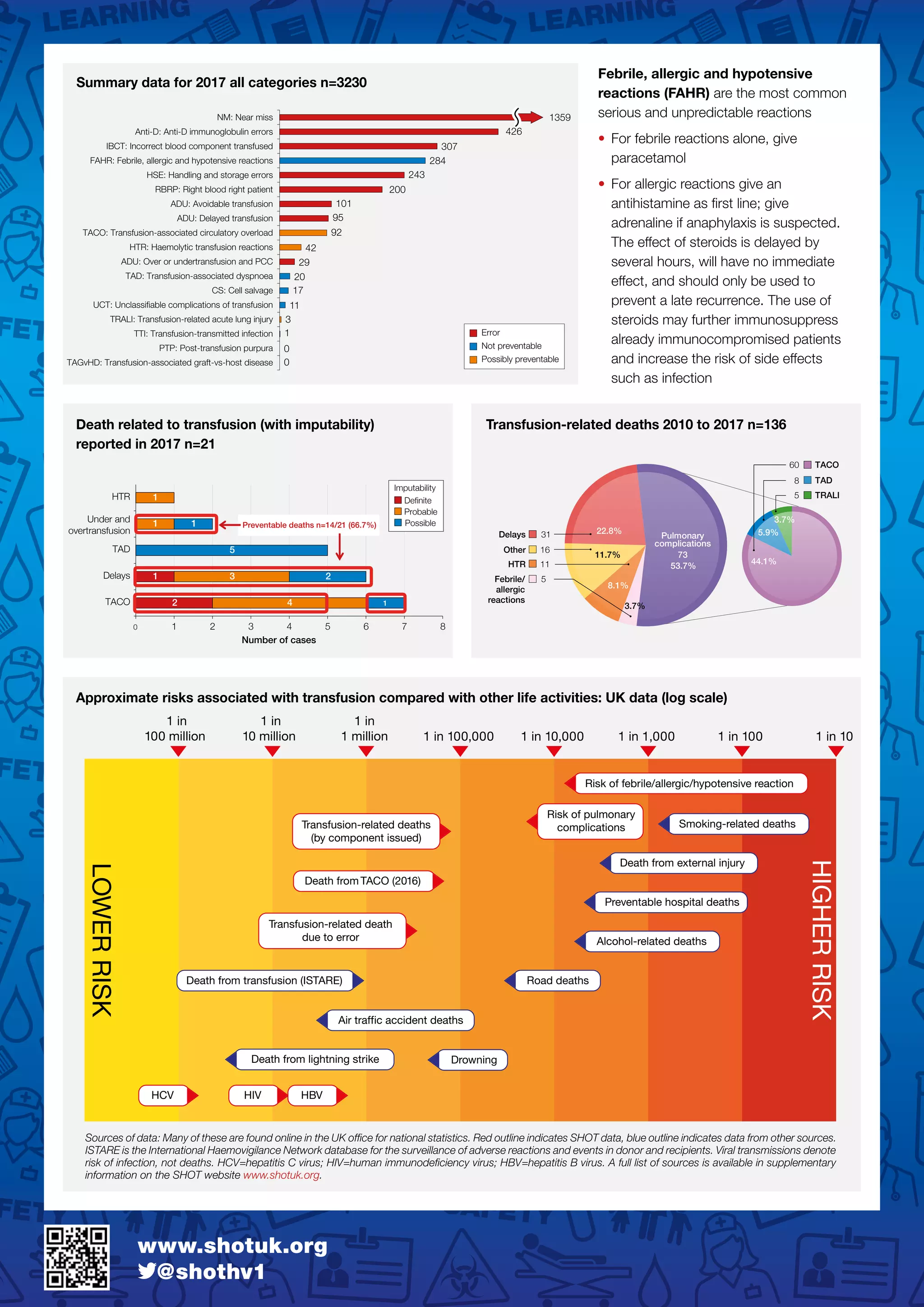
Summary data for 2017 all categories n=3230
Death related to transfusion (with imputability)
reported in 2017 n=21
Transfusion-related deaths 2010 to 2017 n=136
Approximate risks associated with transfusion compared with other life activities: UK data (log scale)
Sources of data: Many of these are found online in the UK office for national statistics. Red outline indicates SHOT data, blue outline indicates data from other sources.
ISTARE is the International Haemovigilance Network database for the surveillance of adverse reactions and events in donor and recipients. Viral transmissions denote
risk of infection, not deaths. HCV=hepatitis C virus; HIV=human immunodeficiency virus; HBV=hepatitis B virus. A full list of sources is available in supplementary
information on the SHOT website www.shotuk.org.
3
3
24
10
7
8
1
21
63
18
72 58
1
18
8
2
2
12
1
9
6
5
6
8
19
24
0 20 40 60 80 100 120 140 160
Miscellaneous
Collection
Component labelling
Component selection
Testing
Sample receipt and registration
WCT
SRNM
HSE
RBRP
Avoidable
Delayed
Anti-D Ig
1 REQUEST
Critical points where
positive patient
identification is
essential
Critical points
in the laboratory
2 SAMPLE TAKING
3 SAMPLE RECEIPT
4 TESTING
5 COMPONENT SELECTION
6 COMPONENT LABELLING
7 COMPONENT COLLECTION
8 PRESCRIPTION
9 ADMINISTRATION
75
110
54
149
3
18
53 53 52
173
Sample receipt
and registration
Testing Component
selection
Component
labelling
Collection Miscellaneous
Laboratory errors
Laboratory near miss
WCT=wrong component transfused; SRNM=specific requirements not met
5
5
26
24
10
7
2
3
10
1
2
1
21
63
18
109
0 20 40 60 80 100 120
Miscellaneous
Administration
Prescription
Collection
Component labelling
Component selection
Testing
Sample receipt
Sample taking
Request
SRNM
WCT
Collection
Request errors
Administration
Wrong blood in tube (WBIT)
Laboratory errors
789
31
18
592
WBIT
87.8%
3
1
4
7
4
11
4
1
5
1
2
3
7
3
10
1
3
4
1
2
1
4
15
3
5
23
9
9
18
≤28 days
>28 days to <1 year
1 to <16 years
16 to <18 years
Others
MB- or
SD-plasma
Irradiated
IBCT-SRNM Totals
Clinical
Laboratory
IBCT-WCT Totals
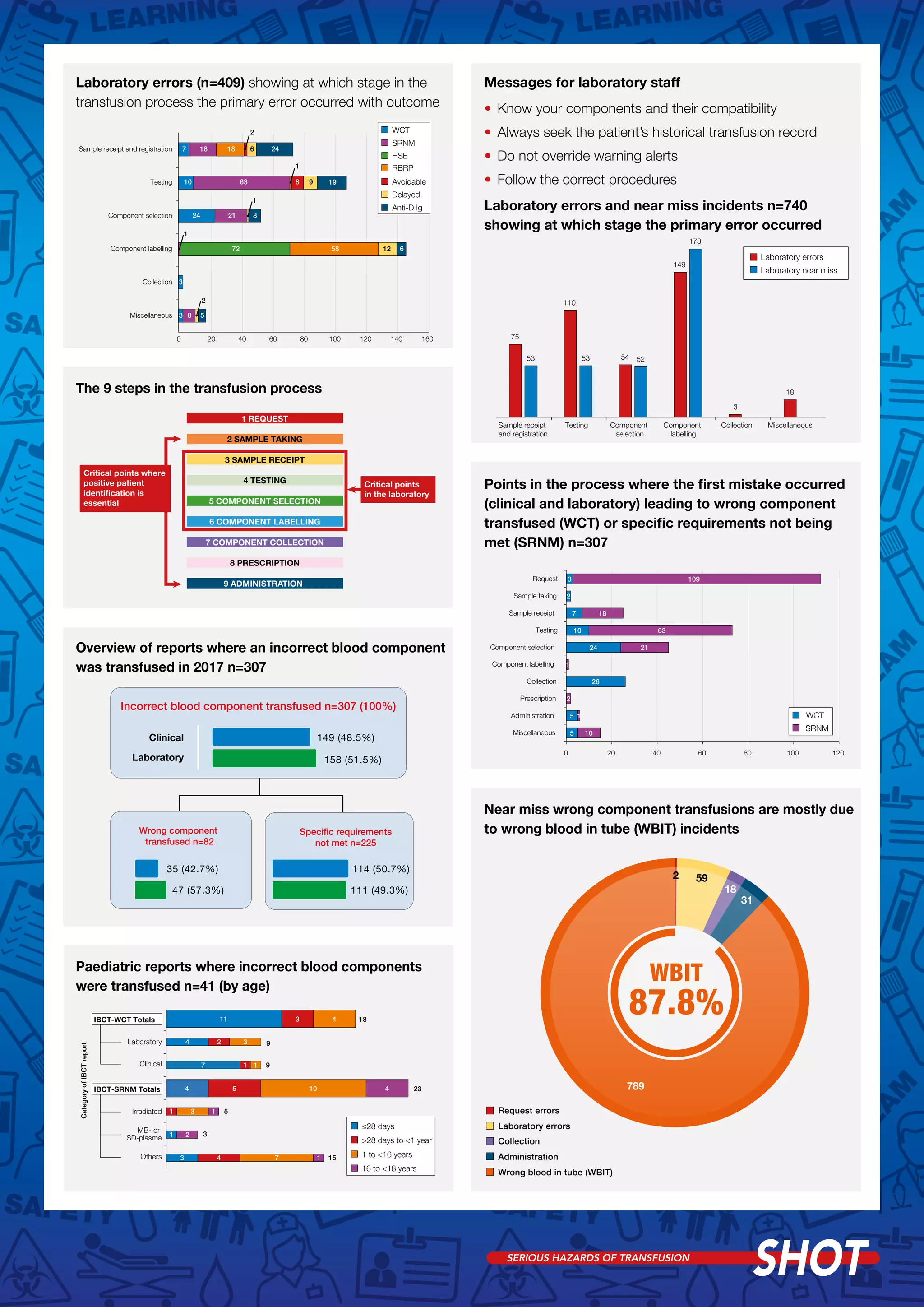
CategoryofIBCTreportLaboratory errors (n=409) showing at which stage in the
transfusion process the primary error occurred with outcome
Messages for laboratory staff
•	 Know your components and their compatibility
•	 Always seek the patient’s historical transfusion record
•	 Do not override warning alerts
•	 Follow the correct procedures
Laboratory errors and near miss incidents n=740
showing at which stage the primary error occurred
The 9 steps in the transfusion process
Overview of reports where an incorrect blood component
was transfused in 2017 n=307
Paediatric reports where incorrect blood components
were transfused n=41 (by age)
Points in the process where the first mistake occurred
(clinical and laboratory) leading to wrong component
transfused (WCT) or specific requirements not being
met (SRNM) n=307
Near miss wrong component transfusions are mostly due
to wrong blood in tube (WBIT) incidents
Incorrect blood component transfused n=307 (100%)
158 (51.5%)
Wrong component
transfused n=82
Laboratory
Clinical 149 (48.5%)
Specific requirements
not met n=225
47 (57.3%)
35 (42.7%)
111 (49.3%)
114 (50.7%)
www.shotuk.org
@shothv1
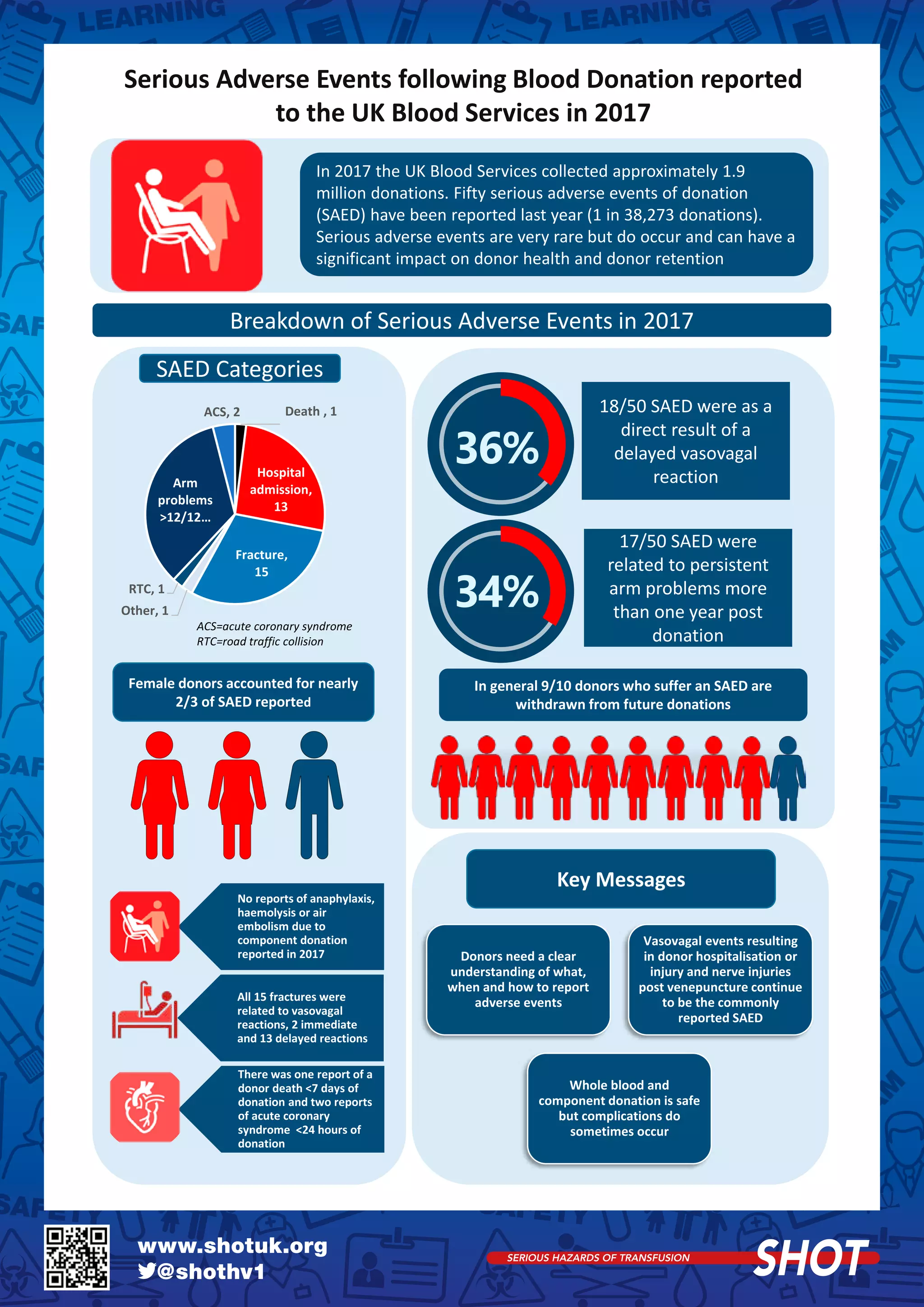
Serious Adverse Events following Blood Donation reported
to the UK Blood Services in 2017
In 2017 the UK Blood Services collected approximately 1.9
million donations. Fifty serious adverse events of donation
(SAED) have been reported last year (1 in 38,273 donations).
Serious adverse events are very rare but do occur and can have a
significant impact on donor health and donor retention
Breakdown of Serious Adverse Events in 2017
SAED Categories
Female donors accounted for nearly
2/3 of SAED reported
18/50 SAED were as a
direct result of a
delayed vasovagal
reaction
34%
36%
17/50 SAED were
related to persistent
arm problems more
than one year post
donation
No reports of anaphylaxis,
haemolysis or air
embolism due to
component donation
reported in 2017
All 15 fractures were
related to vasovagal
reactions, 2 immediate
and 13 delayed reactions
There was one report of a
donor death <7 days of
donation and two reports
of acute coronary
syndrome <24 hours of
donation
In general 9/10 donors who suffer an SAED are
withdrawn from future donations
Death , 1
Hospital
admission,
13
Fracture,
15
Other, 1
RTC, 1
Arm
problems
>12/12…
ACS, 2
Donors need a clear
understanding of what,
when and how to report
adverse events
Vasovagal events resulting
in donor hospitalisation or
injury and nerve injuries
post venepuncture continue
to be the commonly
reported SAED
Whole blood and
component donation is safe
but complications do
sometimes occur
Key Messages
ACS=acute coronary syndrome
RTC=road traffic collision

Shot report-summary-2017

  • 1.
    ANNUAL SHOT REPORT2017 SUMMARY See full SHOT Report (www.shotuk.org) for additional recommendations in the following chapters: Information Technology Incidents, Adverse Events Related to Anti-D immunoglobulin, Immune Anti-D in Pregnancy, Transfusion-Associated Circulatory Overload, Cell Salvage and Paediatric Summary. Possibly preventable 137 4.2% Not preventable 333 10.3% Errors 2760 85.5% Errors 85.5% 3230 TOTAL REPORTS 85.5% ERRORS 21 deaths, 14 preventable Key SHOT messages Do not assume, verify: At each step in the transfusion process, do not assume that no errors have been made in previous steps; verify each step, particularly patient identification Human factors: Failure of communication, distractions, interruptions, wrong assumptions, poor handovers and overriding alerts in the laboratory information systems are all important contributory factors What went wrong? Thorough root cause analyses are essential and must identify attributable system-related and human factors so that appropriate actions can be instituted Is your staffing adequate? Inadequate staffing, lack of training and poor supervision are all likely to be associated with an increased risk of error Do not delay: Emergency transfusion saves lives. Do not let the patient bleed to death or die from anaemia Guidelines or rules? Guidelines must not be translated into inflexible rules which may put patients at risk. Proportionate application of knowledge and experience may lead to a different course of action in individual circumstances. However, the final bedside check is a rule and must be completed in full  TACO alert: Patients who develop respiratory distress during or up to 24 hours after transfusion where transfusion is suspected to be the cause must be reported to SHOT. The national comparative audit of TACO in 2017 demonstrated that risk factors are being missed It is the clinician’s responsibility to know the patient’s specific transfusion requirements ABO-incompatible red cell transfusions 2016 and 2017 ABO-incompatible transfusions: In 2017 there was 1 ABO-incompatible red cell transfusion (administration error), 4 of FFP and 2 of platelets Have you instituted the full bedside checklist? Many more near miss events could have resulted in ABO-incompatible red cell transfusions. Wrong blood in tube errors will not be detected by the bedside check so get it right from the start Key recommendation 1 Training in ABO and D blood group principles is essential for all laboratory and clinical staff with any responsibility for the transfusion process. This should form part of the competency assessments Key recommendation 3 A formal pre-transfusion risk assessment for transfusion-associated circulatory overload (TACO) should be undertaken whenever possible, as TACO is the most commonly reported cause of transfusion- related mortality and major morbidity (repeat from last year) Key recommendation 2 All available information technology (IT) systems to support transfusion practice should be considered and these systems implemented to their full functionality. Electronic blood management systems should be considered in all clinical settings where transfusion takes place. This is no longer an innovative approach to safe transfusion practice, it is the standard that all should aim for 4 606 ABO-incompatible red cell transfusions ABO-incompatible near miss events CONTACT DETAILS SHOT Office, Manchester Blood Centre, Plymouth Grove, Manchester, M13 9LL Tel: +44 (0) 161 423 4208 Enquiries: shot@nhsbt.nhs.uk www.shotuk.org
  • 2.
    www.shotuk.org @shothv1 Febrile, allergic andhypotensive reactions (FAHR) are the most common serious and unpredictable reactions • For febrile reactions alone, give paracetamol • For allergic reactions give an antihistamine as first line; give adrenaline if anaphylaxis is suspected. The effect of steroids is delayed by several hours, will have no immediate effect, and should only be used to prevent a late recurrence. The use of steroids may further immunosuppress already immunocompromised patients and increase the risk of side effects such as infection 0 0 1 3 11 17 20 29 42 92 95 101 200 243 284 307 426 TAGvHD: Transfusion-associated graft-vs-host disease PTP: Post-transfusion purpura TTI: Transfusion-transmitted infection TRALI: Transfusion-related acute lung injury UCT: Unclassifiable complications of transfusion CS: Cell salvage TAD: Transfusion-associated dyspnoea ADU: Over or undertransfusion and PCC HTR: Haemolytic transfusion reactions TACO: Transfusion-associated circulatory overload ADU: Delayed transfusion ADU: Avoidable transfusion RBRP: Right blood right patient HSE: Handling and storage errors FAHR: Febrile, allergic and hypotensive reactions IBCT: Incorrect blood component transfused Anti-D: Anti-D immunoglobulin errors NM: Near miss 1359 Possibly preventable Not preventable Error 1 in 100 million Transfusion-related deaths (by component issued) Risk of pulmonary complications Transfusion-related death due to error 1 in 10 million 1 in 1 million 1 in 100,000 1 in 10,000 1 in 1,000 1 in 100 1 in 10 Death from TACO (2016) Risk of febrile/allergic/hypotensive reaction Death from transfusion (ISTARE) Road deaths Smoking-related deaths Preventable hospital deaths Death from external injury Death from lightning strike Drowning Alcohol-related deaths Air traffic accident deaths HCV HIV HIGHERRISK LOWERRISK HBV 2 1 4 3 1 1 1 2 5 1 0 1 2 3 4 5 6 7 8 TACO Delays TAD Under and overtransfusion HTR Number of cases Definite Imputability Probable PossiblePreventable deaths n=14/21 (66.7%) Pulmonary complications 73 22.8% 11.7% 8.1% 53.7% 3.7% TRALI5 TACO60 TAD8 Febrile/ allergic reactions HTR Other Delays 31 16 11 5 44.1% 5.9% 3.7% Summary data for 2017 all categories n=3230 Death related to transfusion (with imputability) reported in 2017 n=21 Transfusion-related deaths 2010 to 2017 n=136 Approximate risks associated with transfusion compared with other life activities: UK data (log scale) Sources of data: Many of these are found online in the UK office for national statistics. Red outline indicates SHOT data, blue outline indicates data from other sources. ISTARE is the International Haemovigilance Network database for the surveillance of adverse reactions and events in donor and recipients. Viral transmissions denote risk of infection, not deaths. HCV=hepatitis C virus; HIV=human immunodeficiency virus; HBV=hepatitis B virus. A full list of sources is available in supplementary information on the SHOT website www.shotuk.org.
  • 3.
    3 3 24 10 7 8 1 21 63 18 72 58 1 18 8 2 2 12 1 9 6 5 6 8 19 24 0 2040 60 80 100 120 140 160 Miscellaneous Collection Component labelling Component selection Testing Sample receipt and registration WCT SRNM HSE RBRP Avoidable Delayed Anti-D Ig 1 REQUEST Critical points where positive patient identification is essential Critical points in the laboratory 2 SAMPLE TAKING 3 SAMPLE RECEIPT 4 TESTING 5 COMPONENT SELECTION 6 COMPONENT LABELLING 7 COMPONENT COLLECTION 8 PRESCRIPTION 9 ADMINISTRATION 75 110 54 149 3 18 53 53 52 173 Sample receipt and registration Testing Component selection Component labelling Collection Miscellaneous Laboratory errors Laboratory near miss WCT=wrong component transfused; SRNM=specific requirements not met 5 5 26 24 10 7 2 3 10 1 2 1 21 63 18 109 0 20 40 60 80 100 120 Miscellaneous Administration Prescription Collection Component labelling Component selection Testing Sample receipt Sample taking Request SRNM WCT Collection Request errors Administration Wrong blood in tube (WBIT) Laboratory errors 789 31 18 592 WBIT 87.8% 3 1 4 7 4 11 4 1 5 1 2 3 7 3 10 1 3 4 1 2 1 4 15 3 5 23 9 9 18 ≤28 days >28 days to <1 year 1 to <16 years 16 to <18 years Others MB- or SD-plasma Irradiated IBCT-SRNM Totals Clinical Laboratory IBCT-WCT Totals CategoryofIBCTreportLaboratory errors (n=409) showing at which stage in the transfusion process the primary error occurred with outcome Messages for laboratory staff • Know your components and their compatibility • Always seek the patient’s historical transfusion record • Do not override warning alerts • Follow the correct procedures Laboratory errors and near miss incidents n=740 showing at which stage the primary error occurred The 9 steps in the transfusion process Overview of reports where an incorrect blood component was transfused in 2017 n=307 Paediatric reports where incorrect blood components were transfused n=41 (by age) Points in the process where the first mistake occurred (clinical and laboratory) leading to wrong component transfused (WCT) or specific requirements not being met (SRNM) n=307 Near miss wrong component transfusions are mostly due to wrong blood in tube (WBIT) incidents Incorrect blood component transfused n=307 (100%) 158 (51.5%) Wrong component transfused n=82 Laboratory Clinical 149 (48.5%) Specific requirements not met n=225 47 (57.3%) 35 (42.7%) 111 (49.3%) 114 (50.7%)
  • 4.
    www.shotuk.org @shothv1 Serious Adverse Eventsfollowing Blood Donation reported to the UK Blood Services in 2017 In 2017 the UK Blood Services collected approximately 1.9 million donations. Fifty serious adverse events of donation (SAED) have been reported last year (1 in 38,273 donations). Serious adverse events are very rare but do occur and can have a significant impact on donor health and donor retention Breakdown of Serious Adverse Events in 2017 SAED Categories Female donors accounted for nearly 2/3 of SAED reported 18/50 SAED were as a direct result of a delayed vasovagal reaction 34% 36% 17/50 SAED were related to persistent arm problems more than one year post donation No reports of anaphylaxis, haemolysis or air embolism due to component donation reported in 2017 All 15 fractures were related to vasovagal reactions, 2 immediate and 13 delayed reactions There was one report of a donor death <7 days of donation and two reports of acute coronary syndrome <24 hours of donation In general 9/10 donors who suffer an SAED are withdrawn from future donations Death , 1 Hospital admission, 13 Fracture, 15 Other, 1 RTC, 1 Arm problems >12/12… ACS, 2 Donors need a clear understanding of what, when and how to report adverse events Vasovagal events resulting in donor hospitalisation or injury and nerve injuries post venepuncture continue to be the commonly reported SAED Whole blood and component donation is safe but complications do sometimes occur Key Messages ACS=acute coronary syndrome RTC=road traffic collision