Short Term Sources of Finance
Prepared by
Dr Santosh Solanki
LNCT-MBA
Meaning
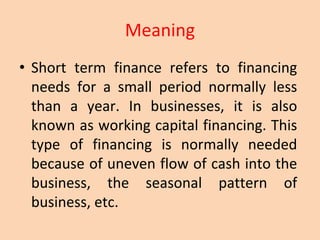
• Short term finance refers to financing
needs for a small period normally less
than a year. In businesses, it is also
known as working capital financing. This
type of financing is normally needed
because of uneven flow of cash into the
business, the seasonal pattern of
business, etc.
Financial needs of the organization:-
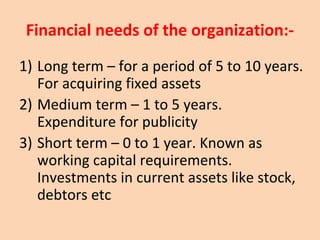
1) Long term – for a period of 5 to 10 years.
For acquiring fixed assets
2) Medium term – 1 to 5 years.
Expenditure for publicity
3) Short term – 0 to 1 year. Known as
working capital requirements.
Investments in current assets like stock,
debtors etc
Short term sources of fund
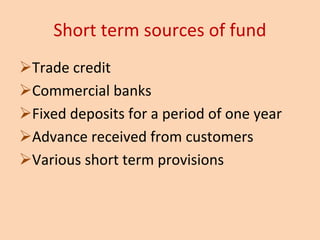
ØTrade credit
ØCommercial banks
ØFixed deposits for a period of one year
ØAdvance received from customers
ØVarious short term provisions
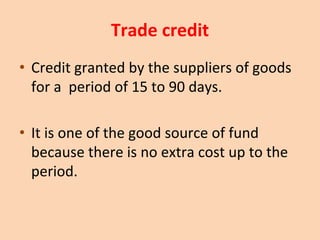
Trade credit
• Credit granted by the suppliers of goods
for a period of 15 to 90 days.
• It is one of the good source of fund
because there is no extra cost up to the
period.
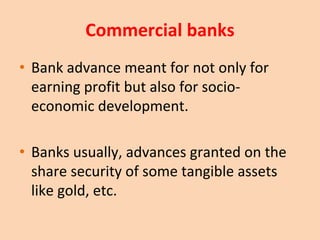
Commercial banks
• Bank advance meant for not only for
earning profit but also for socio-
economic development.
• Banks usually, advances granted on the
share security of some tangible assets
like gold, etc.
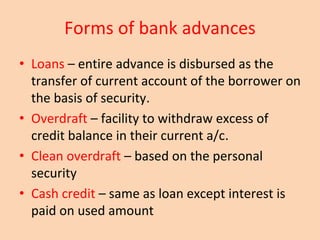
Forms of bank advances
• Loans – entire advance is disbursed as the
transfer of current account of the borrower on
the basis of security.
• Overdraft – facility to withdraw excess of
credit balance in their current a/c.
• Clean overdraft – based on the personal
security
• Cash credit – same as loan except interest is
paid on used amount
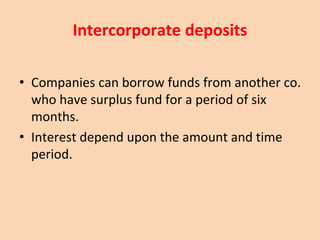
Intercorporate deposits
• Companies can borrow funds from another co.
who have surplus fund for a period of six
months.
• Interest depend upon the amount and time
period.
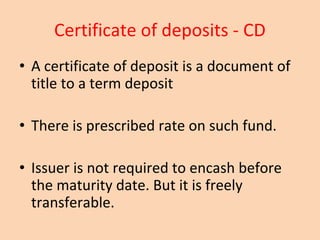
Certificate of deposits - CD
• A certificate of deposit is a document of
title to a term deposit
• There is prescribed rate on such fund.
• Issuer is not required to encash before
the maturity date. But it is freely
transferable.
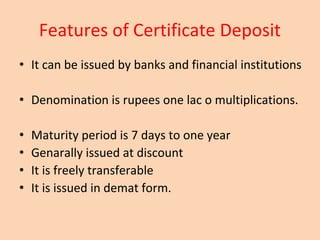
Features of Certificate Deposit
• It can be issued by banks and financial institutions
• Denomination is rupees one lac o multiplications.
• Maturity period is 7 days to one year
• Genarally issued at discount
• It is freely transferable
• It is issued in demat form.
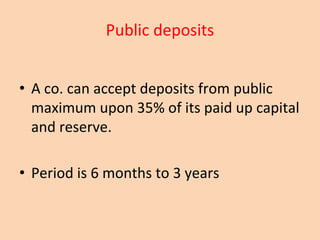
Public deposits
• A co. can accept deposits from public
maximum upon 35% of its paid up capital
and reserve.
• Period is 6 months to 3 years
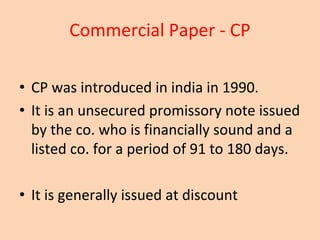
Commercial Paper - CP
• CP was introduced in india in 1990.
• It is an unsecured promissory note issued
by the co. who is financially sound and a
listed co. for a period of 91 to 180 days.
• It is generally issued at discount
Features of Commercial Paper
• The tangible net worth of issuing co.
should be less than rupees four crore
• It is usually issued in multiples of Rs.5 lac.
• It is in the form of unsecured promissory
note
• Minimum credit rating is required from
CRISIL
• Its maturity is less than one year
Factoring
• It is a financial service rendered by a
factor wherein a business organization
sells its accounts receivables to a
factoring firm and gets cash from the
factor, and the factor assumes
responsibility of collecting dues from the
concerned parties.
Types of factoring
• Recourse factoring – any loss of bad debts will
be borne by the business firm.
• Non-recourse factoring – loss of bad debt will
be met by factor.
• Domestic factoring – if factoring is for
domestic sales
• Export factoring – if factor’s bank is situated in
exporter’s country.
Thanks

ShortFianance-MBA Notes...Semester 2.pdf

  • 1.
    Short Term Sourcesof Finance Prepared by Dr Santosh Solanki LNCT-MBA
  • 2.
    Meaning • Short termfinance refers to financing needs for a small period normally less than a year. In businesses, it is also known as working capital financing. This type of financing is normally needed because of uneven flow of cash into the business, the seasonal pattern of business, etc.
  • 3.
    Financial needs ofthe organization:- 1) Long term – for a period of 5 to 10 years. For acquiring fixed assets 2) Medium term – 1 to 5 years. Expenditure for publicity 3) Short term – 0 to 1 year. Known as working capital requirements. Investments in current assets like stock, debtors etc
  • 4.
    Short term sourcesof fund ØTrade credit ØCommercial banks ØFixed deposits for a period of one year ØAdvance received from customers ØVarious short term provisions
  • 5.
    Trade credit • Creditgranted by the suppliers of goods for a period of 15 to 90 days. • It is one of the good source of fund because there is no extra cost up to the period.
  • 6.
    Commercial banks • Bankadvance meant for not only for earning profit but also for socio- economic development. • Banks usually, advances granted on the share security of some tangible assets like gold, etc.
  • 7.
    Forms of bankadvances • Loans – entire advance is disbursed as the transfer of current account of the borrower on the basis of security. • Overdraft – facility to withdraw excess of credit balance in their current a/c. • Clean overdraft – based on the personal security • Cash credit – same as loan except interest is paid on used amount
  • 8.
    Intercorporate deposits • Companiescan borrow funds from another co. who have surplus fund for a period of six months. • Interest depend upon the amount and time period.
  • 9.
    Certificate of deposits- CD • A certificate of deposit is a document of title to a term deposit • There is prescribed rate on such fund. • Issuer is not required to encash before the maturity date. But it is freely transferable.
  • 10.
    Features of CertificateDeposit • It can be issued by banks and financial institutions • Denomination is rupees one lac o multiplications. • Maturity period is 7 days to one year • Genarally issued at discount • It is freely transferable • It is issued in demat form.
  • 11.
    Public deposits • Aco. can accept deposits from public maximum upon 35% of its paid up capital and reserve. • Period is 6 months to 3 years
  • 12.
    Commercial Paper -CP • CP was introduced in india in 1990. • It is an unsecured promissory note issued by the co. who is financially sound and a listed co. for a period of 91 to 180 days. • It is generally issued at discount
  • 13.
    Features of CommercialPaper • The tangible net worth of issuing co. should be less than rupees four crore • It is usually issued in multiples of Rs.5 lac. • It is in the form of unsecured promissory note • Minimum credit rating is required from CRISIL • Its maturity is less than one year
  • 14.
    Factoring • It isa financial service rendered by a factor wherein a business organization sells its accounts receivables to a factoring firm and gets cash from the factor, and the factor assumes responsibility of collecting dues from the concerned parties.
  • 15.
    Types of factoring •Recourse factoring – any loss of bad debts will be borne by the business firm. • Non-recourse factoring – loss of bad debt will be met by factor. • Domestic factoring – if factoring is for domestic sales • Export factoring – if factor’s bank is situated in exporter’s country.
  • 16.