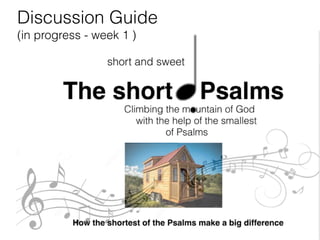
Discussion Guide
week 1 - Psalm 43
Starting the journey: I am for peace, they are for war.
So why the title?
Climbing the mountain of God
with the help of the smallest
of Psalms
Two reasons for the title:
• First, 7 of 10 of the shortest Psalms concern climbing the
mountain of God ( Ps 15, and 6 of the Psalms of ascents)
• Second, many of them touch on themes from the sermon
on the mount
The shortest of chapters in the Bible
make big statements perhaps in a less is more
manner.
We will assume there is a
reason God made these psalms
short and to the point and we seek to
glean their purpose and how it applies to us.
Prelude
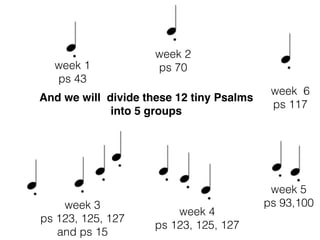
And we will divide these 12 tiny Psalms
into 6 groups
group 1 group 2
ps 70
group 3a
ps 123, 125
and ps 15
group 5
ps 93,100
group 6
ps 117
group 3c
ps 131, 133, 134
‘Send out Your light and truth’ that
You might be my exceeding joy
Psalm 43
Psalm 15
6 of the 15 Psalms of
Ascent
are short Psalms
Who shall ascend the mount
of the Lord and
who shall sojourn in
Your tent (your tabernacle)
‘May all who seek you rejoice
and be glad in you
May those who love your salvation say evermore
‘God is great’
Psalm 70
group 3b
ps 127
we look to You until
You show us mercy
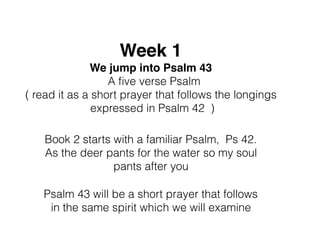
Week 1
We jump into Psalm 43
A five verse Psalm
( read it as a short prayer that follows the longings
expressed in Psalm 42 )
Book 2 starts with a familiar Psalm, Ps 42.
As the deer pants for the water so my soul
pants after you
Psalm 43 will be a short prayer that follows
in the same spirit which we will examine
In this short Psalm and its Psalms around it,
there is quite a range of emotions :
hunger for God, longing,
persistent call to hope, expectation
of the present lack of feeling of God’s presence and
turning into God as the writers’ exceeding joy.
And although the following Psalm 44 starts out
triumphal it ends with unresolved suffering and finds
itself in the book of Romans 8 side by side with ‘God
works all things for good to those who love Him.”
Introduction
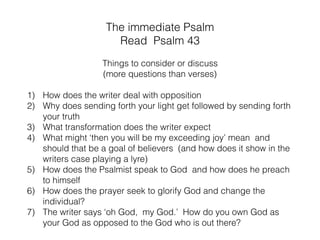
The immediate Psalm
Read Psalm 43
Things to consider or discuss
(more questions than verses)
1) How does the writer deal with opposition
2) Why does sending forth your light get followed by sending forth
your truth
3) What transformation does the writer expect
4) What might ‘then you will be my exceeding joy’ mean and
should that be a goal of believers (and how does it show in the
writers case playing a lyre)
5) How does the Psalmist speak to God and how does he preach
to himself
6) How does the prayer seek to glorify God and change the
individual?
7) The writer says ‘oh God, my God.’ How do you own God as
your God as opposed to the God who is out there?
continue as time permits
don’t feel you have to finish all parts
The context.
The Psalms before and after.
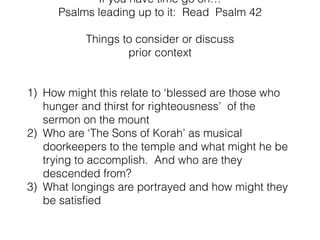
If you have time go on…
Psalms leading up to it: Read Psalm 42
Things to consider or discuss
prior context
1) How might this relate to ‘blessed are those who
hunger and thirst for righteousness’ of the
sermon on the mount
2) Who are ‘The Sons of Korah’, these musical
doorkeepers to the temple, and what might he be
trying to accomplish. And who are they
descended from?
3) What longings are portrayed and how might they
be satisfied
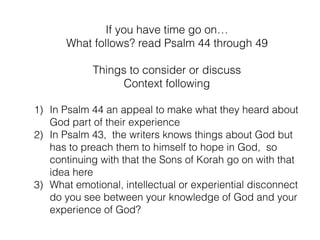
If you have time go on…
What follows? read Psalm 44 through 49
Things to consider or discuss
Context following
1) In Psalm 44 an appeal to make what they heard about God
part of their experience.
2) Psalm 44 also has suffering and persecution in it and is
quoted in Romans 8. ‘We all like sheep are brought to the
slaughter for Your name sake’ How do you combine the
exceeding joy in 43 with suffering of 44?
3) In Psalm 43, the writers knows things about God but has to
preach them to himself to hope in God, so continuing with
that the Sons of Korah go on with that idea here
4) What emotional, intellectual or experiential disconnect do
you see between your knowledge of God and your
experience of God?
Ponder
1) What issues are resolved and what issues not resolved in these
3 psalms
2) Just who are the sons of Korah anyway
3) As it says in the Torah ‘All of the sons of Korah did not die’
when the ground swallowed Korah up perhaps some became
musicians and bouncers in the temple protecting God’s glory
4) The sons of Korah should be in the grave but were redeemed
and sing of it. Korah opposed God’s holiness but the sons of
Korah protect it and sing ‘they’d rather be doorkeepers in
God’s house’ and ‘better is a day in your courts than 1000
elsewhere;
5) Psalms book 2 is poetically ‘Leviticus’ like and most of the
writers priests or levites. How might these psalms advance the
holiness of God and worshipping in holiness ( holiness being
the theme of Leviticus)
We don’t know the specific difficulties that lead to
this Psalms but people will suggest: David leaving
Jerusalem in the rebellion of Abloom or David
pursued by Saul or people leaving Jerusalem in the
exile looking bad in sadness but also in hope.
The immediate historical setting may be one of the
above but the Psalms still portend the Christ and his
sufferings to come as well as those who hope in him
and we have hope and exceeding joy sometimes
even amidst suffering and persecution.
Historical setting
Lastly
Ponder how the Psalms apply
to Christ and/or the church/believers
1) We might look at the longings and abandonment, rejection as
part of the sufferings of Christ but also of the same for
believers in Psalms 42 and 43
2) In Psalm 44, it seems to apply stronger to believers who suffer
‘for His name sake’ and in some sense are joined with the
sufferings of Christ.
3) The 2nd book of Psalms is poetically like Exodus (many feel)
and many of the writers (Sons of Korah and Asaph) will be
Levites (although David was not). How might the start of the
book complement or contrast with Exodus.

Discussion guide week 1 - Psalm 43

  • 1.
    Discussion Guide week 1- Psalm 43 Starting the journey: I am for peace, they are for war.
  • 2.
    So why thetitle? Climbing the mountain of God with the help of the smallest of Psalms Two reasons for the title: • First, 7 of 10 of the shortest Psalms concern climbing the mountain of God ( Ps 15, and 6 of the Psalms of ascents) • Second, many of them touch on themes from the sermon on the mount
  • 3.
    The shortest ofchapters in the Bible make big statements perhaps in a less is more manner. We will assume there is a reason God made these psalms short and to the point and we seek to glean their purpose and how it applies to us. Prelude
  • 4.
    And we willdivide these 12 tiny Psalms into 6 groups group 1 group 2 ps 70 group 3a ps 123, 125 and ps 15 group 5 ps 93,100 group 6 ps 117 group 3c ps 131, 133, 134 ‘Send out Your light and truth’ that You might be my exceeding joy Psalm 43 Psalm 15 6 of the 15 Psalms of Ascent are short Psalms Who shall ascend the mount of the Lord and who shall sojourn in Your tent (your tabernacle) ‘May all who seek you rejoice and be glad in you May those who love your salvation say evermore ‘God is great’ Psalm 70 group 3b ps 127 we look to You until You show us mercy
  • 5.
    Week 1 We jumpinto Psalm 43 A five verse Psalm ( read it as a short prayer that follows the longings expressed in Psalm 42 ) Book 2 starts with a familiar Psalm, Ps 42. As the deer pants for the water so my soul pants after you Psalm 43 will be a short prayer that follows in the same spirit which we will examine
  • 6.
    In this shortPsalm and its Psalms around it, there is quite a range of emotions : hunger for God, longing, persistent call to hope, expectation of the present lack of feeling of God’s presence and turning into God as the writers’ exceeding joy. And although the following Psalm 44 starts out triumphal it ends with unresolved suffering and finds itself in the book of Romans 8 side by side with ‘God works all things for good to those who love Him.” Introduction
  • 7.
    The immediate Psalm ReadPsalm 43 Things to consider or discuss (more questions than verses) 1) How does the writer deal with opposition 2) Why does sending forth your light get followed by sending forth your truth 3) What transformation does the writer expect 4) What might ‘then you will be my exceeding joy’ mean and should that be a goal of believers (and how does it show in the writers case playing a lyre) 5) How does the Psalmist speak to God and how does he preach to himself 6) How does the prayer seek to glorify God and change the individual? 7) The writer says ‘oh God, my God.’ How do you own God as your God as opposed to the God who is out there?
  • 8.
    continue as timepermits don’t feel you have to finish all parts The context. The Psalms before and after.
  • 9.
    If you havetime go on… Psalms leading up to it: Read Psalm 42 Things to consider or discuss prior context 1) How might this relate to ‘blessed are those who hunger and thirst for righteousness’ of the sermon on the mount 2) Who are ‘The Sons of Korah’, these musical doorkeepers to the temple, and what might he be trying to accomplish. And who are they descended from? 3) What longings are portrayed and how might they be satisfied
  • 10.
    If you havetime go on… What follows? read Psalm 44 through 49 Things to consider or discuss Context following 1) In Psalm 44 an appeal to make what they heard about God part of their experience. 2) Psalm 44 also has suffering and persecution in it and is quoted in Romans 8. ‘We all like sheep are brought to the slaughter for Your name sake’ How do you combine the exceeding joy in 43 with suffering of 44? 3) In Psalm 43, the writers knows things about God but has to preach them to himself to hope in God, so continuing with that the Sons of Korah go on with that idea here 4) What emotional, intellectual or experiential disconnect do you see between your knowledge of God and your experience of God?
  • 11.
    Ponder 1) What issuesare resolved and what issues not resolved in these 3 psalms 2) Just who are the sons of Korah anyway 3) As it says in the Torah ‘All of the sons of Korah did not die’ when the ground swallowed Korah up perhaps some became musicians and bouncers in the temple protecting God’s glory 4) The sons of Korah should be in the grave but were redeemed and sing of it. Korah opposed God’s holiness but the sons of Korah protect it and sing ‘they’d rather be doorkeepers in God’s house’ and ‘better is a day in your courts than 1000 elsewhere; 5) Psalms book 2 is poetically ‘Leviticus’ like and most of the writers priests or levites. How might these psalms advance the holiness of God and worshipping in holiness ( holiness being the theme of Leviticus)
  • 12.
    We don’t knowthe specific difficulties that lead to this Psalms but people will suggest: David leaving Jerusalem in the rebellion of Abloom or David pursued by Saul or people leaving Jerusalem in the exile looking bad in sadness but also in hope. The immediate historical setting may be one of the above but the Psalms still portend the Christ and his sufferings to come as well as those who hope in him and we have hope and exceeding joy sometimes even amidst suffering and persecution. Historical setting
  • 13.
    Lastly Ponder how thePsalms apply to Christ and/or the church/believers 1) We might look at the longings and abandonment, rejection as part of the sufferings of Christ but also of the same for believers in Psalms 42 and 43 2) In Psalm 44, it seems to apply stronger to believers who suffer ‘for His name sake’ and in some sense are joined with the sufferings of Christ. 3) The 2nd book of Psalms is poetically like Exodus (many feel) and many of the writers (Sons of Korah and Asaph) will be Levites (although David was not). How might the start of the book complement or contrast with Exodus.