Discussion Guide
week 4 - Psalm 123
A rhyming road song and a prayer for mercy
So why the title?
Climbing the mountain of God
with the help of the smallest
of Psalms
Two reasons for the title:
• First, 7 of 10 of the shortest Psalms concern climbing the
mountain of God ( Ps 15, and 6 of the Psalms of ascents)
• Second, many of them touch on themes from the sermon
on the mount
The shortest of chapters in the Bible
make big statements perhaps in a less is more
manner.
We will assume there is a
reason God made these psalms
short and to the point and we seek to
glean their purpose and how it applies to us.
Prelude
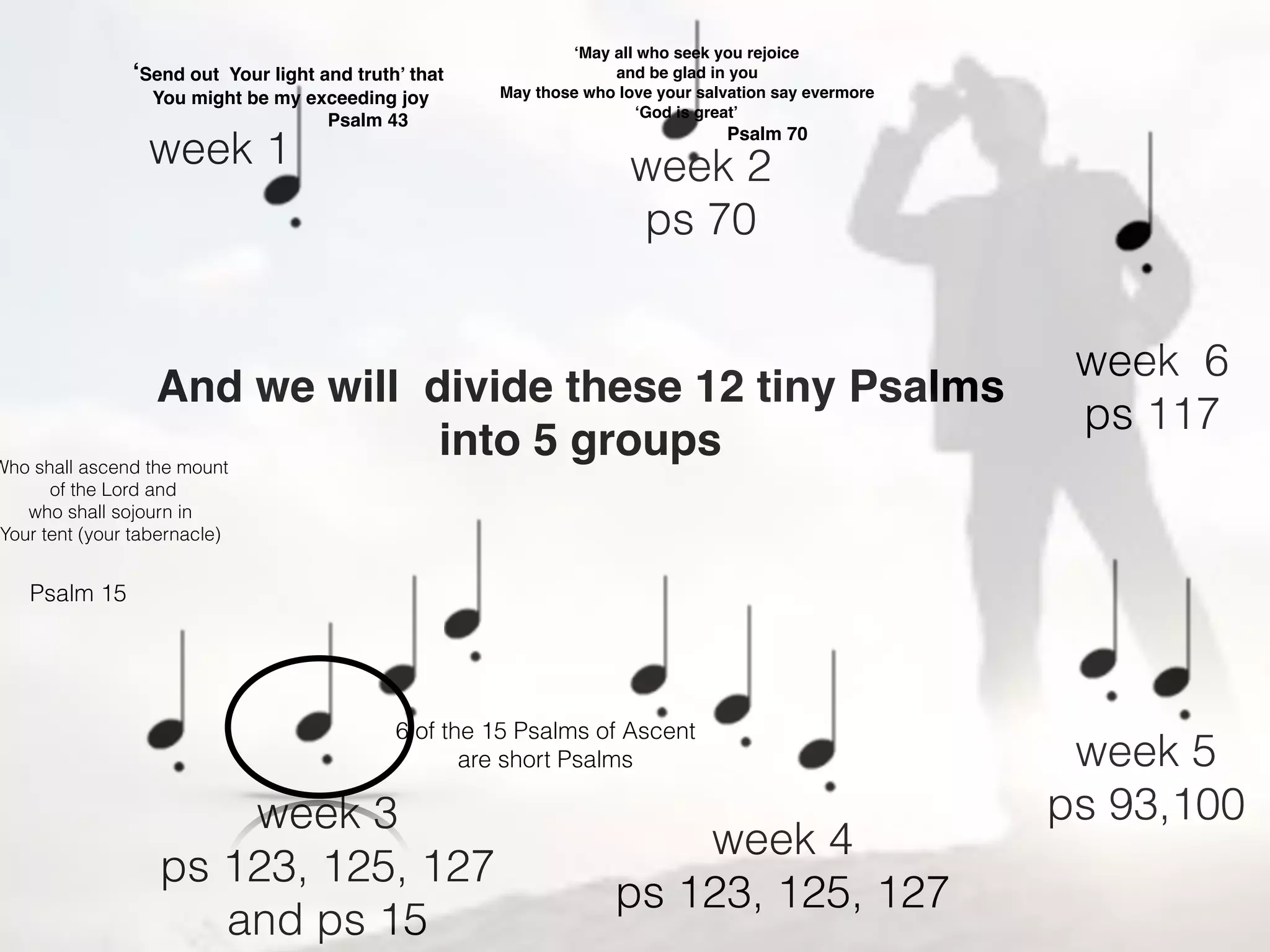
And we will divide these 12 tiny Psalms
into 6 groups
group 1 group 2
ps 70
group 3a
ps 123, 125
and ps 15
group 5
ps 93,100
group 6
ps 117
group 3c
ps 131, 133, 134
‘Send out Your light and truth’ that
You might be my exceeding joy
Psalm 43
Psalm 15
6 of the 15 Psalms of
Ascent
are short Psalms
Who shall ascend the mount
of the Lord and
who shall sojourn in
Your tent (your tabernacle)
‘May all who seek you rejoice
and be glad in you
May those who love your salvation say evermore
‘God is great’
Psalm 70
group 3b
ps 127
we look to You until
You show us mercy
On our journey through the fifteen songs of ascent, three have come
before our short Psalm 123, and they being concerning human
experience and then setting hopes on God, speaking with each other
but this is the first where the Psalm entirely speaks directly to God.
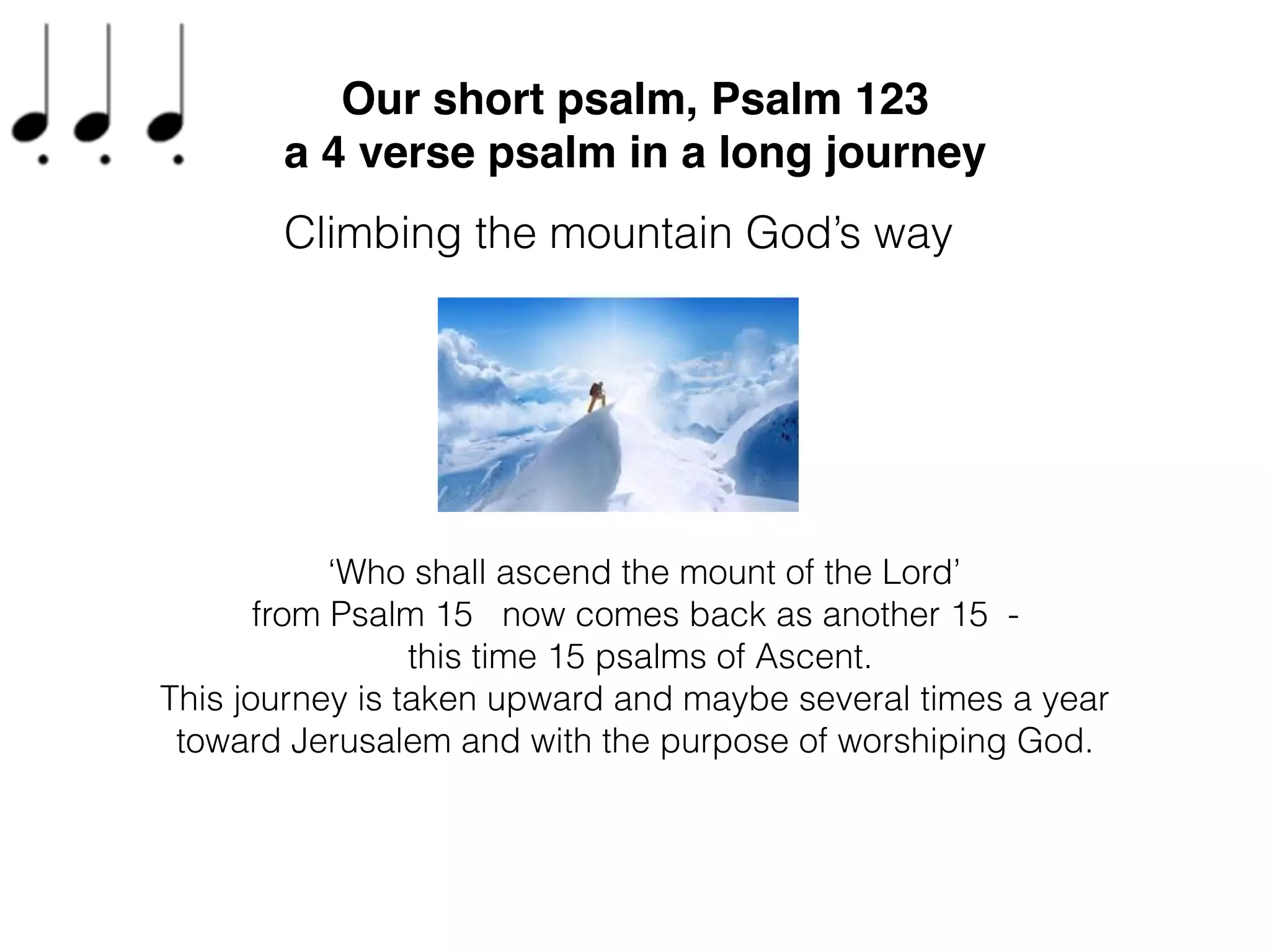
Our short psalm, Psalm 123
a 4 verse psalm in a long journey
Climbing the mountain God’s way
It is a short 4 verse Psalm
a quote from Martin
Our short psalm, Psalm 123
a short psalm in a long journey
This psalm (as ye see) is but short, and therefore a very fit example
to show the force of prayer not to consist in many words, but in
fervency of spirit. For great and weighty matters may be comprised
in a few words, if they proceed from the spirit and the unspeakable
groanings of the heart, especially when our necessity is such as will
not suffer any long prayer. Every prayer is long enough if it be
fervent and proceed from a heart that understandeth the necessity of
the saints.—Martin Luther.
Humble
dependence
on God
Psalm
123
Where we came from
what we are led to
Psalm 120 - A psalm of where the worshipper
came from in the world where ‘I am for peace
and they are for war.’
Psalm 121 - Eyes looking then to the hills and
thinking about God’s help
Psalm 122 - ‘I was glad when they asked me to
go to Jerusalem. Pray for the peace of
Jerusalem’
Psalm 123 - in our short psalm, we look toward
God, eyes and hearts now focused on God, until
He looks to us in prayer. And a prayed entirely to
God.
human
experiences
eyes
to whats around
object
lessons
of trust
joy
for
the
journey
Ps 123 is
entirely
a prayer
The house of God
You
are here
An Emphatic opening
for this road trip song
To you, I lift up my eyes
not
I lift up my eyes to You.
The order in Greek and Hebrew, leading off with ‘to You’ puts the
the emphasis on God
God is front and center in this Psalm.
Spot the repeated phrases
•‘eyes’ repeated often
•Look’ repeated often
•‘We look to God for mercy’ said 3 times
•‘Scorn’ or ‘contempt’ repeated 3 times
many of these will rhyme
in Hebrew
more on that later
A unusual rhyming Psalm
Hebrew usually plays ideas of each other, but also may play on
meter, vowels or similar other sounds, but here in these 4
verses there are 7 rhyming words which is unusual in the Bible
A short road trip song called ‘the rhyming song’
by some
Maybe the closest the Psalms get to
a jingle?
An inverted structure
in psalm 123
Psalm 123 starts talking about the resolution of an issue
Psalm 123 ends with the problem solved
With that in mind, read the psalm
What is the resolution and what is the problem?
resolution first
state problem last
Our short psalm, Psalm 123
a short psalm in a long journey
Questions
1)
1) How does the psalms of ascent move from the pilgrim’s
experience in his village to looking to God’s help, thinking of God
like mountains and now in Psalm 123 looking to God for mercy?
2) How does a servant look to the hands of a master and how
might you take that analogy? Is it positive or negative?
3) What of this scorn? Where might it come from? Why are the
loud in comfort and at ease…. should they be?
4) There is an unusual absence of bitterness and the matter is left
in God’s hands. The Psalmist is attacked by scoffers but appeals
to God for mercy and stops there
An irony?
The pilgrim was ‘for peace not war’ in his village
and yet here he speaks indirectly of experiencing scorn.
The scorn came from those ‘at ease’
who also were ‘the proud’
Those on a journey to worship God may not seem ‘at ease;
and may be broken in humility.
Ponder
There were two parts to this short psalm:
The first relates to God being glorified in man’s dependence,
while the second relates to God opposing man’s independence
Believers, look to the You who are enthroned, and keep
looking ‘until you show us mercy’.
Those in comfort with their current state scoff and show contempt.
“Therefore, let us exalt God alone, and ascribe to him all the glory of
redemption. Let us have a greater and greater understanding of our great
dependence upon God; let us put to death a self-dependent and self-
righteous disposition. Man is prone to exalt himself, and to depend on his
own power or goodness, thinking happiness will come through his efforts.
He is prone to think that happiness will come from objects God withholds or
denies. But this doctrine should teach us to exalt God alone – by trust, by
reliance, and by praise. So let him who boasts, boast in the Lord.”
from Jonathon Edwards first sermon, ‘God glorified in man’s dependence’
Where is Christ in the Psalm?
With a tone of humility throughout,
the writer goes through three phases:
• servant
• supplicant
• sufferer
Christ was a servant and came to serve us first c
Christ is a supplicant and he intercedes at the right hand of God for us
Christ suffered at the hands of the scoffers and yet held no bitterness,
praying Father forgive them they know not what they do
Unless the greater than Solomon
builds ‘the house’
Psalm 127
Humble
dependence
on God
Psalm
123
Humble
rest
in God
Psalm
131
An reflected structure
in the Psalms of ascent
The 15 Psalms of ascent seem to surround Psalm 127, one of
only two Psalms of Solomon, which is like a punchline in the
middle that you step up to one way and then step down in
reverse. Here Psalm 123 (opposing the proud) will be
reflected in Psalm 131 later (on the humble)
slightly a literary chiasm of sorts
Question: Humility is the theme
Why is humility so important in the worship of God?
How might it compare with Jesus description of Himself as humble
fin’
discussion guide Psalm 123

Discussion guide week 4 - Psalm 123

  • 1.
    Discussion Guide week 4- Psalm 123 A rhyming road song and a prayer for mercy
  • 2.
    So why thetitle? Climbing the mountain of God with the help of the smallest of Psalms Two reasons for the title: • First, 7 of 10 of the shortest Psalms concern climbing the mountain of God ( Ps 15, and 6 of the Psalms of ascents) • Second, many of them touch on themes from the sermon on the mount
  • 3.
    The shortest ofchapters in the Bible make big statements perhaps in a less is more manner. We will assume there is a reason God made these psalms short and to the point and we seek to glean their purpose and how it applies to us. Prelude
  • 4.
    And we willdivide these 12 tiny Psalms into 6 groups group 1 group 2 ps 70 group 3a ps 123, 125 and ps 15 group 5 ps 93,100 group 6 ps 117 group 3c ps 131, 133, 134 ‘Send out Your light and truth’ that You might be my exceeding joy Psalm 43 Psalm 15 6 of the 15 Psalms of Ascent are short Psalms Who shall ascend the mount of the Lord and who shall sojourn in Your tent (your tabernacle) ‘May all who seek you rejoice and be glad in you May those who love your salvation say evermore ‘God is great’ Psalm 70 group 3b ps 127 we look to You until You show us mercy
  • 5.
    On our journeythrough the fifteen songs of ascent, three have come before our short Psalm 123, and they being concerning human experience and then setting hopes on God, speaking with each other but this is the first where the Psalm entirely speaks directly to God. Our short psalm, Psalm 123 a 4 verse psalm in a long journey Climbing the mountain God’s way
  • 6.
    It is ashort 4 verse Psalm a quote from Martin Our short psalm, Psalm 123 a short psalm in a long journey This psalm (as ye see) is but short, and therefore a very fit example to show the force of prayer not to consist in many words, but in fervency of spirit. For great and weighty matters may be comprised in a few words, if they proceed from the spirit and the unspeakable groanings of the heart, especially when our necessity is such as will not suffer any long prayer. Every prayer is long enough if it be fervent and proceed from a heart that understandeth the necessity of the saints.—Martin Luther.
  • 7.
    Humble dependence on God Psalm 123 Where wecame from what we are led to Psalm 120 - A psalm of where the worshipper came from in the world where ‘I am for peace and they are for war.’ Psalm 121 - Eyes looking then to the hills and thinking about God’s help Psalm 122 - ‘I was glad when they asked me to go to Jerusalem. Pray for the peace of Jerusalem’ Psalm 123 - in our short psalm, we look toward God, eyes and hearts now focused on God, until He looks to us in prayer. And a prayed entirely to God. human experiences eyes to whats around object lessons of trust joy for the journey Ps 123 is entirely a prayer The house of God You are here
  • 8.
    An Emphatic opening forthis road trip song To you, I lift up my eyes not I lift up my eyes to You. The order in Greek and Hebrew, leading off with ‘to You’ puts the the emphasis on God God is front and center in this Psalm.
  • 9.
    Spot the repeatedphrases •‘eyes’ repeated often •Look’ repeated often •‘We look to God for mercy’ said 3 times •‘Scorn’ or ‘contempt’ repeated 3 times many of these will rhyme in Hebrew more on that later
  • 10.
    A unusual rhymingPsalm Hebrew usually plays ideas of each other, but also may play on meter, vowels or similar other sounds, but here in these 4 verses there are 7 rhyming words which is unusual in the Bible A short road trip song called ‘the rhyming song’ by some Maybe the closest the Psalms get to a jingle?
  • 11.
    An inverted structure inpsalm 123 Psalm 123 starts talking about the resolution of an issue Psalm 123 ends with the problem solved With that in mind, read the psalm What is the resolution and what is the problem? resolution first state problem last
  • 12.
    Our short psalm,Psalm 123 a short psalm in a long journey Questions 1) 1) How does the psalms of ascent move from the pilgrim’s experience in his village to looking to God’s help, thinking of God like mountains and now in Psalm 123 looking to God for mercy? 2) How does a servant look to the hands of a master and how might you take that analogy? Is it positive or negative? 3) What of this scorn? Where might it come from? Why are the loud in comfort and at ease…. should they be? 4) There is an unusual absence of bitterness and the matter is left in God’s hands. The Psalmist is attacked by scoffers but appeals to God for mercy and stops there
  • 13.
    An irony? The pilgrimwas ‘for peace not war’ in his village and yet here he speaks indirectly of experiencing scorn. The scorn came from those ‘at ease’ who also were ‘the proud’ Those on a journey to worship God may not seem ‘at ease; and may be broken in humility.
  • 14.
    Ponder There were twoparts to this short psalm: The first relates to God being glorified in man’s dependence, while the second relates to God opposing man’s independence Believers, look to the You who are enthroned, and keep looking ‘until you show us mercy’. Those in comfort with their current state scoff and show contempt. “Therefore, let us exalt God alone, and ascribe to him all the glory of redemption. Let us have a greater and greater understanding of our great dependence upon God; let us put to death a self-dependent and self- righteous disposition. Man is prone to exalt himself, and to depend on his own power or goodness, thinking happiness will come through his efforts. He is prone to think that happiness will come from objects God withholds or denies. But this doctrine should teach us to exalt God alone – by trust, by reliance, and by praise. So let him who boasts, boast in the Lord.” from Jonathon Edwards first sermon, ‘God glorified in man’s dependence’
  • 15.
    Where is Christin the Psalm? With a tone of humility throughout, the writer goes through three phases: • servant • supplicant • sufferer Christ was a servant and came to serve us first c Christ is a supplicant and he intercedes at the right hand of God for us Christ suffered at the hands of the scoffers and yet held no bitterness, praying Father forgive them they know not what they do
  • 16.
    Unless the greaterthan Solomon builds ‘the house’ Psalm 127 Humble dependence on God Psalm 123 Humble rest in God Psalm 131 An reflected structure in the Psalms of ascent The 15 Psalms of ascent seem to surround Psalm 127, one of only two Psalms of Solomon, which is like a punchline in the middle that you step up to one way and then step down in reverse. Here Psalm 123 (opposing the proud) will be reflected in Psalm 131 later (on the humble) slightly a literary chiasm of sorts Question: Humility is the theme Why is humility so important in the worship of God? How might it compare with Jesus description of Himself as humble
  • 17.