SHOP 2
Simple Hierarchical Ordered
Planner 2
slides by Andrea Tucci
● Introduction
● Hierarchical Task Networks
● Features
● SHOP 2 Algorithm
● Using SHOP 2
● Applications (SHOP & SHOP 2)
● References
Overview
● Introduction
● Hierarchical Task Networks
● Features
● SHOP 2 Algorithm
● Using SHOP 2
● Applications
● References
Overview
Introduction
Simple Hierarchical Ordered Planner 2 (SHOP 2) :
● Based on Hierarchical Task Network (HTN)
● Implemented in LISP
● Developed by D.Nau, T.Au, O.Ilghami, U.Kuter, D.Wu,
and F.Yaman, H. Muñoz-Avila, J.W. Murdock in 2001;
● Award-winning at International Planning Competition
(2002) for its performance
Introduction (2)
● Steps of a plan have the same order as their execution
(like SHOP).
>> this speed up reasoning process
● SHOP 2 characteristics go further :
○ task and subtask can be partially ordered;
○ many PDDL features included (e.g. quantifiers,
conditional effects)
○ possibilities to satisfy a method's precondition are
sorted according to specifications provided by the
programmer
○ others
● Introduction
● Hierarchical Task Networks
● Features
● SHOP 2 Algorithm
● Using SHOP 2
● Applications
● References
Overview
Hierarchical Task Networks
(HTNs)
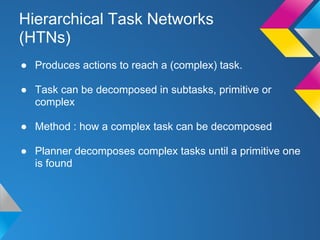
● Produces actions to reach a (complex) task.
● Task can be decomposed in subtasks, primitive or
complex
● Method : how a complex task can be decomposed
● Planner decomposes complex tasks until a primitive one
is found
Hierarchical Task Networks
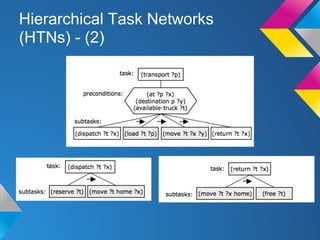
(HTNs) - (2)
Hierarchical Task Networks
(HTNs) - (3)
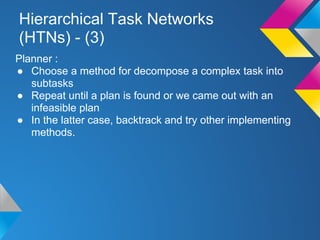
Planner :
● Choose a method for decompose a complex task into
subtasks
● Repeat until a plan is found or we came out with an
infeasible plan
● In the latter case, backtrack and try other implementing
methods.
Hierarchical Task Networks
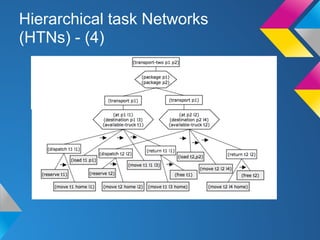
(HTNs) - (4)
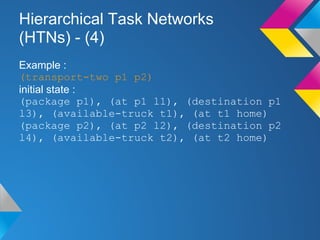
Example :
(transport-two p1 p2)
initial state :
(package p1), (at p1 l1), (destination p1
l3), (available-truck t1), (at t1 home)
(package p2), (at p2 l2), (destination p2
l4), (available-truck t2), (at t2 home)
Hierarchical task Networks
(HTNs) - (4)
● Introduction
● Hierarchical Task Networks
● Features
● SHOP 2 Algorithm
● Using SHOP 2
● Applications
● References
Overview
Features - Basic Elements
Specify a domain description that consists of a set of
methods, operators and axioms.
>Syntactical Note
A variable is preceded by "?" symbol.
A comment is preceded by ";".
● Tasks
Action to be done. They can be either primitive or
complex.
(s t1 t2 ... tn)
A primitive task is preceded by "!" symbol.
● Operators
Indicates how a primitive task can be executed.
(:operator h P D A [c])
Features - Basic Elements - (2)
● Methods
How to decompose a complex task.
(:method h [n1] C1 T1 [n2] C2 T2 ... [nk] Ck
Tk)
● Axioms
Used to infer precondition that are not explicitly
asserted in our current state (e.g. including quantifiers,
implications etc).
(:- a [name1] E1 ... [namen] En)
(:- head tail)
Which means that head is true if tail is true (Horn
clauses).
Features - Basic Elements 6
● External Function Call
Result is returned by a procedure, e.g
numeric evaluation.
( call f t1 t2 ... tn )
where f is a function symbol
Features - Additional
● Sorting variable bindings
● Branch and Bound Optimization
● PDDL Operator Translation
● Protected Condition and Anti-Interleaving
● Debugging Facilities
● Introduction
● Hierarchical Task Networks
● Features
● SHOP 2 Algorithm
● Using SHOP 2
● Applications
● References
Overview
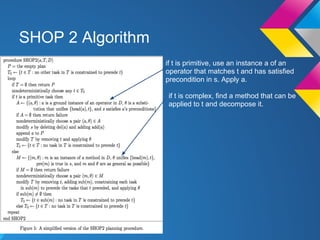
SHOP 2 Algorithm
if t is primitive, use an instance a of an
operator that matches t and has satisfied
precondition in s. Apply a.
if t is complex, find a method that can be
applied to t and decompose it.
● Introduction
● Hierarchical Task Networks
● Features
● SHOP 2 Algorithm
● Using SHOP 2
● Applications
● References
Overview
Using SHOP 2
● SHOP 2 requires lisp
● JSHOP also available, based on Java
Create a program in SHOP 2
1. Define a domain
2. Define one (or more) problems
3. run!
Using SHOP 2 - (2)
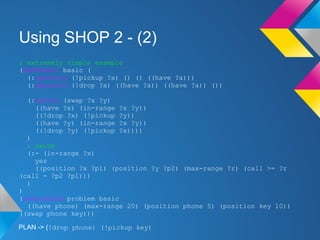
; extremely simple example
(defdomain basic (
(:operator (!pickup ?a) () () ((have ?a)))
(:operator (!drop ?a) ((have ?a)) ((have ?a)) ())
(:method (swap ?x ?y)
((have ?x) (in-range ?x ?y))
((!drop ?x) (!pickup ?y))
((have ?y) (in-range ?x ?y))
((!drop ?y) (!pickup ?x))))
)
; axiom
(:- (in-range ?x)
yes
((position ?x ?p1) (position ?y ?p2) (max-range ?r) (call >= ?r
(call - ?p2 ?p1)))
)
)
(defproblem problem basic
((have phone) (max-range 20) (position phone 5) (position key 10))
((swap phone key)))
PLAN -> (!drop phone) (!pickup key)
● Introduction
● Hierarchical Task Networks
● Features
● SHOP 2 Algorithm
● Using SHOP 2
● Applications
Overview
○ Video games
○ Evacuation
○ Evaluation of terrorist threats
○ Automated composition of web services
○ ...more.
● Resources
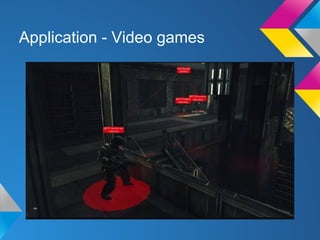
Application - Video games
Application - Video Games (2)
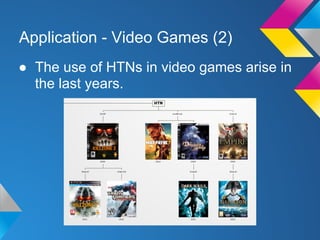
● The use of HTNs in video games arise in
the last years.
Application - Video Game (3)
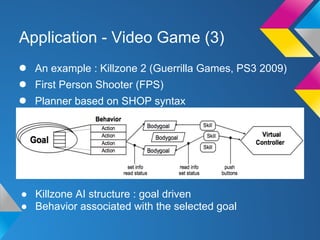
● An example : Killzone 2 (Guerrilla Games, PS3 2009)
● First Person Shooter (FPS)
● Planner based on SHOP syntax
● Killzone AI structure : goal driven
● Behavior associated with the selected goal
Application - Video Games (4)
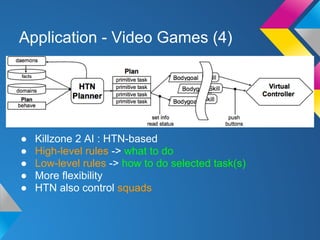
● Killzone 2 AI : HTN-based
● High-level rules -> what to do
● Low-level rules -> how to do selected task(s)
● More flexibility
● HTN also control squads
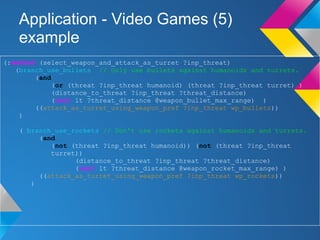
Application - Video Games (5)
example
(:method (select_weapon_and_attack_as_turret ?inp_threat)
(branch_use_bullets // Only use bullets against humanoids and turrets.
(and
(or (threat ?inp_threat humanoid) (threat ?inp_threat turret) )
(distance_to_threat ?inp_threat ?threat_distance)
(call lt ?threat_distance @weapon_bullet_max_range) )
((attack_as_turret_using_weapon_pref ?inp_threat wp_bullets))
)
( branch_use_rockets // Don't use rockets against humanoids and turrets.
(and
(not (threat ?inp_threat humanoid)) (not (threat ?inp_threat
turret))
(distance_to_threat ?inp_threat ?threat_distance)
(call lt ?threat_distance @weapon_rocket_max_range) )
((attack_as_turret_using_weapon_pref ?inp_threat wp_rockets))
)
)
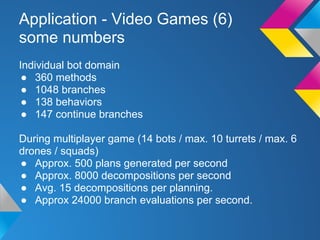
Application - Video Games (6)
some numbers
Individual bot domain
● 360 methods
● 1048 branches
● 138 behaviors
● 147 continue branches
During multiplayer game (14 bots / max. 10 turrets / max. 6
drones / squads)
● Approx. 500 plans generated per second
● Approx. 8000 decompositions per second
● Avg. 15 decompositions per planning.
● Approx 24000 branch evaluations per second.
Application - Evacuation
● US Naval Research Laboratory’s Hierarchical
Interactive Case-Based Architecture for Planning
(HICAP) helps human planners to build evacuation
plans.
● Generative and case-specific planning. SHOP provides
the generative component.
● Interactive plan modification : human expert can modify
tasks and plans interactively.
Application - evaluating terrorist
threats
● Naval Research Laboratory’s Analogical
Hypothesis Elaboration for Activity
Detection (AHEAD) helps to understand
and evaluate terrorists threats.
● A HTN domain encode hostile activities.
● AHEAD takes a hypothesis as input and
returns a model of the hostile activity.
Application - evaluating terrorist
threats
● SHOP 2 produces a plan compatible with
hypothesis.
● SHOP 2 queries an external evidence
database to make some tests
Application - automated
composition of web services
● Web service : a part of web that offer
functionality
● The OWL-S (Web Ontology Language for
Services) is a language for semantic markup
of Web services
● It describes services as complex or atomic
processes with preconditions and effects.
● University of Maryland has developed an
algorithm to translate OWL-S process-
models to SHOP 2 methods and operators.
Application - automated
composition of web services (2)
● Goal : compose web services
● User can compose them by using SHOP
2
● Result : HTN plan that corresponds to the
composite process.
Application - others
● Fighting forest fires
● Material selection for manifacturing
● Project Planning
etc
Check this paper out SHOP & SHOP 2
applications
● Introduction
● Hierarchical Task Networks
● Features
● SHOP 2 Algorithm
● Using SHOP 2
● Applications
○ Video games
○ Evacuation
○ Location-based services
○ Automated composition of web services
○ ...more.
● References
Overview
References
● SHOP 2 : An HTN Planning System - (D.
Nau et al, 2003)
● A hierarchically-layered multiplayer bot
system for a first-person shooter (Tim
Verweij, 2007)
● Killzone 2 Multiplayer Bots - ( Alex
Champandard, Tim Verweij, Remco
Straatman, 2009)
● Application of SHOP and SHOP 2 - (D.Nau
et al, 2005)
● Documentation for SHOP 2
Thanks for your attention
Andrea Tucci
@andreatux

Shop 2 presentation slide

  • 1.
    SHOP 2 Simple HierarchicalOrdered Planner 2 slides by Andrea Tucci
  • 2.
    ● Introduction ● HierarchicalTask Networks ● Features ● SHOP 2 Algorithm ● Using SHOP 2 ● Applications (SHOP & SHOP 2) ● References Overview
  • 3.
    ● Introduction ● HierarchicalTask Networks ● Features ● SHOP 2 Algorithm ● Using SHOP 2 ● Applications ● References Overview
  • 4.
    Introduction Simple Hierarchical OrderedPlanner 2 (SHOP 2) : ● Based on Hierarchical Task Network (HTN) ● Implemented in LISP ● Developed by D.Nau, T.Au, O.Ilghami, U.Kuter, D.Wu, and F.Yaman, H. Muñoz-Avila, J.W. Murdock in 2001; ● Award-winning at International Planning Competition (2002) for its performance
  • 5.
    Introduction (2) ● Stepsof a plan have the same order as their execution (like SHOP). >> this speed up reasoning process ● SHOP 2 characteristics go further : ○ task and subtask can be partially ordered; ○ many PDDL features included (e.g. quantifiers, conditional effects) ○ possibilities to satisfy a method's precondition are sorted according to specifications provided by the programmer ○ others
  • 6.
    ● Introduction ● HierarchicalTask Networks ● Features ● SHOP 2 Algorithm ● Using SHOP 2 ● Applications ● References Overview
  • 7.
    Hierarchical Task Networks (HTNs) ●Produces actions to reach a (complex) task. ● Task can be decomposed in subtasks, primitive or complex ● Method : how a complex task can be decomposed ● Planner decomposes complex tasks until a primitive one is found
  • 8.
  • 9.
    Hierarchical Task Networks (HTNs)- (3) Planner : ● Choose a method for decompose a complex task into subtasks ● Repeat until a plan is found or we came out with an infeasible plan ● In the latter case, backtrack and try other implementing methods.
  • 10.
    Hierarchical Task Networks (HTNs)- (4) Example : (transport-two p1 p2) initial state : (package p1), (at p1 l1), (destination p1 l3), (available-truck t1), (at t1 home) (package p2), (at p2 l2), (destination p2 l4), (available-truck t2), (at t2 home)
  • 11.
  • 12.
    ● Introduction ● HierarchicalTask Networks ● Features ● SHOP 2 Algorithm ● Using SHOP 2 ● Applications ● References Overview
  • 13.
    Features - BasicElements Specify a domain description that consists of a set of methods, operators and axioms. >Syntactical Note A variable is preceded by "?" symbol. A comment is preceded by ";". ● Tasks Action to be done. They can be either primitive or complex. (s t1 t2 ... tn) A primitive task is preceded by "!" symbol. ● Operators Indicates how a primitive task can be executed. (:operator h P D A [c])
  • 14.
    Features - BasicElements - (2) ● Methods How to decompose a complex task. (:method h [n1] C1 T1 [n2] C2 T2 ... [nk] Ck Tk) ● Axioms Used to infer precondition that are not explicitly asserted in our current state (e.g. including quantifiers, implications etc). (:- a [name1] E1 ... [namen] En) (:- head tail) Which means that head is true if tail is true (Horn clauses).
  • 15.
    Features - BasicElements 6 ● External Function Call Result is returned by a procedure, e.g numeric evaluation. ( call f t1 t2 ... tn ) where f is a function symbol
  • 16.
    Features - Additional ●Sorting variable bindings ● Branch and Bound Optimization ● PDDL Operator Translation ● Protected Condition and Anti-Interleaving ● Debugging Facilities
  • 17.
    ● Introduction ● HierarchicalTask Networks ● Features ● SHOP 2 Algorithm ● Using SHOP 2 ● Applications ● References Overview
  • 18.
    SHOP 2 Algorithm ift is primitive, use an instance a of an operator that matches t and has satisfied precondition in s. Apply a. if t is complex, find a method that can be applied to t and decompose it.
  • 19.
    ● Introduction ● HierarchicalTask Networks ● Features ● SHOP 2 Algorithm ● Using SHOP 2 ● Applications ● References Overview
  • 20.
    Using SHOP 2 ●SHOP 2 requires lisp ● JSHOP also available, based on Java Create a program in SHOP 2 1. Define a domain 2. Define one (or more) problems 3. run!
  • 21.
    Using SHOP 2- (2) ; extremely simple example (defdomain basic ( (:operator (!pickup ?a) () () ((have ?a))) (:operator (!drop ?a) ((have ?a)) ((have ?a)) ()) (:method (swap ?x ?y) ((have ?x) (in-range ?x ?y)) ((!drop ?x) (!pickup ?y)) ((have ?y) (in-range ?x ?y)) ((!drop ?y) (!pickup ?x)))) ) ; axiom (:- (in-range ?x) yes ((position ?x ?p1) (position ?y ?p2) (max-range ?r) (call >= ?r (call - ?p2 ?p1))) ) ) (defproblem problem basic ((have phone) (max-range 20) (position phone 5) (position key 10)) ((swap phone key))) PLAN -> (!drop phone) (!pickup key)
  • 22.
    ● Introduction ● HierarchicalTask Networks ● Features ● SHOP 2 Algorithm ● Using SHOP 2 ● Applications Overview ○ Video games ○ Evacuation ○ Evaluation of terrorist threats ○ Automated composition of web services ○ ...more. ● Resources
  • 23.
  • 24.
    Application - VideoGames (2) ● The use of HTNs in video games arise in the last years.
  • 25.
    Application - VideoGame (3) ● An example : Killzone 2 (Guerrilla Games, PS3 2009) ● First Person Shooter (FPS) ● Planner based on SHOP syntax ● Killzone AI structure : goal driven ● Behavior associated with the selected goal
  • 26.
    Application - VideoGames (4) ● Killzone 2 AI : HTN-based ● High-level rules -> what to do ● Low-level rules -> how to do selected task(s) ● More flexibility ● HTN also control squads
  • 27.
    Application - VideoGames (5) example (:method (select_weapon_and_attack_as_turret ?inp_threat) (branch_use_bullets // Only use bullets against humanoids and turrets. (and (or (threat ?inp_threat humanoid) (threat ?inp_threat turret) ) (distance_to_threat ?inp_threat ?threat_distance) (call lt ?threat_distance @weapon_bullet_max_range) ) ((attack_as_turret_using_weapon_pref ?inp_threat wp_bullets)) ) ( branch_use_rockets // Don't use rockets against humanoids and turrets. (and (not (threat ?inp_threat humanoid)) (not (threat ?inp_threat turret)) (distance_to_threat ?inp_threat ?threat_distance) (call lt ?threat_distance @weapon_rocket_max_range) ) ((attack_as_turret_using_weapon_pref ?inp_threat wp_rockets)) ) )
  • 28.
    Application - VideoGames (6) some numbers Individual bot domain ● 360 methods ● 1048 branches ● 138 behaviors ● 147 continue branches During multiplayer game (14 bots / max. 10 turrets / max. 6 drones / squads) ● Approx. 500 plans generated per second ● Approx. 8000 decompositions per second ● Avg. 15 decompositions per planning. ● Approx 24000 branch evaluations per second.
  • 29.
    Application - Evacuation ●US Naval Research Laboratory’s Hierarchical Interactive Case-Based Architecture for Planning (HICAP) helps human planners to build evacuation plans. ● Generative and case-specific planning. SHOP provides the generative component. ● Interactive plan modification : human expert can modify tasks and plans interactively.
  • 30.
    Application - evaluatingterrorist threats ● Naval Research Laboratory’s Analogical Hypothesis Elaboration for Activity Detection (AHEAD) helps to understand and evaluate terrorists threats. ● A HTN domain encode hostile activities. ● AHEAD takes a hypothesis as input and returns a model of the hostile activity.
  • 31.
    Application - evaluatingterrorist threats ● SHOP 2 produces a plan compatible with hypothesis. ● SHOP 2 queries an external evidence database to make some tests
  • 32.
    Application - automated compositionof web services ● Web service : a part of web that offer functionality ● The OWL-S (Web Ontology Language for Services) is a language for semantic markup of Web services ● It describes services as complex or atomic processes with preconditions and effects. ● University of Maryland has developed an algorithm to translate OWL-S process- models to SHOP 2 methods and operators.
  • 33.
    Application - automated compositionof web services (2) ● Goal : compose web services ● User can compose them by using SHOP 2 ● Result : HTN plan that corresponds to the composite process.
  • 34.
    Application - others ●Fighting forest fires ● Material selection for manifacturing ● Project Planning etc Check this paper out SHOP & SHOP 2 applications
  • 35.
    ● Introduction ● HierarchicalTask Networks ● Features ● SHOP 2 Algorithm ● Using SHOP 2 ● Applications ○ Video games ○ Evacuation ○ Location-based services ○ Automated composition of web services ○ ...more. ● References Overview
  • 36.
    References ● SHOP 2: An HTN Planning System - (D. Nau et al, 2003) ● A hierarchically-layered multiplayer bot system for a first-person shooter (Tim Verweij, 2007) ● Killzone 2 Multiplayer Bots - ( Alex Champandard, Tim Verweij, Remco Straatman, 2009) ● Application of SHOP and SHOP 2 - (D.Nau et al, 2005) ● Documentation for SHOP 2
  • 37.
    Thanks for yourattention Andrea Tucci @andreatux