B"H
Annual Report and
Accounts 2017
B"H
Contents
4 		Directors, Secretary & Advisers
5 		Financial & Operational Summary
6 		Strategic Report - Chairman’s Statement
7 		Strategic Report - Financial Review
8 		Our Unique Precious Gem Stones
10 		Operational Site and Minerological Laboratory
11 		Principal Risks and Uncertainties
12 		Directors’ Biographies
15 		Directors’ Report
18 		Corporate Governance Report
23 	Directors’ Remuneration Report
28 	Independent Auditor’s Report
29 	Consolidated & Company Statement of Financial Position
30 	Consolidated Statement of Comprehensive Income
31 	Company Statement of Changes in Equity
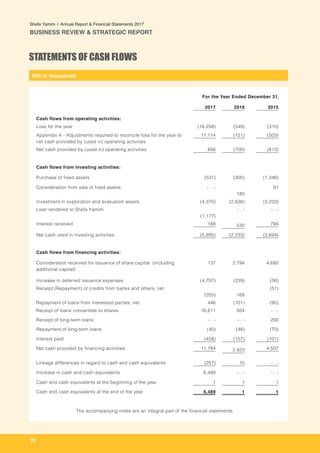
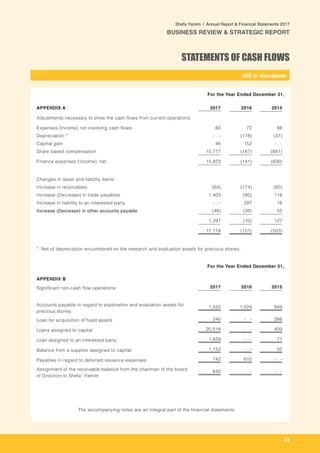
32 	Consolidated & Company Statement of Cash Flows
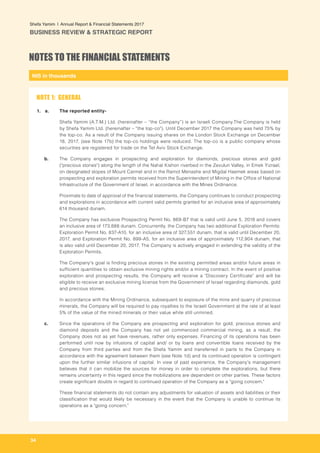
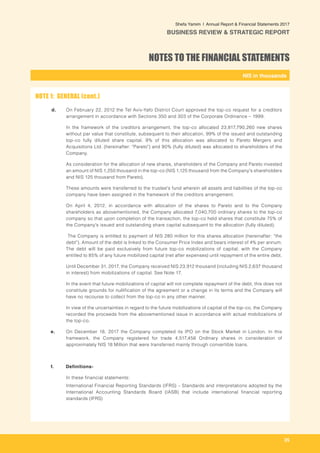
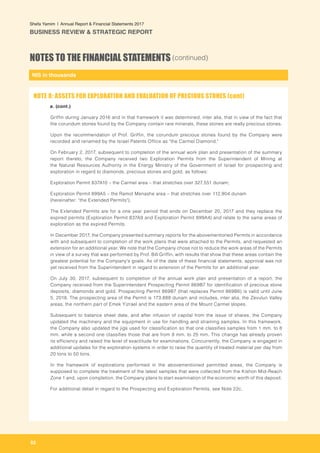
34 	Notes to the Consolidated Financial Statements
4
Shefa Yamim  |  Annual Report & Financial Statements 2017
BUSINESS REVIEW & STRATEGIC REPORT
Directors
Abraham ‘Avi’ Taub
Chief Executive Officer
& Executive Chairman
Michael Rosenberg, OBE
Independent Non-Executive Director
James AH Campbell
Independent Non-Executive Director
Nathalie Schwarz
Independent Non-Executive Director
David Nachshon
Independent Non-Executive Director
Gershon Fraenkel
Independent Non-Executive Director
Hanoch Ehrlich
Independent Non-Executive Director
Registered
Office
90 Herzel Street, P.O.Box 720,
Netanya – 4210602, Israel
Management
Company
One Hundred &
One Gold Holdings Ltd
(“101 Gold Holdings Ltd”).
Netanya Israel
Financial Adviser
and Broker
VSA Capital Limited
New Liverpool House,15 Eldon Street,
London, EC2M 7LD
Auditors and
Reporting Accountants
Barzily & Co.
Har Hotzvim’ 19 Hartom9,
Jerusalem, 97775,Israel
Registrar
Computershare Investor
Services (Jersey) Limited
Queensway House, Hilgrove Street,
St Helier, Jersey, JE11ES
Depositary Computershare
Investor Services Plc
The Pavilions, Bridgwater Road,
Bristol, BS13 8AE
Legal advisers to the Company
-as to English law
Charles Russell Speechlys LLP
5 Fleet Place,
London, EC4M 7RD
- as to Israeli law
Gornitzky & Co.
45 Rothschild Blvd.,
Tel Aviv, 6578403, Israel,
P.O.B. 29141
Financial PR
Luther Pendragon
48 Gracechurch Street,
London, EC3V 0EJ
Directors, Secretary & Advisors
5
Shefa Yamim  |  Annual Report & Financial Statements 2017
BUSINESS REVIEW & STRATEGIC REPORT
KISHON MID-REACH (“THE PROJECT”)
■ New bulk sampling programme in Zone 1 and 2 started in August 2017 with a total of 8
bulk samples and 4,107.86 tonnes of gravel collected during the period
■ Successfully treated 2,990 tonnes of gravel at its operational site in Akko, Northern Israel
■ Total Target Mineral Assemblage Suite (“TMA”) found in the treatment during the period is
1,096.39 carats containing the Heavy Industrial Minerals (“HIM”); zircon, rutile, ilmenite and
garnet and the DMCH Suite; diamond, natural moissanite and the gem corundum varieties of
sapphire, ruby, Carmel Sapphire™ and Hibonite (“DMCH”)
■ Applied and subsequently been granted exploration permit 869B7
■ Competent Persons Report (“CPR”) updated and published in October 2017
■ Presence of Hibonite, an incredibly rare precious stone found only in limited locations
globally, confirmed by work carried out by Shefa Yamim in collaboration with Prof. Griffin from
Macquarie University, Australia. The Hibonite added to the DMC Suite of minerals and the
geological models have been updated accordingly to DMCH
CORPORATE
■ Successful IPO on the Official List of the London Stock Exchange on 18th December 2017
■ Raised gross proceeds of £4.15 million, before expenses
■ Significantly strengthened the Board with the appointment of four Non-Executive Directors
■ Received a trade mark from the Israeli Government for the Carmel Sapphire™,
a unique precious stoneonly found in Mt. Carmel, in Northern Israel
2017 Highlights
6
Shefa Yamim  |  Annual Report & Financial Statements 2017
BUSINESS REVIEW & STRATEGIC REPORT
I am proud to be presenting our maiden annual
results following our listing in December 2017.
It has been a momentous year for Shefa Yamim,
one where we not only completed our IPO but also
built upon the solid foundations set in the previous
year. In 2017 we made great progress with our
operations and bulk samplings which has kept us
on track to commence technical studies during the
course of 2018. During the year, the total target
mineral assemblage found amounted to 1,096.39
carats primarily of natural moissanite and gem
corundum of sapphire, rubies, Carmel Sapphire™
and Hibonite as we conducted bulk samplings on
the Kishon Mid-Reach Zone 1 area. In the short
period since becoming a public company, we
have continued to implement our strategy outlined
at the time of our IPO and we are pleased with the
progress that the business has made.
KISHON MID-REACH
Zone 1 Bulk Sampling
In September 2017, Shefa Yamim completed a
total of 3 new bulk samples in Zone 1 - BS-1226,
1227, 1228 in Zone 1. The 3 bulk samples carried
out in August in the Kishon Mid-Reach Zone are
the last bulk samples planned for Zone 1.
Zone 2 Bulk Sampling
In August, we completed 5 bulk samples in the
Kishon Mid-Reach Zone 2 including: BS-1223, BS-
1224, BS-1225, BS-1229 and BS-1330. In addition,
3 new bulk samples were excavated (BS-1223, BS-
1224 and BS-1225) and 2 new bulk samples were
done across the valley opposite to bulk samples
BS-1223, BS-1224 and BS-1225 samples BS-1229
and BS-1230.
In all, a total of 8 bulk samples and 4,107.86 tonnes
of gravel were collected and 2,990 tonnes of
gravel were successfully treated at its operational
site in Akko, Northern Israel. Total Target Mineral
Assemblage Suite (“TMA”) found in the treatment
during the period is 1,096.39 carats containing the
Heavy Industrial Minerals (“HIM”); zircon, rutile,
ilmenite and garnet and the DMCH Suite; diamond,
natural moissanite and the gem corundum varieties
of sapphire, ruby, Carmel Sapphire™ and Hibonite.
Bulk sample results announced post period, on
the 20th March 2018, covering some of the bulk
samples treated during the period, saw a shift
from findings to date where the Carmel Sapphire™
has been the dominant gem mineral in most of
Zone 1. The southernmost bulk samples of BS-
1226 and BS-1227 have returned higher sapphire
values than the Carmel Sapphire™. In BS-1227 the
recovery of 55.3ct of sapphire was the highest for
a single bulk sample to date, whilst the individual
sapphire recovered weighing 5.52ct was close to
the largest ever discovered by Shefa Yamim which
was 5.72ct.
Processing and exploration
During 2017, we treated a total of 2,990 tonnes
of gravel and is processing the last two bulk
samples from Zone 1 (BS-1228, BS-1208). We
will then start processing historical bulk samples
gravels collected from the Kishon Mid Reach zone
2. Historical bulk samples to note in this area
include BS-9820 which yielded a 6 carat natural
moissanite, the largest found in our license areas
to date.
During the period, we applied for and received a
new exploration permit from the inspector of mines
– Exploration permit 869B7 covering 173,888
Dunams and published an updated Competent
Person’s Report in October 2017.
In addition, and following a review by Macquarie
University, led by Professor Griffin and Shefa
Yamim, we have confirmed the presence of
hibonite in some of its bulk samples. Hibonite, is an
incredibly rare precious stone only found in a few
locations worldwide. Shefa Yamim has discovered
examples intergrown with grossite, fluorite, spinel
and native vanadium of varying quality and size;
the largest of which was 2.83ct stone in historical
bulk sample BS-1214 (Zone 1). Whilst quantitative
data is not yet available, we believe that the
discoveries to date indicate a further potentially
valuable addition to the mineral assemblage.
Chairman’s Statement and
Operational Review
7
Shefa Yamim  |  Annual Report & Financial Statements 2017
BUSINESS REVIEW & STRATEGIC REPORT
CORPORATE REVIEW
During the year Shefa has achieved many
important milestones, but one of the highlights of
the year was our successful listing on the Official
List of the London Stock Exchange on the 18th
December 2017, raising gross proceeds of £4.15
million, before expenses, through the conversion
of existing loans and a placing and subscription
at 110p per Ordinary Share (“Placing Price”). The
funds raised is being used to advance exploration
in the Kishon Mid-Reach Project, its priority target,
towards the completion of a pre-feasibility study
and defining a resource.
As part of the listing process we also took steps
to strengthen its Board with the appointment of
James AH Campbell, Michael Rosenberg, Nathalie
Schwarz and Hanoch Ehrlich, as Non-Executive
Directors.
On the 5 of November 2017, we applied and
received a trade mark from the Israeli Government
for the Carmel Sapphire™, a newly discovered
corundum similar in appearance to a sapphire, but
unlike any other gem corundum previously found.
We intend to market the Carmel Sapphire™ as a
precious stone to be used in jewellery.
Post period, we announced the results of studies
conducted by Macquarie University, Australia,
that provide a clearer understanding of why Shefa
Yamim has been able to find a suite of precious
stones in its exploration area, including natural
moissanite and Carmel Sapphire™. The findings
allow us to make more informed decisions with
regards to future exploration.
Outlook
Our strategy for 2018 is to continue our exploration
programme at the Kishon Mid Reach placer with
the aim of delineating a mineral resource that
is compliant with the South African Code for
Reporting Exploration Results, Mineral Resources
and Mineral Reserves (the “SAMREC”). To this end
we plan to:
• Conclude bulk sampling in the Kishon Mid-
Reach Zone 1
• Start technical studies of Zone 1 in Kishon Mid-
Reach
• Establish grade estimations & resource
definition
• Conduct bulk sampling in the Kishon Mid-
Reach Zone 2
In 2018, we have made good progress in
upgrading our sample treatment facility and moving
towards increasing our processing capacity to
approximately 50 tonnes a day. We remain on track
to achieve our targets for the year of concluding
our bulk sampling in Kishon Mid-Reach Zone 1
and commencing technical studies for this area.
We are also on track to progress with conducting
our bulk sampling in the Kishon Mid-Reach Zone 2.
We look forward to reporting on achieving our key
milestones as we progress through the year.
Avi Taub
Chairman & CEO
30 April 2018
Chief Financial
Officer’s Review
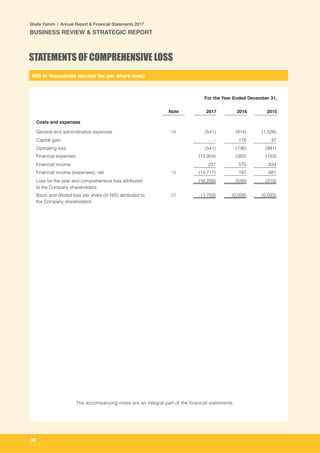
Over the last 12 months, Shefa Yamim recorded
a loss of TNIS (in thousands) 16,258 (2016: TNIS
549), equating to a loss of NIS 1.703 (2016:
0.058) per share. TNIS15,717 are attributed to
financial expenses, including the fair market
value of the Options/Warrants granted to the
convertible loan providers, pre-IPO. In addition,
we paid fees and commission costs associated
with the loans. All loans were converted to
Company shares at the day of the IPO. At the
end of the year, Shefa Yamim’s cash and cash
equivalents stood at TNIS 6,489
8
Shefa Yamim  |  Annual Report & Financial Statements 2017
BUSINESS REVIEW & STRATEGIC REPORT
Shefa Yamim has discovered a unique range of
precious stones in northern Israel, centred on
Mount Carmel and the Kishon Mid-Reach. We
believe that this assemblage has significant
value and marketing potential. The company has
established two mineral suites as part of its Target
Mineral Assemblage (“TMA”) suite:
• The DMCH Suite: Diamond, natural Moissanite
and the gem Corundum varieties of sapphire, ruby,
Carmel SapphireTM
and Hibonite.
• The HIM Suite: Heavy Industrial Minerals; Zircon,
rutile, ilmenite and garnet
Shefa Yamim’s findings to date include dark blue
sapphires, deep red rubies, hibonite, as well
as natural moissanite crystals and the Carmel
Sapphire™.
Moissanite – More brilliant than
diamonds
In 1893, the Nobel Prize-winning French scientist
Dr. Henri Moissan discovered minute quantities of
a new mineral, natural silicon carbide. The mineral
was discovered in an iron meteorite (Canyon
Diablo) in Arizona. It was later named "moissanite"
in honour of Dr. Moissan.
Moissanite is composed of silicon and carbon.
Brighter than a diamond with a reflective index of
2.691-2.648; slightly higher than diamond (2.42)
and almost as hard (9.5 in Mohs scale versus 10),
natural moissanite has the potential to become
a rare precious stone in the jewellery market, as
only synthetic moissanites currently available.
Synthetic moissanite is being created exclusively
by Charles & Colvard (CTHR US) in the USA.
Largest natural moissanite crystal found in the world
to the best of our knowledge, Shefa Yamim is the
only company to have found the largest quantities
of natural moissanite in the world. A total of over
3,000 natural moissanite crystals have been found
to date with the largest being a 4.14mm crystal
new world record finding (the "World Record was
3.5mm in 2009).
Carmel Sapphire™ a newly
discovered corundum
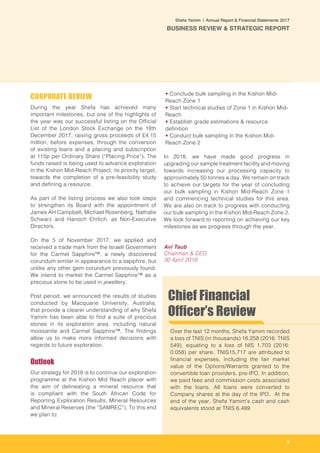
The Carmel Sapphire™ is a newly discovered
corundum similar in appearance to the corundum
but unlike any other sapphire found in the world.
The rough Carmel Sapphires are typically black,
blue to green and brown in colour with the largest
found at 33.3ct in weight (bulk sample 1124 from
the Kishon Mid Reach, zone 1).
Our Unique Precious Stones
Caramel Sapphire
9
Shefa Yamim  |  Annual Report & Financial Statements 2017
BUSINESS REVIEW & STRATEGIC REPORT
It has been given a trade mark by the Israeli
Government. In addition Macquarie University,
which has been collaborating with Shefa
Yamim since January 2014, intends to make an
application to the International Mineralogical
Association (“IMA”) for recognition ShefaTAZite
as a new mineral, (Tistarite + Titanium -Aluminium-
Zirconium-oxide).
Hibonite find is confirmed
by Macquarie University
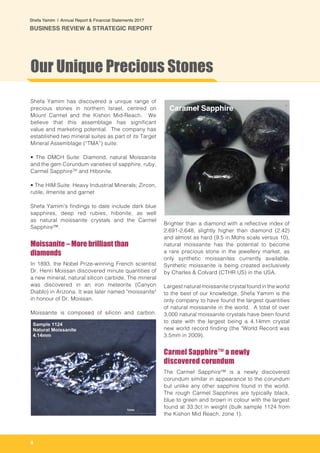
Hibonite, typically yellow to red-brown to black in
colour have been found at Shefa Yamim’s Kishon
Mid-Reach zone. An extremely rare precious
stone only found in a handful of countries globally,
has been confirmed by Macquarie University to
be Hibonite. The find provides Shefa Yamim with
another rare and marketable precious stone. The
largest hibonite found to date was 2.83 ct.
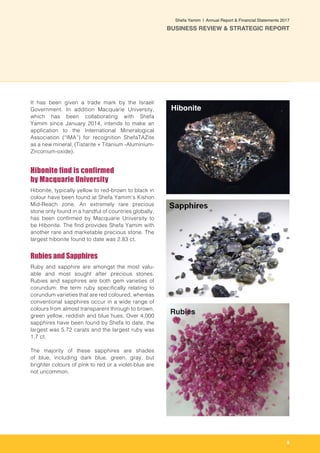
Rubies and Sapphires
Ruby and sapphire are amongst the most valu-
able and most sought after precious stones.
Rubies and sapphires are both gem varieties of
corundum: the term ruby specifically relating to
corundum varieties that are red coloured, whereas
conventional sapphires occur in a wide range of
colours from almost transparent through to brown,
green yellow, reddish and blue hues. Over 4,000
sapphires have been found by Shefa to date, the
largest was 5.72 carats and the largest ruby was
1.7 ct.
The majority of these sapphires are shades
of blue, including dark blue, green, gray, but
brighter colours of pink to red or a violet-blue are
not uncommon.
Rubies
Hibonite
10
Shefa Yamim  |  Annual Report & Financial Statements 2017
BUSINESS REVIEW & STRATEGIC REPORT
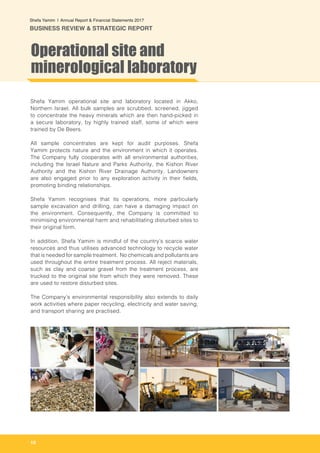
Shefa Yamim operational site and laboratory located in Akko,
Northern Israel. All bulk samples are scrubbed, screened, jigged
to concentrate the heavy minerals which are then hand-picked in
a secure laboratory, by highly trained staff, some of which were
trained by De Beers.
All sample concentrates are kept for audit purposes. Shefa
Yamim protects nature and the environment in which it operates.
The Company fully cooperates with all environmental authorities,
including the Israel Nature and Parks Authority, the Kishon River
Authority and the Kishon River Drainage Authority. Landowners
are also engaged prior to any exploration activity in their fields,
promoting binding relationships.
Shefa Yamim recognises that its operations, more particularly
sample excavation and drilling, can have a damaging impact on
the environment. Consequently, the Company is committed to
minimising environmental harm and rehabilitating disturbed sites to
their original form.
In addition, Shefa Yamim is mindful of the country’s scarce water
resources and thus utilises advanced technology to recycle water
that is needed for sample treatment. No chemicals and pollutants are
used throughout the entire treatment process. All reject materials,
such as clay and coarse gravel from the treatment process, are
trucked to the original site from which they were removed. These
are used to restore disturbed sites.
The Company’s environmental responsibility also extends to daily
work activities where paper recycling, electricity and water saving,
and transport sharing are practised.
Operational site and
minerological laboratory
11
Shefa Yamim  |  Annual Report & Financial Statements 2017
BUSINESS REVIEW & STRATEGIC REPORT
The Company is currently at an early stage of development and has
yet to commence operations at the Kishon Mid Reach Project. The
Company currently has no cash producing properties and therefore
no positive cash flow. The Company will continue to have negative
operating cash flow until commercial production is reached.
The ability of the Company to continue its activities as a going
concern depends to a greater extent on its ability to continue to
raise capital and/or debt. Considering the fact that precious stone
exploration is unique to the Company in Israel, there is a risk that
the Company only has a limited capacity to raise capital and/or
debt from private investors and/or from the public.
In addition, as the Company has no previous experience in the
mining industry and as there has been no previous attempt to
mine for precious stones in Israel, there is a risk that the budgets
planned by the Company in order to pursue its objectives shall not
be sufficient and that the Company would require additional funding
to complete the exploration plans.
Principal Risks and Uncertainties
12
Shefa Yamim  |  Annual Report & Financial Statements 2017
BUSINESS REVIEW & STRATEGIC REPORT
Directors’ Biographies
Abraham ‘Avi’ Taub
Chief Executive Officer,
Executive Chairman
Michael Rosenberg, OBE
Independent
Non-Executive Director
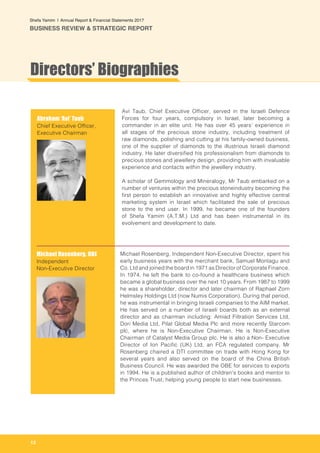
Avi Taub, Chief Executive Officer, served in the Israeli Defence
Forces for four years, compulsory in Israel, later becoming a
commander in an elite unit. He has over 45 years’ experience in
all stages of the precious stone industry, including treatment of
raw diamonds, polishing and cutting at his family-owned business,
one of the supplier of diamonds to the illustrious Israeli diamond
industry. He later diversified his professionalism from diamonds to
precious stones and jewellery design, providing him with invaluable
experience and contacts within the jewellery industry.
A scholar of Gemmology and Mineralogy, Mr Taub embarked on a
number of ventures within the precious stoneindustry becoming the
first person to establish an innovative and highly effective central
marketing system in Israel which facilitated the sale of precious
stone to the end user. In 1999, he became one of the founders
of Shefa Yamim (A.T.M.) Ltd and has been instrumental in its
evolvement and development to date.
Michael Rosenberg, Independent Non-Executive Director, spent his
early business years with the merchant bank, Samuel Montagu and
Co. Ltd and joined the board in 1971 as Director of Corporate Finance.
In 1974, he left the bank to co-found a healthcare business which
became a global business over the next 10 years. From 1987 to 1999
he was a shareholder, director and later chairman of Raphael Zorn
Helmsley Holdings Ltd (now Numis Corporation). During that period,
he was instrumental in bringing Israeli companies to the AIM market.
He has served on a number of Israeli boards both as an external
director and as chairman including: Amiad Filtration Services Ltd,
Dori Media Ltd, Pilat Global Media Plc and more recently Starcom
plc, where he is Non-Executive Chairman. He is Non-Executive
Chairman of Catalyst Media Group plc. He is also a Non- Executive
Director of Ion Pacific (UK) Ltd, an FCA regulated company. Mr
Rosenberg chaired a DTI committee on trade with Hong Kong for
several years and also served on the board of the China British
Business Council. He was awarded the OBE for services to exports
in 1994. He is a published author of children's books and mentor to
the Princes Trust, helping young people to start new businesses.
13
Shefa Yamim  |  Annual Report & Financial Statements 2017
BUSINESS REVIEW & STRATEGIC REPORT
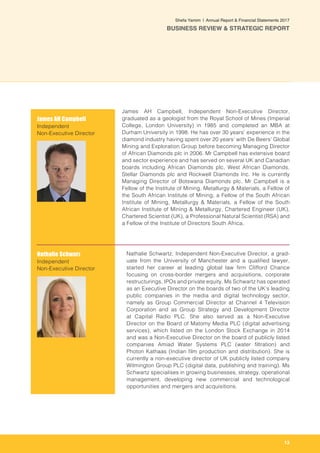
Nathalie Schwartz, Independent Non-Executive Director, a grad-
uate from the University of Manchester and a qualified lawyer,
started her career at leading global law firm Clifford Chance
focusing on cross-border mergers and acquisitions, corporate
restructurings, IPOs and private equity. Ms Schwartz has operated
as an Executive Director on the boards of two of the UK’s leading
public companies in the media and digital technology sector,
namely as Group Commercial Director at Channel 4 Television
Corporation and as Group Strategy and Development Director
at Capital Radio PLC. She also served as a Non-Executive
Director on the Board of Matomy Media PLC (digital advertising
services), which listed on the London Stock Exchange in 2014
and was a Non-Executive Director on the board of publicly listed
companies Amiad Water Systems PLC (water filtration) and
Photon Kathaas (Indian film production and distribution). She is
currently a non-executive director of UK publicly listed company
Wilmington Group PLC (digital data, publishing and training). Ms
Schwartz specialises in growing businesses, strategy, operational
management, developing new commercial and technological
opportunities and mergers and acquisitions.
James AH Campbell
Independent
Non-Executive Director
Nathalie Schwarz
Independent
Non-Executive Director
James AH Campbell, Independent Non-Executive Director,
graduated as a geologist from the Royal School of Mines (Imperial
College, London University) in 1985 and completed an MBA at
Durham University in 1998. He has over 30 years’ experience in the
diamond industry having spent over 20 years’ with De Beers’ Global
Mining and Exploration Group before becoming Managing Director
of African Diamonds plc in 2006. Mr Campbell has extensive board
and sector experience and has served on several UK and Canadian
boards including African Diamonds plc, West African Diamonds,
Stellar Diamonds plc and Rockwell Diamonds Inc. He is currently
Managing Director of Botswana Diamonds plc. Mr Campbell is a
Fellow of the Institute of Mining, Metallurgy & Materials, a Fellow of
the South African Institute of Mining, a Fellow of the South African
Institute of Mining, Metallurgy & Materials, a Fellow of the South
African Institute of Mining & Metallurgy, Chartered Engineer (UK),
Chartered Scientist (UK), a Professional Natural Scientist (RSA) and
a Fellow of the Institute of Directors South Africa.
14
Shefa Yamim  |  Annual Report & Financial Statements 2017
BUSINESS REVIEW & STRATEGIC REPORT
Gershon Fraenkel, Independent Non-Executive Director, is a British
Citizen and founder of WST Charity Ltd, in North West London which
focuses on alleviating poverty within the Jewish Community in the
area. He has successfully launched many international businesses
in the last 25 years, including SEACO Group of Companies and
Linkedell Ltd, as result of which he acts as an intermediary and
adviser of international transactions to companies in Israel and the
UK. Mr Fraenkel is fluent in English, Hebrew and Yiddish.
Directors’ Biographies (continued)
David Nachshon
Independent
Non-Executive Director
Gershon Fraenkel
Independent
Non-Executive Director
Hanoch Ehrlich
Independent Non-
Executive Director
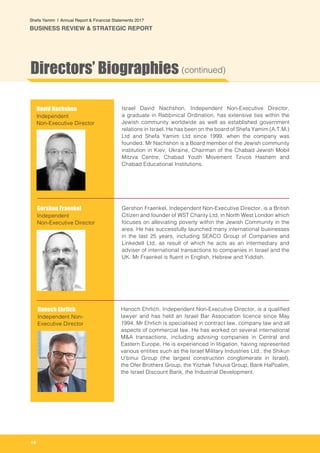
Israel David Nachshon, Independent Non-Executive Director,
a graduate in Rabbinical Ordination, has extensive ties within the
Jewish community worldwide as well as established government
relations in Israel. He has been on the board of Shefa Yamim (A.T.M.)
Ltd and Shefa Yamim Ltd since 1999, when the company was
founded. Mr Nachshon is a Board member of the Jewish community
institution in Kiev, Ukraine, Chairman of the Chabad Jewish Mobil
Mitzva Centre, Chabad Youth Movement Tzivos Hashem and
Chabad Educational Institutions.
Hanoch Ehrlich, Independent Non-Executive Director, is a qualified
lawyer and has held an Israel Bar Association licence since May
1994. Mr Ehrlich is specialised in contract law, company law and all
aspects of commercial law. He has worked on several international
M&A transactions, including advising companies in Central and
Eastern Europe. He is experienced in litigation, having represented
various entities such as the Israel Military Industries Ltd., the Shikun
U’binui Group (the largest construction conglomerate in Israel),
the Ofer Brothers Group, the Yitzhak Tshuva Group, Bank HaPoalim,
the Israel Discount Bank, the Industrial Development.
15
Shefa Yamim  |  Annual Report & Financial Statements 2017
BUSINESS REVIEW & STRATEGIC REPORT
Principal Activities
Shefa Yamim, founded in 1999, is the only co-
loured precious stone exploration company in
northern Israel. The Company’s exploration and
prospecting permits are located across the Kishon
River catchment area of Haifa and Mt Carmel in
northern Israel, covering a total area of 614 km2,
some 85km north of Tel Aviv. The Company also
maintains an operational centre with a processing
facility and laboratory in Akko, a town north of Haifa.
Financial Statements
The Directors present their report together with the
audited financial statements for the year ended 31
December 2017. The results of the year are set out
in the consolidated statement of profit or loss.
Dividends
The Board is not proposing a dividend this year.
Business and Strategic Review
The review of Shefa Yamim’s business operations,
including processing and exploration activity,
corporate overview and outlook, are set out in the
Strategic Report section on pages 6 to 7 together
with this Directors’ Report.
Admission to the Official List of the
London Stock Exchange
The Company was admitted to the Official List of
the London Stock Exchange, under the ticker SEFA
and with the ISIN number IL0011101057.
The Company successfully raised gross proceeds
of £4.15 million, before expenses, through the
conversion of existing loans and a placing and
subscription at 110p per Ordinary Share (“Placing
Price”). Based on the Placing Price, the market
capitalisation of the Company at Admission was
approximately £15.3 million.
The Company’s Converted Debt Shares consist of an
aggregate of 3,973,461 Shares issued in relation to
the Convertible Loans of approximately £3.6 million
and 320,856 Shares issued in relation to the Related
Party Debt of approximately £0.3 million. For more
information please refer to Note 17 on page 58.
Following admission, the Company has 13,905,056
Ordinary Shares in issue.
Directors
The Directors’ who have held office for the year
ended 31 December 2017 and are currently serving
are as follows:
Abraham ‘Avi’ Taub
Chief Executive Officer & Executive Chairman
David Nachshon
Independent Non-Executive Director
The following Directors’ were appointed on the
day the Company listed on the Standard Listing
Segment of the Official list, 18th December 2017:
Michael Rosenberg, OBE
Independent Non-Executive Director
James AH Campbell
Independent Non-Executive Director
Nathalie Schwarz
Independent Non-Executive Director
Hanoch Ehrlich
Independent Non-Executive Director
Gershon Fraenkel
Independent Non-Executive Director
In addition, the following Directors’ held office
during the period and resigned on the day the
Company listed on the Standard Listing Segment
of the Official list, 18th December 2017:
Shimon Hybloom - Chairman
Shlomo Kalish – Director
Nathan Druckman – Director
Eliezer Levison – Director
Corporate Governance Statement
The information that fulfils the requirement of the
corporate governance statement in accordance
with Rule 7.2 of the Financial Conduct Authority’s
Disclosure and Transparency Rules can be found
in this Directors’ Report and in the Corporate
Governance information on pages 15 to 22 which
is incorporated into the Directors’ Report by
reference.
Directors Report
16
Shefa Yamim  |  Annual Report & Financial Statements 2017
BUSINESS REVIEW & STRATEGIC REPORT
The Directors remuneration and interests are set
out in the Directors Remuneration Report on pages
23 to 25.
Rules about appointment
and replacement of Directors;
Amendment of Articles
Pursuant to the Company’s articles of association
and Israeli Companies Law, Directors are elected
at the Annual General Meeting by the vote of
the holders of a majority of the voting power
represented at such meeting in person or by
proxy and voting on the election of Directors. Each
director (except for the public external appointed
Directors) shall serve until the next Annual General
Meeting following the Annual General Meeting at
which such director was appointed, or his earlier
removal. The holders of a majority of the voting
power represented at a General Meeting and
voting thereon shall be entitled to remove any
director(s) from office, to elect Directors in place
of the Directors so removed or to fill any vacancy,
however created, in the Board of Directors by
way of ordinary resolution. Each non-executive
director will serve until the next Annual General
Meeting following his or her election and his
or her successor is duly elected and qualified
or until his or her earlier death, resignation or
removal by a vote of the majority voting power of
the Company’s shareholders at a general meeting
of the Company’s shareholders or until his or her
office expires by operation of law.
Apart from the authority of the General Meeting
to remove a director from office, subject to giving
such director a reasonable opportunity to present
his position to the General Meeting, under the
Company’s articles, the office of a director shall
be vacated ipso facto, upon his death, or if he be
found to be of unsound mind, or becomes bankrupt
or if he becomes prohibited by law from being a
director in a public company, or if the director is a
company upon its winding up.
Under the Israeli Companies Law a company
may amend its articles by a simple majority of the
shareholders at a General Meeting. Any proposed
amendments to the articles regarding modification
of rights attached to shares of the Company and /
or dividing the share capital into various classes of
shares requires the approval of the holders of 75%
of the issued shares in the Company.
Going Concern
Since the operations of the Company are
prospecting and exploration for gold, precious
stones and diamond deposits and the Company
has not yet commenced commercial mining, as a
result, the Company does not as yet have revenues,
rather only expenses. Financing of its operations
has been performed until now by infusions of capital
and/ or by loans and convertible loans received by
the Company from third parties and from the Shefa
Yamim and transferred in parts to the Company
in accordance with the agreement between them
(see Note 1d of the financial statements) and
its continued operation is contingent upon the
further similar infusions of capital. In view of past
experience, the Company's management believes
that it can mobilize the sources for money in order
to complete the explorations, but there remains
uncertainty in this regard since the mobilizations
are dependent on other parties. These factors
create significant doubts in regard to continued
operation of the Company as a "going concern."
These financial statements do not contain any
adjustments for valuation of assets and liabilities or
their classification that would likely be necessary in
the event that the Company is unable to continue
its operations as a "going concern."
Statement of Directors’
Responsibilities
The Directors are responsible for preparing the
Annual Report, the Directors’ Remuneration Report
and the financial statements in accordance with
Directors’ Remuneration
and Interests
17
Shefa Yamim  |  Annual Report & Financial Statements 2017
BUSINESS REVIEW & STRATEGIC REPORT
applicable laws and regulations. The Directors are
required to prepare financial statements for the
Company in accordance with International Financial
Reporting Standards as issued by the International
accounting standard Board (IFRS). Israeli company
law requires the Directors to prepare such financial
statements.International Accounting Standard 1
requires that financial statements present fairly
for each financial year the Company’s financial
position, financial performance and cash flows.
This requires the faithful representation of the
effects of transactions, other events and conditions
in accordance with the definitions and recognition
criteria for assets, liabilities, income and expenses
set out in the International Accounting Standards
Board’s ‘Framework for the Preparation and
Presentation of Financial Statements’. In virtually
all circumstances, a true and fair presentation will
be achieved by compliance with all applicable
International Financial Reporting Standards.
Directors are also required to:
• properly select and apply accounting policies;
• present information, including accounting
policies, in a manner that provides relevant,
reliable, comparable and understandable
information;
• make an assessment of the Company’s ability
to continue as a going concern and disclose
where they consider it appropriate; and provide
additional disclosures when compliance with
the specific requirements in IFRS is insufficient
to enable users to understand the impact
of particular transactions, other events and
conditions on the entity’s financial position and
financial performance.
The Directors are responsible for keeping proper
accounting records which disclose with reasonable
accuracy at any time the financial position of
the Company, for safeguarding the assets, for
taking reasonable steps for the prevention and
detection of fraud and other irregularities and for
the preparation of a Directors Report and Directors
Remuneration Report which comply with the Listing
Rules and the Disclosure and Transparency rules.
Legislation in Israel governing the preparation
and dissemination of financial statements may
differ from legislation in other jurisdictions. Each
of the Directors confirms to the best of his or her
knowledge:
1. the financial statements, prepared in accordance
with International Financial Reporting Standards,
give a true and fair view of the assets, liabilities,
financial position and profit or loss of the Company
and the undertakings included in the consolidation
taken as a whole;
2. the strategic report includes a fair review of the
development and performance of the business and
the position of the Company and the undertakings
included in the consolidation taken as a whole,
together with a description of the principal risks
and uncertainties they face; and
3. the annual report and financial statements, taken
as a whole, are fair, balanced, and understandable,
and provide the information necessary for
shareholders to assess the Company’s position,
performance, business model and strategy.
Accountability and Audit
Barzily & Co has expressed its willingness to
continue in office and a resolution to re-appoint
the firm will be proposed at the annual general
meeting.
The Directors’ Report has been brought for review
to the board and has been approved in its present
form. The Directors’ Report is signed on behalf of
the Board by:
Avi Taub
Chairman & CEO
30 April 2018
Directors’ Remuneration
and Interests
18
Shefa Yamim  |  Annual Report & Financial Statements 2017
BUSINESS REVIEW & STRATEGIC REPORT
Corporate Governance Report
The Company will generally observe the require-
ments of the UK Corporate Governance Code.
As at the date of this Document, the Company is
in compliance with the UK Corporate Governance
Code, save as set out below:
The UK Corporate Governance Code also re-
commends the submission of all Directors for
re-election at annual intervals. Directors will be
required to submit for re-election every three years
from Admission.
THE BOARD – LEADERSHIP AND
EFFECTIVENESS
The Board, which currently comprises one
Executive and six non-executive Directors, is
responsible collectively for the long-term success
of the Company. In compliance with Israeli
company legislation the Board meets at least
four times a year in formal session. Prior to each
meeting, the Board is furnished with information in
a form and quality appropriate for it to discharge
its duties concerning the state of the business and
performance.
Meetings
The Board met prior to the Company’s listing on
11th December 2017, no other Board meetings
took place up to 31st December 2017.
There is not a formal schedule of matters
specifically reserved to the Board for its decision,
as set out in A.1.1 of the Governance Code, since
the Israeli Companies Law which applies to the
Company sets out and defines the responsibilities
and duties of and areas of decision for the Board.
These include approval of financial statements,
dividends, Board appointments and removals,
long-term objectives and commercial strategy,
changes in capital structure, appointment, removal
and compensation of senior management, major
investments including mergers and acquisitions,
risk management, corporate governance,
engagement of professional advisors, political
donations and internal control arrangements. The
ultimate responsibility for reviewing and approving
the annual report and financial statements, and for
ensuring that they present a balanced assessment
of the Company’s position, lies with the Board.
These provisions have been fully complied with.
The Board comprises seven Directors, six of
whom are non-executive Directors, under the
chairmanship of CEO, Avi Taub. The Board’s
members have a wide breadth of experience
in areas relating to the Company’s activities
and the non-executive Directors in particular
bring additional expertise to matters affecting
the Company. All of the Directors are of a high
calibre and standing. The biographies of all the
members of the Board are set out on pages 12 to
14. The interest of the Directors in the Company
and their shareholdings are set out on page 24.
All the non-executive Directors are independent
of management and not involved in any business
or other relationship that could materially interfere
with the exercise of their independent judgment.
The Board is of the opinion that each of its members
has the skills, knowledge, aptitude and experience
to perform the functions required of a director of a
listed Company and that the Board is comprised
of a good balance of executive and non-executive
Directors.
The induction of newly elected Directors into office
is the responsibility of the Chairman of the Board.
The new Directors receive a memorandum on the
responsibilities and liabilities of Directors from the
Company’s general counsel as well as presentations
of all activities of the Company by senior members
of management and a guided tour of the Company’s
premises. All Directors are invited to visit the
Company premises and its manufacturing facilities.
The Directors receive periodically a detailed ope-
rating report on the performance of the Company
in the relevant period, including a consolidated
statement of financial position. A fuller report on
the trading and quarterly results of the Company
is provided at every Board meeting. Once per year
a budget is discussed and approved by the Board
for the following year. All Directors are properly
briefed on issues arising at Board meetings and
19
Shefa Yamim  |  Annual Report & Financial Statements 2017
BUSINESS REVIEW & STRATEGIC REPORT
any further information requested by a Director is
always made available.
The Directors may take independent professional
advice at the Company’s expense in furtherance
of their duties in accordance with section B.5.1. of
the Governance Code.
Relations with Shareholders and
Significant Shareholders
Communication with shareholders is given high
priority. The half-yearly and annual results are
intended to give a detailed review of the business
and developments. A full Annual Report is
made available on the Company’s website to all
shareholders. The Company’s website (www.
shefayamim.com) contains up to date information
on the Company’s activities and published financial
results. The Company solicits regular dialogue with
institutional shareholders (other than during closed
periods) to understand shareholders views. The
Board also uses the Annual General Meeting to
communicate with all shareholders and welcomes
their participation. Directors are available to
meet with shareholders at appropriate times. The
Company is committed to having a constructive
engagement with its shareholders.
As of 31 December 2017, to the best of the
Company’s knowledge, the following persons or
entities had a significant holding of over 3% in
Shefa Yamim ordinary shares:
Parent company Shefa Yamim Limited (TASE:
SEFA) owns 48.9 % and has been traded on
Tel Aviv Stock Exchange since 2012. (MCAP:
ILS42.6m, GBP9.04m).
Eight – O – Eight Global Corp 7.07%
One Hundred and One Gold Holdings 3.39%
Michael Zeller 3.51%
BH26 Investments 4.49%
EOM Investments 4.78%
GEM Capital 4.85%
Haifa Investments 4.82%;
COMMITTEES
The Company has established remuneration, audit
and nomination committees, as follows:
Remuneration Committee
The Remuneration Committee provides recom-
mendation on the Company’s policy on executive
remuneration, determines the levels of remuneration
for executive Directors and the chairman and other
senior executives. The Remuneration Committee
will normally meet not less than four times a year.
The Remuneration Committee is chaired by James
Campbell and its other members are Michael
Rosenberg, Gershon Fraenkel and Nathalie
Schwarz. The UK Corporate Governance Code
recommends that all members of the Remuneration
Committee be non-executive Directors, inde-
pendent in character and judgment and free from
any relationship or circumstance which may, could
or would be likely to, or appear to, affect their
judgment. The Board considers that the Company
complies with the requirements of the UK Corporate
Governance Code in this respect.
Under the Israeli Companies Law, the board
of Directors of a public company must appoint
a remuneration committee. The remuneration
committee must be comprised of at least three
Directors, including all of the external Directors,
who must constitute a majority of the members of
the remuneration committee. Each remuneration
committee member that is not an external director
must be a director whose compensation does not
exceed an amount that may be paid to an external
director. The remuneration committee is subject to
the same Israeli Companies Law restrictions as the
audit committee as to who may not be a member
of the committee.
The duties of the remuneration committee include
the recommendation to the Company’s Board of a
policy regarding the terms of engagement of office
holders, referred to as a compensation policy. ➤
20
Shefa Yamim  |  Annual Report & Financial Statements 2017
BUSINESS REVIEW & STRATEGIC REPORT
➤ That policy must be adopted by the Company’s
Board, after considering the recommendations
of the remuneration committee, and will need
to be brought for approval by the Company’s
shareholders, which approval requires a special
approval for compensation.
A special approval for compensation requires
shareholder approval by a majority vote of
the shares present and voting at a meeting of
shareholders called for such purpose, provided
that either: (a) such majority includes at least a
majority of the shares held by all shareholders
who are not Controlling Shareholders and do not
have a personal interest in such compensation
arrangement; or (b) the total number of shares of
non-Controlling Shareholders and shareholders
who do not have a personal interest in the
compensation arrangement and who vote against
the arrangement does not exceed 2% of the
company’s aggregate voting rights. The Company
will be required to adopt a compensation policy
within nine months following Admission.
The compensation policy must serve as the basis
for decisions concerning the financial terms of
employment or engagement of office holders,
including exculpation, insurance, indemnification
or any monetary payment or obligation of payment
in respect of employment or engagement. The
compensation policy must relate to certain
factors, including advancement of the Company’s
objectives, the Company’s business plan and its
long-term strategy, and creation of appropriate
incentives for office holders. It must also consider,
among other things, the Company’s risk mana-
gement, size and the nature of its operations.
Audit Committee
The Audit Committee’s role will be to assist the
Board with the discharge of its responsibilities in
relation to financial reporting, including reviewing
the Company’s financial statements and accounting
policies, audits and controls (both internal and ex-
ternal), reviewing and monitoring the scope of the
annual audit, advising on the appointment of
external auditor and reviewing the effectiveness of
audit controls.
TheAudit CommitteecomprisesMichaelRosenberg
as chairman and includes James Campbell,
Gershon Fraenkel and Nathalie Schwarz, and
will meet as and when necessary, and not less
than twice per year. The Board has voluntarily
adopted a dealing code for Directors’ dealings
based on the Institute of Chartered Accountants
and Administrators specimen. The Board will be
responsible for taking all proper and reasonable
steps to ensure compliance with the dealing code
by the Directors and to ensure that the Company,
the Directors, any PDMRs and their respective
PCAs are in compliance with the provisions of the
Market Abuse Regulation.
If at the time at which an external director is ap-
pointed all members of the Board who are not
Controlling Shareholders or relatives of Controlling
Shareholders of the Company are of the same
gender, the external director to be appointed must
be of the other gender. A director of one company
may not be appointed as an external director of
another company if a director of the other company
is acting as an external director of the first company
at such time.
Under the Israeli Companies Law, the Company is
required to appoint an audit committee. The Audit
Committee must be comprised of at least three
Directors, including all of the external Directors
and one of whom must serve as chairman of the
committee. The Audit Committee may not include
the Chairman, a Controlling Shareholder of the
Company or a relative of a controlling shareholder,
a director employed by or providing services on
a regular basis to the company, to a controlling
shareholder or to an entity controlled by a controlling
shareholder or a director who derives most of his
or her income from a controlling shareholder.
In addition, under the Israeli Companies Law,
the audit committee must consist of a majority of
unaffiliated Directors. In general, an “unaffiliated
Corporate Governance Report (continued)
21
Shefa Yamim  |  Annual Report & Financial Statements 2017
BUSINESS REVIEW & STRATEGIC REPORT
director” under the Israeli Companies Law is
defined as either an external director or as a
director who meets the following criteria:
• he or she meets the qualifications for being
appointed as an external director, except for (i) the
requirement that the director be an Israeli resident
(which does not apply to companies such as ours
whose securities have been offered outside of
Israel or are listed outside of Israel) and (ii) the
requirement for accounting and financial expertise
or professional qualifications; and
• he or she has not served as a director of the
company for a period exceeding nine consecutive
years. For this purpose, a break of less than two
years in the service shall not be deemed to interrupt
the continuation of the service
Nomination Committee
The Nomination Committee is responsible for
recommendations to the Board for the appointment
of additional Directors or replacement of current
Directors, for reviewing the composition and make-
up of the Board, and for succession planning,
taking into account the skills, knowledge and ex-
perience that will be needed on the Board in the
future. The Nomination Committee comprises Avi
Taub as chairman and includes James Campbell
and Michael Rosenberg and will meet as and when
necessary, and not less than once a year.
Each committee of the Board that exercises the
powers of the Board must include at least one
external director, except that the audit committee
and the compensation committee must include
all external Directors then serving on the board of
Directors and an external director must serve as
chair thereof.
CONFLICTS
Throughout 2017 the Company has complied
with procedures in place for ensuring that the
Board’s powers to authorize conflict situations
have been operated effectively and this has also
been considered at a committee level where
appropriate. During 2017 no conflicts arose which
would require the Board to exercise authority or
discretion in relation to such conflicts.
Risk Management and Internal Control
Risk management is currently reviewed on an
ongoing basis by the Board as a whole.
The Company has an ongoing process for identi-
fying, evaluating and managing the significant risks
faced by the Company that have been in place
from 2012 and up to the date of approval of the
Annual Report and Financial Statements. Principal
controls are managed by the executive Directors
and key employees, including regular review by
management and the Board of the operations and
the financial statements of the Company.
The Board has overall responsibility for ensuring
that the Company maintains adequate systems
of internal control and for determining the nature
and extent of principal risks. The Board confirms
that they have carried out during 2017 a robust
assessment of such risks accordingly, including
those that would impact the Company’s business
model, future performance, solvency or liquidity,
and have considered how they are to be mitigated.
The key features of the financial controls of the
Company include a comprehensive system of
financial reporting, budgeting and forecasting,
and clearly laid down accounting policies and
procedures.
The main elements of internal control currently
include:
• Operating Controls: The identification and miti-
gation of major business risks on a daily basis is
the responsibility of the executive Directors and
senior management. Each business function within
the Company maintains controls and procedures,
as directed by senior management, appropriate to
its own business environment while conforming to
the Company’s standards and guidelines. These
include procedures and guidelines to identify,
evaluate the likelihood of and mitigate all types of
risks on an ongoing basis. ➤
22
Shefa Yamim  |  Annual Report & Financial Statements 2017
BUSINESS REVIEW & STRATEGIC REPORT
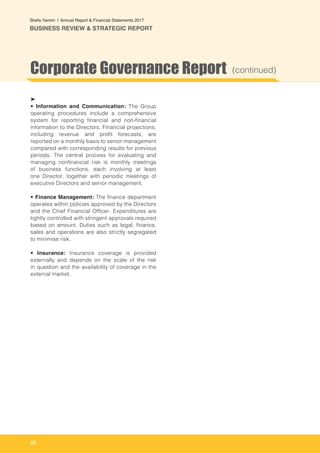
➤
• Information and Communication: The Group
operating procedures include a comprehensive
system for reporting financial and non-financial
information to the Directors. Financial projections,
including revenue and profit forecasts, are
reported on a monthly basis to senior management
compared with corresponding results for previous
periods. The central process for evaluating and
managing nonfinancial risk is monthly meetings
of business functions, each involving at least
one Director, together with periodic meetings of
executive Directors and senior management.
• Finance Management: The finance department
operates within policies approved by the Directors
and the Chief Financial Officer. Expenditures are
tightly controlled with stringent approvals required
based on amount. Duties such as legal, finance,
sales and operations are also strictly segregated
to minimise risk.
• Insurance: Insurance coverage is provided
externally and depends on the scale of the risk
in question and the availability of coverage in the
external market.
Corporate Governance Report (continued)
23
Shefa Yamim  |  Annual Report & Financial Statements 2017
BUSINESS REVIEW & STRATEGIC REPORT
Introduction
This report sets out Shefa Yamim’s executive remuneration policy and details Directors’ remuneration
and benefits for the financial year under review. The recent amendments to the UK Companies Act 2016
in relation to the preparation and approval of Directors remuneration policies and reports for certain
listed companies do not apply to Shefa Yamim as it is not incorporated in England. The remuneration
policy and report referred to below are not necessarily intended to comply with the provisions of such
laws, although the Board considers that the Company’s current remuneration policy would comply with
the Governance Code and have taken into account the requirement that the Company’s remuneration
policies (including any performance-related elements of executive remuneration) must be designed to
promote the long-term success of the Company.
In accordance with Israeli Companies Law, the Board recommends and the General Meeting of the
Company is asked to approve the remuneration policy of the Company for executives in the Company,
after it has been first approved by the Company’s Remuneration Committee and Board of Directors.
The Reporting Regulations (International Auditing Reporting Standards) also require the auditors to
report to the Company’s members in the financial statement within this report and to state whether in
their opinion that part of the report has been properly prepared. The report is therefore divided into
separate sections for audited and unaudited information. No remuneration consultants were engaged by
the Company in 2017.
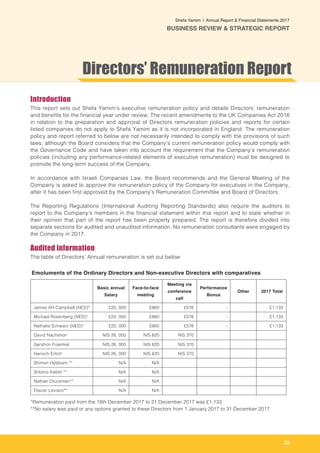
Audited information
The table of Directors’ Annual remuneration is set out below:
Basic annual
Salary
Face-to-face
meeting
Meeting via
conference
call
Performance
Bonus
Other 2017 Total
James AH Campbell (NED)* £20, 000 £860 £576 - £1,133
Michael Rosenberg (NED)* £20, 000 £860 £576 - £1,133
Nathalie Schwarz (NED)* £20, 000 £860 £576 - £1,133
David Nachshon 	 NIS 26, 000 NIS 620 NIS 370
Gershon Fraenkel NIS 26, 000 NIS 620 NIS 370
Hanoch Erlich 	 NIS 26, 000 NIS 620 NIS 370
Shimon Hybloom ** N/A N/A
Shlomo Kalish ** N/A N/A
Nathan Druckman** N/A N/A
Eliezer Levison** N/A N/A
*Remuneration paid from the 18th December 2017 to 31 December 2017 was £1,133
**No salary was paid or any options granted to these Directors from 1 January 2017 to 31 December 2017
Emoluments of the Ordinary Directors and Non-executive Directors with comparatives
Directors’ Remuneration Report
24
Shefa Yamim  |  Annual Report & Financial Statements 2017
BUSINESS REVIEW & STRATEGIC REPORT
Directors’ Remuneration Report (continued)
➤ For efficiency and cost savings, the Company is
managed at two sites:
Firstly, in the Company's operational site and
laboratories in the industrial zone of Akko, where
all exploratory activities take place, including the
entire operational and field activities inclusive
of; research, explorations, field investigations,
classification, geologists, gemologists and
geological reports on the exploration activity.
Secondly, the Company outsources all its
administrative functions to the management
company 101 Gold Holdings Ltd (“101”).101
provides the Company with its offices facilities in
Netanya including services of CEO & Chairman
(Mr. Avi Taub).
In addition to the administrative support supplied
by 101, it also provides professional secretarial
support and ongoing maintenance with supervision
and control on the Finance, Administration,
Legal, Regulation, Marketing, Investor relations,
Insurance, Payroll, Manpower etc.
For all services 101 is providing to the Company,
101 receives a monthly payment of NIS 85,000
plus VAT (out of that amount 101 is paying Mr.
Taub salary).
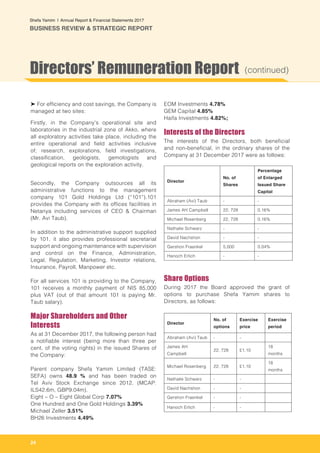
Major Shareholders and Other
Interests
As at 31 December 2017, the following person had
a notifiable interest (being more than three per
cent. of the voting rights) in the issued Shares of
the Company:
Parent company Shefa Yamim Limited (TASE:
SEFA) owns 48.9 % and has been traded on
Tel Aviv Stock Exchange since 2012. (MCAP:
ILS42.6m, GBP9.04m).
Eight – O – Eight Global Corp 7.07%
One Hundred and One Gold Holdings 3.39%
Michael Zeller 3.51%
BH26 Investments 4.49%
EOM Investments 4.78%
GEM Capital 4.85%
Haifa Investments 4.82%;
Interests of the Directors
The interests of the Directors, both beneficial
and non-beneficial, in the ordinary shares of the
Company at 31 December 2017 were as follows:
Director
No. of
Shares
Percentage
of Enlarged
Issued Share
Capital
Abraham (Avi) Taub - -
James AH Campbell 22, 728 0.16%
Michael Rosenberg 22, 728 0.16%
Nathalie Schwarz - -
David Nachshon - -
Gershon Fraenkel 5,000 0.04%
Hanoch Erlich 	 - -
Share Options
During 2017 the Board approved the grant of
options to purchase Shefa Yamim shares to
Directors, as follows:
Director
No. of
options
Exercise
price	
Exercise
period
Abraham (Avi) Taub - -
James AH
Campbell
22, 728 £1.10
18
months
Michael Rosenberg 22, 728 £1.10
18
months
Nathalie Schwarz - -
David Nachshon - -
Gershon Fraenkel - -
Hanoch Erlich 	 - -
25
Shefa Yamim  |  Annual Report & Financial Statements 2017
BUSINESS REVIEW & STRATEGIC REPORT
Subject to specified exceptions, Israeli law gene-
rally requires severance pay upon the retirement,
death or dismissal of an employee, and requires
the Company and its employees to make payments
to the National Insurance Institute. Our employees
have defined benefit pension plans that comply
with the applicable Israeli legal requirements.
The Company’s obligation to make pension
payments is covered by regular deposits with
defined contribution plans. The amounts deposited
are not reflected in the statements of financial
position in the Company’s working capital.
CORPORATE, SOCIAL AND
ENVIRONMENTAL RESPONSIBILITY
Preserving Nature and the Environment
Shefa Yamim protects nature and the environment
in which it operates. The Company fully cooperates
with all environmental authorities, including the
Israel Nature and Parks Authority, the Kishon
River Authority and the Kishon River Drainage
Authority. Landowners are also engaged prior to
any exploration activity in their fields, promoting
binding relationships.
Shefa Yamim recognises that its operations, more
particularly sample excavation and drilling, can
have a damaging impact on the environment.
Consequently, the Company is committed to
minimising environmental harm and rehabilitating
disturbed sites to their original form.
In addition, Shefa Yamim is mindful of the country’s
scarce water resources and thus utilises advanced
technology to recycle water that is needed for
sample treatment. No chemicals and pollutants
are used throughout the entire treatment process.
All reject materials, such as clay and coarse gravel
from the treatment process, are trucked to the
original site from which they were removed. These
are used to restore disturbed sites.
The Company’s environmental responsibility also
extends to daily work activities where paper
recycling, electricity and water saving, and
transport sharing are practised.
Human Capital
The core of Shefa Yamim’s human resources is
local personnel that have diverse expertise and
educational backgrounds. In addition to this,
Shefa Yamim hires the services of world leading
professionals that are experts in the fields of
mineral exploration and precious minerals.
Besides providing technical input and guidance,
they ensure that programmes are designed and
implemented according to international standards
dictated by the SAMREC Code. This also facilitates
regular auditing of Shefa Yamim’s results.
Training of personnel is an important part of
Shefa Yamim’s human resource development. All
employees undergo internal and external training
provided by professional consultants.
The training extends to all operational areas
including fieldwork, sample processing and
laboratory work (microscopy and mineral
identification). Consequently, skills continue to be
improved in concert with the latest technological
and scientific trends.
27
Shefa Yamim  |  Annual Report & Financial Statements 2017
BUSINESS REVIEW & STRATEGIC REPORT
Introduction
This report sets out Shefa Yamim’s executive
remuneration policy and details Directors’
remuneration and benefits for the financial year
under review. The recent amendments to the UK
Companies Act 2016 in relation to the preparation
and approval of Directors remuneration policies
and reports for certain listed companies do not
apply to Shefa Yamim as it is not incorporated
in England. The remuneration policy and report
referred to below are not necessarily intended to
comply with the provisions of such laws, although
the Board considers that the Company’s current
remuneration policy would comply with the
Governance Code and have taken into account
the requirement that the Company’s remuneration
policies (including any performance-related
elements of executive remuneration) must be
designed to promote the long-term success of the
Company.
[In accordance with Israeli Companies Law, the
Board recommends and the General Meeting of
the Company is asked to approve the remuneration
policy of the Company for executives in the
Company, after it has been first approved by the
Company’s Remuneration Committee and Board of
Directors.]
The Reporting Regulations (International Auditing
Reporting Standards) also require the auditors to
report to the Company’s members in the financial
statement within this report and to state whether
in their opinion that part of the report has been
properly prepared. The report is therefore divided
into separate sections for audited and unaudited
information. No remuneration consultants were
engaged by the Company in 2017.
Audited information
The table of Directors’ Annual remuneration is set
out below:
For efficiency and cost savings, the Company is
managed at two sites:
Firstly, in the Company's operational site and
Shefa Yamim (A.T.M.)
Consolidated Financial Statements
for the year ended 31 December 2017
28
Shefa Yamim  |  Annual Report & Financial Statements 2017
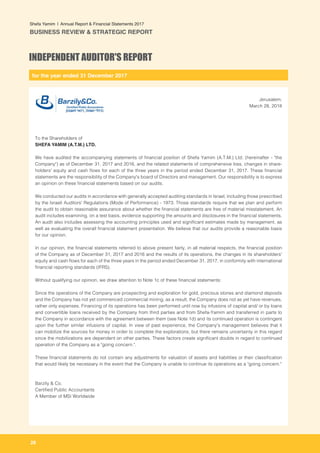
BUSINESS REVIEW & STRATEGIC REPORT
Jerusalem,
March 28, 2018
To the Shareholders of
SHEFA YAMIM (A.T.M.) LTD.
We have audited the accompanying statements of financial position of Shefa Yamim (A.T.M.) Ltd. (hereinafter - "the
Company") as of December 31, 2017 and 2016, and the related statements of comprehensive loss, changes in share-
holders' equity and cash flows for each of the three years in the period ended December 31, 2017. These financial
statements are the responsibility of the Company's board of Directors and management. Our responsibility is to express
an opinion on these financial statements based on our audits.
We conducted our audits in accordance with generally accepted auditing standards in Israel, including those prescribed
by the Israeli Auditors' Regulations (Mode of Performance) - 1973. Those standards require that we plan and perform
the audit to obtain reasonable assurance about whether the financial statements are free of material misstatement. An
audit includes examining, on a test basis, evidence supporting the amounts and disclosures in the financial statements.
An audit also includes assessing the accounting principles used and significant estimates made by management, as
well as evaluating the overall financial statement presentation. We believe that our audits provide a reasonable basis
for our opinion.
	
In our opinion, the financial statements referred to above present fairly, in all material respects, the financial position
of the Company as of December 31, 2017 and 2016 and the results of its operations, the changes in its shareholders'
equity and cash flows for each of the three years in the period ended December 31, 2017, in conformity with international
financial reporting standards (IFRS).
Without qualifying our opinion, we draw attention to Note 1c of these financial statements:
Since the operations of the Company are prospecting and exploration for gold, precious stones and diamond deposits
and the Company has not yet commenced commercial mining, as a result, the Company does not as yet have revenues,
rather only expenses. Financing of its operations has been performed until now by infusions of capital and/ or by loans
and convertible loans received by the Company from third parties and from Shefa-Yamim and transferred in parts to
the Company in accordance with the agreement between them (see Note 1d) and its continued operation is contingent
upon the further similar infusions of capital. In view of past experience, the Company's management believes that it
can mobilize the sources for money in order to complete the explorations, but there remains uncertainty in this regard
since the mobilizations are dependent on other parties. These factors create significant doubts in regard to continued
operation of the Company as a "going concern.".
These financial statements do not contain any adjustments for valuation of assets and liabilities or their classification
that would likely be necessary in the event that the Company is unable to continue its operations as a "going concern."
Barzily & Co.
Certified Public Accountants
A Member of MSI Worldwide
INDEPENDENT AUDITOR'S REPORT
-
NIS in thousands_
Shefa Yamim  |  Annual Report & Financial Statements 2017
BUSINESS REVIEW & STRATEGIC REPORT
29
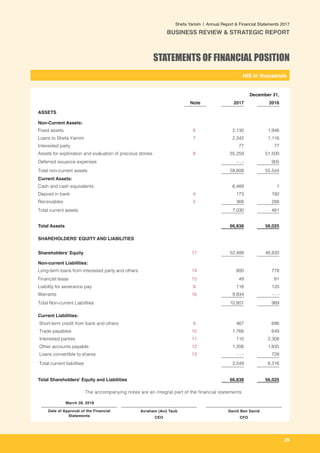
December 31,
Note 2017 2016
ASSETS
Non-Current Assets:
Fixed assets 6 2,130 1,946
Loans to Shefa-Yamim 7 2,342 1,116
Interested party 77 77
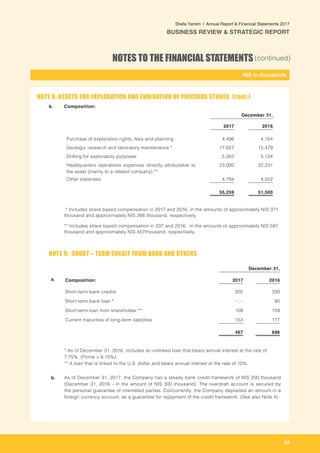
Assets for exploration and evaluation of precious stones 8 55,259 51,500
Deferred issuance expenses - . - 905
Total non-current assets 59,808 55,544
Current Assets:
Cash and cash equivalents 6,489 1
Deposit in bank 4 173 192
Receivables 5 368 288
Total current assets 7,030 481
Total Assets 66,838 56,025
SHAREHOLDERS’ EQUITY AND LIABILITIES
Shareholders’ Equity 17 52,488 48,820
Non-current Liabilities:
Long-term loans from interested party and others 14 800 778
Financiel lease 15 49 91
Liability for severance pay 3i 118 120
Warrants 16 9,834 - . -
Total Non-current Liabilities 10,801 989
Current Liabilities:
Short-term credit from bank and others 9 467 696
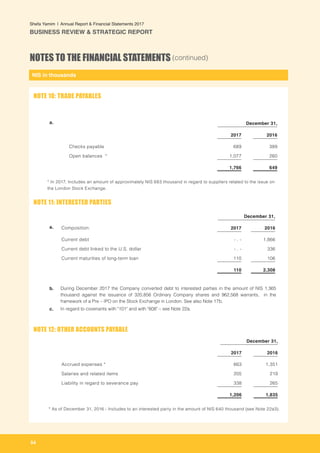
Trade payables 10 1,766 649
Interested parties 11 110 2,308
Other accounts payable 12 1,206 1,835
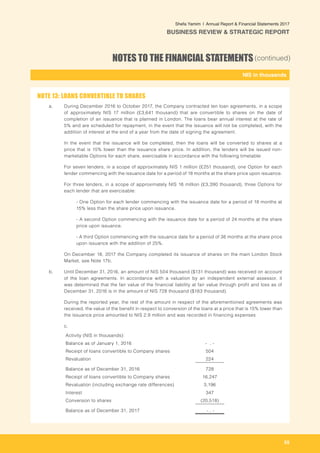
Loans convertible to shares 13 - . - 728
Total current liabilities 3,549 6,216
Total Shareholders' Equity and Liabilities 66,838 56,025
STATEMENTS OF FINANCIAL POSITION
The accompanying notes are an integral part of the financial statements.
March 28, 2018
Date of Approval of the Financial
Statements
Avraham (Avi) Taub
CEO
David Ben David
CFO
NIS in thousands (except for per share loss)
Shefa Yamim  |  Annual Report & Financial Statements 2017
BUSINESS REVIEW & STRATEGIC REPORT
30
For the Year Ended December 31,
Note 2017 2016 2015
Costs and expenses
General and administrative expenses 18 (541) (914) (1,028)
Capital gain - . - 178 37
Operating loss (541) (736) (991)
Financial expenses (15,954) (383) (153)
Financial income 237 570 834
Financial income (expenses), net 19 (15,717) 187 681
Loss for the year and comprehensive loss attributed
to the Company shareholders
(16,258) (549) (310)
Basic and diluted loss per share (in NIS) attributed to
the Company shareholders
23 (1.703) (0.058) (0.033)
STATEMENTS OF COMPREHENSIVE LOSS
The accompanying notes are an integral part of the financial statements.
-
NIS in thousands_
Shefa Yamim  |  Annual Report & Financial Statements 2017
BUSINESS REVIEW & STRATEGIC REPORT
31
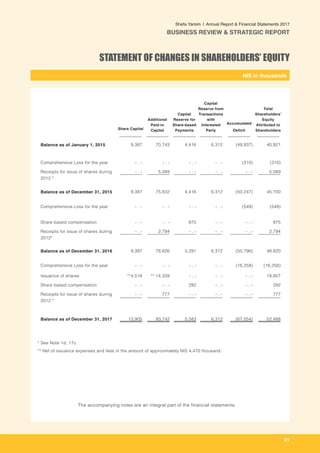
Share Capital
Additional
Paid-in
Capital
Capital
Reserve for
Share-based
Payments
Capital
Reserve from
Transactions
with
Interested
Party
Accumulated
Deficit
Total
Shareholders’
Equity
Attributed to
Shareholders
Balance as of January 1, 2015 9,387 70,743 4,416 6,312 (49,937) 40,921
Comprehensive Loss for the year - . - - . - - . - - . - (310) (310)
Receipts for issue of shares during
2012 *
- . - 5,089 - . - - . - - . - 5,089
Balance as of December 31, 2015 9,387 75,832 4,416 6,312 (50,247) 45,700
Comprehensive Loss for the year - . - - . - - . - - . - (549) (549)
Share based compensation - . - - . - 875 - . - - . - 875
Receipts for issue of shares during
2012*
- . - 2,794 - . - - . - - . - 2,794
Balance as of December 31, 2016 9,387 78,626 5,291 6,312 (50,796) 48,820
Comprehensive Loss for the year - . - - . - - . - - . - (16,258) (16,258)
Issuance of shares **4,518 ** 14,339 - . - - . - - . - 18,857
Share based compensation - . - - . - 292 - . - - . - 292
Receipts for issue of shares during
2012 *
- . - 777 - . - - . - - . - 777
Balance as of December 31, 2017 13,905 93,742 5,583 6,312 (67,054) 52,488
* See Note 1d, 17c.
** Net of issuance expenses and fees in the amount of approximately NIS 4,470 thousand.
STATEMENT OF CHANGES IN SHAREHOLDERS’ EQUITY
The accompanying notes are an integral part of the financial statements.
NIS in thousands
Shefa Yamim  |  Annual Report & Financial Statements 2017
BUSINESS REVIEW & STRATEGIC REPORT
32
2017 2016 2015
Cash flows from operating activities:
Loss for the year (16,258) (549) (310)
Appendix A - Adjustments required to reconcile loss for the year to
net cash provided by (used in) operating activities
17,114 (151) (503)
Net cash provided by (used in) operating activities 856 (700) (813)
Cash flows from investing activities:
Purchase of fixed assets (531) (305) (1,346)
Consideration from sale of fixed assets - . -
180
91
Investment in exploration and evaluation assets (4,375) (2,638) (3,233)
Loan rendered to Shefa Yamim
(1,177)
- . - - . -
Interest received 188 530 794
Net cash used in investing activities (5,895) (2,233) (3,694)
Cash flows from financing activities:
Consideration received for issuance of share capital (including
additional capital)
137 2,794 4,680
Increase in deferred issuance expenses (4,707) (239) (56)
Receipt (Repayment) of credits from banks and others, net
(205) 168
(51)
Repayment of loans from interested parties, net 446 (101) (95)
Receipt of loans convertible to shares 16,611 504 - . -
Receipt of long-term loans - . - - . - 200
Repayment of long-term loans (40) (46) (70)
Interest paid (458) (157) (101)
Net cash provided by financing activities 11,784 2,923 4,507
Linkage differences in regard to cash and cash equivalents (257) 10 - . -
Increase in cash and cash equivalents 6,488 - . - - . -
Cash and cash equivalents at the beginning of the year 1 1 1
Cash and cash equivalents at the end of the year 6,489 1 1
STATEMENTS OF CASH FLOWS
The accompanying notes are an integral part of the financial statements.
For the Year Ended December 31,
-
NIS in thousands_
Shefa Yamim  |  Annual Report & Financial Statements 2017
BUSINESS REVIEW & STRATEGIC REPORT
33
APPENDIX A 2017 2016 2015
Adjustments necessary to show the cash flows from current operations:
Expenses (Income) not involving cash flows: 60 72 88
Depreciation * - . - (178) (37)
Capital gain 46 152 - . -
Share based compensation 15,717 (187) (681)
Finance expenses (income), net 15,823 (141) (630)
Changes in asset and liability items:
Increase in receivables (64) (174) (60)
Increase (Decrease) in trade payables 1,403 (95) 116
Increase in liability to an interested party - . - 297 16
Increase (Decrease) in other accounts payable (48) (38) 55
1,291 (10) 127
17,114 (151) (503)
* Net of depreciation encumbered on the research and evaluation assets for precious stones.
APPENDIX B
Significant non-cash flow operations: 2017 2016 2015
Accounts payable in regard to exploration and evaluation assets for
precious stones
1,550 1,024 949
Loan for acquisition of fixed assets 240 - . - 266
Loans assigned to capital 20,518 - . - 409
Loan assigned to an interested party 1,659 - . - 71
Balance from a supplier assigned to capital 1,152 - . - 50
Payables in regard to deferred issuance expenses 742 610 - . -
Assignment of the receivable balance from the chairman of the board
of Directors to Shefa -Yamim
640 - . - - . -
STATEMENTS OF CASH FLOWS
The accompanying notes are an integral part of the financial statements.
For the Year Ended December 31,
NIS in thousands
Shefa Yamim  |  Annual Report & Financial Statements 2017
BUSINESS REVIEW & STRATEGIC REPORT
34
a. 	 The reported entity-
Shefa Yamim (A.T.M.) Ltd. (hereinafter – “the Company”) is an Israeli Company.The Company is held
by Shefa Yamim Ltd. (hereinafter – "the top-co"). Until December 2017 the Company was held 75% by
the top-co. As a result of the Company issuing shares on the London Stock Exchange on December
18, 2017, (see Note 17b) the top-co holdings were reduced. The top-co is a public company whose
securities are registered for trade on the Tel Aviv Stock Exchange.
b. 	 The Company engages in prospecting and exploration for diamonds, precious stones and gold
("precious stones") along the length of the Nahal Kishon riverbed in the Zevulun Valley, in Emek Yizrael,
on designated slopes of Mount Carmel and in the Ramot Menashe and Migdal Haemek areas based on
prospecting and exploration permits received from the Superintendent of Mining in the Office of National
Infrastructure of the Government of Israel, in accordance with the Mines Ordinance. 	
	 Proximate to date of approval of the financial statements, the Company continues to conduct prospecting
and explorations in accordance with current valid permits granted for an inclusive area of approximately
614 thousand dunam.
	 The Company has exclusive Prospecting Permit No. 869-B7 that is valid until June 5, 2018 and covers
an inclusive area of 173,888 dunam. Concurrently, the Company has two additional Exploration Permits:
Exploration Permit No. 837-A10, for an inclusive area of 327,551 dunam, that is valid until December 20,
2017, and Exploration Permit No. 899-A5, for an inclusive area of approximately 112,904 dunam, that
is also valid until December 20, 2017. The Company is actively engaged in extending the validity of the
Exploration Permits.
The Company's goal is finding precious stones in the existing permitted areas and/or future areas in
sufficient quantities to obtain exclusive mining rights and/or a mining contract. In the event of positive
exploration and prospecting results, the Company will receive a "Discovery Certificate" and will be
eligible to receive an exclusive mining license from the Government of Israel regarding diamonds, gold
and precious stones.
In accordance with the Mining Ordinance, subsequent to exposure of the mine and quarry of precious
minerals, the Company will be required to pay royalties to the Israeli Government at the rate of at least
5% of the value of the mined minerals or their value while still unmined.
c. 	 Since the operations of the Company are prospecting and exploration for gold, precious stones and
diamond deposits and the Company has not yet commenced commercial mining, as a result, the
Company does not as yet have revenues, rather only expenses. Financing of its operations has been
performed until now by infusions of capital and/ or by loans and convertible loans received by the
Company from third parties and from the Shefa Yamim and transferred in parts to the Company in
accordance with the agreement between them (see Note 1d) and its continued operation is contingent
upon the further similar infusions of capital. In view of past experience, the Company's management
believes that it can mobilize the sources for money in order to complete the explorations, but there
remains uncertainty in this regard since the mobilizations are dependent on other parties. These factors
create significant doubts in regard to continued operation of the Company as a "going concern."
	 These financial statements do not contain any adjustments for valuation of assets and liabilities or their
classification that would likely be necessary in the event that the Company is unable to continue its
operations as a "going concern."
NOTES TO THE FINANCIAL STATEMENTS
NOTE 1: GENERAL
1.
-
NIS in thousands_
Shefa Yamim  |  Annual Report & Financial Statements 2017
BUSINESS REVIEW & STRATEGIC REPORT
35
d.	 On February 22, 2012 the Tel Aviv-Yafo District Court approved the top-co request for a creditors
arrangement in accordance with Sections 350 and 303 of the Corporate Ordinance – 1999.
In the framework of the creditors arrangement, the top-co allocated 23,817,790,260 new shares
without par value that constitute, subsequent to their allocation, 99% of the issued and outstanding
top-co fully diluted share capital. 9% of this allocation was allocated to Pareto Mergers and
Acquisitions Ltd. (hereinafter: "Pareto") and 90% (fully diluted) was allocated to shareholders of the
Company.
As consideration for the allocation of new shares, shareholders of the Company and Pareto invested
an amount of NIS 1,250 thousand in the top-co (NIS 1,125 thousand from the Company's shareholders
and NIS 125 thousand from Pareto).
These amounts were transferred to the trustee's fund wherein all assets and liabilities of the top-co
company have been assigned in the framework of the creditors arrangement.
On April 4, 2012, in accordance with allocation of the shares to Pareto and to the Company
shareholders as abovementioned, the Company allocated 7,040,700 ordinary shares to the top-co
company so that upon completion of the transaction, the top-co held shares that constitute 75% of
the Company's issued and outstanding share capital subsequent to the allocation (fully diluted).
The Company is entitled to payment of NIS 280 million for this shares allocation (hereinafter: "the
debt"). Amount of the debt is linked to the Consumer Price Index and bears interest of 4% per annum.
The debt will be paid exclusively from future top-co mobilizations of capital, with the Company
entitled to 85% of any future mobilized capital (net after expenses) until repayment of the entire debt.
Until December 31, 2017, the Company received NIS 23,912 thousand (including NIS 2,637 thousand
in interest) from mobilizations of capital. See Note 17.
In the event that future mobilizations of capital will not complete repayment of the debt, this does not
constitute grounds for nullification of the agreement or a change in its terms and the Company will
have no recourse to collect from the top-co in any other manner.
In view of the uncertainties in regard to the future mobilizations of capital of the top-co, the Company
recorded the proceeds from the abovementioned issue in accordance with actual mobilizations of
the top-co.
e. 	 On December 18, 2017 the Company completed its IPO on the Stock Market in London. In this
framework, the Company registered for trade 4,517,456 Ordinary shares in consideration of
approximately NIS 18 Million that were transferred mainly through convertible loans.
f. 	 Definitions-
		 In these financial statements:
		 International Financial Reporting Standards (IFRS) – Standards and interpretations adopted by the
International Accounting Standards Board (IASB) that include international financial reporting
standards (IFRS)
NOTE 1: GENERAL (cont.)
NOTES TO THE FINANCIAL STATEMENTS
NIS in thousands
36
Shefa Yamim  |  Annual Report & Financial Statements 2017
BUSINESS REVIEW & STRATEGIC REPORT
NOTES TO THE FINANCIAL STATEMENTS (continued)
f. 	 Definitions- (cont.)
	 and international accounting standards (IAS), and interpretations of these standards as determined by
the International Financial Reporting Interpretations Committee (IFRIC) or interpretations determined by
the Standards Interpretation Committee (SIC), respectively.
	 "The Company" – Shefa Yamim (A.T.M.) Ltd.
"top-co Company" – Shefa Yamim Ltd.
"Related Party" – As defined in IAS 24 and by the International Accounting Standards Board (IASB).
"Interested Party" – as defined in the Securities Act – 1968, and its Amendments.
"101" – One Hundred One – Gold Holdings Ltd. – An interested party (hereinafter: "101").
"808" – Eight O Eight Global Corp. – An interested party (hereinafter: "808").
"Index" – The Consumer Price Index published by the Central Bureau of Statistics.
"Dollar" or $ - The U.S. dollar.
a. 	 Declaration in regard to Implementation of International Financial Reporting Standards (IFRS)
	 The Company's financial statements were prepared in accordance with International Financial Reporting
Standards (hereinafter – "IFRS") and related clarifications published by the International Accounting
Standards Board ("IASB").
	 The significant accounting principles detailed below were consistently implemented for all reporting
periods presented in these financial statements except for changes in the accounting policies that derive
from application of standards, amendments to standards and clarifications that became effective at the
date of the financial statements.
	 The financial statements were approved by the board of Directors on March 28, 2018.
b. 	 Functional Currency and Presentation Currency
	 The financial statements are presented in New Israel Shekels (NIS), that is the functional currency of the
Company, and are rounded to the nearest thousand. The Shekel is the currency of the main economic
environment wherein the Company operates.
c. 	 Basis for preparation of financial statements
These financial statements are prepared on the basis of historical cost. The statement of comprehensive
loss was included according to characteristics of operations.
Value of non-cash assets and detail of share capital measured on the basis of historical cost, were
adjusted to changes in the Consumer Price Index until December 31, 2003, since until that date the
Israeli economy was considered to be hyper-inflationary.
d.	 The operating turnover cycle
The ordinary operating turnover cycle for the Company is one year. The assets and liabilities attributed
to this operation and that are intended to be realized during the operating period are shown in the
framework of current assets and current liabilities.
NOTE 1: GENERAL (cont.)
NOTE 2: BASIS FOR PREPARATION OF THE FINANCIAL STATEMENTS
37
-
NIS in thousands_
Shefa Yamim  |  Annual Report & Financial Statements 2017
BUSINESS REVIEW & STRATEGIC REPORT
NOTES TO THE FINANCIAL STATEMENTS(continued)
e. 	 Foreign currency and linkage basis
	 Balances stated in foreign currency are translated into the functional currency of the Company at dates
of transactions, using the representative exchange rate. Financial assets and liabilities designated in
foreign currency at reported date have been included in the financial statements according to the prevailing
representative exchange rates as published by the Bank of Israel at the balance sheet date. Non-monetary
items designated in foreign currency and measured at fair value are translated into the functional currency
at the exchange rate prevailing when the fair value was determined. Non-monetary items measured at cost
are translated into the effective exchange rate at transaction date for the non-monetary item.
	 Detail in regard to the Consumer Price Index and the exchange rate of the U.S. dollar:
December 31,
2017 2016 2015
CPI in points (applicable) * 123.33 122.84 123.08
CPI in points (known) * 123.21 122.84 123.21
Exchange Rate of U.S. $ in NIS 3.467 3.845 3.902
Exchange Rate of British £ in NIS 4.682 4.725 5.784
* Base Index 2002 = 100.
December 31,
2017 2016 2015
CPI in CPI (applicable) * 0.40% (0.20%) (1.00%)
CPI in CPI (known) * 0.30% (0.30%) (0.90%)
Change in rate of exchange - U.S. $ in NIS (9.83%) (1.46%) 0.33%
Change in rate of exchange - £ in NIS (0.91%) (18.31%) (4.62%)
f. 	 Critical accounting decisions
	 Implementation of accounting policies adopted by the Company requires Company management, in certain
instances, to implement broad accounting decisions (as opposed to accounting decisions that related to
determination of estimates and valuations as detailed in Section g. below). These broad decisions relate
mainly to adoption of the accounting principle most suitable to the circumstances, or rendering of an
acceptable interpretation under circumstances where the accounting regulation does not render a full or
clear response for the specific circumstances. A critical accounting decision is such that the results may
have a significant effect on the financial situation and results of operations of the Company as reflected in
the financial statements and with other basic assumptions could lead to an accounting result significantly
different than the one presented therein. By its nature, an accounting decision as such is partially subjective.
Concurrently, by implementing a critical accounting decision, Company management bases its conclusion
on understanding of the accounting principles for implementation of its operations and, where relevant, the
Company consults with external experts in the relevant field.
NOTE 2: BASIS FOR PREPARATION OF THE FINANCIAL STATEMENTS (cont.)
NIS in thousands
38
Shefa Yamim  |  Annual Report & Financial Statements 2017
BUSINESS REVIEW & STRATEGIC REPORT
NOTES TO THE FINANCIAL STATEMENTS (continued)
g. 	 Essential estimates and uncertainties
	 Upon preparation of the financial statements, Company management is required to utilize estimates
or valuations in regard to transactions or matters that their final effect on the financial statements
cannot be accurately determined at the time. The main basis for determination of the quantitative
value of these estimates is assumptions adopted by Company management, taking into account the
circumstances for the estimate, as well as the best of knowledge available at the time. It is natural,
since these estimates and valuations are a result of decisions during uncertainty, that during significant
moments, changes in the basic assumptions derived from changes that are not absolutely dependent
on Company management, as well as additional information at a future date that was unavailable to
the Company management at the time when the estimate was formulated, will result in changes in the
quantitative value of the estimate. Thus, this will also influence the financial position of the Company
and the results of its operations.
	 Therefore, though these estimates and valuations were concluded using the best of knowledge available
to management, based on past experience and taking into account the singular circumstances,
and, where relevant, reliance on external consultants, the final quantitative effect of transactions or
circumstances requiring estimate can only be clarified when these transactions or circumstances reach
their conclusions. Therefore, the actual results, upon final clarification of the results for an event that
requires determination of estimates and valuations, may differ, sometimes significantly, from estimates
and valuations that were determined initially and are updated over the period of the related events.
	 Following are areas where the valuation for the financial statements requires estimation and valuation
that, in the opinion of management, will have a very significant effect:
	 1) valuation of prospecting assets;
2) valuation of financial instruments;
3) fair value of Options.
a. 	 Cash and Cash Equivalents
	 Cash and cash equivalents include highly liquid investments that are immediately realizable. This
includes short-term bank deposits for immediate withdrawal and deposits with maturities of three
months or less that are not limited in any way and no charges are placed thereon.
	 Deposits that are limited or that their maturity dates are in excess of three months but not in excess of
one year are classified as deposits in the current assets section of the statements of financial position.
b. 	 Fixed assets
	 Fixed assets are stated at cost net of accumulated depreciation and any losses in value that may have
occurred.
	 The cost includes acquisition cost of the fixed assets as well as all costs that can be attributed directly
to bringing the asset to its place and to its current situation that are necessary for operations, using the
methodology intended by management.
	 Vehicles purchased under financial lease agreements are presented at cost computed by estimated
capitalization of the leasing costs in accordance with the leasing agreement.
NOTE 2: BASIS FOR PREPARATION OF THE FINANCIAL STATEMENTS (cont.)
NOTE 3: SIGNIFICANT ACCOUNTING POLICIES
39
-
NIS in thousands_
Shefa Yamim  |  Annual Report & Financial Statements 2017
BUSINESS REVIEW & STRATEGIC REPORT
NOTES TO THE FINANCIAL STATEMENTS(continued)
Depreciation included in the statement of operations is calculated using the straight-line method over
the estimated useful lives of the assets, at the following annual rates:
%
Office furniture and equipment 6-15
Laboratory machinery and equipment 10-15
Leasehold improvements – Establishment of a
Laboratory 10
Vehicles 15
Computers 33
Depreciation expense for vehicles and laboratory equipment used during explorations are charged
to cost of assets for exploration and valuation of precious stones. Profit or loss arising from sale or
decrement of a fixed asset item is determined as the difference between receipts from its sale and its
book value at decrement date, and is included in operations.
c. 	 Assets for prospecting and evaluation of precious stones
		 1.The Company has adopted the "Successful Efforts Method" in regard to the accounting treatment of
expenses incurred in exploration, mining and extraction of precious stones. In accordance with this
Method:	
		 a) Expenses for participation in geologic tests and scans that occur prior to the exploration and valuation
stage and prior to receiving a permit are charged immediately to the statements of comprehensive
loss when incurred.			
b) Investments in explorations for precious stones during the exploration and valuation stages,
relating to areas that it is as yet unproven whether they will indeed yield precious stones or are
unprofitable are shown in the statements of financial position at cost, as exploration and valuation
assets that are stated as tangible or intangible assets in accordance with the essence of the asset.
These investments include, inter alia, costs incurred for performance of geological research, drilling
costs, operations relating to evaluation of technical ability for commercial existence of resources
to be yielded as well as general and administrative costs of a headquarters (mainly to a related
company) related to direct costs for mining and extraction assets.
c) Investments in prospecting for precious stones that have an existing technical plan and the resource
has a commercial existence will be restated and included as "investments in precious stones." Prior
to their restatement, these items will be examined for decrease in value. In the event that a loss
has been created, this will be recognized and included in the statements of comprehensive loss.
Investments in precious stones are amortized in the statements of comprehensive loss on the basis
of amounts extracted in relation to total reserves for the precious stones asset, as valuated by an
external assessor with expertise in this area.
d)	Prospecting and evaluation assets will be examined for decrease in value when events and
occurrences would lead one to believe that their book value exceeds their attributed realization value.
NOTE 3: SIGNIFICANT ACCOUNTING POLICIES (cont.)
NIS in thousands
40
Shefa Yamim  |  Annual Report & Financial Statements 2017
BUSINESS REVIEW & STRATEGIC REPORT
NOTES TO THE FINANCIAL STATEMENTS (continued)
c. 	 Assets for prospecting and evaluation of precious stones (cont.)
Such events and occurrences include, inter alia: expiration of exploration rights in a specified area or
predictions that these rights will expire in the near future and renewal is not foreseen; prospecting for
precious stones in a specific area have not resulted in proven commercial quantities of reserves of
precious stones. In the event that there are signs of an impairment in value, as abovementioned, the
realization value is estimated for the asset in accordance with IAS 36 (see Section 3f).
	2. "Investments in Precious Stones" in the statements of financial information will include, also,
accumulated costs for development of infrastructures for the necessary bases in order to yield
resources. These costs are capitalized and can include headquarters costs that are directly
attributable to establishment of the assets and other direct overhead costs. They are shown in the
statements of financial information at cost and are amortized in the statements of comprehensive loss
on the basis of quantity yielded in proportion to total proven reserves as evaluated by an external
expert assessor, as stated in 1c abovementioned.
	3. Investments in precious stones that have an existing technical plan are examined at each reporting
period for any signs of a reduction in value. In the event that such signs exist, the realization value is
computed in accordance with IAS 36 (see Sect. 3f).
	4. The Group will recognize the liability and, correspondingly, the asset in regard to obligation of the
Company to disassemble, clear and rehabilitate the site where the asset was established. The liability
is initially measured at its present value and the expenses derived from its increase are depreciated
over a period of time in the statement of comprehensive loss. The asset is initially measured at its
present value and is depreciated over a period of time in the statement of comprehensive loss in
accordance with the useful life of the removed asset. Changes in timing and in the amount of the
economic resources that are necessary for the removal of the liability as well as the change in the
capitalization rate are added to or deducted from the asset during the current period corresponding
to a change in the liability.
	Changes in the obligation to disassemble and clear items and rehabilitation of the site where they
were established, except for changes deriving from timing, are added to or deducted from the asset
cost during the period when incurred. The amount deducted from the asset cost will not exceed
the book value of the asset and the balance, if any, is immediately recognized in the statements of
comprehensive loss.	
	The Company examines its projected obligations to rehabilitate and renew excavation sites and
includes a provision, when necessary, in accordance with the current value of projected costs.	
d. 	 Issue of a package of securities
	When securities are issued as a package, the consideration received is allotted (prior to issue
expenses) to securities issued as a package in conjunction with the following order of allocation:
financial derivatives and other financial items that are presented at fair value periodically.
Subsequently, the fair value of the financial liabilities is determined, with the allotted consideration for
capital instruments determined as the remaining value. Issue costs are allotted to each component in
accordance with the ratio of amounts determined for each component of the package.
NOTE 3: SIGNIFICANT ACCOUNTING POLICIES (cont.)
41
-
NIS in thousands_
Shefa Yamim  |  Annual Report & Financial Statements 2017
BUSINESS REVIEW & STRATEGIC REPORT
NOTES TO THE FINANCIAL STATEMENTS(continued)
e. 	 	Impairment in value of assets
	 At the close of every reporting period, the Company examines the book value of its tangible assets to
determine any signs of loss from impairment in value of these assets. In the event that there are signs of
impairment, the Company examines the realization value of the designated asset in order to determine
the loss from impairment, if any.
	 The realization value is the higher of net fair value of the asset as compared with its useful life that is
determined by the present value of projected cash flows to be realized from this asset using a rate prior
to taxes that reflects the present book value of the time span for the money and the specific risks for the
asset that the estimated future cash flows were not adjusted for in this regard.
	 In the event that the book value of the asset or cash-yielding unit is greater than its realization value,
a devaluation of the asset has occurred in the amount of the difference between its book value and its
realization value. This amount is recognized immediately in the statements of comprehensive loss.
	 Prior devaluation of an asset is nullified, partially or completely, only when changes in the determinants
of realization value of the asset have occurred. In the event of such an occurrence, the book value of
the asset is increased to the estimated current fair value, but not in excess of the asset book value
that would have existed had there not been devaluation and subsequent to deduction of any relevant
depreciation. Such nullification is recognized immediately in the statements of comprehensive loss.
	
f. 	 Financial instruments
1. Non-derivative financial instruments
Non-derivative financial instruments comprise various accounts receivable and cash and cash
equivalents.
Non-derivative financial instruments are recognized initially on the trade date at which the Group
becomes a party to the contractual provisions allowing the Group to receive the financial instrument.
Investments in these instruments are initially presented at their fair value with the addition of
transaction costs.
The Company classifies its financial assets as loans and receivables. This classification is determined in
accordance with the purpose for holding the financial asset, when initial recognition of the financial asset
occurs.
2. Loss from impairment in value and write-off of non-derivative financial instruments
	 Financial instruments not classified at fair value through profit and loss are examined at each reporting
period as to whether there are signs of impairment in value. Impairment occurs when there is objective
evidence that as a result of a specific incident or occurrences, occurring subsequent to initial recognition
date of the financial asset, a negative effect exists on the projected cash flows for the investment in this
asset.
	 In regard to financial assets that are included at amortized cost (mainly loans and receivables), the amount
of impairment in value is the difference between the book value of the financial asset and the present
value of the estimated future cash flows projected to derive from the asset, discounted at the original
effective interest rate for the asset. This amount is charged to the statement of comprehensive loss.
NOTE 3: SIGNIFICANT ACCOUNTING POLICIES (cont.)
NIS in thousands
42
Shefa Yamim  |  Annual Report & Financial Statements 2017
BUSINESS REVIEW & STRATEGIC REPORT
NOTES TO THE FINANCIAL STATEMENTS (continued)
2. Loss from impairment in value and write-off of non-derivative financial instruments (cont.)
In the event that during a parallel period to that when a loss was recorded for impairment in value
for a financial asset included at amortized cost there are indications that the amount of the loss from
impairment in value is less and is objectively related to an event occurring subsequent to recognition
of the impairment, then the prior impairment loss will be written off, in part or completely, to profit and
loss. The amount written off is limited so that the book value of the investment in the financial asset
at the time of write-off of the loss from impairment in value does not exceed the amortized cost of the
asset at the cancellation date had there not been a prior recognition of impairment in value.
3. Non-derivative financial liabilities
The Company initially recognizes debt securities issued on the date that they originated. All other
financial liabilities (including financial liabilities designated at fair value through profit and loss) are
recognized initially on the trade date at which the Company becomes a party to the contractual
provisions of the instrument.
Financial liabilities are reduced when the obligation of the Company, as specified in the agreement,
expires or when it is discharged or written off.
Financial obligations are initially recognized in accordance with their fair value and transaction costs
that can be attributed. Subsequent measurement of financial liabilities is mainly on the basis of
amortized cost using the effective interest method.
The Company has the following non-derivative financial liabilities: loans and credit from banks and
others, and trade and other payables.
Financial assets and liabilities are offset and the net amounts are presented in the statement of
financial position when the Company currently has a legal enforceable right to offset the amounts
and intends either to settle on a net basis or to realize the asset and settle the liability simultaneously.
g. 	 Leases
	 The criteria for determining whether leases are financial or operating are based on the essence of the
agreements, examined at the time when contracted in accordance with the regulations determined in
IAS 17.
	 Leases that transfer all risks and benefits contained in ownership of the leased property are classified
as financial leases.
	 Other leases are classified as operating leases and leasing payments are recognized as an expense in
the statements of comprehensive loss and are prorated currently using the straight line method over the
lease period.
	 Financial lease payments are divided between financing expense and amortization of the remaining
liability.
NOTE 3: SIGNIFICANT ACCOUNTING POLICIES (cont.)
43
-
NIS in thousands_
Shefa Yamim  |  Annual Report & Financial Statements 2017
BUSINESS REVIEW & STRATEGIC REPORT
NOTES TO THE FINANCIAL STATEMENTS(continued)
h. 	 Provisions
Provisions are recognized when the Company has a current obligation (legal or derived) as a result
of a past occurrence that can be reliably measured, that will in all probability result in the Company
being required to provide additional benefits in order to settle this obligation. The amount recognized
as a provision reflects the best estimate by management of the amount that will be required to
settle the obligation currently at financial statements date, while taking into account the risks and
uncertainties related to obligations. When provisions are determined by capitalization of projected
cash flows in order to settle the obligation, the provision is the current value of the projected cash
flows. Changes in projected time periods are charged to comprehensive income or loss. When the
entire sum or a portion thereof necessary for current settlement of the liability will likely be repaid by
a third party, the Company recognizes an asset for the return, up to the amount of the recognized
provision, only when there is virtual certainty that the amount will be received and it can be reliably
estimated.
	i.	 Liability in regard to employee benefits
		 The Company has several benefit plans for its employees:
		 1. Short-term employee benefits -
		 Short-term employee benefits include salaries, vacation days, recreation and employer deposits to the
National Insurance Institute that are recognized as expenses when rendered. A liability for a cash
bonus or a plan for participation in Company earnings is recognized when the Company has a legal
or derived responsibility for payment of the amount for services rendered in the past by the employee
and the amount can be reliably measured.
		 2. Benefits upon retirement -
	 These plans generally are funded by deposits to insurance companies and pension funds and are
classified as restricted deposit plans or as restricted benefits plans.
	 Some Company employees have restricted deposit plans, in accordance with Section 14 of
the Severance Pay Law, whereby the Company pays fixed amounts without bearing any legal or derived
responsibility to pay additional amounts thereto even if the fund did not accumulate enough amounts
to pay the entire benefit amount to the employee that relates to the services he rendered during the
current and prior periods. Deposits to the restricted plan are classified for benefits or for compensation,
and are recognized as an expense upon deposit to the plan concurrent with receiving services from the
employee and no additional provision is required in the financial statements.
	 Concurrently, the Company operates a restricted benefit plan for severance pay as required by
the Severance Pay Law. In accordance with the Severance Pay Law, employees are entitled to
compensation upon retirement or upon termination of their employment.
	 The financial statements include a provision in the amount of the difference that the Company would
be required to pay in the event that the employees would be entitled to severance pay at balance sheet
date. No actuarial computations of possible obligation and actual value of deposits with the restricted
benefits plan were made since, in the opinion of Company management, such computation would not
have a material effect on the Company's financial statements.
NOTE 3: SIGNIFICANT ACCOUNTING POLICIES (cont.)
NIS in thousands
44
Shefa Yamim  |  Annual Report & Financial Statements 2017
BUSINESS REVIEW & STRATEGIC REPORT
NOTES TO THE FINANCIAL STATEMENTS (continued)
j. 	 Financial income and expenses
	 Financial income includes interest in regard to invested amounts, revenues from exchange rate
differences that are recognized in the statements of comprehensive loss and interest income that is
recognized upon accumulation, using the effective interest method.
	 Financial expenses include interest on loans received and changes in the time estimates of provisions.
Gains and losses from exchange rate differences are reported net. Costs of credit are recognized as
an expense during the period of their inception, in accordance with the effective interest methodology.
k.	 Deferred Taxes
The Company creates deferred taxes in regard to temporary differences of value for tax purposes of
assets and liabilities and their value in the financial statements. These deferred tax balances (asset
or liability) are computed according to the projected tax rates occurring upon realization, based on
tax rates and regulations in force or legislated fully at the date of the statements of financial position.
Deferred tax liabilities are recognized, generally, for all temporary differences between the carrying
amounts of assets and liabilities for financial reporting purposes and the amounts used for taxation
purposes.
A deferred tax asset is recognized on the books for carryforward losses, tax benefits and temporary
differences that are deductible to the extent that it is probable that future taxable profit will be available
against which the temporary differences can be offset. Deferred tax assets are reviewed at every
reporting date and, in the event that the related tax benefits will not be utilized, they are deducted.
In the absence of certainty regarding taxable income in the future, there was no recording of a tax
deferred asset in regard to carryforward losses on the Company books of account.
		
l.	 Statement of cash flows
The statement of cash flows from current operations is presented using the indirect method, whereby
interest amounts paid and received by the Company are included in the cash flows in the framework
of finance operations.
		
m. 	 Loss per Share
The Company computes the basic revenue or loss per share in regard to gain or loss that is attributed
to the Company shareholders by dividing the income or loss, attributable to ordinary shareholders of
the Company, by the weighted average of ordinary shares that exist in the volume during the reported
period. The Company does not have any securities that are convertible to shares that would have a
potential effect on the diluted income per share.
o. 	 Share Based Compensation
In share based compensation, transactions with employees (including officers and others who
provide similar services) that are cleared by Group capital instruments, the costed benefit of capital
instruments granted is based on their fair value at grant date. The costed fair value upon granting
of Options is measured on the basis of the Black-Sholes model. The abovementioned benefit is
attributed to expenses in the profit and loss against a growth in share capital, straight-line over the
vesting period of the capital instrument that was granted, so that every sub-granting is considered
as a graded vesting.
NOTE 3: SIGNIFICANT ACCOUNTING POLICIES (cont.)
45
-
NIS in thousands_
Shefa Yamim  |  Annual Report & Financial Statements 2017
BUSINESS REVIEW & STRATEGIC REPORT
NOTES TO THE FINANCIAL STATEMENTS(continued)
o. Share Based Compensation (cont.)
In transactions involving share based compensation with renderers of services, the Group measures
the expense in accordance with the value of the services received. In share based compensation
transactions cleared by cash payment, the Group measures the services acquired and the liability
that was created, in accordance with the fair value of the liability. Until the liability is cleared, the
Group remeasures the fair value of the liability at every reported period and upon clearance, so that
any changes are recognized in the statement of comprehensive loss for the period.
p.	 Initial Implementation of New Amendments
During January 2016 the International Accounting Standards Board (IASB) published amendments
to IAS 7 for the statement of cash flows (hereinafter: "the Amendments") that require additional
disclosures regarding the financial liabilities. These amendments require showing the activity
between the opening balance and the closing balance of financial liabilities, including changes that
derive from the cash flow financial operations, from the acquisition or the loss of control in regard to
held companies, from changes in the exchange rates and from changes in fair value.
The Amendments will be applicable commencing with the annual periods that start on January 1,
2017 or thereafter. It is not necessary to include disclosures as abovementioned in regard to the
comparative figures for prior periods. Early adoption of the Amendments is permissible.
For disclosures in regard to changes in the liabilities that derive from Company financial operations,
see Note 24f.
		
q. 	 Amendments, Interpretations and Corrections Applicable to Standards that have been
published and are no longer valid, that were not adopted early by the Group, and that are
expected to have an effect on future periods
	(1) IFRS 9 (2014) "Financial Instruments"
IFRS 9 (2014) "Financial Instruments" (hereinafter: "the Standard" is the final Standard of the Financial
Instruments package. This Standard includes classification and measurement instructions for financial
instruments as published in the first stage during 2009 and that were amended in this version. It also
includes the classification and measurement regulations for financial liabilities, suggests an updated
model that is based on principles in regard to hedging and presents a new model for examining a
projected loss from decrement as detailed hereinafter.		
The Standard determines that all financial instruments shall be handled as follows:
• Debit instruments will be classified and measured subsequent to initial recognition under one of
the following alternatives: depreciated cost, fair value through profit and loss or fair value through
other comprehensive income. Determination of the measurement model will take into account the
business model of the entity in regard to management of financial assets and in accordance with the
characteristics of the projected cash flows that derive from those financial assets.
NOTE 3: SIGNIFICANT ACCOUNTING POLICIES (cont.)
NIS in thousands
46
Shefa Yamim  |  Annual Report & Financial Statements 2017
BUSINESS REVIEW & STRATEGIC REPORT
NOTES TO THE FINANCIAL STATEMENTS (continued)
q. (1) IFRS 9 (2014) "Financial Instruments" (cont.)
• A debit instrument that was measured by depreciated cost or by fair value through other
comprehensive income may be designated for fair value through profit and loss, but only if the
designation will nullify lack of consistency in recognition and measurement that would be created if
the asset was measured by depreciated cost or by fair value through other comprehensive income.
• As a rule, the financial instruments will be measured at fair value through profit and loss.
• Upon initial recognition, one may designate financial instruments at fair value through other
comprehensive income. These instruments that will be designated in that manner, will not be subject
any longer to the test of decrement, and profit or loss in their regard will not be transferred to profit
or loss, including upon realization.
• Embedded derivatives will not be separated from the existing contract found at the beginning of the
Amendment. Alternatively, mixed contracts will be measured generally at depreciated cost or at fair
value, in accordance with the testers of the business model and the projected cash flows.
• Debt instruments will be reclassified only when the entity changes its business model to management
of financial assets.
• Investments in capital instruments that do not have a quoted price on a functioning market, including
the derivatives of these instruments, will be measured at fair value. The alternative measurement
according to cost under certain circumstances is hereby nullified. However, the Standard declares
that under certain circumstances the cost should be a proper measure of the fair value.
	Financial Obligations
The Standard determines also the following procedures in regard to financial obligations:
• The change in fair value of financial liabilities that is intended, upon initial recognition, to be fair
value through profit or loss, which is attributed to changes in the credit risk of the liability, will be
directly charged to other comprehensive income unless such attribution will create or increase lack
of consistency - an accounting mismatch.
• When a financial liability is paid or cleared, the amounts charged to other comprehensive income
will not be classified to profit or loss.
• All the derivatives, whether they are assets or liabilities, will be measured at fair value through profit
or loss, including a derived financial instrument that constitutes a liability related to an unquoted
capital instrument that we are unable to measure its fair value in a reliable manner.
Hedging
The Standard determines new hedging procedures and provides the possibility to choose as
an accounting policy whether to implement the new procedures detailed summarily below, or
alternatively, those that exist in IAS 39. When the hedging project will be completed at a future date,
the International Accounting Standards Board (IASB) will reexamine the possibility of choosing the
abovementioned procedure.
In the framework of the Standard, the three hedging types of accounting remain in place: hedging of
cash flows, fair value, and net investment in foreign activities.
NOTE 3: SIGNIFICANT ACCOUNTING POLICIES (cont.)
47
-
NIS in thousands_
Shefa Yamim  |  Annual Report & Financial Statements 2017
BUSINESS REVIEW & STRATEGIC REPORT
NOTES TO THE FINANCIAL STATEMENTS(continued)
Notwithstanding, significant changes were instituted in regard to the types of transactions appropriate
for hedging accounts, especially expansion of the risks related to hedging accounts for non-financial
items. Concurrently, changes also occurred in how to handle futures contracts and derivative Options
when they constitute hedged instruments.
In addition, some of the effective hedging examinations were changed in the basic examination that
is based on "economic relationships."
The exposure requirements in regard to Company risk management operations were expanded in the
framework of the new Standard.	
Decrements
The new model for decrement is based on projected credit losses and will be implemented for the
debit instruments that are measured at depreciated cost or at fair value through other comprehensive
income, receivables in regard to leasing, contract assets that are recognized according to IFRS 15
and written obligations for rendering loans and financial guarantee contracts.
The provision for decrement will be in regard to reasonable projected losses within the following
twelve months (the coming year), or reasonable failure to repay during the entire lifetime of the
financial instrument. Examination for the entire lifetime of the instrument is necessary in the event
that the credit risk for the asset rose significantly since the date of initial recognition. An alternative
approach will be enforced if the financial asset was created or acquired when it was already credit
impaired. The Standard adds policies for disclosure and presentation in regard to decrement of
financial instruments.
Starting Date
The Standard will take effect in accordance with the annual reporting periods commencing January
1, 2018. The Company does not foresee a significant effect from implementation of this Standard on
its financial situation or on the results of its operations.
(2) IFRS 16 "Leasing"
In January 2016 the IASB published IFRS 16 in regard to leasing (hereinafter: "the new Standard").
In accordance with the new Standard, a lease is defined as a contract, or part of a contract, that
transfers the right to use the asset for a defined period of time in return for a consideration. Following
are the terms of the new Standard:
• The new Standard requires all lessees to recognize an asset against a liability in the statement of
financial position (except for certain circumstances) so that the treatment will be similar to a financial
lease, in accordance with the existing IAS 17 – "leases."
• Lessees will recognize a liability in regard to lease payments and will recognize an asset that is the
right of usage. Concurrently, the lessees will recognize related interest and depreciation expenses,
separately.
• Variable lease payments that are not dependent on the Consumer Price Index (CPI) or on interest
but are based on performance or usage (e.g., a percentage of the redemption) will be recognized as
an expense by the lessees or as income by the lessor upon occurrence.
NOTE 3: SIGNIFICANT ACCOUNTING POLICIES (cont.)
NIS in thousands
48
Shefa Yamim  |  Annual Report & Financial Statements 2017
BUSINESS REVIEW & STRATEGIC REPORT
NOTES TO THE FINANCIAL STATEMENTS (continued)
(2) IFRS 16 "Leasing" (cont.)
• In the event of a change in variable lease payments that are linked to the CPI, the lessee must
recalculate the liability in regard to leasing with the effect of the change being attributed to the asset
– right of usage.
• The new Standard includes two exceptions wherein the lessees are permitted to handle the leases
in accordance with the accounting treatment for operating leases; in the event that the leasing is for
assets that have small monetary value or in the event that the leasing is for a period up to one year.
• The accounting treatment for the lessor remains without significant change as compared with the
existing Standard, that is, classification as financial or operating leasing.
The new Standard will be applicable commencing with the annual periods that start on January 1,
2019 or thereafter. Early adoption is possible, as long as IFRS 15 – "Recognition of Revenues from
Contracts with Clients" is applied concurrently.
The new Standard allows lessees to choose a retroactive approach for implementation, either
completely or partially, with certain allowances in regard to leases that exist during the transfer
period, which will not require reclassification of the comparative figures.
The Company is examining the possible effects of the new Standard. At this stage, the Company has
not yet completed its evaluation of the possible effects on its financial position and the results of its
operations, but it does not expect a significant effect.
A short-term deposit in foreign currency, bearing interest at 0.11% (December 31, 2016 – 0.03%). See
also Note 9b.
December 31,
2017 2016
Interested parties 16 -.-
Prepaid expenses 84 18
Advances to suppliers and others 268 270
368 288
	
NOTE 3: SIGNIFICANT ACCOUNTING POLICIES (cont.)
NOTE 5: RECEIVABLES
NOTE 4: DEPOSIT IN BANK
49
-
NIS in thousands_
Shefa Yamim  |  Annual Report & Financial Statements 2017
BUSINESS REVIEW & STRATEGIC REPORT
NOTES TO THE FINANCIAL STATEMENTS(continued)
Machines &
Laboratory
Equipment*
Vehicles **
Office
Furniture and
Equipment
Computers
Leasehold
Improvement
- Laboratory
Total
Cost:
As of January 1, 2016 3,088 599 330 342 436 4,795
Additions 157 - . - 8 11 - . - 176
Decrements (317) (247) - . - - . - - . - (564)
As of December 31, 2016 2,928 352 338 353 436 4,407
Additions 603 23 - . - 8 - . - 634
Decrements - . - - . - - . - - . - - . - - . -
As of December 31, 2017 3,531 375 338 361 436 5,041
Accumulated Depreciation:
As of January 1, 2016 1,413 310 275 325 232 2,555
Depreciation for the year 345 51 20 14 38 468
Decrements (317) (245) - . - - . - - . - (562)
As of December 31, 2016 1,441 116 295 339 270 2,461
Depreciation for the year 339 51 15 8 37 450
Decrements -. - - . - - . - - . - - . - - . -
As of December 31, 2017 1,780 167 310 347 307 2,911
Depreciated Cost:
As of December 31, 2017 1,751 208 28 14 129 2,130
As of December 31, 2016 1,487 236 43 14 166 1,946
* In regard to equipment with liens, see Note 22b4.
** Includes a vehicle that was given to the Company under financial leasing terms and a lien in favor of the leasing
company was placed on the vehicle as part of the leasing terms. See also Note 22b5.
NOTE 6: FIXED ASSETS
NIS in thousands
50
Shefa Yamim  |  Annual Report & Financial Statements 2017
BUSINESS REVIEW & STRATEGIC REPORT
NOTES TO THE FINANCIAL STATEMENTS (continued)
	A loan that is linked to the Consumer Price Index and bears annual interest at the rate of 4%. Terms of
repayment are as yet undetermined.
a. 	 The Company is the first and only company in Israel that is engaged in exploration (prospecting
and exploration) related to precious stones (diamonds, precious stones and gold) since 1999, in the
northern area of Israel.
	 The exploration operation performed by the Company is, actually, exploration and examination of the
primary deposit in targeted entities and performance of work plans that are managed by a professional
work team, expert and competent in the technical aspects necessary for implementation of exploration
operations that include, inter alia: mapping, sampling, geophysical, geochemical and geological
surveys, visual and mineral examination in the laboratory (established in the operating area of the
Company in Acco) of the various findings using the most advanced methods known worldwide in order
to assess the economic potential of the findings at each site that is part of the permit areas in order to
raise expectations and reduce the risk level, and to identify the exact location where it will be possible
to open a "mineralogical resource" and a commercial mine.
	 The Company's operating area is along the southern Acco industrial zone (Barbour Junction) that
stretches over an area of approximately 6,000 sq. m. The area handles, currently, earth and rock
samples ranging in size from 1 kg. up to 600 tons and more, that includes rinsing, straining, identification
of minerals and their classification. The potential for storage of earth samples in the operating area that
is adjacent to the exploration areas reaches approximately 3,500 tons in total (approximately 500 tons
for each sample).
	 The exploration operations of the Company are performed in parallel to the original sources for finding
precious minerals that are located in the volcanic areas of the Carmel mountain range, the Ramot
Menashe area and the Lower Galilee area (primary source) and also in the alluvial secondary deposit
area canals located in the Zevulun Valley and in Emek Yizrael.
	 The exploration procedures are in accordance with international specifications, as is customary in
this field and, for this purpose, the Company is assisted with a wealth of progressive methods that are
performed worldwide by other exploratory companies.
	 The exploratory Company operations are accompanied by a staff of geologists from abroad who are
experts in their fields (hereinafter: "Company advisors from abroad") who have proven expertise in
the fields of earth sciences, geology, geochemistry and geophysics, especially within the field of
dynamic special explorations wherein the Company operates – prospecting for precious stones. At the
beginning of 2014, the Company advisors from abroad developed a dynamic geologic module that is
from Source to Sink in order to guide further Company procedures for identifying precious minerals that
are known by the Company as the TMA (Target Mineral Assemblage) and to find a link between the
Primary Sources and the Secondary Deposits.
The module is based on geologic guidelines as well as on data and Company findings and it points
to areas that will, logically, contain concentrations of precious minerals. Since the work is performed
parallel to the volcanic areas (Primary Sources) as well as in the drainage canals and their seams
(Secondary Sources), the module allows for a three dimensional encompassing approach to the
findings and to the mining of material from the source to the areas of accumulation.
NOTE 7: LOANS TO THE TOP-CO
NOTE 8: ASSETS FOR EXPLORATION AND EVALUATION OF PRECIOUS STONES
51
-
NIS in thousands_
Shefa Yamim  |  Annual Report & Financial Statements 2017
BUSINESS REVIEW & STRATEGIC REPORT
NOTES TO THE FINANCIAL STATEMENTS(continued)
a. (cont.)
During the last few years, the Company is progressing with bulk samples gathered in the Kishon area
known as the "Mid-Reach Area." The strata in this area have yielded TMA samples, which are shallow
and close to the surface being explored. As a result of the unique construction of this area, it was
chosen as a preferred exploration area that is defined as an approachable Transient Deposit.
During the first quarter of 2015 and on the basis of the geological module, the Mid-Reach area of
the Kishon riverbed constitutes an Exploration Target that is approachable for heavy and precious
minerals. Analysis of initial results performed to date shows that the Mid-Reach area of the Kishon
stretches over approximately 4.5 km. length and approximately 150 m. width (minimal) with a
thickness of 0.5 – 4 m. of mineralized basal gravel. The exploration target in the Kishon area has been
to potentially and conservatively mine approximately 1.1 million tons of potentially mineralized gravel.
The Company has founded the TMA based on two leading mineral suites. These minerals, all or
partially, were found initially by the Company at their primary sources of volcanoes on the Carmel
mountain range, Ramot Menashe and the secondary sources, the alluvial drainage basin areas of the
Kishon Mid-Reach area.	
1.	The precious minerals package known as the HDMC Suite includes: diamond, sapphire, ruby
as well as the rare natural mineral known as moissanite, hibonite and the Carmel Sapphire™, a
mineral that to the best of Company’s knowledge, exists only in Israel.
2.	The heavy industrial minerals include minerals that have a high specific gravity that can be used
in manufacturing, such as Zarconite, rotil, ilmenite and granite.
	 Exploration of the volcanic sources on the Carmel mountain range (that constitute a Primary Source)
shows that some of the sources have a constitution similar to kimberlite (a rock that is a source of
diamonds) based on indicators of kimberlite sources. Moreover, a positive identification of a micro-
diamond by the team of geologists from De Beers, in a sample found and handled by them from one of
the volcanic entities of the Carmel (Rakefet) shows that these, at least in part, contain diamonds.
	 The existence of indicators for kimberlite and for diamonds in the alluvial Kishon riverbed (Secondary
Source) shows the existence of local primary sources in the Kishon riverbed and its seams. Thus,
the erosion of rivers that sank in the streams of the Northern valleys contains material that is thin and
sandy whose source is the Carmel mountains, valleys and its ranges. The map of ranging found by
the Company guides the exploration in the direction of favored places, mainly in accordance with the
mineral findings of the kimberlites. (we note that the diamonds were found mainly in the distal segment
– the erosions of the Kishon river area in accordance with the Company’s geological module).
	 During 2015, scientific discoveries were uncovered in regard to the in-depth construction of the earth
where the Company is operating. These discoveries relate to the Company’s findings (heavy and
precious minerals) that were crystallized under the earth's surface and were raised by outbursts of lava
(volcanic outbursts) to the surface.
	 A scientific exploration for the past two years that has been conducted by Prof. Bill Griffin, who is an
expert on the earth's geology at Macquarie University, Australia, centers around the crystallization
of the corundum and the derivation of the precious stones therefrom, the ruby and the sapphire, as
sampled from primary sources on the Carmel mountain and logically related to the rare natural mineral,
moissanite. The exploration and the results contribute to the key question in regard to the geologic
makeup of the deep earth's area in the zones where the Company operates. Results of the exploration
and its conclusions were shown by Prof.
NOTE 8: ASSETS FOR EXPLORATION AND EVALUATION OF PRECIOUS STONES (cont.)
NIS in thousands
52
Shefa Yamim  |  Annual Report & Financial Statements 2017
BUSINESS REVIEW & STRATEGIC REPORT
NOTES TO THE FINANCIAL STATEMENTS (continued)
		 a. (cont.)
Griffin during January 2016 and in that framework it was determined, inter alia, that in view of the fact that
the corundum stones found by the Company contain rare minerals, these stones are really precious stones.
Upon the recommendation of Prof. Griffin, the corundum precious stones found by the Company were
recorded and renamed by the Israel Patents Office as "the Carmel Diamond."
On February 2, 2017, subsequent to completion of the annual work plan and presentation of the summary
report thereto, the Company received two Exploration Permits from the Superintendent of Mining at
the Natural Resources Authority in the Energy Ministry of the Government of Israel for prospecting and
exploration in regard to diamonds, precious stones and gold, as follows:
Exploration Permit 837A10 – the Carmel area – that stretches over 327,551 dunam;
Exploration Permit 899A5 – the Ramot Menashe area – that stretches over 112,904 dunam
(hereinafter: "the Extended Permits").
The Extended Permits are for a one year period that ends on December 20, 2017 and they replace the
expired permits (Exploration Permit 837A9 and Exploration Permit 899A4) and relate to the same areas of
exploration as the expired Permits.
In December 2017, the Company presented summary reports for the abovementioned Permits in accordance
with and subsequent to completion of the work plans that were attached to the Permits, and requested an
extension for an additional year. We note that the Company chose not to reduce the work areas of the Permits
in view of a survey that was performed by Prof. Bill Griffin, with results that show that these areas contain the
greatest potential for the Company's goals. As of the date of these financial statements, approval was not
yet received from the Superintendent in regard to extension of the Permits for an additional year.
On July 30, 2017, subsequent to completion of the annual work plan and presentation of a report, the
Company received from the Superintendent Prospecting Permit 869B7 for identification of precious stone
deposits, diamonds and gold. Prospecting Permit 869B7 (that replaces Permit 869B6) is valid until June
5, 2018. The prospecting area of the Permit is 173,888 dunam and includes, inter alia, the Zevulun Valley
areas, the northern part of Emek Yizrael and the eastern area of the Mount Carmel slopes.
Subsequent to balance sheet date, and after infusion of capital from the issue of shares, the Company
updated the machinery and the equipment in use for handling and straining samples. In this framework,
the Company also updated the jigs used for classification so that one classifies samples from 1 mm. to 8
mm. while a second one classifies those that are from 8 mm. to 25 mm. This change has already proven
its efficiency and raised the level of exactitude for examinations. Concurrently, the Company is engaged in
additional updates for the exploration systems in order to raise the quantity of treated material per day from
20 tons to 50 tons.
In the framework of explorations performed in the abovementioned permitted areas, the Company is
supposed to complete the treatment of the latest samples that were collected from the Kishon Mid-Reach
Zone 1 and, upon completion, the Company plans to start examination of the economic worth of this deposit.
For additional detail in regard to the Prospecting and Exploration Permits, see Note 22c.
NOTE 8: ASSETS FOR EXPLORATION AND EVALUATION OF PRECIOUS STONES (cont)
53
-
NIS in thousands_
Shefa Yamim  |  Annual Report & Financial Statements 2017
BUSINESS REVIEW & STRATEGIC REPORT
NOTES TO THE FINANCIAL STATEMENTS(continued)
b. 	 Composition:
December 31,
2017 2016
Purchase of exploration rights, fees and planning 4,496 4,164
Geologic research and laboratory maintenance * 17,627 15,479
Drilling for exploratory purposes 5,352 5,124
Headquarters operations expenses directly attributable to
the asset (mainly to a related company) **
23,000 22,231
Other expenses 4,784 4,502
55,259 51,500
* Includes share based compensation in 2017 and 2016, in the amounts of approximately NIS 371
thousand and approximately NIS 266 thousand, respectively
** Includes share based compensation in 207 and 2016, in the amounts of approximately NIS 597
thousand and approximately NIS 457thousand, respectively.
NOTE 9: SHORT – TERM CREDIT FROM BANK AND OTHERS
December 31,
a. Composition: 2017 2016
Short-term bank credits 205 330
Short-term bank loan * - . - 80
Short-term loan from shareholder ** 109 109
Current maturities of long-term liabilities 153 177
467 696
* As of December 31, 2016, includes an unlinked loan that bears annual interest at the rate of
7.75% (Prime + 6.15%).
** A loan that is linked to the U.S. dollar and bears annual interest at the rate of 10%.
b. As of December 31, 2017, the Company has a steady bank credit framework of NIS 200 thousand
(December 31, 2016 - in the amount of NIS 300 thousand). The overdraft account is secured by
the personal guarantee of interested parties. Concurrently, the Company deposited an amount in a
foreign currency account, as a guarantee for repayment of the credit framework. (See also Note 4).
NOTE 8: ASSETS FOR EXPLORATION AND EVALUATION OF PRECIOUS STONES (cont.)
NIS in thousands
54
Shefa Yamim  |  Annual Report & Financial Statements 2017
BUSINESS REVIEW & STRATEGIC REPORT
NOTES TO THE FINANCIAL STATEMENTS (continued)
a. December 31,
2017 2016
Checks payable 689 389
Open balances * 1,077 260
1,766 649
* In 2017, Includes an amount of approximately NIS 683 thousand in regard to suppliers related to the issue on
the London Stock Exchange.
December 31,
a. Composition: 2017 2016
Current debt - . - 1,866
Current debt linked to the U.S. dollar - . - 336
Current maturities of long-term loan 110 106
110 2,308
b. During December 2017 the Company converted debt to interested parties in the amount of NIS 1,365
thousand against the issuance of 320,856 Ordinary Company shares and 962,568 warrants, in the
framework of a Pre – IPO on the Stock Exchange in London. See also Note 17b.
c. In regard to covenants with "101" and with "808" – see Note 22a.
		
December 31,
2017 2016
Accrued expenses * 663 1,351
Salaries and related items 205 219
Liability in regard to severance pay 338 265
1,206 1,835
* As of December 31, 2016 - Includes to an interested party in the amount of NIS 640 thousand (see Note 22a3).
NOTE 10: TRADE PAYABLES
NOTE 11: INTERESTED PARTIES
NOTE 12: OTHER ACCOUNTS PAYABLE
55
-
NIS in thousands_
Shefa Yamim  |  Annual Report & Financial Statements 2017
BUSINESS REVIEW & STRATEGIC REPORT
NOTES TO THE FINANCIAL STATEMENTS(continued)
a. 	 During December 2016 to October 2017, the Company contracted ten loan agreements, in a scope
of approximately NIS 17 million (£3,641 thousand) that are convertible to shares on the date of
completion of an issuance that is planned in London. The loans bear annual interest at the rate of
5% and are scheduled for repayment, in the event that the issuance will not be completed, with the
addition of interest at the end of a year from the date of signing the agreement.
In the event that the issuance will be completed, then the loans will be converted to shares at a
price that is 15% lower than the issuance share price. In addition, the lenders will be issued non-
marketable Options for each share, exercisable in accordance with the following timetable:
For seven lenders, in a scope of approximately NIS 1 million (£251 thousand), one Option for each
lender commencing with the issuance date for a period of 18 months at the share price upon issuance.
For three lenders, in a scope of approximately NIS 16 million (£3,390 thousand), three Options for
each lender that are exercisable:
- One Option for each lender commencing with the issuance date for a period of 18 months at
15% less than the share price upon issuance.
- A second Option commencing with the issuance date for a period of 24 months at the share
price upon issuance.
- A third Option commencing with the issuance date for a period of 36 months at the share price
upon issuance with the addition of 25%.
On December 18, 2017 the Company completed its issuance of shares on the main London Stock
Market, see Note 17b.
b. 	 Until December 31, 2016, an amount of NIS 504 thousand ($131 thousand) was received on account
of the loan agreements. In accordance with a valuation by an independent external assessor, it
was determined that the fair value of the financial liability at fair value through profit and loss as of
December 31, 2016 is in the amount of NIS 728 thousand ($183 thousand).
During the reported year, the rest of the amount in respect of the aforementioned agreements was
received, the value of the benefit in respect to conversion of the loans at a price that is 15% lower than
the issuance price amounted to NIS 2.9 million and was recorded in financing expenses
c.	
Activity (NIS in thousands):
Balance as of January 1, 2016 - . -
Receipt of loans convertible to Company shares 504
Revaluation 224
Balance as of December 31, 2016 728
Receipt of loans convertible to Company shares 16,247
Revaluation (including exchange rate differences) 3,196
Interest 347
Conversion to shares (20,518)
Balance as of December 31, 2017 - . -
NOTE 13: LOANS CONVERTIBLE TO SHARES
NIS in thousands
56
Shefa Yamim  |  Annual Report & Financial Statements 2017
BUSINESS REVIEW & STRATEGIC REPORT
NOTES TO THE FINANCIAL STATEMENTS (continued)
December 31,
Composition: 2017 2016
Loan from interested party (1) 781 883
Loan from supplier (2) 240 137
1,021 1,020
Net of current maturities (221) (242)
800 778
(1) Loan from an interested party -
a. A loan in NIS bearing annual interest of Prime + 3.6%.
December 31, 2017
Principal
Principal
and Interest
First year - current installment 110 146
Second year 116 146
Third year 122 146
Fourth year 128 146
Fifth year and beyond 305 340
781 924
	
(2) 	Loan from a supplier -	
a. A loan for purchase of a tractor (Shovel), that was received during December 2017 and is payable in
24 equal monthly installments. The loan is in NIS and bears annual interest of 5%
December 31, 2017
b. Payment dates of the loan:
Principal
Principal
and Interest
First year - current installment 111 120
Second year 129 133
240 253
NOTE 14: LONG-TERM LOANS FROM INTERESTED PARTY AND OTHERS
57
-
NIS in thousands_
Shefa Yamim  |  Annual Report & Financial Statements 2017
BUSINESS REVIEW & STRATEGIC REPORT
NOTES TO THE FINANCIAL STATEMENTS(continued)
December 31,
a. Composition: 2017 2016
Liability 91 131
Net of current maturities (42) (40)
49 91
b. The amount of the liability was computed by capitalization of the leasehold payments for the
payments period at an annual interest rate of 6.9%. The amounts are linked to the Consumer
Price Index.
a. 	 On December 18, 2017, the Company completed its Initial Public Offering (IPO) on the London Stock
Exchange in the framework of which convertible loans (see Note 13) were converted to 3,973,461 shares
and an amount of 6,589,331 non-marketable Options. In accordance with the valuation of an independent
external assessor, the Options have a fair value of approximately NIS 11 million as of December 18, 2017
and, they have a value as of December 31, 2017 of approximately NIS 10 million.
b. Parameters used in the fair value valuation:
December 31, 2017
Projected fluctuations (in percentages) 53 - 61
Life of the Option (in years) 1.5 - 3
Rate of non-risk interest (in percentages) 0.45 – 0.55
Fair value (in £) 1.1
c. 	 Fair value hierarchy -
Measurement of fair value of financial instruments is performed using a fair value hierarchy that reflects
the data that was used in performance of a measurement of fair value. The hierarchy of fair value is based
on the following three levels:
Level 1 - Quoted prices (unadjusted) on the active markets for identical assets or liabilities.
Level 2 - Data that are not price quotes included in Level 1 abovementioned, that may be seen directly
(that is, price quotes) or indirectly (that is, derivatives of price quotes).
Level 3 - Data in regard to an asset or liability that are not based on market information that may be seen
(unseen data).		
NOTE 15: FINANCE LEASE
NOTE 16: WARRANTS CONVERTIBLE TO SHARES
NIS in thousands
58
Shefa Yamim  |  Annual Report & Financial Statements 2017
BUSINESS REVIEW & STRATEGIC REPORT
NOTES TO THE FINANCIAL STATEMENTS (continued)
c. 	 Fair value hierarchy (cont.)
As of December 31, 2017 the liability in regard to allocation agreements and the liability in regard to
convertible loans were measured using a valuation technique based on Level 2 while basing itself on
visual market data.
December 31, 2017 December 31, 2016
Number of Ordinary Shares Number of Ordinary Shares
a Composition:
Authorized
Issued and
Outstanding Authorized
Issued and
Outstanding
Ordinary shares of NIS 1 par
value. 100,000,000 13,905,056 10,000,000 9,387,600
b On December 18, 2017 the Company completed its IPO on the London Stock Exchange in the framework
of which 4,517,456 Ordinary Company shares were registered for trade as follows:
3,973,461 shares were allocated as a result of loan conversions to shares (see Note 13c).
320,856 shares were allocated to an interested party in the framework of a debt conversion (see Note
11b).
202,230 shares were allocated in consideration for payment of debts to issuance advisors.
20,909 shares were allocated to subscribers on the issuance date.
4,294,317 shares were allocated at a 15% discount from the basic issuance price - £ 1.10.
The inclusive amount attributed to capital in accordance with the basic price per share is NIS 18,857
thousand (net of issuance expenses and fees in the amount of approximately NIS 4,470 thousand).
c. On April 4, 2012 the Company allocated to the top-co, Shefa Yamim Ltd., 7,040,700 shares that
constituted, subsequent to issuance, 75% of the Company share capital. In accordance with the
agreement (see Note 1d), the amount received in consideration of the issuance from the agreement
date until the balance sheet date is NIS 21,275 thousand.
d. The shares render to their owners the right to vote and to participate in meetings of the shareholders,
the right to receive revenues and to participate in surplus assets upon dissolution of the Company.
e. In regard to agreements with interested parties – see Note 22a.
f. On August 26, 2015 the general meeting of the top-co approved the decision of the board of Directors
that was rendered on July 16, 2015 in regard to granting 2,160,000 Options convertible to shares of
the top-co to officers, Directors and Company employees. As of the date of approval of the financial
statements, the Options were not yet allocated.
NOTE 16: WARRANTS CONVERTIBLE TO SHARES (cont.)
NOTE 17: SHARE CAPITAL
59
-
NIS in thousands_
Shefa Yamim  |  Annual Report & Financial Statements 2017
BUSINESS REVIEW & STRATEGIC REPORT
NOTES TO THE FINANCIAL STATEMENTS(continued)
1) Division of Options by Offerees
Number of Options
Officer - CFO 360,000
Officer – Project
Manager
195,000
4 Directors 408,000 (102,000 Options each)
7 Employees 1,197,000 (6 employees, 195,000
Options each + one employee
27,000 Options)
2,160,000
2) Each Option may be exercised to one Company share. Price per share as of date
of approval by the general meeting is NIS 1.18.
3) Maturation Dates -
The right to receive Options will crystallize in three rounds of 33.33% each. The
first round was on July 19, 2016, the second round will occur on July 19, 2017 and
the third round on July 19, 2018.
The right to exercise each round of Options will be available to every offeree for
a one year period from the date of formulation of the entitlement to obtain the
relevant round.
4) Exercise price -
Exercise price for the first round – NIS 3.
Exercise price for the second round – NIS 4.
Exercise price for the third round – NIS 6.
However, the exercised Options will be without payment of the exercise price.
Rather, they will be allocated to the offerees of allocated shares in an amount
that will reflect the component benefit grossed up within those Options that are
exercised, as will be computed on the exercise date.
5) Fair Value -
In accordance with the valuation by an independent external assessor, it was
determined that the fair value of the Options is in the amount of NIS 561 thousand.
Fair value of the first round – NIS 70 thousand.
Fair value of the second round – NIS 243 thousand.
Fair value of the third round – NIS 248 thousand.
		
NOTE 17: SHARE CAPITAL (cont.)
NIS in thousands
60
Shefa Yamim  |  Annual Report & Financial Statements 2017
BUSINESS REVIEW & STRATEGIC REPORT
NOTES TO THE FINANCIAL STATEMENTS (continued)
December 31,
2017 2016 2015
Management fees to interested party
(see Note 21a, 22a) **
389 * 467 * 315
Other items 157 96 85
Depreciation 60 71 88
Office maintenance and office expenses 53 33 31
Office services to an interested party
(see Note21a, 22a2)
32 35 36
Salaries and related items - . - - . - 194
Participation in expenses of the top-co (150) 212 279
541 914 1,028
* Net of participation by the top-co in expenses - . - 105 105
** Includes share based compensation 46 152 - . -
NOTE 19:FINANCING (EXPENSES) INCOME, NET
December 31,
2017 2016 2015
Finance expense -
Adjustment of the value of a financial liability
according to fair value
12,867 223 - . -
Issuance and fees expenses in regard to Options 1,884 24 - . -
Exchange rate differentials 702 - . - - . -
Interest on convertible loans 347 - . - - . -
Other expenses 111 91 66
Interest to a company that is an interested party 43 45 50
Interest to interested parties - .- - . - 37
15,954 383 153
Finance income -
Interest income from the top-co 237 570 834
NOTE 18: GENERAL AND ADMINISTRATIVE EXPENSES
61
-
NIS in thousands_
Shefa Yamim  |  Annual Report & Financial Statements 2017
BUSINESS REVIEW & STRATEGIC REPORT
NOTES TO THE FINANCIAL STATEMENTS(continued)
a.	 Data in regard to the tax environment wherein the Company operates:
	 Tax rates
	 Corporate tax rate in Israel for 2017 was 24%. For 2016, the rate was 25% and during 2015 it was
26.5%.
	 At the end of December 2016, the Knesset passed the Economic Efficiency Law (Amendments in order
to achieve Budget Goals for the Budgeted Years 2017 and 2018) – 2016, (hereinafter: "the Law"). In the
framework of the legislation, the corporate tax rate was reduced to 24% for the year 2017 and to 23%
for 2018 and thereafter.
b. 	 The Company received final assessments from the Income Tax Authorities through 2012.		
c. 	 The Company has a carryforward loss for tax purposes as of December 31, 2017 in the amount of
approximately NIS 68 million. The tax benefit in this regard will be included in the financial statements
at the time when realization is expected.
NOTE 20: TAXES ON INCOME
NIS in thousands
62
Shefa Yamim  |  Annual Report & Financial Statements 2017
BUSINESS REVIEW & STRATEGIC REPORT
NOTES TO THE FINANCIAL STATEMENTS (continued)
a. Transactions with interested parties:
December 31,
2017 2016 2015
Charged to statements of comprehensive loss:
Management fees paid to "101" 389 467 315
Fees for office services paid to "808" 32 35 36
Finance expenses paid to "101" 43 45 50
Interest income received from the top-co 237 570 834
Finance expenses to an interested party 249 - . - 37
Charged to the statement of financial position:
Capitalized management fees and participation in
expenses to "101" 630 1,724 1,034
b. Transactions with interested and related parties:
December 31,
2017 2016
In the framework of current assets:
Receivables 16 - . -
In the framework of long-term assets:
Interested parties 77 77
Loan to the top-co 2,342 1,116
In the framework of short-term liabilities:
Interested parties 110 2,308
Expenses payable to the Chairman of the Board of
Directors
- . - 640
In the framework of non-current liabilities:
Loan from interested parties 671 883
c. Commitments:
See Note 22a.
d. Guarantees from interested parties for the Company's benefit:
See Note 22b.
NOTE 21: TRANSACTIONS WITH INTERESTED AND RELATED PARTIES
63
-
NIS in thousands_
Shefa Yamim  |  Annual Report & Financial Statements 2017
BUSINESS REVIEW & STRATEGIC REPORT
NOTES TO THE FINANCIAL STATEMENTS(continued)
a. 	 Commitments with interested parties:
1. Commitment regarding "101":
Since 1999, when the Company was established, it has been managed by 101 Gold Holdings
(hereinafter – "101"), an interested company, that holds at balance sheet date 3.39% of the Company
shares and 5.91% fully diluted, in the framework of management agreements.
In view of the issuance of Company shares in London, the Company had to separate the general
administration and the financial management between the Company and the top-co. Therefore, on
December 6, 2017 a new management agreement was signed between "101" and the Company only
(without the management of the top-co), for a new period of thirty six months commencing January 1,
2017 until December 31, 2019.
In accordance with the new agreement, "101" will provide for the Company management services
that will include a Chairman, a CEO, secretarial services for management as well as office space
that is owned by "101". These services will be rendered for a consideration of NIS 85 thousand per
month with the addition of Value Added Tax (VAT) in accordance with the prevailing law (not including
refund of expenses for maintaining a vehicle and a telephone for the CEO and refund of expenses
for travel abroad in order to locate potential investors. Concurrently, the Company is obligated to
cover insurance for "101" employees who engage in rendering the abovementioned services to the
Company.
On December 18, 2017, date of the London IPO, the Company converted a debt to "101" in the amount
of approximately $300 thousand (approximately £231 thousand) into 247,059 shares and 741,177
Options.
2. Commitments regarding "808":
On January 1, 2005, the Company signed an agreement with "808", an interested party in the Company,
whereby "808" will assist in finding potential investors. In addition, "808" will provide collection services
regarding the investment money of investors for a consideration of 2% of the total gross investment by
each investor in the Company that was found by "808".
In addition, "808" will provide office services to Company representatives in the United States for a
fixed monthly retainer in the amount of $770. The Company and "808" agreed that the agreement will be
valid until December 31, 2015. Each party has the right to bring the agreement to an early termination
upon written notification six months in advance. The agreement was extended until December 31,
2017 under the same terms.
On December 18, 2017, the IPO date in London, the Company converted a debt to "808" in the
amount of approximately $90 thousand (approximately £69 thousand) into 73,797 shares and 221,391
Options.	
3. Commitment with the chairman of the board of Directors:
In accordance with the approval of the board of Directors and a meeting of the shareholders in August
2010, the Company signed an agreement on December 7, 2011, with a corporation (hereinafter:
"the corporation") owned entirely by the chairman of the board of Directors. In accordance with
this agreement, the corporation will offer management and supervisory services for the Company
businesses that are mainly in regard to the chairman serving as an active director of the Company.
NOTE 22: COMMITMENTS AND LIENS
NIS in thousands
64
Shefa Yamim  |  Annual Report & Financial Statements 2017
BUSINESS REVIEW & STRATEGIC REPORT
NOTES TO THE FINANCIAL STATEMENTS (continued)
a. 3. Commitment with the chairman of the board of Directors (cont.)
The following are the main points of the agreement:
a) Engagement period is for five years, commencing May 1, 2010 until May 31, 2015.
b) In consideration for performance of these services, the corporation will be entitled to monthly
management fees in the amount of NIS 20 thousand + VAT. In addition, the chairman of the board
of Directors will be entitled to a refund of reasonable expenses.
c) In addition, the agreement requires the Company to provide an Options plan for its employees
in the framework therein the chairman will be entitled to untraded convertible Company Options
at a rate that will provide him with 1.5% of the Company share capital at the date the agreement is
signed. These Options will have identical terms as the Options initially to be issued to the public
on one of the worldwide stock exchanges.
During April 2012, the Company assigned the agreement to the top-co. On June 30, 2017, the Company
assigned to the top-co a debt of NIS 640 thousand in regard to the abovementioned agreement to
be offset by 240 thousand shares of the Company held by the top-co. This amount was charged on
account of a payment in regard to shares – see Note 17c.
In September 2017, the chairman of the board of Directors resigned from the Company.
b.	 Guarantees and Liens:
1. The Company gave a guarantee through a bank in the amount of approximately NIS 7 thousand to
a third party.
2. The interested parties are personal guarantors (for an unlimited amount) to a bank in order to
guarantee the Company's liabilities. Balance of the Company's liabilities as of December 31, 2017
that is guaranteed by the interested parties is in the amount of approximately NIS 205 thousand. See
also Note 9b.
3. A lien in favor of the bank was placed on a foreign currency deposit of the Company. See also Note 9b.
4. Engineering equipment at a cost of NIS 775 thousand had a charge placed on it in favor of the
supplier of the equipment.
5. A lien in favor of the leasing company was placed on a vehicle that was rendered to the Company
under financial leasing terms – see Note 6. As of the date of the financial statements, Mr. Avraham
Taub, Company CEO, personally guaranteed the Company's liability to the leasing company.
		
c. 	 Information in Regard to Exploration and Prospecting Permits:
The Company received exploration and prospecting permits from the mining Inspector at the
Government of Israel National Infrastructures Ministry. These exploration permits grant exclusive rights
to perform geological explorations in specific areas of northern Israel. Prospecting and discovery of
minerals in Israel is subject to the statutes detailed in the Mining Ordinance and Mining Amendments
added thereto as well as the Mining Regulations subsequently appended.
Since commencement of the Company's operations in January 1999, the Company has acquired all
NOTE 22: COMMITMENTS AND LIENS (cont.)
65
-
NIS in thousands_
Shefa Yamim  |  Annual Report & Financial Statements 2017
BUSINESS REVIEW & STRATEGIC REPORT
NOTES TO THE FINANCIAL STATEMENTS(continued)
c. 	Information in Regard to Exploration and Prospecting Permits (cont.)
necessary permits and licenses and maintains its schedule of operations determined in accordance
with these licenses by the mining Inspector in the National Infrastructures Ministry.
Prospecting permit:
A prospecting permit grants to its holder the right to enter any area included in the permit, in order
to verify the presence or absence of minerals in the area and to dig up to two meters and tunnel
up to a depth of ten meters. A prospecting permit holder is not allowed to drill or perform any other
actions that have the intent or directly result in removal of minerals, unless other special terms were
designated by the Inspector. The prospecting permit is also limited in regard to the exploration area
and to the minerals that may be prospected. The permit does not grant exclusive rights to its holder in
regard to the area and to the minerals that are permitted to be prospected. The prospecting permit is
for an initial twelve month period and may then be renewed for an unlimited amount of months, subject
to terms and conditions to be determined. Concurrently, the prospecting permit is not transferable.
Exploration permit:
An exploration permit grants exclusive rights to its holder for exploring in the area designated in
the permit. An exploration permit may cover an area up to 500 sq. km. and is valid for a two-year
period. The holder of an exploration permit is required to employ expert geologists and other trained
individuals who are approved by the Inspector and have been hired to explore in accordance with
the general guidelines published periodically by the Inspector. In addition, these individuals explore
the rocks, minerals, quarries, ground and water supply in the area in accordance with the Inspector's
opinion and they furnish reports, maps or other information as requested.
The Inspector has the right to nullify an exploration permit, completely or partially, without any
compensation to the holder of the permit, in the event that the Inspector determines that the holder of
the exploration permit is not conducting a survey of the area with proper expertise, as required by the
Ordinance and instructions of the Inspector.
Prospecting License:
Subject to the limitations designated in the Ordinance and in the event that the prospecting that
is conducted in accordance with the prospecting permit is completed satisfactorily, the holder of
a prospecting permit may request a "prospecting license" for certain areas that he chooses from
those areas designated in the prospecting permit. The Inspector may choose to grant a prospecting
license to an individual, subject, inter alia, to the fact that this person holds an exploration permit or a
prospecting permit for the area that he requested and that this individual presented sufficient proofs
that the minerals for which he wants to explore do exist in the requested license area.
In the event that the prospecting is for non-precious quarries, the prospecting license area will not
exceed 1% of the prospecting permit area granted to the holder. In the event that the prospecting is
for precious stones, then the prospecting license area will not exceed 0.5% of the prospecting permit
area. (Precious stones are defined in the Ordinance as including gems, as well as diamonds, precious
metals and metal ores.) In the event that the requestor does not hold a prospecting permit, then the
area requested will not exceed 50 hectares (0.5 sq. km) for exploration of non-precious minerals; and
will not exceed 20 hectares (0.2 sq. km.) if the individual wishes to explore for precious minerals in
the determined area.
NOTE 22: COMMITMENTS AND LIENS (cont.)
NIS in thousands
66
Shefa Yamim  |  Annual Report & Financial Statements 2017
BUSINESS REVIEW & STRATEGIC REPORT
NOTES TO THE FINANCIAL STATEMENTS (continued)
Prospecting License: (cont.)
A prospecting license is granted for a period from one up to five years. However, in the event that
the license is granted for a period of less than one year, then the Inspector may decide to renew the
license for a period of up to five years.
A prospecting license grants to its holder the exclusive right to explore the designated area and
for this purpose, he is permitted, inter alia, to dig, drill or perform other work required to determine
whether the area contains "sufficient quantities" of minerals for which the license was granted (that
would enable continued operations on a commercial level) and to establish and maintain machinery
and equipment and pave roads necessary for performance of the exploration.
The holder of a prospecting license is required to operate efficiently and with proper expertise. Failure
to conform to these requirements can result in the nullification of the license. The transfer to a third
party of the license or any other right granted therein is subject to obtainment of written consent from
the Inspector.
	d. 	 Consultation agreements:
On November 27, 2016 the Company contracted with GEM Global Yield Investment Fund (hereinafter
– "GEM") in order to receive a framework for capital withdrawals in a scope that is not in excess of £ 7
million subject to completion of the stock issuance in London.
As compensation for each withdrawal, the Company will issue to GEM ordinary shares at a price
per share that is equivalent to 90% of the average market price for the shares during the 15 days
subsequent to notice of the withdrawal. In addition, the Company is obligated to pay GEM a commission
in the amount of £140 thousand that will be paid subsequent to a year from the issuance date, in the
event that the Company will decide that it is interested in bringing to fruition the contract and subject
to signing of a detailed contract, as abovementioned.
Year Ended December 31,
2017 2016 2015
Comprehensive loss for the year (NIS in thousands) (16,258) (549) (310)
Weighted number of Ordinary shares 9,548,938 9,387,600 9,387,600
Basic and diluted loss per share (in NIS) (1.703) (0.058) (0.033)
NOTE 22: COMMITMENTS AND LIENS (cont)
NOTE 23: LOSS PER SHARE
67
-
NIS in thousands_
Shefa Yamim  |  Annual Report & Financial Statements 2017
BUSINESS REVIEW & STRATEGIC REPORT
NOTES TO THE FINANCIAL STATEMENTS(continued)
a. 	 Financial risk management
1) General
The Company is exposed to the following main risks arising from the use of financial instruments:
	• Credit risk
	• Liquidity risk
	• Market risk
This Note will render information in regard to Company exposure for each of the risks abovementioned,
Company goals, policies and procedures regarding gauging and management of these risks.
Additional quantitative disclosure is included throughout these financial statements.
2) Framework for risk management
Company policy for risk management was formulated in order to identify and analyze the risks
confronting the Company, to determine sufficient limitations to the risks and control while supervising
the risks and compliance with limitations. The policies and methods for risk management are surveyed
currently in order to reflect changes in the market conditions and the Company operations. The
Company utilizes training and management procedures in order to develop a control environment that
is efficient, wherein all employees understand their roles and responsibilities.
3) Credit risk
Credit risks arise from cash and cash equivalents, deposits in banks and receivable balances that
are as yet unpaid. Company balances of cash and cash equivalents are deposited in a bank. The
Company considers credit risks for unpaid receivable balances to be insignificant.
4) Liquidity risk
Liquidity risk is the danger that the Company will not be able to pay its obligations related to its
financial liabilities that are cleared by cash payments or payment of another financial asset. The
Company's approach to management of its liquidity risks is to assure, as much as possible, the
necessary liquidity to meet its obligations on time, under ordinary terms and when pressured, without
encountering undesired losses or damage to its reputation.
Hitherto, the Company’s financing has been supplied by issuance of share capital, receipt of loans
and use of credit from interested parties (management fees have been paid in accordance with the
Company’s abilities).
5) Market risks
Market risks include the risk that changes in market prices, such as the exchange rates of foreign
currencies, the Consumer Price Index, interest rates, and prices of capital instruments will have an
effect on the value of Company holdings of financial instruments. The intent of market risk management
is to manage and supervise exposure to market risks in the framework of accepted parameters, while
maximizing yields.
NOTE 24: FINANCIAL INSTRUMENTS
NIS in thousands
68
Shefa Yamim  |  Annual Report & Financial Statements 2017
BUSINESS REVIEW & STRATEGIC REPORT
NOTES TO THE FINANCIAL STATEMENTS (continued)
The Company is exposed to the following risks:
Exchange rate risks:
Part of the Company's liabilities and mobilizations of capital are measured in dollars. Therefore, the
Company is exposed to changes in the exchange rate of the U.S. dollar. The Company has not utilized
any protective measures against this exposure.
Risks of falling market prices for diamonds, gold and precious stones:
The Company is exposed to changes in market prices for diamonds, gold and precious stones. Despite
the fact that the Company is still in the pre-production stage for the minerals, significant changes in
the future market prices can and may have an effect on the preparation to repay investments in
exploration and mining.
b. 	 Interest rate risks
Exposures to interest rate risks and average weighted interest rates for financial assets and liabilities
are detailed as follows:
NOTE 24: FINANCIAL INSTRUMENTS
NIS Foreign Currency
Linked to
the CPI
Fixed
Interest
Variable
Interest
Non-
Interest
Fixed
Interest
Non-
Interest Total
NIS in thousands
31.12.2017
Financial Assets:
Cash and cash
equivalents 6,489 6,489
Deposit in bank 173 173
Receivables 284 284
Interested party 77 77
top-co 2,342 2,342
Financial Liabilities:
Short-term credit from
banks and others 205 109 314
Trade and other
accounts payable 1,858 776 2,634
Long-term loans from
bank and others 240 781 1,021
Financial leasing
91 91
69
-
NIS in thousands_
Shefa Yamim  |  Annual Report & Financial Statements 2017
BUSINESS REVIEW & STRATEGIC REPORT
NOTES TO THE FINANCIAL STATEMENTS(continued)
NIS Foreign Currency
Linked to
the CPI
Fixed
Interest
Variable
Interest
Non-
Interest
Fixed
Interest
Non-
Interest Total
NIS in thousands
31.12.2016
Financial Assets:
Cash and cash
equivalents 1 1
Deposit in bank 192 192
Receivables 270 270
Interested party 77 77
top-co 1,116 1,116
Financial Liabilities:
Short-term credit from
banks and others 410 109 519
Trade and other
accounts payable 2,219 2,219
Interested parties 1,866 336 2,202
Long-term loans from
bank and others 137 883 1,020
Financial leasing 131 131
c.	Analysis of sensitivity
1) 	As of December 31, 2017 and 2016, the Company has net liabilities with variable interest rates in
the amounts of NIS 986 thousand and NIS 1,293 thousand, respectively.
An increase in the market annual interest rate of 50% for the year ended December 31, 2017 is likely
to increase interest expense in the amount of approximately NIS 8 thousand; to decrease net profit
and shareholders' equity in the amounts of approximately NIS 8 thousand. A decrease in the market
interest rate of 50% would decrease the interest and increase net profit and shareholders' equity
by identical amounts. This analysis was performed assuming that there will not be any changes in
other factors.
2) A stronger New Israel Shekel (NIS) against the U.S. dollar would increase (decrease) the
shareholders' equity and net income or loss as follows. This analysis was performed assuming that
all other variables, especially interest rates, will remain fixed.
NOTE 24: FINANCIAL INSTRUMENTS (cont.)
NIS in thousands
70
Shefa Yamim  |  Annual Report & Financial Statements 2017
BUSINESS REVIEW & STRATEGIC REPORT
NOTES TO THE FINANCIAL STATEMENTS (continued)
c. 	Analysis of sensitivity (cont.)
Date
5% Increase in
Exchange Rate
5% Decrease in
Exchange Rate
December 31, 2017 289 (289)
December 31, 2016 (13) 13
		
d. 	 Fair value
	 Book value of financial assets and liabilities, including cash and cash equivalents, other receivables,
deposits, bank short-term credits, loans and overdrafts, trade payable and other payables is proximate
to or equivalent to their fair value.
e. 	 Liquidity risk		
	 The Company has liabilities bearing interest at variable rates and is, therefore, exposed to changes in
the market interest rate. See Section c.2 above. Information regarding repayment dates of long-term
loans is shown in Note 14.
NOTE 24: FINANCIAL INSTRUMENTS (cont.)
71
-
NIS in thousands_
Shefa Yamim  |  Annual Report & Financial Statements 2017
BUSINESS REVIEW & STRATEGIC REPORT
NOTES TO THE FINANCIAL STATEMENTS(continued)
Bank and
Other Credits
Deferred
Issuance
Expenses
Financial
Obligations at
Fair Value
Loans from
Interested
Parties
Financial
Leasing
Receipts on
Account of
Shares
Other
Total Flow
from Financing
Operations
Balance 1.1.2017 (519) 905 (504) (3,086) (131) (20,498) - . - - . -
Consideration from issue
of shares and Options
(including additional paid-
in capital), net
(777) - . - (777)
Increase in deferred
issuance expenses
4,707 4,707
Repayment of loans from
banks and others
205 205
Receipt of loans from
interested party, net
(446) - . - (446)
Receipt of loans
convertible to shares
(16,611) (16,611)
Repayment of long-term
loans
40 - . - 40
Interest paid 347 111 458
205 4,707 (16,264) (446) 40 (137) 111 (11,784)
Issue expenses
attributable to P&L
(1,884)
Issue expenses
attributable to paid-in
capital
(4,470)
Increase in suppliers in
regard to issue expenses
683
Increase in payables in
regard to issue expenses
59
Conversion of convertible
shares
20,518
Revaluation of finance
obligations
(3,750)
Finance paid to interested
parties
(292)
Conversion of a debit
balance to shares
1,659
Reduction of a debit
balance attributable to
exploration assets
1,400
Conversion of a debit
balance to the chairman
of the board of Directors
of the top-co
(640)
Balance as of 31.12.2017
(314) - . - - . - (765) (91) (21,275) - . - - . -
NOTE 24: FINANCIAL INSTRUMENTS (cont.)
f. 	 Changes in the liabilities resulting from financing operations
for the year ended 31 December 2017
74
Shefa Yamim  |  Annual Report & Financial Statements 2017
BUSINESS REVIEW & STRATEGIC REPORT

Shefa Yamim Annual Report 2018

  • 1.
  • 3.
    Contents 4 Directors, Secretary& Advisers 5 Financial & Operational Summary 6 Strategic Report - Chairman’s Statement 7 Strategic Report - Financial Review 8 Our Unique Precious Gem Stones 10 Operational Site and Minerological Laboratory 11 Principal Risks and Uncertainties 12 Directors’ Biographies 15 Directors’ Report 18 Corporate Governance Report 23 Directors’ Remuneration Report 28 Independent Auditor’s Report 29 Consolidated & Company Statement of Financial Position 30 Consolidated Statement of Comprehensive Income 31 Company Statement of Changes in Equity 32 Consolidated & Company Statement of Cash Flows 34 Notes to the Consolidated Financial Statements
  • 4.
    4 Shefa Yamim  | Annual Report & Financial Statements 2017 BUSINESS REVIEW & STRATEGIC REPORT Directors Abraham ‘Avi’ Taub Chief Executive Officer & Executive Chairman Michael Rosenberg, OBE Independent Non-Executive Director James AH Campbell Independent Non-Executive Director Nathalie Schwarz Independent Non-Executive Director David Nachshon Independent Non-Executive Director Gershon Fraenkel Independent Non-Executive Director Hanoch Ehrlich Independent Non-Executive Director Registered Office 90 Herzel Street, P.O.Box 720, Netanya – 4210602, Israel Management Company One Hundred & One Gold Holdings Ltd (“101 Gold Holdings Ltd”). Netanya Israel Financial Adviser and Broker VSA Capital Limited New Liverpool House,15 Eldon Street, London, EC2M 7LD Auditors and Reporting Accountants Barzily & Co. Har Hotzvim’ 19 Hartom9, Jerusalem, 97775,Israel Registrar Computershare Investor Services (Jersey) Limited Queensway House, Hilgrove Street, St Helier, Jersey, JE11ES Depositary Computershare Investor Services Plc The Pavilions, Bridgwater Road, Bristol, BS13 8AE Legal advisers to the Company -as to English law Charles Russell Speechlys LLP 5 Fleet Place, London, EC4M 7RD - as to Israeli law Gornitzky & Co. 45 Rothschild Blvd., Tel Aviv, 6578403, Israel, P.O.B. 29141 Financial PR Luther Pendragon 48 Gracechurch Street, London, EC3V 0EJ Directors, Secretary & Advisors
  • 5.
    5 Shefa Yamim  | Annual Report & Financial Statements 2017 BUSINESS REVIEW & STRATEGIC REPORT KISHON MID-REACH (“THE PROJECT”) ■ New bulk sampling programme in Zone 1 and 2 started in August 2017 with a total of 8 bulk samples and 4,107.86 tonnes of gravel collected during the period ■ Successfully treated 2,990 tonnes of gravel at its operational site in Akko, Northern Israel ■ Total Target Mineral Assemblage Suite (“TMA”) found in the treatment during the period is 1,096.39 carats containing the Heavy Industrial Minerals (“HIM”); zircon, rutile, ilmenite and garnet and the DMCH Suite; diamond, natural moissanite and the gem corundum varieties of sapphire, ruby, Carmel Sapphire™ and Hibonite (“DMCH”) ■ Applied and subsequently been granted exploration permit 869B7 ■ Competent Persons Report (“CPR”) updated and published in October 2017 ■ Presence of Hibonite, an incredibly rare precious stone found only in limited locations globally, confirmed by work carried out by Shefa Yamim in collaboration with Prof. Griffin from Macquarie University, Australia. The Hibonite added to the DMC Suite of minerals and the geological models have been updated accordingly to DMCH CORPORATE ■ Successful IPO on the Official List of the London Stock Exchange on 18th December 2017 ■ Raised gross proceeds of £4.15 million, before expenses ■ Significantly strengthened the Board with the appointment of four Non-Executive Directors ■ Received a trade mark from the Israeli Government for the Carmel Sapphire™, a unique precious stoneonly found in Mt. Carmel, in Northern Israel 2017 Highlights
  • 6.
    6 Shefa Yamim  | Annual Report & Financial Statements 2017 BUSINESS REVIEW & STRATEGIC REPORT I am proud to be presenting our maiden annual results following our listing in December 2017. It has been a momentous year for Shefa Yamim, one where we not only completed our IPO but also built upon the solid foundations set in the previous year. In 2017 we made great progress with our operations and bulk samplings which has kept us on track to commence technical studies during the course of 2018. During the year, the total target mineral assemblage found amounted to 1,096.39 carats primarily of natural moissanite and gem corundum of sapphire, rubies, Carmel Sapphire™ and Hibonite as we conducted bulk samplings on the Kishon Mid-Reach Zone 1 area. In the short period since becoming a public company, we have continued to implement our strategy outlined at the time of our IPO and we are pleased with the progress that the business has made. KISHON MID-REACH Zone 1 Bulk Sampling In September 2017, Shefa Yamim completed a total of 3 new bulk samples in Zone 1 - BS-1226, 1227, 1228 in Zone 1. The 3 bulk samples carried out in August in the Kishon Mid-Reach Zone are the last bulk samples planned for Zone 1. Zone 2 Bulk Sampling In August, we completed 5 bulk samples in the Kishon Mid-Reach Zone 2 including: BS-1223, BS- 1224, BS-1225, BS-1229 and BS-1330. In addition, 3 new bulk samples were excavated (BS-1223, BS- 1224 and BS-1225) and 2 new bulk samples were done across the valley opposite to bulk samples BS-1223, BS-1224 and BS-1225 samples BS-1229 and BS-1230. In all, a total of 8 bulk samples and 4,107.86 tonnes of gravel were collected and 2,990 tonnes of gravel were successfully treated at its operational site in Akko, Northern Israel. Total Target Mineral Assemblage Suite (“TMA”) found in the treatment during the period is 1,096.39 carats containing the Heavy Industrial Minerals (“HIM”); zircon, rutile, ilmenite and garnet and the DMCH Suite; diamond, natural moissanite and the gem corundum varieties of sapphire, ruby, Carmel Sapphire™ and Hibonite. Bulk sample results announced post period, on the 20th March 2018, covering some of the bulk samples treated during the period, saw a shift from findings to date where the Carmel Sapphire™ has been the dominant gem mineral in most of Zone 1. The southernmost bulk samples of BS- 1226 and BS-1227 have returned higher sapphire values than the Carmel Sapphire™. In BS-1227 the recovery of 55.3ct of sapphire was the highest for a single bulk sample to date, whilst the individual sapphire recovered weighing 5.52ct was close to the largest ever discovered by Shefa Yamim which was 5.72ct. Processing and exploration During 2017, we treated a total of 2,990 tonnes of gravel and is processing the last two bulk samples from Zone 1 (BS-1228, BS-1208). We will then start processing historical bulk samples gravels collected from the Kishon Mid Reach zone 2. Historical bulk samples to note in this area include BS-9820 which yielded a 6 carat natural moissanite, the largest found in our license areas to date. During the period, we applied for and received a new exploration permit from the inspector of mines – Exploration permit 869B7 covering 173,888 Dunams and published an updated Competent Person’s Report in October 2017. In addition, and following a review by Macquarie University, led by Professor Griffin and Shefa Yamim, we have confirmed the presence of hibonite in some of its bulk samples. Hibonite, is an incredibly rare precious stone only found in a few locations worldwide. Shefa Yamim has discovered examples intergrown with grossite, fluorite, spinel and native vanadium of varying quality and size; the largest of which was 2.83ct stone in historical bulk sample BS-1214 (Zone 1). Whilst quantitative data is not yet available, we believe that the discoveries to date indicate a further potentially valuable addition to the mineral assemblage. Chairman’s Statement and Operational Review
  • 7.
    7 Shefa Yamim  | Annual Report & Financial Statements 2017 BUSINESS REVIEW & STRATEGIC REPORT CORPORATE REVIEW During the year Shefa has achieved many important milestones, but one of the highlights of the year was our successful listing on the Official List of the London Stock Exchange on the 18th December 2017, raising gross proceeds of £4.15 million, before expenses, through the conversion of existing loans and a placing and subscription at 110p per Ordinary Share (“Placing Price”). The funds raised is being used to advance exploration in the Kishon Mid-Reach Project, its priority target, towards the completion of a pre-feasibility study and defining a resource. As part of the listing process we also took steps to strengthen its Board with the appointment of James AH Campbell, Michael Rosenberg, Nathalie Schwarz and Hanoch Ehrlich, as Non-Executive Directors. On the 5 of November 2017, we applied and received a trade mark from the Israeli Government for the Carmel Sapphire™, a newly discovered corundum similar in appearance to a sapphire, but unlike any other gem corundum previously found. We intend to market the Carmel Sapphire™ as a precious stone to be used in jewellery. Post period, we announced the results of studies conducted by Macquarie University, Australia, that provide a clearer understanding of why Shefa Yamim has been able to find a suite of precious stones in its exploration area, including natural moissanite and Carmel Sapphire™. The findings allow us to make more informed decisions with regards to future exploration. Outlook Our strategy for 2018 is to continue our exploration programme at the Kishon Mid Reach placer with the aim of delineating a mineral resource that is compliant with the South African Code for Reporting Exploration Results, Mineral Resources and Mineral Reserves (the “SAMREC”). To this end we plan to: • Conclude bulk sampling in the Kishon Mid- Reach Zone 1 • Start technical studies of Zone 1 in Kishon Mid- Reach • Establish grade estimations & resource definition • Conduct bulk sampling in the Kishon Mid- Reach Zone 2 In 2018, we have made good progress in upgrading our sample treatment facility and moving towards increasing our processing capacity to approximately 50 tonnes a day. We remain on track to achieve our targets for the year of concluding our bulk sampling in Kishon Mid-Reach Zone 1 and commencing technical studies for this area. We are also on track to progress with conducting our bulk sampling in the Kishon Mid-Reach Zone 2. We look forward to reporting on achieving our key milestones as we progress through the year. Avi Taub Chairman & CEO 30 April 2018 Chief Financial Officer’s Review Over the last 12 months, Shefa Yamim recorded a loss of TNIS (in thousands) 16,258 (2016: TNIS 549), equating to a loss of NIS 1.703 (2016: 0.058) per share. TNIS15,717 are attributed to financial expenses, including the fair market value of the Options/Warrants granted to the convertible loan providers, pre-IPO. In addition, we paid fees and commission costs associated with the loans. All loans were converted to Company shares at the day of the IPO. At the end of the year, Shefa Yamim’s cash and cash equivalents stood at TNIS 6,489
  • 8.
    8 Shefa Yamim  | Annual Report & Financial Statements 2017 BUSINESS REVIEW & STRATEGIC REPORT Shefa Yamim has discovered a unique range of precious stones in northern Israel, centred on Mount Carmel and the Kishon Mid-Reach. We believe that this assemblage has significant value and marketing potential. The company has established two mineral suites as part of its Target Mineral Assemblage (“TMA”) suite: • The DMCH Suite: Diamond, natural Moissanite and the gem Corundum varieties of sapphire, ruby, Carmel SapphireTM and Hibonite. • The HIM Suite: Heavy Industrial Minerals; Zircon, rutile, ilmenite and garnet Shefa Yamim’s findings to date include dark blue sapphires, deep red rubies, hibonite, as well as natural moissanite crystals and the Carmel Sapphire™. Moissanite – More brilliant than diamonds In 1893, the Nobel Prize-winning French scientist Dr. Henri Moissan discovered minute quantities of a new mineral, natural silicon carbide. The mineral was discovered in an iron meteorite (Canyon Diablo) in Arizona. It was later named "moissanite" in honour of Dr. Moissan. Moissanite is composed of silicon and carbon. Brighter than a diamond with a reflective index of 2.691-2.648; slightly higher than diamond (2.42) and almost as hard (9.5 in Mohs scale versus 10), natural moissanite has the potential to become a rare precious stone in the jewellery market, as only synthetic moissanites currently available. Synthetic moissanite is being created exclusively by Charles & Colvard (CTHR US) in the USA. Largest natural moissanite crystal found in the world to the best of our knowledge, Shefa Yamim is the only company to have found the largest quantities of natural moissanite in the world. A total of over 3,000 natural moissanite crystals have been found to date with the largest being a 4.14mm crystal new world record finding (the "World Record was 3.5mm in 2009). Carmel Sapphire™ a newly discovered corundum The Carmel Sapphire™ is a newly discovered corundum similar in appearance to the corundum but unlike any other sapphire found in the world. The rough Carmel Sapphires are typically black, blue to green and brown in colour with the largest found at 33.3ct in weight (bulk sample 1124 from the Kishon Mid Reach, zone 1). Our Unique Precious Stones Caramel Sapphire
  • 9.
    9 Shefa Yamim  | Annual Report & Financial Statements 2017 BUSINESS REVIEW & STRATEGIC REPORT It has been given a trade mark by the Israeli Government. In addition Macquarie University, which has been collaborating with Shefa Yamim since January 2014, intends to make an application to the International Mineralogical Association (“IMA”) for recognition ShefaTAZite as a new mineral, (Tistarite + Titanium -Aluminium- Zirconium-oxide). Hibonite find is confirmed by Macquarie University Hibonite, typically yellow to red-brown to black in colour have been found at Shefa Yamim’s Kishon Mid-Reach zone. An extremely rare precious stone only found in a handful of countries globally, has been confirmed by Macquarie University to be Hibonite. The find provides Shefa Yamim with another rare and marketable precious stone. The largest hibonite found to date was 2.83 ct. Rubies and Sapphires Ruby and sapphire are amongst the most valu- able and most sought after precious stones. Rubies and sapphires are both gem varieties of corundum: the term ruby specifically relating to corundum varieties that are red coloured, whereas conventional sapphires occur in a wide range of colours from almost transparent through to brown, green yellow, reddish and blue hues. Over 4,000 sapphires have been found by Shefa to date, the largest was 5.72 carats and the largest ruby was 1.7 ct. The majority of these sapphires are shades of blue, including dark blue, green, gray, but brighter colours of pink to red or a violet-blue are not uncommon. Rubies Hibonite
  • 10.
    10 Shefa Yamim  | Annual Report & Financial Statements 2017 BUSINESS REVIEW & STRATEGIC REPORT Shefa Yamim operational site and laboratory located in Akko, Northern Israel. All bulk samples are scrubbed, screened, jigged to concentrate the heavy minerals which are then hand-picked in a secure laboratory, by highly trained staff, some of which were trained by De Beers. All sample concentrates are kept for audit purposes. Shefa Yamim protects nature and the environment in which it operates. The Company fully cooperates with all environmental authorities, including the Israel Nature and Parks Authority, the Kishon River Authority and the Kishon River Drainage Authority. Landowners are also engaged prior to any exploration activity in their fields, promoting binding relationships. Shefa Yamim recognises that its operations, more particularly sample excavation and drilling, can have a damaging impact on the environment. Consequently, the Company is committed to minimising environmental harm and rehabilitating disturbed sites to their original form. In addition, Shefa Yamim is mindful of the country’s scarce water resources and thus utilises advanced technology to recycle water that is needed for sample treatment. No chemicals and pollutants are used throughout the entire treatment process. All reject materials, such as clay and coarse gravel from the treatment process, are trucked to the original site from which they were removed. These are used to restore disturbed sites. The Company’s environmental responsibility also extends to daily work activities where paper recycling, electricity and water saving, and transport sharing are practised. Operational site and minerological laboratory
  • 11.
    11 Shefa Yamim  | Annual Report & Financial Statements 2017 BUSINESS REVIEW & STRATEGIC REPORT The Company is currently at an early stage of development and has yet to commence operations at the Kishon Mid Reach Project. The Company currently has no cash producing properties and therefore no positive cash flow. The Company will continue to have negative operating cash flow until commercial production is reached. The ability of the Company to continue its activities as a going concern depends to a greater extent on its ability to continue to raise capital and/or debt. Considering the fact that precious stone exploration is unique to the Company in Israel, there is a risk that the Company only has a limited capacity to raise capital and/or debt from private investors and/or from the public. In addition, as the Company has no previous experience in the mining industry and as there has been no previous attempt to mine for precious stones in Israel, there is a risk that the budgets planned by the Company in order to pursue its objectives shall not be sufficient and that the Company would require additional funding to complete the exploration plans. Principal Risks and Uncertainties
  • 12.
    12 Shefa Yamim  | Annual Report & Financial Statements 2017 BUSINESS REVIEW & STRATEGIC REPORT Directors’ Biographies Abraham ‘Avi’ Taub Chief Executive Officer, Executive Chairman Michael Rosenberg, OBE Independent Non-Executive Director Avi Taub, Chief Executive Officer, served in the Israeli Defence Forces for four years, compulsory in Israel, later becoming a commander in an elite unit. He has over 45 years’ experience in all stages of the precious stone industry, including treatment of raw diamonds, polishing and cutting at his family-owned business, one of the supplier of diamonds to the illustrious Israeli diamond industry. He later diversified his professionalism from diamonds to precious stones and jewellery design, providing him with invaluable experience and contacts within the jewellery industry. A scholar of Gemmology and Mineralogy, Mr Taub embarked on a number of ventures within the precious stoneindustry becoming the first person to establish an innovative and highly effective central marketing system in Israel which facilitated the sale of precious stone to the end user. In 1999, he became one of the founders of Shefa Yamim (A.T.M.) Ltd and has been instrumental in its evolvement and development to date. Michael Rosenberg, Independent Non-Executive Director, spent his early business years with the merchant bank, Samuel Montagu and Co. Ltd and joined the board in 1971 as Director of Corporate Finance. In 1974, he left the bank to co-found a healthcare business which became a global business over the next 10 years. From 1987 to 1999 he was a shareholder, director and later chairman of Raphael Zorn Helmsley Holdings Ltd (now Numis Corporation). During that period, he was instrumental in bringing Israeli companies to the AIM market. He has served on a number of Israeli boards both as an external director and as chairman including: Amiad Filtration Services Ltd, Dori Media Ltd, Pilat Global Media Plc and more recently Starcom plc, where he is Non-Executive Chairman. He is Non-Executive Chairman of Catalyst Media Group plc. He is also a Non- Executive Director of Ion Pacific (UK) Ltd, an FCA regulated company. Mr Rosenberg chaired a DTI committee on trade with Hong Kong for several years and also served on the board of the China British Business Council. He was awarded the OBE for services to exports in 1994. He is a published author of children's books and mentor to the Princes Trust, helping young people to start new businesses.
  • 13.
    13 Shefa Yamim  | Annual Report & Financial Statements 2017 BUSINESS REVIEW & STRATEGIC REPORT Nathalie Schwartz, Independent Non-Executive Director, a grad- uate from the University of Manchester and a qualified lawyer, started her career at leading global law firm Clifford Chance focusing on cross-border mergers and acquisitions, corporate restructurings, IPOs and private equity. Ms Schwartz has operated as an Executive Director on the boards of two of the UK’s leading public companies in the media and digital technology sector, namely as Group Commercial Director at Channel 4 Television Corporation and as Group Strategy and Development Director at Capital Radio PLC. She also served as a Non-Executive Director on the Board of Matomy Media PLC (digital advertising services), which listed on the London Stock Exchange in 2014 and was a Non-Executive Director on the board of publicly listed companies Amiad Water Systems PLC (water filtration) and Photon Kathaas (Indian film production and distribution). She is currently a non-executive director of UK publicly listed company Wilmington Group PLC (digital data, publishing and training). Ms Schwartz specialises in growing businesses, strategy, operational management, developing new commercial and technological opportunities and mergers and acquisitions. James AH Campbell Independent Non-Executive Director Nathalie Schwarz Independent Non-Executive Director James AH Campbell, Independent Non-Executive Director, graduated as a geologist from the Royal School of Mines (Imperial College, London University) in 1985 and completed an MBA at Durham University in 1998. He has over 30 years’ experience in the diamond industry having spent over 20 years’ with De Beers’ Global Mining and Exploration Group before becoming Managing Director of African Diamonds plc in 2006. Mr Campbell has extensive board and sector experience and has served on several UK and Canadian boards including African Diamonds plc, West African Diamonds, Stellar Diamonds plc and Rockwell Diamonds Inc. He is currently Managing Director of Botswana Diamonds plc. Mr Campbell is a Fellow of the Institute of Mining, Metallurgy & Materials, a Fellow of the South African Institute of Mining, a Fellow of the South African Institute of Mining, Metallurgy & Materials, a Fellow of the South African Institute of Mining & Metallurgy, Chartered Engineer (UK), Chartered Scientist (UK), a Professional Natural Scientist (RSA) and a Fellow of the Institute of Directors South Africa.
  • 14.
    14 Shefa Yamim  | Annual Report & Financial Statements 2017 BUSINESS REVIEW & STRATEGIC REPORT Gershon Fraenkel, Independent Non-Executive Director, is a British Citizen and founder of WST Charity Ltd, in North West London which focuses on alleviating poverty within the Jewish Community in the area. He has successfully launched many international businesses in the last 25 years, including SEACO Group of Companies and Linkedell Ltd, as result of which he acts as an intermediary and adviser of international transactions to companies in Israel and the UK. Mr Fraenkel is fluent in English, Hebrew and Yiddish. Directors’ Biographies (continued) David Nachshon Independent Non-Executive Director Gershon Fraenkel Independent Non-Executive Director Hanoch Ehrlich Independent Non- Executive Director Israel David Nachshon, Independent Non-Executive Director, a graduate in Rabbinical Ordination, has extensive ties within the Jewish community worldwide as well as established government relations in Israel. He has been on the board of Shefa Yamim (A.T.M.) Ltd and Shefa Yamim Ltd since 1999, when the company was founded. Mr Nachshon is a Board member of the Jewish community institution in Kiev, Ukraine, Chairman of the Chabad Jewish Mobil Mitzva Centre, Chabad Youth Movement Tzivos Hashem and Chabad Educational Institutions. Hanoch Ehrlich, Independent Non-Executive Director, is a qualified lawyer and has held an Israel Bar Association licence since May 1994. Mr Ehrlich is specialised in contract law, company law and all aspects of commercial law. He has worked on several international M&A transactions, including advising companies in Central and Eastern Europe. He is experienced in litigation, having represented various entities such as the Israel Military Industries Ltd., the Shikun U’binui Group (the largest construction conglomerate in Israel), the Ofer Brothers Group, the Yitzhak Tshuva Group, Bank HaPoalim, the Israel Discount Bank, the Industrial Development.
  • 15.
    15 Shefa Yamim  | Annual Report & Financial Statements 2017 BUSINESS REVIEW & STRATEGIC REPORT Principal Activities Shefa Yamim, founded in 1999, is the only co- loured precious stone exploration company in northern Israel. The Company’s exploration and prospecting permits are located across the Kishon River catchment area of Haifa and Mt Carmel in northern Israel, covering a total area of 614 km2, some 85km north of Tel Aviv. The Company also maintains an operational centre with a processing facility and laboratory in Akko, a town north of Haifa. Financial Statements The Directors present their report together with the audited financial statements for the year ended 31 December 2017. The results of the year are set out in the consolidated statement of profit or loss. Dividends The Board is not proposing a dividend this year. Business and Strategic Review The review of Shefa Yamim’s business operations, including processing and exploration activity, corporate overview and outlook, are set out in the Strategic Report section on pages 6 to 7 together with this Directors’ Report. Admission to the Official List of the London Stock Exchange The Company was admitted to the Official List of the London Stock Exchange, under the ticker SEFA and with the ISIN number IL0011101057. The Company successfully raised gross proceeds of £4.15 million, before expenses, through the conversion of existing loans and a placing and subscription at 110p per Ordinary Share (“Placing Price”). Based on the Placing Price, the market capitalisation of the Company at Admission was approximately £15.3 million. The Company’s Converted Debt Shares consist of an aggregate of 3,973,461 Shares issued in relation to the Convertible Loans of approximately £3.6 million and 320,856 Shares issued in relation to the Related Party Debt of approximately £0.3 million. For more information please refer to Note 17 on page 58. Following admission, the Company has 13,905,056 Ordinary Shares in issue. Directors The Directors’ who have held office for the year ended 31 December 2017 and are currently serving are as follows: Abraham ‘Avi’ Taub Chief Executive Officer & Executive Chairman David Nachshon Independent Non-Executive Director The following Directors’ were appointed on the day the Company listed on the Standard Listing Segment of the Official list, 18th December 2017: Michael Rosenberg, OBE Independent Non-Executive Director James AH Campbell Independent Non-Executive Director Nathalie Schwarz Independent Non-Executive Director Hanoch Ehrlich Independent Non-Executive Director Gershon Fraenkel Independent Non-Executive Director In addition, the following Directors’ held office during the period and resigned on the day the Company listed on the Standard Listing Segment of the Official list, 18th December 2017: Shimon Hybloom - Chairman Shlomo Kalish – Director Nathan Druckman – Director Eliezer Levison – Director Corporate Governance Statement The information that fulfils the requirement of the corporate governance statement in accordance with Rule 7.2 of the Financial Conduct Authority’s Disclosure and Transparency Rules can be found in this Directors’ Report and in the Corporate Governance information on pages 15 to 22 which is incorporated into the Directors’ Report by reference. Directors Report
  • 16.
    16 Shefa Yamim  | Annual Report & Financial Statements 2017 BUSINESS REVIEW & STRATEGIC REPORT The Directors remuneration and interests are set out in the Directors Remuneration Report on pages 23 to 25. Rules about appointment and replacement of Directors; Amendment of Articles Pursuant to the Company’s articles of association and Israeli Companies Law, Directors are elected at the Annual General Meeting by the vote of the holders of a majority of the voting power represented at such meeting in person or by proxy and voting on the election of Directors. Each director (except for the public external appointed Directors) shall serve until the next Annual General Meeting following the Annual General Meeting at which such director was appointed, or his earlier removal. The holders of a majority of the voting power represented at a General Meeting and voting thereon shall be entitled to remove any director(s) from office, to elect Directors in place of the Directors so removed or to fill any vacancy, however created, in the Board of Directors by way of ordinary resolution. Each non-executive director will serve until the next Annual General Meeting following his or her election and his or her successor is duly elected and qualified or until his or her earlier death, resignation or removal by a vote of the majority voting power of the Company’s shareholders at a general meeting of the Company’s shareholders or until his or her office expires by operation of law. Apart from the authority of the General Meeting to remove a director from office, subject to giving such director a reasonable opportunity to present his position to the General Meeting, under the Company’s articles, the office of a director shall be vacated ipso facto, upon his death, or if he be found to be of unsound mind, or becomes bankrupt or if he becomes prohibited by law from being a director in a public company, or if the director is a company upon its winding up. Under the Israeli Companies Law a company may amend its articles by a simple majority of the shareholders at a General Meeting. Any proposed amendments to the articles regarding modification of rights attached to shares of the Company and / or dividing the share capital into various classes of shares requires the approval of the holders of 75% of the issued shares in the Company. Going Concern Since the operations of the Company are prospecting and exploration for gold, precious stones and diamond deposits and the Company has not yet commenced commercial mining, as a result, the Company does not as yet have revenues, rather only expenses. Financing of its operations has been performed until now by infusions of capital and/ or by loans and convertible loans received by the Company from third parties and from the Shefa Yamim and transferred in parts to the Company in accordance with the agreement between them (see Note 1d of the financial statements) and its continued operation is contingent upon the further similar infusions of capital. In view of past experience, the Company's management believes that it can mobilize the sources for money in order to complete the explorations, but there remains uncertainty in this regard since the mobilizations are dependent on other parties. These factors create significant doubts in regard to continued operation of the Company as a "going concern." These financial statements do not contain any adjustments for valuation of assets and liabilities or their classification that would likely be necessary in the event that the Company is unable to continue its operations as a "going concern." Statement of Directors’ Responsibilities The Directors are responsible for preparing the Annual Report, the Directors’ Remuneration Report and the financial statements in accordance with Directors’ Remuneration and Interests
  • 17.
    17 Shefa Yamim  | Annual Report & Financial Statements 2017 BUSINESS REVIEW & STRATEGIC REPORT applicable laws and regulations. The Directors are required to prepare financial statements for the Company in accordance with International Financial Reporting Standards as issued by the International accounting standard Board (IFRS). Israeli company law requires the Directors to prepare such financial statements.International Accounting Standard 1 requires that financial statements present fairly for each financial year the Company’s financial position, financial performance and cash flows. This requires the faithful representation of the effects of transactions, other events and conditions in accordance with the definitions and recognition criteria for assets, liabilities, income and expenses set out in the International Accounting Standards Board’s ‘Framework for the Preparation and Presentation of Financial Statements’. In virtually all circumstances, a true and fair presentation will be achieved by compliance with all applicable International Financial Reporting Standards. Directors are also required to: • properly select and apply accounting policies; • present information, including accounting policies, in a manner that provides relevant, reliable, comparable and understandable information; • make an assessment of the Company’s ability to continue as a going concern and disclose where they consider it appropriate; and provide additional disclosures when compliance with the specific requirements in IFRS is insufficient to enable users to understand the impact of particular transactions, other events and conditions on the entity’s financial position and financial performance. The Directors are responsible for keeping proper accounting records which disclose with reasonable accuracy at any time the financial position of the Company, for safeguarding the assets, for taking reasonable steps for the prevention and detection of fraud and other irregularities and for the preparation of a Directors Report and Directors Remuneration Report which comply with the Listing Rules and the Disclosure and Transparency rules. Legislation in Israel governing the preparation and dissemination of financial statements may differ from legislation in other jurisdictions. Each of the Directors confirms to the best of his or her knowledge: 1. the financial statements, prepared in accordance with International Financial Reporting Standards, give a true and fair view of the assets, liabilities, financial position and profit or loss of the Company and the undertakings included in the consolidation taken as a whole; 2. the strategic report includes a fair review of the development and performance of the business and the position of the Company and the undertakings included in the consolidation taken as a whole, together with a description of the principal risks and uncertainties they face; and 3. the annual report and financial statements, taken as a whole, are fair, balanced, and understandable, and provide the information necessary for shareholders to assess the Company’s position, performance, business model and strategy. Accountability and Audit Barzily & Co has expressed its willingness to continue in office and a resolution to re-appoint the firm will be proposed at the annual general meeting. The Directors’ Report has been brought for review to the board and has been approved in its present form. The Directors’ Report is signed on behalf of the Board by: Avi Taub Chairman & CEO 30 April 2018 Directors’ Remuneration and Interests
  • 18.
    18 Shefa Yamim  | Annual Report & Financial Statements 2017 BUSINESS REVIEW & STRATEGIC REPORT Corporate Governance Report The Company will generally observe the require- ments of the UK Corporate Governance Code. As at the date of this Document, the Company is in compliance with the UK Corporate Governance Code, save as set out below: The UK Corporate Governance Code also re- commends the submission of all Directors for re-election at annual intervals. Directors will be required to submit for re-election every three years from Admission. THE BOARD – LEADERSHIP AND EFFECTIVENESS The Board, which currently comprises one Executive and six non-executive Directors, is responsible collectively for the long-term success of the Company. In compliance with Israeli company legislation the Board meets at least four times a year in formal session. Prior to each meeting, the Board is furnished with information in a form and quality appropriate for it to discharge its duties concerning the state of the business and performance. Meetings The Board met prior to the Company’s listing on 11th December 2017, no other Board meetings took place up to 31st December 2017. There is not a formal schedule of matters specifically reserved to the Board for its decision, as set out in A.1.1 of the Governance Code, since the Israeli Companies Law which applies to the Company sets out and defines the responsibilities and duties of and areas of decision for the Board. These include approval of financial statements, dividends, Board appointments and removals, long-term objectives and commercial strategy, changes in capital structure, appointment, removal and compensation of senior management, major investments including mergers and acquisitions, risk management, corporate governance, engagement of professional advisors, political donations and internal control arrangements. The ultimate responsibility for reviewing and approving the annual report and financial statements, and for ensuring that they present a balanced assessment of the Company’s position, lies with the Board. These provisions have been fully complied with. The Board comprises seven Directors, six of whom are non-executive Directors, under the chairmanship of CEO, Avi Taub. The Board’s members have a wide breadth of experience in areas relating to the Company’s activities and the non-executive Directors in particular bring additional expertise to matters affecting the Company. All of the Directors are of a high calibre and standing. The biographies of all the members of the Board are set out on pages 12 to 14. The interest of the Directors in the Company and their shareholdings are set out on page 24. All the non-executive Directors are independent of management and not involved in any business or other relationship that could materially interfere with the exercise of their independent judgment. The Board is of the opinion that each of its members has the skills, knowledge, aptitude and experience to perform the functions required of a director of a listed Company and that the Board is comprised of a good balance of executive and non-executive Directors. The induction of newly elected Directors into office is the responsibility of the Chairman of the Board. The new Directors receive a memorandum on the responsibilities and liabilities of Directors from the Company’s general counsel as well as presentations of all activities of the Company by senior members of management and a guided tour of the Company’s premises. All Directors are invited to visit the Company premises and its manufacturing facilities. The Directors receive periodically a detailed ope- rating report on the performance of the Company in the relevant period, including a consolidated statement of financial position. A fuller report on the trading and quarterly results of the Company is provided at every Board meeting. Once per year a budget is discussed and approved by the Board for the following year. All Directors are properly briefed on issues arising at Board meetings and
  • 19.
    19 Shefa Yamim  | Annual Report & Financial Statements 2017 BUSINESS REVIEW & STRATEGIC REPORT any further information requested by a Director is always made available. The Directors may take independent professional advice at the Company’s expense in furtherance of their duties in accordance with section B.5.1. of the Governance Code. Relations with Shareholders and Significant Shareholders Communication with shareholders is given high priority. The half-yearly and annual results are intended to give a detailed review of the business and developments. A full Annual Report is made available on the Company’s website to all shareholders. The Company’s website (www. shefayamim.com) contains up to date information on the Company’s activities and published financial results. The Company solicits regular dialogue with institutional shareholders (other than during closed periods) to understand shareholders views. The Board also uses the Annual General Meeting to communicate with all shareholders and welcomes their participation. Directors are available to meet with shareholders at appropriate times. The Company is committed to having a constructive engagement with its shareholders. As of 31 December 2017, to the best of the Company’s knowledge, the following persons or entities had a significant holding of over 3% in Shefa Yamim ordinary shares: Parent company Shefa Yamim Limited (TASE: SEFA) owns 48.9 % and has been traded on Tel Aviv Stock Exchange since 2012. (MCAP: ILS42.6m, GBP9.04m). Eight – O – Eight Global Corp 7.07% One Hundred and One Gold Holdings 3.39% Michael Zeller 3.51% BH26 Investments 4.49% EOM Investments 4.78% GEM Capital 4.85% Haifa Investments 4.82%; COMMITTEES The Company has established remuneration, audit and nomination committees, as follows: Remuneration Committee The Remuneration Committee provides recom- mendation on the Company’s policy on executive remuneration, determines the levels of remuneration for executive Directors and the chairman and other senior executives. The Remuneration Committee will normally meet not less than four times a year. The Remuneration Committee is chaired by James Campbell and its other members are Michael Rosenberg, Gershon Fraenkel and Nathalie Schwarz. The UK Corporate Governance Code recommends that all members of the Remuneration Committee be non-executive Directors, inde- pendent in character and judgment and free from any relationship or circumstance which may, could or would be likely to, or appear to, affect their judgment. The Board considers that the Company complies with the requirements of the UK Corporate Governance Code in this respect. Under the Israeli Companies Law, the board of Directors of a public company must appoint a remuneration committee. The remuneration committee must be comprised of at least three Directors, including all of the external Directors, who must constitute a majority of the members of the remuneration committee. Each remuneration committee member that is not an external director must be a director whose compensation does not exceed an amount that may be paid to an external director. The remuneration committee is subject to the same Israeli Companies Law restrictions as the audit committee as to who may not be a member of the committee. The duties of the remuneration committee include the recommendation to the Company’s Board of a policy regarding the terms of engagement of office holders, referred to as a compensation policy. ➤
  • 20.
    20 Shefa Yamim  | Annual Report & Financial Statements 2017 BUSINESS REVIEW & STRATEGIC REPORT ➤ That policy must be adopted by the Company’s Board, after considering the recommendations of the remuneration committee, and will need to be brought for approval by the Company’s shareholders, which approval requires a special approval for compensation. A special approval for compensation requires shareholder approval by a majority vote of the shares present and voting at a meeting of shareholders called for such purpose, provided that either: (a) such majority includes at least a majority of the shares held by all shareholders who are not Controlling Shareholders and do not have a personal interest in such compensation arrangement; or (b) the total number of shares of non-Controlling Shareholders and shareholders who do not have a personal interest in the compensation arrangement and who vote against the arrangement does not exceed 2% of the company’s aggregate voting rights. The Company will be required to adopt a compensation policy within nine months following Admission. The compensation policy must serve as the basis for decisions concerning the financial terms of employment or engagement of office holders, including exculpation, insurance, indemnification or any monetary payment or obligation of payment in respect of employment or engagement. The compensation policy must relate to certain factors, including advancement of the Company’s objectives, the Company’s business plan and its long-term strategy, and creation of appropriate incentives for office holders. It must also consider, among other things, the Company’s risk mana- gement, size and the nature of its operations. Audit Committee The Audit Committee’s role will be to assist the Board with the discharge of its responsibilities in relation to financial reporting, including reviewing the Company’s financial statements and accounting policies, audits and controls (both internal and ex- ternal), reviewing and monitoring the scope of the annual audit, advising on the appointment of external auditor and reviewing the effectiveness of audit controls. TheAudit CommitteecomprisesMichaelRosenberg as chairman and includes James Campbell, Gershon Fraenkel and Nathalie Schwarz, and will meet as and when necessary, and not less than twice per year. The Board has voluntarily adopted a dealing code for Directors’ dealings based on the Institute of Chartered Accountants and Administrators specimen. The Board will be responsible for taking all proper and reasonable steps to ensure compliance with the dealing code by the Directors and to ensure that the Company, the Directors, any PDMRs and their respective PCAs are in compliance with the provisions of the Market Abuse Regulation. If at the time at which an external director is ap- pointed all members of the Board who are not Controlling Shareholders or relatives of Controlling Shareholders of the Company are of the same gender, the external director to be appointed must be of the other gender. A director of one company may not be appointed as an external director of another company if a director of the other company is acting as an external director of the first company at such time. Under the Israeli Companies Law, the Company is required to appoint an audit committee. The Audit Committee must be comprised of at least three Directors, including all of the external Directors and one of whom must serve as chairman of the committee. The Audit Committee may not include the Chairman, a Controlling Shareholder of the Company or a relative of a controlling shareholder, a director employed by or providing services on a regular basis to the company, to a controlling shareholder or to an entity controlled by a controlling shareholder or a director who derives most of his or her income from a controlling shareholder. In addition, under the Israeli Companies Law, the audit committee must consist of a majority of unaffiliated Directors. In general, an “unaffiliated Corporate Governance Report (continued)
  • 21.
    21 Shefa Yamim  | Annual Report & Financial Statements 2017 BUSINESS REVIEW & STRATEGIC REPORT director” under the Israeli Companies Law is defined as either an external director or as a director who meets the following criteria: • he or she meets the qualifications for being appointed as an external director, except for (i) the requirement that the director be an Israeli resident (which does not apply to companies such as ours whose securities have been offered outside of Israel or are listed outside of Israel) and (ii) the requirement for accounting and financial expertise or professional qualifications; and • he or she has not served as a director of the company for a period exceeding nine consecutive years. For this purpose, a break of less than two years in the service shall not be deemed to interrupt the continuation of the service Nomination Committee The Nomination Committee is responsible for recommendations to the Board for the appointment of additional Directors or replacement of current Directors, for reviewing the composition and make- up of the Board, and for succession planning, taking into account the skills, knowledge and ex- perience that will be needed on the Board in the future. The Nomination Committee comprises Avi Taub as chairman and includes James Campbell and Michael Rosenberg and will meet as and when necessary, and not less than once a year. Each committee of the Board that exercises the powers of the Board must include at least one external director, except that the audit committee and the compensation committee must include all external Directors then serving on the board of Directors and an external director must serve as chair thereof. CONFLICTS Throughout 2017 the Company has complied with procedures in place for ensuring that the Board’s powers to authorize conflict situations have been operated effectively and this has also been considered at a committee level where appropriate. During 2017 no conflicts arose which would require the Board to exercise authority or discretion in relation to such conflicts. Risk Management and Internal Control Risk management is currently reviewed on an ongoing basis by the Board as a whole. The Company has an ongoing process for identi- fying, evaluating and managing the significant risks faced by the Company that have been in place from 2012 and up to the date of approval of the Annual Report and Financial Statements. Principal controls are managed by the executive Directors and key employees, including regular review by management and the Board of the operations and the financial statements of the Company. The Board has overall responsibility for ensuring that the Company maintains adequate systems of internal control and for determining the nature and extent of principal risks. The Board confirms that they have carried out during 2017 a robust assessment of such risks accordingly, including those that would impact the Company’s business model, future performance, solvency or liquidity, and have considered how they are to be mitigated. The key features of the financial controls of the Company include a comprehensive system of financial reporting, budgeting and forecasting, and clearly laid down accounting policies and procedures. The main elements of internal control currently include: • Operating Controls: The identification and miti- gation of major business risks on a daily basis is the responsibility of the executive Directors and senior management. Each business function within the Company maintains controls and procedures, as directed by senior management, appropriate to its own business environment while conforming to the Company’s standards and guidelines. These include procedures and guidelines to identify, evaluate the likelihood of and mitigate all types of risks on an ongoing basis. ➤
  • 22.
    22 Shefa Yamim  | Annual Report & Financial Statements 2017 BUSINESS REVIEW & STRATEGIC REPORT ➤ • Information and Communication: The Group operating procedures include a comprehensive system for reporting financial and non-financial information to the Directors. Financial projections, including revenue and profit forecasts, are reported on a monthly basis to senior management compared with corresponding results for previous periods. The central process for evaluating and managing nonfinancial risk is monthly meetings of business functions, each involving at least one Director, together with periodic meetings of executive Directors and senior management. • Finance Management: The finance department operates within policies approved by the Directors and the Chief Financial Officer. Expenditures are tightly controlled with stringent approvals required based on amount. Duties such as legal, finance, sales and operations are also strictly segregated to minimise risk. • Insurance: Insurance coverage is provided externally and depends on the scale of the risk in question and the availability of coverage in the external market. Corporate Governance Report (continued)
  • 23.
    23 Shefa Yamim  | Annual Report & Financial Statements 2017 BUSINESS REVIEW & STRATEGIC REPORT Introduction This report sets out Shefa Yamim’s executive remuneration policy and details Directors’ remuneration and benefits for the financial year under review. The recent amendments to the UK Companies Act 2016 in relation to the preparation and approval of Directors remuneration policies and reports for certain listed companies do not apply to Shefa Yamim as it is not incorporated in England. The remuneration policy and report referred to below are not necessarily intended to comply with the provisions of such laws, although the Board considers that the Company’s current remuneration policy would comply with the Governance Code and have taken into account the requirement that the Company’s remuneration policies (including any performance-related elements of executive remuneration) must be designed to promote the long-term success of the Company. In accordance with Israeli Companies Law, the Board recommends and the General Meeting of the Company is asked to approve the remuneration policy of the Company for executives in the Company, after it has been first approved by the Company’s Remuneration Committee and Board of Directors. The Reporting Regulations (International Auditing Reporting Standards) also require the auditors to report to the Company’s members in the financial statement within this report and to state whether in their opinion that part of the report has been properly prepared. The report is therefore divided into separate sections for audited and unaudited information. No remuneration consultants were engaged by the Company in 2017. Audited information The table of Directors’ Annual remuneration is set out below: Basic annual Salary Face-to-face meeting Meeting via conference call Performance Bonus Other 2017 Total James AH Campbell (NED)* £20, 000 £860 £576 - £1,133 Michael Rosenberg (NED)* £20, 000 £860 £576 - £1,133 Nathalie Schwarz (NED)* £20, 000 £860 £576 - £1,133 David Nachshon NIS 26, 000 NIS 620 NIS 370 Gershon Fraenkel NIS 26, 000 NIS 620 NIS 370 Hanoch Erlich NIS 26, 000 NIS 620 NIS 370 Shimon Hybloom ** N/A N/A Shlomo Kalish ** N/A N/A Nathan Druckman** N/A N/A Eliezer Levison** N/A N/A *Remuneration paid from the 18th December 2017 to 31 December 2017 was £1,133 **No salary was paid or any options granted to these Directors from 1 January 2017 to 31 December 2017 Emoluments of the Ordinary Directors and Non-executive Directors with comparatives Directors’ Remuneration Report
  • 24.
    24 Shefa Yamim  | Annual Report & Financial Statements 2017 BUSINESS REVIEW & STRATEGIC REPORT Directors’ Remuneration Report (continued) ➤ For efficiency and cost savings, the Company is managed at two sites: Firstly, in the Company's operational site and laboratories in the industrial zone of Akko, where all exploratory activities take place, including the entire operational and field activities inclusive of; research, explorations, field investigations, classification, geologists, gemologists and geological reports on the exploration activity. Secondly, the Company outsources all its administrative functions to the management company 101 Gold Holdings Ltd (“101”).101 provides the Company with its offices facilities in Netanya including services of CEO & Chairman (Mr. Avi Taub). In addition to the administrative support supplied by 101, it also provides professional secretarial support and ongoing maintenance with supervision and control on the Finance, Administration, Legal, Regulation, Marketing, Investor relations, Insurance, Payroll, Manpower etc. For all services 101 is providing to the Company, 101 receives a monthly payment of NIS 85,000 plus VAT (out of that amount 101 is paying Mr. Taub salary). Major Shareholders and Other Interests As at 31 December 2017, the following person had a notifiable interest (being more than three per cent. of the voting rights) in the issued Shares of the Company: Parent company Shefa Yamim Limited (TASE: SEFA) owns 48.9 % and has been traded on Tel Aviv Stock Exchange since 2012. (MCAP: ILS42.6m, GBP9.04m). Eight – O – Eight Global Corp 7.07% One Hundred and One Gold Holdings 3.39% Michael Zeller 3.51% BH26 Investments 4.49% EOM Investments 4.78% GEM Capital 4.85% Haifa Investments 4.82%; Interests of the Directors The interests of the Directors, both beneficial and non-beneficial, in the ordinary shares of the Company at 31 December 2017 were as follows: Director No. of Shares Percentage of Enlarged Issued Share Capital Abraham (Avi) Taub - - James AH Campbell 22, 728 0.16% Michael Rosenberg 22, 728 0.16% Nathalie Schwarz - - David Nachshon - - Gershon Fraenkel 5,000 0.04% Hanoch Erlich - - Share Options During 2017 the Board approved the grant of options to purchase Shefa Yamim shares to Directors, as follows: Director No. of options Exercise price Exercise period Abraham (Avi) Taub - - James AH Campbell 22, 728 £1.10 18 months Michael Rosenberg 22, 728 £1.10 18 months Nathalie Schwarz - - David Nachshon - - Gershon Fraenkel - - Hanoch Erlich - -
  • 25.
    25 Shefa Yamim  | Annual Report & Financial Statements 2017 BUSINESS REVIEW & STRATEGIC REPORT Subject to specified exceptions, Israeli law gene- rally requires severance pay upon the retirement, death or dismissal of an employee, and requires the Company and its employees to make payments to the National Insurance Institute. Our employees have defined benefit pension plans that comply with the applicable Israeli legal requirements. The Company’s obligation to make pension payments is covered by regular deposits with defined contribution plans. The amounts deposited are not reflected in the statements of financial position in the Company’s working capital. CORPORATE, SOCIAL AND ENVIRONMENTAL RESPONSIBILITY Preserving Nature and the Environment Shefa Yamim protects nature and the environment in which it operates. The Company fully cooperates with all environmental authorities, including the Israel Nature and Parks Authority, the Kishon River Authority and the Kishon River Drainage Authority. Landowners are also engaged prior to any exploration activity in their fields, promoting binding relationships. Shefa Yamim recognises that its operations, more particularly sample excavation and drilling, can have a damaging impact on the environment. Consequently, the Company is committed to minimising environmental harm and rehabilitating disturbed sites to their original form. In addition, Shefa Yamim is mindful of the country’s scarce water resources and thus utilises advanced technology to recycle water that is needed for sample treatment. No chemicals and pollutants are used throughout the entire treatment process. All reject materials, such as clay and coarse gravel from the treatment process, are trucked to the original site from which they were removed. These are used to restore disturbed sites. The Company’s environmental responsibility also extends to daily work activities where paper recycling, electricity and water saving, and transport sharing are practised. Human Capital The core of Shefa Yamim’s human resources is local personnel that have diverse expertise and educational backgrounds. In addition to this, Shefa Yamim hires the services of world leading professionals that are experts in the fields of mineral exploration and precious minerals. Besides providing technical input and guidance, they ensure that programmes are designed and implemented according to international standards dictated by the SAMREC Code. This also facilitates regular auditing of Shefa Yamim’s results. Training of personnel is an important part of Shefa Yamim’s human resource development. All employees undergo internal and external training provided by professional consultants. The training extends to all operational areas including fieldwork, sample processing and laboratory work (microscopy and mineral identification). Consequently, skills continue to be improved in concert with the latest technological and scientific trends.
  • 27.
    27 Shefa Yamim  | Annual Report & Financial Statements 2017 BUSINESS REVIEW & STRATEGIC REPORT Introduction This report sets out Shefa Yamim’s executive remuneration policy and details Directors’ remuneration and benefits for the financial year under review. The recent amendments to the UK Companies Act 2016 in relation to the preparation and approval of Directors remuneration policies and reports for certain listed companies do not apply to Shefa Yamim as it is not incorporated in England. The remuneration policy and report referred to below are not necessarily intended to comply with the provisions of such laws, although the Board considers that the Company’s current remuneration policy would comply with the Governance Code and have taken into account the requirement that the Company’s remuneration policies (including any performance-related elements of executive remuneration) must be designed to promote the long-term success of the Company. [In accordance with Israeli Companies Law, the Board recommends and the General Meeting of the Company is asked to approve the remuneration policy of the Company for executives in the Company, after it has been first approved by the Company’s Remuneration Committee and Board of Directors.] The Reporting Regulations (International Auditing Reporting Standards) also require the auditors to report to the Company’s members in the financial statement within this report and to state whether in their opinion that part of the report has been properly prepared. The report is therefore divided into separate sections for audited and unaudited information. No remuneration consultants were engaged by the Company in 2017. Audited information The table of Directors’ Annual remuneration is set out below: For efficiency and cost savings, the Company is managed at two sites: Firstly, in the Company's operational site and Shefa Yamim (A.T.M.) Consolidated Financial Statements for the year ended 31 December 2017
  • 28.
    for the yearended 31 December 2017 28 Shefa Yamim  |  Annual Report & Financial Statements 2017 BUSINESS REVIEW & STRATEGIC REPORT Jerusalem, March 28, 2018 To the Shareholders of SHEFA YAMIM (A.T.M.) LTD. We have audited the accompanying statements of financial position of Shefa Yamim (A.T.M.) Ltd. (hereinafter - "the Company") as of December 31, 2017 and 2016, and the related statements of comprehensive loss, changes in share- holders' equity and cash flows for each of the three years in the period ended December 31, 2017. These financial statements are the responsibility of the Company's board of Directors and management. Our responsibility is to express an opinion on these financial statements based on our audits. We conducted our audits in accordance with generally accepted auditing standards in Israel, including those prescribed by the Israeli Auditors' Regulations (Mode of Performance) - 1973. Those standards require that we plan and perform the audit to obtain reasonable assurance about whether the financial statements are free of material misstatement. An audit includes examining, on a test basis, evidence supporting the amounts and disclosures in the financial statements. An audit also includes assessing the accounting principles used and significant estimates made by management, as well as evaluating the overall financial statement presentation. We believe that our audits provide a reasonable basis for our opinion. In our opinion, the financial statements referred to above present fairly, in all material respects, the financial position of the Company as of December 31, 2017 and 2016 and the results of its operations, the changes in its shareholders' equity and cash flows for each of the three years in the period ended December 31, 2017, in conformity with international financial reporting standards (IFRS). Without qualifying our opinion, we draw attention to Note 1c of these financial statements: Since the operations of the Company are prospecting and exploration for gold, precious stones and diamond deposits and the Company has not yet commenced commercial mining, as a result, the Company does not as yet have revenues, rather only expenses. Financing of its operations has been performed until now by infusions of capital and/ or by loans and convertible loans received by the Company from third parties and from Shefa-Yamim and transferred in parts to the Company in accordance with the agreement between them (see Note 1d) and its continued operation is contingent upon the further similar infusions of capital. In view of past experience, the Company's management believes that it can mobilize the sources for money in order to complete the explorations, but there remains uncertainty in this regard since the mobilizations are dependent on other parties. These factors create significant doubts in regard to continued operation of the Company as a "going concern.". These financial statements do not contain any adjustments for valuation of assets and liabilities or their classification that would likely be necessary in the event that the Company is unable to continue its operations as a "going concern." Barzily & Co. Certified Public Accountants A Member of MSI Worldwide INDEPENDENT AUDITOR'S REPORT
  • 29.
    - NIS in thousands_ ShefaYamim  |  Annual Report & Financial Statements 2017 BUSINESS REVIEW & STRATEGIC REPORT 29 December 31, Note 2017 2016 ASSETS Non-Current Assets: Fixed assets 6 2,130 1,946 Loans to Shefa-Yamim 7 2,342 1,116 Interested party 77 77 Assets for exploration and evaluation of precious stones 8 55,259 51,500 Deferred issuance expenses - . - 905 Total non-current assets 59,808 55,544 Current Assets: Cash and cash equivalents 6,489 1 Deposit in bank 4 173 192 Receivables 5 368 288 Total current assets 7,030 481 Total Assets 66,838 56,025 SHAREHOLDERS’ EQUITY AND LIABILITIES Shareholders’ Equity 17 52,488 48,820 Non-current Liabilities: Long-term loans from interested party and others 14 800 778 Financiel lease 15 49 91 Liability for severance pay 3i 118 120 Warrants 16 9,834 - . - Total Non-current Liabilities 10,801 989 Current Liabilities: Short-term credit from bank and others 9 467 696 Trade payables 10 1,766 649 Interested parties 11 110 2,308 Other accounts payable 12 1,206 1,835 Loans convertible to shares 13 - . - 728 Total current liabilities 3,549 6,216 Total Shareholders' Equity and Liabilities 66,838 56,025 STATEMENTS OF FINANCIAL POSITION The accompanying notes are an integral part of the financial statements. March 28, 2018 Date of Approval of the Financial Statements Avraham (Avi) Taub CEO David Ben David CFO
  • 30.
    NIS in thousands(except for per share loss) Shefa Yamim  |  Annual Report & Financial Statements 2017 BUSINESS REVIEW & STRATEGIC REPORT 30 For the Year Ended December 31, Note 2017 2016 2015 Costs and expenses General and administrative expenses 18 (541) (914) (1,028) Capital gain - . - 178 37 Operating loss (541) (736) (991) Financial expenses (15,954) (383) (153) Financial income 237 570 834 Financial income (expenses), net 19 (15,717) 187 681 Loss for the year and comprehensive loss attributed to the Company shareholders (16,258) (549) (310) Basic and diluted loss per share (in NIS) attributed to the Company shareholders 23 (1.703) (0.058) (0.033) STATEMENTS OF COMPREHENSIVE LOSS The accompanying notes are an integral part of the financial statements.
  • 31.
    - NIS in thousands_ ShefaYamim  |  Annual Report & Financial Statements 2017 BUSINESS REVIEW & STRATEGIC REPORT 31 Share Capital Additional Paid-in Capital Capital Reserve for Share-based Payments Capital Reserve from Transactions with Interested Party Accumulated Deficit Total Shareholders’ Equity Attributed to Shareholders Balance as of January 1, 2015 9,387 70,743 4,416 6,312 (49,937) 40,921 Comprehensive Loss for the year - . - - . - - . - - . - (310) (310) Receipts for issue of shares during 2012 * - . - 5,089 - . - - . - - . - 5,089 Balance as of December 31, 2015 9,387 75,832 4,416 6,312 (50,247) 45,700 Comprehensive Loss for the year - . - - . - - . - - . - (549) (549) Share based compensation - . - - . - 875 - . - - . - 875 Receipts for issue of shares during 2012* - . - 2,794 - . - - . - - . - 2,794 Balance as of December 31, 2016 9,387 78,626 5,291 6,312 (50,796) 48,820 Comprehensive Loss for the year - . - - . - - . - - . - (16,258) (16,258) Issuance of shares **4,518 ** 14,339 - . - - . - - . - 18,857 Share based compensation - . - - . - 292 - . - - . - 292 Receipts for issue of shares during 2012 * - . - 777 - . - - . - - . - 777 Balance as of December 31, 2017 13,905 93,742 5,583 6,312 (67,054) 52,488 * See Note 1d, 17c. ** Net of issuance expenses and fees in the amount of approximately NIS 4,470 thousand. STATEMENT OF CHANGES IN SHAREHOLDERS’ EQUITY The accompanying notes are an integral part of the financial statements.
  • 32.
    NIS in thousands ShefaYamim  |  Annual Report & Financial Statements 2017 BUSINESS REVIEW & STRATEGIC REPORT 32 2017 2016 2015 Cash flows from operating activities: Loss for the year (16,258) (549) (310) Appendix A - Adjustments required to reconcile loss for the year to net cash provided by (used in) operating activities 17,114 (151) (503) Net cash provided by (used in) operating activities 856 (700) (813) Cash flows from investing activities: Purchase of fixed assets (531) (305) (1,346) Consideration from sale of fixed assets - . - 180 91 Investment in exploration and evaluation assets (4,375) (2,638) (3,233) Loan rendered to Shefa Yamim (1,177) - . - - . - Interest received 188 530 794 Net cash used in investing activities (5,895) (2,233) (3,694) Cash flows from financing activities: Consideration received for issuance of share capital (including additional capital) 137 2,794 4,680 Increase in deferred issuance expenses (4,707) (239) (56) Receipt (Repayment) of credits from banks and others, net (205) 168 (51) Repayment of loans from interested parties, net 446 (101) (95) Receipt of loans convertible to shares 16,611 504 - . - Receipt of long-term loans - . - - . - 200 Repayment of long-term loans (40) (46) (70) Interest paid (458) (157) (101) Net cash provided by financing activities 11,784 2,923 4,507 Linkage differences in regard to cash and cash equivalents (257) 10 - . - Increase in cash and cash equivalents 6,488 - . - - . - Cash and cash equivalents at the beginning of the year 1 1 1 Cash and cash equivalents at the end of the year 6,489 1 1 STATEMENTS OF CASH FLOWS The accompanying notes are an integral part of the financial statements. For the Year Ended December 31,
  • 33.
    - NIS in thousands_ ShefaYamim  |  Annual Report & Financial Statements 2017 BUSINESS REVIEW & STRATEGIC REPORT 33 APPENDIX A 2017 2016 2015 Adjustments necessary to show the cash flows from current operations: Expenses (Income) not involving cash flows: 60 72 88 Depreciation * - . - (178) (37) Capital gain 46 152 - . - Share based compensation 15,717 (187) (681) Finance expenses (income), net 15,823 (141) (630) Changes in asset and liability items: Increase in receivables (64) (174) (60) Increase (Decrease) in trade payables 1,403 (95) 116 Increase in liability to an interested party - . - 297 16 Increase (Decrease) in other accounts payable (48) (38) 55 1,291 (10) 127 17,114 (151) (503) * Net of depreciation encumbered on the research and evaluation assets for precious stones. APPENDIX B Significant non-cash flow operations: 2017 2016 2015 Accounts payable in regard to exploration and evaluation assets for precious stones 1,550 1,024 949 Loan for acquisition of fixed assets 240 - . - 266 Loans assigned to capital 20,518 - . - 409 Loan assigned to an interested party 1,659 - . - 71 Balance from a supplier assigned to capital 1,152 - . - 50 Payables in regard to deferred issuance expenses 742 610 - . - Assignment of the receivable balance from the chairman of the board of Directors to Shefa -Yamim 640 - . - - . - STATEMENTS OF CASH FLOWS The accompanying notes are an integral part of the financial statements. For the Year Ended December 31, For the Year Ended December 31,
  • 34.
    NIS in thousands ShefaYamim  |  Annual Report & Financial Statements 2017 BUSINESS REVIEW & STRATEGIC REPORT 34 a. The reported entity- Shefa Yamim (A.T.M.) Ltd. (hereinafter – “the Company”) is an Israeli Company.The Company is held by Shefa Yamim Ltd. (hereinafter – "the top-co"). Until December 2017 the Company was held 75% by the top-co. As a result of the Company issuing shares on the London Stock Exchange on December 18, 2017, (see Note 17b) the top-co holdings were reduced. The top-co is a public company whose securities are registered for trade on the Tel Aviv Stock Exchange. b. The Company engages in prospecting and exploration for diamonds, precious stones and gold ("precious stones") along the length of the Nahal Kishon riverbed in the Zevulun Valley, in Emek Yizrael, on designated slopes of Mount Carmel and in the Ramot Menashe and Migdal Haemek areas based on prospecting and exploration permits received from the Superintendent of Mining in the Office of National Infrastructure of the Government of Israel, in accordance with the Mines Ordinance. Proximate to date of approval of the financial statements, the Company continues to conduct prospecting and explorations in accordance with current valid permits granted for an inclusive area of approximately 614 thousand dunam. The Company has exclusive Prospecting Permit No. 869-B7 that is valid until June 5, 2018 and covers an inclusive area of 173,888 dunam. Concurrently, the Company has two additional Exploration Permits: Exploration Permit No. 837-A10, for an inclusive area of 327,551 dunam, that is valid until December 20, 2017, and Exploration Permit No. 899-A5, for an inclusive area of approximately 112,904 dunam, that is also valid until December 20, 2017. The Company is actively engaged in extending the validity of the Exploration Permits. The Company's goal is finding precious stones in the existing permitted areas and/or future areas in sufficient quantities to obtain exclusive mining rights and/or a mining contract. In the event of positive exploration and prospecting results, the Company will receive a "Discovery Certificate" and will be eligible to receive an exclusive mining license from the Government of Israel regarding diamonds, gold and precious stones. In accordance with the Mining Ordinance, subsequent to exposure of the mine and quarry of precious minerals, the Company will be required to pay royalties to the Israeli Government at the rate of at least 5% of the value of the mined minerals or their value while still unmined. c. Since the operations of the Company are prospecting and exploration for gold, precious stones and diamond deposits and the Company has not yet commenced commercial mining, as a result, the Company does not as yet have revenues, rather only expenses. Financing of its operations has been performed until now by infusions of capital and/ or by loans and convertible loans received by the Company from third parties and from the Shefa Yamim and transferred in parts to the Company in accordance with the agreement between them (see Note 1d) and its continued operation is contingent upon the further similar infusions of capital. In view of past experience, the Company's management believes that it can mobilize the sources for money in order to complete the explorations, but there remains uncertainty in this regard since the mobilizations are dependent on other parties. These factors create significant doubts in regard to continued operation of the Company as a "going concern." These financial statements do not contain any adjustments for valuation of assets and liabilities or their classification that would likely be necessary in the event that the Company is unable to continue its operations as a "going concern." NOTES TO THE FINANCIAL STATEMENTS NOTE 1: GENERAL 1.
  • 35.
    - NIS in thousands_ ShefaYamim  |  Annual Report & Financial Statements 2017 BUSINESS REVIEW & STRATEGIC REPORT 35 d. On February 22, 2012 the Tel Aviv-Yafo District Court approved the top-co request for a creditors arrangement in accordance with Sections 350 and 303 of the Corporate Ordinance – 1999. In the framework of the creditors arrangement, the top-co allocated 23,817,790,260 new shares without par value that constitute, subsequent to their allocation, 99% of the issued and outstanding top-co fully diluted share capital. 9% of this allocation was allocated to Pareto Mergers and Acquisitions Ltd. (hereinafter: "Pareto") and 90% (fully diluted) was allocated to shareholders of the Company. As consideration for the allocation of new shares, shareholders of the Company and Pareto invested an amount of NIS 1,250 thousand in the top-co (NIS 1,125 thousand from the Company's shareholders and NIS 125 thousand from Pareto). These amounts were transferred to the trustee's fund wherein all assets and liabilities of the top-co company have been assigned in the framework of the creditors arrangement. On April 4, 2012, in accordance with allocation of the shares to Pareto and to the Company shareholders as abovementioned, the Company allocated 7,040,700 ordinary shares to the top-co company so that upon completion of the transaction, the top-co held shares that constitute 75% of the Company's issued and outstanding share capital subsequent to the allocation (fully diluted). The Company is entitled to payment of NIS 280 million for this shares allocation (hereinafter: "the debt"). Amount of the debt is linked to the Consumer Price Index and bears interest of 4% per annum. The debt will be paid exclusively from future top-co mobilizations of capital, with the Company entitled to 85% of any future mobilized capital (net after expenses) until repayment of the entire debt. Until December 31, 2017, the Company received NIS 23,912 thousand (including NIS 2,637 thousand in interest) from mobilizations of capital. See Note 17. In the event that future mobilizations of capital will not complete repayment of the debt, this does not constitute grounds for nullification of the agreement or a change in its terms and the Company will have no recourse to collect from the top-co in any other manner. In view of the uncertainties in regard to the future mobilizations of capital of the top-co, the Company recorded the proceeds from the abovementioned issue in accordance with actual mobilizations of the top-co. e. On December 18, 2017 the Company completed its IPO on the Stock Market in London. In this framework, the Company registered for trade 4,517,456 Ordinary shares in consideration of approximately NIS 18 Million that were transferred mainly through convertible loans. f. Definitions- In these financial statements: International Financial Reporting Standards (IFRS) – Standards and interpretations adopted by the International Accounting Standards Board (IASB) that include international financial reporting standards (IFRS) NOTE 1: GENERAL (cont.) NOTES TO THE FINANCIAL STATEMENTS
  • 36.
    NIS in thousands 36 ShefaYamim  |  Annual Report & Financial Statements 2017 BUSINESS REVIEW & STRATEGIC REPORT NOTES TO THE FINANCIAL STATEMENTS (continued) f. Definitions- (cont.) and international accounting standards (IAS), and interpretations of these standards as determined by the International Financial Reporting Interpretations Committee (IFRIC) or interpretations determined by the Standards Interpretation Committee (SIC), respectively. "The Company" – Shefa Yamim (A.T.M.) Ltd. "top-co Company" – Shefa Yamim Ltd. "Related Party" – As defined in IAS 24 and by the International Accounting Standards Board (IASB). "Interested Party" – as defined in the Securities Act – 1968, and its Amendments. "101" – One Hundred One – Gold Holdings Ltd. – An interested party (hereinafter: "101"). "808" – Eight O Eight Global Corp. – An interested party (hereinafter: "808"). "Index" – The Consumer Price Index published by the Central Bureau of Statistics. "Dollar" or $ - The U.S. dollar. a. Declaration in regard to Implementation of International Financial Reporting Standards (IFRS) The Company's financial statements were prepared in accordance with International Financial Reporting Standards (hereinafter – "IFRS") and related clarifications published by the International Accounting Standards Board ("IASB"). The significant accounting principles detailed below were consistently implemented for all reporting periods presented in these financial statements except for changes in the accounting policies that derive from application of standards, amendments to standards and clarifications that became effective at the date of the financial statements. The financial statements were approved by the board of Directors on March 28, 2018. b. Functional Currency and Presentation Currency The financial statements are presented in New Israel Shekels (NIS), that is the functional currency of the Company, and are rounded to the nearest thousand. The Shekel is the currency of the main economic environment wherein the Company operates. c. Basis for preparation of financial statements These financial statements are prepared on the basis of historical cost. The statement of comprehensive loss was included according to characteristics of operations. Value of non-cash assets and detail of share capital measured on the basis of historical cost, were adjusted to changes in the Consumer Price Index until December 31, 2003, since until that date the Israeli economy was considered to be hyper-inflationary. d. The operating turnover cycle The ordinary operating turnover cycle for the Company is one year. The assets and liabilities attributed to this operation and that are intended to be realized during the operating period are shown in the framework of current assets and current liabilities. NOTE 1: GENERAL (cont.) NOTE 2: BASIS FOR PREPARATION OF THE FINANCIAL STATEMENTS
  • 37.
    37 - NIS in thousands_ ShefaYamim  |  Annual Report & Financial Statements 2017 BUSINESS REVIEW & STRATEGIC REPORT NOTES TO THE FINANCIAL STATEMENTS(continued) e. Foreign currency and linkage basis Balances stated in foreign currency are translated into the functional currency of the Company at dates of transactions, using the representative exchange rate. Financial assets and liabilities designated in foreign currency at reported date have been included in the financial statements according to the prevailing representative exchange rates as published by the Bank of Israel at the balance sheet date. Non-monetary items designated in foreign currency and measured at fair value are translated into the functional currency at the exchange rate prevailing when the fair value was determined. Non-monetary items measured at cost are translated into the effective exchange rate at transaction date for the non-monetary item. Detail in regard to the Consumer Price Index and the exchange rate of the U.S. dollar: December 31, 2017 2016 2015 CPI in points (applicable) * 123.33 122.84 123.08 CPI in points (known) * 123.21 122.84 123.21 Exchange Rate of U.S. $ in NIS 3.467 3.845 3.902 Exchange Rate of British £ in NIS 4.682 4.725 5.784 * Base Index 2002 = 100. December 31, 2017 2016 2015 CPI in CPI (applicable) * 0.40% (0.20%) (1.00%) CPI in CPI (known) * 0.30% (0.30%) (0.90%) Change in rate of exchange - U.S. $ in NIS (9.83%) (1.46%) 0.33% Change in rate of exchange - £ in NIS (0.91%) (18.31%) (4.62%) f. Critical accounting decisions Implementation of accounting policies adopted by the Company requires Company management, in certain instances, to implement broad accounting decisions (as opposed to accounting decisions that related to determination of estimates and valuations as detailed in Section g. below). These broad decisions relate mainly to adoption of the accounting principle most suitable to the circumstances, or rendering of an acceptable interpretation under circumstances where the accounting regulation does not render a full or clear response for the specific circumstances. A critical accounting decision is such that the results may have a significant effect on the financial situation and results of operations of the Company as reflected in the financial statements and with other basic assumptions could lead to an accounting result significantly different than the one presented therein. By its nature, an accounting decision as such is partially subjective. Concurrently, by implementing a critical accounting decision, Company management bases its conclusion on understanding of the accounting principles for implementation of its operations and, where relevant, the Company consults with external experts in the relevant field. NOTE 2: BASIS FOR PREPARATION OF THE FINANCIAL STATEMENTS (cont.)
  • 38.
    NIS in thousands 38 ShefaYamim  |  Annual Report & Financial Statements 2017 BUSINESS REVIEW & STRATEGIC REPORT NOTES TO THE FINANCIAL STATEMENTS (continued) g. Essential estimates and uncertainties Upon preparation of the financial statements, Company management is required to utilize estimates or valuations in regard to transactions or matters that their final effect on the financial statements cannot be accurately determined at the time. The main basis for determination of the quantitative value of these estimates is assumptions adopted by Company management, taking into account the circumstances for the estimate, as well as the best of knowledge available at the time. It is natural, since these estimates and valuations are a result of decisions during uncertainty, that during significant moments, changes in the basic assumptions derived from changes that are not absolutely dependent on Company management, as well as additional information at a future date that was unavailable to the Company management at the time when the estimate was formulated, will result in changes in the quantitative value of the estimate. Thus, this will also influence the financial position of the Company and the results of its operations. Therefore, though these estimates and valuations were concluded using the best of knowledge available to management, based on past experience and taking into account the singular circumstances, and, where relevant, reliance on external consultants, the final quantitative effect of transactions or circumstances requiring estimate can only be clarified when these transactions or circumstances reach their conclusions. Therefore, the actual results, upon final clarification of the results for an event that requires determination of estimates and valuations, may differ, sometimes significantly, from estimates and valuations that were determined initially and are updated over the period of the related events. Following are areas where the valuation for the financial statements requires estimation and valuation that, in the opinion of management, will have a very significant effect: 1) valuation of prospecting assets; 2) valuation of financial instruments; 3) fair value of Options. a. Cash and Cash Equivalents Cash and cash equivalents include highly liquid investments that are immediately realizable. This includes short-term bank deposits for immediate withdrawal and deposits with maturities of three months or less that are not limited in any way and no charges are placed thereon. Deposits that are limited or that their maturity dates are in excess of three months but not in excess of one year are classified as deposits in the current assets section of the statements of financial position. b. Fixed assets Fixed assets are stated at cost net of accumulated depreciation and any losses in value that may have occurred. The cost includes acquisition cost of the fixed assets as well as all costs that can be attributed directly to bringing the asset to its place and to its current situation that are necessary for operations, using the methodology intended by management. Vehicles purchased under financial lease agreements are presented at cost computed by estimated capitalization of the leasing costs in accordance with the leasing agreement. NOTE 2: BASIS FOR PREPARATION OF THE FINANCIAL STATEMENTS (cont.) NOTE 3: SIGNIFICANT ACCOUNTING POLICIES
  • 39.
    39 - NIS in thousands_ ShefaYamim  |  Annual Report & Financial Statements 2017 BUSINESS REVIEW & STRATEGIC REPORT NOTES TO THE FINANCIAL STATEMENTS(continued) Depreciation included in the statement of operations is calculated using the straight-line method over the estimated useful lives of the assets, at the following annual rates: % Office furniture and equipment 6-15 Laboratory machinery and equipment 10-15 Leasehold improvements – Establishment of a Laboratory 10 Vehicles 15 Computers 33 Depreciation expense for vehicles and laboratory equipment used during explorations are charged to cost of assets for exploration and valuation of precious stones. Profit or loss arising from sale or decrement of a fixed asset item is determined as the difference between receipts from its sale and its book value at decrement date, and is included in operations. c. Assets for prospecting and evaluation of precious stones 1.The Company has adopted the "Successful Efforts Method" in regard to the accounting treatment of expenses incurred in exploration, mining and extraction of precious stones. In accordance with this Method: a) Expenses for participation in geologic tests and scans that occur prior to the exploration and valuation stage and prior to receiving a permit are charged immediately to the statements of comprehensive loss when incurred. b) Investments in explorations for precious stones during the exploration and valuation stages, relating to areas that it is as yet unproven whether they will indeed yield precious stones or are unprofitable are shown in the statements of financial position at cost, as exploration and valuation assets that are stated as tangible or intangible assets in accordance with the essence of the asset. These investments include, inter alia, costs incurred for performance of geological research, drilling costs, operations relating to evaluation of technical ability for commercial existence of resources to be yielded as well as general and administrative costs of a headquarters (mainly to a related company) related to direct costs for mining and extraction assets. c) Investments in prospecting for precious stones that have an existing technical plan and the resource has a commercial existence will be restated and included as "investments in precious stones." Prior to their restatement, these items will be examined for decrease in value. In the event that a loss has been created, this will be recognized and included in the statements of comprehensive loss. Investments in precious stones are amortized in the statements of comprehensive loss on the basis of amounts extracted in relation to total reserves for the precious stones asset, as valuated by an external assessor with expertise in this area. d) Prospecting and evaluation assets will be examined for decrease in value when events and occurrences would lead one to believe that their book value exceeds their attributed realization value. NOTE 3: SIGNIFICANT ACCOUNTING POLICIES (cont.)
  • 40.
    NIS in thousands 40 ShefaYamim  |  Annual Report & Financial Statements 2017 BUSINESS REVIEW & STRATEGIC REPORT NOTES TO THE FINANCIAL STATEMENTS (continued) c. Assets for prospecting and evaluation of precious stones (cont.) Such events and occurrences include, inter alia: expiration of exploration rights in a specified area or predictions that these rights will expire in the near future and renewal is not foreseen; prospecting for precious stones in a specific area have not resulted in proven commercial quantities of reserves of precious stones. In the event that there are signs of an impairment in value, as abovementioned, the realization value is estimated for the asset in accordance with IAS 36 (see Section 3f). 2. "Investments in Precious Stones" in the statements of financial information will include, also, accumulated costs for development of infrastructures for the necessary bases in order to yield resources. These costs are capitalized and can include headquarters costs that are directly attributable to establishment of the assets and other direct overhead costs. They are shown in the statements of financial information at cost and are amortized in the statements of comprehensive loss on the basis of quantity yielded in proportion to total proven reserves as evaluated by an external expert assessor, as stated in 1c abovementioned. 3. Investments in precious stones that have an existing technical plan are examined at each reporting period for any signs of a reduction in value. In the event that such signs exist, the realization value is computed in accordance with IAS 36 (see Sect. 3f). 4. The Group will recognize the liability and, correspondingly, the asset in regard to obligation of the Company to disassemble, clear and rehabilitate the site where the asset was established. The liability is initially measured at its present value and the expenses derived from its increase are depreciated over a period of time in the statement of comprehensive loss. The asset is initially measured at its present value and is depreciated over a period of time in the statement of comprehensive loss in accordance with the useful life of the removed asset. Changes in timing and in the amount of the economic resources that are necessary for the removal of the liability as well as the change in the capitalization rate are added to or deducted from the asset during the current period corresponding to a change in the liability. Changes in the obligation to disassemble and clear items and rehabilitation of the site where they were established, except for changes deriving from timing, are added to or deducted from the asset cost during the period when incurred. The amount deducted from the asset cost will not exceed the book value of the asset and the balance, if any, is immediately recognized in the statements of comprehensive loss. The Company examines its projected obligations to rehabilitate and renew excavation sites and includes a provision, when necessary, in accordance with the current value of projected costs. d. Issue of a package of securities When securities are issued as a package, the consideration received is allotted (prior to issue expenses) to securities issued as a package in conjunction with the following order of allocation: financial derivatives and other financial items that are presented at fair value periodically. Subsequently, the fair value of the financial liabilities is determined, with the allotted consideration for capital instruments determined as the remaining value. Issue costs are allotted to each component in accordance with the ratio of amounts determined for each component of the package. NOTE 3: SIGNIFICANT ACCOUNTING POLICIES (cont.)
  • 41.
    41 - NIS in thousands_ ShefaYamim  |  Annual Report & Financial Statements 2017 BUSINESS REVIEW & STRATEGIC REPORT NOTES TO THE FINANCIAL STATEMENTS(continued) e. Impairment in value of assets At the close of every reporting period, the Company examines the book value of its tangible assets to determine any signs of loss from impairment in value of these assets. In the event that there are signs of impairment, the Company examines the realization value of the designated asset in order to determine the loss from impairment, if any. The realization value is the higher of net fair value of the asset as compared with its useful life that is determined by the present value of projected cash flows to be realized from this asset using a rate prior to taxes that reflects the present book value of the time span for the money and the specific risks for the asset that the estimated future cash flows were not adjusted for in this regard. In the event that the book value of the asset or cash-yielding unit is greater than its realization value, a devaluation of the asset has occurred in the amount of the difference between its book value and its realization value. This amount is recognized immediately in the statements of comprehensive loss. Prior devaluation of an asset is nullified, partially or completely, only when changes in the determinants of realization value of the asset have occurred. In the event of such an occurrence, the book value of the asset is increased to the estimated current fair value, but not in excess of the asset book value that would have existed had there not been devaluation and subsequent to deduction of any relevant depreciation. Such nullification is recognized immediately in the statements of comprehensive loss. f. Financial instruments 1. Non-derivative financial instruments Non-derivative financial instruments comprise various accounts receivable and cash and cash equivalents. Non-derivative financial instruments are recognized initially on the trade date at which the Group becomes a party to the contractual provisions allowing the Group to receive the financial instrument. Investments in these instruments are initially presented at their fair value with the addition of transaction costs. The Company classifies its financial assets as loans and receivables. This classification is determined in accordance with the purpose for holding the financial asset, when initial recognition of the financial asset occurs. 2. Loss from impairment in value and write-off of non-derivative financial instruments Financial instruments not classified at fair value through profit and loss are examined at each reporting period as to whether there are signs of impairment in value. Impairment occurs when there is objective evidence that as a result of a specific incident or occurrences, occurring subsequent to initial recognition date of the financial asset, a negative effect exists on the projected cash flows for the investment in this asset. In regard to financial assets that are included at amortized cost (mainly loans and receivables), the amount of impairment in value is the difference between the book value of the financial asset and the present value of the estimated future cash flows projected to derive from the asset, discounted at the original effective interest rate for the asset. This amount is charged to the statement of comprehensive loss. NOTE 3: SIGNIFICANT ACCOUNTING POLICIES (cont.)
  • 42.
    NIS in thousands 42 ShefaYamim  |  Annual Report & Financial Statements 2017 BUSINESS REVIEW & STRATEGIC REPORT NOTES TO THE FINANCIAL STATEMENTS (continued) 2. Loss from impairment in value and write-off of non-derivative financial instruments (cont.) In the event that during a parallel period to that when a loss was recorded for impairment in value for a financial asset included at amortized cost there are indications that the amount of the loss from impairment in value is less and is objectively related to an event occurring subsequent to recognition of the impairment, then the prior impairment loss will be written off, in part or completely, to profit and loss. The amount written off is limited so that the book value of the investment in the financial asset at the time of write-off of the loss from impairment in value does not exceed the amortized cost of the asset at the cancellation date had there not been a prior recognition of impairment in value. 3. Non-derivative financial liabilities The Company initially recognizes debt securities issued on the date that they originated. All other financial liabilities (including financial liabilities designated at fair value through profit and loss) are recognized initially on the trade date at which the Company becomes a party to the contractual provisions of the instrument. Financial liabilities are reduced when the obligation of the Company, as specified in the agreement, expires or when it is discharged or written off. Financial obligations are initially recognized in accordance with their fair value and transaction costs that can be attributed. Subsequent measurement of financial liabilities is mainly on the basis of amortized cost using the effective interest method. The Company has the following non-derivative financial liabilities: loans and credit from banks and others, and trade and other payables. Financial assets and liabilities are offset and the net amounts are presented in the statement of financial position when the Company currently has a legal enforceable right to offset the amounts and intends either to settle on a net basis or to realize the asset and settle the liability simultaneously. g. Leases The criteria for determining whether leases are financial or operating are based on the essence of the agreements, examined at the time when contracted in accordance with the regulations determined in IAS 17. Leases that transfer all risks and benefits contained in ownership of the leased property are classified as financial leases. Other leases are classified as operating leases and leasing payments are recognized as an expense in the statements of comprehensive loss and are prorated currently using the straight line method over the lease period. Financial lease payments are divided between financing expense and amortization of the remaining liability. NOTE 3: SIGNIFICANT ACCOUNTING POLICIES (cont.)
  • 43.
    43 - NIS in thousands_ ShefaYamim  |  Annual Report & Financial Statements 2017 BUSINESS REVIEW & STRATEGIC REPORT NOTES TO THE FINANCIAL STATEMENTS(continued) h. Provisions Provisions are recognized when the Company has a current obligation (legal or derived) as a result of a past occurrence that can be reliably measured, that will in all probability result in the Company being required to provide additional benefits in order to settle this obligation. The amount recognized as a provision reflects the best estimate by management of the amount that will be required to settle the obligation currently at financial statements date, while taking into account the risks and uncertainties related to obligations. When provisions are determined by capitalization of projected cash flows in order to settle the obligation, the provision is the current value of the projected cash flows. Changes in projected time periods are charged to comprehensive income or loss. When the entire sum or a portion thereof necessary for current settlement of the liability will likely be repaid by a third party, the Company recognizes an asset for the return, up to the amount of the recognized provision, only when there is virtual certainty that the amount will be received and it can be reliably estimated. i. Liability in regard to employee benefits The Company has several benefit plans for its employees: 1. Short-term employee benefits - Short-term employee benefits include salaries, vacation days, recreation and employer deposits to the National Insurance Institute that are recognized as expenses when rendered. A liability for a cash bonus or a plan for participation in Company earnings is recognized when the Company has a legal or derived responsibility for payment of the amount for services rendered in the past by the employee and the amount can be reliably measured. 2. Benefits upon retirement - These plans generally are funded by deposits to insurance companies and pension funds and are classified as restricted deposit plans or as restricted benefits plans. Some Company employees have restricted deposit plans, in accordance with Section 14 of the Severance Pay Law, whereby the Company pays fixed amounts without bearing any legal or derived responsibility to pay additional amounts thereto even if the fund did not accumulate enough amounts to pay the entire benefit amount to the employee that relates to the services he rendered during the current and prior periods. Deposits to the restricted plan are classified for benefits or for compensation, and are recognized as an expense upon deposit to the plan concurrent with receiving services from the employee and no additional provision is required in the financial statements. Concurrently, the Company operates a restricted benefit plan for severance pay as required by the Severance Pay Law. In accordance with the Severance Pay Law, employees are entitled to compensation upon retirement or upon termination of their employment. The financial statements include a provision in the amount of the difference that the Company would be required to pay in the event that the employees would be entitled to severance pay at balance sheet date. No actuarial computations of possible obligation and actual value of deposits with the restricted benefits plan were made since, in the opinion of Company management, such computation would not have a material effect on the Company's financial statements. NOTE 3: SIGNIFICANT ACCOUNTING POLICIES (cont.)
  • 44.
    NIS in thousands 44 ShefaYamim  |  Annual Report & Financial Statements 2017 BUSINESS REVIEW & STRATEGIC REPORT NOTES TO THE FINANCIAL STATEMENTS (continued) j. Financial income and expenses Financial income includes interest in regard to invested amounts, revenues from exchange rate differences that are recognized in the statements of comprehensive loss and interest income that is recognized upon accumulation, using the effective interest method. Financial expenses include interest on loans received and changes in the time estimates of provisions. Gains and losses from exchange rate differences are reported net. Costs of credit are recognized as an expense during the period of their inception, in accordance with the effective interest methodology. k. Deferred Taxes The Company creates deferred taxes in regard to temporary differences of value for tax purposes of assets and liabilities and their value in the financial statements. These deferred tax balances (asset or liability) are computed according to the projected tax rates occurring upon realization, based on tax rates and regulations in force or legislated fully at the date of the statements of financial position. Deferred tax liabilities are recognized, generally, for all temporary differences between the carrying amounts of assets and liabilities for financial reporting purposes and the amounts used for taxation purposes. A deferred tax asset is recognized on the books for carryforward losses, tax benefits and temporary differences that are deductible to the extent that it is probable that future taxable profit will be available against which the temporary differences can be offset. Deferred tax assets are reviewed at every reporting date and, in the event that the related tax benefits will not be utilized, they are deducted. In the absence of certainty regarding taxable income in the future, there was no recording of a tax deferred asset in regard to carryforward losses on the Company books of account. l. Statement of cash flows The statement of cash flows from current operations is presented using the indirect method, whereby interest amounts paid and received by the Company are included in the cash flows in the framework of finance operations. m. Loss per Share The Company computes the basic revenue or loss per share in regard to gain or loss that is attributed to the Company shareholders by dividing the income or loss, attributable to ordinary shareholders of the Company, by the weighted average of ordinary shares that exist in the volume during the reported period. The Company does not have any securities that are convertible to shares that would have a potential effect on the diluted income per share. o. Share Based Compensation In share based compensation, transactions with employees (including officers and others who provide similar services) that are cleared by Group capital instruments, the costed benefit of capital instruments granted is based on their fair value at grant date. The costed fair value upon granting of Options is measured on the basis of the Black-Sholes model. The abovementioned benefit is attributed to expenses in the profit and loss against a growth in share capital, straight-line over the vesting period of the capital instrument that was granted, so that every sub-granting is considered as a graded vesting. NOTE 3: SIGNIFICANT ACCOUNTING POLICIES (cont.)
  • 45.
    45 - NIS in thousands_ ShefaYamim  |  Annual Report & Financial Statements 2017 BUSINESS REVIEW & STRATEGIC REPORT NOTES TO THE FINANCIAL STATEMENTS(continued) o. Share Based Compensation (cont.) In transactions involving share based compensation with renderers of services, the Group measures the expense in accordance with the value of the services received. In share based compensation transactions cleared by cash payment, the Group measures the services acquired and the liability that was created, in accordance with the fair value of the liability. Until the liability is cleared, the Group remeasures the fair value of the liability at every reported period and upon clearance, so that any changes are recognized in the statement of comprehensive loss for the period. p. Initial Implementation of New Amendments During January 2016 the International Accounting Standards Board (IASB) published amendments to IAS 7 for the statement of cash flows (hereinafter: "the Amendments") that require additional disclosures regarding the financial liabilities. These amendments require showing the activity between the opening balance and the closing balance of financial liabilities, including changes that derive from the cash flow financial operations, from the acquisition or the loss of control in regard to held companies, from changes in the exchange rates and from changes in fair value. The Amendments will be applicable commencing with the annual periods that start on January 1, 2017 or thereafter. It is not necessary to include disclosures as abovementioned in regard to the comparative figures for prior periods. Early adoption of the Amendments is permissible. For disclosures in regard to changes in the liabilities that derive from Company financial operations, see Note 24f. q. Amendments, Interpretations and Corrections Applicable to Standards that have been published and are no longer valid, that were not adopted early by the Group, and that are expected to have an effect on future periods (1) IFRS 9 (2014) "Financial Instruments" IFRS 9 (2014) "Financial Instruments" (hereinafter: "the Standard" is the final Standard of the Financial Instruments package. This Standard includes classification and measurement instructions for financial instruments as published in the first stage during 2009 and that were amended in this version. It also includes the classification and measurement regulations for financial liabilities, suggests an updated model that is based on principles in regard to hedging and presents a new model for examining a projected loss from decrement as detailed hereinafter. The Standard determines that all financial instruments shall be handled as follows: • Debit instruments will be classified and measured subsequent to initial recognition under one of the following alternatives: depreciated cost, fair value through profit and loss or fair value through other comprehensive income. Determination of the measurement model will take into account the business model of the entity in regard to management of financial assets and in accordance with the characteristics of the projected cash flows that derive from those financial assets. NOTE 3: SIGNIFICANT ACCOUNTING POLICIES (cont.)
  • 46.
    NIS in thousands 46 ShefaYamim  |  Annual Report & Financial Statements 2017 BUSINESS REVIEW & STRATEGIC REPORT NOTES TO THE FINANCIAL STATEMENTS (continued) q. (1) IFRS 9 (2014) "Financial Instruments" (cont.) • A debit instrument that was measured by depreciated cost or by fair value through other comprehensive income may be designated for fair value through profit and loss, but only if the designation will nullify lack of consistency in recognition and measurement that would be created if the asset was measured by depreciated cost or by fair value through other comprehensive income. • As a rule, the financial instruments will be measured at fair value through profit and loss. • Upon initial recognition, one may designate financial instruments at fair value through other comprehensive income. These instruments that will be designated in that manner, will not be subject any longer to the test of decrement, and profit or loss in their regard will not be transferred to profit or loss, including upon realization. • Embedded derivatives will not be separated from the existing contract found at the beginning of the Amendment. Alternatively, mixed contracts will be measured generally at depreciated cost or at fair value, in accordance with the testers of the business model and the projected cash flows. • Debt instruments will be reclassified only when the entity changes its business model to management of financial assets. • Investments in capital instruments that do not have a quoted price on a functioning market, including the derivatives of these instruments, will be measured at fair value. The alternative measurement according to cost under certain circumstances is hereby nullified. However, the Standard declares that under certain circumstances the cost should be a proper measure of the fair value. Financial Obligations The Standard determines also the following procedures in regard to financial obligations: • The change in fair value of financial liabilities that is intended, upon initial recognition, to be fair value through profit or loss, which is attributed to changes in the credit risk of the liability, will be directly charged to other comprehensive income unless such attribution will create or increase lack of consistency - an accounting mismatch. • When a financial liability is paid or cleared, the amounts charged to other comprehensive income will not be classified to profit or loss. • All the derivatives, whether they are assets or liabilities, will be measured at fair value through profit or loss, including a derived financial instrument that constitutes a liability related to an unquoted capital instrument that we are unable to measure its fair value in a reliable manner. Hedging The Standard determines new hedging procedures and provides the possibility to choose as an accounting policy whether to implement the new procedures detailed summarily below, or alternatively, those that exist in IAS 39. When the hedging project will be completed at a future date, the International Accounting Standards Board (IASB) will reexamine the possibility of choosing the abovementioned procedure. In the framework of the Standard, the three hedging types of accounting remain in place: hedging of cash flows, fair value, and net investment in foreign activities. NOTE 3: SIGNIFICANT ACCOUNTING POLICIES (cont.)
  • 47.
    47 - NIS in thousands_ ShefaYamim  |  Annual Report & Financial Statements 2017 BUSINESS REVIEW & STRATEGIC REPORT NOTES TO THE FINANCIAL STATEMENTS(continued) Notwithstanding, significant changes were instituted in regard to the types of transactions appropriate for hedging accounts, especially expansion of the risks related to hedging accounts for non-financial items. Concurrently, changes also occurred in how to handle futures contracts and derivative Options when they constitute hedged instruments. In addition, some of the effective hedging examinations were changed in the basic examination that is based on "economic relationships." The exposure requirements in regard to Company risk management operations were expanded in the framework of the new Standard. Decrements The new model for decrement is based on projected credit losses and will be implemented for the debit instruments that are measured at depreciated cost or at fair value through other comprehensive income, receivables in regard to leasing, contract assets that are recognized according to IFRS 15 and written obligations for rendering loans and financial guarantee contracts. The provision for decrement will be in regard to reasonable projected losses within the following twelve months (the coming year), or reasonable failure to repay during the entire lifetime of the financial instrument. Examination for the entire lifetime of the instrument is necessary in the event that the credit risk for the asset rose significantly since the date of initial recognition. An alternative approach will be enforced if the financial asset was created or acquired when it was already credit impaired. The Standard adds policies for disclosure and presentation in regard to decrement of financial instruments. Starting Date The Standard will take effect in accordance with the annual reporting periods commencing January 1, 2018. The Company does not foresee a significant effect from implementation of this Standard on its financial situation or on the results of its operations. (2) IFRS 16 "Leasing" In January 2016 the IASB published IFRS 16 in regard to leasing (hereinafter: "the new Standard"). In accordance with the new Standard, a lease is defined as a contract, or part of a contract, that transfers the right to use the asset for a defined period of time in return for a consideration. Following are the terms of the new Standard: • The new Standard requires all lessees to recognize an asset against a liability in the statement of financial position (except for certain circumstances) so that the treatment will be similar to a financial lease, in accordance with the existing IAS 17 – "leases." • Lessees will recognize a liability in regard to lease payments and will recognize an asset that is the right of usage. Concurrently, the lessees will recognize related interest and depreciation expenses, separately. • Variable lease payments that are not dependent on the Consumer Price Index (CPI) or on interest but are based on performance or usage (e.g., a percentage of the redemption) will be recognized as an expense by the lessees or as income by the lessor upon occurrence. NOTE 3: SIGNIFICANT ACCOUNTING POLICIES (cont.)
  • 48.
    NIS in thousands 48 ShefaYamim  |  Annual Report & Financial Statements 2017 BUSINESS REVIEW & STRATEGIC REPORT NOTES TO THE FINANCIAL STATEMENTS (continued) (2) IFRS 16 "Leasing" (cont.) • In the event of a change in variable lease payments that are linked to the CPI, the lessee must recalculate the liability in regard to leasing with the effect of the change being attributed to the asset – right of usage. • The new Standard includes two exceptions wherein the lessees are permitted to handle the leases in accordance with the accounting treatment for operating leases; in the event that the leasing is for assets that have small monetary value or in the event that the leasing is for a period up to one year. • The accounting treatment for the lessor remains without significant change as compared with the existing Standard, that is, classification as financial or operating leasing. The new Standard will be applicable commencing with the annual periods that start on January 1, 2019 or thereafter. Early adoption is possible, as long as IFRS 15 – "Recognition of Revenues from Contracts with Clients" is applied concurrently. The new Standard allows lessees to choose a retroactive approach for implementation, either completely or partially, with certain allowances in regard to leases that exist during the transfer period, which will not require reclassification of the comparative figures. The Company is examining the possible effects of the new Standard. At this stage, the Company has not yet completed its evaluation of the possible effects on its financial position and the results of its operations, but it does not expect a significant effect. A short-term deposit in foreign currency, bearing interest at 0.11% (December 31, 2016 – 0.03%). See also Note 9b. December 31, 2017 2016 Interested parties 16 -.- Prepaid expenses 84 18 Advances to suppliers and others 268 270 368 288 NOTE 3: SIGNIFICANT ACCOUNTING POLICIES (cont.) NOTE 5: RECEIVABLES NOTE 4: DEPOSIT IN BANK
  • 49.
    49 - NIS in thousands_ ShefaYamim  |  Annual Report & Financial Statements 2017 BUSINESS REVIEW & STRATEGIC REPORT NOTES TO THE FINANCIAL STATEMENTS(continued) Machines & Laboratory Equipment* Vehicles ** Office Furniture and Equipment Computers Leasehold Improvement - Laboratory Total Cost: As of January 1, 2016 3,088 599 330 342 436 4,795 Additions 157 - . - 8 11 - . - 176 Decrements (317) (247) - . - - . - - . - (564) As of December 31, 2016 2,928 352 338 353 436 4,407 Additions 603 23 - . - 8 - . - 634 Decrements - . - - . - - . - - . - - . - - . - As of December 31, 2017 3,531 375 338 361 436 5,041 Accumulated Depreciation: As of January 1, 2016 1,413 310 275 325 232 2,555 Depreciation for the year 345 51 20 14 38 468 Decrements (317) (245) - . - - . - - . - (562) As of December 31, 2016 1,441 116 295 339 270 2,461 Depreciation for the year 339 51 15 8 37 450 Decrements -. - - . - - . - - . - - . - - . - As of December 31, 2017 1,780 167 310 347 307 2,911 Depreciated Cost: As of December 31, 2017 1,751 208 28 14 129 2,130 As of December 31, 2016 1,487 236 43 14 166 1,946 * In regard to equipment with liens, see Note 22b4. ** Includes a vehicle that was given to the Company under financial leasing terms and a lien in favor of the leasing company was placed on the vehicle as part of the leasing terms. See also Note 22b5. NOTE 6: FIXED ASSETS
  • 50.
    NIS in thousands 50 ShefaYamim  |  Annual Report & Financial Statements 2017 BUSINESS REVIEW & STRATEGIC REPORT NOTES TO THE FINANCIAL STATEMENTS (continued) A loan that is linked to the Consumer Price Index and bears annual interest at the rate of 4%. Terms of repayment are as yet undetermined. a. The Company is the first and only company in Israel that is engaged in exploration (prospecting and exploration) related to precious stones (diamonds, precious stones and gold) since 1999, in the northern area of Israel. The exploration operation performed by the Company is, actually, exploration and examination of the primary deposit in targeted entities and performance of work plans that are managed by a professional work team, expert and competent in the technical aspects necessary for implementation of exploration operations that include, inter alia: mapping, sampling, geophysical, geochemical and geological surveys, visual and mineral examination in the laboratory (established in the operating area of the Company in Acco) of the various findings using the most advanced methods known worldwide in order to assess the economic potential of the findings at each site that is part of the permit areas in order to raise expectations and reduce the risk level, and to identify the exact location where it will be possible to open a "mineralogical resource" and a commercial mine. The Company's operating area is along the southern Acco industrial zone (Barbour Junction) that stretches over an area of approximately 6,000 sq. m. The area handles, currently, earth and rock samples ranging in size from 1 kg. up to 600 tons and more, that includes rinsing, straining, identification of minerals and their classification. The potential for storage of earth samples in the operating area that is adjacent to the exploration areas reaches approximately 3,500 tons in total (approximately 500 tons for each sample). The exploration operations of the Company are performed in parallel to the original sources for finding precious minerals that are located in the volcanic areas of the Carmel mountain range, the Ramot Menashe area and the Lower Galilee area (primary source) and also in the alluvial secondary deposit area canals located in the Zevulun Valley and in Emek Yizrael. The exploration procedures are in accordance with international specifications, as is customary in this field and, for this purpose, the Company is assisted with a wealth of progressive methods that are performed worldwide by other exploratory companies. The exploratory Company operations are accompanied by a staff of geologists from abroad who are experts in their fields (hereinafter: "Company advisors from abroad") who have proven expertise in the fields of earth sciences, geology, geochemistry and geophysics, especially within the field of dynamic special explorations wherein the Company operates – prospecting for precious stones. At the beginning of 2014, the Company advisors from abroad developed a dynamic geologic module that is from Source to Sink in order to guide further Company procedures for identifying precious minerals that are known by the Company as the TMA (Target Mineral Assemblage) and to find a link between the Primary Sources and the Secondary Deposits. The module is based on geologic guidelines as well as on data and Company findings and it points to areas that will, logically, contain concentrations of precious minerals. Since the work is performed parallel to the volcanic areas (Primary Sources) as well as in the drainage canals and their seams (Secondary Sources), the module allows for a three dimensional encompassing approach to the findings and to the mining of material from the source to the areas of accumulation. NOTE 7: LOANS TO THE TOP-CO NOTE 8: ASSETS FOR EXPLORATION AND EVALUATION OF PRECIOUS STONES
  • 51.
    51 - NIS in thousands_ ShefaYamim  |  Annual Report & Financial Statements 2017 BUSINESS REVIEW & STRATEGIC REPORT NOTES TO THE FINANCIAL STATEMENTS(continued) a. (cont.) During the last few years, the Company is progressing with bulk samples gathered in the Kishon area known as the "Mid-Reach Area." The strata in this area have yielded TMA samples, which are shallow and close to the surface being explored. As a result of the unique construction of this area, it was chosen as a preferred exploration area that is defined as an approachable Transient Deposit. During the first quarter of 2015 and on the basis of the geological module, the Mid-Reach area of the Kishon riverbed constitutes an Exploration Target that is approachable for heavy and precious minerals. Analysis of initial results performed to date shows that the Mid-Reach area of the Kishon stretches over approximately 4.5 km. length and approximately 150 m. width (minimal) with a thickness of 0.5 – 4 m. of mineralized basal gravel. The exploration target in the Kishon area has been to potentially and conservatively mine approximately 1.1 million tons of potentially mineralized gravel. The Company has founded the TMA based on two leading mineral suites. These minerals, all or partially, were found initially by the Company at their primary sources of volcanoes on the Carmel mountain range, Ramot Menashe and the secondary sources, the alluvial drainage basin areas of the Kishon Mid-Reach area. 1. The precious minerals package known as the HDMC Suite includes: diamond, sapphire, ruby as well as the rare natural mineral known as moissanite, hibonite and the Carmel Sapphire™, a mineral that to the best of Company’s knowledge, exists only in Israel. 2. The heavy industrial minerals include minerals that have a high specific gravity that can be used in manufacturing, such as Zarconite, rotil, ilmenite and granite. Exploration of the volcanic sources on the Carmel mountain range (that constitute a Primary Source) shows that some of the sources have a constitution similar to kimberlite (a rock that is a source of diamonds) based on indicators of kimberlite sources. Moreover, a positive identification of a micro- diamond by the team of geologists from De Beers, in a sample found and handled by them from one of the volcanic entities of the Carmel (Rakefet) shows that these, at least in part, contain diamonds. The existence of indicators for kimberlite and for diamonds in the alluvial Kishon riverbed (Secondary Source) shows the existence of local primary sources in the Kishon riverbed and its seams. Thus, the erosion of rivers that sank in the streams of the Northern valleys contains material that is thin and sandy whose source is the Carmel mountains, valleys and its ranges. The map of ranging found by the Company guides the exploration in the direction of favored places, mainly in accordance with the mineral findings of the kimberlites. (we note that the diamonds were found mainly in the distal segment – the erosions of the Kishon river area in accordance with the Company’s geological module). During 2015, scientific discoveries were uncovered in regard to the in-depth construction of the earth where the Company is operating. These discoveries relate to the Company’s findings (heavy and precious minerals) that were crystallized under the earth's surface and were raised by outbursts of lava (volcanic outbursts) to the surface. A scientific exploration for the past two years that has been conducted by Prof. Bill Griffin, who is an expert on the earth's geology at Macquarie University, Australia, centers around the crystallization of the corundum and the derivation of the precious stones therefrom, the ruby and the sapphire, as sampled from primary sources on the Carmel mountain and logically related to the rare natural mineral, moissanite. The exploration and the results contribute to the key question in regard to the geologic makeup of the deep earth's area in the zones where the Company operates. Results of the exploration and its conclusions were shown by Prof. NOTE 8: ASSETS FOR EXPLORATION AND EVALUATION OF PRECIOUS STONES (cont.)
  • 52.
    NIS in thousands 52 ShefaYamim  |  Annual Report & Financial Statements 2017 BUSINESS REVIEW & STRATEGIC REPORT NOTES TO THE FINANCIAL STATEMENTS (continued) a. (cont.) Griffin during January 2016 and in that framework it was determined, inter alia, that in view of the fact that the corundum stones found by the Company contain rare minerals, these stones are really precious stones. Upon the recommendation of Prof. Griffin, the corundum precious stones found by the Company were recorded and renamed by the Israel Patents Office as "the Carmel Diamond." On February 2, 2017, subsequent to completion of the annual work plan and presentation of the summary report thereto, the Company received two Exploration Permits from the Superintendent of Mining at the Natural Resources Authority in the Energy Ministry of the Government of Israel for prospecting and exploration in regard to diamonds, precious stones and gold, as follows: Exploration Permit 837A10 – the Carmel area – that stretches over 327,551 dunam; Exploration Permit 899A5 – the Ramot Menashe area – that stretches over 112,904 dunam (hereinafter: "the Extended Permits"). The Extended Permits are for a one year period that ends on December 20, 2017 and they replace the expired permits (Exploration Permit 837A9 and Exploration Permit 899A4) and relate to the same areas of exploration as the expired Permits. In December 2017, the Company presented summary reports for the abovementioned Permits in accordance with and subsequent to completion of the work plans that were attached to the Permits, and requested an extension for an additional year. We note that the Company chose not to reduce the work areas of the Permits in view of a survey that was performed by Prof. Bill Griffin, with results that show that these areas contain the greatest potential for the Company's goals. As of the date of these financial statements, approval was not yet received from the Superintendent in regard to extension of the Permits for an additional year. On July 30, 2017, subsequent to completion of the annual work plan and presentation of a report, the Company received from the Superintendent Prospecting Permit 869B7 for identification of precious stone deposits, diamonds and gold. Prospecting Permit 869B7 (that replaces Permit 869B6) is valid until June 5, 2018. The prospecting area of the Permit is 173,888 dunam and includes, inter alia, the Zevulun Valley areas, the northern part of Emek Yizrael and the eastern area of the Mount Carmel slopes. Subsequent to balance sheet date, and after infusion of capital from the issue of shares, the Company updated the machinery and the equipment in use for handling and straining samples. In this framework, the Company also updated the jigs used for classification so that one classifies samples from 1 mm. to 8 mm. while a second one classifies those that are from 8 mm. to 25 mm. This change has already proven its efficiency and raised the level of exactitude for examinations. Concurrently, the Company is engaged in additional updates for the exploration systems in order to raise the quantity of treated material per day from 20 tons to 50 tons. In the framework of explorations performed in the abovementioned permitted areas, the Company is supposed to complete the treatment of the latest samples that were collected from the Kishon Mid-Reach Zone 1 and, upon completion, the Company plans to start examination of the economic worth of this deposit. For additional detail in regard to the Prospecting and Exploration Permits, see Note 22c. NOTE 8: ASSETS FOR EXPLORATION AND EVALUATION OF PRECIOUS STONES (cont)
  • 53.
    53 - NIS in thousands_ ShefaYamim  |  Annual Report & Financial Statements 2017 BUSINESS REVIEW & STRATEGIC REPORT NOTES TO THE FINANCIAL STATEMENTS(continued) b. Composition: December 31, 2017 2016 Purchase of exploration rights, fees and planning 4,496 4,164 Geologic research and laboratory maintenance * 17,627 15,479 Drilling for exploratory purposes 5,352 5,124 Headquarters operations expenses directly attributable to the asset (mainly to a related company) ** 23,000 22,231 Other expenses 4,784 4,502 55,259 51,500 * Includes share based compensation in 2017 and 2016, in the amounts of approximately NIS 371 thousand and approximately NIS 266 thousand, respectively ** Includes share based compensation in 207 and 2016, in the amounts of approximately NIS 597 thousand and approximately NIS 457thousand, respectively. NOTE 9: SHORT – TERM CREDIT FROM BANK AND OTHERS December 31, a. Composition: 2017 2016 Short-term bank credits 205 330 Short-term bank loan * - . - 80 Short-term loan from shareholder ** 109 109 Current maturities of long-term liabilities 153 177 467 696 * As of December 31, 2016, includes an unlinked loan that bears annual interest at the rate of 7.75% (Prime + 6.15%). ** A loan that is linked to the U.S. dollar and bears annual interest at the rate of 10%. b. As of December 31, 2017, the Company has a steady bank credit framework of NIS 200 thousand (December 31, 2016 - in the amount of NIS 300 thousand). The overdraft account is secured by the personal guarantee of interested parties. Concurrently, the Company deposited an amount in a foreign currency account, as a guarantee for repayment of the credit framework. (See also Note 4). NOTE 8: ASSETS FOR EXPLORATION AND EVALUATION OF PRECIOUS STONES (cont.)
  • 54.
    NIS in thousands 54 ShefaYamim  |  Annual Report & Financial Statements 2017 BUSINESS REVIEW & STRATEGIC REPORT NOTES TO THE FINANCIAL STATEMENTS (continued) a. December 31, 2017 2016 Checks payable 689 389 Open balances * 1,077 260 1,766 649 * In 2017, Includes an amount of approximately NIS 683 thousand in regard to suppliers related to the issue on the London Stock Exchange. December 31, a. Composition: 2017 2016 Current debt - . - 1,866 Current debt linked to the U.S. dollar - . - 336 Current maturities of long-term loan 110 106 110 2,308 b. During December 2017 the Company converted debt to interested parties in the amount of NIS 1,365 thousand against the issuance of 320,856 Ordinary Company shares and 962,568 warrants, in the framework of a Pre – IPO on the Stock Exchange in London. See also Note 17b. c. In regard to covenants with "101" and with "808" – see Note 22a. December 31, 2017 2016 Accrued expenses * 663 1,351 Salaries and related items 205 219 Liability in regard to severance pay 338 265 1,206 1,835 * As of December 31, 2016 - Includes to an interested party in the amount of NIS 640 thousand (see Note 22a3). NOTE 10: TRADE PAYABLES NOTE 11: INTERESTED PARTIES NOTE 12: OTHER ACCOUNTS PAYABLE
  • 55.
    55 - NIS in thousands_ ShefaYamim  |  Annual Report & Financial Statements 2017 BUSINESS REVIEW & STRATEGIC REPORT NOTES TO THE FINANCIAL STATEMENTS(continued) a. During December 2016 to October 2017, the Company contracted ten loan agreements, in a scope of approximately NIS 17 million (£3,641 thousand) that are convertible to shares on the date of completion of an issuance that is planned in London. The loans bear annual interest at the rate of 5% and are scheduled for repayment, in the event that the issuance will not be completed, with the addition of interest at the end of a year from the date of signing the agreement. In the event that the issuance will be completed, then the loans will be converted to shares at a price that is 15% lower than the issuance share price. In addition, the lenders will be issued non- marketable Options for each share, exercisable in accordance with the following timetable: For seven lenders, in a scope of approximately NIS 1 million (£251 thousand), one Option for each lender commencing with the issuance date for a period of 18 months at the share price upon issuance. For three lenders, in a scope of approximately NIS 16 million (£3,390 thousand), three Options for each lender that are exercisable: - One Option for each lender commencing with the issuance date for a period of 18 months at 15% less than the share price upon issuance. - A second Option commencing with the issuance date for a period of 24 months at the share price upon issuance. - A third Option commencing with the issuance date for a period of 36 months at the share price upon issuance with the addition of 25%. On December 18, 2017 the Company completed its issuance of shares on the main London Stock Market, see Note 17b. b. Until December 31, 2016, an amount of NIS 504 thousand ($131 thousand) was received on account of the loan agreements. In accordance with a valuation by an independent external assessor, it was determined that the fair value of the financial liability at fair value through profit and loss as of December 31, 2016 is in the amount of NIS 728 thousand ($183 thousand). During the reported year, the rest of the amount in respect of the aforementioned agreements was received, the value of the benefit in respect to conversion of the loans at a price that is 15% lower than the issuance price amounted to NIS 2.9 million and was recorded in financing expenses c. Activity (NIS in thousands): Balance as of January 1, 2016 - . - Receipt of loans convertible to Company shares 504 Revaluation 224 Balance as of December 31, 2016 728 Receipt of loans convertible to Company shares 16,247 Revaluation (including exchange rate differences) 3,196 Interest 347 Conversion to shares (20,518) Balance as of December 31, 2017 - . - NOTE 13: LOANS CONVERTIBLE TO SHARES
  • 56.
    NIS in thousands 56 ShefaYamim  |  Annual Report & Financial Statements 2017 BUSINESS REVIEW & STRATEGIC REPORT NOTES TO THE FINANCIAL STATEMENTS (continued) December 31, Composition: 2017 2016 Loan from interested party (1) 781 883 Loan from supplier (2) 240 137 1,021 1,020 Net of current maturities (221) (242) 800 778 (1) Loan from an interested party - a. A loan in NIS bearing annual interest of Prime + 3.6%. December 31, 2017 Principal Principal and Interest First year - current installment 110 146 Second year 116 146 Third year 122 146 Fourth year 128 146 Fifth year and beyond 305 340 781 924 (2) Loan from a supplier - a. A loan for purchase of a tractor (Shovel), that was received during December 2017 and is payable in 24 equal monthly installments. The loan is in NIS and bears annual interest of 5% December 31, 2017 b. Payment dates of the loan: Principal Principal and Interest First year - current installment 111 120 Second year 129 133 240 253 NOTE 14: LONG-TERM LOANS FROM INTERESTED PARTY AND OTHERS
  • 57.
    57 - NIS in thousands_ ShefaYamim  |  Annual Report & Financial Statements 2017 BUSINESS REVIEW & STRATEGIC REPORT NOTES TO THE FINANCIAL STATEMENTS(continued) December 31, a. Composition: 2017 2016 Liability 91 131 Net of current maturities (42) (40) 49 91 b. The amount of the liability was computed by capitalization of the leasehold payments for the payments period at an annual interest rate of 6.9%. The amounts are linked to the Consumer Price Index. a. On December 18, 2017, the Company completed its Initial Public Offering (IPO) on the London Stock Exchange in the framework of which convertible loans (see Note 13) were converted to 3,973,461 shares and an amount of 6,589,331 non-marketable Options. In accordance with the valuation of an independent external assessor, the Options have a fair value of approximately NIS 11 million as of December 18, 2017 and, they have a value as of December 31, 2017 of approximately NIS 10 million. b. Parameters used in the fair value valuation: December 31, 2017 Projected fluctuations (in percentages) 53 - 61 Life of the Option (in years) 1.5 - 3 Rate of non-risk interest (in percentages) 0.45 – 0.55 Fair value (in £) 1.1 c. Fair value hierarchy - Measurement of fair value of financial instruments is performed using a fair value hierarchy that reflects the data that was used in performance of a measurement of fair value. The hierarchy of fair value is based on the following three levels: Level 1 - Quoted prices (unadjusted) on the active markets for identical assets or liabilities. Level 2 - Data that are not price quotes included in Level 1 abovementioned, that may be seen directly (that is, price quotes) or indirectly (that is, derivatives of price quotes). Level 3 - Data in regard to an asset or liability that are not based on market information that may be seen (unseen data). NOTE 15: FINANCE LEASE NOTE 16: WARRANTS CONVERTIBLE TO SHARES
  • 58.
    NIS in thousands 58 ShefaYamim  |  Annual Report & Financial Statements 2017 BUSINESS REVIEW & STRATEGIC REPORT NOTES TO THE FINANCIAL STATEMENTS (continued) c. Fair value hierarchy (cont.) As of December 31, 2017 the liability in regard to allocation agreements and the liability in regard to convertible loans were measured using a valuation technique based on Level 2 while basing itself on visual market data. December 31, 2017 December 31, 2016 Number of Ordinary Shares Number of Ordinary Shares a Composition: Authorized Issued and Outstanding Authorized Issued and Outstanding Ordinary shares of NIS 1 par value. 100,000,000 13,905,056 10,000,000 9,387,600 b On December 18, 2017 the Company completed its IPO on the London Stock Exchange in the framework of which 4,517,456 Ordinary Company shares were registered for trade as follows: 3,973,461 shares were allocated as a result of loan conversions to shares (see Note 13c). 320,856 shares were allocated to an interested party in the framework of a debt conversion (see Note 11b). 202,230 shares were allocated in consideration for payment of debts to issuance advisors. 20,909 shares were allocated to subscribers on the issuance date. 4,294,317 shares were allocated at a 15% discount from the basic issuance price - £ 1.10. The inclusive amount attributed to capital in accordance with the basic price per share is NIS 18,857 thousand (net of issuance expenses and fees in the amount of approximately NIS 4,470 thousand). c. On April 4, 2012 the Company allocated to the top-co, Shefa Yamim Ltd., 7,040,700 shares that constituted, subsequent to issuance, 75% of the Company share capital. In accordance with the agreement (see Note 1d), the amount received in consideration of the issuance from the agreement date until the balance sheet date is NIS 21,275 thousand. d. The shares render to their owners the right to vote and to participate in meetings of the shareholders, the right to receive revenues and to participate in surplus assets upon dissolution of the Company. e. In regard to agreements with interested parties – see Note 22a. f. On August 26, 2015 the general meeting of the top-co approved the decision of the board of Directors that was rendered on July 16, 2015 in regard to granting 2,160,000 Options convertible to shares of the top-co to officers, Directors and Company employees. As of the date of approval of the financial statements, the Options were not yet allocated. NOTE 16: WARRANTS CONVERTIBLE TO SHARES (cont.) NOTE 17: SHARE CAPITAL
  • 59.
    59 - NIS in thousands_ ShefaYamim  |  Annual Report & Financial Statements 2017 BUSINESS REVIEW & STRATEGIC REPORT NOTES TO THE FINANCIAL STATEMENTS(continued) 1) Division of Options by Offerees Number of Options Officer - CFO 360,000 Officer – Project Manager 195,000 4 Directors 408,000 (102,000 Options each) 7 Employees 1,197,000 (6 employees, 195,000 Options each + one employee 27,000 Options) 2,160,000 2) Each Option may be exercised to one Company share. Price per share as of date of approval by the general meeting is NIS 1.18. 3) Maturation Dates - The right to receive Options will crystallize in three rounds of 33.33% each. The first round was on July 19, 2016, the second round will occur on July 19, 2017 and the third round on July 19, 2018. The right to exercise each round of Options will be available to every offeree for a one year period from the date of formulation of the entitlement to obtain the relevant round. 4) Exercise price - Exercise price for the first round – NIS 3. Exercise price for the second round – NIS 4. Exercise price for the third round – NIS 6. However, the exercised Options will be without payment of the exercise price. Rather, they will be allocated to the offerees of allocated shares in an amount that will reflect the component benefit grossed up within those Options that are exercised, as will be computed on the exercise date. 5) Fair Value - In accordance with the valuation by an independent external assessor, it was determined that the fair value of the Options is in the amount of NIS 561 thousand. Fair value of the first round – NIS 70 thousand. Fair value of the second round – NIS 243 thousand. Fair value of the third round – NIS 248 thousand. NOTE 17: SHARE CAPITAL (cont.)
  • 60.
    NIS in thousands 60 ShefaYamim  |  Annual Report & Financial Statements 2017 BUSINESS REVIEW & STRATEGIC REPORT NOTES TO THE FINANCIAL STATEMENTS (continued) December 31, 2017 2016 2015 Management fees to interested party (see Note 21a, 22a) ** 389 * 467 * 315 Other items 157 96 85 Depreciation 60 71 88 Office maintenance and office expenses 53 33 31 Office services to an interested party (see Note21a, 22a2) 32 35 36 Salaries and related items - . - - . - 194 Participation in expenses of the top-co (150) 212 279 541 914 1,028 * Net of participation by the top-co in expenses - . - 105 105 ** Includes share based compensation 46 152 - . - NOTE 19:FINANCING (EXPENSES) INCOME, NET December 31, 2017 2016 2015 Finance expense - Adjustment of the value of a financial liability according to fair value 12,867 223 - . - Issuance and fees expenses in regard to Options 1,884 24 - . - Exchange rate differentials 702 - . - - . - Interest on convertible loans 347 - . - - . - Other expenses 111 91 66 Interest to a company that is an interested party 43 45 50 Interest to interested parties - .- - . - 37 15,954 383 153 Finance income - Interest income from the top-co 237 570 834 NOTE 18: GENERAL AND ADMINISTRATIVE EXPENSES
  • 61.
    61 - NIS in thousands_ ShefaYamim  |  Annual Report & Financial Statements 2017 BUSINESS REVIEW & STRATEGIC REPORT NOTES TO THE FINANCIAL STATEMENTS(continued) a. Data in regard to the tax environment wherein the Company operates: Tax rates Corporate tax rate in Israel for 2017 was 24%. For 2016, the rate was 25% and during 2015 it was 26.5%. At the end of December 2016, the Knesset passed the Economic Efficiency Law (Amendments in order to achieve Budget Goals for the Budgeted Years 2017 and 2018) – 2016, (hereinafter: "the Law"). In the framework of the legislation, the corporate tax rate was reduced to 24% for the year 2017 and to 23% for 2018 and thereafter. b. The Company received final assessments from the Income Tax Authorities through 2012. c. The Company has a carryforward loss for tax purposes as of December 31, 2017 in the amount of approximately NIS 68 million. The tax benefit in this regard will be included in the financial statements at the time when realization is expected. NOTE 20: TAXES ON INCOME
  • 62.
    NIS in thousands 62 ShefaYamim  |  Annual Report & Financial Statements 2017 BUSINESS REVIEW & STRATEGIC REPORT NOTES TO THE FINANCIAL STATEMENTS (continued) a. Transactions with interested parties: December 31, 2017 2016 2015 Charged to statements of comprehensive loss: Management fees paid to "101" 389 467 315 Fees for office services paid to "808" 32 35 36 Finance expenses paid to "101" 43 45 50 Interest income received from the top-co 237 570 834 Finance expenses to an interested party 249 - . - 37 Charged to the statement of financial position: Capitalized management fees and participation in expenses to "101" 630 1,724 1,034 b. Transactions with interested and related parties: December 31, 2017 2016 In the framework of current assets: Receivables 16 - . - In the framework of long-term assets: Interested parties 77 77 Loan to the top-co 2,342 1,116 In the framework of short-term liabilities: Interested parties 110 2,308 Expenses payable to the Chairman of the Board of Directors - . - 640 In the framework of non-current liabilities: Loan from interested parties 671 883 c. Commitments: See Note 22a. d. Guarantees from interested parties for the Company's benefit: See Note 22b. NOTE 21: TRANSACTIONS WITH INTERESTED AND RELATED PARTIES
  • 63.
    63 - NIS in thousands_ ShefaYamim  |  Annual Report & Financial Statements 2017 BUSINESS REVIEW & STRATEGIC REPORT NOTES TO THE FINANCIAL STATEMENTS(continued) a. Commitments with interested parties: 1. Commitment regarding "101": Since 1999, when the Company was established, it has been managed by 101 Gold Holdings (hereinafter – "101"), an interested company, that holds at balance sheet date 3.39% of the Company shares and 5.91% fully diluted, in the framework of management agreements. In view of the issuance of Company shares in London, the Company had to separate the general administration and the financial management between the Company and the top-co. Therefore, on December 6, 2017 a new management agreement was signed between "101" and the Company only (without the management of the top-co), for a new period of thirty six months commencing January 1, 2017 until December 31, 2019. In accordance with the new agreement, "101" will provide for the Company management services that will include a Chairman, a CEO, secretarial services for management as well as office space that is owned by "101". These services will be rendered for a consideration of NIS 85 thousand per month with the addition of Value Added Tax (VAT) in accordance with the prevailing law (not including refund of expenses for maintaining a vehicle and a telephone for the CEO and refund of expenses for travel abroad in order to locate potential investors. Concurrently, the Company is obligated to cover insurance for "101" employees who engage in rendering the abovementioned services to the Company. On December 18, 2017, date of the London IPO, the Company converted a debt to "101" in the amount of approximately $300 thousand (approximately £231 thousand) into 247,059 shares and 741,177 Options. 2. Commitments regarding "808": On January 1, 2005, the Company signed an agreement with "808", an interested party in the Company, whereby "808" will assist in finding potential investors. In addition, "808" will provide collection services regarding the investment money of investors for a consideration of 2% of the total gross investment by each investor in the Company that was found by "808". In addition, "808" will provide office services to Company representatives in the United States for a fixed monthly retainer in the amount of $770. The Company and "808" agreed that the agreement will be valid until December 31, 2015. Each party has the right to bring the agreement to an early termination upon written notification six months in advance. The agreement was extended until December 31, 2017 under the same terms. On December 18, 2017, the IPO date in London, the Company converted a debt to "808" in the amount of approximately $90 thousand (approximately £69 thousand) into 73,797 shares and 221,391 Options. 3. Commitment with the chairman of the board of Directors: In accordance with the approval of the board of Directors and a meeting of the shareholders in August 2010, the Company signed an agreement on December 7, 2011, with a corporation (hereinafter: "the corporation") owned entirely by the chairman of the board of Directors. In accordance with this agreement, the corporation will offer management and supervisory services for the Company businesses that are mainly in regard to the chairman serving as an active director of the Company. NOTE 22: COMMITMENTS AND LIENS
  • 64.
    NIS in thousands 64 ShefaYamim  |  Annual Report & Financial Statements 2017 BUSINESS REVIEW & STRATEGIC REPORT NOTES TO THE FINANCIAL STATEMENTS (continued) a. 3. Commitment with the chairman of the board of Directors (cont.) The following are the main points of the agreement: a) Engagement period is for five years, commencing May 1, 2010 until May 31, 2015. b) In consideration for performance of these services, the corporation will be entitled to monthly management fees in the amount of NIS 20 thousand + VAT. In addition, the chairman of the board of Directors will be entitled to a refund of reasonable expenses. c) In addition, the agreement requires the Company to provide an Options plan for its employees in the framework therein the chairman will be entitled to untraded convertible Company Options at a rate that will provide him with 1.5% of the Company share capital at the date the agreement is signed. These Options will have identical terms as the Options initially to be issued to the public on one of the worldwide stock exchanges. During April 2012, the Company assigned the agreement to the top-co. On June 30, 2017, the Company assigned to the top-co a debt of NIS 640 thousand in regard to the abovementioned agreement to be offset by 240 thousand shares of the Company held by the top-co. This amount was charged on account of a payment in regard to shares – see Note 17c. In September 2017, the chairman of the board of Directors resigned from the Company. b. Guarantees and Liens: 1. The Company gave a guarantee through a bank in the amount of approximately NIS 7 thousand to a third party. 2. The interested parties are personal guarantors (for an unlimited amount) to a bank in order to guarantee the Company's liabilities. Balance of the Company's liabilities as of December 31, 2017 that is guaranteed by the interested parties is in the amount of approximately NIS 205 thousand. See also Note 9b. 3. A lien in favor of the bank was placed on a foreign currency deposit of the Company. See also Note 9b. 4. Engineering equipment at a cost of NIS 775 thousand had a charge placed on it in favor of the supplier of the equipment. 5. A lien in favor of the leasing company was placed on a vehicle that was rendered to the Company under financial leasing terms – see Note 6. As of the date of the financial statements, Mr. Avraham Taub, Company CEO, personally guaranteed the Company's liability to the leasing company. c. Information in Regard to Exploration and Prospecting Permits: The Company received exploration and prospecting permits from the mining Inspector at the Government of Israel National Infrastructures Ministry. These exploration permits grant exclusive rights to perform geological explorations in specific areas of northern Israel. Prospecting and discovery of minerals in Israel is subject to the statutes detailed in the Mining Ordinance and Mining Amendments added thereto as well as the Mining Regulations subsequently appended. Since commencement of the Company's operations in January 1999, the Company has acquired all NOTE 22: COMMITMENTS AND LIENS (cont.)
  • 65.
    65 - NIS in thousands_ ShefaYamim  |  Annual Report & Financial Statements 2017 BUSINESS REVIEW & STRATEGIC REPORT NOTES TO THE FINANCIAL STATEMENTS(continued) c. Information in Regard to Exploration and Prospecting Permits (cont.) necessary permits and licenses and maintains its schedule of operations determined in accordance with these licenses by the mining Inspector in the National Infrastructures Ministry. Prospecting permit: A prospecting permit grants to its holder the right to enter any area included in the permit, in order to verify the presence or absence of minerals in the area and to dig up to two meters and tunnel up to a depth of ten meters. A prospecting permit holder is not allowed to drill or perform any other actions that have the intent or directly result in removal of minerals, unless other special terms were designated by the Inspector. The prospecting permit is also limited in regard to the exploration area and to the minerals that may be prospected. The permit does not grant exclusive rights to its holder in regard to the area and to the minerals that are permitted to be prospected. The prospecting permit is for an initial twelve month period and may then be renewed for an unlimited amount of months, subject to terms and conditions to be determined. Concurrently, the prospecting permit is not transferable. Exploration permit: An exploration permit grants exclusive rights to its holder for exploring in the area designated in the permit. An exploration permit may cover an area up to 500 sq. km. and is valid for a two-year period. The holder of an exploration permit is required to employ expert geologists and other trained individuals who are approved by the Inspector and have been hired to explore in accordance with the general guidelines published periodically by the Inspector. In addition, these individuals explore the rocks, minerals, quarries, ground and water supply in the area in accordance with the Inspector's opinion and they furnish reports, maps or other information as requested. The Inspector has the right to nullify an exploration permit, completely or partially, without any compensation to the holder of the permit, in the event that the Inspector determines that the holder of the exploration permit is not conducting a survey of the area with proper expertise, as required by the Ordinance and instructions of the Inspector. Prospecting License: Subject to the limitations designated in the Ordinance and in the event that the prospecting that is conducted in accordance with the prospecting permit is completed satisfactorily, the holder of a prospecting permit may request a "prospecting license" for certain areas that he chooses from those areas designated in the prospecting permit. The Inspector may choose to grant a prospecting license to an individual, subject, inter alia, to the fact that this person holds an exploration permit or a prospecting permit for the area that he requested and that this individual presented sufficient proofs that the minerals for which he wants to explore do exist in the requested license area. In the event that the prospecting is for non-precious quarries, the prospecting license area will not exceed 1% of the prospecting permit area granted to the holder. In the event that the prospecting is for precious stones, then the prospecting license area will not exceed 0.5% of the prospecting permit area. (Precious stones are defined in the Ordinance as including gems, as well as diamonds, precious metals and metal ores.) In the event that the requestor does not hold a prospecting permit, then the area requested will not exceed 50 hectares (0.5 sq. km) for exploration of non-precious minerals; and will not exceed 20 hectares (0.2 sq. km.) if the individual wishes to explore for precious minerals in the determined area. NOTE 22: COMMITMENTS AND LIENS (cont.)
  • 66.
    NIS in thousands 66 ShefaYamim  |  Annual Report & Financial Statements 2017 BUSINESS REVIEW & STRATEGIC REPORT NOTES TO THE FINANCIAL STATEMENTS (continued) Prospecting License: (cont.) A prospecting license is granted for a period from one up to five years. However, in the event that the license is granted for a period of less than one year, then the Inspector may decide to renew the license for a period of up to five years. A prospecting license grants to its holder the exclusive right to explore the designated area and for this purpose, he is permitted, inter alia, to dig, drill or perform other work required to determine whether the area contains "sufficient quantities" of minerals for which the license was granted (that would enable continued operations on a commercial level) and to establish and maintain machinery and equipment and pave roads necessary for performance of the exploration. The holder of a prospecting license is required to operate efficiently and with proper expertise. Failure to conform to these requirements can result in the nullification of the license. The transfer to a third party of the license or any other right granted therein is subject to obtainment of written consent from the Inspector. d. Consultation agreements: On November 27, 2016 the Company contracted with GEM Global Yield Investment Fund (hereinafter – "GEM") in order to receive a framework for capital withdrawals in a scope that is not in excess of £ 7 million subject to completion of the stock issuance in London. As compensation for each withdrawal, the Company will issue to GEM ordinary shares at a price per share that is equivalent to 90% of the average market price for the shares during the 15 days subsequent to notice of the withdrawal. In addition, the Company is obligated to pay GEM a commission in the amount of £140 thousand that will be paid subsequent to a year from the issuance date, in the event that the Company will decide that it is interested in bringing to fruition the contract and subject to signing of a detailed contract, as abovementioned. Year Ended December 31, 2017 2016 2015 Comprehensive loss for the year (NIS in thousands) (16,258) (549) (310) Weighted number of Ordinary shares 9,548,938 9,387,600 9,387,600 Basic and diluted loss per share (in NIS) (1.703) (0.058) (0.033) NOTE 22: COMMITMENTS AND LIENS (cont) NOTE 23: LOSS PER SHARE
  • 67.
    67 - NIS in thousands_ ShefaYamim  |  Annual Report & Financial Statements 2017 BUSINESS REVIEW & STRATEGIC REPORT NOTES TO THE FINANCIAL STATEMENTS(continued) a. Financial risk management 1) General The Company is exposed to the following main risks arising from the use of financial instruments: • Credit risk • Liquidity risk • Market risk This Note will render information in regard to Company exposure for each of the risks abovementioned, Company goals, policies and procedures regarding gauging and management of these risks. Additional quantitative disclosure is included throughout these financial statements. 2) Framework for risk management Company policy for risk management was formulated in order to identify and analyze the risks confronting the Company, to determine sufficient limitations to the risks and control while supervising the risks and compliance with limitations. The policies and methods for risk management are surveyed currently in order to reflect changes in the market conditions and the Company operations. The Company utilizes training and management procedures in order to develop a control environment that is efficient, wherein all employees understand their roles and responsibilities. 3) Credit risk Credit risks arise from cash and cash equivalents, deposits in banks and receivable balances that are as yet unpaid. Company balances of cash and cash equivalents are deposited in a bank. The Company considers credit risks for unpaid receivable balances to be insignificant. 4) Liquidity risk Liquidity risk is the danger that the Company will not be able to pay its obligations related to its financial liabilities that are cleared by cash payments or payment of another financial asset. The Company's approach to management of its liquidity risks is to assure, as much as possible, the necessary liquidity to meet its obligations on time, under ordinary terms and when pressured, without encountering undesired losses or damage to its reputation. Hitherto, the Company’s financing has been supplied by issuance of share capital, receipt of loans and use of credit from interested parties (management fees have been paid in accordance with the Company’s abilities). 5) Market risks Market risks include the risk that changes in market prices, such as the exchange rates of foreign currencies, the Consumer Price Index, interest rates, and prices of capital instruments will have an effect on the value of Company holdings of financial instruments. The intent of market risk management is to manage and supervise exposure to market risks in the framework of accepted parameters, while maximizing yields. NOTE 24: FINANCIAL INSTRUMENTS
  • 68.
    NIS in thousands 68 ShefaYamim  |  Annual Report & Financial Statements 2017 BUSINESS REVIEW & STRATEGIC REPORT NOTES TO THE FINANCIAL STATEMENTS (continued) The Company is exposed to the following risks: Exchange rate risks: Part of the Company's liabilities and mobilizations of capital are measured in dollars. Therefore, the Company is exposed to changes in the exchange rate of the U.S. dollar. The Company has not utilized any protective measures against this exposure. Risks of falling market prices for diamonds, gold and precious stones: The Company is exposed to changes in market prices for diamonds, gold and precious stones. Despite the fact that the Company is still in the pre-production stage for the minerals, significant changes in the future market prices can and may have an effect on the preparation to repay investments in exploration and mining. b. Interest rate risks Exposures to interest rate risks and average weighted interest rates for financial assets and liabilities are detailed as follows: NOTE 24: FINANCIAL INSTRUMENTS NIS Foreign Currency Linked to the CPI Fixed Interest Variable Interest Non- Interest Fixed Interest Non- Interest Total NIS in thousands 31.12.2017 Financial Assets: Cash and cash equivalents 6,489 6,489 Deposit in bank 173 173 Receivables 284 284 Interested party 77 77 top-co 2,342 2,342 Financial Liabilities: Short-term credit from banks and others 205 109 314 Trade and other accounts payable 1,858 776 2,634 Long-term loans from bank and others 240 781 1,021 Financial leasing 91 91
  • 69.
    69 - NIS in thousands_ ShefaYamim  |  Annual Report & Financial Statements 2017 BUSINESS REVIEW & STRATEGIC REPORT NOTES TO THE FINANCIAL STATEMENTS(continued) NIS Foreign Currency Linked to the CPI Fixed Interest Variable Interest Non- Interest Fixed Interest Non- Interest Total NIS in thousands 31.12.2016 Financial Assets: Cash and cash equivalents 1 1 Deposit in bank 192 192 Receivables 270 270 Interested party 77 77 top-co 1,116 1,116 Financial Liabilities: Short-term credit from banks and others 410 109 519 Trade and other accounts payable 2,219 2,219 Interested parties 1,866 336 2,202 Long-term loans from bank and others 137 883 1,020 Financial leasing 131 131 c. Analysis of sensitivity 1) As of December 31, 2017 and 2016, the Company has net liabilities with variable interest rates in the amounts of NIS 986 thousand and NIS 1,293 thousand, respectively. An increase in the market annual interest rate of 50% for the year ended December 31, 2017 is likely to increase interest expense in the amount of approximately NIS 8 thousand; to decrease net profit and shareholders' equity in the amounts of approximately NIS 8 thousand. A decrease in the market interest rate of 50% would decrease the interest and increase net profit and shareholders' equity by identical amounts. This analysis was performed assuming that there will not be any changes in other factors. 2) A stronger New Israel Shekel (NIS) against the U.S. dollar would increase (decrease) the shareholders' equity and net income or loss as follows. This analysis was performed assuming that all other variables, especially interest rates, will remain fixed. NOTE 24: FINANCIAL INSTRUMENTS (cont.)
  • 70.
    NIS in thousands 70 ShefaYamim  |  Annual Report & Financial Statements 2017 BUSINESS REVIEW & STRATEGIC REPORT NOTES TO THE FINANCIAL STATEMENTS (continued) c. Analysis of sensitivity (cont.) Date 5% Increase in Exchange Rate 5% Decrease in Exchange Rate December 31, 2017 289 (289) December 31, 2016 (13) 13 d. Fair value Book value of financial assets and liabilities, including cash and cash equivalents, other receivables, deposits, bank short-term credits, loans and overdrafts, trade payable and other payables is proximate to or equivalent to their fair value. e. Liquidity risk The Company has liabilities bearing interest at variable rates and is, therefore, exposed to changes in the market interest rate. See Section c.2 above. Information regarding repayment dates of long-term loans is shown in Note 14. NOTE 24: FINANCIAL INSTRUMENTS (cont.)
  • 71.
    71 - NIS in thousands_ ShefaYamim  |  Annual Report & Financial Statements 2017 BUSINESS REVIEW & STRATEGIC REPORT NOTES TO THE FINANCIAL STATEMENTS(continued) Bank and Other Credits Deferred Issuance Expenses Financial Obligations at Fair Value Loans from Interested Parties Financial Leasing Receipts on Account of Shares Other Total Flow from Financing Operations Balance 1.1.2017 (519) 905 (504) (3,086) (131) (20,498) - . - - . - Consideration from issue of shares and Options (including additional paid- in capital), net (777) - . - (777) Increase in deferred issuance expenses 4,707 4,707 Repayment of loans from banks and others 205 205 Receipt of loans from interested party, net (446) - . - (446) Receipt of loans convertible to shares (16,611) (16,611) Repayment of long-term loans 40 - . - 40 Interest paid 347 111 458 205 4,707 (16,264) (446) 40 (137) 111 (11,784) Issue expenses attributable to P&L (1,884) Issue expenses attributable to paid-in capital (4,470) Increase in suppliers in regard to issue expenses 683 Increase in payables in regard to issue expenses 59 Conversion of convertible shares 20,518 Revaluation of finance obligations (3,750) Finance paid to interested parties (292) Conversion of a debit balance to shares 1,659 Reduction of a debit balance attributable to exploration assets 1,400 Conversion of a debit balance to the chairman of the board of Directors of the top-co (640) Balance as of 31.12.2017 (314) - . - - . - (765) (91) (21,275) - . - - . - NOTE 24: FINANCIAL INSTRUMENTS (cont.) f. Changes in the liabilities resulting from financing operations
  • 74.
    for the yearended 31 December 2017 74 Shefa Yamim  |  Annual Report & Financial Statements 2017 BUSINESS REVIEW & STRATEGIC REPORT