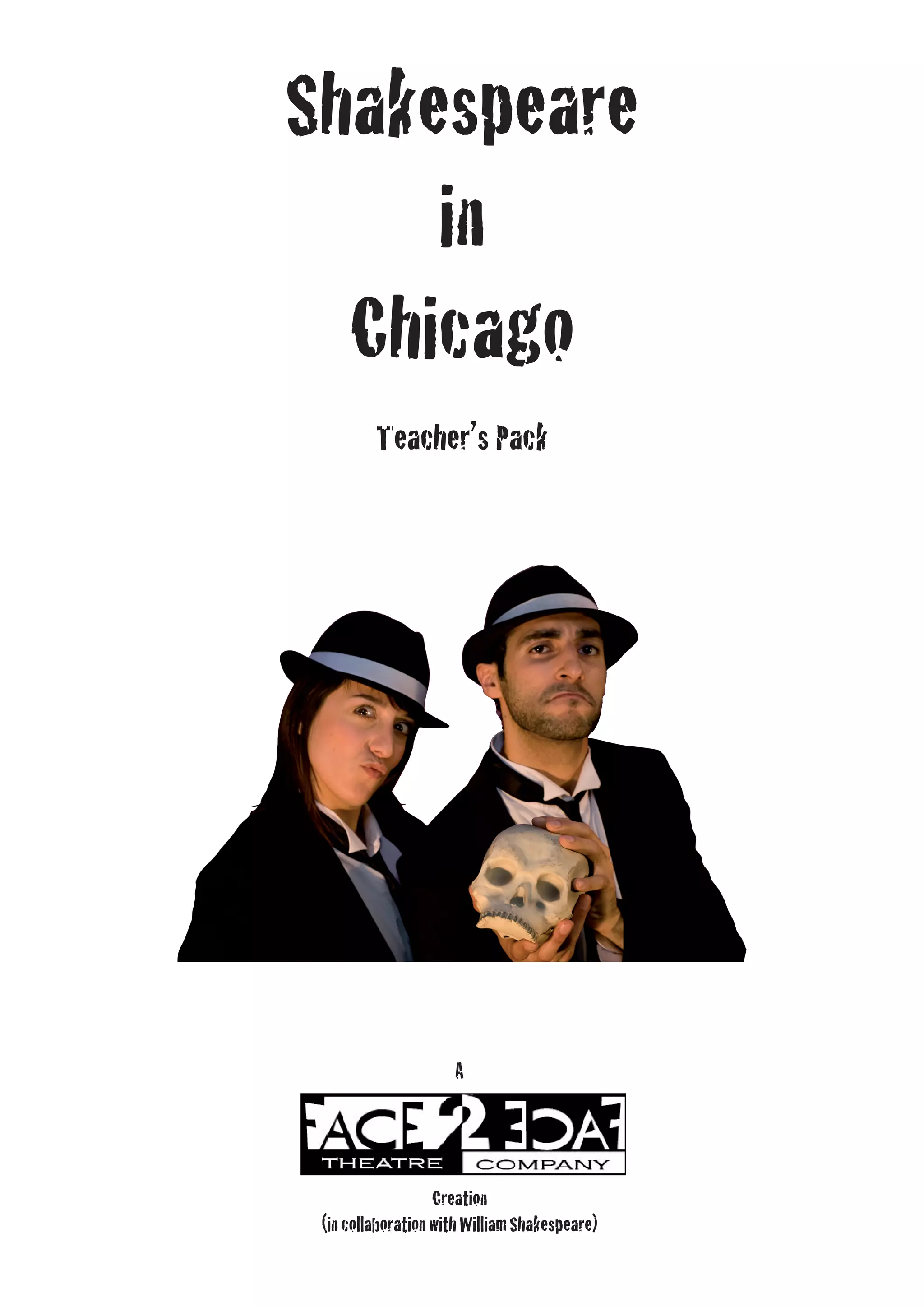
The document provides information about a teacher's pack for the show "Shakespeare in Chicago". It aims to entertain students and help them enjoy Shakespeare's work. The pack includes synopses and extracts from plays referred to in the show, such as Romeo and Juliet and Hamlet. It also contains vocabulary used in the show and descriptions of the main characters Whacko and Dick Vizioso, two gangsters who discover they have stolen a box of Shakespeare's works. The extracts are meant to introduce students to Shakespeare's plays and language in an fun way.

![Teacher’s Pack
The aim of the show Shakespeare in Chicago is, above all, to entertain. Shakespeare wrote plays so
people would be entertained. He wanted people to have FUN! Face 2 Face would like your students
to have fun and lose any apprehension they may have of Shakespeare’s work.
Many people have too much respect for Shakespeare and forget he was basically an entertainer.
His plays are as entertaining now as they were 400 years ago and this is something the students
should realise.
This teacher’s pack is designed to help teacher’s get the most out of the show. There is a brief sy-
nopsis of each play referred to in “Shakespeare in Chicago” as well as the actual extracts in English
and Spanish.
Each extract has been chosen to demonstrate a different aspect of Shakespeare’s work. Obviously
we can only look at a small number of plays during the course of the show. However they are the
most well known plays and extracts and should provide an excellent introduction to Shakespeare.
Each extract is preceded by an explanation of its relevance to the play in particular and to
Shakespeare’s work as a whole.
All the extracts are also to be found on the tracks that accompany the teacher’s pack as read by the
actors. These extracts can be used as extensive listening exercises to get students used to Shakes-
pearean verse or as more intensive gap filling exercises.
2009 Face 2 Face Theatre Company, Madrid, España - [34] (91) 434-0284 - www.teatroeningles.com - info@face2facetheatre.com 2
t e a c h e r s
l i s t e n i n g
CD
2
Exercises for students
Exercises to be used at teacher’s discretion
Track Numbers](https://image.slidesharecdn.com/shakespeareinchicagoteacherspack-1-151117162641-lva1-app6891/85/Shakespeare-in-chicago_teachers_pack-1-2-320.jpg)
![Plot Synopsis
2009 Face 2 Face Theatre Company, Madrid, España - [34] (91) 434-0284 - www.teatroeningles.com - info@face2facetheatre.com 3
CD
5
Extracts used in the show:
Romeo and Juliet: Prologue
Act 2, Scene 1
Hamlet: Act 3, Scene 1
Act 5, Scene 2
Macbeth: Act 1, Scene 1
King Henry V: Act 4, Scene 3
Othello: The whole play
Whacko and Dick Vizioso, two of the most incompetent gangsters in the city, have just robbed a
box full of money from a security van. When they arrive home they discover that the box is actually
full of books: The Complete Works of William Shakespeare. Chick has the idea of trying to sell the
books to the audience. In order to bring the books to life Whacko and Chick decide to perform some
extracts from the plays. Will Chick and Whacko be able to sell the books? How much does the Com-
plete Works of Shakespeare cost? How will they perform Hamlet? Who will Juliet be? Who is the
better actor? Is Shakespeare boring?
Vocabulary used durung the show:
money to buy zilch books idea to sell special offer
death violence romance monologue boring exciting magic
Whacko Vizioso
The older (and more intelligent) of the two
She lives in Chicago with her pet dog Spot.
Whacko liked theatre when she was much
younger, her favourite play being “Hamlet”.
However she made friends with the wrong
people and started living a life of crime. Her
dream is to live in Marbella..
Dick Vizioso
The younger of the two brothers. He lives in
Chicago with his mother. Dick doesn’t rea-
lly like the theatre but he does like the ice-
cream that Whacko buys when they go to
the cinema. Dick’s favourite Shakespeare
play is Shrek (and Othello)](https://image.slidesharecdn.com/shakespeareinchicagoteacherspack-1-151117162641-lva1-app6891/85/Shakespeare-in-chicago_teachers_pack-1-3-320.jpg)
![Macbeth: Act 1, Scene 1
Extract One
2009 Face 2 Face Theatre Company, Madrid, España - [34] (91) 434-0284 - www.teatroeningles.com - info@face2facetheatre.com 4
CD
5
MACBETH is a play with many magical elements - especially the three witches. They predict that
Macbeth will become King of Scotland. Macbeth’s ambition is awoken by this prophecy and, with the
help of his wife lady Macbeth, he kills Duncan the King to become king himself. MACBETH is also
the shortest of Shakespeare’s tragedies making it a good starting point to explore his work.
This extract comes from the very beginning of the play and sets the tone for the rest of the plot. The
three witches meet to arrange their encounter with Macbeth.
FIRST WITCH
When shall we three meet again?
In thunder, lighting or in rain?
SECOND WITCH
When the hurly burly’s done
When the battle’s lost and won.
THIRD WITCH
That will be ere the set of the sun.
FIRST WITCH
Where the place?
SECOND WITCH
Upon the heath
THIRD WITCH
There to meet woth Macbeth.
FIRST WITCH
I come, Grey-Malkin.
SECOND WITCH
Paddock calls
THIRD WITCH
Anon!
BRUJA 1
¿Cuando volvemos a juntarnos?
¿Cuando relampeguee, cuando truene o cuando llueva?
BRUJA 2
Cuando acabe el estruendo de la batalla,
Y unos la pierdan y otros la ganen.
BRUJA 3
Entonces será antes de ponerse el sol.
BRUJA 1
Dónde hemos de encontrarnos?
BRUJA 2
En el yermo.
BRUJA 3
Allí toparemos con Macbeth.
BRUJA 1
Allí voy, Gris Malkin
BRUJA 2
Me llama Morrongo.
BRUJA 3
¡Vamos!](https://image.slidesharecdn.com/shakespeareinchicagoteacherspack-1-151117162641-lva1-app6891/85/Shakespeare-in-chicago_teachers_pack-1-4-320.jpg)
![2009 Face 2 Face Theatre Company, Madrid, España - [34] (91) 434-0284 - www.teatroeningles.com - info@face2facetheatre.com 5
CD
5
ExtractTwo
This is probably one of Shakespeare’s most famous plays and one of the most famous love stories
ever told. Two young people from two rival families meet and fall in love. Through a series of coinci-
dences, mistakes and the hatred between their two families they both end up dying along with other
characters in the play.
Prologue
The chorus sums up the whole play in only 14 lines, forewarning his audience that the feud
between the two families is the real cause of the young lovers’ tragic deaths.
Two households, both alike in dignity
In fair Verona where we lay our scene,
From Ancient grudge break to new mutiny,
Where civil blood makes civil hands unclean.
From forth the fatal loins of these two foes
A pair of star-crossed lovers take their life,
Whose misadventured piteous overthrows
Doth with their death bury their parents strife.
The fearful passage of their death-marked love
And the continuance of their parents rage-
Which but their children’s end, naught could remove-
Is now the two-hours traffic of our stage;
The which if you with patient ears attend,
What here shall miss, our toil shall strive to end.
Dos casas antiguas, en dignidad igual
En hermosa Verona, donde situamos la escena
Del odio antiguo a nueva muerte
Donde sangre civil mancha las manos de los
ciudadanos
Del interior de estos dos enemigos
Una pareja de amantes toman su vida
Y con sus muertes terribles entierran
El odio de sus familias.
El horrible pasaje de aquel amor muerto
Y la continuada rabia de sus padres-
Que solamente el desgraciado fin de su hijos
Podía quitar será, por dos horas, aquí nuestro
argumento
Lo cual si prestan atención
Lo que aquí falta, nuestro trabajo suplirá
households - familias
fair - bonita
grudge - odio
mutiny - muerte
fatal - fatal
loins - interior
foes - enemigos
star-crossed - destinados
Useful vocabulary
ROMEO MONTAGUE
Young, handsome hero. Madly in
love with... Rosalind! That is until he
meets Juliet of course. Good with
swords and words. If he lived today
he would have a vespa, drink kalimo-
cho and support Real Madrid.
JULIET CAPULET
Romantic teenager (around 14 years
old). Not in love with anyone. Until she
meets Romeo, of course. If she lived
today she would listen to pop music,
go to discos, buy lots of clothes and
talk to her friends](https://image.slidesharecdn.com/shakespeareinchicagoteacherspack-1-151117162641-lva1-app6891/85/Shakespeare-in-chicago_teachers_pack-1-5-320.jpg)
![2009 Face 2 Face Theatre Company, Madrid, España - [34] (91) 434-0284 - www.teatroeningles.com - info@face2facetheatre.com 6
CD
5
Extract Three
The Balcony Scene
ROMEO: But soft! What light through yonder
window breaks?
It is the east and Juliet is the sun.
Arise fair sun and kill the envious moon
Who is already sick and pale with grief
That thou her maid art far more fair than she.
JULIET: Ay me!
ROMEO: She speaks! Oh speak again bright
angel, for thou art
As glorious to this night being o’er my head
As is a winged messenger of heaven.
JULIET: Oh Romeo, Romeo, wherefore art
thou Romeo?
Deny thy father and refuse thy name.
ROMEO: Shall I hear more or shall I speak
at this?
JULIET: Tis but thy name that is my enemy.
What’s in a name? That which we call a rose
By any other name would smell as sweet.
Without that title Romeo, doff thy name
And for thy name which is no part of thee
Take all my self.
ROMEO: I take thee at thy word
Call me but love and I’ll be new baptised
Henceforth I never will be Romeo.
JULIET: What man art thou?
ROMEO: By a name
I know not how to tell thee who I am.
JULIET: Art thou not Romeo and a Montague’
ROMEO: Neither fair maid if either thee dis-
like.
ROMEO: Pero que luz es la que se asoma por ahi?
Es el este y Julieta es el sol.
El sol que sale ya por los balcones de oriente
Sal, hermoso sol, y mata de envidia con tus rayos
a la luna
Que está pálida y ojeriza porque vence tu hermo-
sura
Cualquier ninfa de tu corro.
Ahora pone la mano en la mejilla
¡Quién pudiera tocarla como el guante que la cu-
bre.
JULIETA: ¡Ay de mi!
ROMEO: ¡Habló! Vuelvo a sentir su voz.
Que hables más, ángel mío
Eres tan glorioso esta noche ahí arriba
Como los mensajeros de los cielos, las estrellas.
JULIETA: ¡Romeo, Romeo! ¿por qué eres tú
Romeo?
¿Por qué no reniegas del nombre de tu padre?
ROMEO: ¿Qué hago, seguír oyéndola o hablar?
JULIETA: No eres tú mi enemigo sino tu nombre.
¿Que hay en un nombre?
La rosa no dejaría de ser rosa, y de esparcir su
aroma
Aunque se llamase de otro nombre.
Deja tu nombre, Romeo, y en cambio de tu nombre,
Que no es cosa sustancial, toma
todo mi alma.
ROMEO: Si de tu palabra me apodero,
llámame tu amante
Y creeré que me he bautizado de nuevo,
Y que he perdido el nombre de Romeo.
JULIETA: ¿No eres Romeo?
¿No eres de la familia de los
Montescos?
ROMEO: No seré ni una cosa ni otra, ángel
mío, si cualquiera de las dos te enfada.](https://image.slidesharecdn.com/shakespeareinchicagoteacherspack-1-151117162641-lva1-app6891/85/Shakespeare-in-chicago_teachers_pack-1-6-320.jpg)
![2009 Face 2 Face Theatre Company, Madrid, España - [34] (91) 434-0284 - www.teatroeningles.com - info@face2facetheatre.com 7
CD
5
JULIET: How cames’t thee hither, tell me, and
wherefore?
ROMEO: With love’s light wings did I o’er-
perch these walls
JULIET: By whose direction foundst thou out
this place
ROMEO: By love that first did prompt me
to inquire,
He lent me counsel and I lent him eyes;
I am no pilot, yet wert thou as far
As that vast shore washed with the farthest
sea
I should adventure for such merchandise.
JULIET: Dost thou love me?
If thou dost love pronounce it faithfully
ROMEO: Lady, by yonder blessed moon I
vow,
That tips with silver all these fruit tree tops.
JULIET:Oh swear not by the moon the
inconstant moon
That monthly changes in her circled orb,
Lest that thy love prove likewise variable.
ROMEO: What shal I swear by?
JULIET: Do not swear at all
ROMEO: If my heart’s dear love –
JULIET: Oh wilt thou leave me unsatis
fied?
ROMEO:A thousand times the worst to
want thy light
Love goes towards love as schoolboys from
their books
But love from love towards school with heavy
looks
JULIETA: ¿Cómo has llegado hasta aquí, y para
qué?
ROMEO: Las paredes las salté con las alas que
me dio el amor.
JULIETA: ¿Y quién te guió aquí?
ROMEO: El amor que me dijo donde vivías. De el
me aconsejé
El guió mis ojos que yo le había entregado.
Sin ser su marinero, te juro que navegaría hasta la
plaza
Mas remota de los mares por conseguir joya tan
preciosa
JULIETA: Si me amas de veras, Romeo, dilo con
sinceridad
ROMEO: Júrote, amada mía, por los rayos de la
luna que platean la copa de estos arboles.
JULIETA: No jures por la luna, que en su rápido
movimiento. Cambia de aspecto cada mes.
No vayas a imitar su inconstancia
JULIETA: No hagas ningún juramento.
ROMEO: ¡Ojalá que el fuego de mi amor...!
JULIETA: ¿Y no me das más consuelo que
ese?
ROMEO: El amor va en busca del amor como
el estudiante huyendo de sus libros, el amor se
aleja del amor
Como el niño que deja sus juegos para tornar al
estudio.
Extract Three](https://image.slidesharecdn.com/shakespeareinchicagoteacherspack-1-151117162641-lva1-app6891/85/Shakespeare-in-chicago_teachers_pack-1-7-320.jpg)
![2009 Face 2 Face Theatre Company, Madrid, España - [34] (91) 434-0284 - www.teatroeningles.com - info@face2facetheatre.com 8
CD
5
Extract Four
If we are mark’d to die, we are enough
To do our country loss; and if to live,
The fewer men, the greater share of
honour.
This day is called the feast of Crispian:
He that outlives this day, and comes safe
home,
Will stand a tip-toe when the day is named,
And rouse him at the name of Crispian.
He that shall live this day, and see old age,
Will yearly on the vigil feast his neighbours,
And say ‘To-morrow is Saint Crispian:’
Then will he strip his sleeve and show his
scars.
And say ‘These wounds I had on Crispin’s
day.’
This story shall the good man teach his
son;
And Crispin Crispian shall ne’er go by,
From this day to the ending of the world,
But we in it shall be remember ‘d;
We few, we happy few, we band of
brothers;
For he to-day that sheds his blood with me
Shall be my brother; be he ne’er so vile,
This day shall gentle his condition:
And gentlemen in England now a-bed
Shall think themselves accursed they were
not here,
And hold their manhoods cheap whilst any
speaks
That fought with us upon Saint Crispin’s
day.
Si estamos llamados a morir, somos los
suficientes
Para hacer que nuestro país sienta nuestra
pérdida; y si vivimos,
A menos hombres, mas gloria.
Hoy es el día de San Crispinián;
Quién sobreviva este día y vuelve a casa
indemne,
Se levantará orgulloso cuando se mencione
este día
Y se emocionará al oír el nombre de Crispi-
nián.
El que sobreviva hoy y que llega a viejo
Cada año celebrará este día con sus veci-
nos.
Y les dirá: “¡Mañana es San Crispinián!”
Entonces subirá sus mangas y enseñará
sus
heridas
Y dirá: “Estas son las heridas que me hicie-
ron
el día de San Crispinián.”
Y los hombres buenos contarán esta historia
a
sus hijos;
Y Crispin Crispinián no pasará -
Desde ahora hasta el fin del mundo - sin
que
Nosotros hayamos sido recordados,
Nosotros pocos, felices pocos, nosotros,
banda
de hermanos.
Porque el que hoy derrame su sangre con-
migo
Será mi hermano aunque sea de bajo rango,
Y desde este día se alzará hasta la nobleza
Y caballeros ingleses que se han quedado
en](https://image.slidesharecdn.com/shakespeareinchicagoteacherspack-1-151117162641-lva1-app6891/85/Shakespeare-in-chicago_teachers_pack-1-8-320.jpg)
![2009 Face 2 Face Theatre Company, Madrid, España - [34] (91) 434-0284 - www.teatroeningles.com - info@face2facetheatre.com 9
Extract Five - Song
The main theme to be found in Othello is that of jealousy. A husband’s jealousy (Othello) is aroused
and manipulated by his enemy (Iago). Othello’s wife, Desdemona, is accused of infidelity. The pro-
of is a handkerchief that is found in the posession of her so called lover. In actual fact it has been
planted there by Iago.
OTHELLO
Where I’m from they call me Othell-o
But my friends they know me as big Daddy-o
‘Cos I’m the master, the rasta, the toughest
Damned gangster since Ceasar
And this is my babe Desdemona
The most beautiful girl from Venice to Roma
She’s hot to trot, she’s always on top
Once she starts she ain’t never gonna stop
And she don’t stop
And she don’t quit.
IAGO:
Poor old Othello he thinks he’s so cool
He’s got no idea, he’s reallly a fool
Iago this, Iago that,
It’s about time he fell on his back.
Flat upon his back (x 2)
Desdemona, he thinks she’s so neat
Sugar and spice and all things sweet.
All I’ve got to do to make him mad
Is find a poor boy to make her glad.
Hey, what’s this I spy?
It’s Cassio the man going to make her cry.
You see that babe with the beautiful hair?
I’ve got an idea that I want to share.
All you’ve got to do is slide up real close
And whisper in her ear, that’s what she likes
most.
OTHELLO:
This little mama´s my joy and relief
That’s why I’m giving her this handkerchief.
IAGO:
Hey! What’s that I see?
Hey! That could be the key!
You see that handkerchief? It’s made out of co-
tton
Well I’m going to use it, ‘cos I’m pretty rotten.
Cassio’s the one to fulfil my dreaming
When I’m through with him they’ll all be screa-
ming.
Yo Daddy-o! I said yo! Cassio!
I’ve got a little something I want you to keep.
Don’t show it to the boss or he’ll probably weep
(to Othello)
Hey you big of a gun,
I’ve seen something and it isn’t much fun.
Go over there and see what’s up,
And when you do you’re going to beat him up.
OTHELLO:
Hey, Cassio! You done wrong you know.
You’ve got to stop going around like you’re Romeo
Or you’re going to get
A big bullet
Through your fat chest.
(Othello kills Cassio)
(to Desdemona)
No, no, no, oh Desdemona no,
No Desdemona, oh Desdemona, no Desdemona,
no
How can you flirt with that Cassio
He’s the ugliest little guy I’ve ever known.
I can’t stand it, I can’t take it, I won’t fake it
When you take this little heart and just break it.
(Othello kills Ophelia)
Oh hot damn! What the hell have I done?
I’ve just killed my true love, my only one.
(Othello kills himself)
IAGO:
So you kids that’s the end of the tale
I’m gonna get out of here before they throw me in
jail.
And just remember, it’ll be a relief
Never, ever, ever, lose your handkerchief.](https://image.slidesharecdn.com/shakespeareinchicagoteacherspack-1-151117162641-lva1-app6891/85/Shakespeare-in-chicago_teachers_pack-1-9-320.jpg)
![2009 Face 2 Face Theatre Company, Madrid, España - [34] (91) 434-0284 - www.teatroeningles.com - info@face2facetheatre.com 10
CD
6
Extract Six
Hamlet Prince of Denmark
In this scene Hamlet is meditating on suicide and the difference between life and death. Hamlet is
not your typical hero.His father (the old King) has been murdered by his uncle Claudius who has
now married Hamlet’s mother Gertrude and become King. Hamlet has seen his father’s ghost who
has asked Hamlet to revenge his death. All Hamlet can do is hesitate and philosophise on the
meaning of life. This is probably Shakespeare’s most famous speech and everyone has heard the
line “to be or not to be”·
To be, or not to be: that is the question:
Whether ‘tis nobler in the mind to suffer
The slings and arrows of outrageous fortune,
Or to take arms against a sea of troubles,
And by opposing end them? To die: to sleep;
No more; and by a sleep to say we end
The heart-ache and the thousand natural shocks
That flesh is heir to, ‘tis a consummation
Devoutly to be wish’d. To die, to sleep;
To sleep: perchance to dream: ay, there’s the rub;
For in that sleep of death what dreams may come
When we have shuffled off this mortal coil ,
Must give us pause: there’s the respect
That makes calamity of so long life;
For who would bear the whips and scorns of time,
The oppressor’s wrong, the proud man’s contumely,
The pangs of despised love, the law’s delay,
The insolence of office and the spurns
That pateient merit of the unworthy takes,
When he himself might his quietus make
With a bare bodkin? who would fardels bear,
To grunt and sweat under a weary life,
But that the dread of something after death,
The undiscover’d country from whose bourn
No traveller returns, puzzles the will
And makes us rather bear those ills we have
Than fly to others that we know not of?
Thus conscience does make cowards of us all;
And thus the native hue of resolution
Is sicklied o’er with the pale cast of thought,
And enterprises of great pith and moment
With this regard their currents turn awry,
And lose the name of action.
Ser o no ser...He ahí el dilema
¿Que es mejor para el alma,
Sufrir insultos de fortuna, golpes, dardos,
O levantarse en armas contra el océano del mal
Y oponerse a él, y que así cesen? Morir, dormir,
Nada más; y decir así que con un sueño
Damos fin a las llagas del corazón
Y a todos los males, herencia de la carne
Y decir: ven, consumación, yo te deseo. Morir, dormir,
Dormir... ¡Soñar acaso! Que difícil pues en el sueño
De la muerte ¿que sueños sobrevendrán
Cuando despojados de ataduras mortales
Encontramos la paz? He ahí la razón
Por la que tan longeva llega a ser la desgracia
¿Pues quién podrá soportar los azotes y las burlas
del mundo,
La injusticia, del tirano, la afrenta del soberbio,
La angustia del amor despreciado, la espera de
juicio,
La arrogancia del poderoso, y la humillación
Que la virtud recibe de quién es indigno,
Cuando uno mismo tiene a su alcance el descanso,
En el filo desnudo del puñal? ¿Quién puede soportar
Tanto? ¿Gemir tanto? ¿Llevar de la vida una carga
Tan pesada? Nadie, si no fuera por ese algo tras la
muerte
- Ese país por descubrir, de cuyos confines
Ningún viajero retorna - que confunde la voluntad
Haciéndonos pacientes ante el infortunio
Antes que volar hacía un mal desconocido.
La conciencia, así, hace a todos cobardes
Y así, el natural color de la resolución
Se desvanece en tenues sombras del pensamiento,
Y así empresas de importancia, y de gran valía,
Llegan a torcer su rumbo al considerarse
Para nunca volver a merear el nombre de la acción.](https://image.slidesharecdn.com/shakespeareinchicagoteacherspack-1-151117162641-lva1-app6891/85/Shakespeare-in-chicago_teachers_pack-1-10-320.jpg)
![2009 Face 2 Face Theatre Company, Madrid, España - [34] (91) 434-0284 - www.teatroeningles.com - info@face2facetheatre.com 11
Extract Seven
Like a good tragedy at the end of Hamlet everyone dies. Laertes challenges Hamlet to a duel but the
King secretly puts poison on the tip of the sword. The King also poisons Hamlet’s drink. During the
fight. Hamlet gets scratched by the poisoned sword and Queen Gertrude drinks the poisoned drink.
She dies. Hamlet stabs Claudius (his father in law) and then Laertes with the poisoned sword. Then
Hamlet dies. Eight people die during the course of the play, five of them in the last scene.
HAMLET: One.
LAERTES: No!
KING: Here Hamlet, drink.
The Queen takes the cup.
KING: Gertrude, do not drink!
QUEEN: Yes.
She drinks.
KING: O no! The poison!
Laertes and Hamlet fight.
LAERTES: Have at you now!
They are both stabbed by the poisoned sword.
QUEEN: O no, the drink, the drink, the
drink!
She dies.
HAMLET: Oh villainy! Ho! Let the door be
locked.
Treachery! Seek it out!
LAERTES: It is here Hamlet. Hamlet thou art
slain.
No medicine in the world can do thee
good.
In thee there is not half an hour’s life.
I can do no more. The King, the king’s to blame.
HAMLET: The point envenomed too?
Then venom do thy work.
Hamlet stabs the King.
KING: Oh I am hurt!
Hamlet forces the King to drink from his cup.
HAMLET: Here, thou incestuous, murderous,
damnéd Dane. Drink off this potion.
The King dies.
LAERTES: Forgive me Hamlet. I am slain.
HAMLET: Heaven make thee free of it! I follow
thee.
I am dead, Horatio. Wretched queen, adieu!
HAMLET: Uno!
LAERTES: No!
REY: Hamlet, bebe.
La reina coge el vaso.
REY: ¡Gertrude, no bebas!
REINA: He de beber, señor.
Bebe.
REY: ¡No! Es la copa de veneno.
Laertes y Hamlet se pelean.
LAERTES: ¡Tomad ahora esta!
Mientras se pelean los dos están puñalados con
la
espada envenenada.
REINA: ¡O no, la bebida, la bebida, la
bebida!
Muere.
HAMLET: ¡Felonía! ¡Hola! Cerrad las puertas.
¡Traición! ¡Hay que descubrirla!
LAERTES: Está aquí Hamlet. Hamlet tú también
vas a morir.
No hay medicina en el mundo que
pueda salvarte.
Ni media hora de vida te queda.
Más no puedo hacer.. El rey, el rey
es el culpable.
HAMLET: ¿Envenenada la punta?
¡Pues haz tu obra, veneno!
Puñala al rey.
REY: Ah, estoy herido!
Hamlet obliga el rey a beber el veneno.
HAMLET: ¡Toma tú ahora, incesto, asesino, rey
maldito!
¡Bebe esta pócima.!
El rey muere
LAERTES: Perdóname Hamlet. Estoy muerto.
HAMLET: ¡Que el cielo te perdone! Voy
contigo.
Me muero, Horatio. ¡Reina infeliz,](https://image.slidesharecdn.com/shakespeareinchicagoteacherspack-1-151117162641-lva1-app6891/85/Shakespeare-in-chicago_teachers_pack-1-11-320.jpg)
![2009 Face 2 Face Theatre Company, Madrid, España - [34] (91) 434-0284 - www.teatroeningles.com - info@face2facetheatre.com 12
Exercises
1564 Birth of William Shakespeare in Stratford-Upon-Avon
1582 Marriage to Anne Hathaway (8 years older than him)
1583 Birth of daughter Susanna
1585 Birth of twins, son Hamnet and daughter Judith.
1592 Shakespeare’s name first appears as an actor.
1593 Theatres in London are closed because of the plague.
1596 Death of Shakespeare’s son, Hamnet.
1599 “The Globe” theatre is built.
1601 Death of Shakespeare’s father, John.
1607 Daughter, Susanna, marries John Hall.
1613 Critic, Leonard Digges, compares Shakespeare to Lope de Vega
1613 “The Globe” is burnt to the ground.
1614 “The Globe” is rebuilt.
1616 Marriage of daughter, Judith, to Thomas Quinney.
1. In what year was Shakespeare born?
2. Who was older? Shakespeare or his wife
3. When was his first daughter born?
4. His son Hamnet died very young. How old was he when he died?
5. Why were theatres in London closed in 1593 and 1594?
6. Has Shakespeare ever been compared to a 16th /17th century Spanish playwright?
7. When did the Globe first open to the public?
8. Who lived longer, Shakespeare or his wife, Anne?
9. When did Shakespeare die?
10. How old was he when he died?
Facts about William Shakespeare
Answer the following questions:](https://image.slidesharecdn.com/shakespeareinchicagoteacherspack-1-151117162641-lva1-app6891/85/Shakespeare-in-chicago_teachers_pack-1-12-320.jpg)
![2009 Face 2 Face Theatre Company, Madrid, España - [34] (91) 434-0284 - www.teatroeningles.com - info@face2facetheatre.com 13
The Plays
The two leading families of Verona, the Capulets and the Montagues, are fighting. Romeo, a Mon-
tague, falls in love with Juliet, a Capulet, at a ball which he attends in disguise. That night, he waits
under her window and hears her speak of her love for him. He declares his loquarrelve for her. They
marry in secret the next day, helped by Friar Lawrence. Tybalt, a Capulet, argues with and kills
Romeo’s friend Mercutio. Romeo, arriving on the scene, kills Tybalt. He is banished from Verona,
and after spending the night with Juliet, goes to Mantua. Meanwhile, Juliet’s father wants her to ma-
rry Paris. The friar tells Juliet to agree to this but arranges for her to take a potion which will make
her seem dead for two days. He plans to warn Romeo, who will resecue her from her tomb, but the
message to Romeo gets lost. Romeo, hearing that Juliet has died, comes to the tomb. He doesn’t
know she has taken the potion. Paris is also at the tomb. They fight and Romeo kills Paris. Then he
kisses Juliet, takes some poison and dies. Juliet wakes up and, seeing what has happened, stabs
herself. On discovery of the tragedy, the two familes are finally persuaded to end their argument.
Romeo and Juliet
Returning triumphant from battle, Macbeth and Banquo meet three witches who predict Macbeth
will be Thane of Condor, and after King of Scotland, and that Banquo will be a father of kings. Soon
Macbeth hears that he has been made Thane of Condor. Spurred on by the prophecy and by his
ambitious wife, Lady Macbeth, Macbeth murders King Duncan who is visiting his castle at Dunsina-
ne. Duncan’s sons Malcolm and Donalblain flee in terror and Macbeth is crowned king. Macbeth has
Banquo killed, but Banquo’s son Fleance escapes. Macbeth visits the witches again and is told he
should beware of Macduff, that he can be harmed by no man born of woman, and that he is safe until
Birnham Wood comes to Dunsinane. Macbeth has Macduff’s wife and children killed, while his own
wife goes mad and dies. Malcolm brings an army to attack Dunsinane, using leaves from Birnham
Wood as camouflage, and Macduff, who was not brn, but cut from his mother’s body, kills Macbeth.
Malcolm is proclaimed king.
Macbeth
Hamlet, Prince of Denmark, sees his dead father’s ghost who tells him that he was murdered by his
brother Cluadius, and urges him to take revenge. Claudius is now king and has married Hamlet’s
mother, Queen Gertrude. Hamlet decides to pretend to be insane while he works out what to do. He
rejects his old girlfriend Ophelia, the daughter of Polonius, a lord. He arranges a play to be put on,
in which a king is murdered by his nephew. Claudius calls off the performance, seeming guilty or
worried. Hamlet talks to his mother in her bedroom, and stabs through a curtain behind which Po-
lonius is hiding, killing him. Claudius sends Hamlet to England with Rosencrantz and Guilderstern,
with instructions for them to kill him, but Hamlet escapes and returns to Denmark. During Hamlet’s
absence Ophelia has gone insane with grief and drowned. Her brother Laertes has returned from
France and encounters Hamlet in the graveyard where Ophelia is to be buried. Claudius arranges
a duel, giving Laertes a poisoned sword with which to fight Hamlet, also providing a cup of poison
for hamlet to drink. But the swords get mixed up, both Laertes and Hamlet are fatally wounded, and
Gertrude accidentally drinks the poison. Before dying, Hamlet manages at last to kill Claudius woth
the poisoned sword.
Hamlet](https://image.slidesharecdn.com/shakespeareinchicagoteacherspack-1-151117162641-lva1-app6891/85/Shakespeare-in-chicago_teachers_pack-1-13-320.jpg)
![2009 Face 2 Face Theatre Company, Madrid, España - [34] (91) 434-0284 - www.teatroeningles.com - info@face2facetheatre.com 14
Othello, a black Venetian general, has secretly married Desdemona, who is white. Her father is
angry, but Othello justifies himself and is asked to sail to Cyprus to defend it against the Turks.
Iago, Othello’s ensign (a kind of army officer) is jealous that the younger Cassio has been promo-
ted above him. He gets Cassio drunk and involves him in a fight. Demoted by Othello, Cassio asks
Desdemona to plead with othello for him, which she does. Iago suggests to Othello that Cassio
and Desdemona are secret lovers. Iago also obtains Desdemona’s handkerchief, a present from
Othello, through his wife Emilia who is Desdemona’s waiting lady, and plants it on Cassio. Othello is
driven to distraction, unable to bear the thought that Desdemona has deceived him, and afraid that
she prefers Cassio because he is whitel. Eventually Othello murders Desdemona. Too late, Emilia
reveals Iago’s deception to Othello, who commits suicide.
Othello
The Plays](https://image.slidesharecdn.com/shakespeareinchicagoteacherspack-1-151117162641-lva1-app6891/85/Shakespeare-in-chicago_teachers_pack-1-14-320.jpg)


