CEB's IT Blog » CIOs Must Teach a New Attitude Toward Shadow IT

Page 1 of 3

CEB's IT Blog
CIOs Must Teach a New Attitude Toward Shadow IT
Posted on 4 September 13 by Jamie Heyes
Technology innovations by business partners are often stifled by IT’s fears that the risks of
shadow IT initiatives outweigh the potential value. Leading

CIOs are already taking steps to change their IT team’s mindset through the introduction of a
“Shallow IT” framework, which communicates what business partners are trying to achieve and
where IT staff should (and should not) step in.
As my colleague Andrew wrote, not all shadow IT is a bad thing, and healthy doses can be
extremely beneficial to an organization. What IT employees often struggle with is the distinction
between “healthy” and “unhealthy” shadow IT, and it is no surprise, considering the fact that they
have had a “shut-it down” mentality engrained in them over the past decades. This is something
that needs to change, not only so that IT is better equipped to provide business partners with
technology advice, but also that they know exactly when to get involved.
The framework comes from our latest research into digital marketing (which will be published in
the next few weeks), and provides the CIO at a leading manufacturer with an effective way of
dealing with the many technology experiments that occur in the company’s marketing department.
The framework not only helps IT employees understand what marketers are trying to do with
technology, but also defines a point for IT to step in to help drive integration and scale. The CIO
took three key steps to build the framework.
1) Roadmap Capabilities, Not Technologies: Business capabilities offer greater stability than
technologies and are less likely to change. They also accommodate the many short cycle
experiments business partners undertake. So rather than having business partners talk about what
technologies they want, capabilities help IT understand what they are trying to achieve.
2) Classify Capabilities In Four Categories: Each category is defined by the potential risk and
value that change and experimentation will bring to an organization. From capabilities of Record
and Engagement (see Geoffrey Moore’s, Escape Velocity), to capabilities of Productivity and

http://www.executiveboard.com/it-blog/cios-must-teach-a-new-attitude-toward-shado... 18/09/2013
CEB's IT Blog » CIOs Must Teach a New Attitude Toward Shadow IT

Page 2 of 3

Insight. This clear categorization of capabilities helps to change IT employees’ “shut-it down”
mentality, as they can clearly identify the healthy and unhealthy shadow IT experiments.
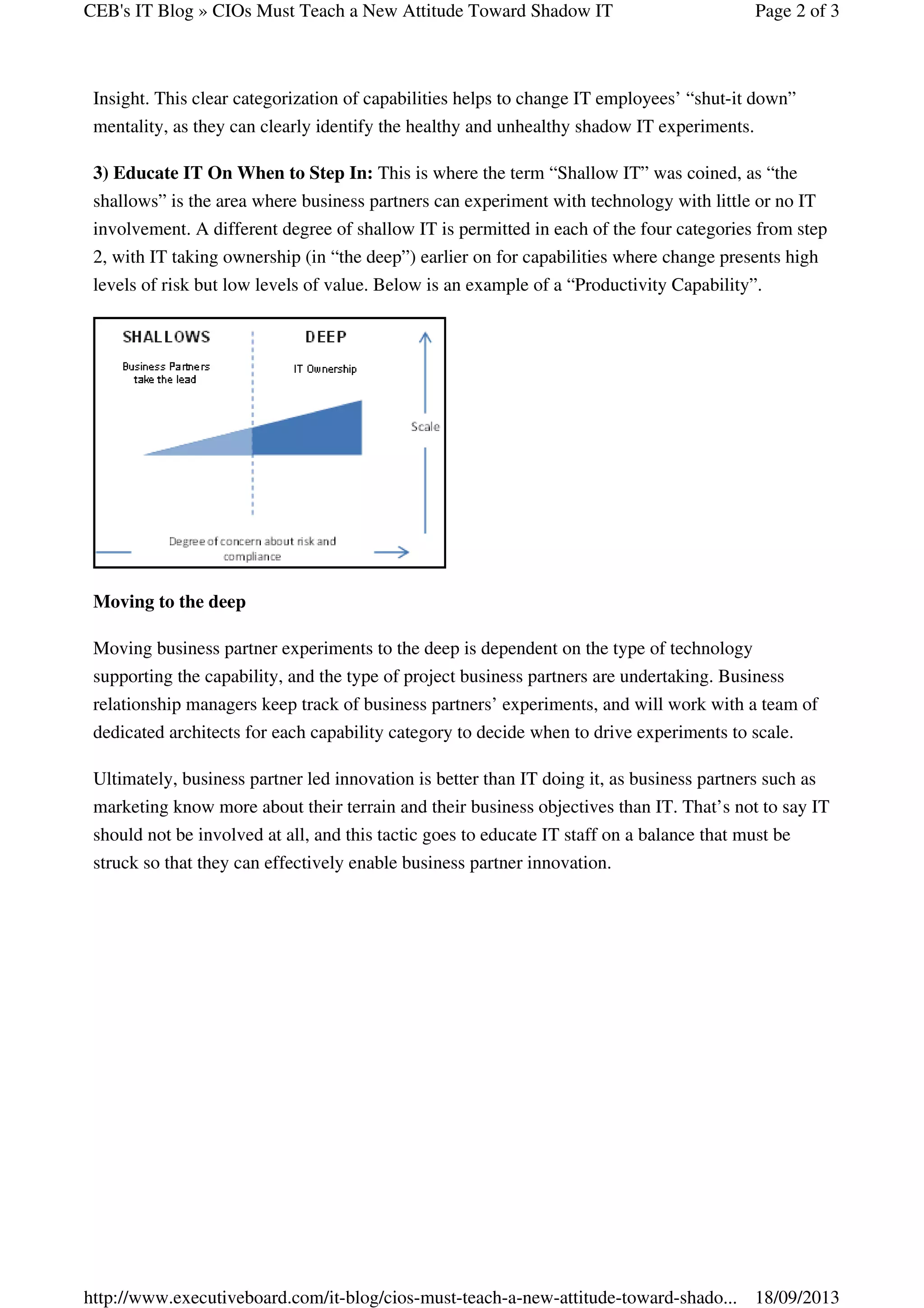
3) Educate IT On When to Step In: This is where the term “Shallow IT” was coined, as “the
shallows” is the area where business partners can experiment with technology with little or no IT
involvement. A different degree of shallow IT is permitted in each of the four categories from step
2, with IT taking ownership (in “the deep”) earlier on for capabilities where change presents high
levels of risk but low levels of value. Below is an example of a “Productivity Capability”.

Moving to the deep
Moving business partner experiments to the deep is dependent on the type of technology
supporting the capability, and the type of project business partners are undertaking. Business
relationship managers keep track of business partners’ experiments, and will work with a team of
dedicated architects for each capability category to decide when to drive experiments to scale.
Ultimately, business partner led innovation is better than IT doing it, as business partners such as
marketing know more about their terrain and their business objectives than IT. That’s not to say IT
should not be involved at all, and this tactic goes to educate IT staff on a balance that must be
struck so that they can effectively enable business partner innovation.

http://www.executiveboard.com/it-blog/cios-must-teach-a-new-attitude-toward-shado... 18/09/2013
CEB's IT Blog » CIOs Must Teach a New Attitude Toward Shadow IT

Page 3 of 3

Commenting Guidelines
We hope conversations will be energetic, constructive, and provocative. All posts will be reviewed
by our editors and may be edited for clarity, length, and relevance.
We ask that you adhere to the following guidelines.
1. No selling of products or services.
2. No ad hominem attacks. These are conversations in which we debate ideas. Criticize ideas,
not the people behind them.

http://www.executiveboard.com/it-blog/cios-must-teach-a-new-attitude-toward-shado... 18/09/2013

Shadow it new attitude

  • 1.
    CEB's IT Blog» CIOs Must Teach a New Attitude Toward Shadow IT Page 1 of 3 CEB's IT Blog CIOs Must Teach a New Attitude Toward Shadow IT Posted on 4 September 13 by Jamie Heyes Technology innovations by business partners are often stifled by IT’s fears that the risks of shadow IT initiatives outweigh the potential value. Leading CIOs are already taking steps to change their IT team’s mindset through the introduction of a “Shallow IT” framework, which communicates what business partners are trying to achieve and where IT staff should (and should not) step in. As my colleague Andrew wrote, not all shadow IT is a bad thing, and healthy doses can be extremely beneficial to an organization. What IT employees often struggle with is the distinction between “healthy” and “unhealthy” shadow IT, and it is no surprise, considering the fact that they have had a “shut-it down” mentality engrained in them over the past decades. This is something that needs to change, not only so that IT is better equipped to provide business partners with technology advice, but also that they know exactly when to get involved. The framework comes from our latest research into digital marketing (which will be published in the next few weeks), and provides the CIO at a leading manufacturer with an effective way of dealing with the many technology experiments that occur in the company’s marketing department. The framework not only helps IT employees understand what marketers are trying to do with technology, but also defines a point for IT to step in to help drive integration and scale. The CIO took three key steps to build the framework. 1) Roadmap Capabilities, Not Technologies: Business capabilities offer greater stability than technologies and are less likely to change. They also accommodate the many short cycle experiments business partners undertake. So rather than having business partners talk about what technologies they want, capabilities help IT understand what they are trying to achieve. 2) Classify Capabilities In Four Categories: Each category is defined by the potential risk and value that change and experimentation will bring to an organization. From capabilities of Record and Engagement (see Geoffrey Moore’s, Escape Velocity), to capabilities of Productivity and http://www.executiveboard.com/it-blog/cios-must-teach-a-new-attitude-toward-shado... 18/09/2013
  • 2.
    CEB's IT Blog» CIOs Must Teach a New Attitude Toward Shadow IT Page 2 of 3 Insight. This clear categorization of capabilities helps to change IT employees’ “shut-it down” mentality, as they can clearly identify the healthy and unhealthy shadow IT experiments. 3) Educate IT On When to Step In: This is where the term “Shallow IT” was coined, as “the shallows” is the area where business partners can experiment with technology with little or no IT involvement. A different degree of shallow IT is permitted in each of the four categories from step 2, with IT taking ownership (in “the deep”) earlier on for capabilities where change presents high levels of risk but low levels of value. Below is an example of a “Productivity Capability”. Moving to the deep Moving business partner experiments to the deep is dependent on the type of technology supporting the capability, and the type of project business partners are undertaking. Business relationship managers keep track of business partners’ experiments, and will work with a team of dedicated architects for each capability category to decide when to drive experiments to scale. Ultimately, business partner led innovation is better than IT doing it, as business partners such as marketing know more about their terrain and their business objectives than IT. That’s not to say IT should not be involved at all, and this tactic goes to educate IT staff on a balance that must be struck so that they can effectively enable business partner innovation. http://www.executiveboard.com/it-blog/cios-must-teach-a-new-attitude-toward-shado... 18/09/2013
  • 3.
    CEB's IT Blog» CIOs Must Teach a New Attitude Toward Shadow IT Page 3 of 3 Commenting Guidelines We hope conversations will be energetic, constructive, and provocative. All posts will be reviewed by our editors and may be edited for clarity, length, and relevance. We ask that you adhere to the following guidelines. 1. No selling of products or services. 2. No ad hominem attacks. These are conversations in which we debate ideas. Criticize ideas, not the people behind them. http://www.executiveboard.com/it-blog/cios-must-teach-a-new-attitude-toward-shado... 18/09/2013