CS526 Topic 5: Hash Functions and
Message Authentication
1
Computer Security
CS 526
Topic 5
Cryptography: Cryptographic Hash
Functions And Message Authentication Code
Announcements
• HW1 due on Sept 5
• Quiz 1 will be on Sept 10, covering topics 1-5
• Both projects will be allow a team of two
– May want to start forming teams
• Mid-term exam tentatively scheduled to be Tuesday
Oct 15, during lecture time
CS526 Topic 5: Hash Functions and
Message Authentication
2
CS526 Topic 5: Hash Functions and
Message Authentication
3
Readings for This Lecture
• Wikipedia
• Cryptographic Hash Function
s
• Message Authentication Cod
e
CS526 Topic 5: Hash Functions and
Message Authentication
4
Data Integrity and Source
Authentication
• Encryption does not protect data from modification
by another party.
• Why?
• Need a way to ensure that data arrives at destination
in its original form as sent by the sender and it is
coming from an authenticated source.
Hash Functions
• A hash function maps a message of an arbitrary length to
a m-bit output
– output known as the fingerprint or the message digest
• What is an example of hash functions?
– Give a hash function that maps Strings to integers in [0,2^{32}-1]
• Cryptographic hash functions are hash functions with
additional security requirements
CS526 Topic 5: Hash Functions and
Message Authentication
5
CS526 Topic 5: Hash Functions and
Message Authentication
6
Using Hash Functions for Message
Integrity
• Method 1: Uses a Hash Function h, assuming an
authentic (adversary cannot modify) channel for short
messages
– Transmit a message M over the normal (insecure) channel
– Transmit the message digest h(M) over the secure channel
– When receiver receives both M’ and h, how does the receiver
check to make sure the message has not been modified?
• This is insecure. How to attack it?
• A hash function is a many-to-one function, so collisions
can happen.
CS526 Topic 5: Hash Functions and
Message Authentication
7
Security Requirements for
Cryptographic Hash Functions
Given a function h:X Y, then we say that h is:
• preimage resistant (one-way):
if given y Y it is computationally infeasible to find a
value x X s.t. h(x) = y
• 2-nd preimage resistant (weak collision resistant):
if given x  X it is computationally infeasible to find a
value x’  X, s.t. x’x and h(x’) = h(x)
• collision resistant (strong collision resistant):
if it is computationally infeasible to find two distinct
values x’,x  X, s.t. h(x’) = h(x)
CS526 Topic 5: Hash Functions and
Message Authentication
8
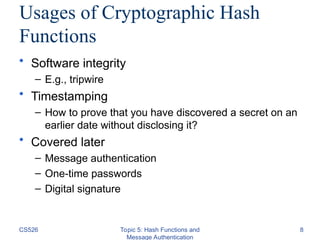
Usages of Cryptographic Hash
Functions
• Software integrity
– E.g., tripwire
• Timestamping
– How to prove that you have discovered a secret on an
earlier date without disclosing it?
• Covered later
– Message authentication
– One-time passwords
– Digital signature
CS526 Topic 5: Hash Functions and
Message Authentication
9
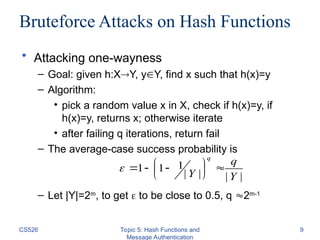
Bruteforce Attacks on Hash Functions
• Attacking one-wayness
– Goal: given h:XY, yY, find x such that h(x)=y
– Algorithm:
• pick a random value x in X, check if h(x)=y, if
h(x)=y, returns x; otherwise iterate
• after failing q iterations, return fail
– The average-case success probability is
– Let |Y|=2m
, to get  to be close to 0.5, q 2m-1
|
|
|
|
1
1
1
Y
q
Y
q






 



CS526 Topic 5: Hash Functions and
Message Authentication
10
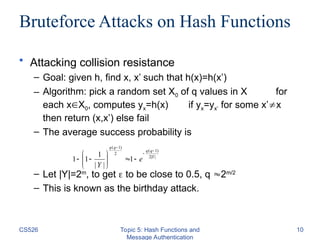
Bruteforce Attacks on Hash Functions
• Attacking collision resistance
– Goal: given h, find x, x’ such that h(x)=h(x’)
– Algorithm: pick a random set X0 of q values in X for
each xX0, computes yx=h(x) if yx=yx’ for some x’x
then return (x,x’) else fail
– The average success probability is
– Let |Y|=2m
, to get  to be close to 0.5, q 2m/2
– This is known as the birthday attack.
1
|
|
1
1
1 |
|
2
)
1
(
2
)
1
(
Y
q
q
q
q
e
Y















CS526 Topic 5: Hash Functions and
Message Authentication
11
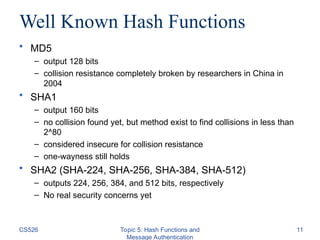
Well Known Hash Functions
• MD5
– output 128 bits
– collision resistance completely broken by researchers in China in
2004
• SHA1
– output 160 bits
– no collision found yet, but method exist to find collisions in less than
2^80
– considered insecure for collision resistance
– one-wayness still holds
• SHA2 (SHA-224, SHA-256, SHA-384, SHA-512)
– outputs 224, 256, 384, and 512 bits, respectively
– No real security concerns yet
Merkle-Damgard Construction for
Hash Functions
CS526 Topic 5: Hash Functions and
Message Authentication
12
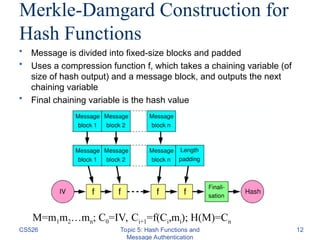
• Message is divided into fixed-size blocks and padded
• Uses a compression function f, which takes a chaining variable (of
size of hash output) and a message block, and outputs the next
chaining variable
• Final chaining variable is the hash value
M=m1m2…mn; C0=IV, Ci+1=f(Ci,mi); H(M)=Cn
NIST SHA-3 Competition
• NIST is having an ongoing competition for SHA-3, the next generation of
standard hash algorithms
• 2007: Request for submissions of new hash functions
• 2008: Submissions deadline. Received 64 entries. Announced first-round
selections of 51 candidates.
• 2009: After First SHA-3 candidate conference in Feb, announced 14
Second Round Candidates in July.
• 2010: After one year public review of the algorithms, hold second SHA-3
candidate conference in Aug. Announced 5 Third-round candidates in Dec.
• 2011: Public comment for final round
• 2012: October 2, NIST selected SHA3
– Keccak (pronounced “catch-ack”) created by Guido Bertoni, Joan Daemen and Gilles Van
Assche, Michaël Peeters
CS526 Topic 5: Hash Functions and
Message Authentication
13
The Sponge Construction: Used by
SHA-3
CS526 Topic 5: Hash Functions and
Message Authentication
14
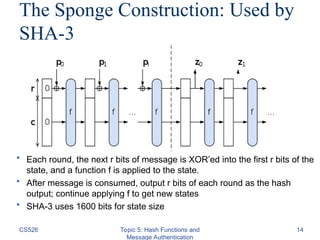
• Each round, the next r bits of message is XOR’ed into the first r bits of the
state, and a function f is applied to the state.
• After message is consumed, output r bits of each round as the hash
output; continue applying f to get new states
• SHA-3 uses 1600 bits for state size
CS526 Topic 5: Hash Functions and
Message Authentication
15
Choosing the length of Hash outputs
• The Weakest Link Principle:
– A system is only as secure as its weakest link.
• Hence all links in a system should have similar levels of
security.
• Because of the birthday attack, the length of hash outputs
in general should double the key length of block ciphers
– SHA-224 matches the 112-bit strength of triple-DES (encryption
3 times using DES)
– SHA-256, SHA-384, SHA-512 match the new key lengths
(128,192,256) in AES
CS526 Topic 5: Hash Functions and
Message Authentication
16
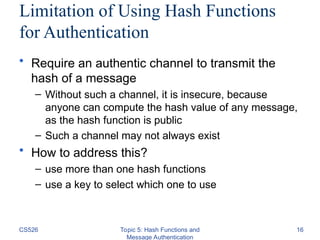
Limitation of Using Hash Functions
for Authentication
• Require an authentic channel to transmit the
hash of a message
– Without such a channel, it is insecure, because
anyone can compute the hash value of any message,
as the hash function is public
– Such a channel may not always exist
• How to address this?
– use more than one hash functions
– use a key to select which one to use
CS526 Topic 5: Hash Functions and
Message Authentication
17
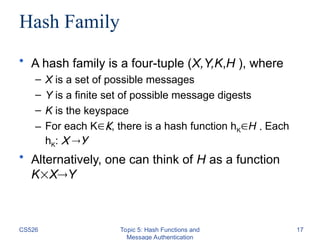
Hash Family
• A hash family is a four-tuple (X,Y,K,H ), where
– X is a set of possible messages
– Y is a finite set of possible message digests
– K is the keyspace
– For each KK, there is a hash function hKH . Each
hK: X Y
• Alternatively, one can think of H as a function
KXY
CS526 Topic 5: Hash Functions and
Message Authentication
18
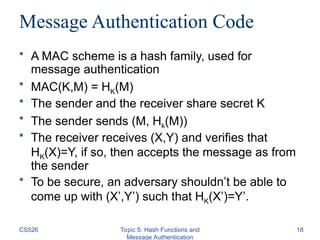
Message Authentication Code
• A MAC scheme is a hash family, used for
message authentication
• MAC(K,M) = HK(M)
• The sender and the receiver share secret K
• The sender sends (M, Hk(M))
• The receiver receives (X,Y) and verifies that
HK(X)=Y, if so, then accepts the message as from
the sender
• To be secure, an adversary shouldn’t be able to
come up with (X’,Y’) such that HK(X’)=Y’.
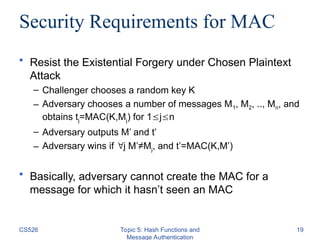
Security Requirements for MAC
• Resist the Existential Forgery under Chosen Plaintext
Attack
– Challenger chooses a random key K
– Adversary chooses a number of messages M1, M2, .., Mn, and
obtains tj=MAC(K,Mj) for 1jn
– Adversary outputs M’ and t’
– Adversary wins if j M’≠Mj, and t’=MAC(K,M’)
• Basically, adversary cannot create the MAC for a
message for which it hasn’t seen an MAC
CS526 Topic 5: Hash Functions and
Message Authentication
19
Constructing MAC from Hash
Functions
• Let h be a one-way hash function
• MAC(K,M) = h(K || M), where || denote
concatenation
– Insecure as MAC
– Because of the Merkle-Damgard construction for hash
functions, given M and t=h(K || M), adversary can
compute M’=M||Pad(M)||X and t’, such that h(K||M’) =
t’
CS526 Topic 5: Hash Functions and
Message Authentication
20
CS526 Topic 5: Hash Functions and
Message Authentication
21
HMAC: Constructing MAC from
Cryptographic Hash Functions
• K+
is the key padded (with 0) to B bytes, the
input block size of the hash function
• ipad = the byte 0x36 repeated B times
• opad = the byte 0x5C repeated B times.
HMACK[M] = Hash[(K+
 opad) || Hash[(K+
 ipad)||M)]]
At high level, HMACK[M] = H(K || H(K || M))
CS526 Topic 5: Hash Functions and
Message Authentication
22
HMAC Security
• If used with a secure hash functions (e.g.,
SHA-256) and according to the specification
(key size, and use correct output), no known
practical attacks against HMAC
CS526 Topic 5: Hash Functions and
Message Authentication
23
Coming Attractions …
• Cryptography: Public Key
Cryptography

SHA New Revised Version - SHA-512 Syllabus Module 3

  • 1.
    CS526 Topic 5:Hash Functions and Message Authentication 1 Computer Security CS 526 Topic 5 Cryptography: Cryptographic Hash Functions And Message Authentication Code
  • 2.
    Announcements • HW1 dueon Sept 5 • Quiz 1 will be on Sept 10, covering topics 1-5 • Both projects will be allow a team of two – May want to start forming teams • Mid-term exam tentatively scheduled to be Tuesday Oct 15, during lecture time CS526 Topic 5: Hash Functions and Message Authentication 2
  • 3.
    CS526 Topic 5:Hash Functions and Message Authentication 3 Readings for This Lecture • Wikipedia • Cryptographic Hash Function s • Message Authentication Cod e
  • 4.
    CS526 Topic 5:Hash Functions and Message Authentication 4 Data Integrity and Source Authentication • Encryption does not protect data from modification by another party. • Why? • Need a way to ensure that data arrives at destination in its original form as sent by the sender and it is coming from an authenticated source.
  • 5.
    Hash Functions • Ahash function maps a message of an arbitrary length to a m-bit output – output known as the fingerprint or the message digest • What is an example of hash functions? – Give a hash function that maps Strings to integers in [0,2^{32}-1] • Cryptographic hash functions are hash functions with additional security requirements CS526 Topic 5: Hash Functions and Message Authentication 5
  • 6.
    CS526 Topic 5:Hash Functions and Message Authentication 6 Using Hash Functions for Message Integrity • Method 1: Uses a Hash Function h, assuming an authentic (adversary cannot modify) channel for short messages – Transmit a message M over the normal (insecure) channel – Transmit the message digest h(M) over the secure channel – When receiver receives both M’ and h, how does the receiver check to make sure the message has not been modified? • This is insecure. How to attack it? • A hash function is a many-to-one function, so collisions can happen.
  • 7.
    CS526 Topic 5:Hash Functions and Message Authentication 7 Security Requirements for Cryptographic Hash Functions Given a function h:X Y, then we say that h is: • preimage resistant (one-way): if given y Y it is computationally infeasible to find a value x X s.t. h(x) = y • 2-nd preimage resistant (weak collision resistant): if given x  X it is computationally infeasible to find a value x’  X, s.t. x’x and h(x’) = h(x) • collision resistant (strong collision resistant): if it is computationally infeasible to find two distinct values x’,x  X, s.t. h(x’) = h(x)
  • 8.
    CS526 Topic 5:Hash Functions and Message Authentication 8 Usages of Cryptographic Hash Functions • Software integrity – E.g., tripwire • Timestamping – How to prove that you have discovered a secret on an earlier date without disclosing it? • Covered later – Message authentication – One-time passwords – Digital signature
  • 9.
    CS526 Topic 5:Hash Functions and Message Authentication 9 Bruteforce Attacks on Hash Functions • Attacking one-wayness – Goal: given h:XY, yY, find x such that h(x)=y – Algorithm: • pick a random value x in X, check if h(x)=y, if h(x)=y, returns x; otherwise iterate • after failing q iterations, return fail – The average-case success probability is – Let |Y|=2m , to get  to be close to 0.5, q 2m-1 | | | | 1 1 1 Y q Y q           
  • 10.
    CS526 Topic 5:Hash Functions and Message Authentication 10 Bruteforce Attacks on Hash Functions • Attacking collision resistance – Goal: given h, find x, x’ such that h(x)=h(x’) – Algorithm: pick a random set X0 of q values in X for each xX0, computes yx=h(x) if yx=yx’ for some x’x then return (x,x’) else fail – The average success probability is – Let |Y|=2m , to get  to be close to 0.5, q 2m/2 – This is known as the birthday attack. 1 | | 1 1 1 | | 2 ) 1 ( 2 ) 1 ( Y q q q q e Y               
  • 11.
    CS526 Topic 5:Hash Functions and Message Authentication 11 Well Known Hash Functions • MD5 – output 128 bits – collision resistance completely broken by researchers in China in 2004 • SHA1 – output 160 bits – no collision found yet, but method exist to find collisions in less than 2^80 – considered insecure for collision resistance – one-wayness still holds • SHA2 (SHA-224, SHA-256, SHA-384, SHA-512) – outputs 224, 256, 384, and 512 bits, respectively – No real security concerns yet
  • 12.
    Merkle-Damgard Construction for HashFunctions CS526 Topic 5: Hash Functions and Message Authentication 12 • Message is divided into fixed-size blocks and padded • Uses a compression function f, which takes a chaining variable (of size of hash output) and a message block, and outputs the next chaining variable • Final chaining variable is the hash value M=m1m2…mn; C0=IV, Ci+1=f(Ci,mi); H(M)=Cn
  • 13.
    NIST SHA-3 Competition •NIST is having an ongoing competition for SHA-3, the next generation of standard hash algorithms • 2007: Request for submissions of new hash functions • 2008: Submissions deadline. Received 64 entries. Announced first-round selections of 51 candidates. • 2009: After First SHA-3 candidate conference in Feb, announced 14 Second Round Candidates in July. • 2010: After one year public review of the algorithms, hold second SHA-3 candidate conference in Aug. Announced 5 Third-round candidates in Dec. • 2011: Public comment for final round • 2012: October 2, NIST selected SHA3 – Keccak (pronounced “catch-ack”) created by Guido Bertoni, Joan Daemen and Gilles Van Assche, Michaël Peeters CS526 Topic 5: Hash Functions and Message Authentication 13
  • 14.
    The Sponge Construction:Used by SHA-3 CS526 Topic 5: Hash Functions and Message Authentication 14 • Each round, the next r bits of message is XOR’ed into the first r bits of the state, and a function f is applied to the state. • After message is consumed, output r bits of each round as the hash output; continue applying f to get new states • SHA-3 uses 1600 bits for state size
  • 15.
    CS526 Topic 5:Hash Functions and Message Authentication 15 Choosing the length of Hash outputs • The Weakest Link Principle: – A system is only as secure as its weakest link. • Hence all links in a system should have similar levels of security. • Because of the birthday attack, the length of hash outputs in general should double the key length of block ciphers – SHA-224 matches the 112-bit strength of triple-DES (encryption 3 times using DES) – SHA-256, SHA-384, SHA-512 match the new key lengths (128,192,256) in AES
  • 16.
    CS526 Topic 5:Hash Functions and Message Authentication 16 Limitation of Using Hash Functions for Authentication • Require an authentic channel to transmit the hash of a message – Without such a channel, it is insecure, because anyone can compute the hash value of any message, as the hash function is public – Such a channel may not always exist • How to address this? – use more than one hash functions – use a key to select which one to use
  • 17.
    CS526 Topic 5:Hash Functions and Message Authentication 17 Hash Family • A hash family is a four-tuple (X,Y,K,H ), where – X is a set of possible messages – Y is a finite set of possible message digests – K is the keyspace – For each KK, there is a hash function hKH . Each hK: X Y • Alternatively, one can think of H as a function KXY
  • 18.
    CS526 Topic 5:Hash Functions and Message Authentication 18 Message Authentication Code • A MAC scheme is a hash family, used for message authentication • MAC(K,M) = HK(M) • The sender and the receiver share secret K • The sender sends (M, Hk(M)) • The receiver receives (X,Y) and verifies that HK(X)=Y, if so, then accepts the message as from the sender • To be secure, an adversary shouldn’t be able to come up with (X’,Y’) such that HK(X’)=Y’.
  • 19.
    Security Requirements forMAC • Resist the Existential Forgery under Chosen Plaintext Attack – Challenger chooses a random key K – Adversary chooses a number of messages M1, M2, .., Mn, and obtains tj=MAC(K,Mj) for 1jn – Adversary outputs M’ and t’ – Adversary wins if j M’≠Mj, and t’=MAC(K,M’) • Basically, adversary cannot create the MAC for a message for which it hasn’t seen an MAC CS526 Topic 5: Hash Functions and Message Authentication 19
  • 20.
    Constructing MAC fromHash Functions • Let h be a one-way hash function • MAC(K,M) = h(K || M), where || denote concatenation – Insecure as MAC – Because of the Merkle-Damgard construction for hash functions, given M and t=h(K || M), adversary can compute M’=M||Pad(M)||X and t’, such that h(K||M’) = t’ CS526 Topic 5: Hash Functions and Message Authentication 20
  • 21.
    CS526 Topic 5:Hash Functions and Message Authentication 21 HMAC: Constructing MAC from Cryptographic Hash Functions • K+ is the key padded (with 0) to B bytes, the input block size of the hash function • ipad = the byte 0x36 repeated B times • opad = the byte 0x5C repeated B times. HMACK[M] = Hash[(K+  opad) || Hash[(K+  ipad)||M)]] At high level, HMACK[M] = H(K || H(K || M))
  • 22.
    CS526 Topic 5:Hash Functions and Message Authentication 22 HMAC Security • If used with a secure hash functions (e.g., SHA-256) and according to the specification (key size, and use correct output), no known practical attacks against HMAC
  • 23.
    CS526 Topic 5:Hash Functions and Message Authentication 23 Coming Attractions … • Cryptography: Public Key Cryptography

Editor's Notes

  • #4 Modified ciphertext can often still be decrypted into plaintexts?
  • #5 Example hash function: v:=1; for each character c, v=v*(c+1)+2 mod 2^{32};
  • #6 An authenticated channel for short messages bootstraps authenticity. A short secret key in encryption boostraps confidentiality.
  • #10 Assuming |Y|=N. With q choices, the Prob that there is no collision is P = (N-1)/N * (N-2)/N * … * (N-q+1)/N = [i=1 to q-1] (1 – i/N) 1-i/N  e^{-i/N} P  e^{-  [i=1 to q-1] i/N} = e^{-q(q-1) / 2N }
  • #15 Which hash function to use?
  • #19 Good homework problem, break simple MAC constructions. MAC uses shared secret key to bootstrap integrity/authenticity.