SRI KRISHNA COLLEGE OF ENGINEERING AND TECHNOLOGY
Kuniamuthur, Coimbatore, Tamilnadu, India
An Autonomous Institution, Affiliated to Anna University,
Accredited by NAAC with “A” Grade & Accredited by NBA (CSE, ECE, IT, MECH ,EEE, CIVIL& MCT)
COURSE MATERIALMATERIAL
Course : 20EC603 – Fundamentals of Network Security
Module - 2: Public Key Cryptography and authentication
requirements
Topics : Message authentication code and Hash
functions
www.skcet.ac.in
2
Outline
 Cryptographic Hash Functions
 Applications
 Simple hash functions
 Requirements and security
 Hash functions based on Cipher Block Chaining
 Secure Hash Algorithm (SHA)
3
Hash Function
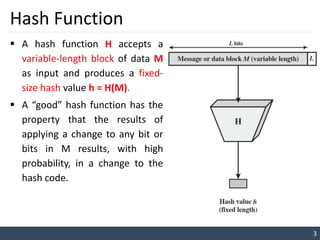
 A hash function H accepts a
variable-length block of data M
as input and produces a fixed-
size hash value h = H(M).
 A “good” hash function has the
property that the results of
applying a change to any bit or
bits in M results, with high
probability, in a change to the
hash code.
4
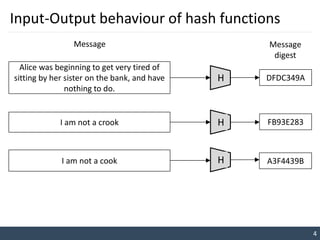
Input-Output behaviour of hash functions
Alice was beginning to get very tired of
sitting by her sister on the bank, and have
nothing to do.
I am not a crook
I am not a cook H
H
H DFDC349A
FB93E283
A3F4439B
Message Message
digest
5
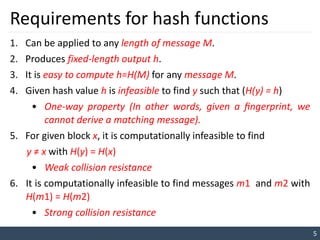
Requirements for hash functions
1. Can be applied to any length of message M.
2. Produces fixed-length output h.
3. It is easy to compute h=H(M) for any message M.
4. Given hash value h is infeasible to find y such that (H(y) = h)
• One-way property (In other words, given a fingerprint, we
cannot derive a matching message).
5. For given block x, it is computationally infeasible to find
y ≠ x with H(y) = H(x)
• Weak collision resistance
6. It is computationally infeasible to find messages m1 and m2 with
H(m1) = H(m2)
• Strong collision resistance
6
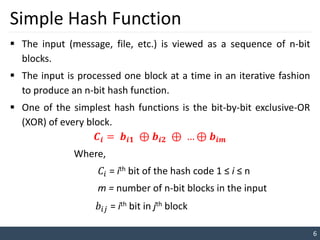
Simple Hash Function
 The input (message, file, etc.) is viewed as a sequence of n-bit
blocks.
 The input is processed one block at a time in an iterative fashion
to produce an n-bit hash function.
 One of the simplest hash functions is the bit-by-bit exclusive-OR
(XOR) of every block.
𝑪𝒊 = 𝒃𝒊𝟏 ⊕ 𝒃𝒊𝟐 ⊕ … ⊕ 𝒃𝒊𝒎
Where,
𝐶𝑖 = ith bit of the hash code 1 ≤ i ≤ n
m = number of n-bit blocks in the input
𝑏𝑖𝑗 = ith bit in jth block

2.15 Message Authentication Code and Hash Functions.pptx

  • 1.
    SRI KRISHNA COLLEGEOF ENGINEERING AND TECHNOLOGY Kuniamuthur, Coimbatore, Tamilnadu, India An Autonomous Institution, Affiliated to Anna University, Accredited by NAAC with “A” Grade & Accredited by NBA (CSE, ECE, IT, MECH ,EEE, CIVIL& MCT) COURSE MATERIALMATERIAL Course : 20EC603 – Fundamentals of Network Security Module - 2: Public Key Cryptography and authentication requirements Topics : Message authentication code and Hash functions www.skcet.ac.in
  • 2.
    2 Outline  Cryptographic HashFunctions  Applications  Simple hash functions  Requirements and security  Hash functions based on Cipher Block Chaining  Secure Hash Algorithm (SHA)
  • 3.
    3 Hash Function  Ahash function H accepts a variable-length block of data M as input and produces a fixed- size hash value h = H(M).  A “good” hash function has the property that the results of applying a change to any bit or bits in M results, with high probability, in a change to the hash code.
  • 4.
    4 Input-Output behaviour ofhash functions Alice was beginning to get very tired of sitting by her sister on the bank, and have nothing to do. I am not a crook I am not a cook H H H DFDC349A FB93E283 A3F4439B Message Message digest
  • 5.
    5 Requirements for hashfunctions 1. Can be applied to any length of message M. 2. Produces fixed-length output h. 3. It is easy to compute h=H(M) for any message M. 4. Given hash value h is infeasible to find y such that (H(y) = h) • One-way property (In other words, given a fingerprint, we cannot derive a matching message). 5. For given block x, it is computationally infeasible to find y ≠ x with H(y) = H(x) • Weak collision resistance 6. It is computationally infeasible to find messages m1 and m2 with H(m1) = H(m2) • Strong collision resistance
  • 6.
    6 Simple Hash Function The input (message, file, etc.) is viewed as a sequence of n-bit blocks.  The input is processed one block at a time in an iterative fashion to produce an n-bit hash function.  One of the simplest hash functions is the bit-by-bit exclusive-OR (XOR) of every block. 𝑪𝒊 = 𝒃𝒊𝟏 ⊕ 𝒃𝒊𝟐 ⊕ … ⊕ 𝒃𝒊𝒎 Where, 𝐶𝑖 = ith bit of the hash code 1 ≤ i ≤ n m = number of n-bit blocks in the input 𝑏𝑖𝑗 = ith bit in jth block

Editor's Notes

  • #3 X.800 and RFC 2828 International Telecommunication Union (ITU)