

Sexual arousal and intercourse
• humans
ABHISHEK JAGUESSAR
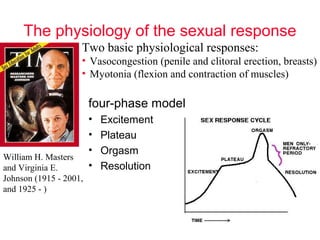
The physiology of the sexual response
William H. Masters
and Virginia E.
Johnson (1915 - 2001,
and 1925 - )
Two basic physiological responses:
• Vasocongestion (penile and clitoral erection, breasts)
• Myotonia (flexion and contraction of muscles)
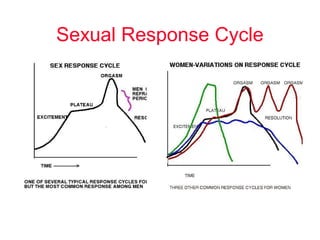
four-phase model
• Excitement
• Plateau
• Orgasm
• Resolution
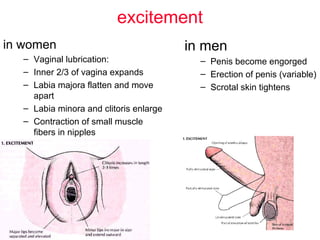
excitement
in women
– Vaginal lubrication:
– Inner 2/3 of vagina expands
– Labia majora flatten and move
apart
– Labia minora and clitoris enlarge
– Contraction of small muscle
fibers in nipples
in men
– Penis become engorged
– Erection of penis (variable)
– Scrotal skin tightens
Plateau
•women
–Prominent vasocongestion
in outer 2/3 of vagina
cause tissue to swell
–Clitoris pulled back against
pubic bone
• men
–Full erection of penis
–Muscular tension
–Cowper’s glands secrete
the pre-ejaculatory fluid
–Testes are pulled up
closely against the body
Orgasm
• women
– Contractions at 0.8
second intervals
– Contractions of vagina,
uterus and anal
sphincter
–
• men
– Rhythmic contractions
of genital ducts,
muscles at the base of
the penis, and penis
– May be followed by
ejaculation of semen
resolution
– Return to pre-orgasmic state
Sexual Response Cycle
Problems with Masters & Johnson
Theoretical Model
• Model does not allow for individual variation, and suggests
that most people proceed smoothly through discrete stages.
• Model focuses on orgasm as the climax of a sexual encounter;
may deemphasize other forms of sexual pleasure, and
pressure couples to meet this sexual “goal”.
• Model is physiological, and does not include cognitive or
emotional aspects of sexuality.
– Implication may be that sexual function (and dysfunctions)
are mainly physiological, rather than psychological or
relational
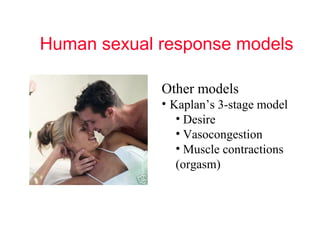
Human sexual response models
Other models
• Kaplan’s 3-stage model
• Desire
• Vasocongestion
• Muscle contractions
(orgasm)
Human sexual response models
Walen and Roth’s cognitive model
Emphasizes the thoughts and feelings that must
occur for physiological arousal to happen.
1. Perception of a stimulus: “That’s sexy!”
2. Positive evaluation of perception: “I like
that!”
3. Physiological Arousal
4. Perception of Arousal: “I’m turned on!”
5. Positive evaluation of arousal: “in the mood!”
6. Sexual Behaviors
7. Perception of Behaviors: “We’re getting it
on.”
8. Evaluation of Behaviors: “That was fun!”
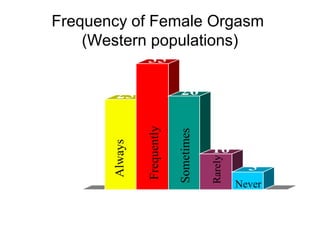
Frequency of Female Orgasm
(Western populations)
25
35
26
10
5
0
5
10
15
20
25
30
35
%FrequencyofOrgas
Always
Frequently
Sometimes
Rarely
Never
How do women achieve orgasm?
• 95% women said could
orgasm easily with
masturbation
• Women masturbate through
manual stimulation of clitoris
• 1.5% through vaginal insertion
alone
• Little cross-cultural
information
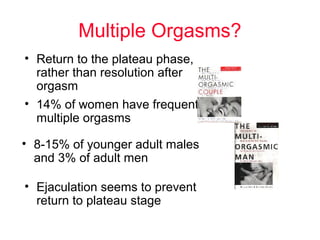
Multiple Orgasms?
• 14% of women have frequent
multiple orgasms
• Return to the plateau phase,
rather than resolution after
orgasm
• 8-15% of younger adult males
and 3% of adult men
• Ejaculation seems to prevent
return to plateau stage
Spare slides
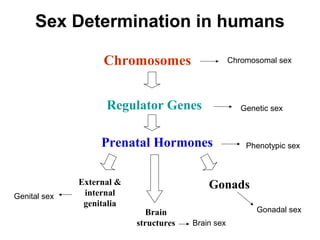
Regulator Genes
Prenatal Hormones
Chromosomes
Gonads
Sex Determination in humans
External &
internal
genitalia
Chromosomal sex
Genital sex
Genetic sex
Phenotypic sex
Gonadal sexBrain
structures Brain sex
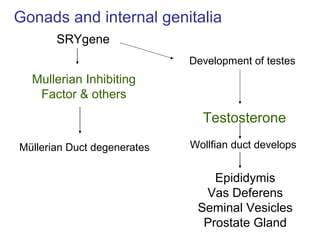
Wollfian duct develops
Epididymis
Vas Deferens
Seminal Vesicles
Prostate Gland
Testosterone
Gonads and internal genitalia
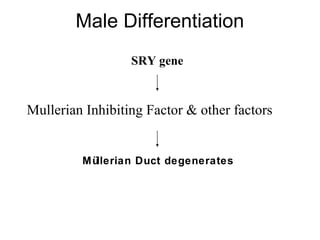
Müllerian Duct degenerates
SRYgene
Mullerian Inhibiting
Factor & others
Development of testes
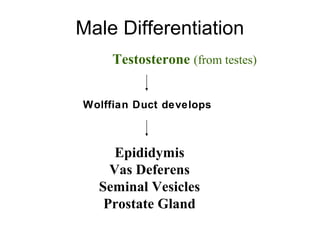
Male Differentiation
Wolffian Duct develops
Epididymis
Vas Deferens
Seminal Vesicles
Prostate Gland
Testosterone (from testes)
Male Differentiation
Müllerian Duct degenerates
SRY gene
Mullerian Inhibiting Factor & other factors
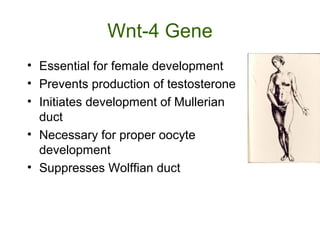
Wnt-4 Gene
• Essential for female development
• Prevents production of testosterone
• Initiates development of Mullerian
duct
• Necessary for proper oocyte
development
• Suppresses Wolffian duct
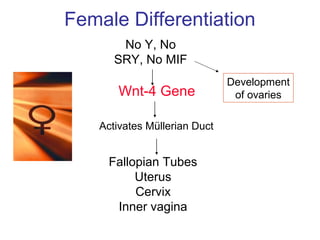
Female Differentiation
Activates Müllerian Duct
Fallopian Tubes
Uterus
Cervix
Inner vagina
Wnt-4 Gene
No Y, No
SRY, No MIF
Development
of ovaries

Sexual Arousal and Intercourse

  • 1.
    Sexual arousal andintercourse • humans ABHISHEK JAGUESSAR
  • 2.
    The physiology ofthe sexual response William H. Masters and Virginia E. Johnson (1915 - 2001, and 1925 - ) Two basic physiological responses: • Vasocongestion (penile and clitoral erection, breasts) • Myotonia (flexion and contraction of muscles) four-phase model • Excitement • Plateau • Orgasm • Resolution
  • 3.
    excitement in women – Vaginallubrication: – Inner 2/3 of vagina expands – Labia majora flatten and move apart – Labia minora and clitoris enlarge – Contraction of small muscle fibers in nipples in men – Penis become engorged – Erection of penis (variable) – Scrotal skin tightens
  • 4.
    Plateau •women –Prominent vasocongestion in outer2/3 of vagina cause tissue to swell –Clitoris pulled back against pubic bone • men –Full erection of penis –Muscular tension –Cowper’s glands secrete the pre-ejaculatory fluid –Testes are pulled up closely against the body
  • 5.
    Orgasm • women – Contractionsat 0.8 second intervals – Contractions of vagina, uterus and anal sphincter – • men – Rhythmic contractions of genital ducts, muscles at the base of the penis, and penis – May be followed by ejaculation of semen
  • 6.
    resolution – Return topre-orgasmic state
  • 7.
  • 8.
    Problems with Masters& Johnson Theoretical Model • Model does not allow for individual variation, and suggests that most people proceed smoothly through discrete stages. • Model focuses on orgasm as the climax of a sexual encounter; may deemphasize other forms of sexual pleasure, and pressure couples to meet this sexual “goal”. • Model is physiological, and does not include cognitive or emotional aspects of sexuality. – Implication may be that sexual function (and dysfunctions) are mainly physiological, rather than psychological or relational
  • 9.
    Human sexual responsemodels Other models • Kaplan’s 3-stage model • Desire • Vasocongestion • Muscle contractions (orgasm)
  • 10.
    Human sexual responsemodels Walen and Roth’s cognitive model Emphasizes the thoughts and feelings that must occur for physiological arousal to happen. 1. Perception of a stimulus: “That’s sexy!” 2. Positive evaluation of perception: “I like that!” 3. Physiological Arousal 4. Perception of Arousal: “I’m turned on!” 5. Positive evaluation of arousal: “in the mood!” 6. Sexual Behaviors 7. Perception of Behaviors: “We’re getting it on.” 8. Evaluation of Behaviors: “That was fun!”
  • 11.
    Frequency of FemaleOrgasm (Western populations) 25 35 26 10 5 0 5 10 15 20 25 30 35 %FrequencyofOrgas Always Frequently Sometimes Rarely Never
  • 12.
    How do womenachieve orgasm? • 95% women said could orgasm easily with masturbation • Women masturbate through manual stimulation of clitoris • 1.5% through vaginal insertion alone • Little cross-cultural information
  • 13.
    Multiple Orgasms? • 14%of women have frequent multiple orgasms • Return to the plateau phase, rather than resolution after orgasm • 8-15% of younger adult males and 3% of adult men • Ejaculation seems to prevent return to plateau stage
  • 14.
  • 15.
    Regulator Genes Prenatal Hormones Chromosomes Gonads SexDetermination in humans External & internal genitalia Chromosomal sex Genital sex Genetic sex Phenotypic sex Gonadal sexBrain structures Brain sex
  • 17.
    Wollfian duct develops Epididymis VasDeferens Seminal Vesicles Prostate Gland Testosterone Gonads and internal genitalia Müllerian Duct degenerates SRYgene Mullerian Inhibiting Factor & others Development of testes
  • 18.
    Male Differentiation Wolffian Ductdevelops Epididymis Vas Deferens Seminal Vesicles Prostate Gland Testosterone (from testes)
  • 19.
    Male Differentiation Müllerian Ductdegenerates SRY gene Mullerian Inhibiting Factor & other factors
  • 20.
    Wnt-4 Gene • Essentialfor female development • Prevents production of testosterone • Initiates development of Mullerian duct • Necessary for proper oocyte development • Suppresses Wolffian duct
  • 21.
    Female Differentiation Activates MüllerianDuct Fallopian Tubes Uterus Cervix Inner vagina Wnt-4 Gene No Y, No SRY, No MIF Development of ovaries

Editor's Notes

  • #13 
  • #16 Under typical circumstances, the sex of an individual will be determined and expressed through the following mechanisms: Chromosomal Sex: Presence or absence of Y chromosome Genetic Sex (Primary Sex Determination): Controlled by presence or absence of testis determining factor (TDF) Phenotypic Sex (Secondary Sex Differentiation): Determined by the hormonal products produced by the gonads.
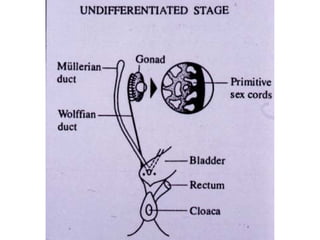
  • #17 SLIDE:Undifferentiated Stage Starting off the embryo has two types of ducts, which are important to remember, the Mullerian Duct and the Wolffian duct. So both sexes start out with the rudiments of male and female reproductive systems and one system must be eliminated. There are a number of hormones and ultimately genes that control the development or elimination of these ducts. Lets first consider male development. Males release a hormone called Müllerian Inhibiting Substance (MIS) which destroys the female duct. Males also make testosterone to promote differentiation of the rudimentary Wolffian duct into sperm ducts (epididymis and vas deferens) and seminal vesicles. If there is no testosterone then the Wollfian duct degenerates. Or so it was thought.
  • #21 A 3rd gene is the Wnt-4 gene whose action was discovered in the last few years by Harvard researchers. Wnt-4 suppresses development of the male sex system by preventing production of testosterone. AT the same time it initiates development of the Müllerian duct which gives rise to the oviduct, uterus and upper vagina. And also apparently in egg development. Professor Andrew McMahon here at Harvard of Molecular and Cellular Biology was working with mice investigatng a gene called Wnt-4 which is involved in kidney development. Kidneys lie close to the gonads in both mice and humans and when he was examining the kidneys of the miceSeppo Vainio a postdoctoral fellow discovered that female mice with mutnat Wnt genes appeared to be developing male sexual organs. Thus, they speculated that Wnt genes were masculinizing the females. And what he discovered after three years of research is that mice must have a properly functioning Wnt gene in order to develop into a female. Although this hasn't been demonstrated for humans, all mammals seem to be very similar in the regulation of sexual develpment so it most likely similar in humans. This sex determining activity starts during the first 3 months of pregnancy in humans.