SELF LEARNING MATERIAL
Reaching At The Age Of Adolescence
By: ShaikhFarzin
Id No. : 14162073
REACHING THE AGE OF ADOLESCENCE
In the previous times, you must have learnt
how animals reproduce. It is only after
‘growing up’ to a certain age that human
beings and many other animals can reproduce.
Why can humans reproduce only after a certain
age?
In this section, you will learn about
changes that take place in the human body
after which a person becomes capable of
reproduction.
Here, we shall discuss the role that
hormones play in bringing about changes that
make a child grow into an adult.
1.1 Adolescence andPuberty
Boojho was celebrating his 12th birthday.
After his friends left, Boojho and Paheli began
chatting with their parents. Paheli studies in an
all-girls school. She started laughing. She
remarked that many of Boojho’s school
friends, whom she met after a year, had
suddenly shot up in height. Some of them were
looking very funny with a hairy line above
their lips. Her mother explained that the boys
had grown up.
Growth begins from the day one is born.
But upon crossing the age of 10 or 11, there is
a sudden spurt in growth which becomes
noticeable. The changes taking place in the
body are part of growing up. They indicate that
you are
no longer a child but are on the way to
becoming an adult.
I wonder how long this period
marked by changes in the body
will last!
It is a strange period of life when you are
neither a child nor an adult. I wonder
whether this period between childhood
and adulthood had a special name!
Growing up is a natural process. The
period of life, when the body undergoes
changes, leading to reproductive maturity, is
called adolescence. Adolescence begins
around the age of 11 and lasts upto 18 or 19
years of age. Since this period covers the
‘teens’ (13 to 18 or 19 years of age),
adolescents are also called ‘teenagers’. In girls,
adolescence may begin a year or two earlier
than in boys. Also, the period of adolescence
varies from person to person.
The human body undergoes several
changes during adolescence. These changes
mark the onset of puberty. The most important
change which marks puberty is that boys and
girls become capable of reproduction. Puberty
ends when an adolescent reaches reproductive
maturity.
Paheli and Boojho realised
that sudden increase in height
and hairy line above the lips
in boys were signs of
adolescence. They wanted to
know more about other
changes at puberty.
1.2 Changes at Puberty
Increase in Height
The most conspicuous change during puberty
is the sudden increase in height. At this time
the long bones, that is, the bones of the arms
and the legs elongate and make a person tall.
Activity 1.1
The following chart gives the average rate
of growth in height of boys and girls with
age. The figures in columns 2 and 3, give
the percentage of the height a person has
reached at the age given in column 1. For
example, by the age 11, a boy has reached
81% of his probable full height, while a
girl has reached 88% of her full height.
These figures are only representative and
there may be individual variations.
Use the Table for your friends and
work out how tall they are likely to be.
Find out who is likely to be
the tallest and who might be the shortest
in your class.
Age in % of full height
Years Boys Girls
8 72% 77%
9 75% 81%
10 78% 84%
11 81% 88%
12 84% 91%
13 88% 95%
14 92% 98%
15 95% 99%
16 98% 99.5%
17 99% 100%
18 100% 100%
Calculation for full height (cm)
Present height ( cm)
 100
% of full height at this age
(as given in the chart)
Example:
A boy is 9 years old and 120 cm tall. At
the end of the growth period he is likely
to be
120  100 cm = 160 cm tall
75
3 SCIENCE
Activity 1.2
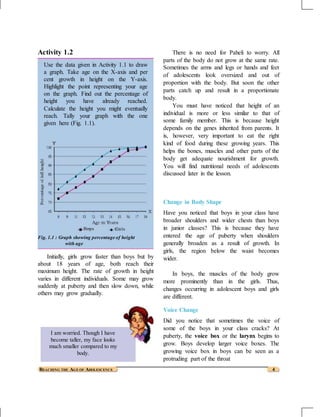
Use the data given in Activity 1.1 to draw
a graph. Take age on the X-axis and per
cent growth in height on the Y-axis.
Highlight the point representing your age
on the graph. Find out the percentage of
height you have already reached.
Calculate the height you might eventually
reach. Tally your graph with the one
given here (Fig. 1.1).
Fig. 1.1 : Graph showing percentage of height
with age
Initially, girls grow faster than boys but by
about 18 years of age, both reach their
maximum height. The rate of growth in height
varies in different individuals. Some may grow
suddenly at puberty and then slow down, while
others may grow gradually.
I am worried. Though I have
become taller, my face looks
much smaller compared to my
body.
There is no need for Paheli to worry. All
parts of the body do not grow at the same rate.
Sometimes the arms and legs or hands and feet
of adolescents look oversized and out of
proportion with the body. But soon the other
parts catch up and result in a proportionate
body.
You must have noticed that height of an
individual is more or less similar to that of
some family member. This is because height
depends on the genes inherited from parents. It
is, however, very important to eat the right
kind of food during these growing years. This
helps the bones, muscles and other parts of the
body get adequate nourishment for growth.
You will find nutritional needs of adolescents
discussed later in the lesson.
Change in Body Shape
Have you noticed that boys in your class have
broader shoulders and wider chests than boys
in junior classes? This is because they have
entered the age of puberty when shoulders
generally broaden as a result of growth. In
girls, the region below the waist becomes
wider.
In boys, the muscles of the body grow
more prominently than in the girls. Thus,
changes occurring in adolescent boys and girls
are different.
Voice Change
Did you notice that sometimes the voice of
some of the boys in your class cracks? At
puberty, the voice box or the larynx begins to
grow. Boys develop larger voice boxes. The
growing voice box in boys can be seen as a
protruding part of the throat
REACHING THE AGE OF ADOLESCENCE 4
called Adam’s apple (Fig. 1.2). In girls, the
larynx is hardly visible from the outside
because of its small size. Generally, girls have
a high pitched voice, whereas boys have a deep
voice. In adolescent boys, sometimes, the
muscles of the growing voice box go out of
control and the voice becomes hoarse. This
state may remain for a few days or weeks after
which the voice becomes normal.
Adam’s
apple
Fig. 1.2 : Adam’s apple in a grown up boy
Many of my classmates have a
hoarse voice. Now I know why?
Increased Activity of Sweat and
Sebaceous Glands
During puberty the secretion of sweat glands
and sebaceous glands (oil glands) increases.
Many young people get acne
A few glands such as sweat glands, oil glands
and salivary glands release their secretions
through ducts. Endocrine glands release
hormones directly into the bloodstream. So,
they are also termed ductless glands.
and pimples on the face at this time because of
the increased activity of these glands in the
skin.
Development of Sex Organs
Look up figures of the previous lesson which
shows sex organs of humans. At puberty, male
sex organs like the testes and penis develop
completely. The testes also begin to produce
sperms. In girls, the ovaries enlarge and eggs
begin to mature. Also ovaries start releasing
mature eggs.
Reaching Mental, Intellectual and
Emotional Maturity
Adolescence is also a period of change in a
person’s way of thinking. Adolescents are
more independent than before and are also self
conscious. Intellectual development takes
place and they tend to spend considerable time
thinking. In fact, it is often the time in one’s
life when the brain has the greatest capacity for
learning. Sometimes, however, an adolescent
may feel insecure while trying to adjust to the
changes in the body and mind. But as
adolescent learners, you should know that
there is no reason to feel insecure. These
changes are a natural part of growing up.
1.3 Secondary Sexual
Characters
You have learnt in previous chapter , that
testes and ovaries are the reproductive organs.
They produce the gametes, that is, sperms and
ova. In girls, breasts begin to develop at
puberty
5 SCIENCE
and boys begin to grow facial hair, that is,
moustaches and beard. As these features help
to distinguish the male from the female they
are called secondary sexual characters. Boys
also develop hair on their chest. In both, boys
and girls, hair grows under the arms and in the
region above the thighs or the pubic region.
Both Boojho and Paheli wish to know what
initiates changes at puberty.
The changes which occur at adolescence
are controlled by hormones. Hormones are
chemical substances. These are secretions from
endocrine glands, or endocrine system. The
male hormone or testosterone begins to be
released by the testes at the onset of puberty.
This causes changes in boys about which you
have just learnt, for example, the growth of
facial hair. Once puberty is reached in girls,
ovaries begin to produce the female hormone
or estrogen which makes the breasts develop.
Milk secreting glands or mammary glands
develop inside the breasts. The production of
these hormones is under the control of another
hormone secreted from an endocrine gland
called pituitary gland.
1.4 Role of Hormones in
Initiating Reproductive
Function
Endocrine glands release hormones into the
bloodstream to reach a particular body part
called target site. The target site responds to
the hormone. There are many endocrine glands
or ductless glands in the body.
The testes and ovaries secrete sex hormones.
You have just learnt that these hormones are
responsible for the male and female secondary
sexual characters. Further, the sex hormones
are under the control of hormones from the
pituitary gland (Fig. 1.3). The pituitary secretes
many hormones, one of which makes ova
mature in the ovaries and sperms form in the
testes.
Fig. 1.3 : The onset of puberty is controlled by
hormones
Paheli and Boojho have now understood that
puberty marks the beginning of the
reproductive period when one becomes
capable of reproduction. But they want to
know if reproductive life, once begun,
continues, or it ends some time.
REACHING THE AGE OF ADOLESCENCE 6
1.5 Reproductive Phase of Life
in Humans
Adolescents become capable of reproduction
when their testes and ovaries begin to produce
gametes. The capacity for maturation and
production of gametes lasts for a much longer
time in males than in females.
In females, the reproductive phase of life
begins at puberty (10 to 12 years of age) and
generally lasts till the age of approximately 45
to 50 years. The ova begin to mature with the
onset of puberty. One ovum matures and is
released by one of the ovaries once in about 28
to 30 days. During this period, the wall of the
uterus becomes thick so as to receive the egg,
in case it is fertilized and begins to develop.
This results in pregnancy. If fertilization does
not occur, the released egg, and the thickened
lining of the uterus along with its blood vessels
are shed off. This causes bleeding in women
which is called menstruation. Menstruation
occurs once in about 28 to 30 days. The first
menstrual flow begins at puberty and is termed
menarche. At 45 to 50 years of age, the
menstrual cycle stops. Stoppage of
menstruation is termed menopause. Initially,
menstrual cycle may be irregular. It take some
time to become regular.
Paheli says that the
reproductive life of a woman
lasts from menarche to
menopause. Is she right?
Menstrual cycle is controlled by hormones.
The cycle includes the maturation of the egg,
its release, thickening of uterine wall and its
breakdown if pregnancy does not occur. In
case the egg is fertilized it begins to divide and
then gets embedded in the uterus for further
development as you have learnt in previous
Chapter.
1.6 How is the Sex of the Baby
Determined?
I heard my mother and my aunt
talking about my cousin who is going
to have a baby. They were discussing
whether she would give birth to a boy
or a girl. I wonder what makes the
fertilised egg develop either into a boy
or a girl!
Boy or Girl?
Inside the fertilized egg or zygote is the
instruction for determining the sex of the baby.
This instruction is present in the thread-like
structures, called chromosomes in the
fertilized egg. Recall from Chapter 8, that
chromosomes are present inside the nucleus of
every cell. All human beings have 23 pairs of
chromosomes in the nuclei of their cells. Two
chromosomes out of these are the sex
chromosomes, named X and Y. A female has
two X chromosomes, while a male has one X
and one Y chromosome. The gametes (egg and
sperm) have only one set of chromosomes. The
unfertilised egg always has one X
chromosome. But
7 SCIENCE
sperms are of two kinds. One kind has an X
chromosome, and the other kind has a Y
chromosome.
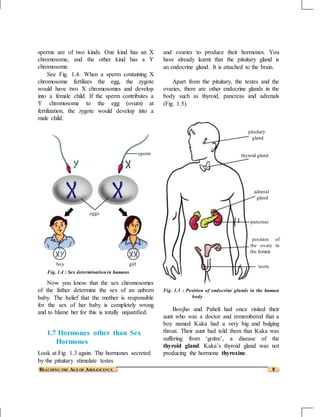
See Fig. 1.4. When a sperm containing X
chromosome fertilizes the egg, the zygote
would have two X chromosomes and develop
into a female child. If the sperm contributes a
Y chromosome to the egg (ovum) at
fertilization, the zygote would develop into a
male child.
sperm
eggs
boy girl
Fig. 1.4 : Sex determinationin humans
Now you know that the sex chromosomes
of the father determine the sex of an unborn
baby. The belief that the mother is responsible
for the sex of her baby is completely wrong
and to blame her for this is totally unjustified.
1.7 Hormones other than Sex
Hormones
Look at Fig. 1.3 again. The hormones secreted
by the pituitary stimulate testes
and ovaries to produce their hormones. You
have already learnt that the pituitary gland is
an endocrine gland. It is attached to the brain.
Apart from the pituitary, the testes and the
ovaries, there are other endocrine glands in the
body such as thyroid, pancreas and adrenals
(Fig. 1.5).
pituitary
gland
thyroid gland
adrenal
gland
pancreas
position of
the ovary in
the female
testis
Fig. 1.5 : Position of endocrine glands in the human
body
Boojho and Paheli had once visited their
aunt who was a doctor and remembered that a
boy named Kaka had a very big and bulging
throat. Their aunt had told them that Kaka was
suffering from ‘goitre’, a disease of the
thyroid gland. Kaka’s thyroid gland was not
producing the hormone thyroxine.
REACHING THE AGE OF ADOLESCENCE 8
Their aunt also told them that their uncle was
suffering from ‘diabetes’ because his pancreas
was not producing the hormone insulin in
sufficient quantities. Boojho and Paheli then
asked their aunt about the adrenal glands,
which are also shown in the chart hung on the
wall of her clinic. The aunt told them that
adrenal glands secrete hormones which
maintain the correct salt balance in the blood.
Adrenals also produce the hormone adrenalin.
It helps the body to adjust to stress when one is
very angry, embarrassed or worried.
Thyroid and adrenals secrete their
hormones when they receive orders from the
pituitary through its hormones. Pituitary also
secretes growth hormone which is necessary
for the normal growth of a person.
Are there hormones in other
animals also? Have they any
role to play in reproduction?
1.8 Role of Hormones in
completing the Life History
of Insects and Frogs
You have already learnt about the life history
of the silk moth and the frog. The caterpillar
has to pass through various stages to become
an adult moth. Recall from previous classes the
stages of the life history of the silk moth.
Similarly, the tadpole passes through certain
stages to become a frog.
This change from larva to adult is called
metamorphosis. Metamorphosis in insects is
controlled by insect hormones. In a frog, it is
controlled by thyroxine, the hormone
produced by thyroid. Thyroxine production
requires the presence of iodine in water. If the
water in which the tadpoles are growing does
not contain sufficient iodine, the tadpoles
cannot become adults.
If people do not have enough
iodine in their diet, will they get
goitre caused by lack of
thyroxine?
Activity 1.3
Collect information from magazines or
from doctors and prepare a note on the
importance of consuming iodised salt.
You can also look for this information on
the internet.
1.9 Reproductive Health
The physical and mental well being of an
individual is regarded as an individual’s health.
To keep the body healthy, every human being,
at any age, needs to have a balanced diet. The
person must also observe personal hygiene and
undertake adequate physical exercise.
During adolescence, however, these
become even more essential as the body is
growing.
Nutritional Needs of the Adolescents
Adolescence is a stage of rapid growth and
development. Hence the diet for an
9 SCIENCE
adolescent has to be carefully planned. You
have already learnt what a balanced diet is.
Recall that a balanced diet means that the
meals include proteins, carbohydrates, fats and
vitamins in requisite proportions. Our Indian
meal of roti/rice, dal (pulses) and vegetables is
a balanced meal. Milk is a balanced food in
itself. Fruits also provide nourishment. For
infants, mother’s milk provides all the
nourishment that they need.
Iron builds blood and iron-rich food such
as leafy vegetables, jaggery, meat, citrus,
Indian gooseberry (amla) are good for
adolescents.
Check items for lunch and dinner in your
meal. Is the meal balanced and nutritious?
Does it include cereals which give energy and
milk, meat, nuts and pulses which provide
proteins for growth? Also, does it include fats
and sugar that give energy? What about fruits
and vegetables which are protective foods?
Chips and packed or tinned snacks, though
very tasty should never replace regular
meals as they do not have adequate
nutritional value.
Activity 1.4
Make a group with your friends. Write
down the items of food in your breakfast,
lunch and dinner you had on the previous
day. Identify the items responsible for
proper growth. Also identified the junk
food that you consumed the previous day.
Activity 1.5
Get ideas from the pictures given in
Fig.1.6. Prepare charts or posters and
paste them in the class so that you are
aware of the diet for adolescents. You
may use your creative ideas and present it
like an advertisement. You may even
organise a competition on this topic.
meat
vegetables
milk and
eggs
fruits
grains
Fig. 1.6 : Nutritious items of food
Personal Hygiene
Everyone should have a bath at least once
everyday. It is more necessary for teenagers
because the increased activity of sweat glands
sometimes makes the body smelly. All parts of
the body should be washed and cleaned
everyday. If
REACHING THE AGE OF ADOLESCENCE 10
cleanliness is not maintained there are chances
of catching bacterial infection. Girls should
take special care of cleanliness during the time
of menstrual flow. They should keep track of
their menstrual cycle and be prepared for the
onset of menstruation.
Physical exercise
Walking and playing in fresh air keeps the
body fit and healthy. All young boys and girls
should take walks, exercise and play outdoor
games.
Myths, Taboos, Do’s and Don’ts
You have learnt here and from Chapter 9 the
scientific facts related to human reproduction.
There are many wrong notions which you
should now be able to discard as informed
adolescents. For example, there are myths and
taboos regarding bodily changes that
adolescents experience. Some of these are
given below and you can now argue why
these are myths and not facts.
1. A girl becomes pregnant if she looks at
boys during menstruation.
2. The mother is responsible for the sex of
her child.
3. A girl should not be allowed to
work in the kitchen during menstruation.
You may come across many other myths and
taboos. Discard them.
Activity 1.6
Collect data on the number of children in
your class who exercise regularly and
who do not exercise regularly. Did you
notice any difference in their fitness and
health? Prepare a report on the benefits of
regular exercise.
Say “NO” to Drugs
Adolescence is a period of much activity in the
body and mind which is a normal part of
growing up. So do not feel confused or
insecure. If anybody suggests that you will get
relief if you take some drugs, just say ‘No’
unless prescribed by the doctor. Drugs are
addictive. If you take them once, you feel like
taking them again and again. They harm the
body in the long run. They ruin health and
happiness.
You must have heard about AIDS which is
caused by a dangerous virus, HIV. This virus
can pass on to a normal person from an
infected person by sharing the syringes used
for injecting drugs. It can also be transmitted to
an infant from the infected mother through her
milk. The virus can also be transmitted through
sexual contact with a person infected with
HIV.
Adolescent Pregnancy
You might be knowing that in our country, the legal age for marriage is 18 years for girls and 21
years for boys. This is because teenage mothers are not prepared mentally or physically for
motherhood. Early marriage and motherhood cause health problems in the mother and the child. It
also curtails employment opportunities for the young woman and may cause mental agony as she is
not ready for responsibilities of motherhood.
11 SCIENCE
KEYWORDS
ADAM’S APPLE
ADOLESCENCE
ADRENALIN
BALANCED DIET
ENDOCRINE GLANDS
ESTROGEN
HORMONES
INSULIN
PITUITARY GLAND
PUBERTY
REPRODUCTIVE
HEALTH
SECONDARY SEXUAL
CHARACTERS
SEX CHROMOSOMES
TARGET SITE
TESTOSTERONE
THYROXINE
VOICE BOX
WHAT YOU HAVE LEARNT
o Humans become capable of reproduction af-
ter puberty sets in. Between the ages of 11
years and 19 years children are called ado-
lescents.
o The onset of puberty brings about growth of
the reproductive organs. Hair grow at various
places on the body. Breasts develop in girls
and facial hair (moustache and beard) appear
in boys. Voice of boys becomes hoarse as
voice box enlarges during adolescence.
o Children gain height during adolescence.
o The onset of puberty and maturity of
reproductive parts are controlled by
hormones.
o Hormones are secretions of endocrine glands
which pour them directly into the blood
stream.
o Pituitary gland secretes hormones which in-
clude growth hormone and hormones that
make other glands such as the testes, ovaries,
thyroids and adrenals, secrete hormones.
Pancreas secretes insulin, thyroid produces
thyroxine and adrenals produce adrenalin.
o Testosterone is the male hormone and
estrogen, the female hormone. The uterine
wall in females prepares itself to receive the
developing fertilised egg. In case there is no
fertilisation, the thickened lining of the
uterine wall breaks down and goes out of the
body along with blood. This is called
menstruation.
o Sex of the unborn child depends on whether
the zygote has XX or XY chromosomes.
o It is important to eat balanced food and
maintain personal hygiene during
adolescence.
Exercises
1. What is the term used for secretions of endocrine glands responsible for changes taking
place in the body?
2. Define adolescence.
3. What is menstruation? Explain.
4. List changes in the body that take place at puberty.
5. Prepare a Table having two columns depicting names of endocrine glands and
hormones secreted by them.
6. What are sex hormones? Why are they named so? State their function.
7. Choose the correct option.
(a) Adolescents should be careful about what they eat, because
(i) proper diet develops their brains.
(ii) proper diet is needed for the rapid growth taking place in their body.
(iii) adolescents feel hungry all the time.
(iv) taste buds are well developed in teenagers.
(b) Reproductive age in women starts when their
(i) menstruation starts.
(ii) breasts start developing.
(iii) body weight increases.
(iv) height increases.
(c) The right meal for adolescents consists of
(i) chips, noodles, coke.
(ii) chapati, dal, vegetables.
(iii) rice, noodles and burger.
(iv) vegetable cutlets, chips and lemon drink.
8. Write notes on—
(a) Adam’s apple.
(b) Secondary sexual characters.
(c) Sex determination in the unborn baby.
13 SCIENCE
EXERCISES
9. Word game : Use the clues to work out the words.
Across
3. Protruding voice box in boys
4. Glands without ducts
7. Endocrine gland attached to brain
8. Secretion of endocrine glands
9. Pancreatic hormone
10. Female hormone
Down
1. Male hormone
2. Secretes thyroxine
3. Another term for teenage
5. Hormone reaches here through blood stream
6. Voice box
7. Term for changes at adolescence
REACHING THE AGE OF ADOLESCENCE 14
10. The table below shows the data on likely heights of boys and girls as they grow in age.
Draw graphs showing height and age for both boys and girls on the same graph paper.
What conclusions can be drawn fromthese graphs?
Age Height (cm)
(Years) Boys Girls
0 53 53
4 96 92
8 114 110
12 129 133
16 150 150
20 173 165
Extended Learning — Activities and Projects
1. Find out from your elder relatives about their awareness of the legal status of
early marriage. You yourself may get information on it from your teacher,
parents, a doctor or the internet. Write a two-minute speech explaining why
early marriage is not good for the couple.
2. Collect newspaper cuttings and information in magazines about HIV/ AIDS.
Write a one page article of 15 to 20 sentences on HIV/AIDS.
3. In our country, according to a census, there are 882 adolescent females for
every 1000 males. Find out.
(a) the concerns of the community regarding this low ratio. Remember that
the chance of having a boy or a girl is equal.
(b) what amniocentesis is and how useful this technique is. Why is its use
for identification of sex of the unborn child banned in India?
4. Put your ideas together and write a short note on the importance of knowing
facts about reproduction.
For more information, visit :
www.teenshealth.org/teen/sexual_health/
www.ama_assn.org/ama/pub/category/1947.html
www.adolescenthealth.com
15 SCIENCE

Slm science farzin

  • 1.
    SELF LEARNING MATERIAL ReachingAt The Age Of Adolescence By: ShaikhFarzin Id No. : 14162073
  • 2.
    REACHING THE AGEOF ADOLESCENCE In the previous times, you must have learnt how animals reproduce. It is only after ‘growing up’ to a certain age that human beings and many other animals can reproduce. Why can humans reproduce only after a certain age? In this section, you will learn about changes that take place in the human body after which a person becomes capable of reproduction. Here, we shall discuss the role that hormones play in bringing about changes that make a child grow into an adult. 1.1 Adolescence andPuberty Boojho was celebrating his 12th birthday. After his friends left, Boojho and Paheli began chatting with their parents. Paheli studies in an all-girls school. She started laughing. She remarked that many of Boojho’s school friends, whom she met after a year, had suddenly shot up in height. Some of them were looking very funny with a hairy line above their lips. Her mother explained that the boys had grown up. Growth begins from the day one is born. But upon crossing the age of 10 or 11, there is a sudden spurt in growth which becomes noticeable. The changes taking place in the body are part of growing up. They indicate that you are no longer a child but are on the way to becoming an adult. I wonder how long this period marked by changes in the body will last! It is a strange period of life when you are neither a child nor an adult. I wonder whether this period between childhood and adulthood had a special name! Growing up is a natural process. The period of life, when the body undergoes changes, leading to reproductive maturity, is called adolescence. Adolescence begins around the age of 11 and lasts upto 18 or 19 years of age. Since this period covers the ‘teens’ (13 to 18 or 19 years of age), adolescents are also called ‘teenagers’. In girls, adolescence may begin a year or two earlier than in boys. Also, the period of adolescence varies from person to person. The human body undergoes several changes during adolescence. These changes mark the onset of puberty. The most important change which marks puberty is that boys and girls become capable of reproduction. Puberty ends when an adolescent reaches reproductive maturity.
  • 3.
    Paheli and Boojhorealised that sudden increase in height and hairy line above the lips in boys were signs of adolescence. They wanted to know more about other changes at puberty. 1.2 Changes at Puberty Increase in Height The most conspicuous change during puberty is the sudden increase in height. At this time the long bones, that is, the bones of the arms and the legs elongate and make a person tall. Activity 1.1 The following chart gives the average rate of growth in height of boys and girls with age. The figures in columns 2 and 3, give the percentage of the height a person has reached at the age given in column 1. For example, by the age 11, a boy has reached 81% of his probable full height, while a girl has reached 88% of her full height. These figures are only representative and there may be individual variations. Use the Table for your friends and work out how tall they are likely to be. Find out who is likely to be the tallest and who might be the shortest in your class. Age in % of full height Years Boys Girls 8 72% 77% 9 75% 81% 10 78% 84% 11 81% 88% 12 84% 91% 13 88% 95% 14 92% 98% 15 95% 99% 16 98% 99.5% 17 99% 100% 18 100% 100% Calculation for full height (cm) Present height ( cm)  100 % of full height at this age (as given in the chart) Example: A boy is 9 years old and 120 cm tall. At the end of the growth period he is likely to be 120  100 cm = 160 cm tall 75 3 SCIENCE
  • 4.
    Activity 1.2 Use thedata given in Activity 1.1 to draw a graph. Take age on the X-axis and per cent growth in height on the Y-axis. Highlight the point representing your age on the graph. Find out the percentage of height you have already reached. Calculate the height you might eventually reach. Tally your graph with the one given here (Fig. 1.1). Fig. 1.1 : Graph showing percentage of height with age Initially, girls grow faster than boys but by about 18 years of age, both reach their maximum height. The rate of growth in height varies in different individuals. Some may grow suddenly at puberty and then slow down, while others may grow gradually. I am worried. Though I have become taller, my face looks much smaller compared to my body. There is no need for Paheli to worry. All parts of the body do not grow at the same rate. Sometimes the arms and legs or hands and feet of adolescents look oversized and out of proportion with the body. But soon the other parts catch up and result in a proportionate body. You must have noticed that height of an individual is more or less similar to that of some family member. This is because height depends on the genes inherited from parents. It is, however, very important to eat the right kind of food during these growing years. This helps the bones, muscles and other parts of the body get adequate nourishment for growth. You will find nutritional needs of adolescents discussed later in the lesson. Change in Body Shape Have you noticed that boys in your class have broader shoulders and wider chests than boys in junior classes? This is because they have entered the age of puberty when shoulders generally broaden as a result of growth. In girls, the region below the waist becomes wider. In boys, the muscles of the body grow more prominently than in the girls. Thus, changes occurring in adolescent boys and girls are different. Voice Change Did you notice that sometimes the voice of some of the boys in your class cracks? At puberty, the voice box or the larynx begins to grow. Boys develop larger voice boxes. The growing voice box in boys can be seen as a protruding part of the throat REACHING THE AGE OF ADOLESCENCE 4
  • 5.
    called Adam’s apple(Fig. 1.2). In girls, the larynx is hardly visible from the outside because of its small size. Generally, girls have a high pitched voice, whereas boys have a deep voice. In adolescent boys, sometimes, the muscles of the growing voice box go out of control and the voice becomes hoarse. This state may remain for a few days or weeks after which the voice becomes normal. Adam’s apple Fig. 1.2 : Adam’s apple in a grown up boy Many of my classmates have a hoarse voice. Now I know why? Increased Activity of Sweat and Sebaceous Glands During puberty the secretion of sweat glands and sebaceous glands (oil glands) increases. Many young people get acne A few glands such as sweat glands, oil glands and salivary glands release their secretions through ducts. Endocrine glands release hormones directly into the bloodstream. So, they are also termed ductless glands. and pimples on the face at this time because of the increased activity of these glands in the skin. Development of Sex Organs Look up figures of the previous lesson which shows sex organs of humans. At puberty, male sex organs like the testes and penis develop completely. The testes also begin to produce sperms. In girls, the ovaries enlarge and eggs begin to mature. Also ovaries start releasing mature eggs. Reaching Mental, Intellectual and Emotional Maturity Adolescence is also a period of change in a person’s way of thinking. Adolescents are more independent than before and are also self conscious. Intellectual development takes place and they tend to spend considerable time thinking. In fact, it is often the time in one’s life when the brain has the greatest capacity for learning. Sometimes, however, an adolescent may feel insecure while trying to adjust to the changes in the body and mind. But as adolescent learners, you should know that there is no reason to feel insecure. These changes are a natural part of growing up. 1.3 Secondary Sexual Characters You have learnt in previous chapter , that testes and ovaries are the reproductive organs. They produce the gametes, that is, sperms and ova. In girls, breasts begin to develop at puberty 5 SCIENCE
  • 6.
    and boys beginto grow facial hair, that is, moustaches and beard. As these features help to distinguish the male from the female they are called secondary sexual characters. Boys also develop hair on their chest. In both, boys and girls, hair grows under the arms and in the region above the thighs or the pubic region. Both Boojho and Paheli wish to know what initiates changes at puberty. The changes which occur at adolescence are controlled by hormones. Hormones are chemical substances. These are secretions from endocrine glands, or endocrine system. The male hormone or testosterone begins to be released by the testes at the onset of puberty. This causes changes in boys about which you have just learnt, for example, the growth of facial hair. Once puberty is reached in girls, ovaries begin to produce the female hormone or estrogen which makes the breasts develop. Milk secreting glands or mammary glands develop inside the breasts. The production of these hormones is under the control of another hormone secreted from an endocrine gland called pituitary gland. 1.4 Role of Hormones in Initiating Reproductive Function Endocrine glands release hormones into the bloodstream to reach a particular body part called target site. The target site responds to the hormone. There are many endocrine glands or ductless glands in the body. The testes and ovaries secrete sex hormones. You have just learnt that these hormones are responsible for the male and female secondary sexual characters. Further, the sex hormones are under the control of hormones from the pituitary gland (Fig. 1.3). The pituitary secretes many hormones, one of which makes ova mature in the ovaries and sperms form in the testes. Fig. 1.3 : The onset of puberty is controlled by hormones Paheli and Boojho have now understood that puberty marks the beginning of the reproductive period when one becomes capable of reproduction. But they want to know if reproductive life, once begun, continues, or it ends some time. REACHING THE AGE OF ADOLESCENCE 6
  • 7.
    1.5 Reproductive Phaseof Life in Humans Adolescents become capable of reproduction when their testes and ovaries begin to produce gametes. The capacity for maturation and production of gametes lasts for a much longer time in males than in females. In females, the reproductive phase of life begins at puberty (10 to 12 years of age) and generally lasts till the age of approximately 45 to 50 years. The ova begin to mature with the onset of puberty. One ovum matures and is released by one of the ovaries once in about 28 to 30 days. During this period, the wall of the uterus becomes thick so as to receive the egg, in case it is fertilized and begins to develop. This results in pregnancy. If fertilization does not occur, the released egg, and the thickened lining of the uterus along with its blood vessels are shed off. This causes bleeding in women which is called menstruation. Menstruation occurs once in about 28 to 30 days. The first menstrual flow begins at puberty and is termed menarche. At 45 to 50 years of age, the menstrual cycle stops. Stoppage of menstruation is termed menopause. Initially, menstrual cycle may be irregular. It take some time to become regular. Paheli says that the reproductive life of a woman lasts from menarche to menopause. Is she right? Menstrual cycle is controlled by hormones. The cycle includes the maturation of the egg, its release, thickening of uterine wall and its breakdown if pregnancy does not occur. In case the egg is fertilized it begins to divide and then gets embedded in the uterus for further development as you have learnt in previous Chapter. 1.6 How is the Sex of the Baby Determined? I heard my mother and my aunt talking about my cousin who is going to have a baby. They were discussing whether she would give birth to a boy or a girl. I wonder what makes the fertilised egg develop either into a boy or a girl! Boy or Girl? Inside the fertilized egg or zygote is the instruction for determining the sex of the baby. This instruction is present in the thread-like structures, called chromosomes in the fertilized egg. Recall from Chapter 8, that chromosomes are present inside the nucleus of every cell. All human beings have 23 pairs of chromosomes in the nuclei of their cells. Two chromosomes out of these are the sex chromosomes, named X and Y. A female has two X chromosomes, while a male has one X and one Y chromosome. The gametes (egg and sperm) have only one set of chromosomes. The unfertilised egg always has one X chromosome. But 7 SCIENCE
  • 8.
    sperms are oftwo kinds. One kind has an X chromosome, and the other kind has a Y chromosome. See Fig. 1.4. When a sperm containing X chromosome fertilizes the egg, the zygote would have two X chromosomes and develop into a female child. If the sperm contributes a Y chromosome to the egg (ovum) at fertilization, the zygote would develop into a male child. sperm eggs boy girl Fig. 1.4 : Sex determinationin humans Now you know that the sex chromosomes of the father determine the sex of an unborn baby. The belief that the mother is responsible for the sex of her baby is completely wrong and to blame her for this is totally unjustified. 1.7 Hormones other than Sex Hormones Look at Fig. 1.3 again. The hormones secreted by the pituitary stimulate testes and ovaries to produce their hormones. You have already learnt that the pituitary gland is an endocrine gland. It is attached to the brain. Apart from the pituitary, the testes and the ovaries, there are other endocrine glands in the body such as thyroid, pancreas and adrenals (Fig. 1.5). pituitary gland thyroid gland adrenal gland pancreas position of the ovary in the female testis Fig. 1.5 : Position of endocrine glands in the human body Boojho and Paheli had once visited their aunt who was a doctor and remembered that a boy named Kaka had a very big and bulging throat. Their aunt had told them that Kaka was suffering from ‘goitre’, a disease of the thyroid gland. Kaka’s thyroid gland was not producing the hormone thyroxine. REACHING THE AGE OF ADOLESCENCE 8
  • 9.
    Their aunt alsotold them that their uncle was suffering from ‘diabetes’ because his pancreas was not producing the hormone insulin in sufficient quantities. Boojho and Paheli then asked their aunt about the adrenal glands, which are also shown in the chart hung on the wall of her clinic. The aunt told them that adrenal glands secrete hormones which maintain the correct salt balance in the blood. Adrenals also produce the hormone adrenalin. It helps the body to adjust to stress when one is very angry, embarrassed or worried. Thyroid and adrenals secrete their hormones when they receive orders from the pituitary through its hormones. Pituitary also secretes growth hormone which is necessary for the normal growth of a person. Are there hormones in other animals also? Have they any role to play in reproduction? 1.8 Role of Hormones in completing the Life History of Insects and Frogs You have already learnt about the life history of the silk moth and the frog. The caterpillar has to pass through various stages to become an adult moth. Recall from previous classes the stages of the life history of the silk moth. Similarly, the tadpole passes through certain stages to become a frog. This change from larva to adult is called metamorphosis. Metamorphosis in insects is controlled by insect hormones. In a frog, it is controlled by thyroxine, the hormone produced by thyroid. Thyroxine production requires the presence of iodine in water. If the water in which the tadpoles are growing does not contain sufficient iodine, the tadpoles cannot become adults. If people do not have enough iodine in their diet, will they get goitre caused by lack of thyroxine? Activity 1.3 Collect information from magazines or from doctors and prepare a note on the importance of consuming iodised salt. You can also look for this information on the internet. 1.9 Reproductive Health The physical and mental well being of an individual is regarded as an individual’s health. To keep the body healthy, every human being, at any age, needs to have a balanced diet. The person must also observe personal hygiene and undertake adequate physical exercise. During adolescence, however, these become even more essential as the body is growing. Nutritional Needs of the Adolescents Adolescence is a stage of rapid growth and development. Hence the diet for an 9 SCIENCE
  • 10.
    adolescent has tobe carefully planned. You have already learnt what a balanced diet is. Recall that a balanced diet means that the meals include proteins, carbohydrates, fats and vitamins in requisite proportions. Our Indian meal of roti/rice, dal (pulses) and vegetables is a balanced meal. Milk is a balanced food in itself. Fruits also provide nourishment. For infants, mother’s milk provides all the nourishment that they need. Iron builds blood and iron-rich food such as leafy vegetables, jaggery, meat, citrus, Indian gooseberry (amla) are good for adolescents. Check items for lunch and dinner in your meal. Is the meal balanced and nutritious? Does it include cereals which give energy and milk, meat, nuts and pulses which provide proteins for growth? Also, does it include fats and sugar that give energy? What about fruits and vegetables which are protective foods? Chips and packed or tinned snacks, though very tasty should never replace regular meals as they do not have adequate nutritional value. Activity 1.4 Make a group with your friends. Write down the items of food in your breakfast, lunch and dinner you had on the previous day. Identify the items responsible for proper growth. Also identified the junk food that you consumed the previous day. Activity 1.5 Get ideas from the pictures given in Fig.1.6. Prepare charts or posters and paste them in the class so that you are aware of the diet for adolescents. You may use your creative ideas and present it like an advertisement. You may even organise a competition on this topic. meat vegetables milk and eggs fruits grains Fig. 1.6 : Nutritious items of food Personal Hygiene Everyone should have a bath at least once everyday. It is more necessary for teenagers because the increased activity of sweat glands sometimes makes the body smelly. All parts of the body should be washed and cleaned everyday. If REACHING THE AGE OF ADOLESCENCE 10
  • 11.
    cleanliness is notmaintained there are chances of catching bacterial infection. Girls should take special care of cleanliness during the time of menstrual flow. They should keep track of their menstrual cycle and be prepared for the onset of menstruation. Physical exercise Walking and playing in fresh air keeps the body fit and healthy. All young boys and girls should take walks, exercise and play outdoor games. Myths, Taboos, Do’s and Don’ts You have learnt here and from Chapter 9 the scientific facts related to human reproduction. There are many wrong notions which you should now be able to discard as informed adolescents. For example, there are myths and taboos regarding bodily changes that adolescents experience. Some of these are given below and you can now argue why these are myths and not facts. 1. A girl becomes pregnant if she looks at boys during menstruation. 2. The mother is responsible for the sex of her child. 3. A girl should not be allowed to work in the kitchen during menstruation. You may come across many other myths and taboos. Discard them. Activity 1.6 Collect data on the number of children in your class who exercise regularly and who do not exercise regularly. Did you notice any difference in their fitness and health? Prepare a report on the benefits of regular exercise. Say “NO” to Drugs Adolescence is a period of much activity in the body and mind which is a normal part of growing up. So do not feel confused or insecure. If anybody suggests that you will get relief if you take some drugs, just say ‘No’ unless prescribed by the doctor. Drugs are addictive. If you take them once, you feel like taking them again and again. They harm the body in the long run. They ruin health and happiness. You must have heard about AIDS which is caused by a dangerous virus, HIV. This virus can pass on to a normal person from an infected person by sharing the syringes used for injecting drugs. It can also be transmitted to an infant from the infected mother through her milk. The virus can also be transmitted through sexual contact with a person infected with HIV. Adolescent Pregnancy You might be knowing that in our country, the legal age for marriage is 18 years for girls and 21 years for boys. This is because teenage mothers are not prepared mentally or physically for motherhood. Early marriage and motherhood cause health problems in the mother and the child. It also curtails employment opportunities for the young woman and may cause mental agony as she is not ready for responsibilities of motherhood. 11 SCIENCE
  • 12.
    KEYWORDS ADAM’S APPLE ADOLESCENCE ADRENALIN BALANCED DIET ENDOCRINEGLANDS ESTROGEN HORMONES INSULIN PITUITARY GLAND PUBERTY REPRODUCTIVE HEALTH SECONDARY SEXUAL CHARACTERS SEX CHROMOSOMES TARGET SITE TESTOSTERONE THYROXINE VOICE BOX WHAT YOU HAVE LEARNT o Humans become capable of reproduction af- ter puberty sets in. Between the ages of 11 years and 19 years children are called ado- lescents. o The onset of puberty brings about growth of the reproductive organs. Hair grow at various places on the body. Breasts develop in girls and facial hair (moustache and beard) appear in boys. Voice of boys becomes hoarse as voice box enlarges during adolescence. o Children gain height during adolescence. o The onset of puberty and maturity of reproductive parts are controlled by hormones. o Hormones are secretions of endocrine glands which pour them directly into the blood stream. o Pituitary gland secretes hormones which in- clude growth hormone and hormones that make other glands such as the testes, ovaries, thyroids and adrenals, secrete hormones. Pancreas secretes insulin, thyroid produces thyroxine and adrenals produce adrenalin. o Testosterone is the male hormone and estrogen, the female hormone. The uterine wall in females prepares itself to receive the developing fertilised egg. In case there is no fertilisation, the thickened lining of the uterine wall breaks down and goes out of the body along with blood. This is called menstruation. o Sex of the unborn child depends on whether the zygote has XX or XY chromosomes. o It is important to eat balanced food and maintain personal hygiene during adolescence.
  • 13.
    Exercises 1. What isthe term used for secretions of endocrine glands responsible for changes taking place in the body? 2. Define adolescence. 3. What is menstruation? Explain. 4. List changes in the body that take place at puberty. 5. Prepare a Table having two columns depicting names of endocrine glands and hormones secreted by them. 6. What are sex hormones? Why are they named so? State their function. 7. Choose the correct option. (a) Adolescents should be careful about what they eat, because (i) proper diet develops their brains. (ii) proper diet is needed for the rapid growth taking place in their body. (iii) adolescents feel hungry all the time. (iv) taste buds are well developed in teenagers. (b) Reproductive age in women starts when their (i) menstruation starts. (ii) breasts start developing. (iii) body weight increases. (iv) height increases. (c) The right meal for adolescents consists of (i) chips, noodles, coke. (ii) chapati, dal, vegetables. (iii) rice, noodles and burger. (iv) vegetable cutlets, chips and lemon drink. 8. Write notes on— (a) Adam’s apple. (b) Secondary sexual characters. (c) Sex determination in the unborn baby. 13 SCIENCE
  • 14.
    EXERCISES 9. Word game: Use the clues to work out the words. Across 3. Protruding voice box in boys 4. Glands without ducts 7. Endocrine gland attached to brain 8. Secretion of endocrine glands 9. Pancreatic hormone 10. Female hormone Down 1. Male hormone 2. Secretes thyroxine 3. Another term for teenage 5. Hormone reaches here through blood stream 6. Voice box 7. Term for changes at adolescence REACHING THE AGE OF ADOLESCENCE 14
  • 15.
    10. The tablebelow shows the data on likely heights of boys and girls as they grow in age. Draw graphs showing height and age for both boys and girls on the same graph paper. What conclusions can be drawn fromthese graphs? Age Height (cm) (Years) Boys Girls 0 53 53 4 96 92 8 114 110 12 129 133 16 150 150 20 173 165 Extended Learning — Activities and Projects 1. Find out from your elder relatives about their awareness of the legal status of early marriage. You yourself may get information on it from your teacher, parents, a doctor or the internet. Write a two-minute speech explaining why early marriage is not good for the couple. 2. Collect newspaper cuttings and information in magazines about HIV/ AIDS. Write a one page article of 15 to 20 sentences on HIV/AIDS. 3. In our country, according to a census, there are 882 adolescent females for every 1000 males. Find out. (a) the concerns of the community regarding this low ratio. Remember that the chance of having a boy or a girl is equal. (b) what amniocentesis is and how useful this technique is. Why is its use for identification of sex of the unborn child banned in India? 4. Put your ideas together and write a short note on the importance of knowing facts about reproduction. For more information, visit : www.teenshealth.org/teen/sexual_health/ www.ama_assn.org/ama/pub/category/1947.html www.adolescenthealth.com 15 SCIENCE