Sexual and Reproductive
Health in National Context
• Kusumsheela Bhatta (403)
• Madhurjee Dhakal (404)
• Manoj Dhakal (406)
16 August
2022
Presented
by
• Shraddha Nepal (409)
• Saraswati Sharma(408)
• Prakash KC(411)
MPH, PAHS
1. Introduction
2. Current Situation in Nepal
3. Evolution of SRH Strategy in Nepal
4. Program Implementation
5. Challenges and Opportunities in the
context of Nepal
Table of Contents
Introduction
01
11/18/2022 4
Sexual and reproductive health
• A state of complete physical, mental and social well-being in all matters
relating to the reproductive system.
• People are able to have a satisfying and safe sex life, the capability to
reproduce and the freedom to decide if, when, and how often to do so.
• People have access to accurate information and the safe, effective, affordable
and acceptable contraception method of their choice.
• They are informed and empowered to protect themselves from sexually
transmitted infections.
• When they decide to have children, women must have access to skilled
health care providers and services that can help them have a fit pregnancy,
safe birth and healthy baby.
Source: UNFPA, 2022
SRH in National Context: MPH PAHS
11/18/2022 5
Sexual and reproductive health
Broadly comprises
• Improving maternal and newborn care
• Providing high quality services for family planning
• Eliminating unsafe abortion
• Combatting sexually transmitted infections
• Promoting sexual health Source: WHO Africa, 2020
SRH in National Context: MPH PAHS
Current Situation in
Nepal
02
11/18/2022 7
Age
Women of reproductive age: 15-49 years
Adolescents: 10- 19 years
Source: NDHS, 2016
SRH in National Context: MPH PAHS
11/18/2022 8
Family planning
Contraceptive use:
• 53% of married women use a method of family
planning
• 10% use traditional method
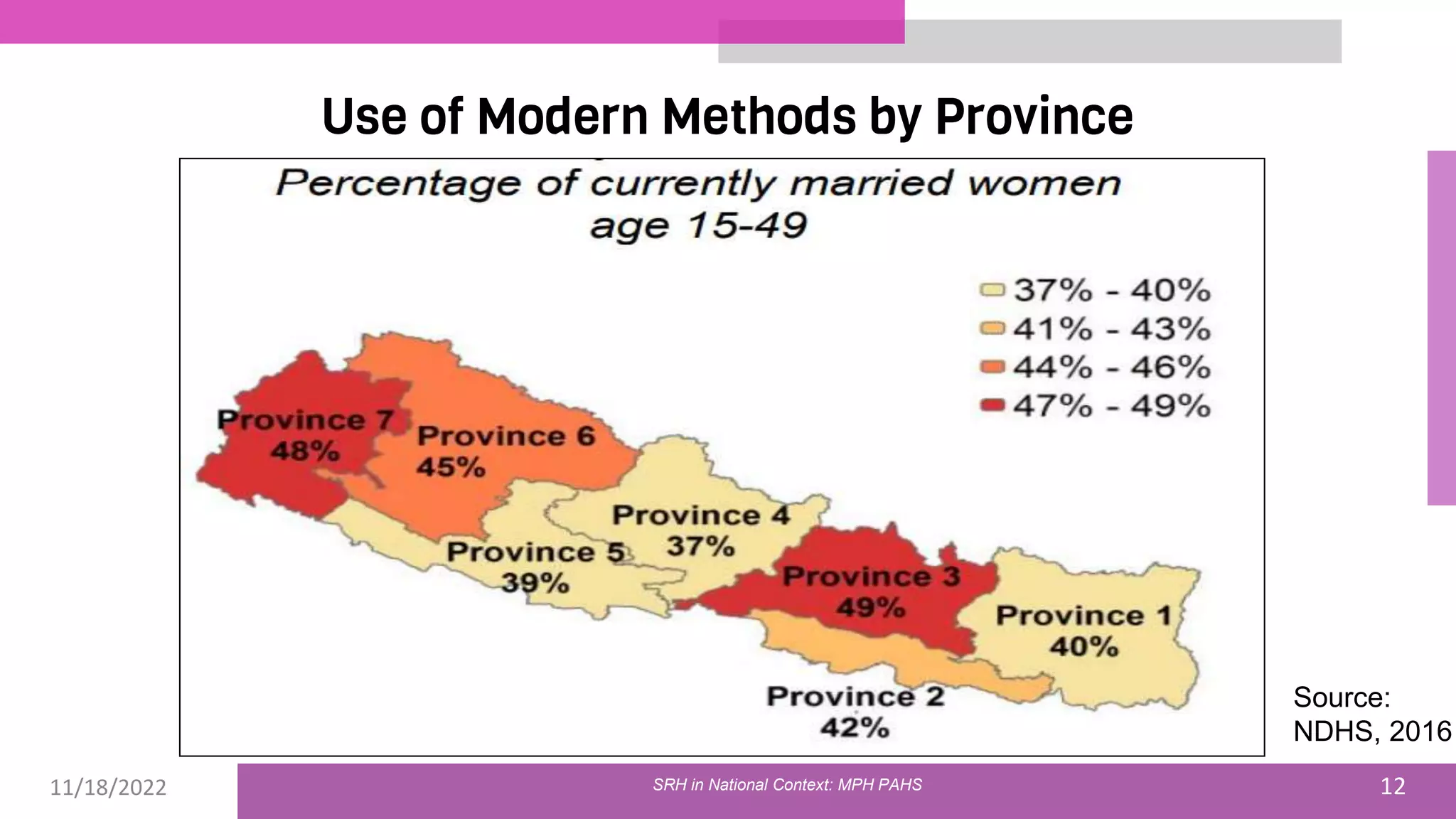
• 43% use modern method
Adolescent use of contraception: 15% of currently
married women age 15-19 use a modern method of
contraception
Source: NDHS, 2016
SRH in National Context: MPH PAHS
11/18/2022 9
Family Planning
Modern Methods
• Male and female sterilization
• Injectables
• Intrauterine devices
• Contraceptive pills
• Implants
• Male condoms
• Lactational amenorrhea
• Emergency contraception
Source: NDHS, 2016
SRH in National Context: MPH PAHS
11/18/2022 10
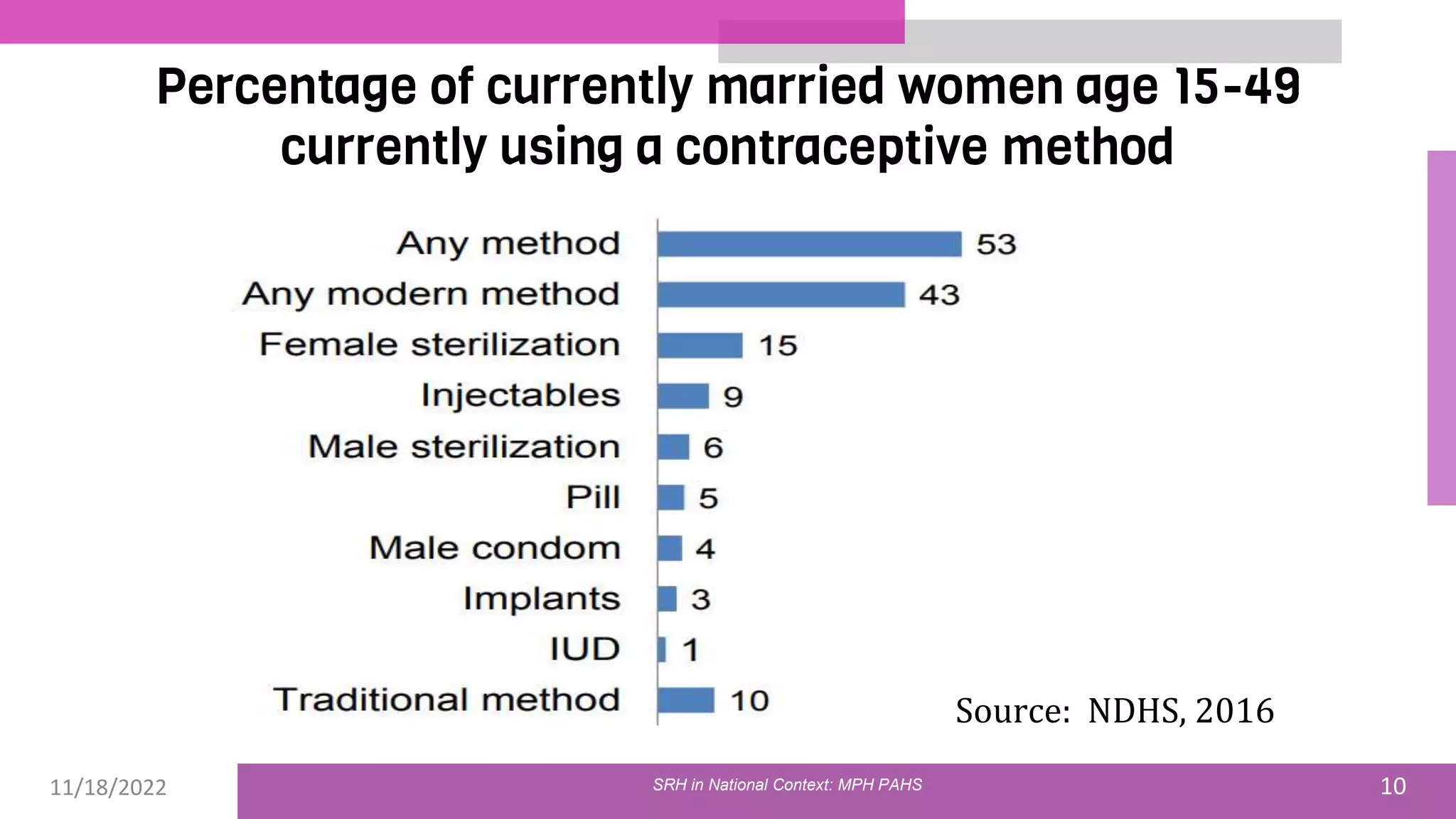
Percentage of currently married women age 15-49
currently using a contraceptive method
Source: NDHS, 2016
SRH in National Context: MPH PAHS
11/18/2022 11
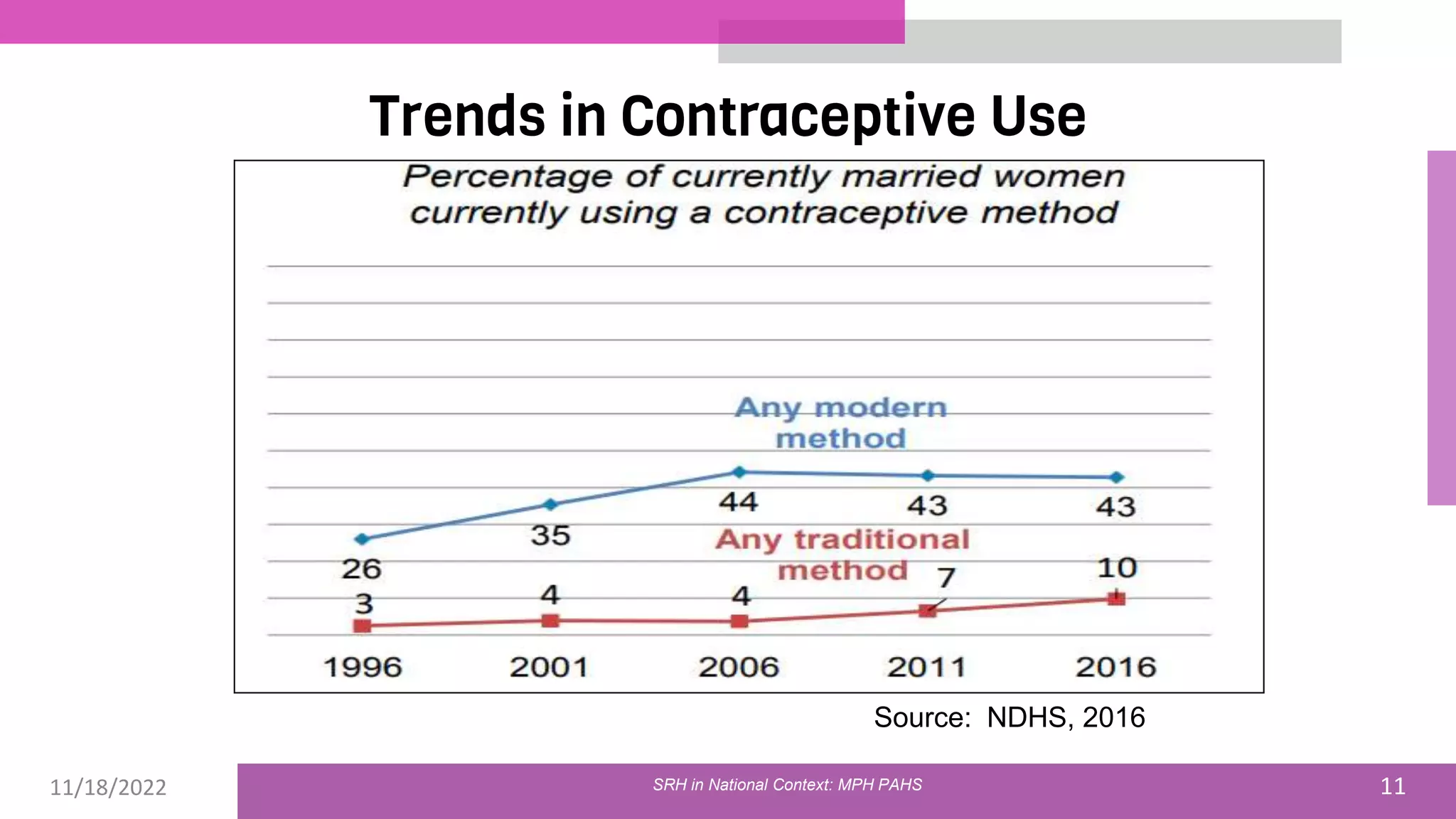
Trends in Contraceptive Use
Source: NDHS, 2016
SRH in National Context: MPH PAHS
11/18/2022 12
Use of Modern Methods by Province
Source:
NDHS, 2016
SRH in National Context: MPH PAHS
11/18/2022 13
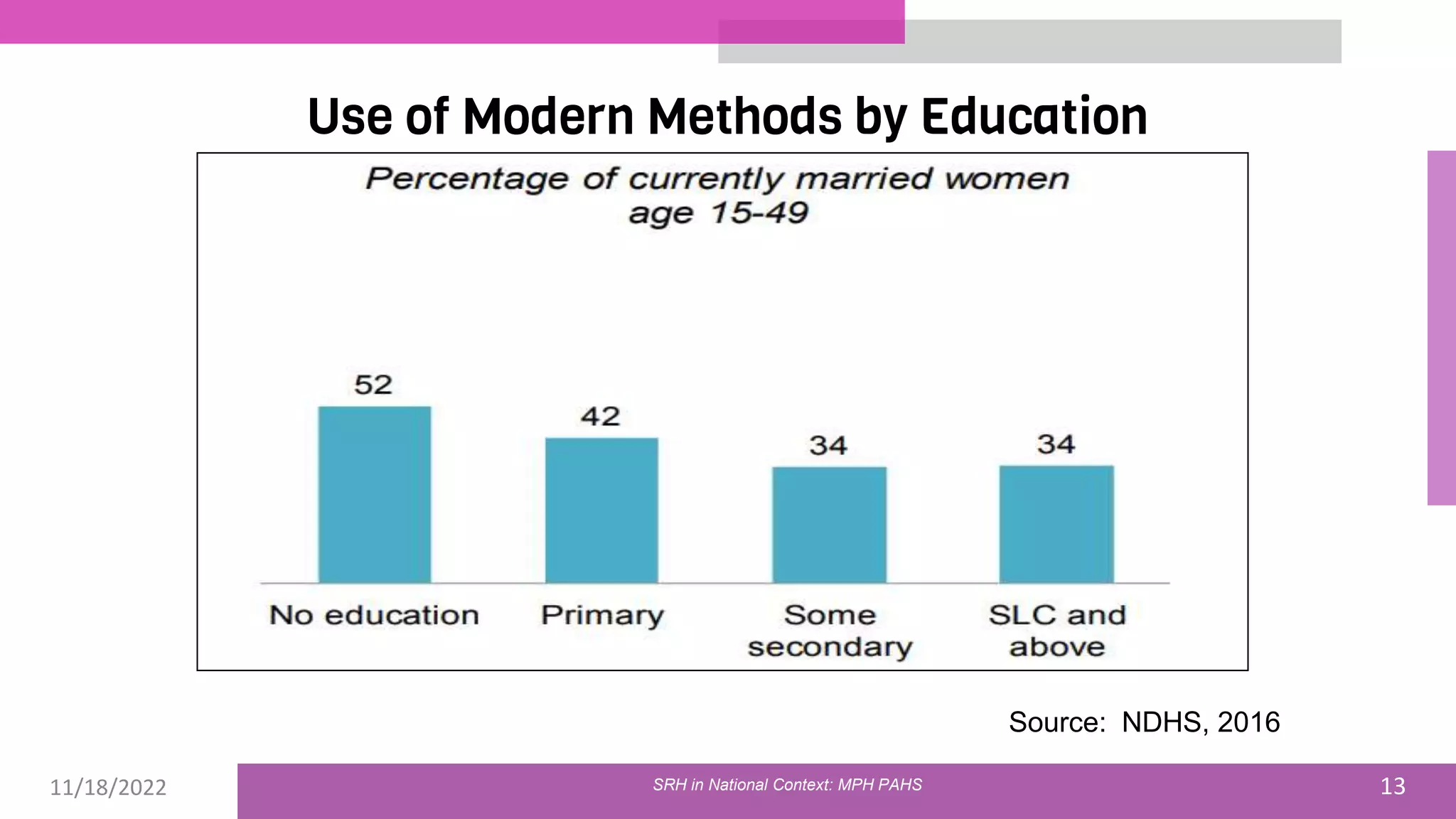
Use of Modern Methods by Education
Source: NDHS, 2016
SRH in National Context: MPH PAHS
11/18/2022 14
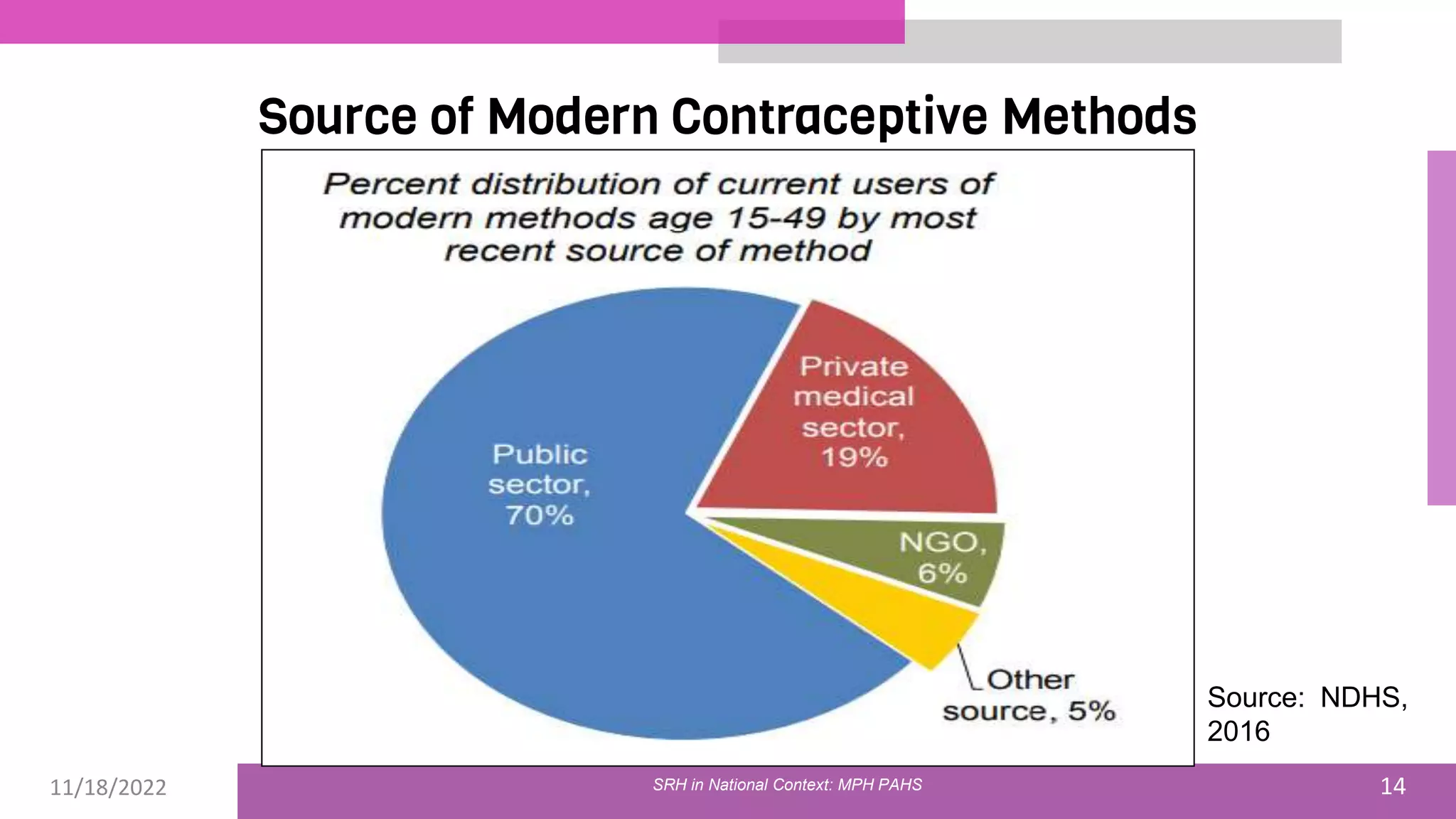
Source of Modern Contraceptive Methods
Source: NDHS,
2016
SRH in National Context: MPH PAHS
11/18/2022 15
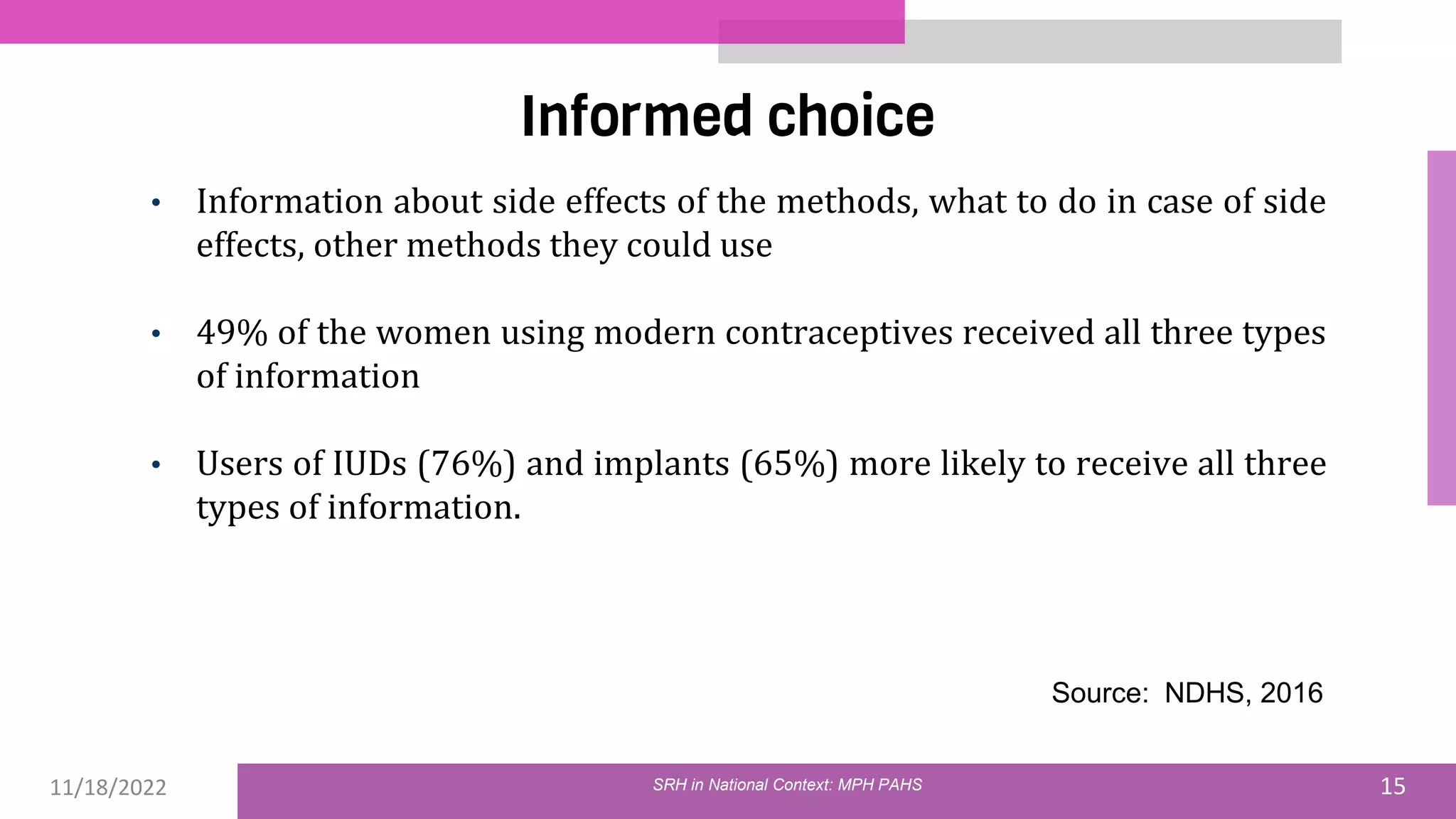
Informed choice
• Information about side effects of the methods, what to do in case of side
effects, other methods they could use
• 49% of the women using modern contraceptives received all three types
of information
• Users of IUDs (76%) and implants (65%) more likely to receive all three
types of information.
Source: NDHS, 2016
SRH in National Context: MPH PAHS
11/18/2022 16
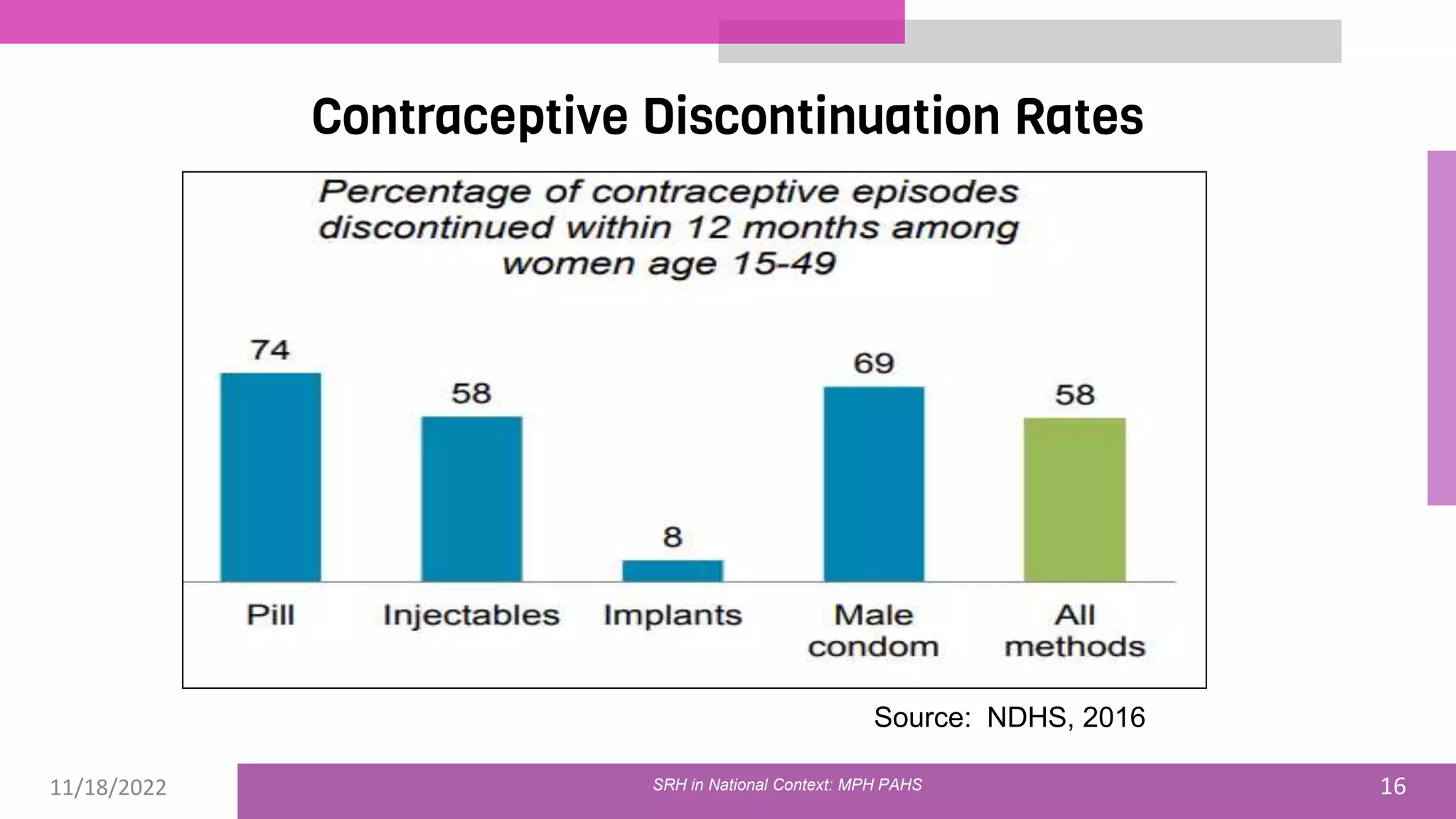
Contraceptive Discontinuation Rates
Source: NDHS, 2016
SRH in National Context: MPH PAHS
11/18/2022 17
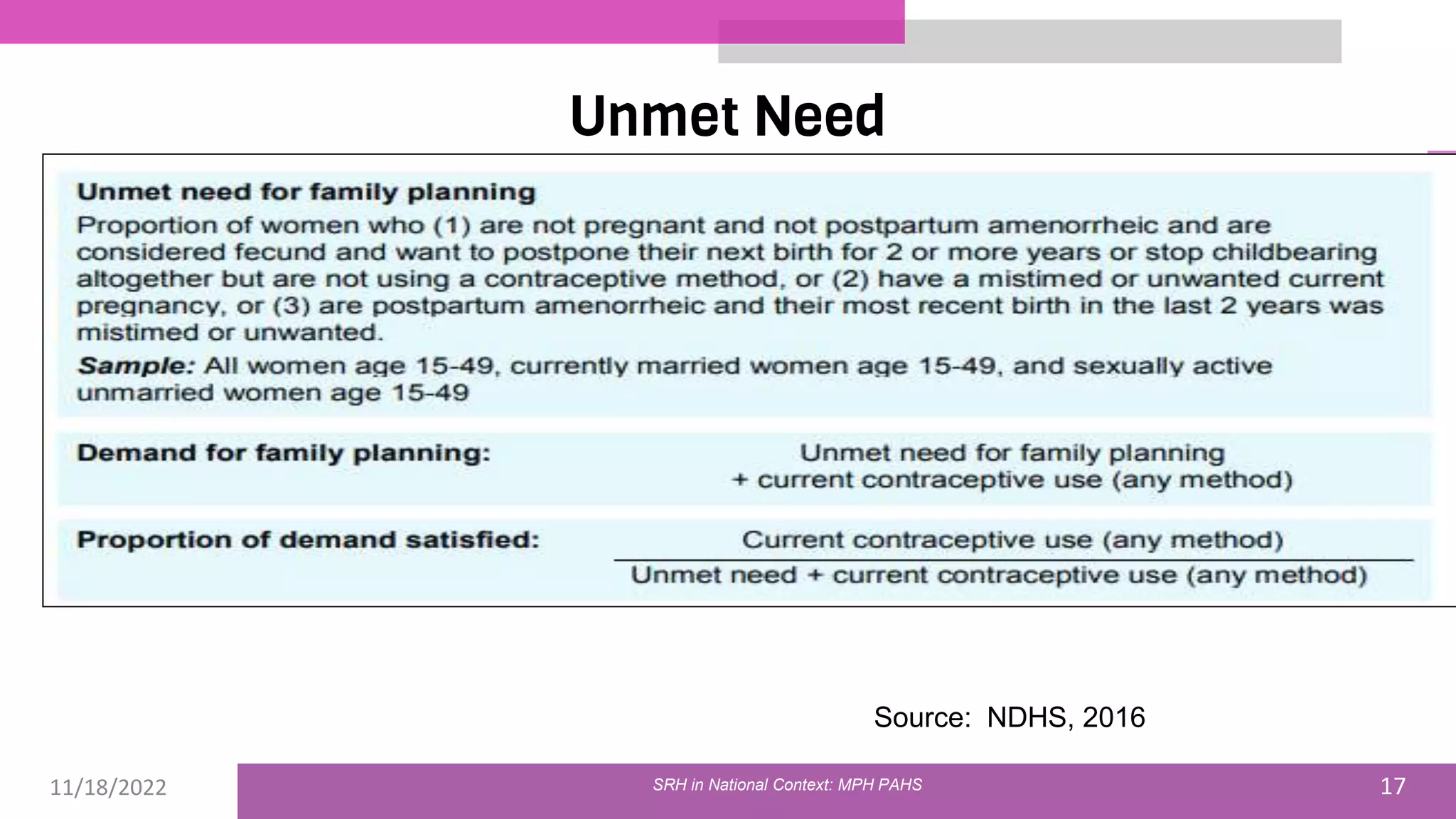
Unmet Need
Source: NDHS, 2016
SRH in National Context: MPH PAHS
11/18/2022 18
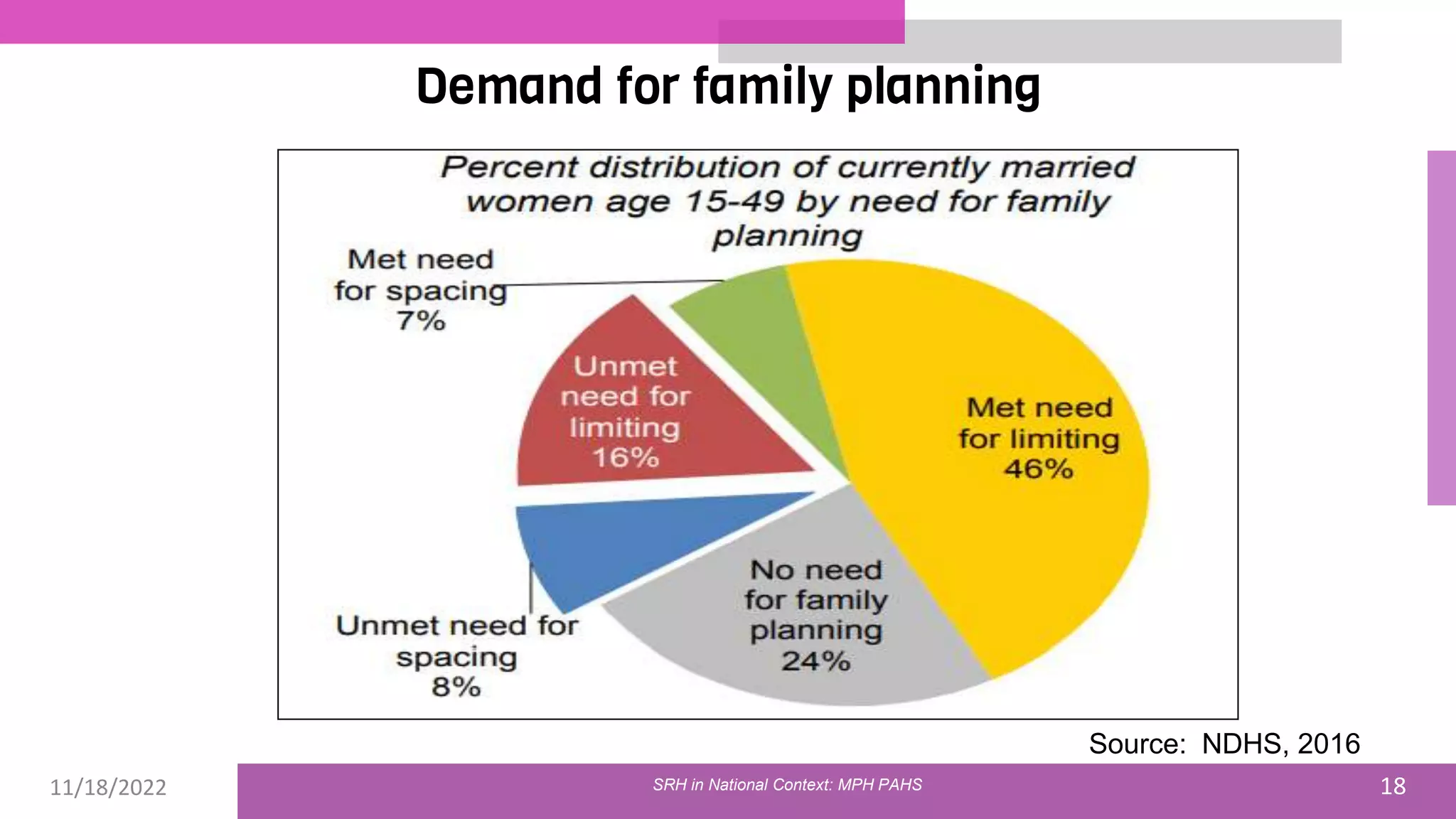
Demand for family planning
Source: NDHS, 2016
SRH in National Context: MPH PAHS
11/18/2022 19
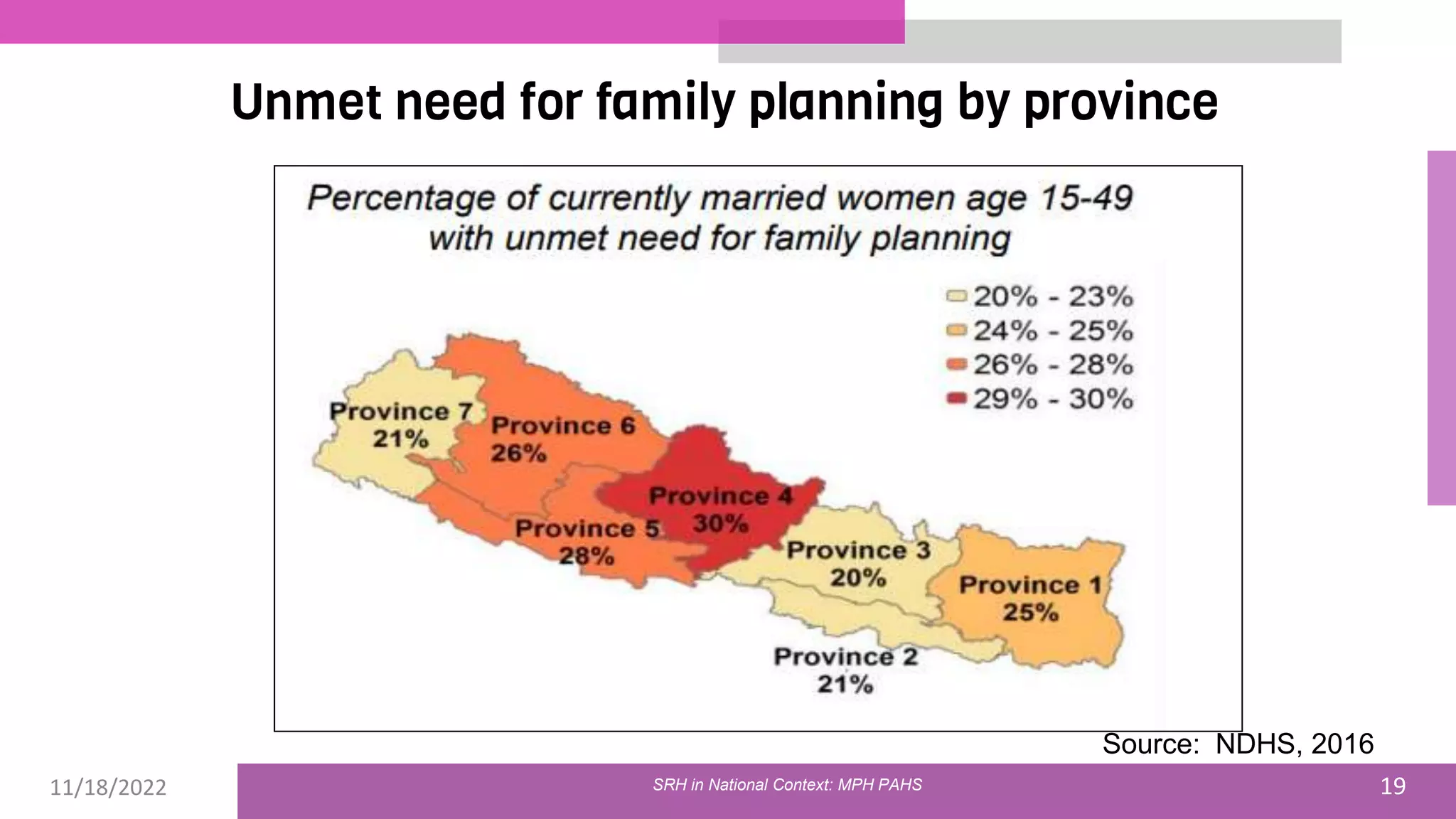
Unmet need for family planning by province
Source: NDHS, 2016
SRH in National Context: MPH PAHS
11/18/2022 20
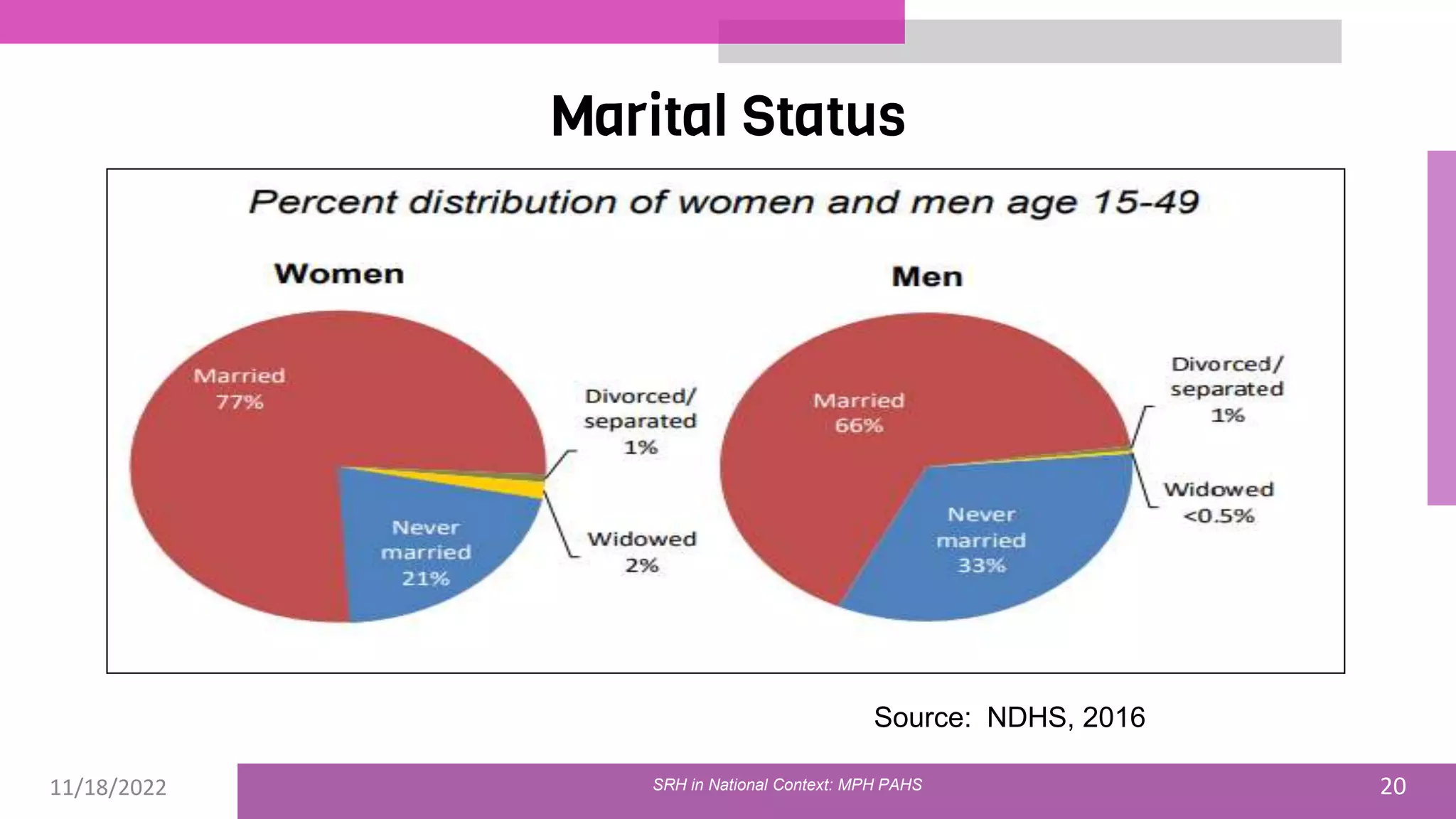
Marital Status
Source: NDHS, 2016
SRH in National Context: MPH PAHS
11/18/2022 21
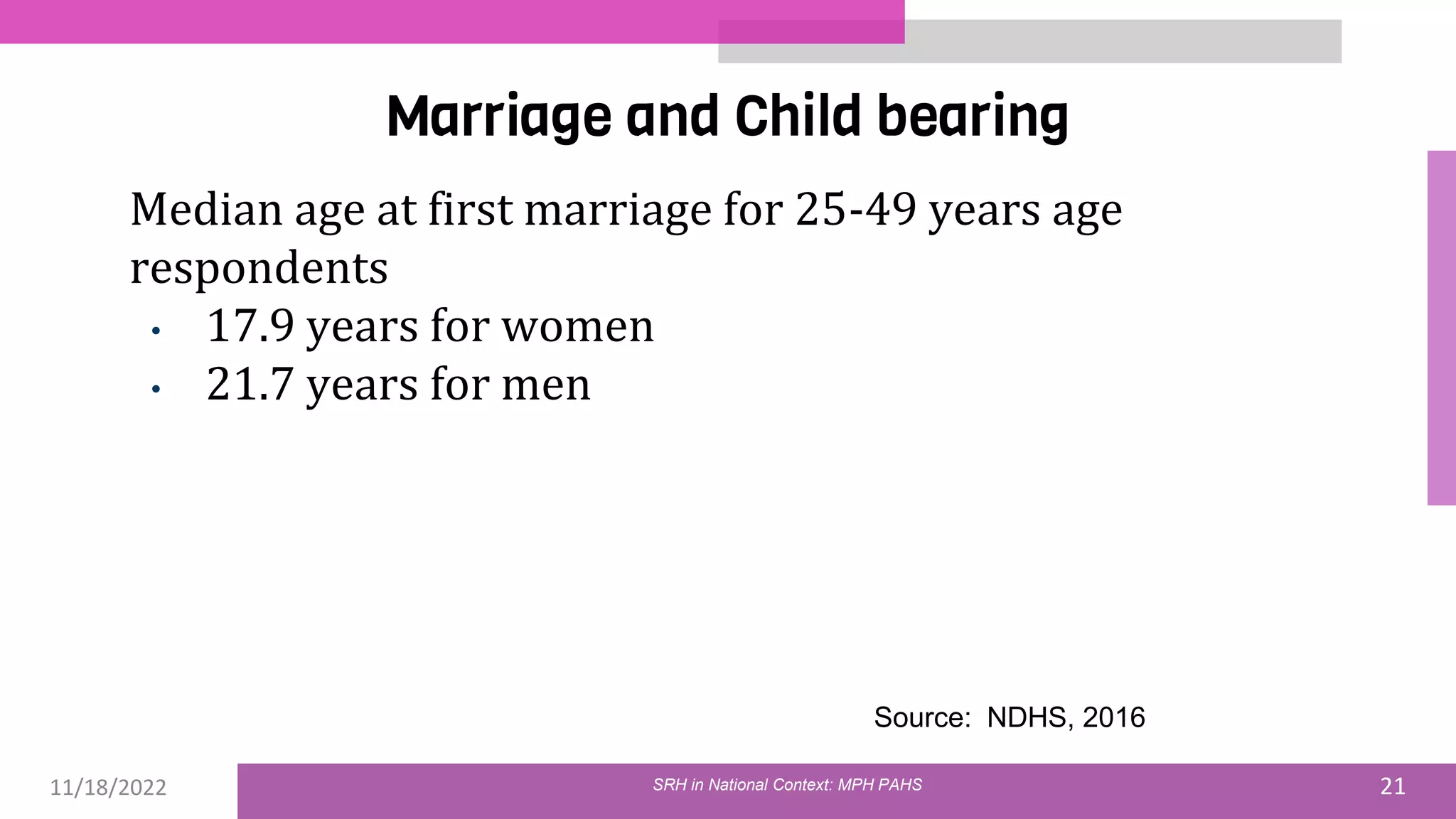
Marriage and Child bearing
Median age at first marriage for 25-49 years age
respondents
• 17.9 years for women
• 21.7 years for men
Source: NDHS, 2016
SRH in National Context: MPH PAHS
11/18/2022 22
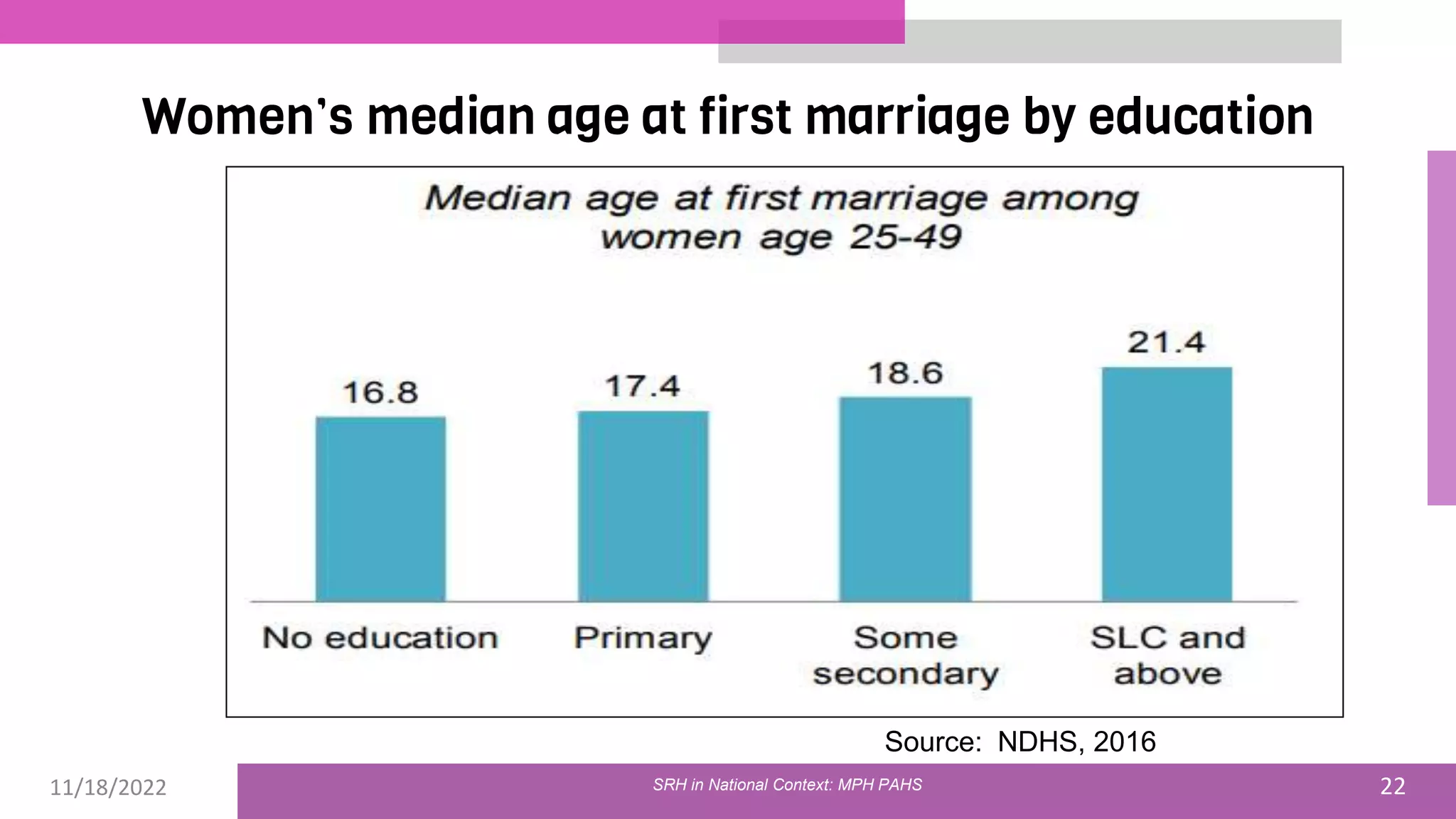
Women’s median age at first marriage by education
Source: NDHS, 2016
SRH in National Context: MPH PAHS
11/18/2022 23
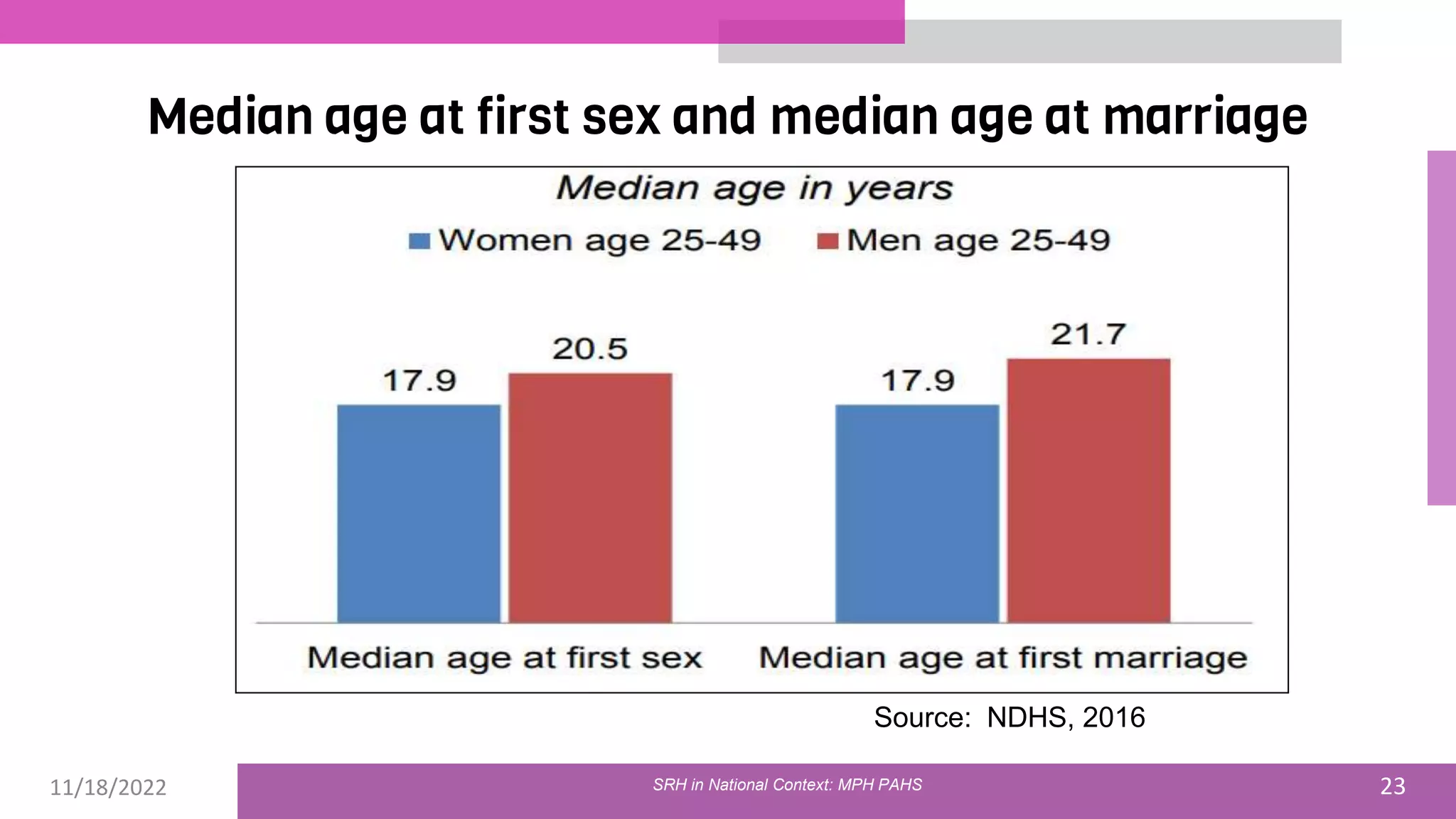
Median age at first sex and median age at marriage
Source: NDHS, 2016
SRH in National Context: MPH PAHS
11/18/2022 24
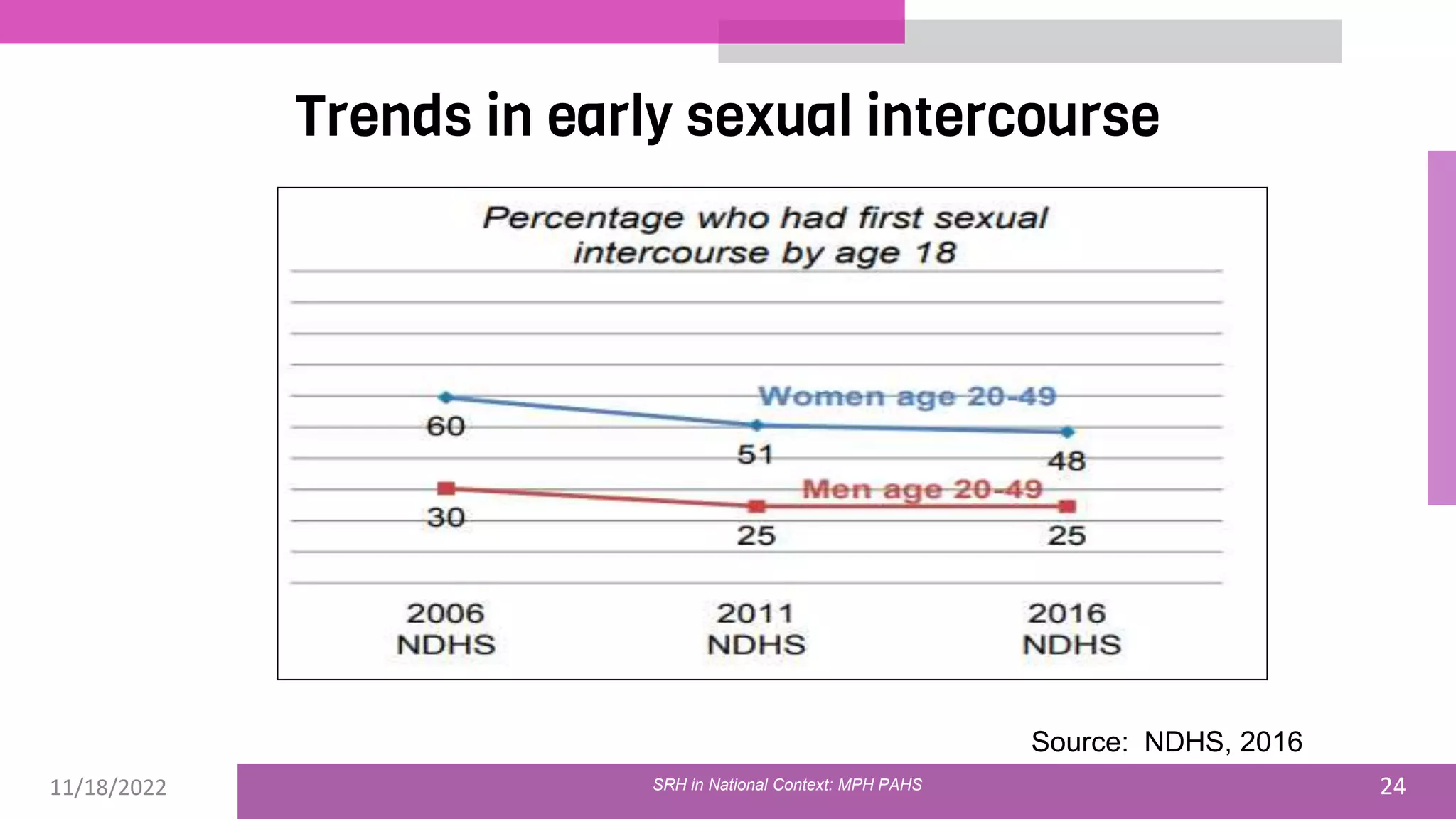
Trends in early sexual intercourse
Source: NDHS, 2016
SRH in National Context: MPH PAHS
11/18/2022 25
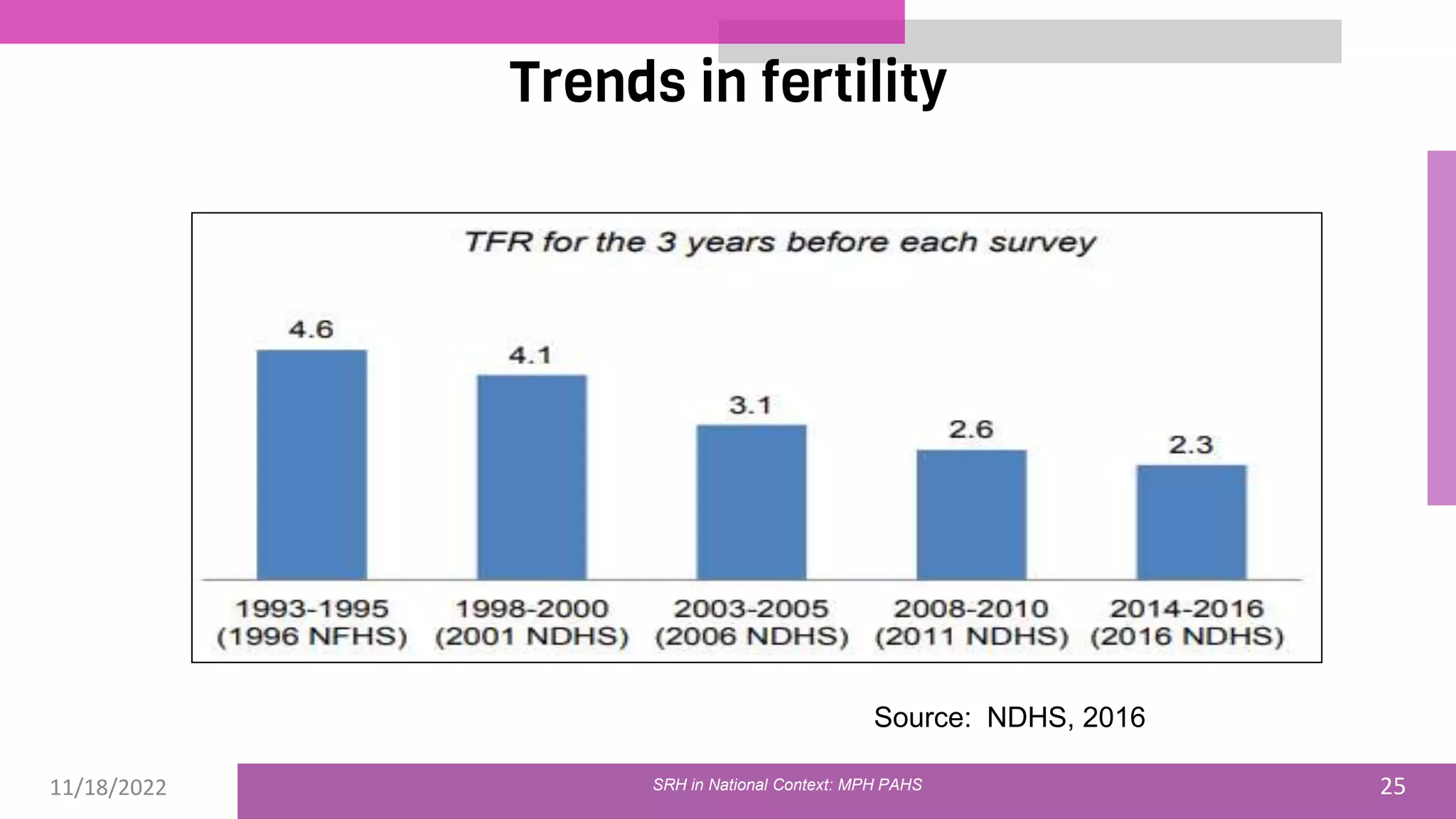
Trends in fertility
Source: NDHS, 2016
SRH in National Context: MPH PAHS
11/18/2022 26
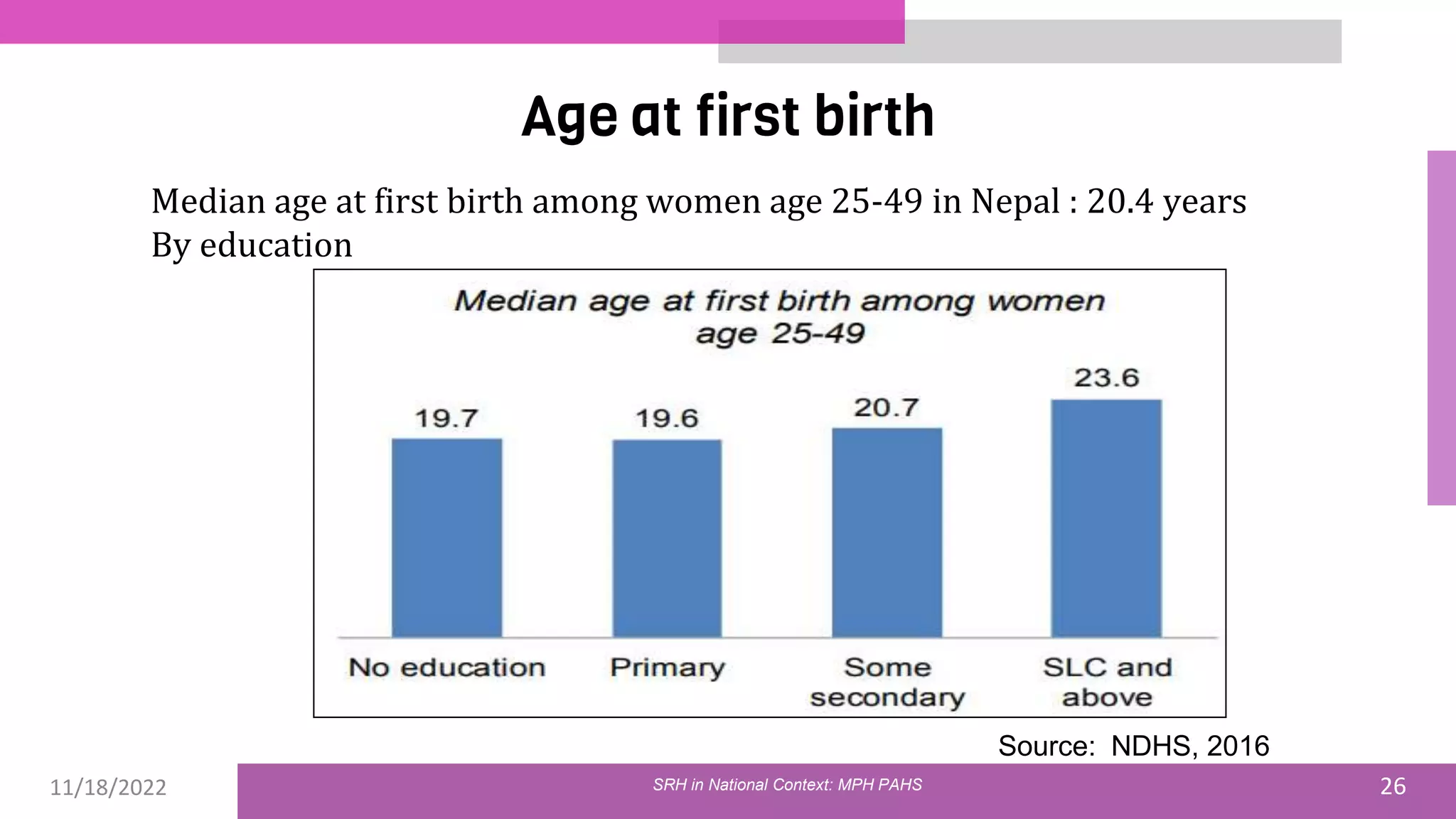
Age at first birth
Median age at first birth among women age 25-49 in Nepal : 20.4 years
By education
Source: NDHS, 2016
SRH in National Context: MPH PAHS
11/18/2022 27
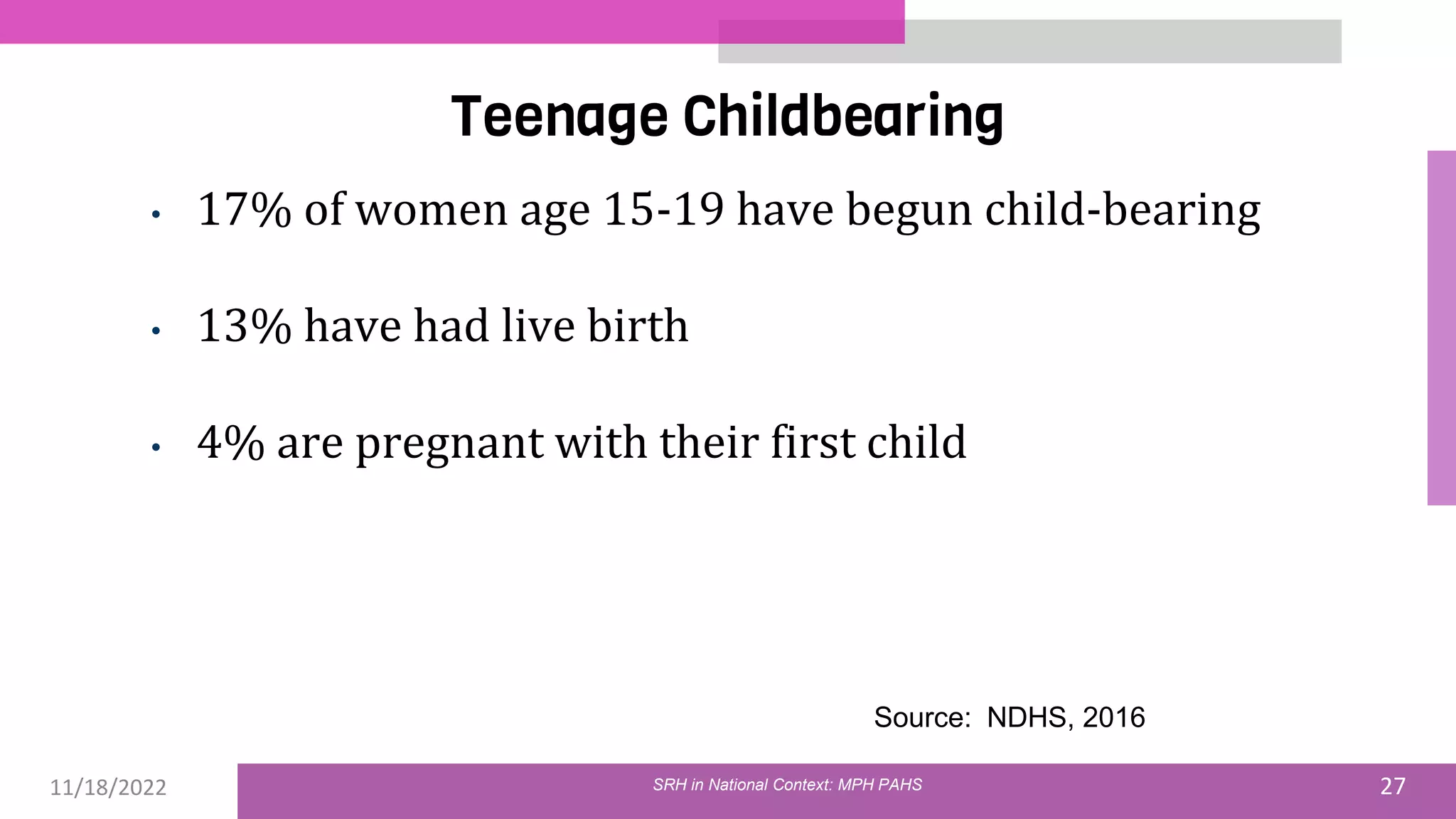
Teenage Childbearing
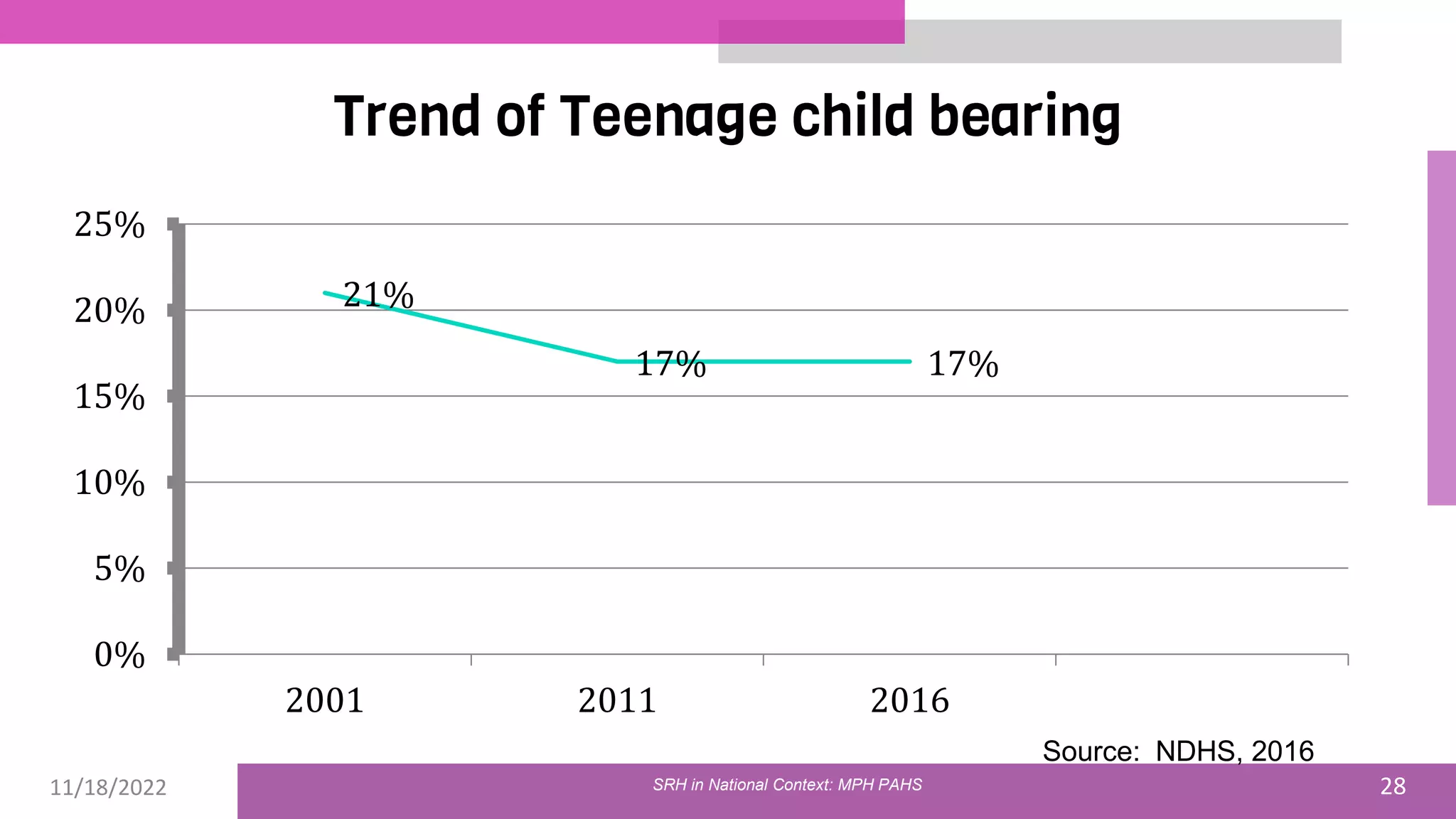
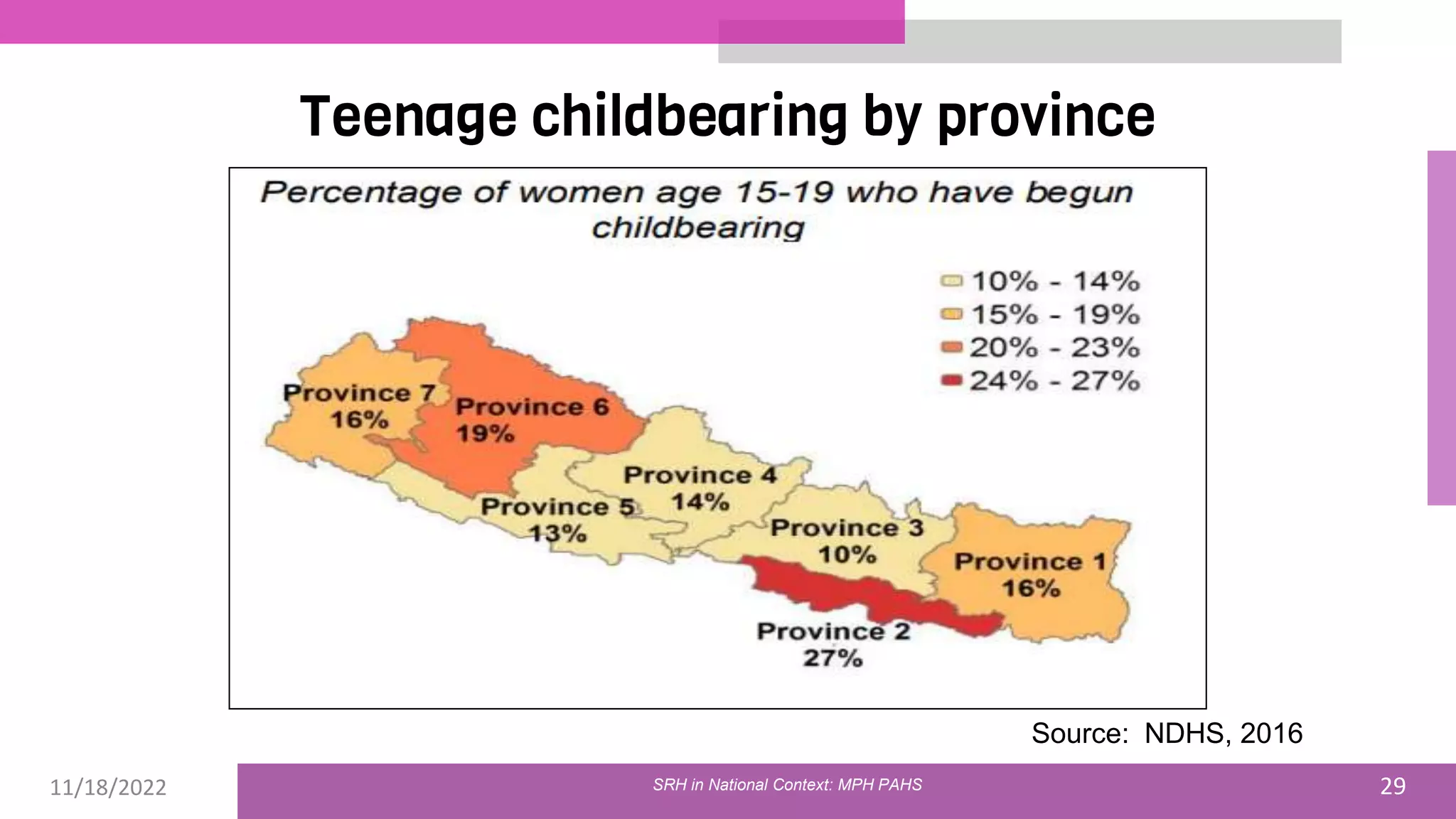
• 17% of women age 15-19 have begun child-bearing
• 13% have had live birth
• 4% are pregnant with their first child
Source: NDHS, 2016
SRH in National Context: MPH PAHS
11/18/2022 28
Trend of Teenage child bearing
21%
17% 17%
0%
5%
10%
15%
20%
25%
2001 2011 2016
Source: NDHS, 2016
SRH in National Context: MPH PAHS
11/18/2022 29
Teenage childbearing by province
Source: NDHS, 2016
SRH in National Context: MPH PAHS
11/18/2022 30
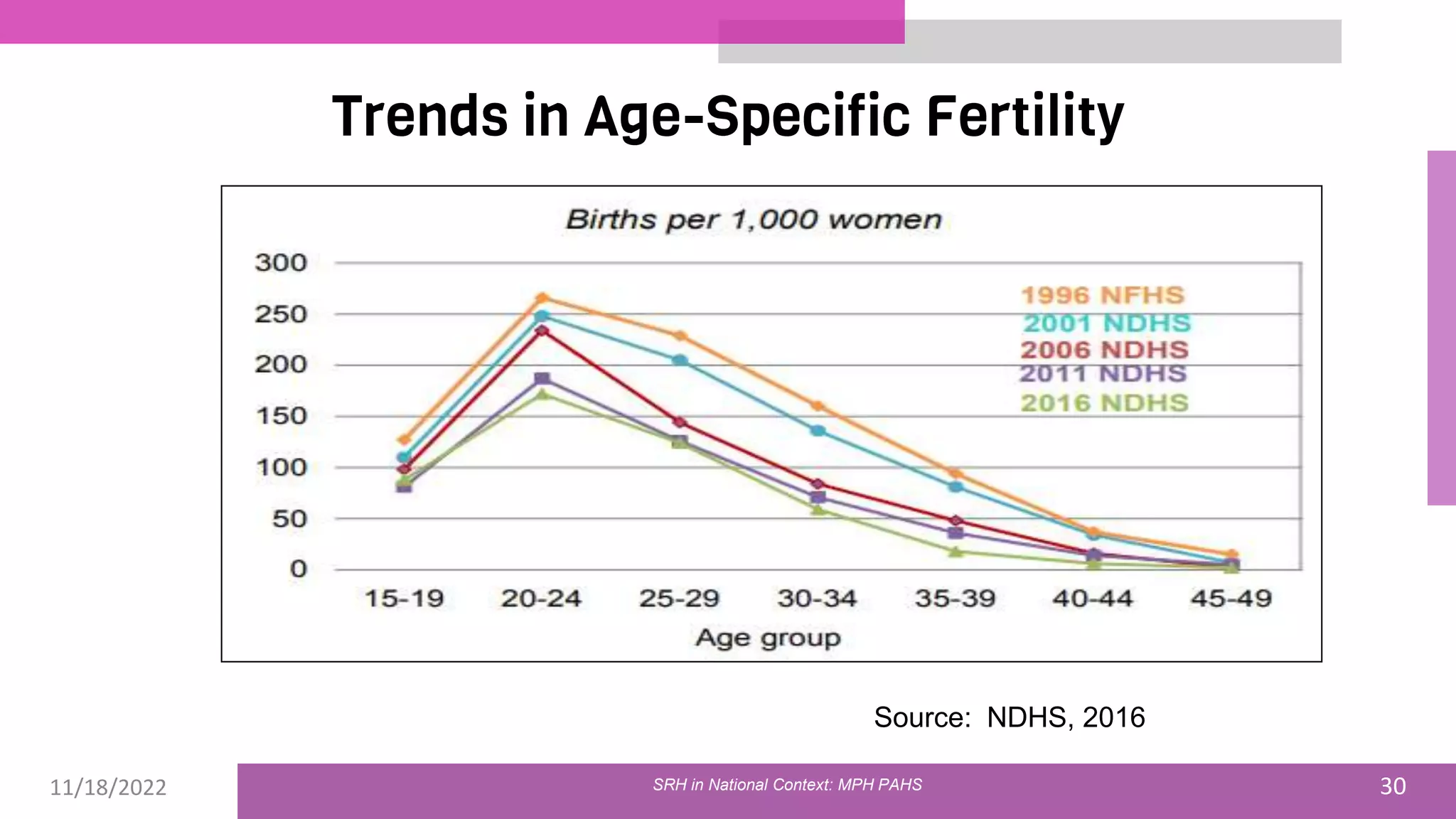
Trends in Age-Specific Fertility
Source: NDHS, 2016
SRH in National Context: MPH PAHS
11/18/2022 31
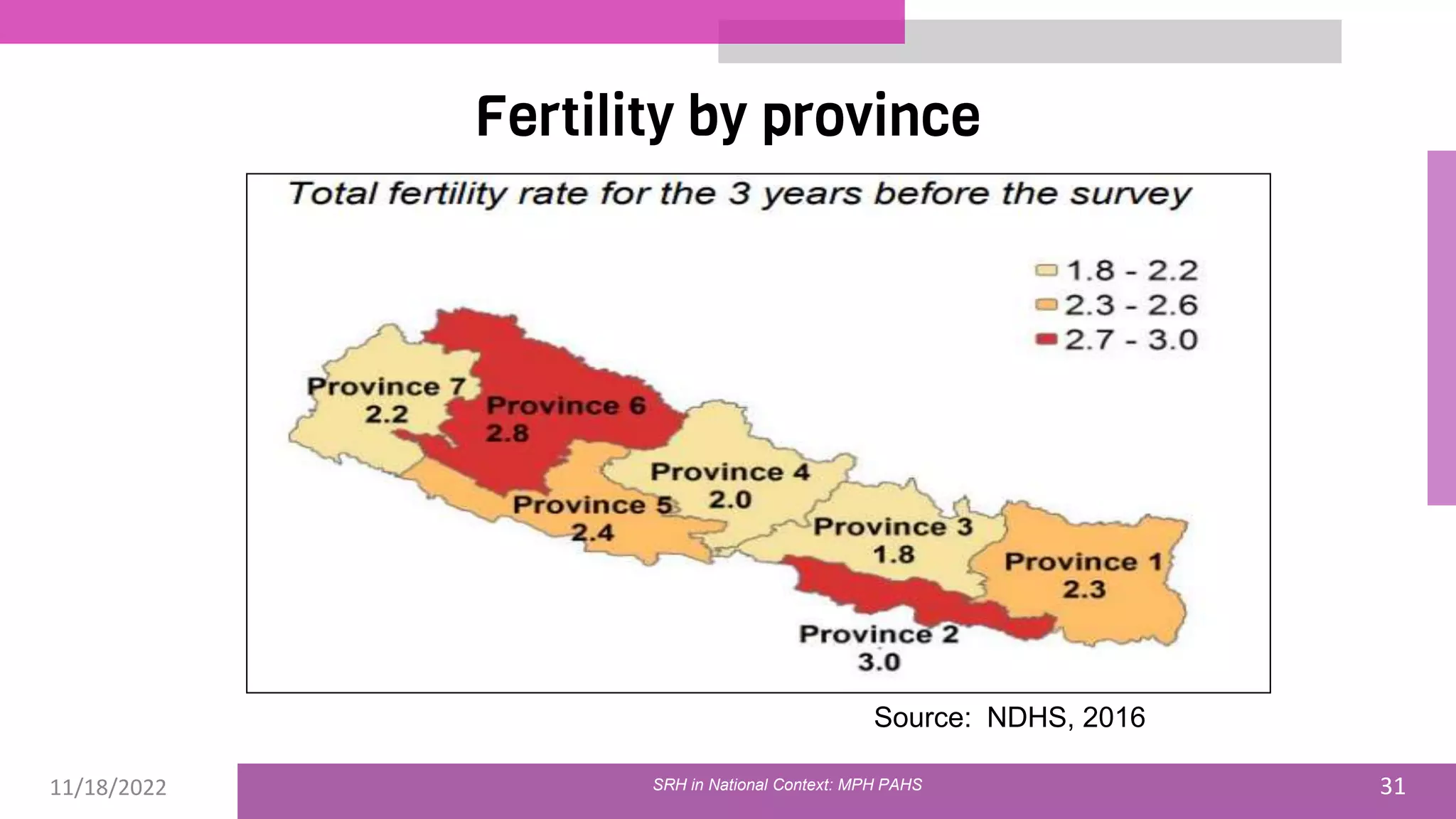
Fertility by province
Source: NDHS, 2016
SRH in National Context: MPH PAHS
11/18/2022 32
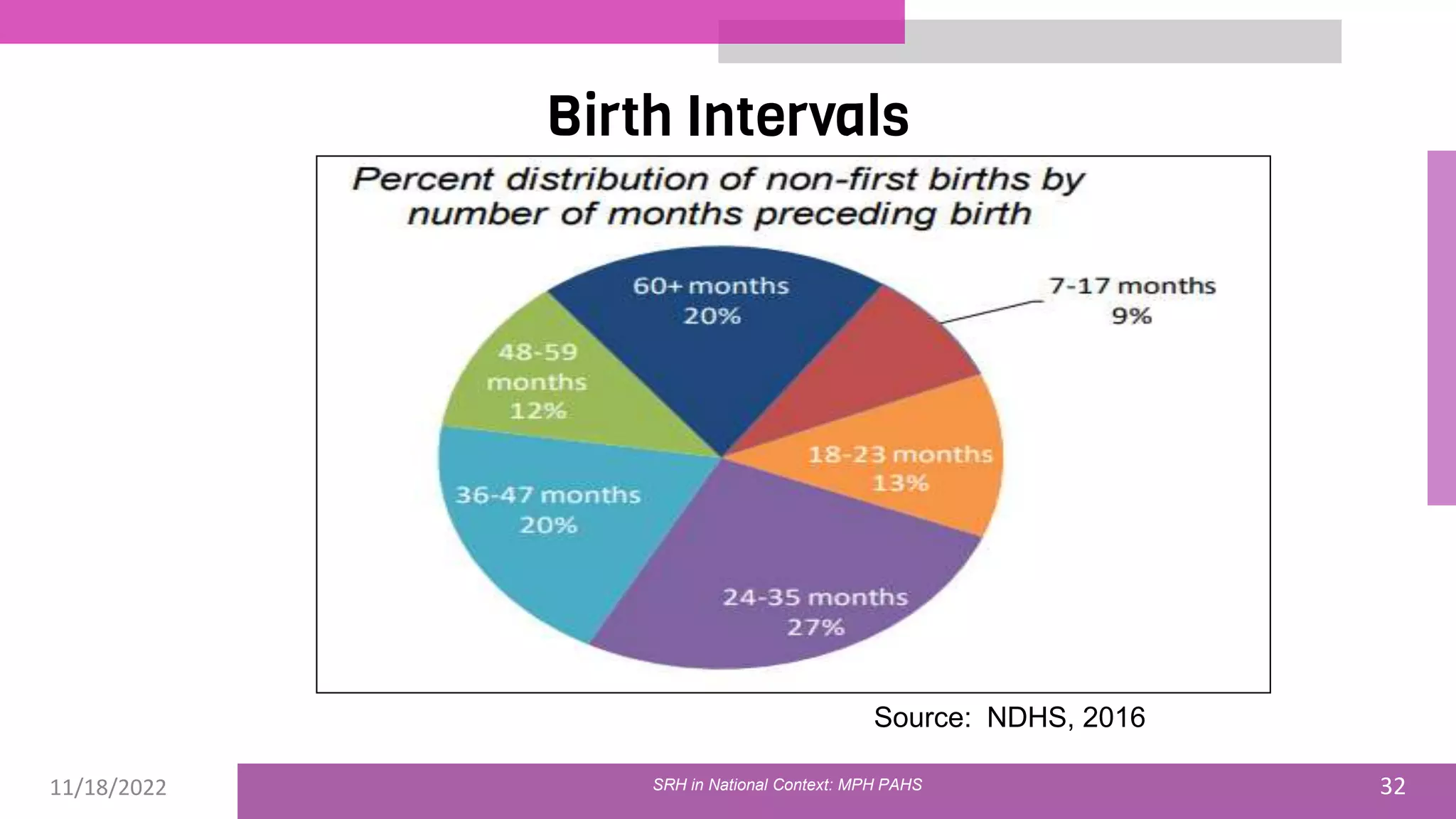
Birth Intervals
Source: NDHS, 2016
SRH in National Context: MPH PAHS
11/18/2022 33
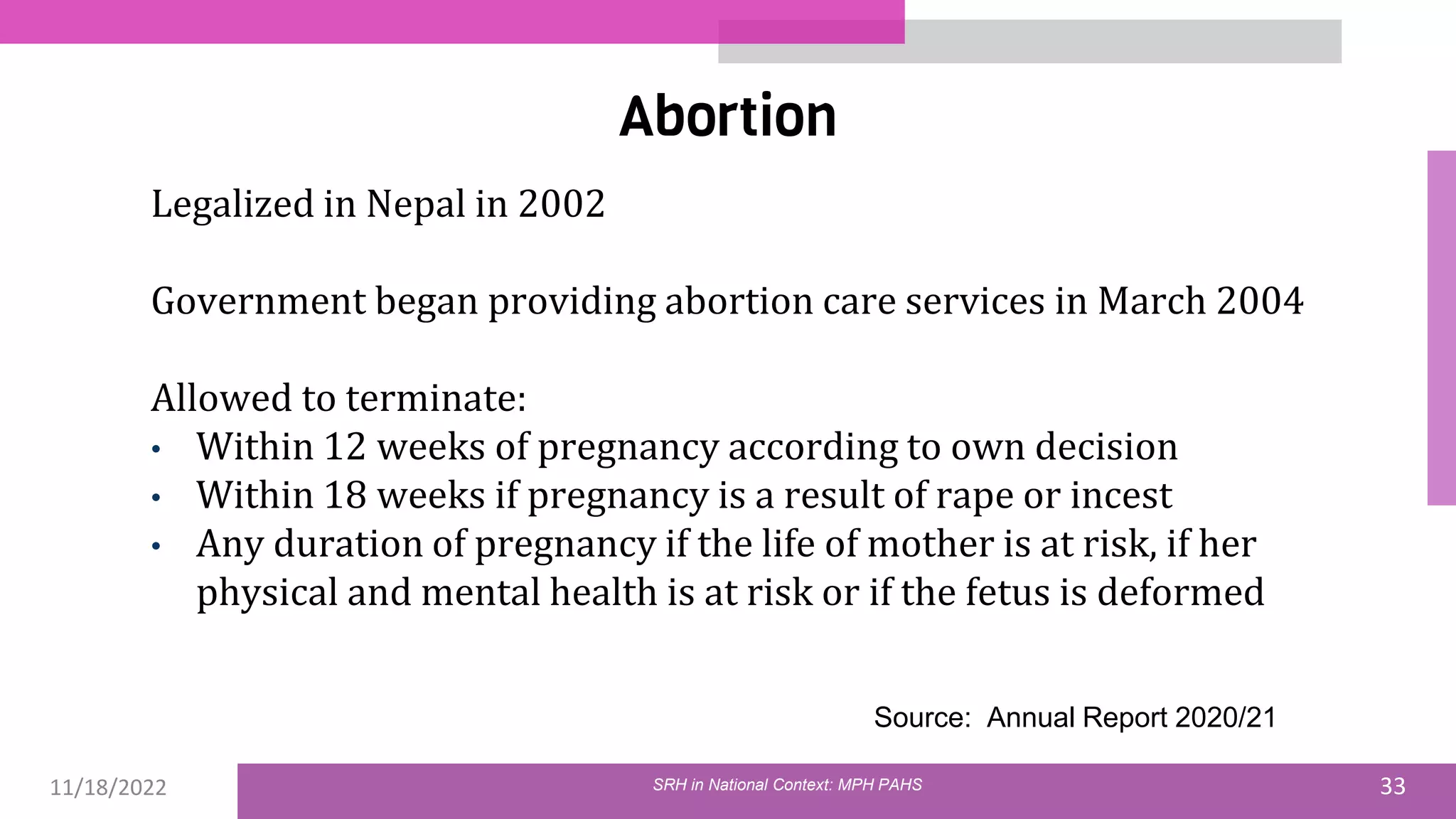
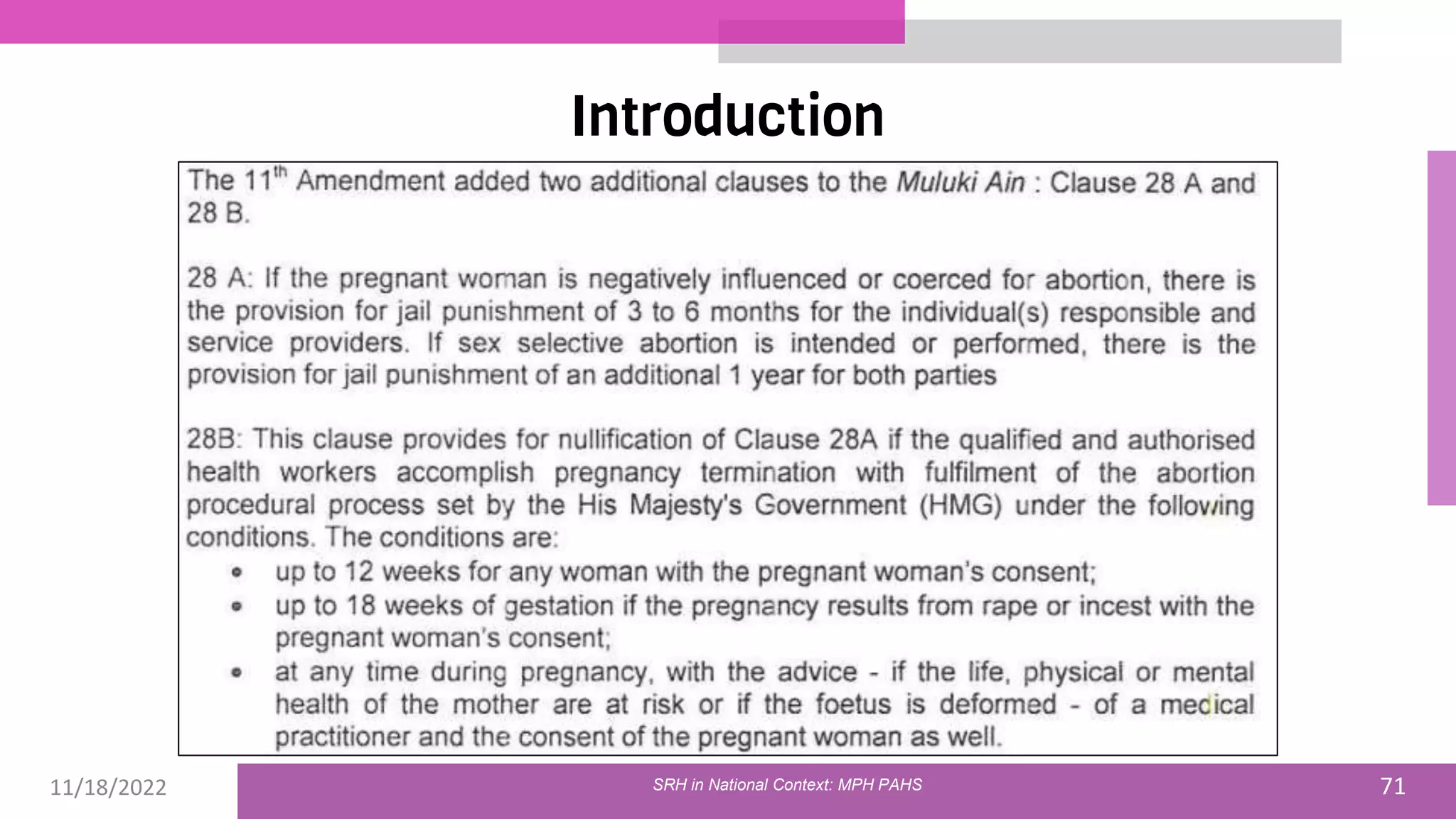
Abortion
Legalized in Nepal in 2002
Government began providing abortion care services in March 2004
Allowed to terminate:
• Within 12 weeks of pregnancy according to own decision
• Within 18 weeks if pregnancy is a result of rape or incest
• Any duration of pregnancy if the life of mother is at risk, if her
physical and mental health is at risk or if the fetus is deformed
Source: Annual Report 2020/21
SRH in National Context: MPH PAHS
11/18/2022 34
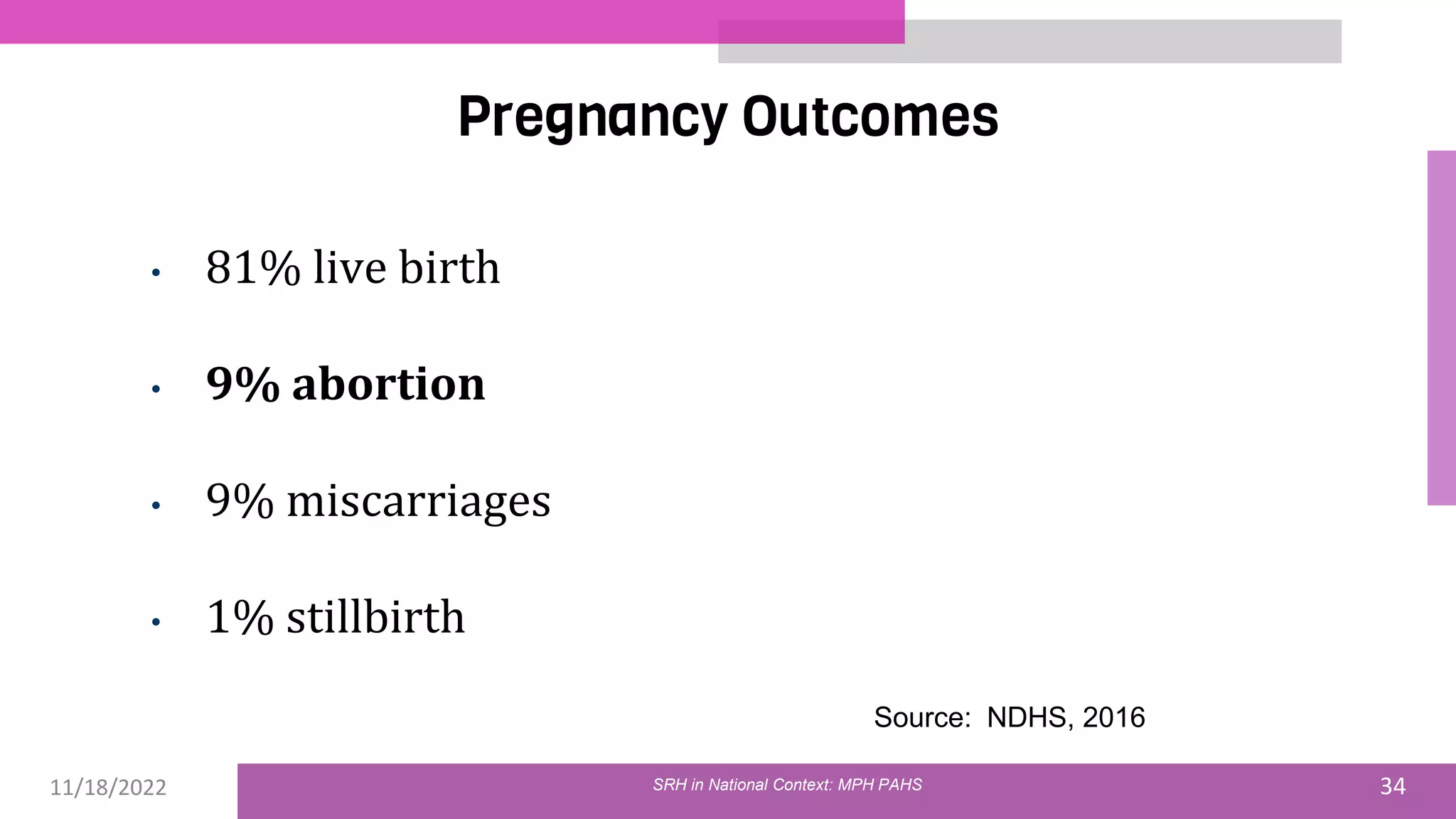
Pregnancy Outcomes
• 81% live birth
• 9% abortion
• 9% miscarriages
• 1% stillbirth
Source: NDHS, 2016
SRH in National Context: MPH PAHS
11/18/2022 35
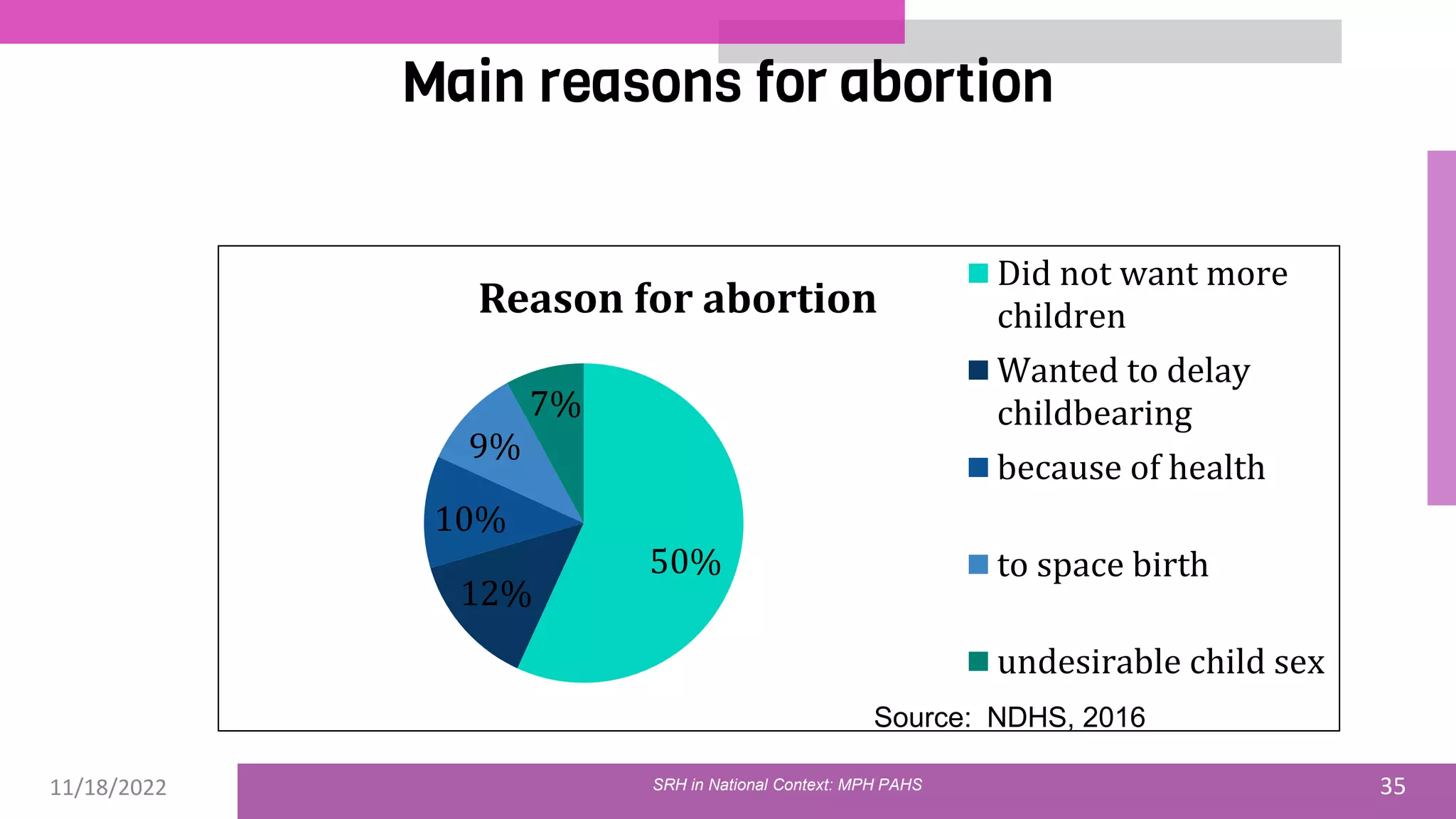
Main reasons for abortion
50%
12%
10%
9%
7%
Reason for abortion
Did not want more
children
Wanted to delay
childbearing
because of health
to space birth
undesirable child sex
Source: NDHS, 2016
SRH in National Context: MPH PAHS
11/18/2022 36
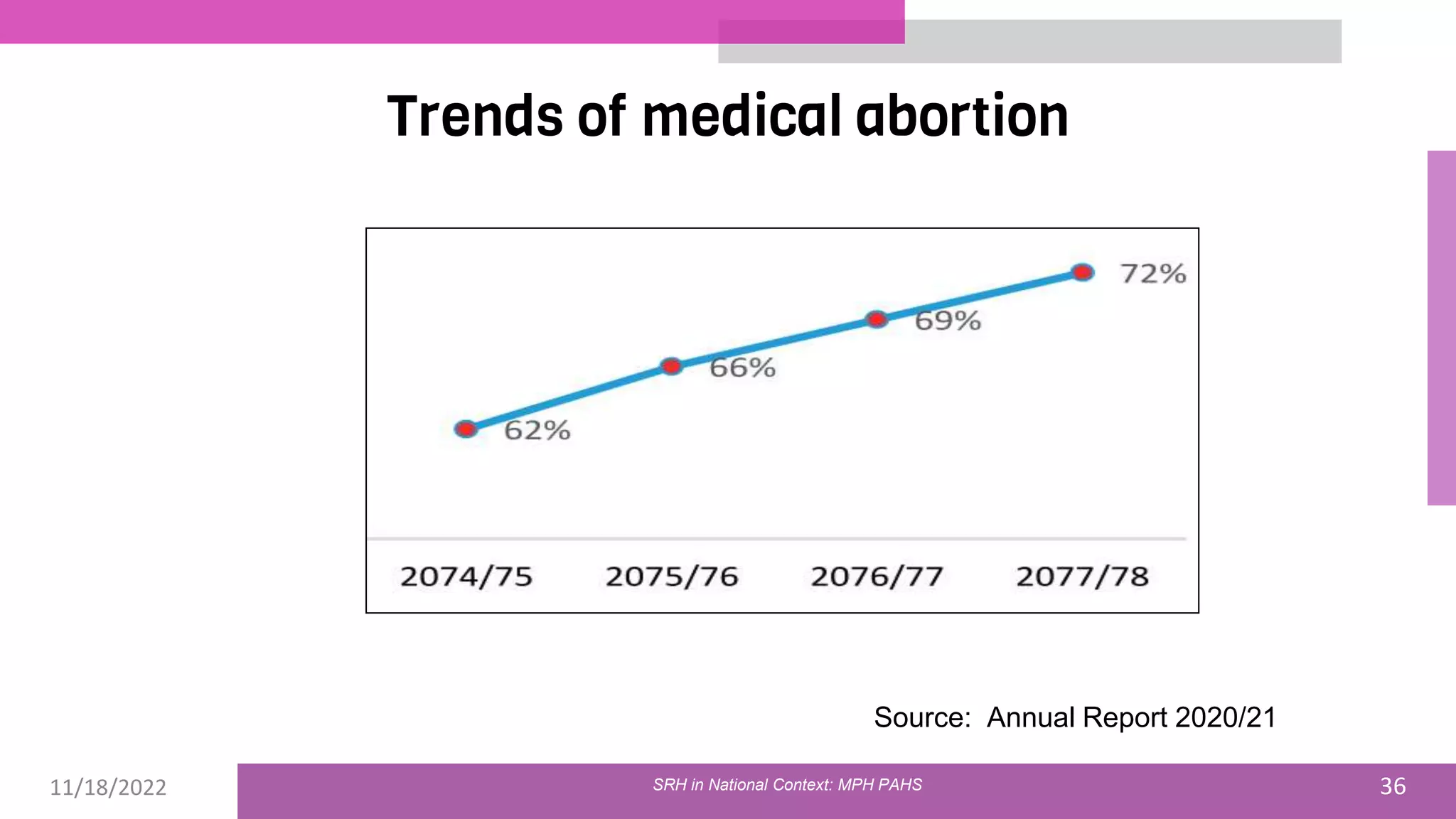
Trends of medical abortion
Source: Annual Report 2020/21
SRH in National Context: MPH PAHS
11/18/2022 37
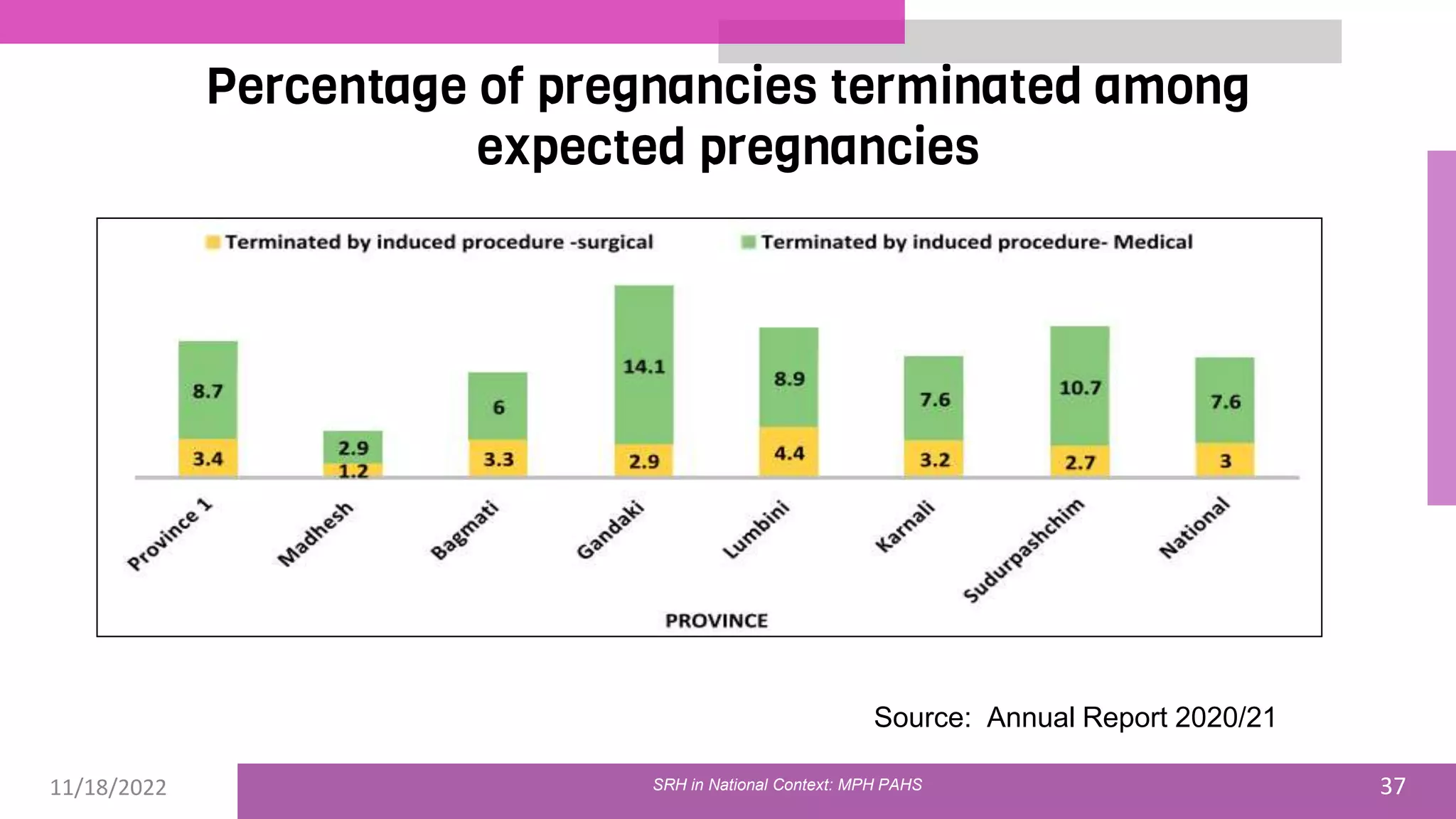
Percentage of pregnancies terminated among
expected pregnancies
Source: Annual Report 2020/21
SRH in National Context: MPH PAHS
11/18/2022 38
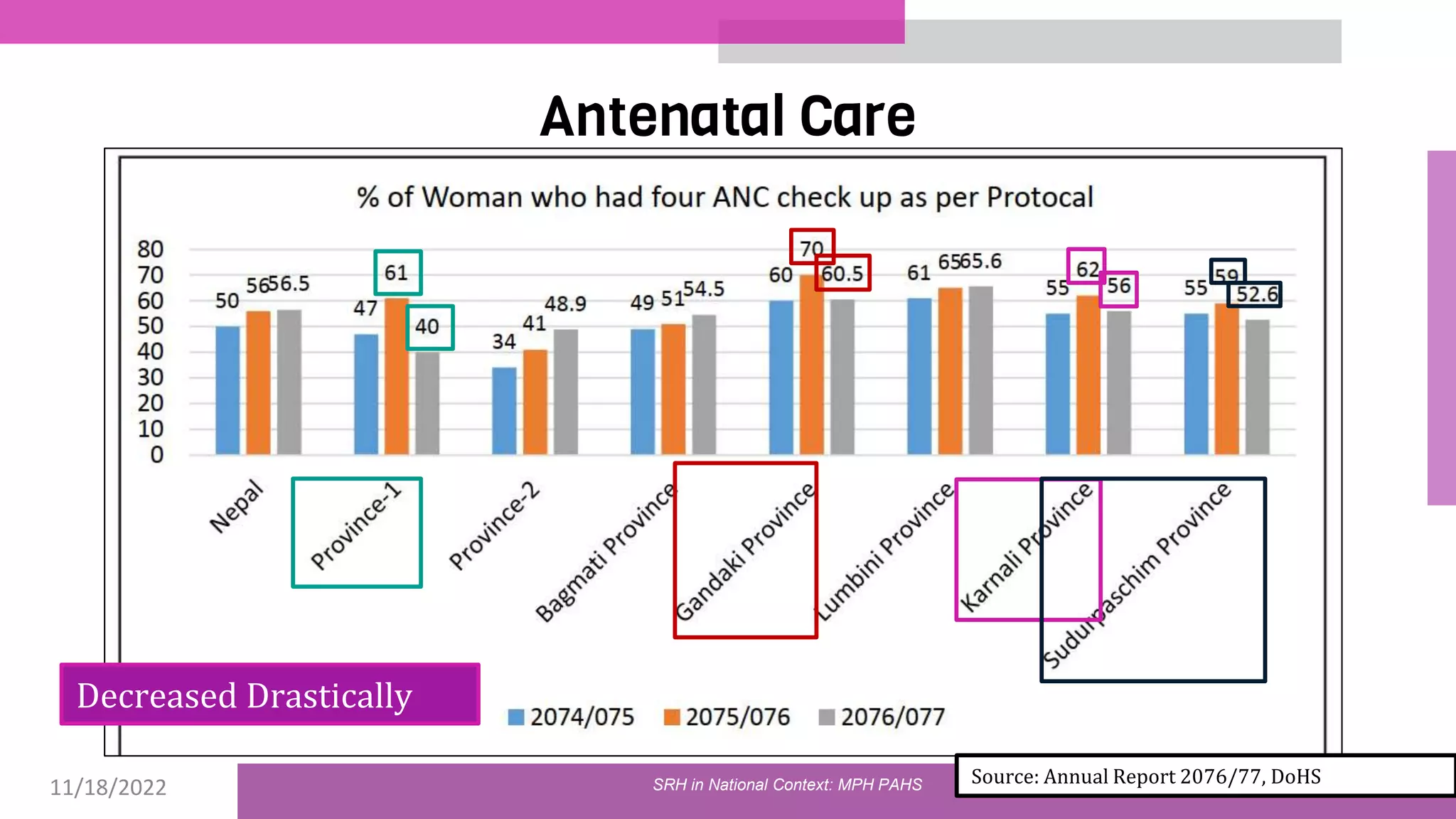
Antenatal Care
Source: Annual Report 2076/77, DoHS
Decreased Drastically
SRH in National Context: MPH PAHS
11/18/2022 39
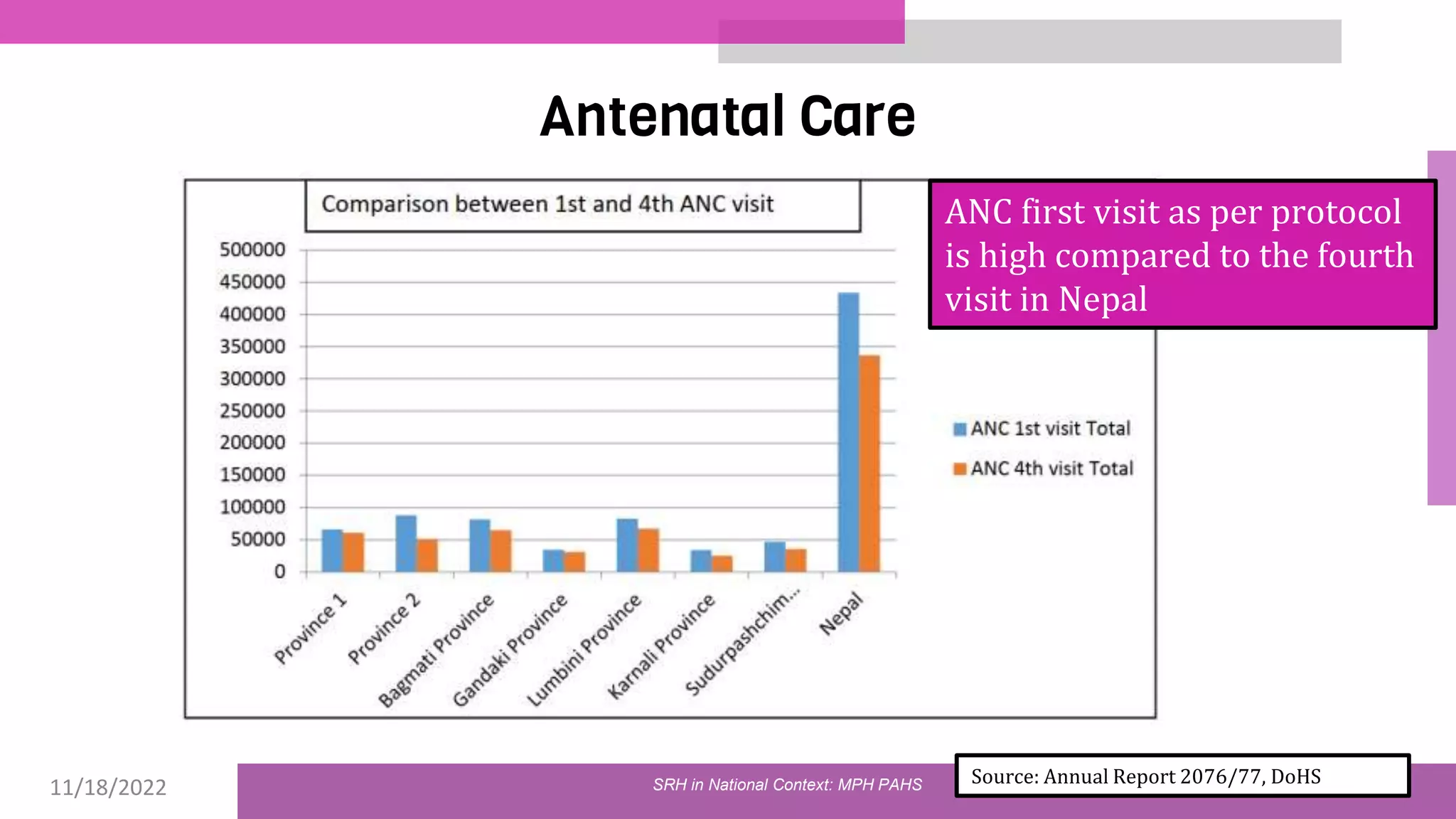
Antenatal Care
Source: Annual Report 2076/77, DoHS
ANC first visit as per protocol
is high compared to the fourth
visit in Nepal
SRH in National Context: MPH PAHS
11/18/2022 40
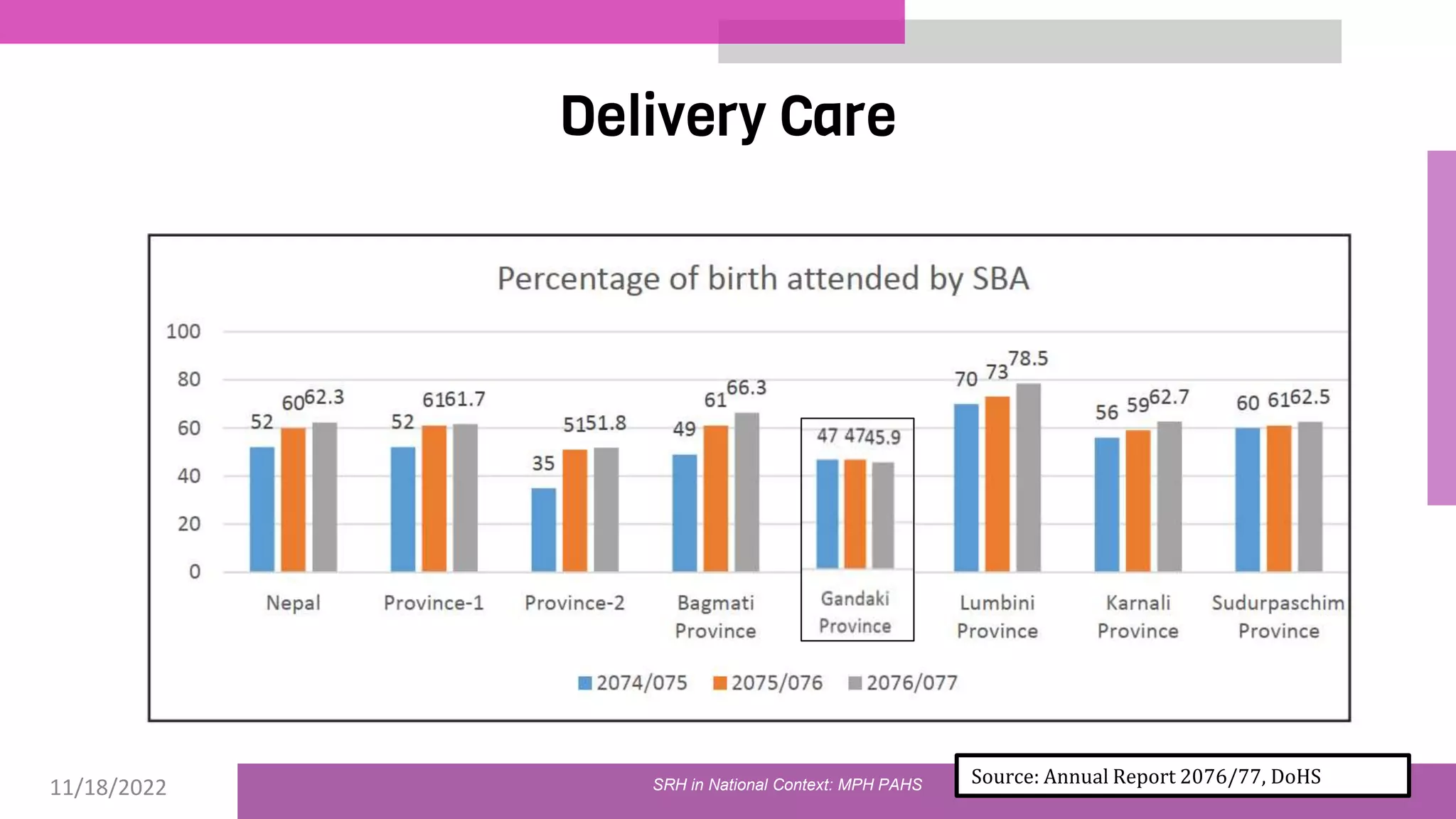
Delivery Care
Source: Annual Report 2076/77, DoHS
SRH in National Context: MPH PAHS
11/18/2022 41
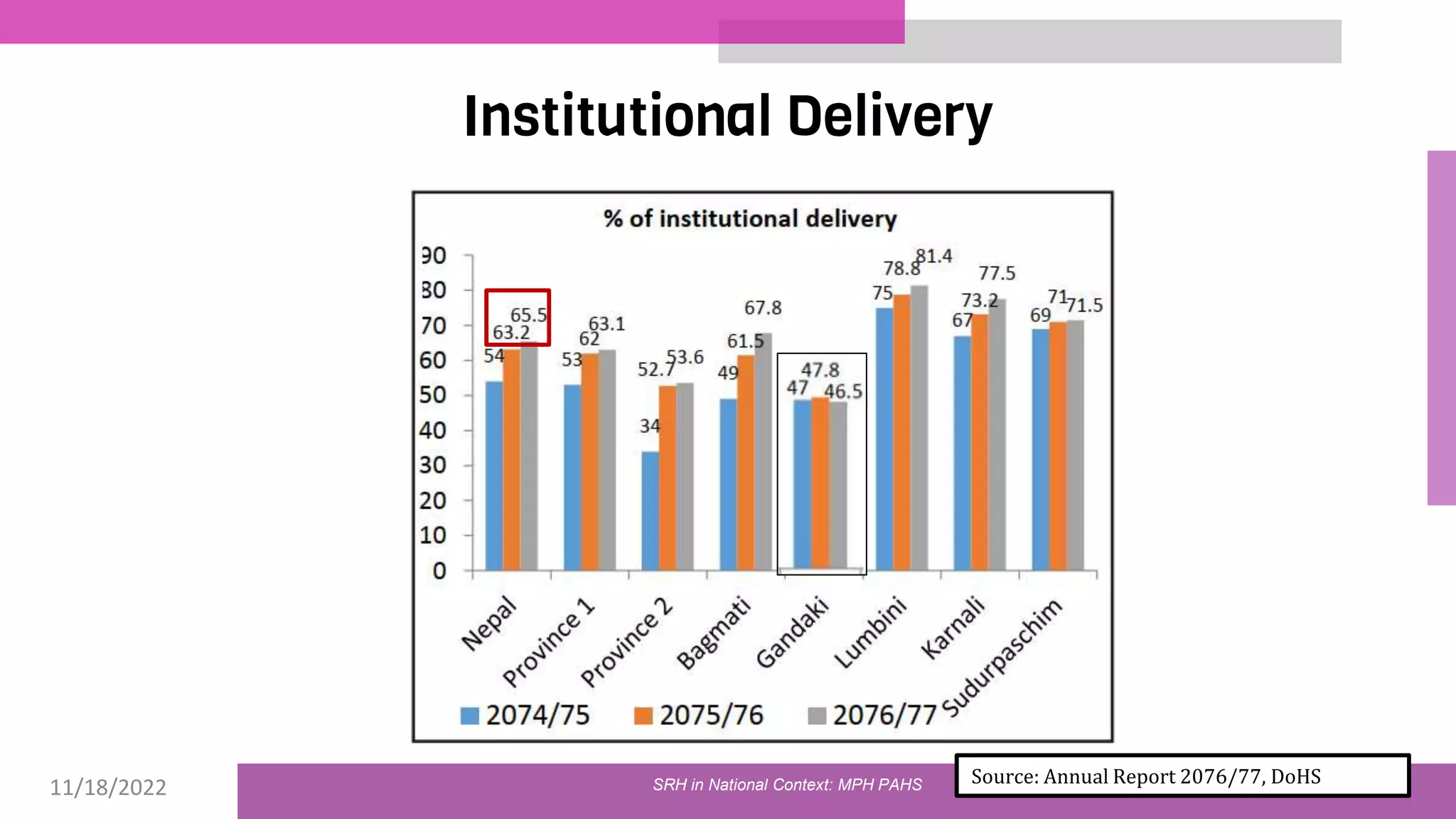
Institutional Delivery
Source: Annual Report 2076/77, DoHS
SRH in National Context: MPH PAHS
11/18/2022 42
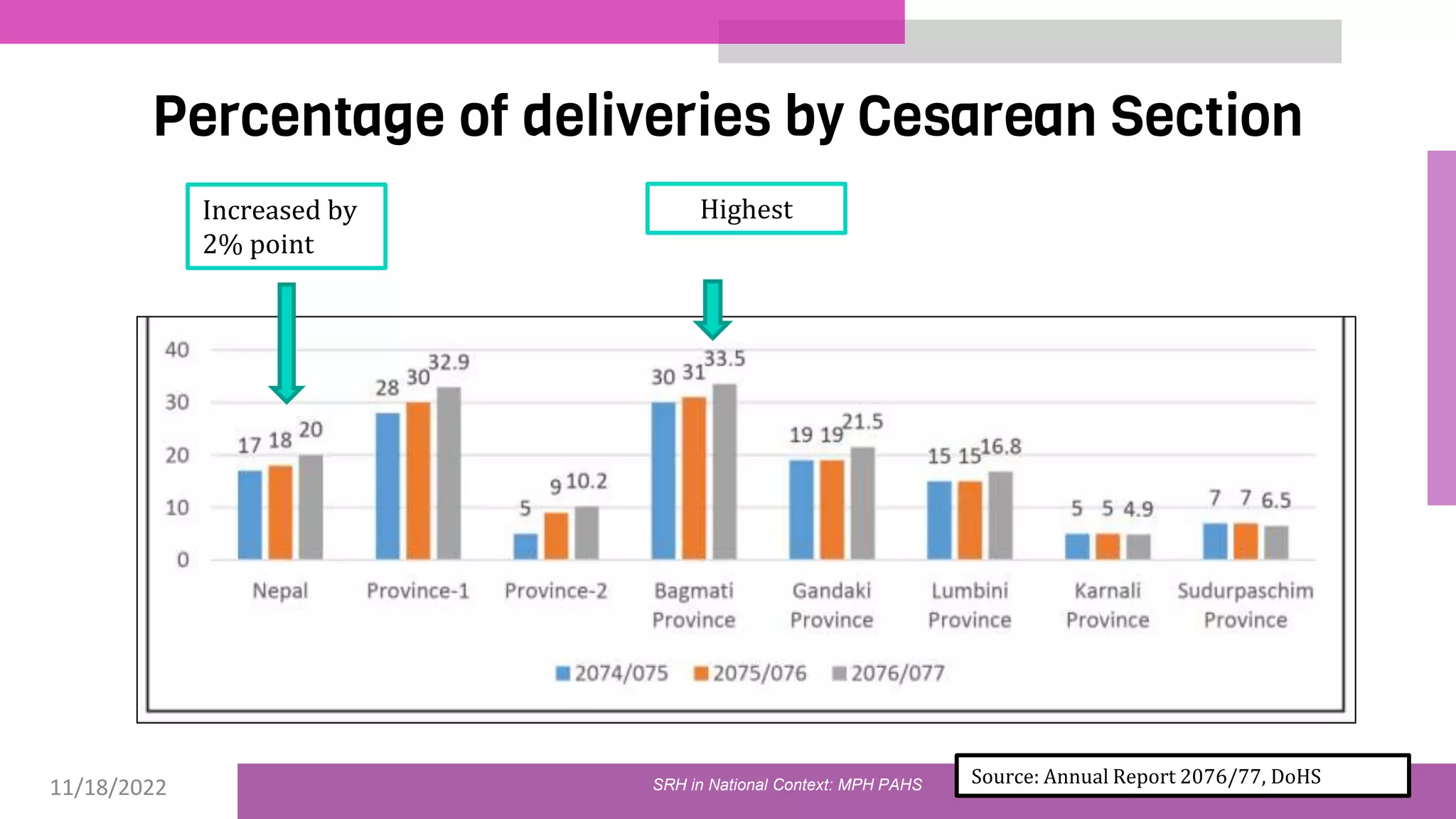
Percentage of deliveries by Cesarean Section
Source: Annual Report 2076/77, DoHS
Increased by
2% point
Highest
SRH in National Context: MPH PAHS
11/18/2022 43
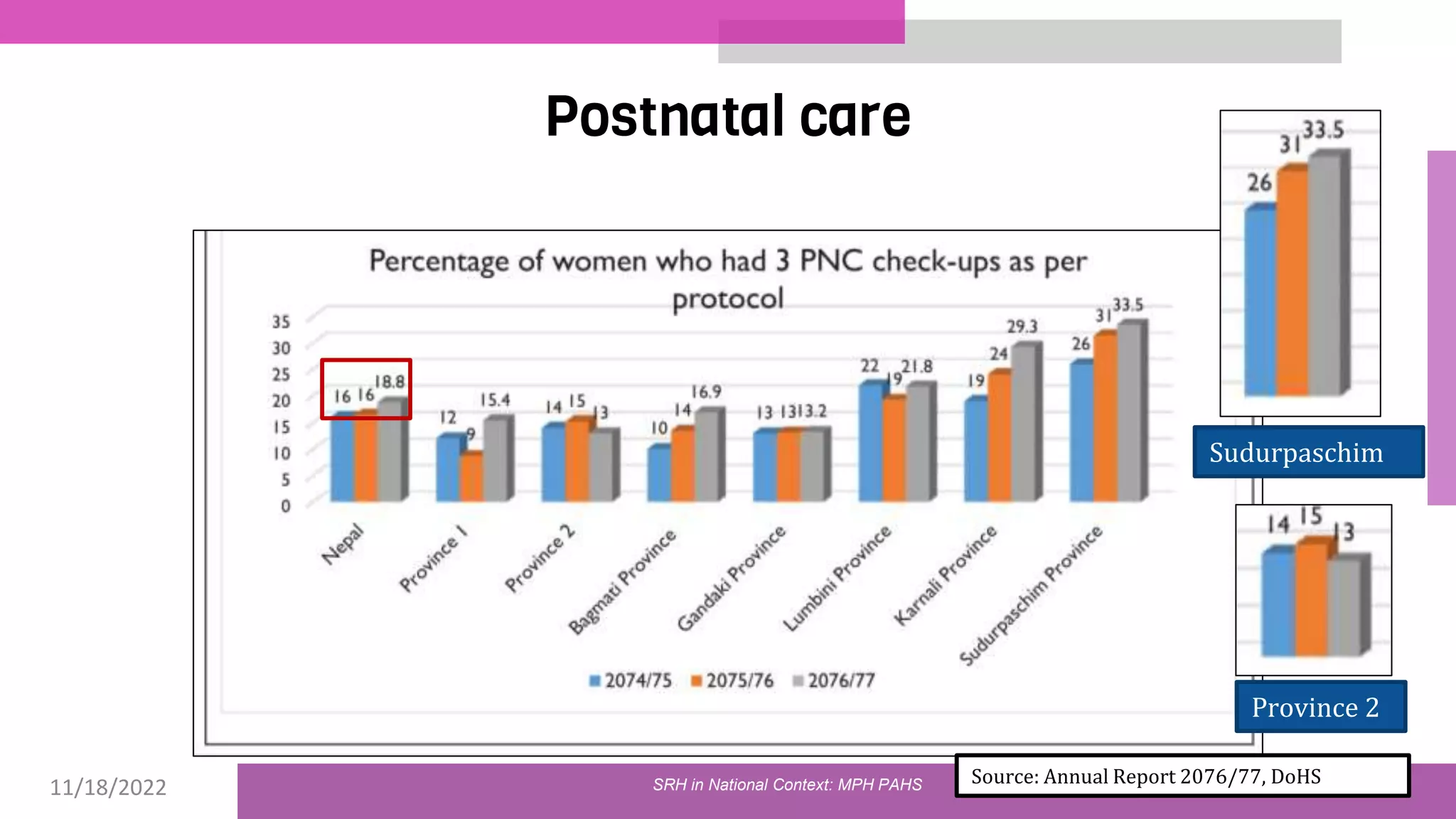
Postnatal care
Source: Annual Report 2076/77, DoHS
Province 2
Sudurpaschim
SRH in National Context: MPH PAHS
11/18/2022 44
Maternal and child health
HIGHEST??
SRH in National Context: MPH PAHS
11/18/2022 45
Domestic Violence
Source: NDHS 2016
22% 7%
Experience of violence
by women aged 15-49
Physical Violence
Sexual Violence
Six percent of women who have ever been pregnant have
experienced violence during pregnancy.
SRH in National Context: MPH PAHS
11/18/2022 46
Domestic Violence
Source: NDHS 2016
26%
Physical Violence (23%)
Spousal Violence
Emotional Violence (12%)
Sexual Violence (7%)
SRH in National Context: MPH PAHS
11/18/2022 47
Source: NDHS 2016
Types of Spousal
Violence
SRH in National Context: MPH PAHS
11/18/2022 48
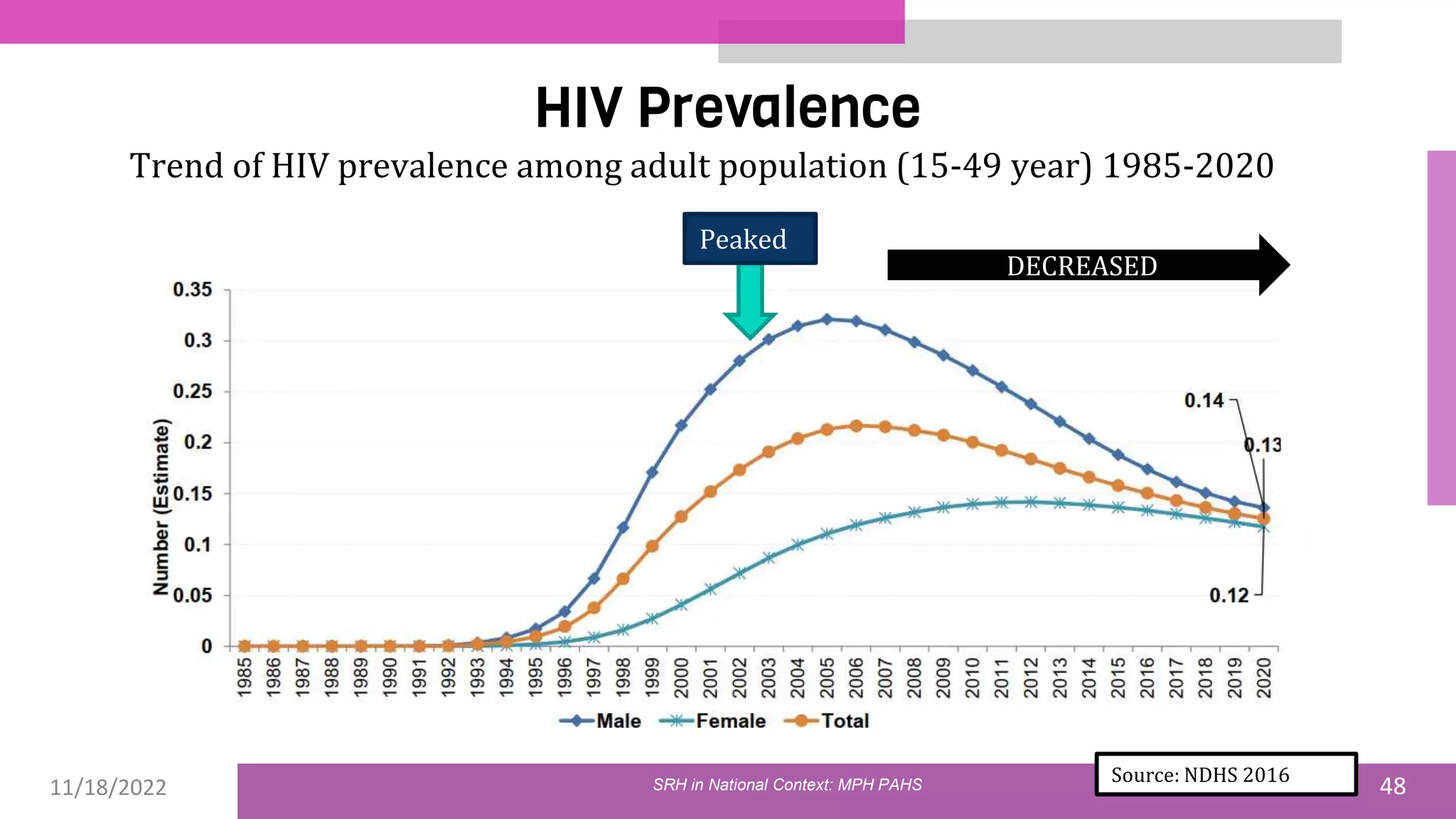
HIV Prevalence
Trend of HIV prevalence among adult population (15-49 year) 1985-2020
Source: NDHS 2016
Peaked
DECREASED
SRH in National Context: MPH PAHS
11/18/2022 49
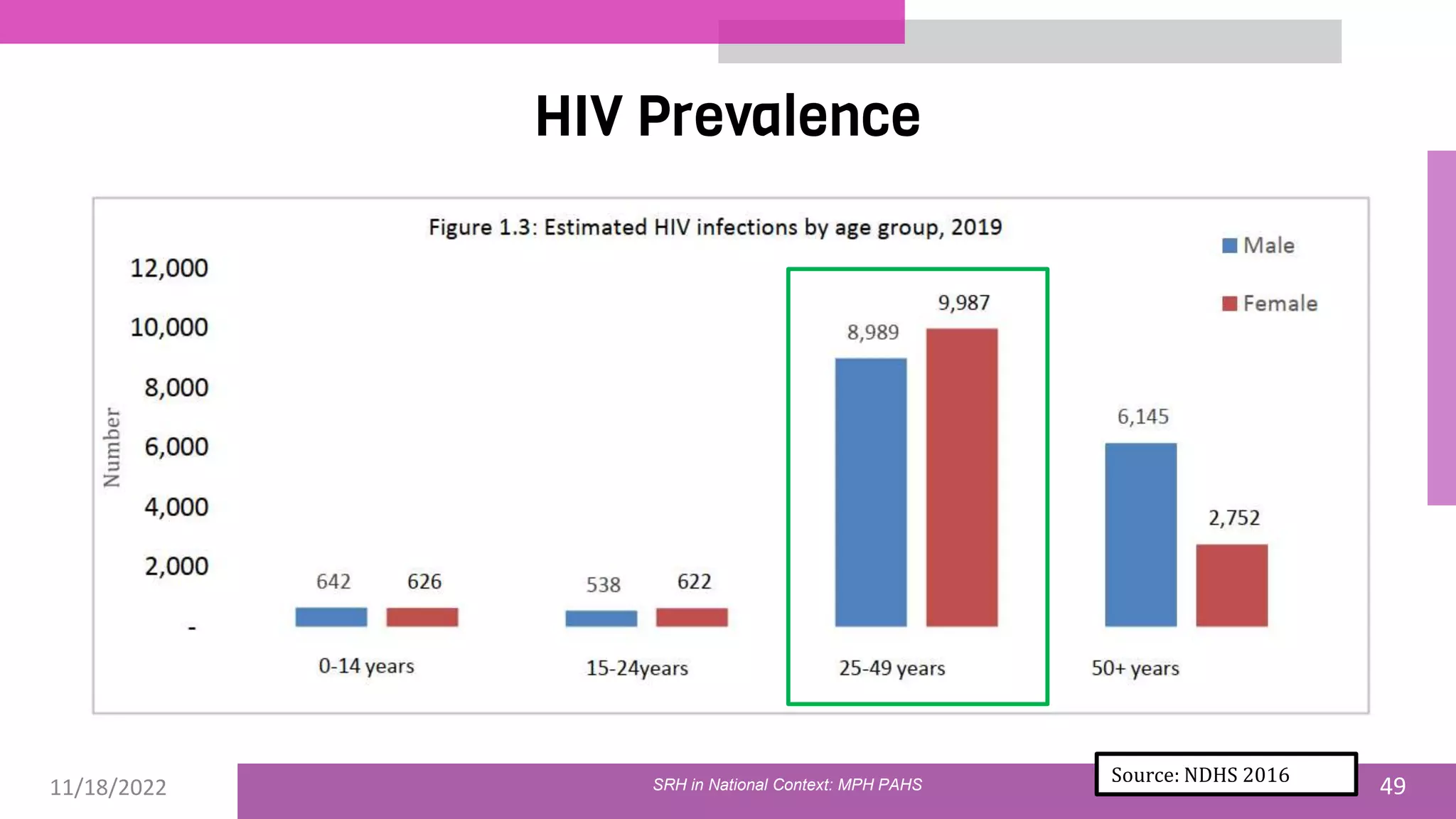
HIV Prevalence
Source: NDHS 2016
SRH in National Context: MPH PAHS
Evolution of SRH
Strategies in Nepal
03
11/18/2022 51
Evolution of SRH Strategies in Nepal
SRH in National Context: MPH PAHS
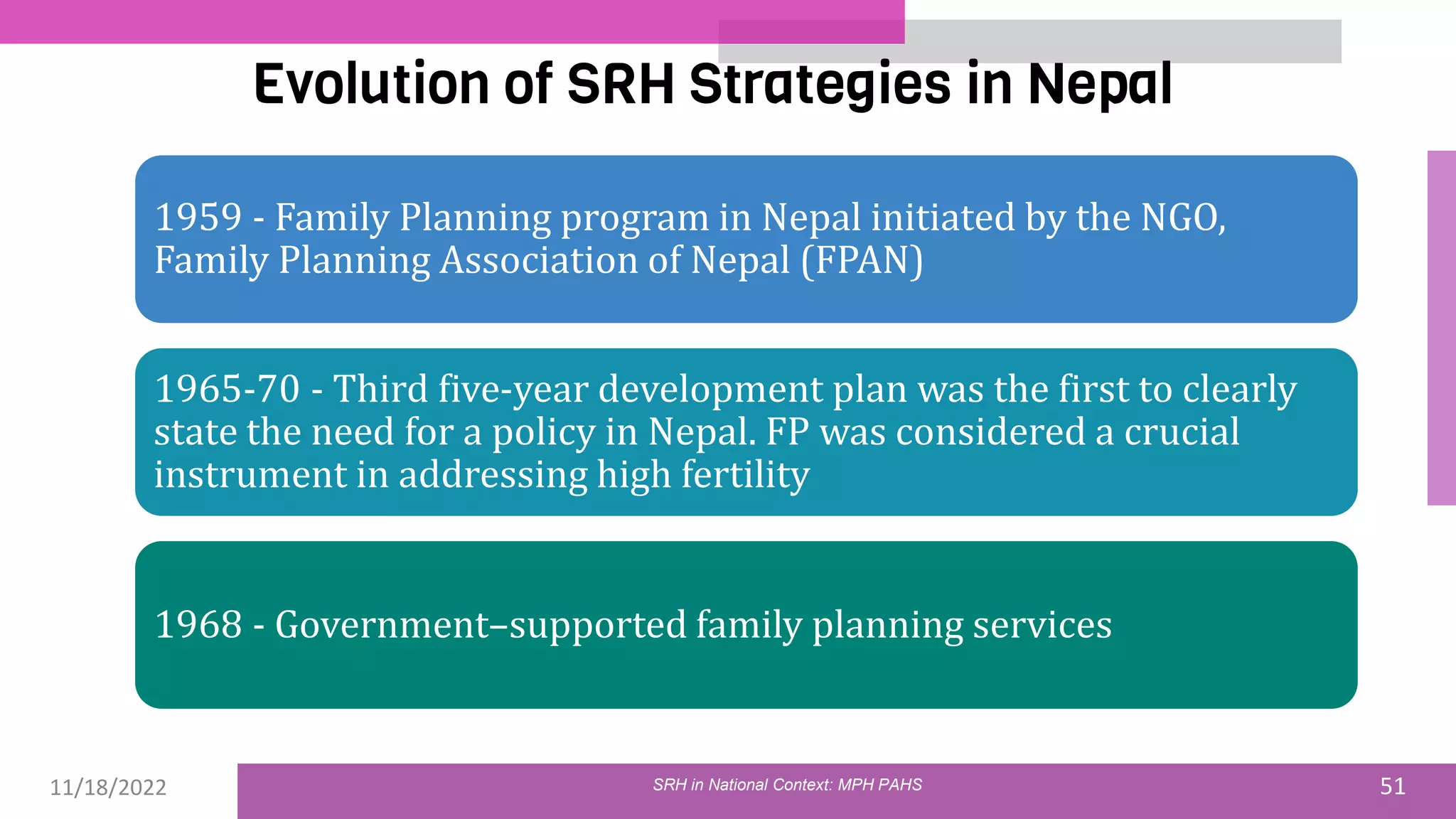
1959 - Family Planning program in Nepal initiated by the NGO,
Family Planning Association of Nepal (FPAN)
1965-70 - Third five-year development plan was the first to clearly
state the need for a policy in Nepal. FP was considered a crucial
instrument in addressing high fertility
1968 - Government–supported family planning services
11/18/2022 52
Evolution of SRH Strategies in Nepal
SRH in National Context: MPH PAHS
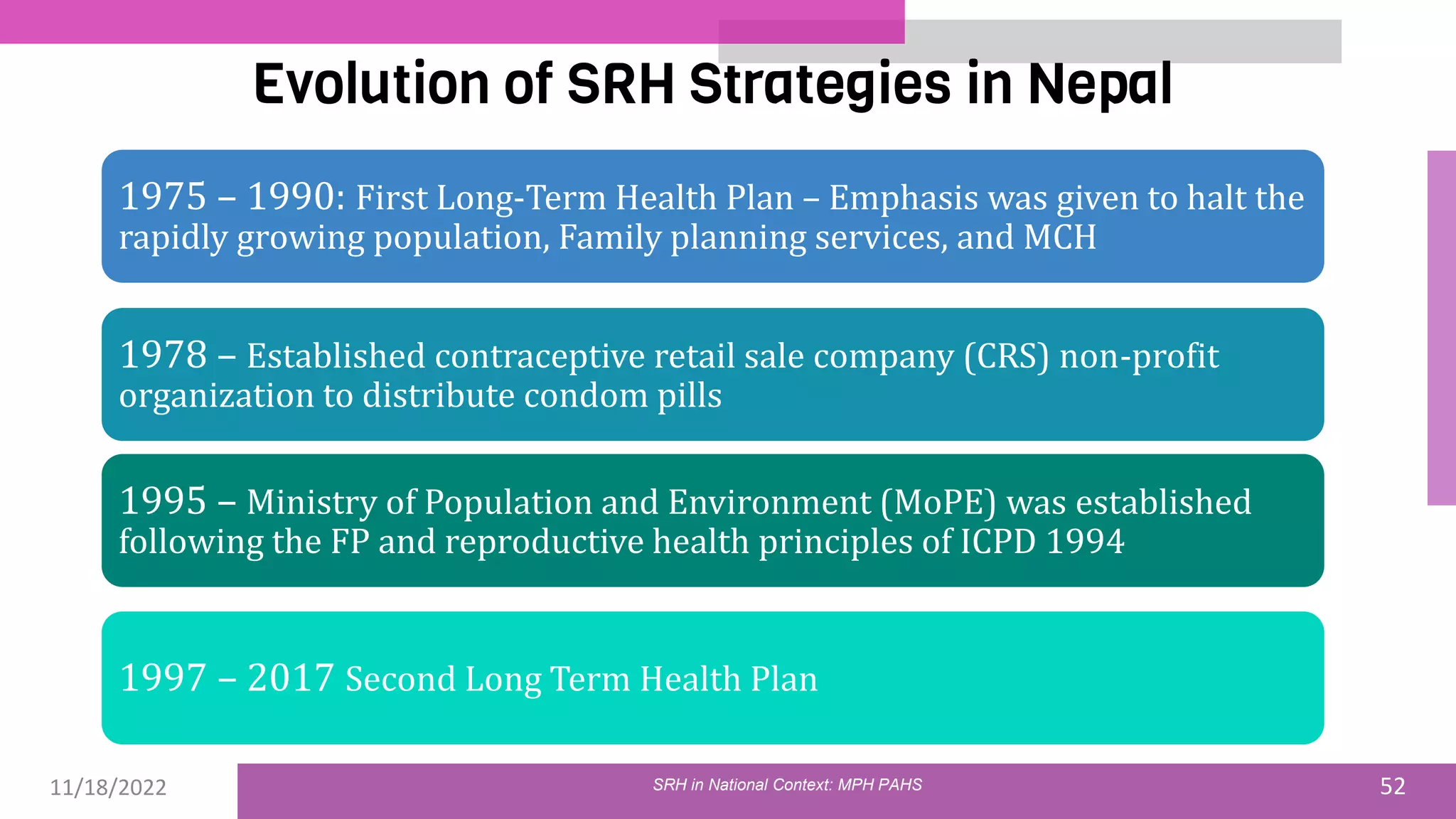
1975 – 1990: First Long-Term Health Plan – Emphasis was given to halt the
rapidly growing population, Family planning services, and MCH
1978 – Established contraceptive retail sale company (CRS) non-profit
organization to distribute condom pills
1995 – Ministry of Population and Environment (MoPE) was established
following the FP and reproductive health principles of ICPD 1994
1997 – 2017 Second Long Term Health Plan
11/18/2022 53
Evolution of SRH Strategies in Nepal
SRH in National Context: MPH PAHS
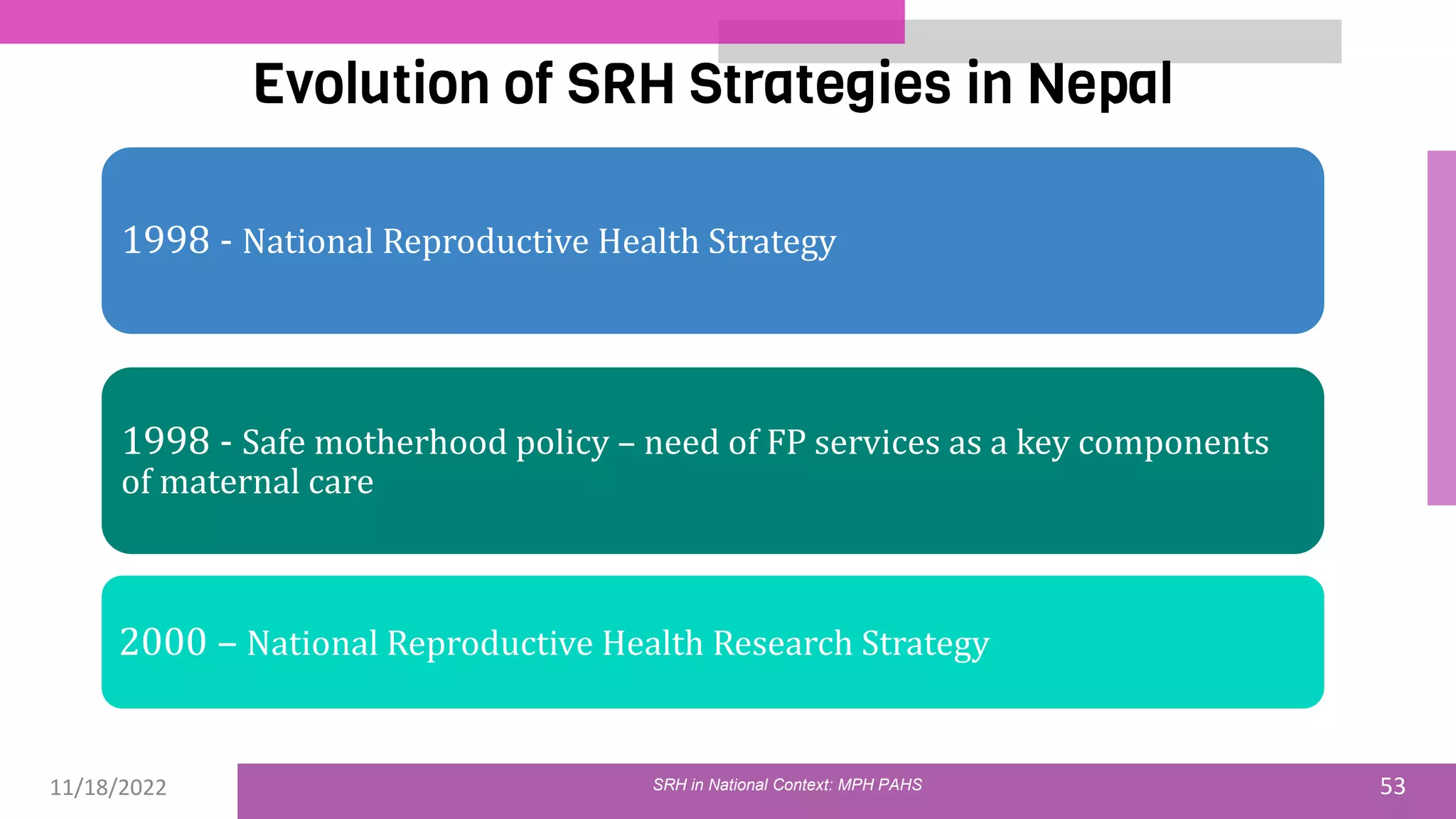
1998 - National Reproductive Health Strategy
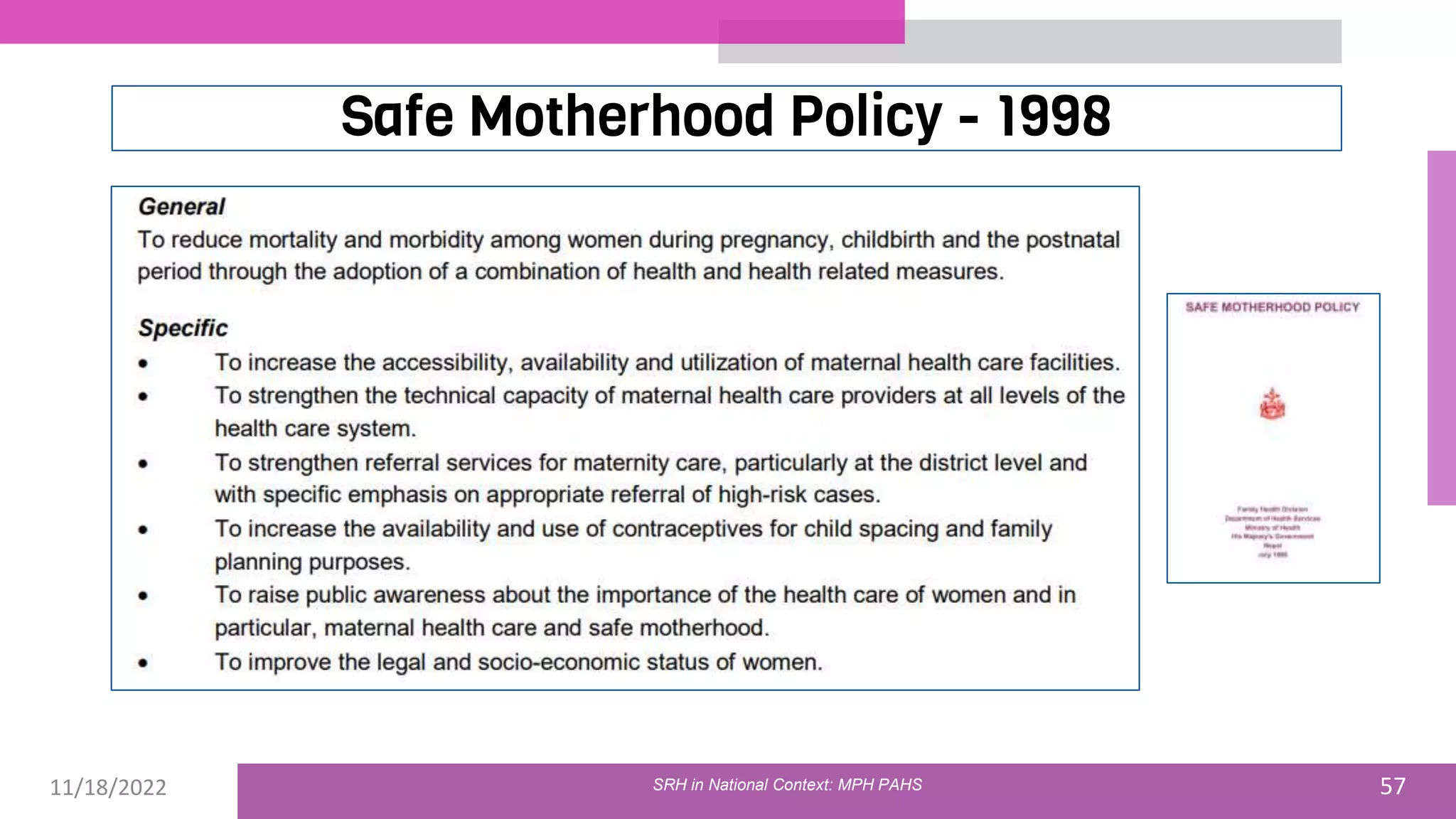
1998 - Safe motherhood policy – need of FP services as a key components
of maternal care
2000 – National Reproductive Health Research Strategy
11/18/2022 54
Evolution of SRH Strategies in Nepal
SRH in National Context: MPH PAHS
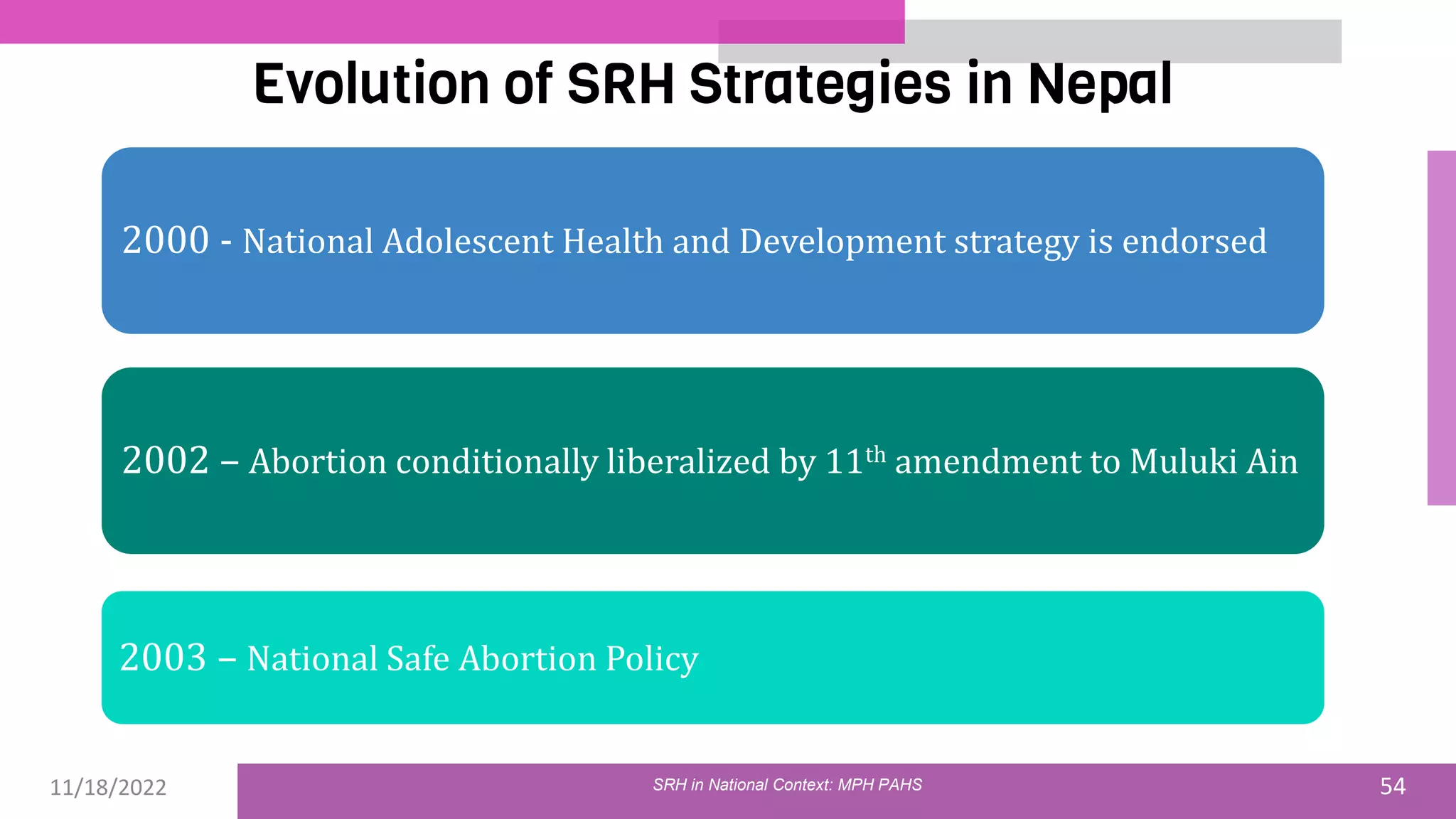
2000 - National Adolescent Health and Development strategy is endorsed
2002 – Abortion conditionally liberalized by 11th amendment to Muluki Ain
2003 – National Safe Abortion Policy
11/18/2022 55
Evolution of SRH Strategies in Nepal
SRH in National Context: MPH PAHS
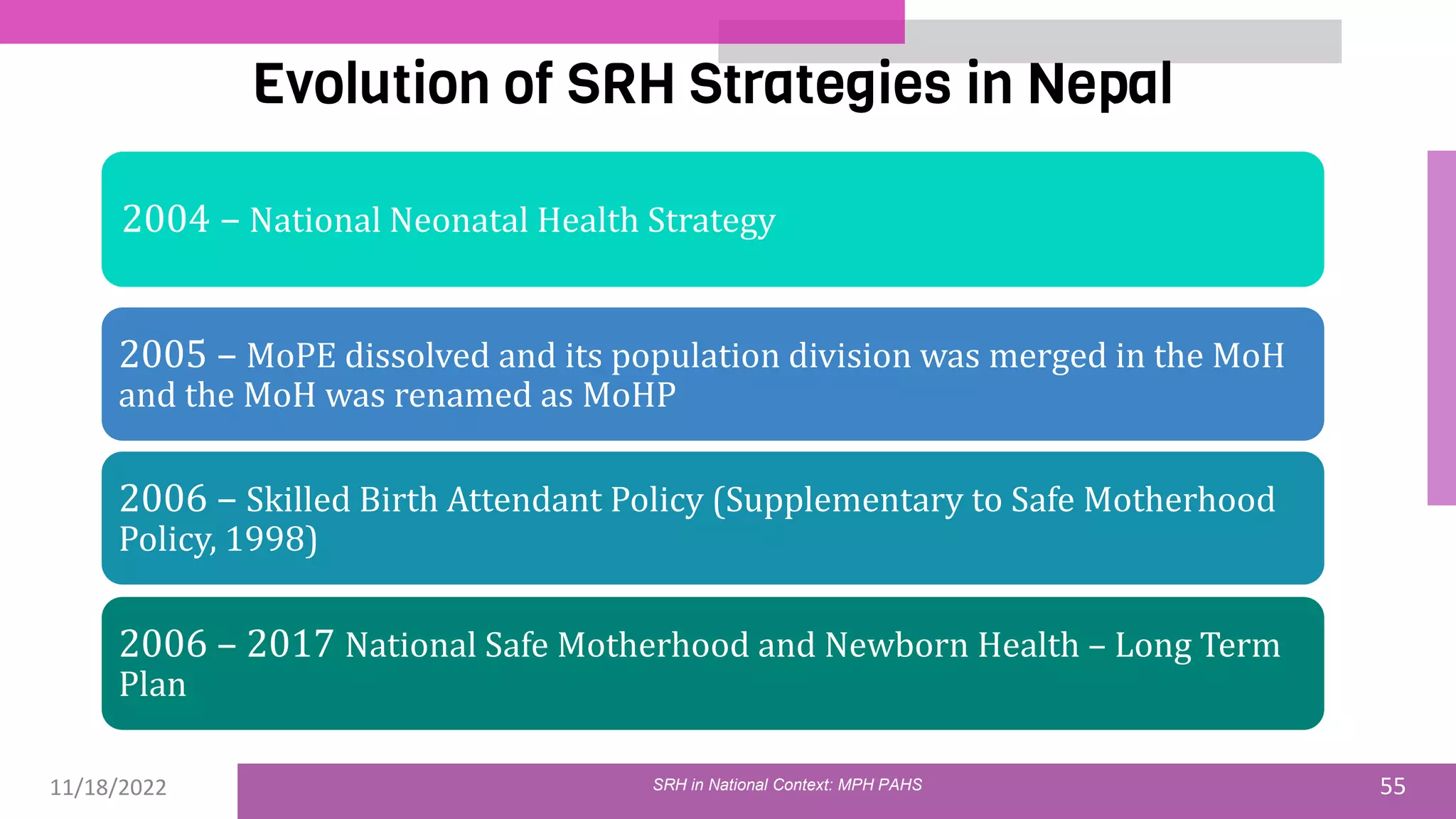
2005 – MoPE dissolved and its population division was merged in the MoH
and the MoH was renamed as MoHP
2006 – Skilled Birth Attendant Policy (Supplementary to Safe Motherhood
Policy, 1998)
2006 – 2017 National Safe Motherhood and Newborn Health – Long Term
Plan
2004 – National Neonatal Health Strategy
11/18/2022 56
Evolution of SRH Strategies in Nepal
SRH in National Context: MPH PAHS
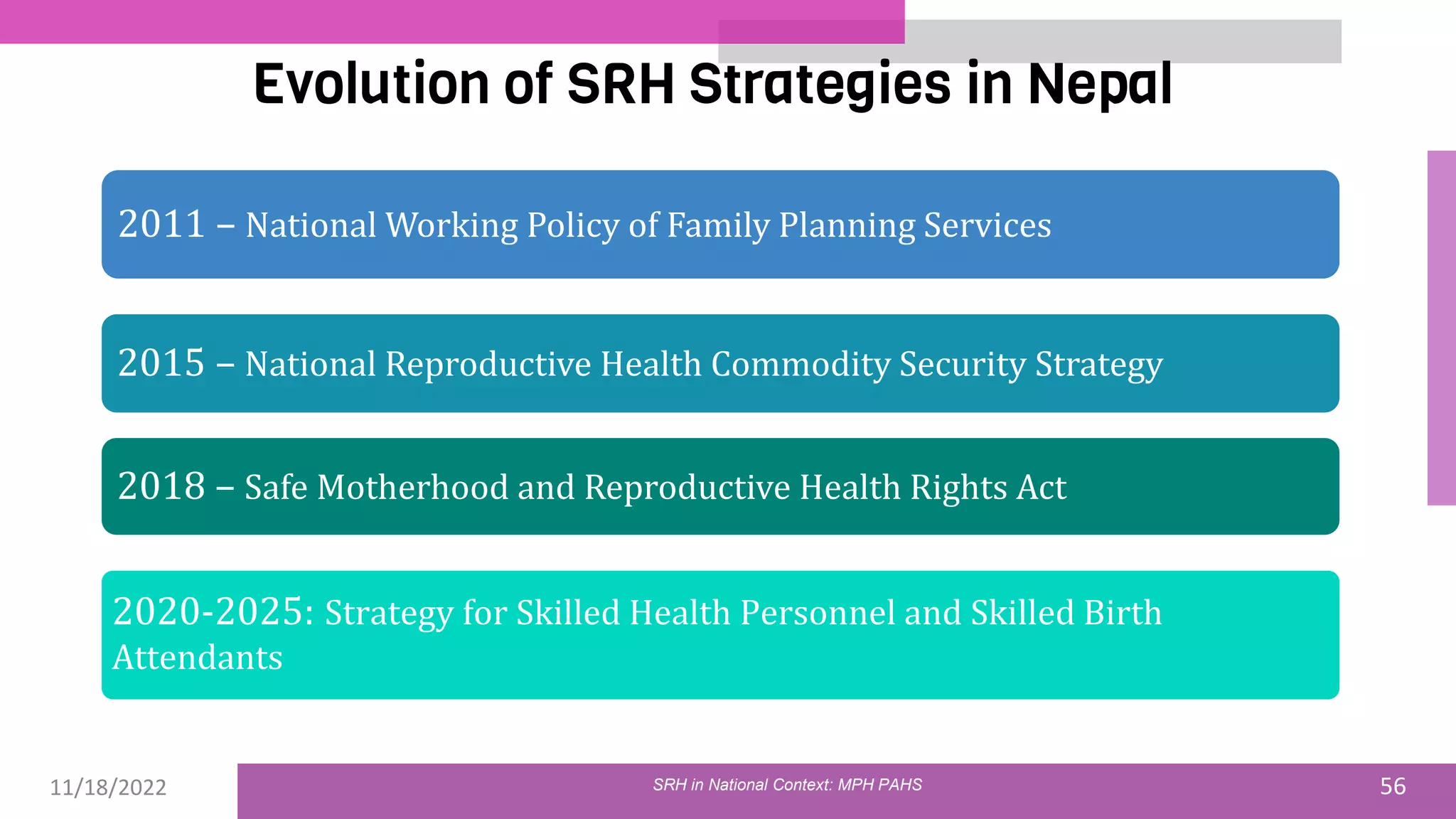
2011 – National Working Policy of Family Planning Services
2015 – National Reproductive Health Commodity Security Strategy
2018 – Safe Motherhood and Reproductive Health Rights Act
2020-2025: Strategy for Skilled Health Personnel and Skilled Birth
Attendants
11/18/2022 57
Safe Motherhood Policy - 1998
SRH in National Context: MPH PAHS
11/18/2022 58
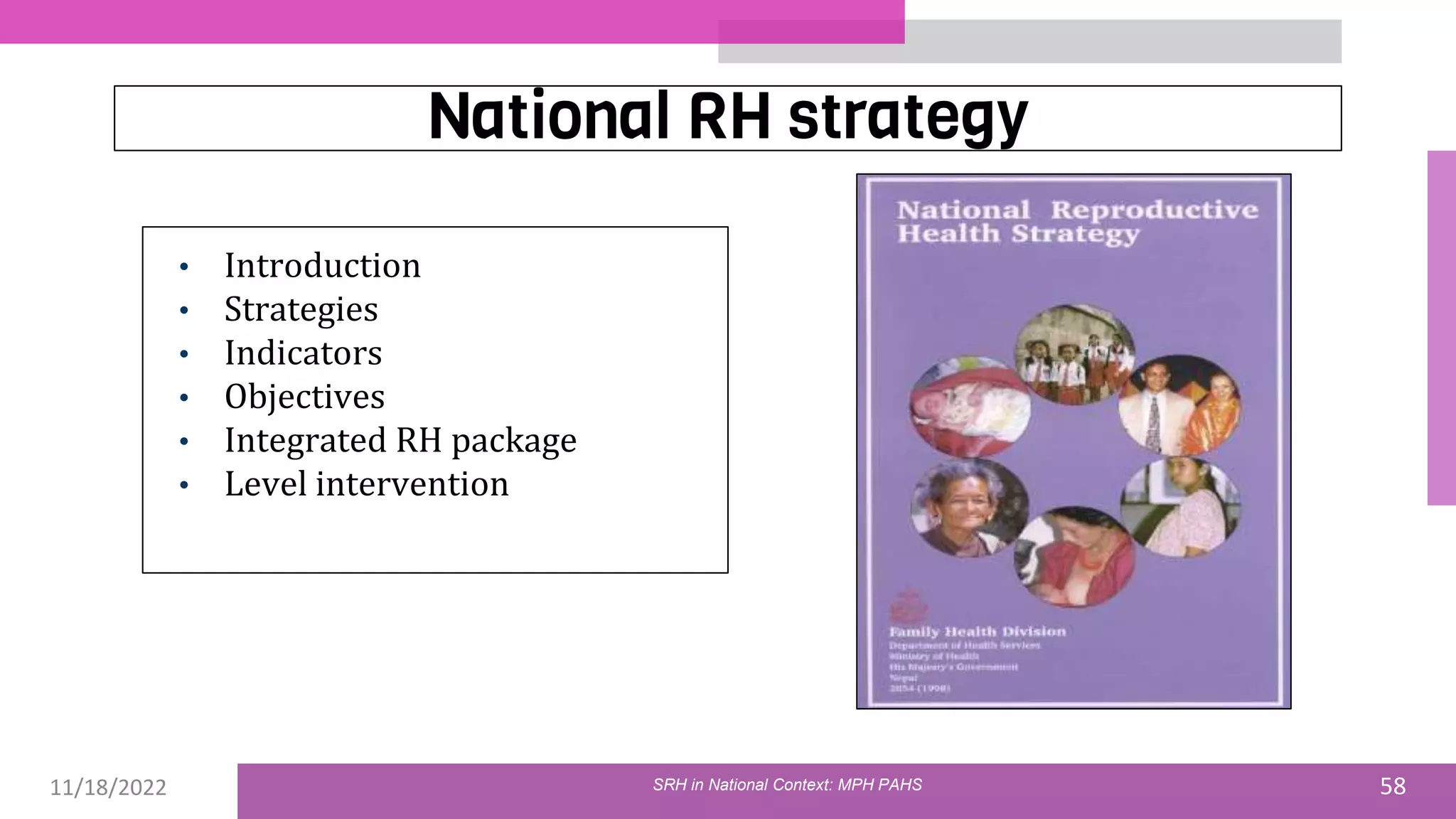
National RH strategy
• Introduction
• Strategies
• Indicators
• Objectives
• Integrated RH package
• Level intervention
01
SRH in National Context: MPH PAHS
11/18/2022 59
Introduction
SRH in National Context: MPH PAHS
New approach to strengthen the existing Safe Motherhood, Family
planning, HIV/AIDS, STD, child survival and nutrition programmes with a
holistic life cycle approach.
Fits within the context of the 1991 Health policy as well as the 1997-2017
Second Long Term Health Plan.
11/18/2022 60
Strategies
SRH in National Context: MPH PAHS
• Implement the ‘Integrated Reproductive Health Package’ at hospital,
PHC Center, Health Posts and Sub-Health Post as well as through
primary health care outreach, TBAs, FCHVs/ mothers groups and other
community and family level activities based on standardized clinical
protocols and operational guidelines.
• Enhance functional integration of Reproductive Health activities carried
out by different divisions
• Emphasize advocacy for the concept of Reproductive Health including
the creation of an enabling environment for inter and intra-sectoral
collaboration
11/18/2022 61
Strategies
SRH in National Context: MPH PAHS
Review and develop IEC materials to support all levels of intervention
including rumor countering messages.
Review and update the existing training curricula of various health workers
to include missing reproductive health components.
Ensure effective management systems by strengthening and revitalizing
existing committees at various levels.
11/18/2022 62
Strategies
SRH in National Context: MPH PAHS
• Develop a national RH research strategy which outlines research priorities
and work plans based on information requirements of policy makers,
planners, managers and service providers.
• Construct/upgrade appropriate service delivery and training facilities at
the National, Regional, District and Health post level.
• Institutional strengthening through structured planning,
monitoring/supervision and performance review
• Develop an appropriate RH programme for adolescents Support for
national experts/consultants
• Promote inter-sectoral and multi-sectoral co-ordination.
11/18/2022 63
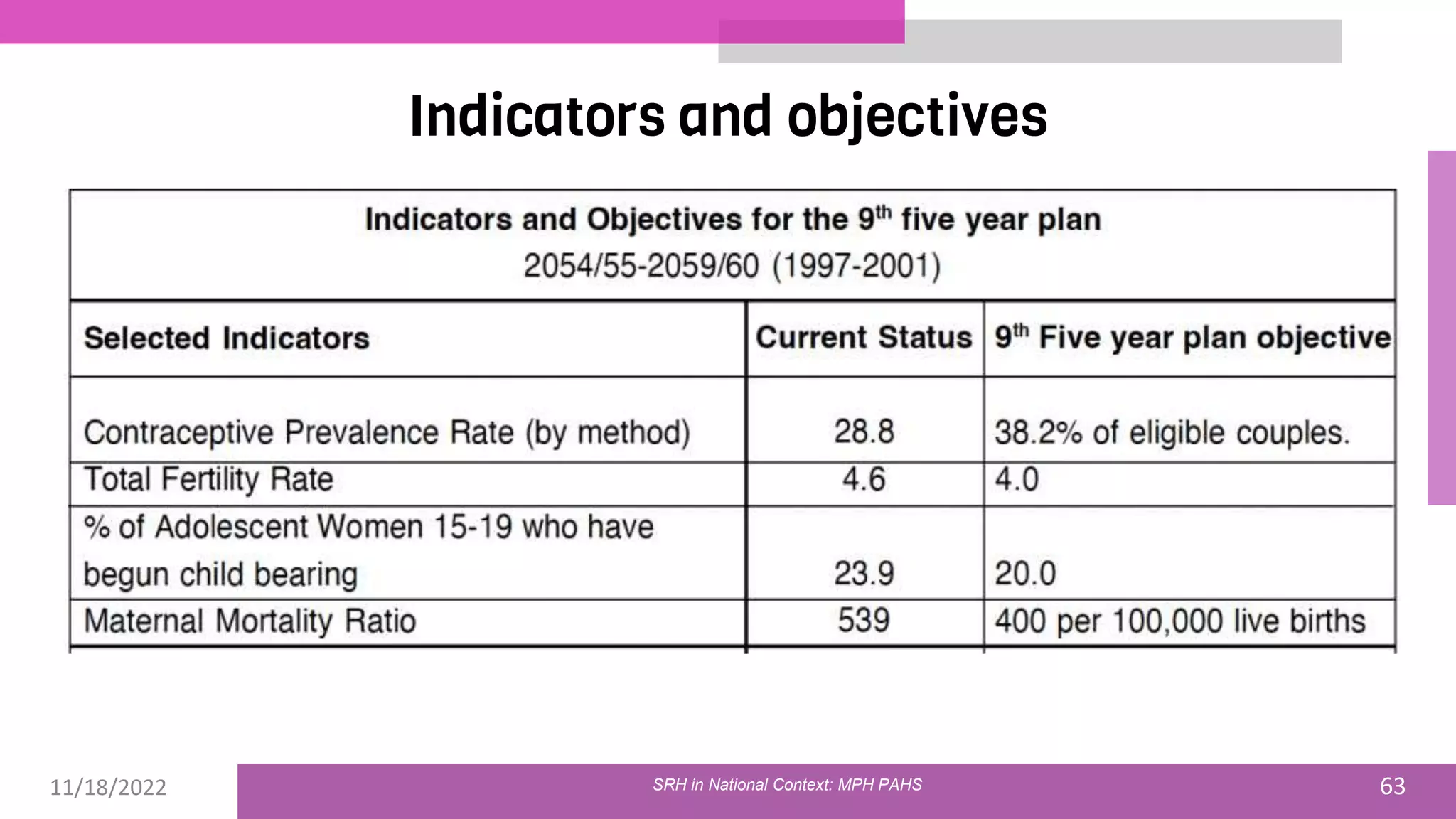
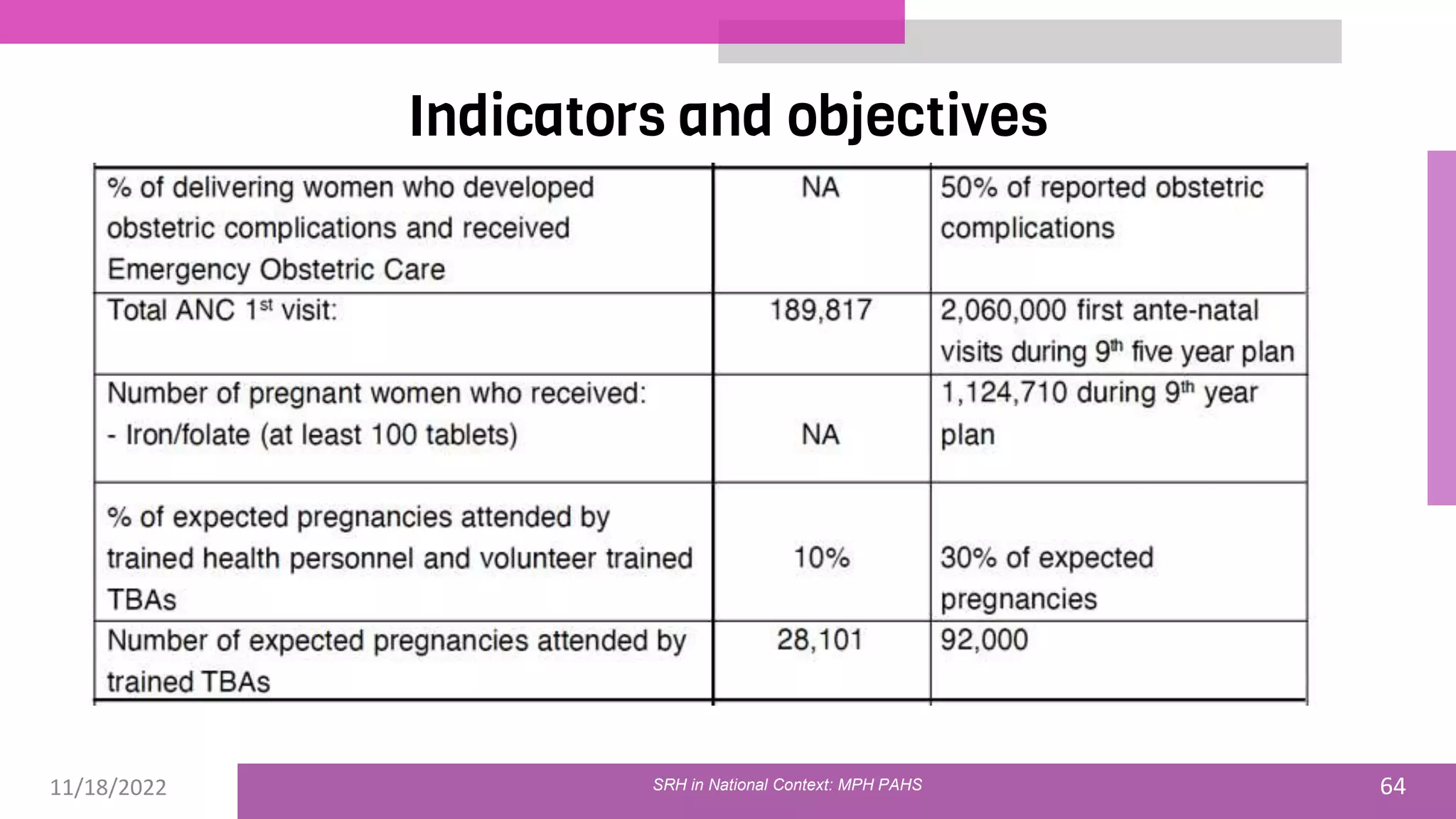
Indicators and objectives
SRH in National Context: MPH PAHS
11/18/2022 64
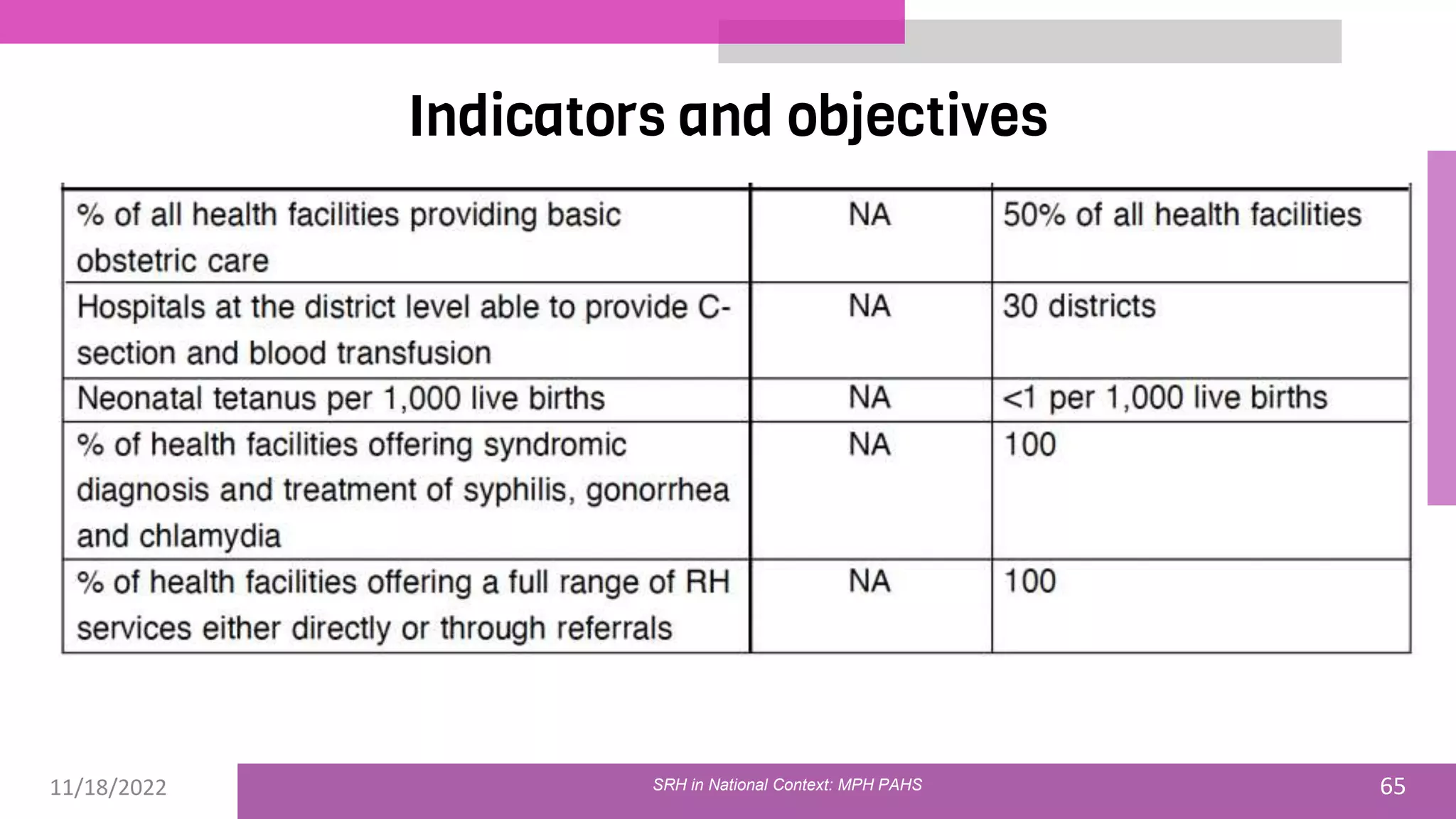
Indicators and objectives
SRH in National Context: MPH PAHS
11/18/2022 65
Indicators and objectives
SRH in National Context: MPH PAHS
11/18/2022 66
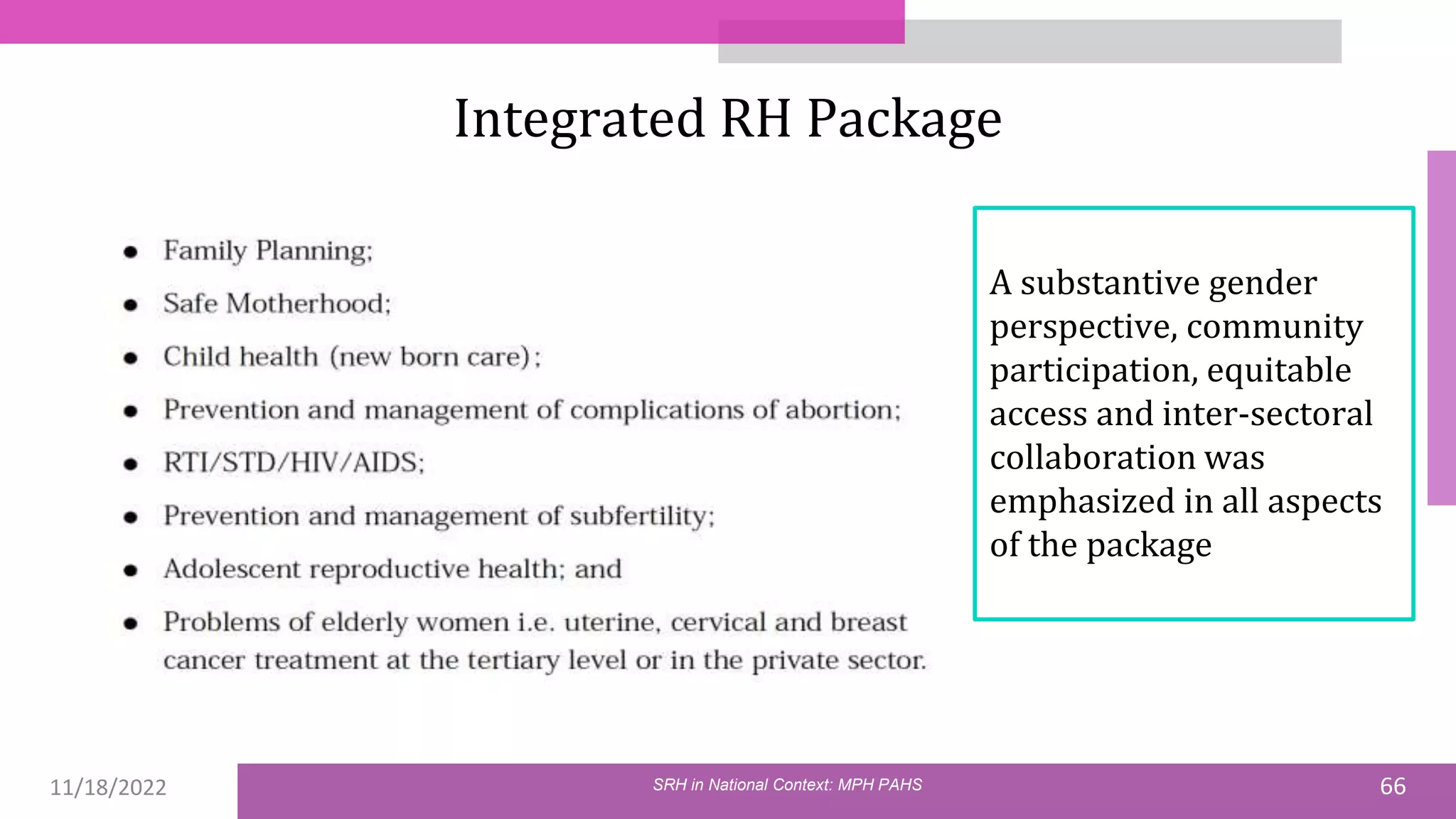
Integrated RH Package
SRH in National Context: MPH PAHS
A substantive gender
perspective, community
participation, equitable
access and inter-sectoral
collaboration was
emphasized in all aspects
of the package
11/18/2022 67
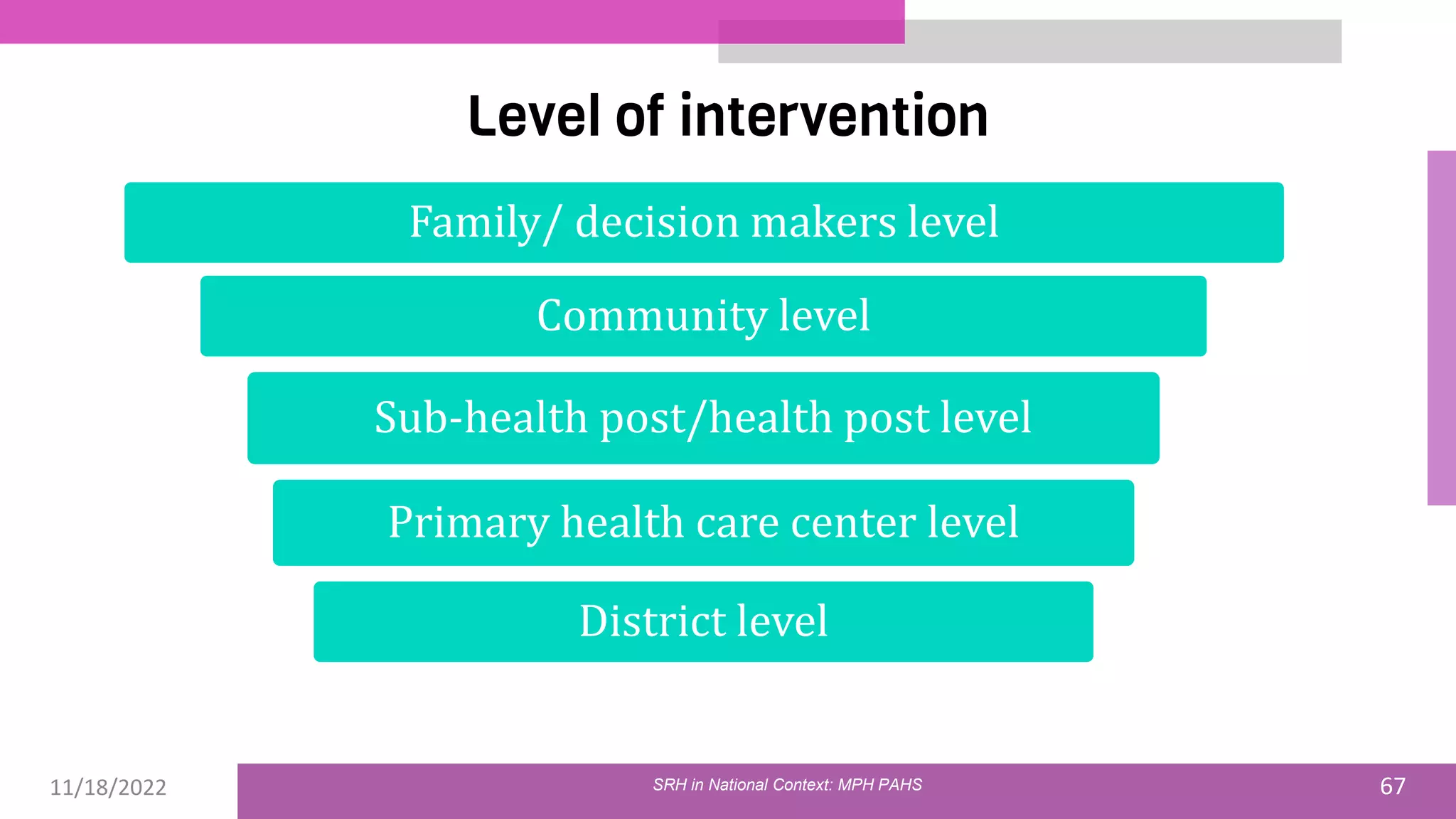
Level of intervention
SRH in National Context: MPH PAHS
Family/ decision makers level
Community level
Sub-health post/health post level
Primary health care center level
District level
11/18/2022 68
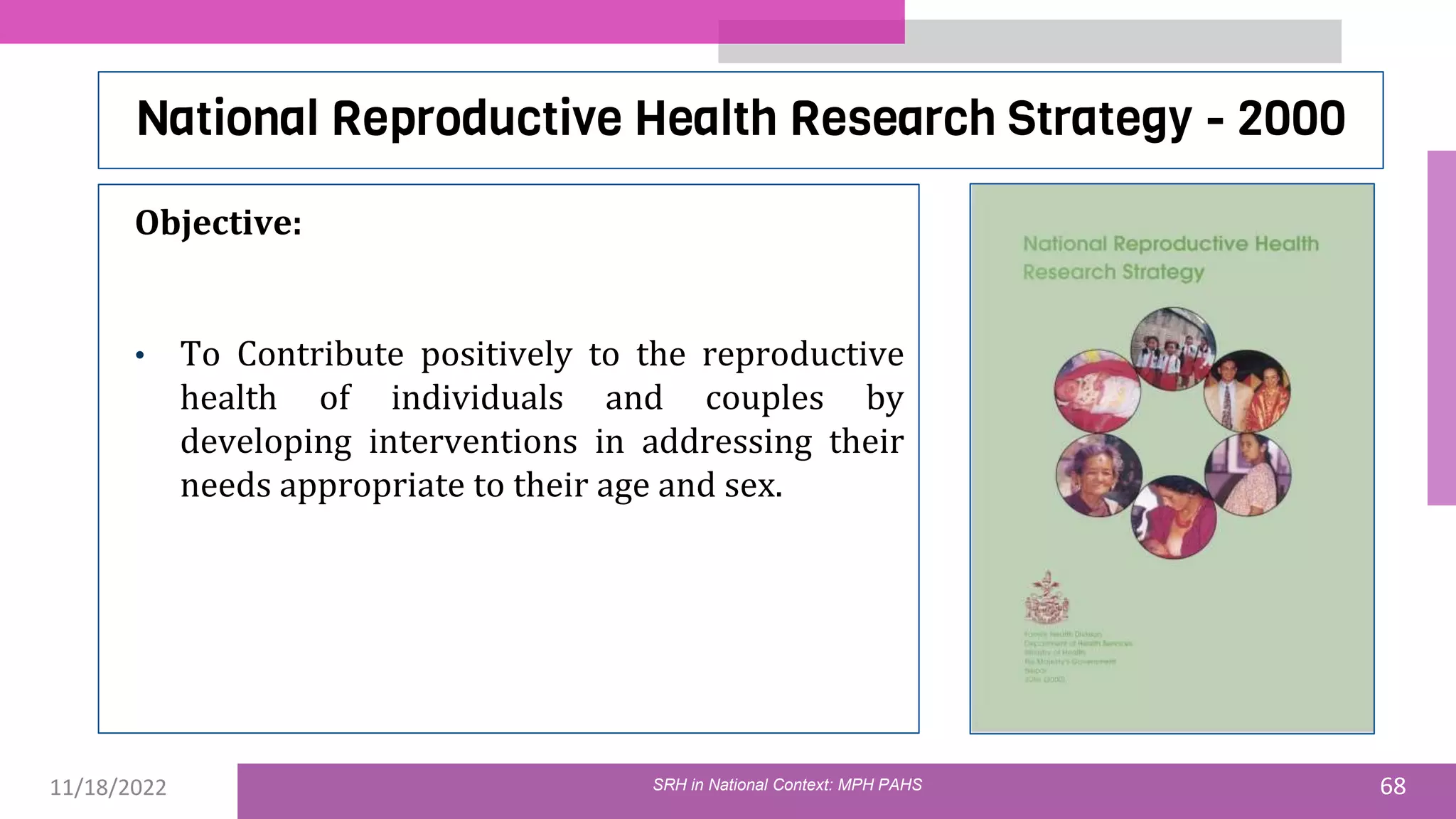
National Reproductive Health Research Strategy - 2000
Objective:
• To Contribute positively to the reproductive
health of individuals and couples by
developing interventions in addressing their
needs appropriate to their age and sex.
SRH in National Context: MPH PAHS
11/18/2022 69
National safe abortion policy,2003
SRH in National Context: MPH PAHS
Introduction
Policy statements
11/18/2022 70
Introduction
SRH in National Context: MPH PAHS
Parliament approved 11th ammendment bill to the Muluki Ain on the 14th
of March 2002 and on the 27th of September 2002, Royal seal achievement.
For the first time in Nepal abortion has been conditionally liberalised.
This was developed in the same context of 11th ammendment of Muluki
Ain 1959(2020 B.S).
11/18/2022 71
Introduction
SRH in National Context: MPH PAHS
11/18/2022 72
Policy statement
SRH in National Context: MPH PAHS
Comprehensive Abortion Care(CAC) services
1. Availability with equity and quality for all women.
2. Maximise aceessibility
3. Establishment of referral networks CAC facilities and advanced referral
centers.
4. Integration of CAC services with existing reproductive health and
hospital services.
5. Development of clinical protocols
6. Coordination between CAC service site
11/18/2022 73
Policy statement
SRH in National Context: MPH PAHS
Human resource development
Rights of women
Role of non-government and private sectors
Advocacy, IEC and Social Mobilisation
Coordination, Planning, Monitoring, Supervision and Follow-up Research
Institutional arrangements
11/18/2022 74
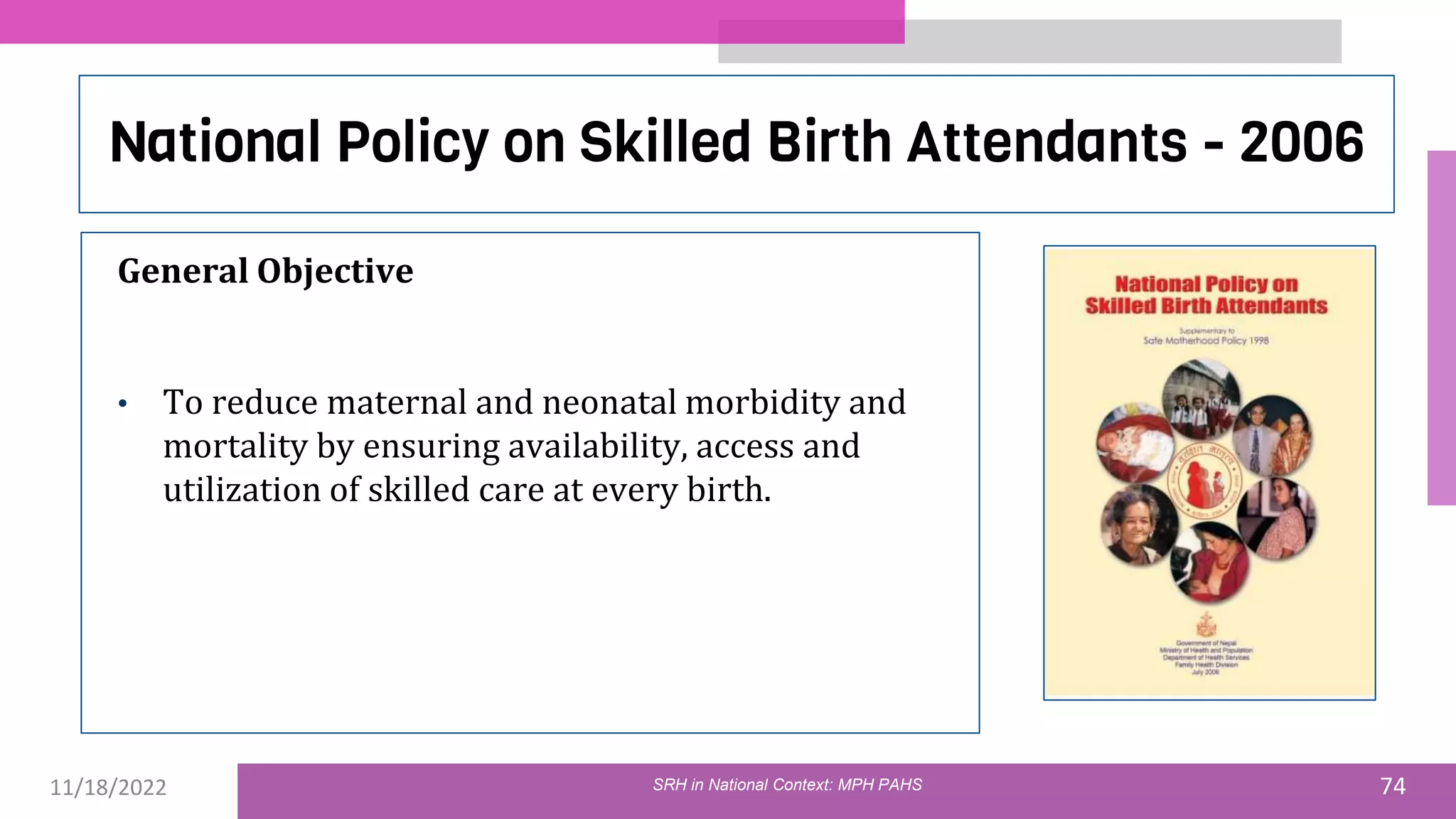
National Policy on Skilled Birth Attendants - 2006
General Objective
• To reduce maternal and neonatal morbidity and
mortality by ensuring availability, access and
utilization of skilled care at every birth.
SRH in National Context: MPH PAHS
11/18/2022 75
National Neonatal Health Strategy - 2060
Strategic Objectives
• To achieve a sustainable increase in the
adoption of healthy newborn care practices
and reduce prevailing harmful practices.
• To strengthen the quality of promotive,
preventive and curative neonatal health
services at all levels
SRH in National Context: MPH PAHS
11/18/2022 76
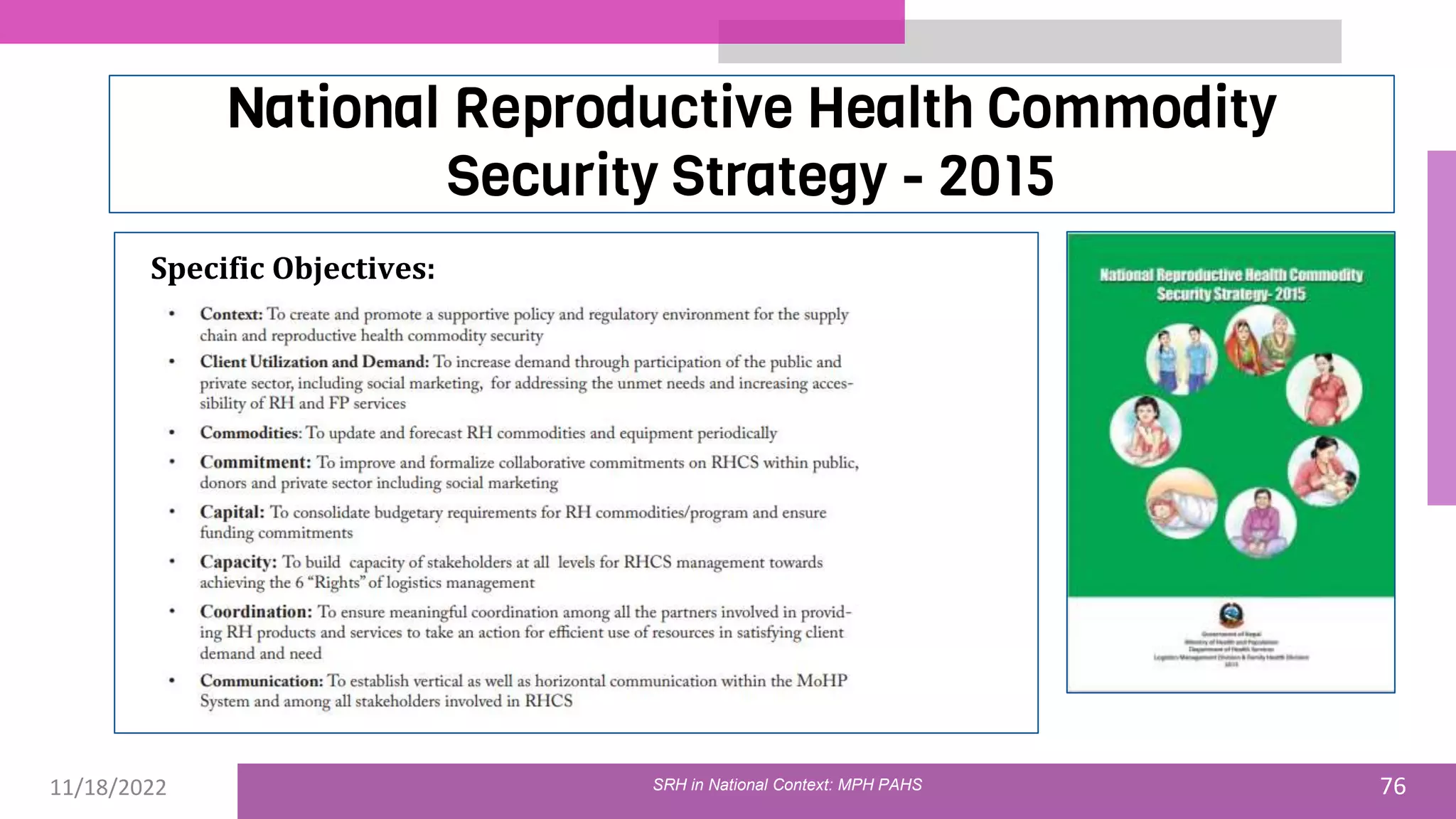
National Reproductive Health Commodity
Security Strategy - 2015
Specific Objectives:
SRH in National Context: MPH PAHS
11/18/2022 77
Safe Motherhood and Reproductive Health Right Act, 2018
• Right to Reproductive Health
• Safe Motherhood and Newborn
• Safe Abortion
• Reproductive Health Morbidity
• Budget and Grant Allocation for Motherhood and
Reproductive Health
• Offences and Punishment
• Miscellaneous
SRH in National Context: MPH PAHS
11/18/2022 78
Strategy for Skilled Health Personnel and SBA 2020-2025
General Objective
• To ensure that the SHP/SBAs have the appropriate
clinical skills, comply with the national standards and
protocols, and provide evidence-based quality of care.
They engage with women in a non-discriminatory and
respectful manner so that the women have a positive
pregnancy and childbirth experience
SRH in National Context: MPH PAHS
11/18/2022 79
The Fifteenth Plan
2019/20-2023/24
SRH in National Context: MPH PAHS
11/18/2022 80
Health and Nutrition: Strategies-3
To address the health necessity of citizens of all age groups as per the Life
Course Approach and to make additional improvements and expansion of
overall development of mother and child, children and adolescents, and
family management services
SRH in National Context: MPH PAHS
11/18/2022 81
Health and Nutrition: Working Policies-3
• The overall development of mother and child, children and adolescents,
and family management services will be reformed further and expanded
as per the concept of the life cycle.
• The health services will be made senior citizen-, gender and disability-
friendly as per the Life Course Approach to address the health needs of
citizens of all age groups.
• Provisions will be made for regular health check-ups for the rapid
detection of health risks of various age groups.
• Provisions will be made for a free check-up for the diseases increasingly
prevalent among women such as breast cancer and cervical cancer.
• Special programmes including evidence-based midwife education and
services will be formulated and carried out for reducing the maternal
mortality rate
SRH in National Context: MPH PAHS
11/18/2022 82
The Constitution of Nepal
2015
SRH in National Context: MPH PAHS
11/18/2022 83
38. Rights of women
(1) Every woman shall have equal lineage right without gender based
discrimination.
(2) Every woman shall have the right to safe motherhood and reproductive
health.
(3) No woman shall be subjected to physical, mental, sexual, psychological or
other form of violence or exploitation on grounds of religion, social, cultural
tradition, practice or on any other grounds. Such act shall be punishable by
law, and the victim shall have the right to obtain compensation in accordance
with law.
(4) Women shall have the right to participate in all bodies of the State on the
basis of the principle of proportional inclusion.
(5) Women shall have the right to obtain special opportunity in education,
health, employment and social security, on the basis of positive
discrimination.
SRH in National Context: MPH PAHS
11/18/2022 84
Nepal Health Sector
Programme 2-
Implementation Plan
(NHSP-IP) 2010 – 2015
SRH in National Context: MPH PAHS
11/18/2022 85
Goal and Objective
Goal
To improve maternal and neonatal health and survival, especially of the
poor and excluded.
Objective
Increased healthy practices and utilisation of quality maternal and
neonatal health services, especially by the poor and excluded
SRH in National Context: MPH PAHS
11/18/2022 86
Major Strategies
Strengthening and expansion of maternal and newborn health care services to improve coverage
and quality of services
• Strengthening and expansion of Comprehensive Emergency Obstetric and Neonatal Care
(CEONC) services
• Strengthening and expansion of birthing centres at PHCC, HP and SHP levels . Expansion of
safe surgical and Medical Abortion (MA) services
• Expansion of Adolescent Sexual and Reproductive Health (ASRH) Programme (1,000 HFs)
• Screening for uterine prolapse through Reproductive Health (RH) camps
• Management of uterine prolapse in static (hospitals) and mobile settings
• Revise/develop (as required) and implement RH and SM-related guidelines and protocols
• Develop a mechanism for quality monitoring
• Strengthening the referral system, including Emergency Obstetric Care (EOC) referral funds
for remote districts
• Other RH services (fistula, cancer screening).
SRH in National Context: MPH PAHS
11/18/2022 87
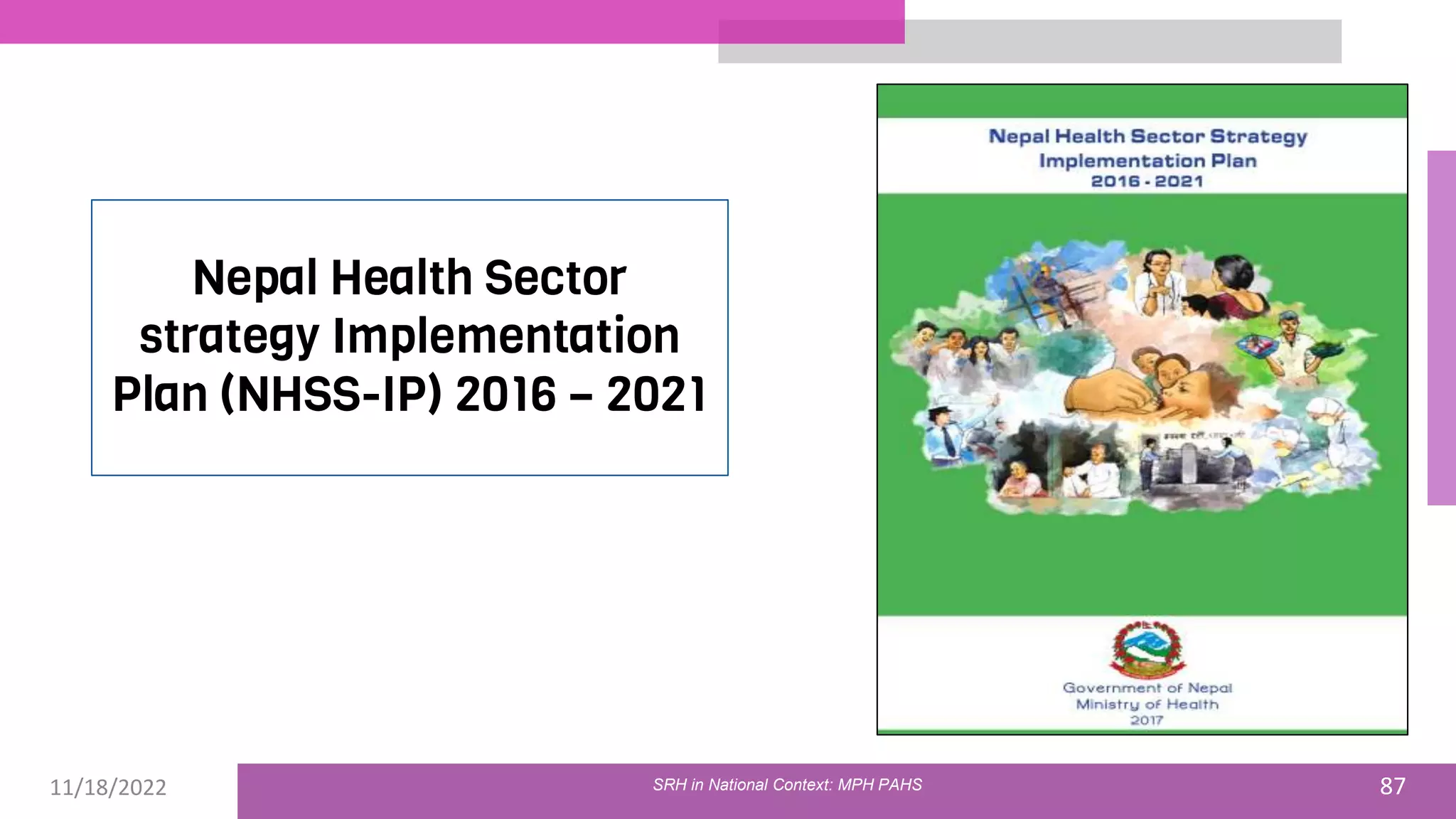
Nepal Health Sector
strategy Implementation
Plan (NHSS-IP) 2016 – 2021
SRH in National Context: MPH PAHS
11/18/2022 88
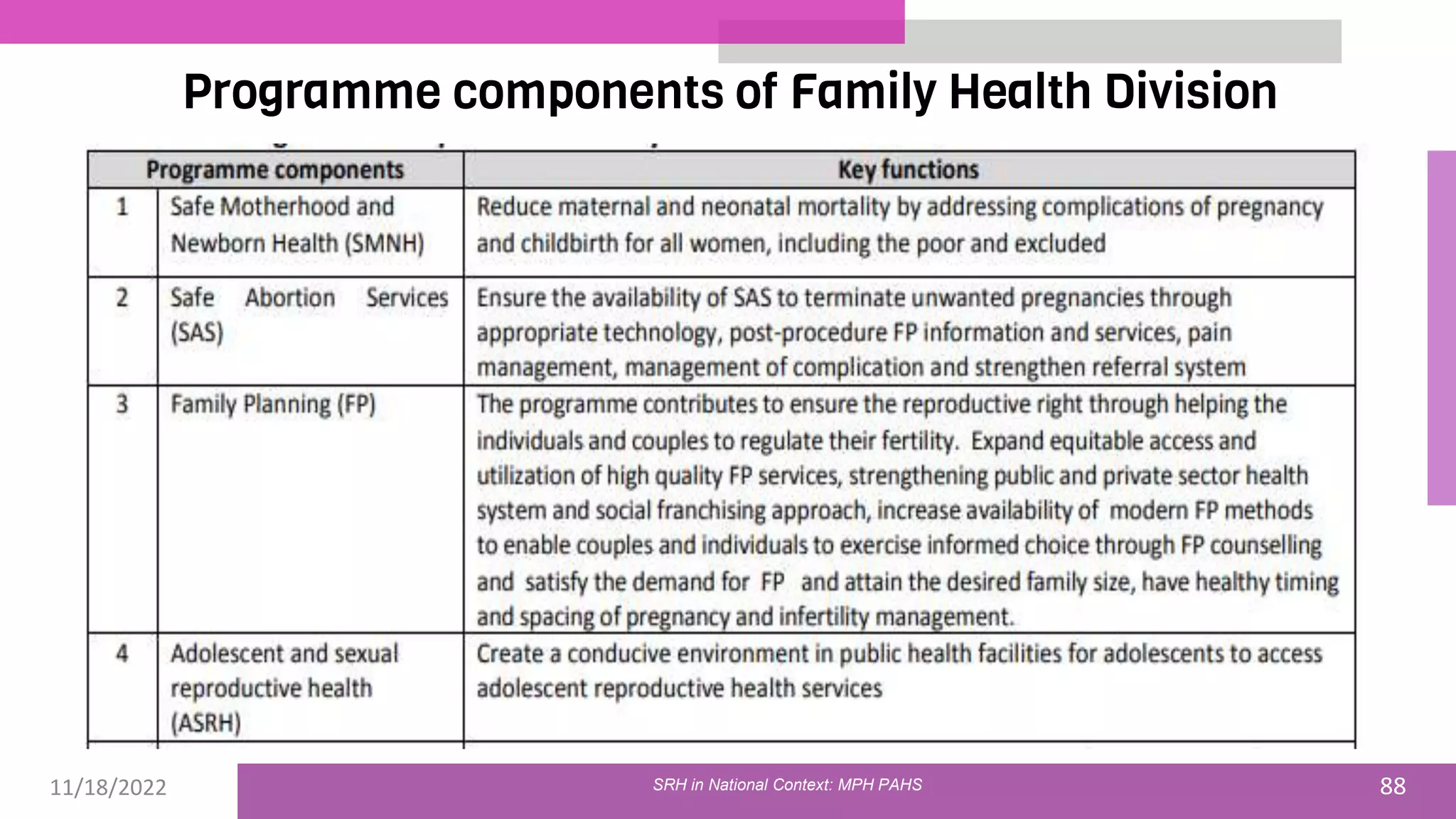
Programme components of Family Health Division
SRH in National Context: MPH PAHS
11/18/2022 89
National Dignified Menstrual Policy 2017
• Under Coordination of Ministry of Water Supply and involvement of Ministry
of Education, Ministry of Women and Ministry of Health
• Focuses on curbing negative impacts of menstruation –related taboos on
women’s lives by providing menstrual health facilities, raising awareness to
break misconceptions, and increasing participation of menstruating girls’ in
daily activities.
• For raising knowledge surrounding menstrual hygiene, providing access to
adequate sanitation facilities and ensuring access to sanitary products.
SRH in National Context: MPH PAHS
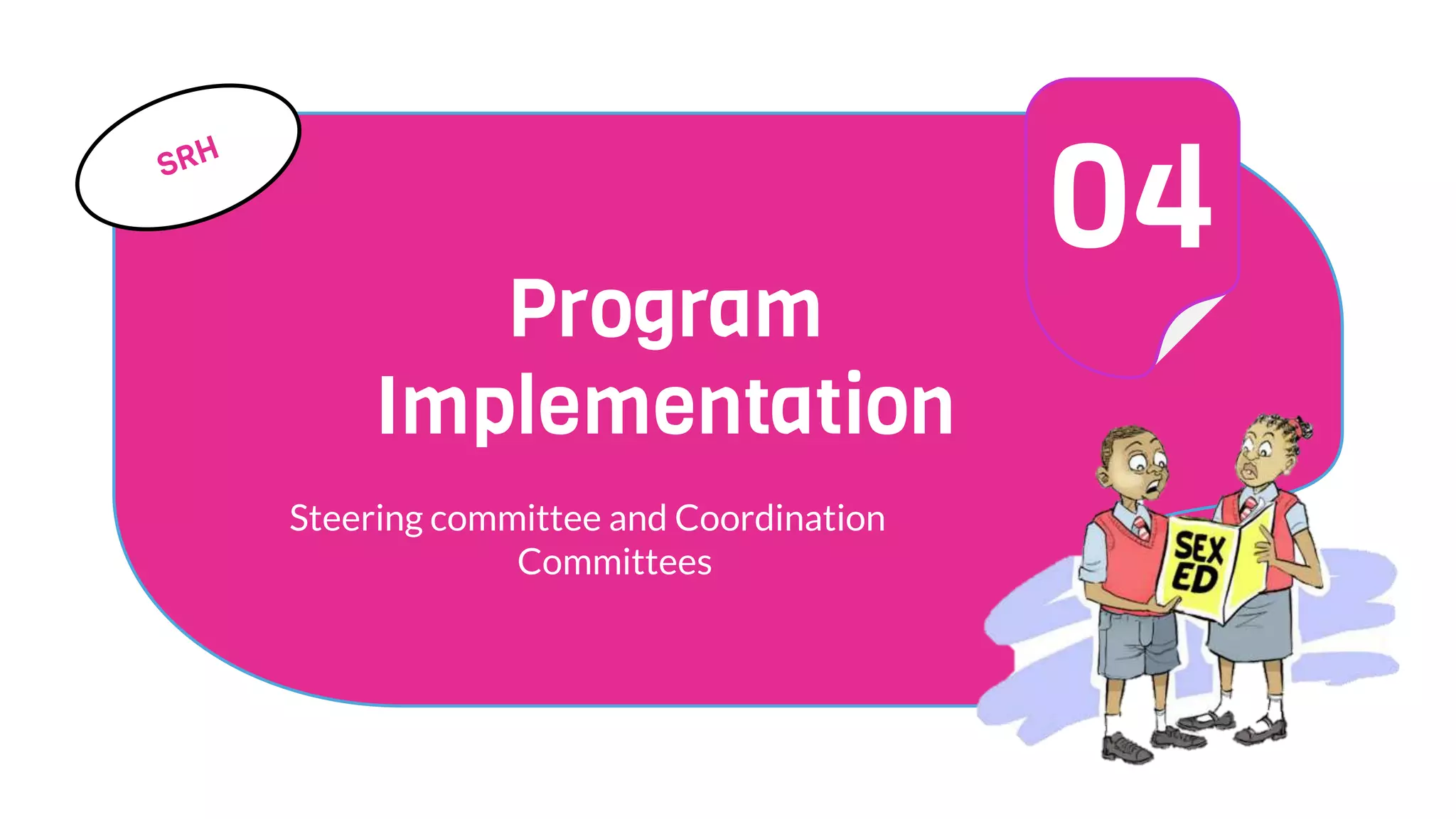
Program
Implementation
04
Steering committee and Coordination
Committees
11/18/2022 91
National RH Program Steering Committee
SRH in National Context: MPH PAHS
• An apex body responsible for reviewing the overall policy of the national
reproductive health program. Meets once a year.
Composition
Chair: Health Secretary
Member Secretary: FHD Director
Other members
Secretaries: Law and Justice/Women and Social Welfare/Local
Development/Ministry of Population and Environment/Ministry of
Education/A Representative of NPC/Directors of related division or centers
under DoHS/Selected representatives of NGO/INGOs/EDPs
Source: National Reproductive Health Strategy, 2054
11/18/2022 92
National RH Program Coordinating Committee
SRH in National Context: MPH PAHS
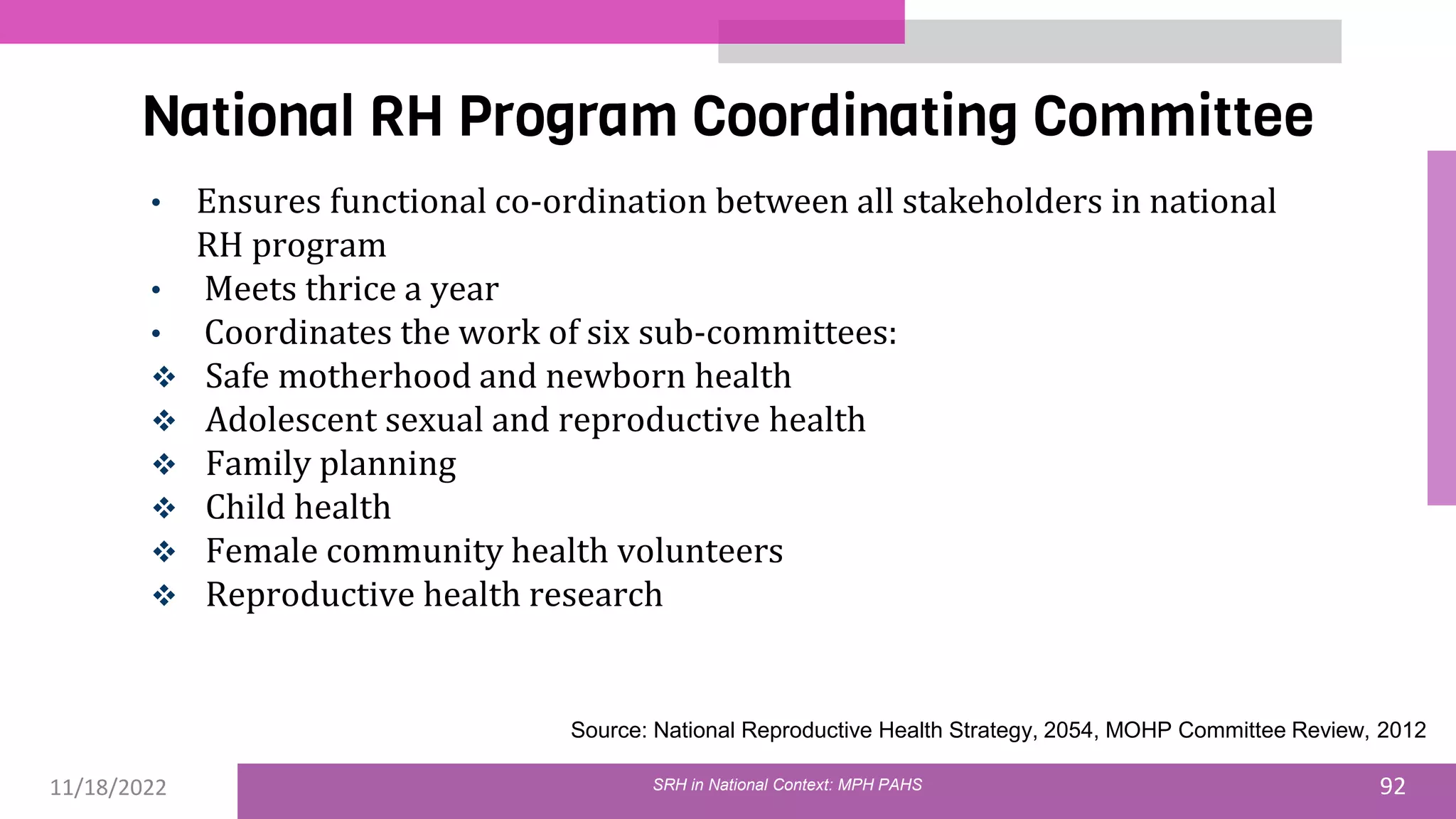
• Ensures functional co-ordination between all stakeholders in national
RH program
• Meets thrice a year
• Coordinates the work of six sub-committees:
 Safe motherhood and newborn health
 Adolescent sexual and reproductive health
 Family planning
 Child health
 Female community health volunteers
 Reproductive health research
Source: National Reproductive Health Strategy, 2054, MOHP Committee Review, 2012
11/18/2022 93
National RH Program Coordinating Committee
SRH in National Context: MPH PAHS
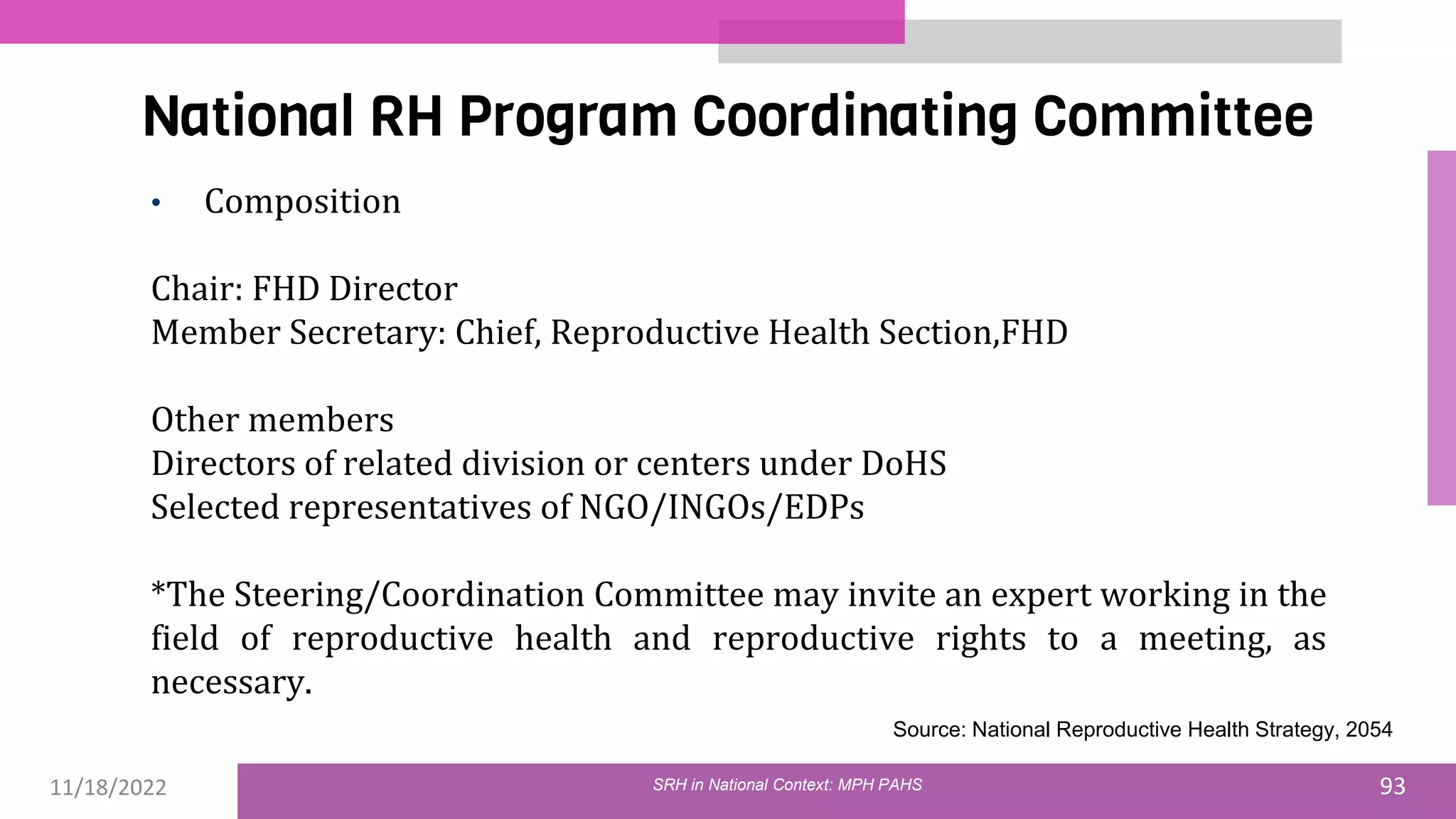
• Composition
Chair: FHD Director
Member Secretary: Chief, Reproductive Health Section,FHD
Other members
Directors of related division or centers under DoHS
Selected representatives of NGO/INGOs/EDPs
*The Steering/Coordination Committee may invite an expert working in the
field of reproductive health and reproductive rights to a meeting, as
necessary.
Source: National Reproductive Health Strategy, 2054
11/18/2022 94
RH Program Coordinating Committee
SRH in National Context: MPH PAHS
Source: National Reproductive Health Strategy, 2054
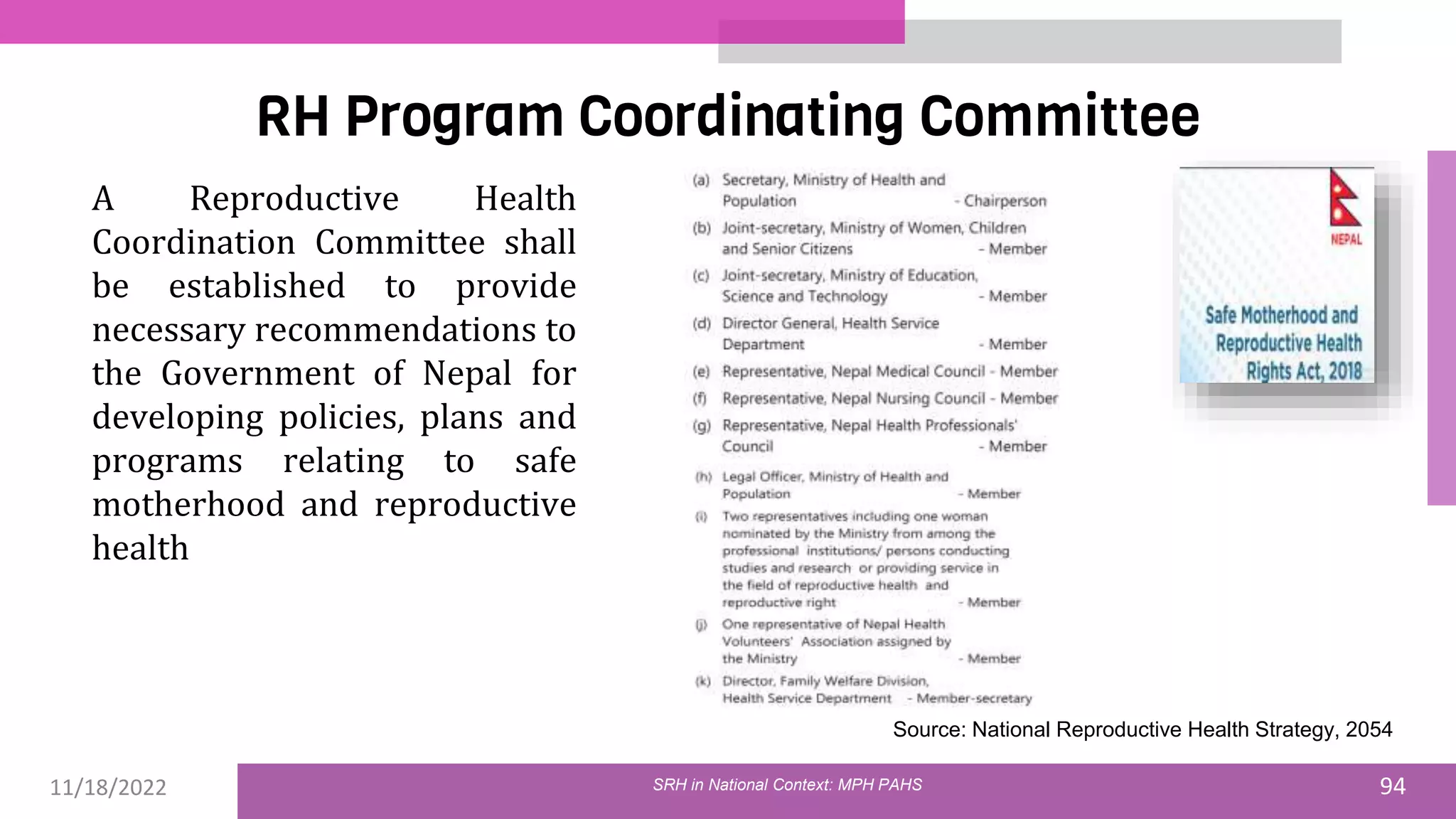
A Reproductive Health
Coordination Committee shall
be established to provide
necessary recommendations to
the Government of Nepal for
developing policies, plans and
programs relating to safe
motherhood and reproductive
health
11/18/2022 95
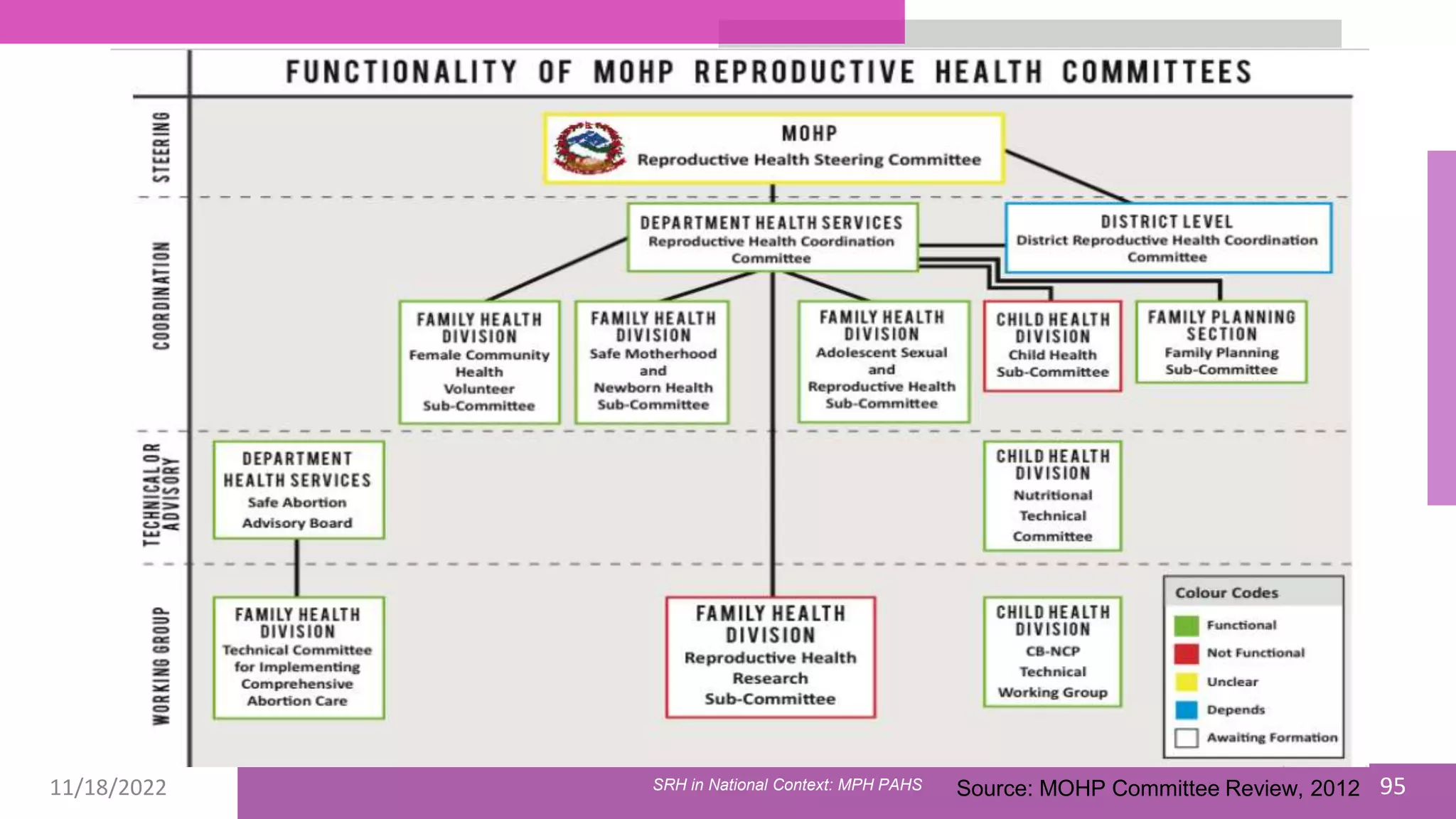
SRH in National Context: MPH PAHS Source: MOHP Committee Review, 2012
11/18/2022 96
Provincial RHCC
SRH in National Context: MPH PAHS
• Effort on making coordination between state and non-state bodies in the
sector of reproductive health
• Technical assistance to health offices and local health authorities for
planning and implementation of reproductive health activities
• Record keeping of reproductive health activities by all non
governmental, private, development partners to reduce duplication
• Co-ordination with division and provincial health directorate for
planning, budget allocation and implementation of reproductive health
activities
• Feedback in necessary reproductive health research areas to provincial
government
PRHCC,TOR, Province 2
11/18/2022 97
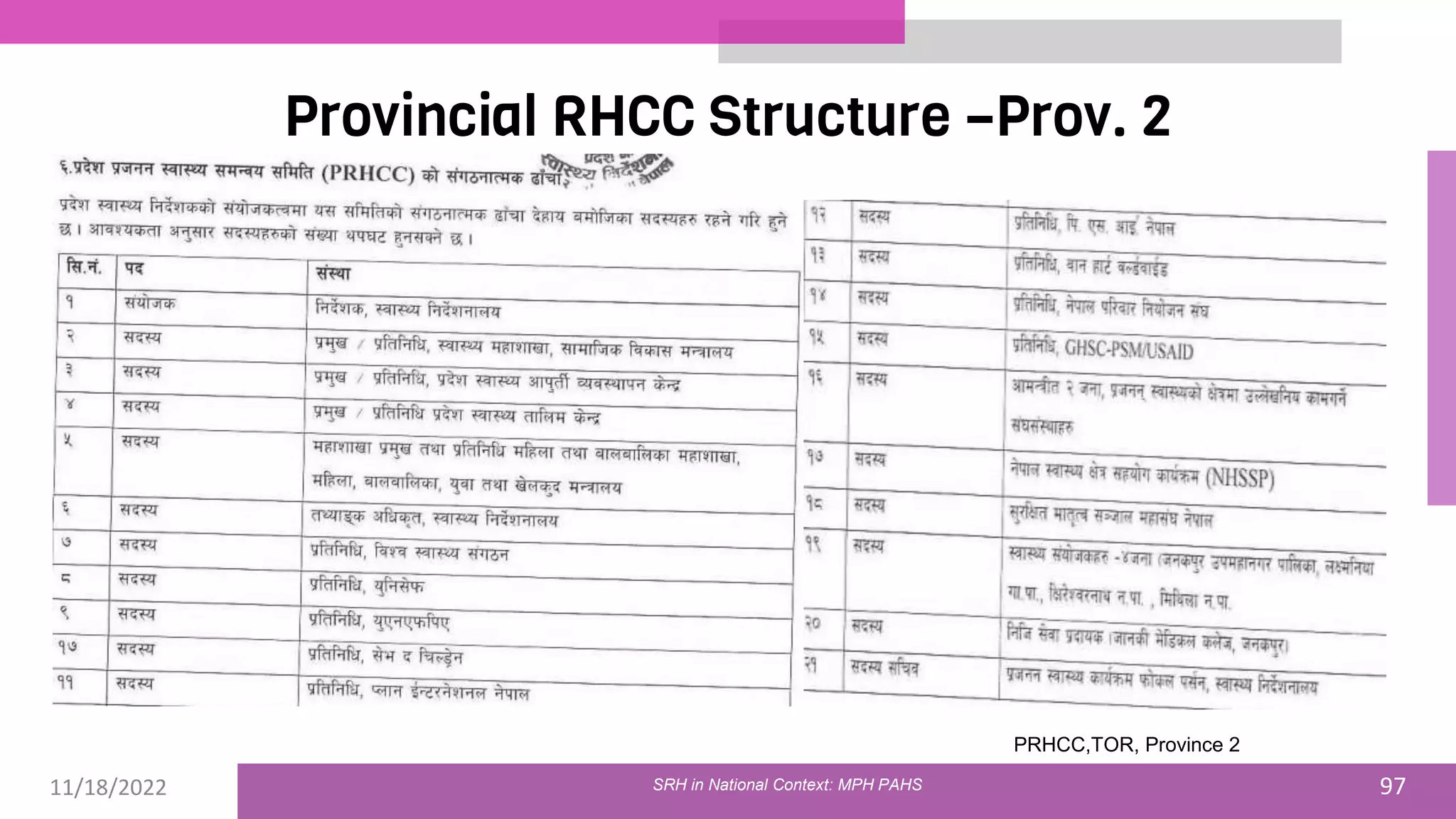
Provincial RHCC Structure –Prov. 2
SRH in National Context: MPH PAHS
PRHCC,TOR, Province 2
11/18/2022 98
Issues
SRH in National Context: MPH PAHS
• Rare meetings of RHCC
• Co-ordination Gap -District Reproductive Health Coordination
Committees operate in a vertical manner, with no connection to other
EHCS areas.
• Agenda setting by sub-committees is not actively coordinated by the
Coordinating Committee, resulting at times in overlap and duplication.
• Certain committees with a clear link to reproductive health have been
set up outside of the RHCC’s authority-Eg: e Safe Abortion Advisory
Board-Hampers main-streaming of abortion within reproductive health
services as a whole. Source: MOHP Committee Review, 2012
Challenges and
Opportunities of SRH
in Context of Nepal
05
11/18/2022 100
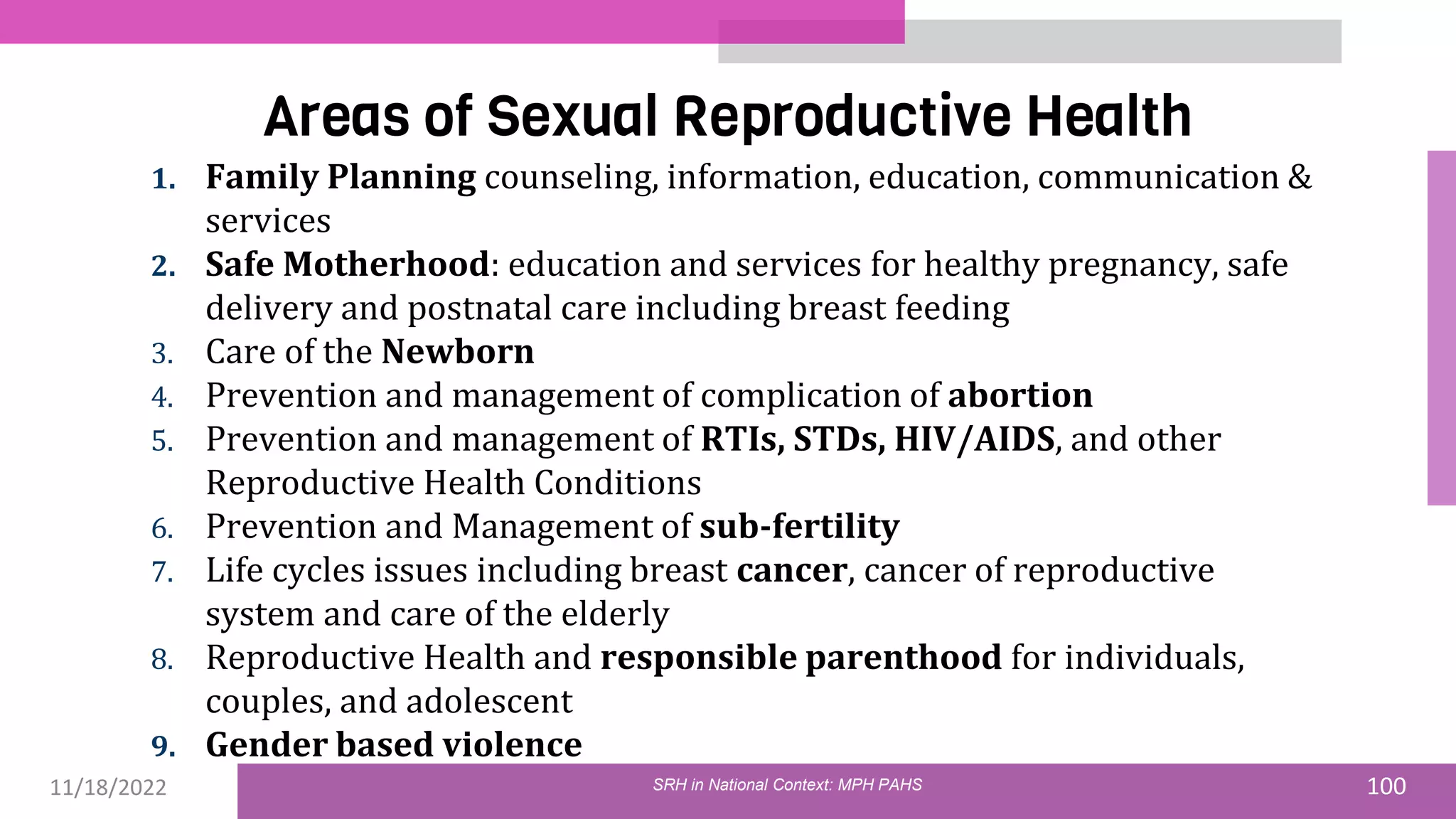
Areas of Sexual Reproductive Health
1. Family Planning counseling, information, education, communication &
services
2. Safe Motherhood: education and services for healthy pregnancy, safe
delivery and postnatal care including breast feeding
3. Care of the Newborn
4. Prevention and management of complication of abortion
5. Prevention and management of RTIs, STDs, HIV/AIDS, and other
Reproductive Health Conditions
6. Prevention and Management of sub-fertility
7. Life cycles issues including breast cancer, cancer of reproductive
system and care of the elderly
8. Reproductive Health and responsible parenthood for individuals,
couples, and adolescent
9. Gender based violence
SRH in National Context: MPH PAHS
11/18/2022 101
Challenges & Opportunities in SRH in Nepal
SRH in National Context: MPH PAHS
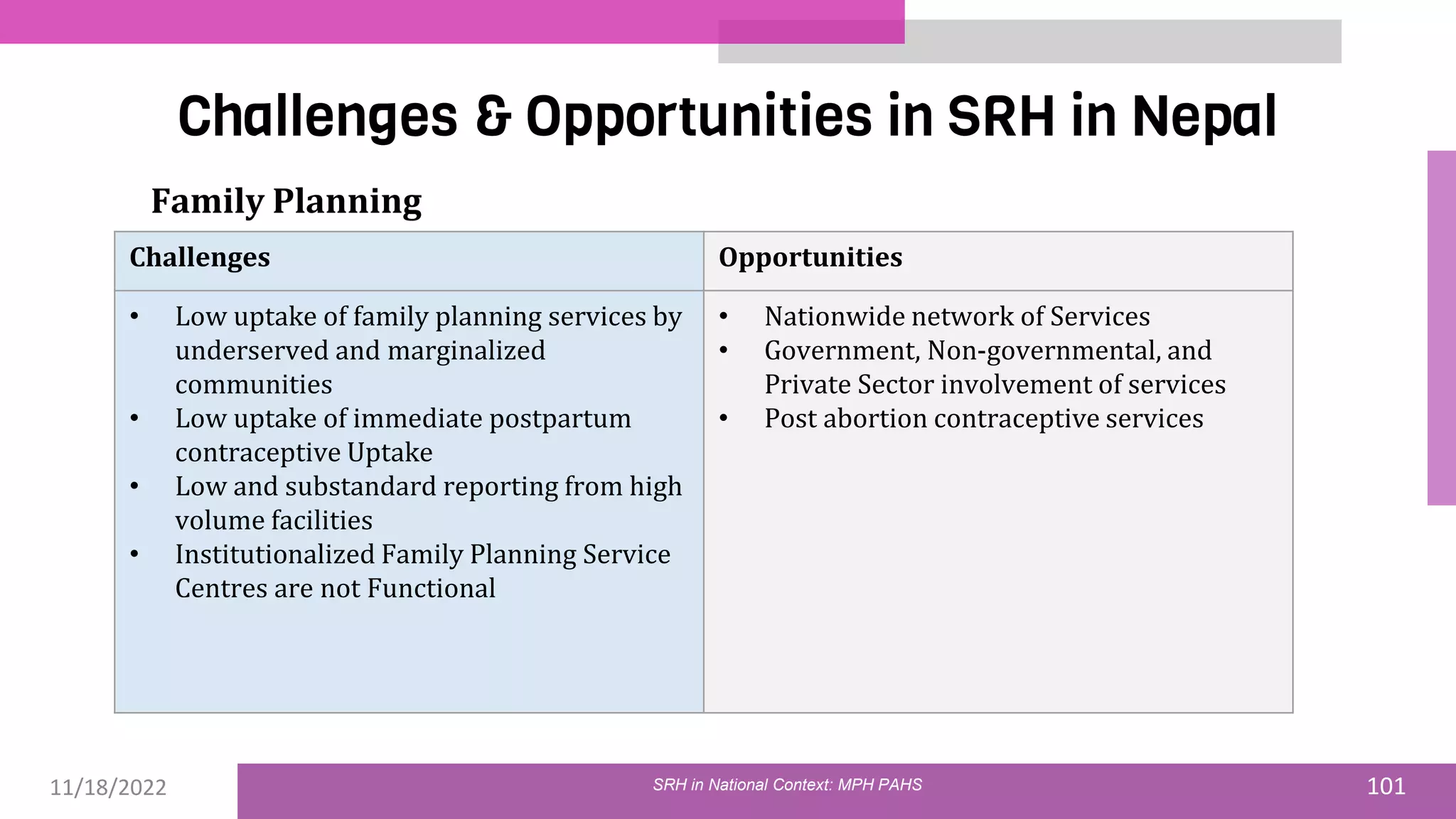
Family Planning
Challenges Opportunities
• Low uptake of family planning services by
underserved and marginalized
communities
• Low uptake of immediate postpartum
contraceptive Uptake
• Low and substandard reporting from high
volume facilities
• Institutionalized Family Planning Service
Centres are not Functional
• Nationwide network of Services
• Government, Non-governmental, and
Private Sector involvement of services
• Post abortion contraceptive services
11/18/2022 102
Challenges & Opportunities in SRH in Nepal
SRH in National Context: MPH PAHS
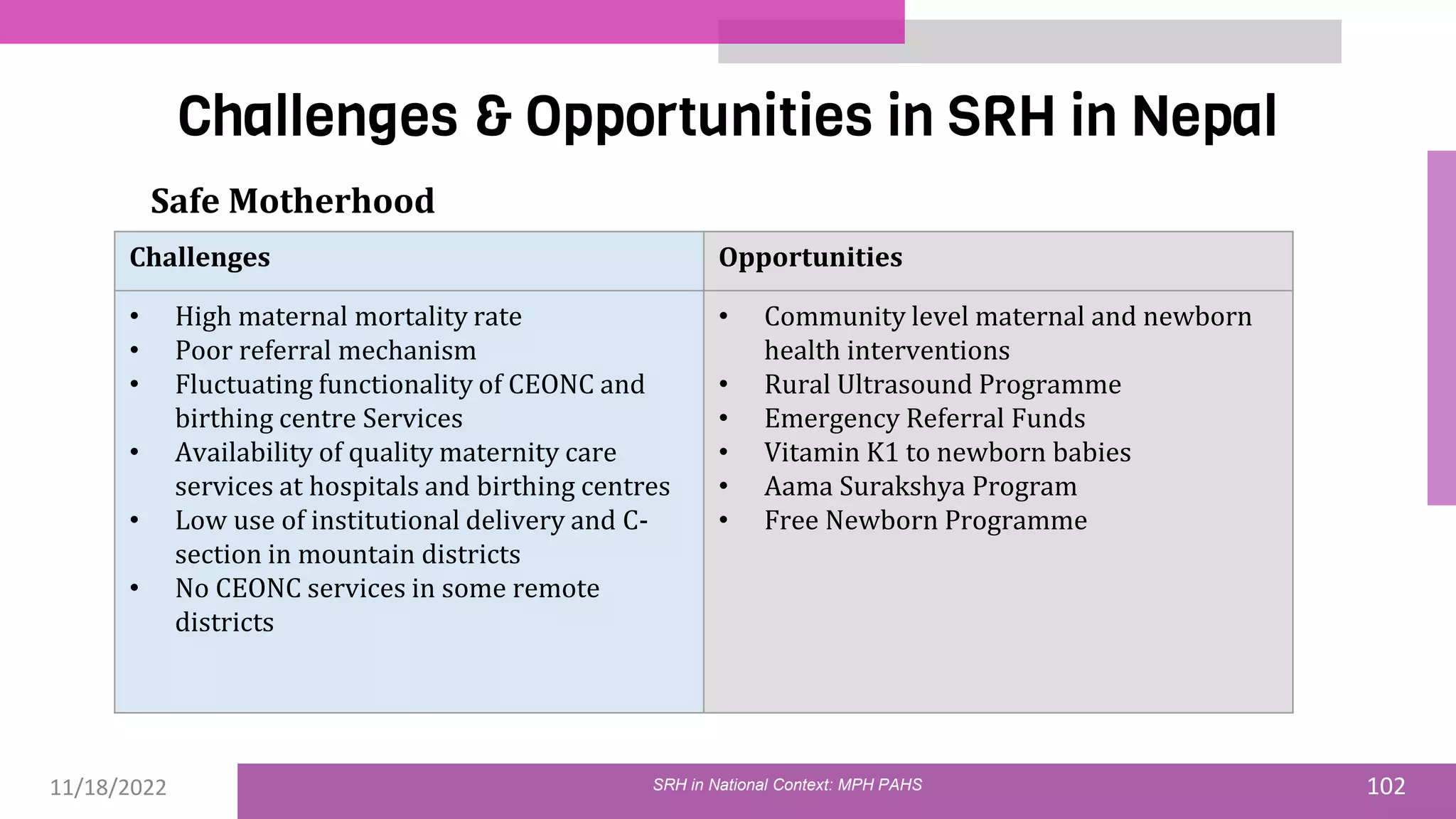
Safe Motherhood
Challenges Opportunities
• High maternal mortality rate
• Poor referral mechanism
• Fluctuating functionality of CEONC and
birthing centre Services
• Availability of quality maternity care
services at hospitals and birthing centres
• Low use of institutional delivery and C-
section in mountain districts
• No CEONC services in some remote
districts
• Community level maternal and newborn
health interventions
• Rural Ultrasound Programme
• Emergency Referral Funds
• Vitamin K1 to newborn babies
• Aama Surakshya Program
• Free Newborn Programme
11/18/2022 103
Challenges & Opportunities in SRH in Nepal
SRH in National Context: MPH PAHS
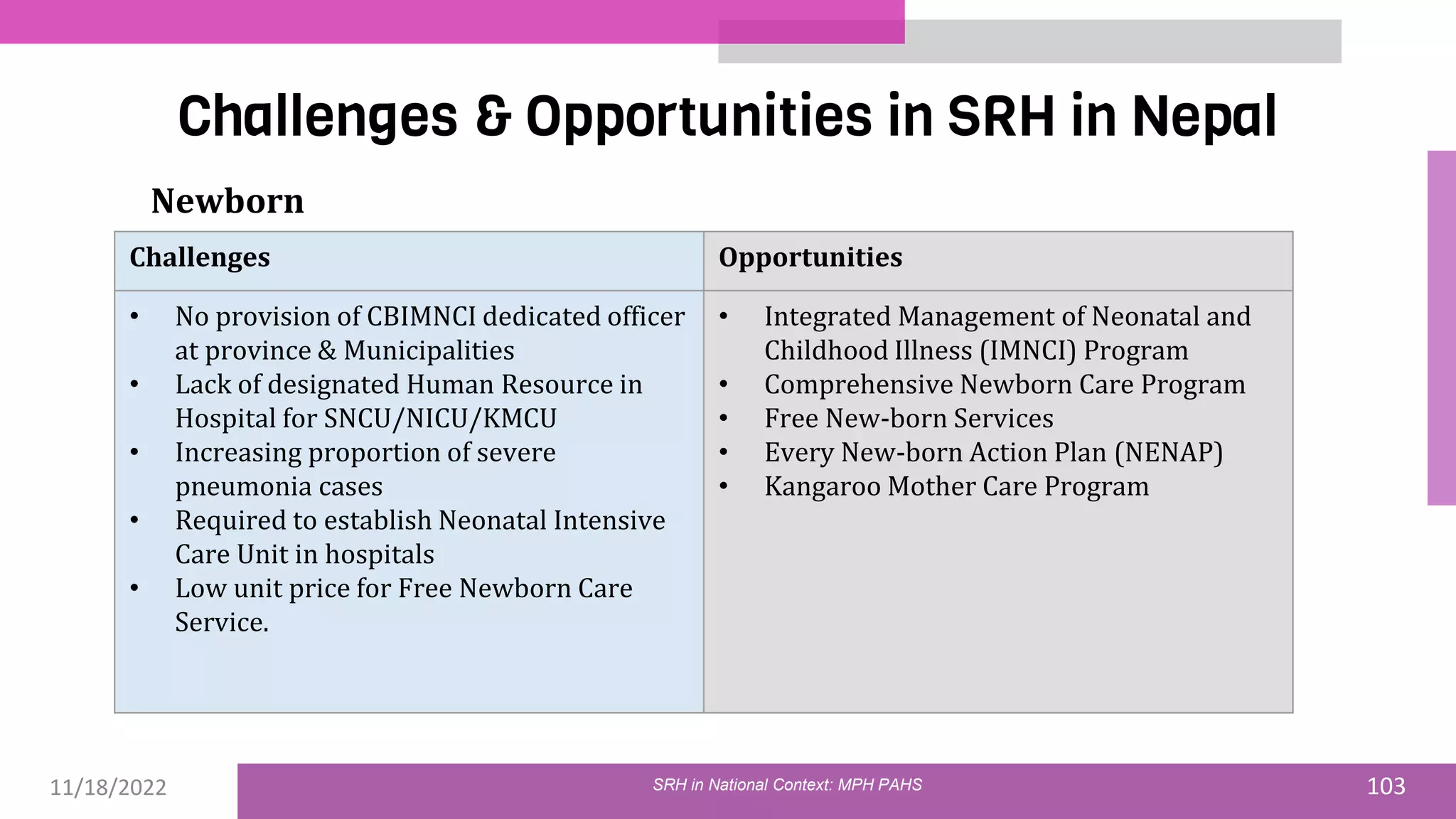
Newborn
Challenges Opportunities
• No provision of CBIMNCI dedicated officer
at province & Municipalities
• Lack of designated Human Resource in
Hospital for SNCU/NICU/KMCU
• Increasing proportion of severe
pneumonia cases
• Required to establish Neonatal Intensive
Care Unit in hospitals
• Low unit price for Free Newborn Care
Service.
• Integrated Management of Neonatal and
Childhood Illness (IMNCI) Program
• Comprehensive Newborn Care Program
• Free New-born Services
• Every New-born Action Plan (NENAP)
• Kangaroo Mother Care Program
11/18/2022 104
Challenges & Opportunities in SRH in Nepal
SRH in National Context: MPH PAHS
Abortion
Challenges Opportunities
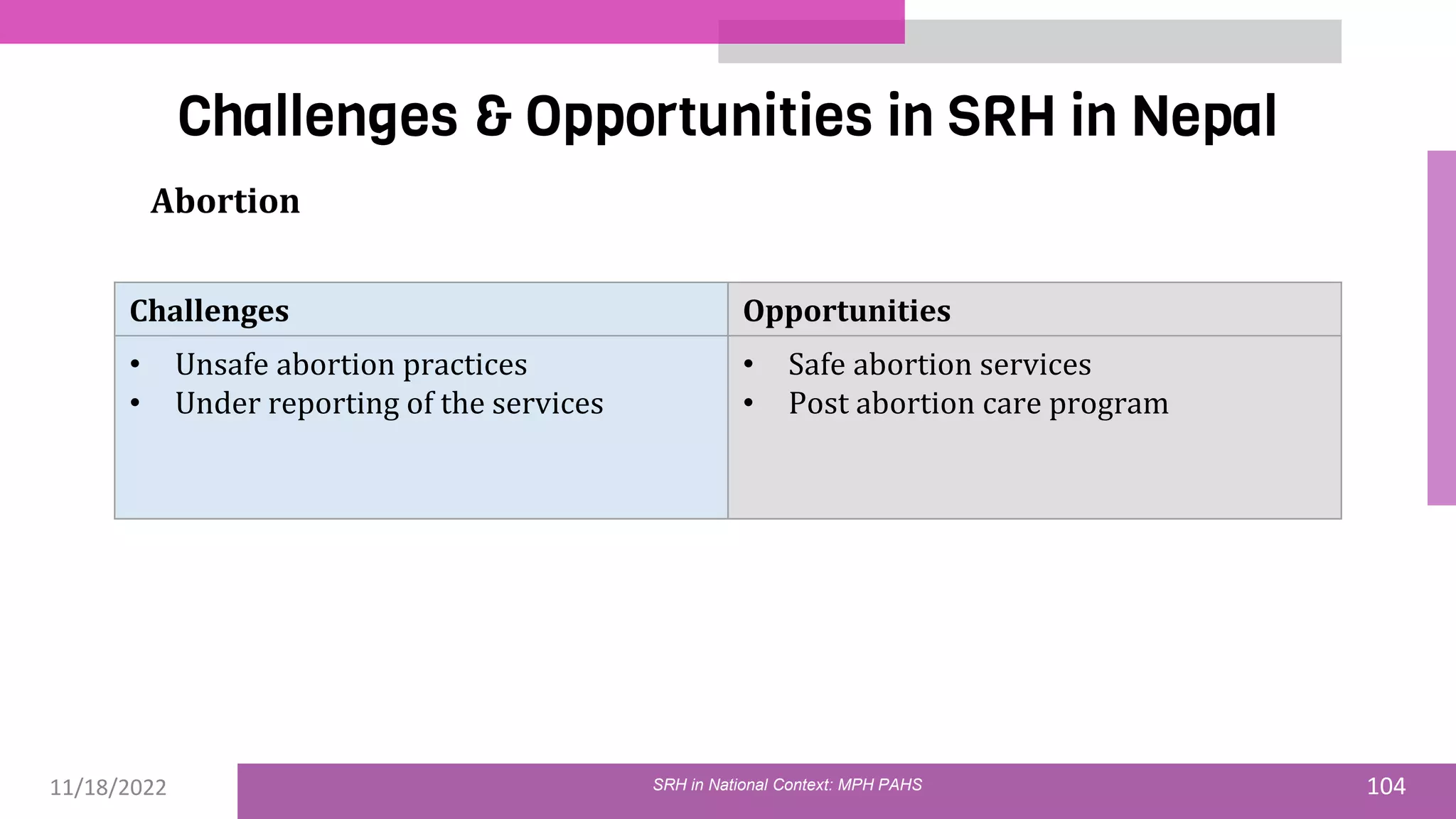
• Unsafe abortion practices
• Under reporting of the services
• Safe abortion services
• Post abortion care program
11/18/2022 105
Challenges & Opportunities in SRH in Nepal
SRH in National Context: MPH PAHS
RTIs, STDs, HIV AIDS
Challenges Opportunities
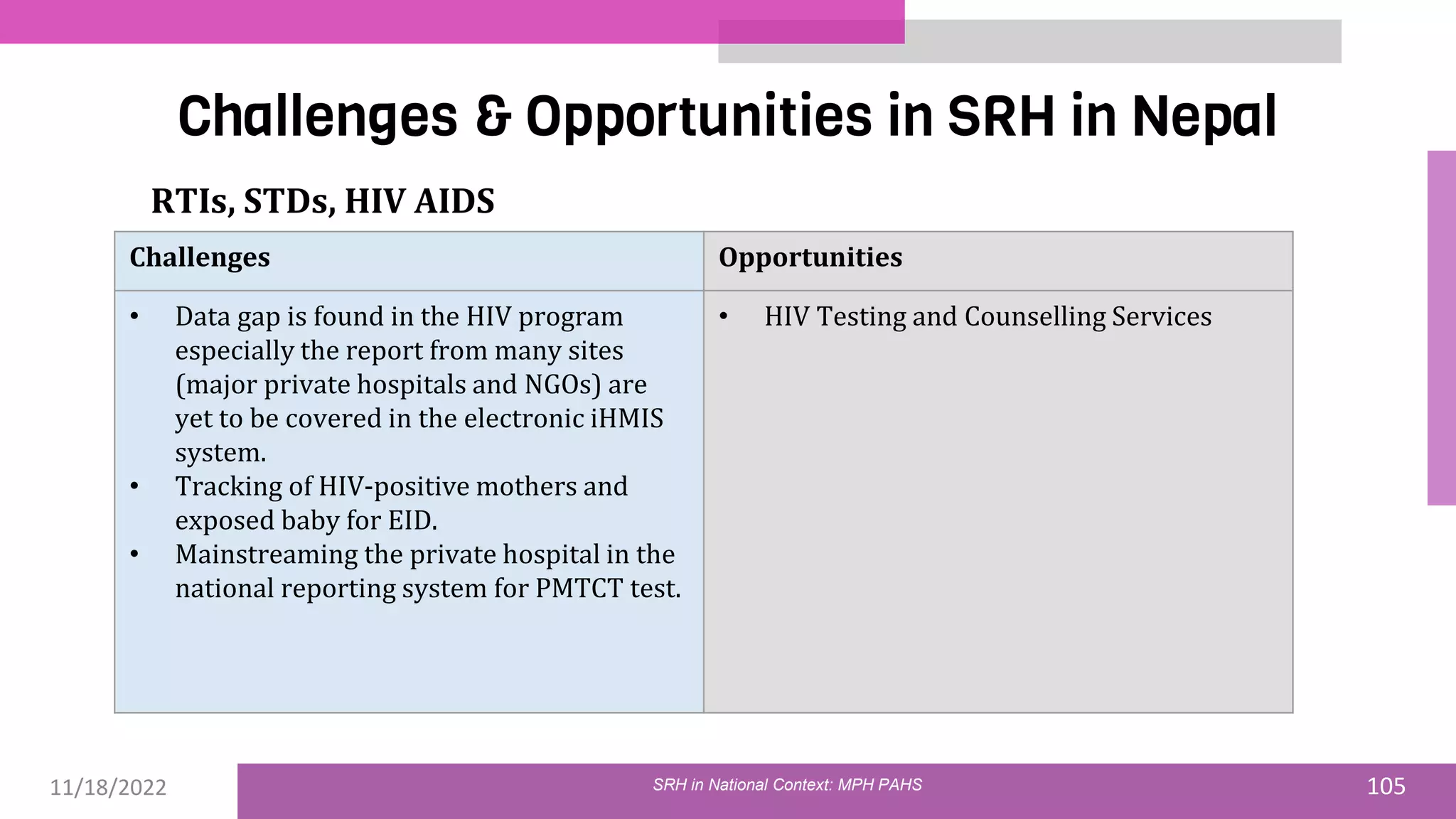
• Data gap is found in the HIV program
especially the report from many sites
(major private hospitals and NGOs) are
yet to be covered in the electronic iHMIS
system.
• Tracking of HIV-positive mothers and
exposed baby for EID.
• Mainstreaming the private hospital in the
national reporting system for PMTCT test.
• HIV Testing and Counselling Services
11/18/2022 106
Challenges & Opportunities in SRH in Nepal
SRH in National Context: MPH PAHS
Sub-fertility
Challenges Opportunities
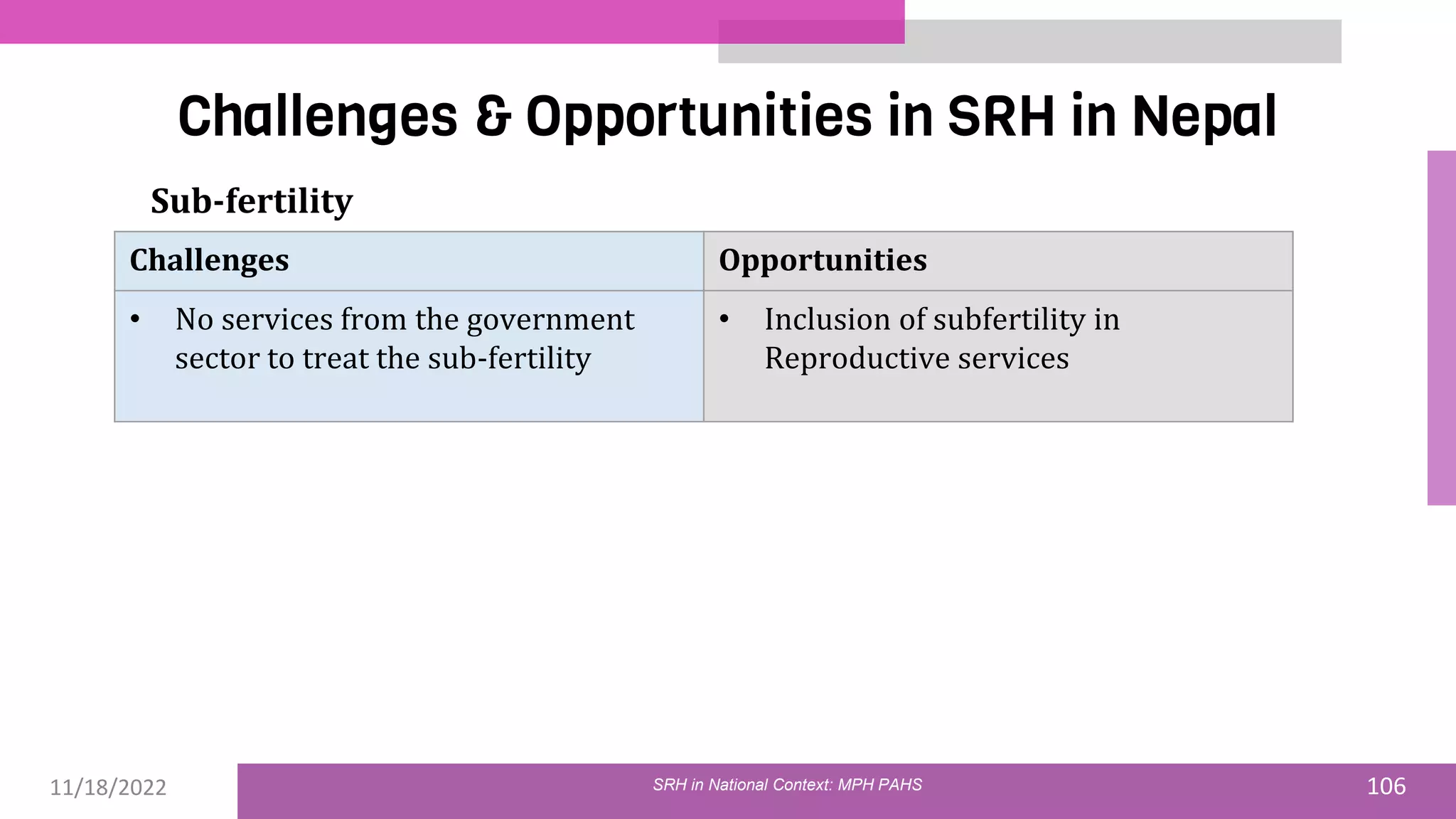
• No services from the government
sector to treat the sub-fertility
• Inclusion of subfertility in
Reproductive services
11/18/2022 107
Challenges & Opportunities in SRH in Nepal
SRH in National Context: MPH PAHS
Lifecycle issues including Cancers
Challenges Opportunities
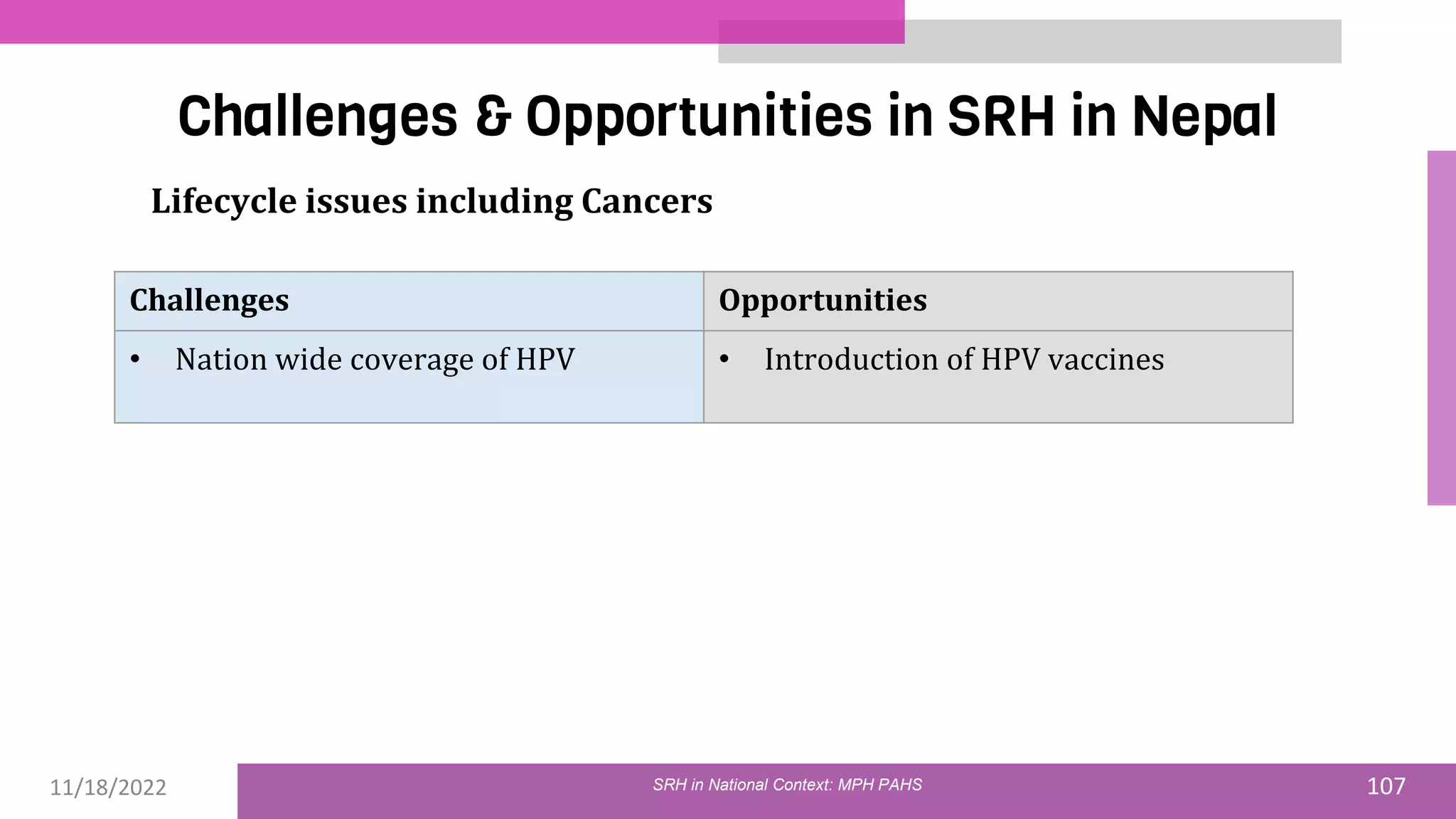
• Nation wide coverage of HPV • Introduction of HPV vaccines
11/18/2022 108
Challenges & Opportunities in SRH in Nepal
SRH in National Context: MPH PAHS
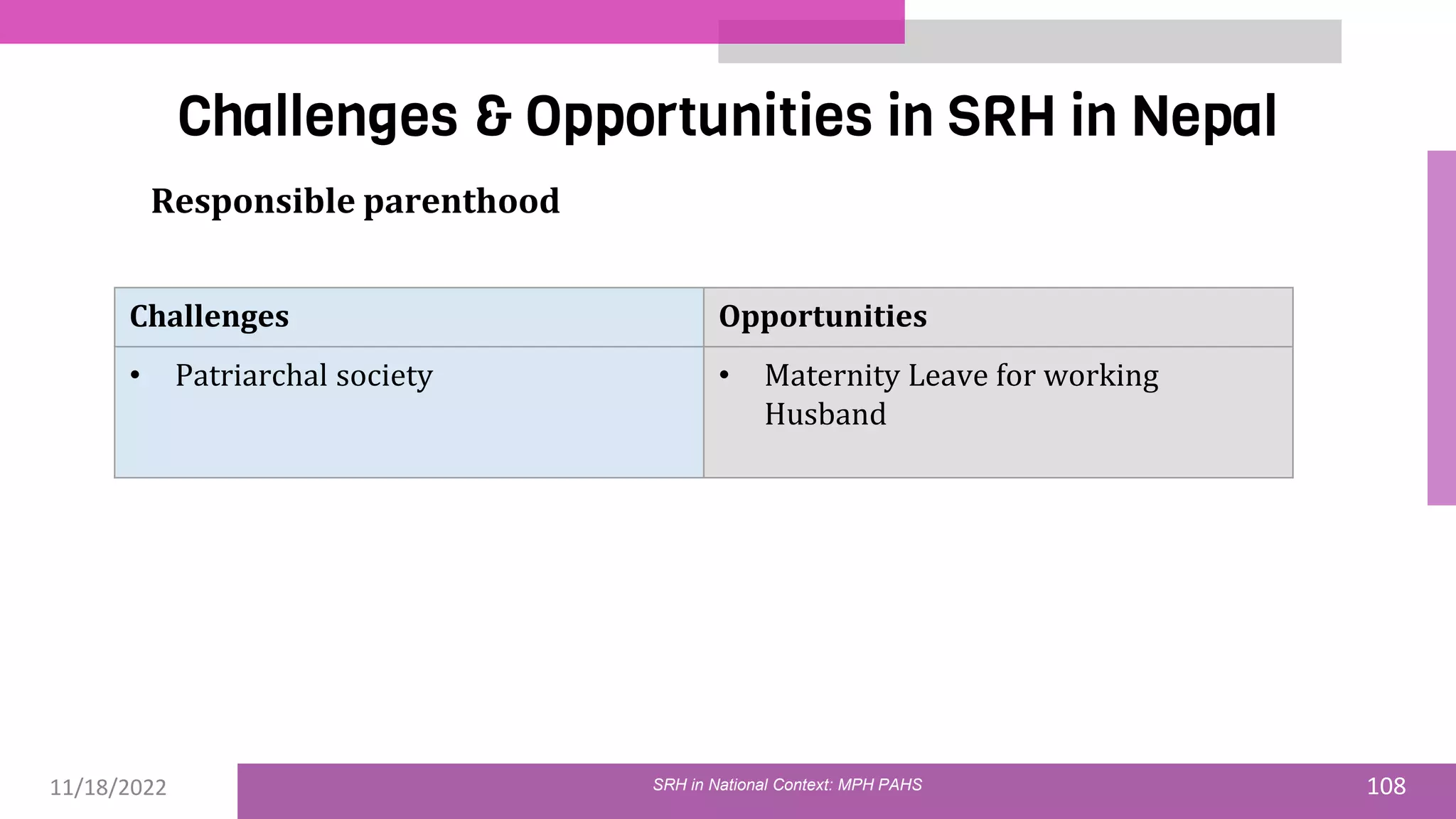
Responsible parenthood
Challenges Opportunities
• Patriarchal society • Maternity Leave for working
Husband
11/18/2022 109
Challenges & Opportunities in SRH in Nepal
SRH in National Context: MPH PAHS
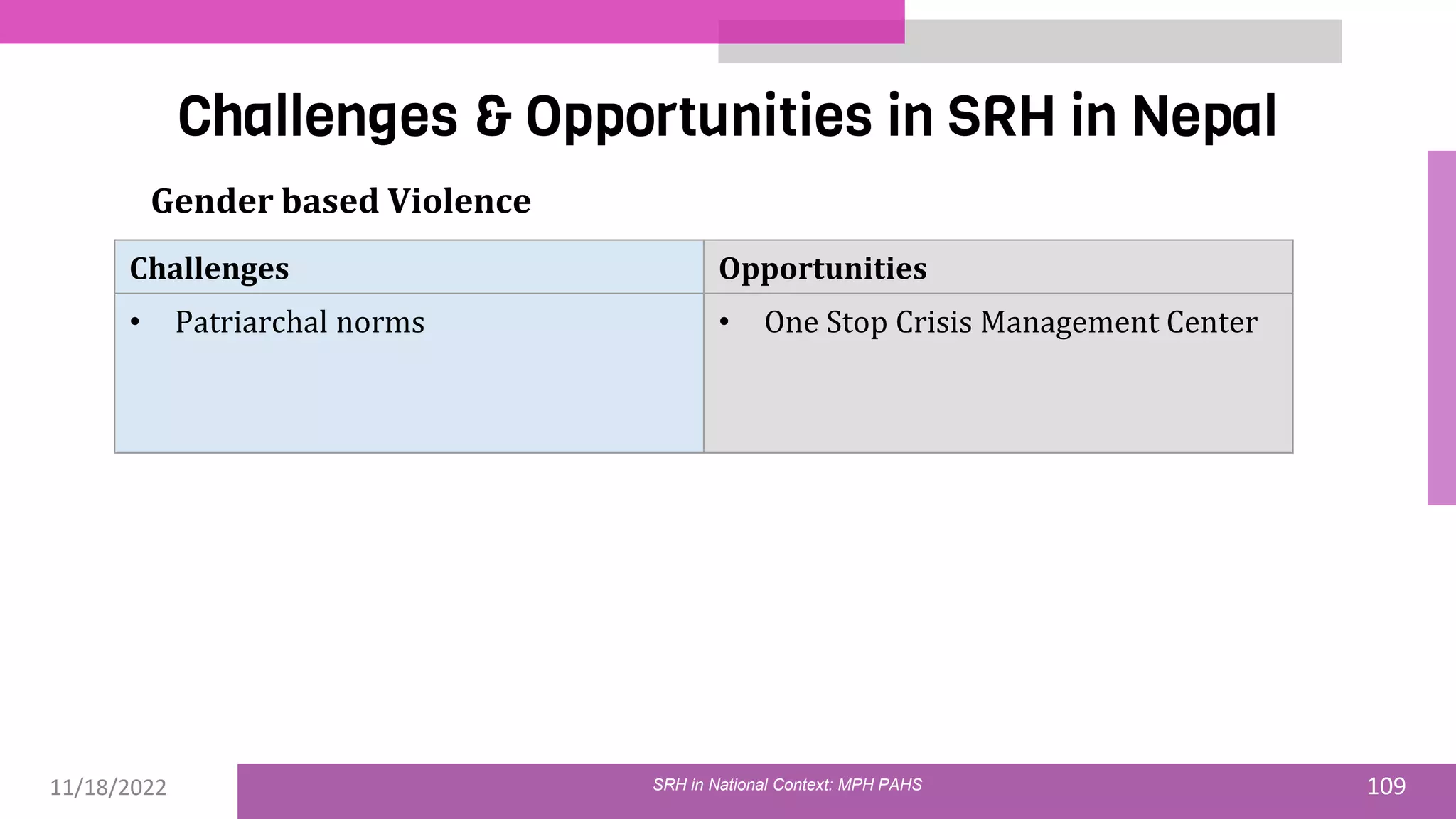
Gender based Violence
Challenges Opportunities
• Patriarchal norms • One Stop Crisis Management Center
11/18/2022 110
References
SRH in National Context: MPH PAHS
• DoHS, Annual Report 2077/78
• MoHP, New Era, NDHS 2016
• National Reproductive Health Strategy, 2054
• Provincial Reproductive Health Coordination Committee ToR
[Internet].Available from https://mosd.p2.gov.np/post/provincial-
reproductive-health-coordination-committee-tor
• NHSSP Review of MOHP Committees-Summary Report.2012. [Internet]
Available from
http://www.nhssp.org.np/NHSSP_Archives/health_policy/MoHP_commi
ttees_review_2012.pdf
11/18/2022 111
SRH in National Context: MPH PAHS
Thankyou!

Sexual and Reproductive Health in Context of Nepal

  • 1.
    Sexual and Reproductive Healthin National Context • Kusumsheela Bhatta (403) • Madhurjee Dhakal (404) • Manoj Dhakal (406) 16 August 2022 Presented by • Shraddha Nepal (409) • Saraswati Sharma(408) • Prakash KC(411) MPH, PAHS
  • 2.
    1. Introduction 2. CurrentSituation in Nepal 3. Evolution of SRH Strategy in Nepal 4. Program Implementation 5. Challenges and Opportunities in the context of Nepal Table of Contents
  • 3.
  • 4.
    11/18/2022 4 Sexual andreproductive health • A state of complete physical, mental and social well-being in all matters relating to the reproductive system. • People are able to have a satisfying and safe sex life, the capability to reproduce and the freedom to decide if, when, and how often to do so. • People have access to accurate information and the safe, effective, affordable and acceptable contraception method of their choice. • They are informed and empowered to protect themselves from sexually transmitted infections. • When they decide to have children, women must have access to skilled health care providers and services that can help them have a fit pregnancy, safe birth and healthy baby. Source: UNFPA, 2022 SRH in National Context: MPH PAHS
  • 5.
    11/18/2022 5 Sexual andreproductive health Broadly comprises • Improving maternal and newborn care • Providing high quality services for family planning • Eliminating unsafe abortion • Combatting sexually transmitted infections • Promoting sexual health Source: WHO Africa, 2020 SRH in National Context: MPH PAHS
  • 6.
  • 7.
    11/18/2022 7 Age Women ofreproductive age: 15-49 years Adolescents: 10- 19 years Source: NDHS, 2016 SRH in National Context: MPH PAHS
  • 8.
    11/18/2022 8 Family planning Contraceptiveuse: • 53% of married women use a method of family planning • 10% use traditional method • 43% use modern method Adolescent use of contraception: 15% of currently married women age 15-19 use a modern method of contraception Source: NDHS, 2016 SRH in National Context: MPH PAHS
  • 9.
    11/18/2022 9 Family Planning ModernMethods • Male and female sterilization • Injectables • Intrauterine devices • Contraceptive pills • Implants • Male condoms • Lactational amenorrhea • Emergency contraception Source: NDHS, 2016 SRH in National Context: MPH PAHS
  • 10.
    11/18/2022 10 Percentage ofcurrently married women age 15-49 currently using a contraceptive method Source: NDHS, 2016 SRH in National Context: MPH PAHS
  • 11.
    11/18/2022 11 Trends inContraceptive Use Source: NDHS, 2016 SRH in National Context: MPH PAHS
  • 12.
    11/18/2022 12 Use ofModern Methods by Province Source: NDHS, 2016 SRH in National Context: MPH PAHS
  • 13.
    11/18/2022 13 Use ofModern Methods by Education Source: NDHS, 2016 SRH in National Context: MPH PAHS
  • 14.
    11/18/2022 14 Source ofModern Contraceptive Methods Source: NDHS, 2016 SRH in National Context: MPH PAHS
  • 15.
    11/18/2022 15 Informed choice •Information about side effects of the methods, what to do in case of side effects, other methods they could use • 49% of the women using modern contraceptives received all three types of information • Users of IUDs (76%) and implants (65%) more likely to receive all three types of information. Source: NDHS, 2016 SRH in National Context: MPH PAHS
  • 16.
    11/18/2022 16 Contraceptive DiscontinuationRates Source: NDHS, 2016 SRH in National Context: MPH PAHS
  • 17.
    11/18/2022 17 Unmet Need Source:NDHS, 2016 SRH in National Context: MPH PAHS
  • 18.
    11/18/2022 18 Demand forfamily planning Source: NDHS, 2016 SRH in National Context: MPH PAHS
  • 19.
    11/18/2022 19 Unmet needfor family planning by province Source: NDHS, 2016 SRH in National Context: MPH PAHS
  • 20.
    11/18/2022 20 Marital Status Source:NDHS, 2016 SRH in National Context: MPH PAHS
  • 21.
    11/18/2022 21 Marriage andChild bearing Median age at first marriage for 25-49 years age respondents • 17.9 years for women • 21.7 years for men Source: NDHS, 2016 SRH in National Context: MPH PAHS
  • 22.
    11/18/2022 22 Women’s medianage at first marriage by education Source: NDHS, 2016 SRH in National Context: MPH PAHS
  • 23.
    11/18/2022 23 Median ageat first sex and median age at marriage Source: NDHS, 2016 SRH in National Context: MPH PAHS
  • 24.
    11/18/2022 24 Trends inearly sexual intercourse Source: NDHS, 2016 SRH in National Context: MPH PAHS
  • 25.
    11/18/2022 25 Trends infertility Source: NDHS, 2016 SRH in National Context: MPH PAHS
  • 26.
    11/18/2022 26 Age atfirst birth Median age at first birth among women age 25-49 in Nepal : 20.4 years By education Source: NDHS, 2016 SRH in National Context: MPH PAHS
  • 27.
    11/18/2022 27 Teenage Childbearing •17% of women age 15-19 have begun child-bearing • 13% have had live birth • 4% are pregnant with their first child Source: NDHS, 2016 SRH in National Context: MPH PAHS
  • 28.
    11/18/2022 28 Trend ofTeenage child bearing 21% 17% 17% 0% 5% 10% 15% 20% 25% 2001 2011 2016 Source: NDHS, 2016 SRH in National Context: MPH PAHS
  • 29.
    11/18/2022 29 Teenage childbearingby province Source: NDHS, 2016 SRH in National Context: MPH PAHS
  • 30.
    11/18/2022 30 Trends inAge-Specific Fertility Source: NDHS, 2016 SRH in National Context: MPH PAHS
  • 31.
    11/18/2022 31 Fertility byprovince Source: NDHS, 2016 SRH in National Context: MPH PAHS
  • 32.
    11/18/2022 32 Birth Intervals Source:NDHS, 2016 SRH in National Context: MPH PAHS
  • 33.
    11/18/2022 33 Abortion Legalized inNepal in 2002 Government began providing abortion care services in March 2004 Allowed to terminate: • Within 12 weeks of pregnancy according to own decision • Within 18 weeks if pregnancy is a result of rape or incest • Any duration of pregnancy if the life of mother is at risk, if her physical and mental health is at risk or if the fetus is deformed Source: Annual Report 2020/21 SRH in National Context: MPH PAHS
  • 34.
    11/18/2022 34 Pregnancy Outcomes •81% live birth • 9% abortion • 9% miscarriages • 1% stillbirth Source: NDHS, 2016 SRH in National Context: MPH PAHS
  • 35.
    11/18/2022 35 Main reasonsfor abortion 50% 12% 10% 9% 7% Reason for abortion Did not want more children Wanted to delay childbearing because of health to space birth undesirable child sex Source: NDHS, 2016 SRH in National Context: MPH PAHS
  • 36.
    11/18/2022 36 Trends ofmedical abortion Source: Annual Report 2020/21 SRH in National Context: MPH PAHS
  • 37.
    11/18/2022 37 Percentage ofpregnancies terminated among expected pregnancies Source: Annual Report 2020/21 SRH in National Context: MPH PAHS
  • 38.
    11/18/2022 38 Antenatal Care Source:Annual Report 2076/77, DoHS Decreased Drastically SRH in National Context: MPH PAHS
  • 39.
    11/18/2022 39 Antenatal Care Source:Annual Report 2076/77, DoHS ANC first visit as per protocol is high compared to the fourth visit in Nepal SRH in National Context: MPH PAHS
  • 40.
    11/18/2022 40 Delivery Care Source:Annual Report 2076/77, DoHS SRH in National Context: MPH PAHS
  • 41.
    11/18/2022 41 Institutional Delivery Source:Annual Report 2076/77, DoHS SRH in National Context: MPH PAHS
  • 42.
    11/18/2022 42 Percentage ofdeliveries by Cesarean Section Source: Annual Report 2076/77, DoHS Increased by 2% point Highest SRH in National Context: MPH PAHS
  • 43.
    11/18/2022 43 Postnatal care Source:Annual Report 2076/77, DoHS Province 2 Sudurpaschim SRH in National Context: MPH PAHS
  • 44.
    11/18/2022 44 Maternal andchild health HIGHEST?? SRH in National Context: MPH PAHS
  • 45.
    11/18/2022 45 Domestic Violence Source:NDHS 2016 22% 7% Experience of violence by women aged 15-49 Physical Violence Sexual Violence Six percent of women who have ever been pregnant have experienced violence during pregnancy. SRH in National Context: MPH PAHS
  • 46.
    11/18/2022 46 Domestic Violence Source:NDHS 2016 26% Physical Violence (23%) Spousal Violence Emotional Violence (12%) Sexual Violence (7%) SRH in National Context: MPH PAHS
  • 47.
    11/18/2022 47 Source: NDHS2016 Types of Spousal Violence SRH in National Context: MPH PAHS
  • 48.
    11/18/2022 48 HIV Prevalence Trendof HIV prevalence among adult population (15-49 year) 1985-2020 Source: NDHS 2016 Peaked DECREASED SRH in National Context: MPH PAHS
  • 49.
    11/18/2022 49 HIV Prevalence Source:NDHS 2016 SRH in National Context: MPH PAHS
  • 50.
  • 51.
    11/18/2022 51 Evolution ofSRH Strategies in Nepal SRH in National Context: MPH PAHS 1959 - Family Planning program in Nepal initiated by the NGO, Family Planning Association of Nepal (FPAN) 1965-70 - Third five-year development plan was the first to clearly state the need for a policy in Nepal. FP was considered a crucial instrument in addressing high fertility 1968 - Government–supported family planning services
  • 52.
    11/18/2022 52 Evolution ofSRH Strategies in Nepal SRH in National Context: MPH PAHS 1975 – 1990: First Long-Term Health Plan – Emphasis was given to halt the rapidly growing population, Family planning services, and MCH 1978 – Established contraceptive retail sale company (CRS) non-profit organization to distribute condom pills 1995 – Ministry of Population and Environment (MoPE) was established following the FP and reproductive health principles of ICPD 1994 1997 – 2017 Second Long Term Health Plan
  • 53.
    11/18/2022 53 Evolution ofSRH Strategies in Nepal SRH in National Context: MPH PAHS 1998 - National Reproductive Health Strategy 1998 - Safe motherhood policy – need of FP services as a key components of maternal care 2000 – National Reproductive Health Research Strategy
  • 54.
    11/18/2022 54 Evolution ofSRH Strategies in Nepal SRH in National Context: MPH PAHS 2000 - National Adolescent Health and Development strategy is endorsed 2002 – Abortion conditionally liberalized by 11th amendment to Muluki Ain 2003 – National Safe Abortion Policy
  • 55.
    11/18/2022 55 Evolution ofSRH Strategies in Nepal SRH in National Context: MPH PAHS 2005 – MoPE dissolved and its population division was merged in the MoH and the MoH was renamed as MoHP 2006 – Skilled Birth Attendant Policy (Supplementary to Safe Motherhood Policy, 1998) 2006 – 2017 National Safe Motherhood and Newborn Health – Long Term Plan 2004 – National Neonatal Health Strategy
  • 56.
    11/18/2022 56 Evolution ofSRH Strategies in Nepal SRH in National Context: MPH PAHS 2011 – National Working Policy of Family Planning Services 2015 – National Reproductive Health Commodity Security Strategy 2018 – Safe Motherhood and Reproductive Health Rights Act 2020-2025: Strategy for Skilled Health Personnel and Skilled Birth Attendants
  • 57.
    11/18/2022 57 Safe MotherhoodPolicy - 1998 SRH in National Context: MPH PAHS
  • 58.
    11/18/2022 58 National RHstrategy • Introduction • Strategies • Indicators • Objectives • Integrated RH package • Level intervention 01 SRH in National Context: MPH PAHS
  • 59.
    11/18/2022 59 Introduction SRH inNational Context: MPH PAHS New approach to strengthen the existing Safe Motherhood, Family planning, HIV/AIDS, STD, child survival and nutrition programmes with a holistic life cycle approach. Fits within the context of the 1991 Health policy as well as the 1997-2017 Second Long Term Health Plan.
  • 60.
    11/18/2022 60 Strategies SRH inNational Context: MPH PAHS • Implement the ‘Integrated Reproductive Health Package’ at hospital, PHC Center, Health Posts and Sub-Health Post as well as through primary health care outreach, TBAs, FCHVs/ mothers groups and other community and family level activities based on standardized clinical protocols and operational guidelines. • Enhance functional integration of Reproductive Health activities carried out by different divisions • Emphasize advocacy for the concept of Reproductive Health including the creation of an enabling environment for inter and intra-sectoral collaboration
  • 61.
    11/18/2022 61 Strategies SRH inNational Context: MPH PAHS Review and develop IEC materials to support all levels of intervention including rumor countering messages. Review and update the existing training curricula of various health workers to include missing reproductive health components. Ensure effective management systems by strengthening and revitalizing existing committees at various levels.
  • 62.
    11/18/2022 62 Strategies SRH inNational Context: MPH PAHS • Develop a national RH research strategy which outlines research priorities and work plans based on information requirements of policy makers, planners, managers and service providers. • Construct/upgrade appropriate service delivery and training facilities at the National, Regional, District and Health post level. • Institutional strengthening through structured planning, monitoring/supervision and performance review • Develop an appropriate RH programme for adolescents Support for national experts/consultants • Promote inter-sectoral and multi-sectoral co-ordination.
  • 63.
    11/18/2022 63 Indicators andobjectives SRH in National Context: MPH PAHS
  • 64.
    11/18/2022 64 Indicators andobjectives SRH in National Context: MPH PAHS
  • 65.
    11/18/2022 65 Indicators andobjectives SRH in National Context: MPH PAHS
  • 66.
    11/18/2022 66 Integrated RHPackage SRH in National Context: MPH PAHS A substantive gender perspective, community participation, equitable access and inter-sectoral collaboration was emphasized in all aspects of the package
  • 67.
    11/18/2022 67 Level ofintervention SRH in National Context: MPH PAHS Family/ decision makers level Community level Sub-health post/health post level Primary health care center level District level
  • 68.
    11/18/2022 68 National ReproductiveHealth Research Strategy - 2000 Objective: • To Contribute positively to the reproductive health of individuals and couples by developing interventions in addressing their needs appropriate to their age and sex. SRH in National Context: MPH PAHS
  • 69.
    11/18/2022 69 National safeabortion policy,2003 SRH in National Context: MPH PAHS Introduction Policy statements
  • 70.
    11/18/2022 70 Introduction SRH inNational Context: MPH PAHS Parliament approved 11th ammendment bill to the Muluki Ain on the 14th of March 2002 and on the 27th of September 2002, Royal seal achievement. For the first time in Nepal abortion has been conditionally liberalised. This was developed in the same context of 11th ammendment of Muluki Ain 1959(2020 B.S).
  • 71.
    11/18/2022 71 Introduction SRH inNational Context: MPH PAHS
  • 72.
    11/18/2022 72 Policy statement SRHin National Context: MPH PAHS Comprehensive Abortion Care(CAC) services 1. Availability with equity and quality for all women. 2. Maximise aceessibility 3. Establishment of referral networks CAC facilities and advanced referral centers. 4. Integration of CAC services with existing reproductive health and hospital services. 5. Development of clinical protocols 6. Coordination between CAC service site
  • 73.
    11/18/2022 73 Policy statement SRHin National Context: MPH PAHS Human resource development Rights of women Role of non-government and private sectors Advocacy, IEC and Social Mobilisation Coordination, Planning, Monitoring, Supervision and Follow-up Research Institutional arrangements
  • 74.
    11/18/2022 74 National Policyon Skilled Birth Attendants - 2006 General Objective • To reduce maternal and neonatal morbidity and mortality by ensuring availability, access and utilization of skilled care at every birth. SRH in National Context: MPH PAHS
  • 75.
    11/18/2022 75 National NeonatalHealth Strategy - 2060 Strategic Objectives • To achieve a sustainable increase in the adoption of healthy newborn care practices and reduce prevailing harmful practices. • To strengthen the quality of promotive, preventive and curative neonatal health services at all levels SRH in National Context: MPH PAHS
  • 76.
    11/18/2022 76 National ReproductiveHealth Commodity Security Strategy - 2015 Specific Objectives: SRH in National Context: MPH PAHS
  • 77.
    11/18/2022 77 Safe Motherhoodand Reproductive Health Right Act, 2018 • Right to Reproductive Health • Safe Motherhood and Newborn • Safe Abortion • Reproductive Health Morbidity • Budget and Grant Allocation for Motherhood and Reproductive Health • Offences and Punishment • Miscellaneous SRH in National Context: MPH PAHS
  • 78.
    11/18/2022 78 Strategy forSkilled Health Personnel and SBA 2020-2025 General Objective • To ensure that the SHP/SBAs have the appropriate clinical skills, comply with the national standards and protocols, and provide evidence-based quality of care. They engage with women in a non-discriminatory and respectful manner so that the women have a positive pregnancy and childbirth experience SRH in National Context: MPH PAHS
  • 79.
    11/18/2022 79 The FifteenthPlan 2019/20-2023/24 SRH in National Context: MPH PAHS
  • 80.
    11/18/2022 80 Health andNutrition: Strategies-3 To address the health necessity of citizens of all age groups as per the Life Course Approach and to make additional improvements and expansion of overall development of mother and child, children and adolescents, and family management services SRH in National Context: MPH PAHS
  • 81.
    11/18/2022 81 Health andNutrition: Working Policies-3 • The overall development of mother and child, children and adolescents, and family management services will be reformed further and expanded as per the concept of the life cycle. • The health services will be made senior citizen-, gender and disability- friendly as per the Life Course Approach to address the health needs of citizens of all age groups. • Provisions will be made for regular health check-ups for the rapid detection of health risks of various age groups. • Provisions will be made for a free check-up for the diseases increasingly prevalent among women such as breast cancer and cervical cancer. • Special programmes including evidence-based midwife education and services will be formulated and carried out for reducing the maternal mortality rate SRH in National Context: MPH PAHS
  • 82.
    11/18/2022 82 The Constitutionof Nepal 2015 SRH in National Context: MPH PAHS
  • 83.
    11/18/2022 83 38. Rightsof women (1) Every woman shall have equal lineage right without gender based discrimination. (2) Every woman shall have the right to safe motherhood and reproductive health. (3) No woman shall be subjected to physical, mental, sexual, psychological or other form of violence or exploitation on grounds of religion, social, cultural tradition, practice or on any other grounds. Such act shall be punishable by law, and the victim shall have the right to obtain compensation in accordance with law. (4) Women shall have the right to participate in all bodies of the State on the basis of the principle of proportional inclusion. (5) Women shall have the right to obtain special opportunity in education, health, employment and social security, on the basis of positive discrimination. SRH in National Context: MPH PAHS
  • 84.
    11/18/2022 84 Nepal HealthSector Programme 2- Implementation Plan (NHSP-IP) 2010 – 2015 SRH in National Context: MPH PAHS
  • 85.
    11/18/2022 85 Goal andObjective Goal To improve maternal and neonatal health and survival, especially of the poor and excluded. Objective Increased healthy practices and utilisation of quality maternal and neonatal health services, especially by the poor and excluded SRH in National Context: MPH PAHS
  • 86.
    11/18/2022 86 Major Strategies Strengtheningand expansion of maternal and newborn health care services to improve coverage and quality of services • Strengthening and expansion of Comprehensive Emergency Obstetric and Neonatal Care (CEONC) services • Strengthening and expansion of birthing centres at PHCC, HP and SHP levels . Expansion of safe surgical and Medical Abortion (MA) services • Expansion of Adolescent Sexual and Reproductive Health (ASRH) Programme (1,000 HFs) • Screening for uterine prolapse through Reproductive Health (RH) camps • Management of uterine prolapse in static (hospitals) and mobile settings • Revise/develop (as required) and implement RH and SM-related guidelines and protocols • Develop a mechanism for quality monitoring • Strengthening the referral system, including Emergency Obstetric Care (EOC) referral funds for remote districts • Other RH services (fistula, cancer screening). SRH in National Context: MPH PAHS
  • 87.
    11/18/2022 87 Nepal HealthSector strategy Implementation Plan (NHSS-IP) 2016 – 2021 SRH in National Context: MPH PAHS
  • 88.
    11/18/2022 88 Programme componentsof Family Health Division SRH in National Context: MPH PAHS
  • 89.
    11/18/2022 89 National DignifiedMenstrual Policy 2017 • Under Coordination of Ministry of Water Supply and involvement of Ministry of Education, Ministry of Women and Ministry of Health • Focuses on curbing negative impacts of menstruation –related taboos on women’s lives by providing menstrual health facilities, raising awareness to break misconceptions, and increasing participation of menstruating girls’ in daily activities. • For raising knowledge surrounding menstrual hygiene, providing access to adequate sanitation facilities and ensuring access to sanitary products. SRH in National Context: MPH PAHS
  • 90.
  • 91.
    11/18/2022 91 National RHProgram Steering Committee SRH in National Context: MPH PAHS • An apex body responsible for reviewing the overall policy of the national reproductive health program. Meets once a year. Composition Chair: Health Secretary Member Secretary: FHD Director Other members Secretaries: Law and Justice/Women and Social Welfare/Local Development/Ministry of Population and Environment/Ministry of Education/A Representative of NPC/Directors of related division or centers under DoHS/Selected representatives of NGO/INGOs/EDPs Source: National Reproductive Health Strategy, 2054
  • 92.
    11/18/2022 92 National RHProgram Coordinating Committee SRH in National Context: MPH PAHS • Ensures functional co-ordination between all stakeholders in national RH program • Meets thrice a year • Coordinates the work of six sub-committees:  Safe motherhood and newborn health  Adolescent sexual and reproductive health  Family planning  Child health  Female community health volunteers  Reproductive health research Source: National Reproductive Health Strategy, 2054, MOHP Committee Review, 2012
  • 93.
    11/18/2022 93 National RHProgram Coordinating Committee SRH in National Context: MPH PAHS • Composition Chair: FHD Director Member Secretary: Chief, Reproductive Health Section,FHD Other members Directors of related division or centers under DoHS Selected representatives of NGO/INGOs/EDPs *The Steering/Coordination Committee may invite an expert working in the field of reproductive health and reproductive rights to a meeting, as necessary. Source: National Reproductive Health Strategy, 2054
  • 94.
    11/18/2022 94 RH ProgramCoordinating Committee SRH in National Context: MPH PAHS Source: National Reproductive Health Strategy, 2054 A Reproductive Health Coordination Committee shall be established to provide necessary recommendations to the Government of Nepal for developing policies, plans and programs relating to safe motherhood and reproductive health
  • 95.
    11/18/2022 95 SRH inNational Context: MPH PAHS Source: MOHP Committee Review, 2012
  • 96.
    11/18/2022 96 Provincial RHCC SRHin National Context: MPH PAHS • Effort on making coordination between state and non-state bodies in the sector of reproductive health • Technical assistance to health offices and local health authorities for planning and implementation of reproductive health activities • Record keeping of reproductive health activities by all non governmental, private, development partners to reduce duplication • Co-ordination with division and provincial health directorate for planning, budget allocation and implementation of reproductive health activities • Feedback in necessary reproductive health research areas to provincial government PRHCC,TOR, Province 2
  • 97.
    11/18/2022 97 Provincial RHCCStructure –Prov. 2 SRH in National Context: MPH PAHS PRHCC,TOR, Province 2
  • 98.
    11/18/2022 98 Issues SRH inNational Context: MPH PAHS • Rare meetings of RHCC • Co-ordination Gap -District Reproductive Health Coordination Committees operate in a vertical manner, with no connection to other EHCS areas. • Agenda setting by sub-committees is not actively coordinated by the Coordinating Committee, resulting at times in overlap and duplication. • Certain committees with a clear link to reproductive health have been set up outside of the RHCC’s authority-Eg: e Safe Abortion Advisory Board-Hampers main-streaming of abortion within reproductive health services as a whole. Source: MOHP Committee Review, 2012
  • 99.
    Challenges and Opportunities ofSRH in Context of Nepal 05
  • 100.
    11/18/2022 100 Areas ofSexual Reproductive Health 1. Family Planning counseling, information, education, communication & services 2. Safe Motherhood: education and services for healthy pregnancy, safe delivery and postnatal care including breast feeding 3. Care of the Newborn 4. Prevention and management of complication of abortion 5. Prevention and management of RTIs, STDs, HIV/AIDS, and other Reproductive Health Conditions 6. Prevention and Management of sub-fertility 7. Life cycles issues including breast cancer, cancer of reproductive system and care of the elderly 8. Reproductive Health and responsible parenthood for individuals, couples, and adolescent 9. Gender based violence SRH in National Context: MPH PAHS
  • 101.
    11/18/2022 101 Challenges &Opportunities in SRH in Nepal SRH in National Context: MPH PAHS Family Planning Challenges Opportunities • Low uptake of family planning services by underserved and marginalized communities • Low uptake of immediate postpartum contraceptive Uptake • Low and substandard reporting from high volume facilities • Institutionalized Family Planning Service Centres are not Functional • Nationwide network of Services • Government, Non-governmental, and Private Sector involvement of services • Post abortion contraceptive services
  • 102.
    11/18/2022 102 Challenges &Opportunities in SRH in Nepal SRH in National Context: MPH PAHS Safe Motherhood Challenges Opportunities • High maternal mortality rate • Poor referral mechanism • Fluctuating functionality of CEONC and birthing centre Services • Availability of quality maternity care services at hospitals and birthing centres • Low use of institutional delivery and C- section in mountain districts • No CEONC services in some remote districts • Community level maternal and newborn health interventions • Rural Ultrasound Programme • Emergency Referral Funds • Vitamin K1 to newborn babies • Aama Surakshya Program • Free Newborn Programme
  • 103.
    11/18/2022 103 Challenges &Opportunities in SRH in Nepal SRH in National Context: MPH PAHS Newborn Challenges Opportunities • No provision of CBIMNCI dedicated officer at province & Municipalities • Lack of designated Human Resource in Hospital for SNCU/NICU/KMCU • Increasing proportion of severe pneumonia cases • Required to establish Neonatal Intensive Care Unit in hospitals • Low unit price for Free Newborn Care Service. • Integrated Management of Neonatal and Childhood Illness (IMNCI) Program • Comprehensive Newborn Care Program • Free New-born Services • Every New-born Action Plan (NENAP) • Kangaroo Mother Care Program
  • 104.
    11/18/2022 104 Challenges &Opportunities in SRH in Nepal SRH in National Context: MPH PAHS Abortion Challenges Opportunities • Unsafe abortion practices • Under reporting of the services • Safe abortion services • Post abortion care program
  • 105.
    11/18/2022 105 Challenges &Opportunities in SRH in Nepal SRH in National Context: MPH PAHS RTIs, STDs, HIV AIDS Challenges Opportunities • Data gap is found in the HIV program especially the report from many sites (major private hospitals and NGOs) are yet to be covered in the electronic iHMIS system. • Tracking of HIV-positive mothers and exposed baby for EID. • Mainstreaming the private hospital in the national reporting system for PMTCT test. • HIV Testing and Counselling Services
  • 106.
    11/18/2022 106 Challenges &Opportunities in SRH in Nepal SRH in National Context: MPH PAHS Sub-fertility Challenges Opportunities • No services from the government sector to treat the sub-fertility • Inclusion of subfertility in Reproductive services
  • 107.
    11/18/2022 107 Challenges &Opportunities in SRH in Nepal SRH in National Context: MPH PAHS Lifecycle issues including Cancers Challenges Opportunities • Nation wide coverage of HPV • Introduction of HPV vaccines
  • 108.
    11/18/2022 108 Challenges &Opportunities in SRH in Nepal SRH in National Context: MPH PAHS Responsible parenthood Challenges Opportunities • Patriarchal society • Maternity Leave for working Husband
  • 109.
    11/18/2022 109 Challenges &Opportunities in SRH in Nepal SRH in National Context: MPH PAHS Gender based Violence Challenges Opportunities • Patriarchal norms • One Stop Crisis Management Center
  • 110.
    11/18/2022 110 References SRH inNational Context: MPH PAHS • DoHS, Annual Report 2077/78 • MoHP, New Era, NDHS 2016 • National Reproductive Health Strategy, 2054 • Provincial Reproductive Health Coordination Committee ToR [Internet].Available from https://mosd.p2.gov.np/post/provincial- reproductive-health-coordination-committee-tor • NHSSP Review of MOHP Committees-Summary Report.2012. [Internet] Available from http://www.nhssp.org.np/NHSSP_Archives/health_policy/MoHP_commi ttees_review_2012.pdf
  • 111.
    11/18/2022 111 SRH inNational Context: MPH PAHS
  • 112.

Editor's Notes

  • #39 Percentage of four ANC checkups decreased drastically in Province 1, from 61 percent in FY 2075/76 to 40 percent in the FY 2076/77 and same trend was observed in Gandaki Province and Sudurpaschim Province The percentage of women going for complete ANC check-ups as per protocol increased marginally from 56 percent in FY 2075/76 to 56.5 percent in the FY 2076/77. Lumbini Province with 65.6 percent recorded the highest percentage while Province 1 recorded the lowANC check-us as per protocol. The Percentage of four ANC check-ups decreased drastically in Province 1, from 61 percent in FY 2075/76 to 40 percent in the FY 2076/77 and same trend was observed in Gandaki Province and Sudurpaschim Province. est rate (40%) of four
  • #40 While comparing the total percentage of first and fourth visit, ANC first visit as per protocol is high compared to the fourth visit in Nepal. Even when the individual trends in all provinces are observed, it can be found that in each and every province the percentage of women going for first ANC visit is drastically high compared to the women going for the fourth ANC visit.
  • #42 Institutional deliveries as percentage of expected live births have increased from 63 percent (FY 075/76) to 65.6 percent (FY 076/77) (Figure 4.2.6)
  • #43 In FY2076/77, 20 percent of institutional deliveries were conducted by CS. Compared to last fiscal year CS delivery increased by two percentage point. CS delivery was observed highest in Bagmati Province (33.5%), Province 1 (32.5%) and Gandaki Province (21.5%)
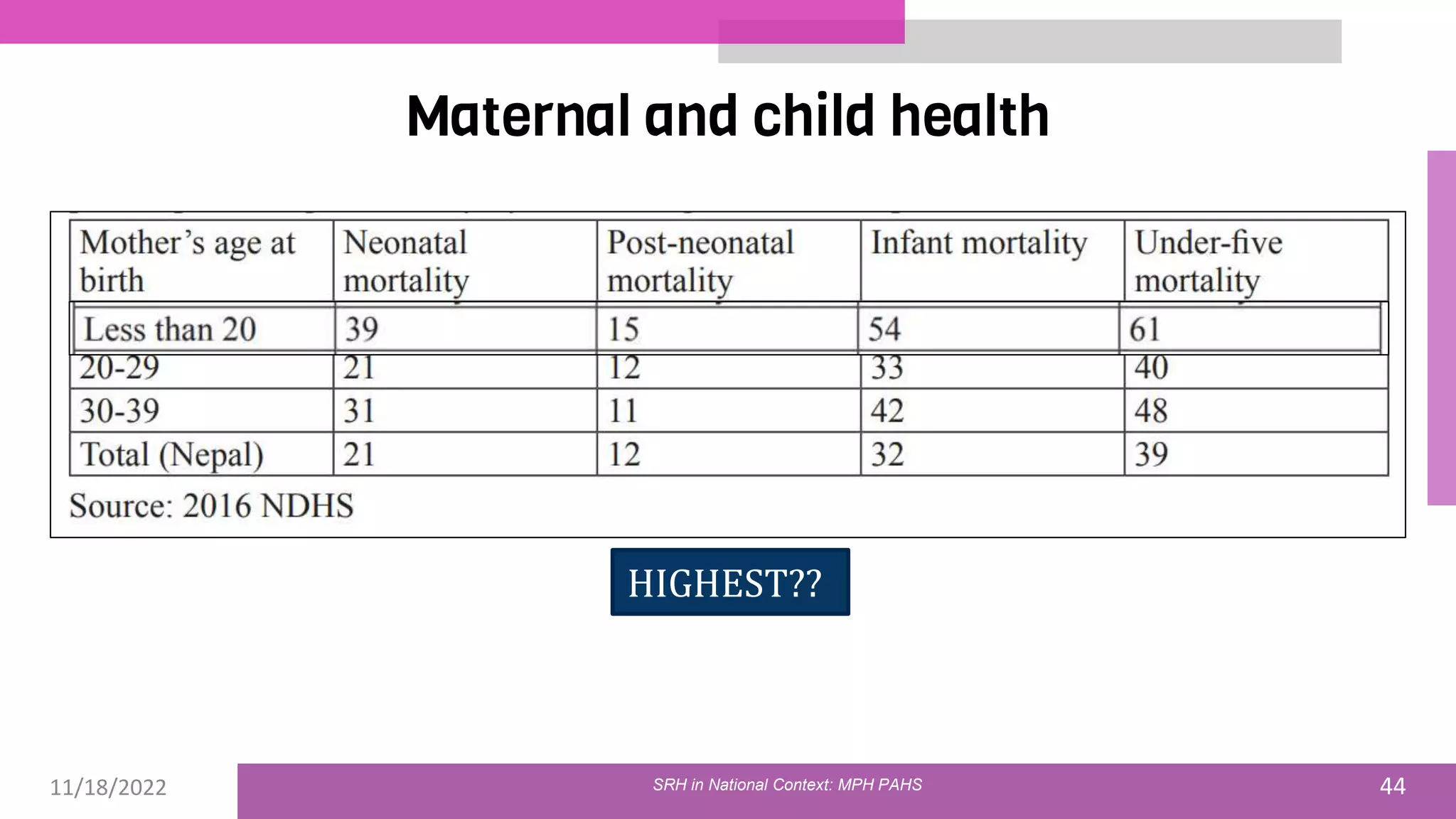
  • #45 Maternal and child health About a half (48.5%) of the women under 20 years had delivered their birth in government sector health facility, whereas about 35 percent delivered at home. In total (including private sector), 63.7 percent of them had delivered in a health facility (MOH, Nepal, New ERA & ICF, 2017). Not only the women but also the mortality of children is affected by the age of mother. The mortality was found highest for the mother of age less than 20 at the age of birth (MOH, Nepal, New ERA & ICF, 2017). It has been shown in the following table:
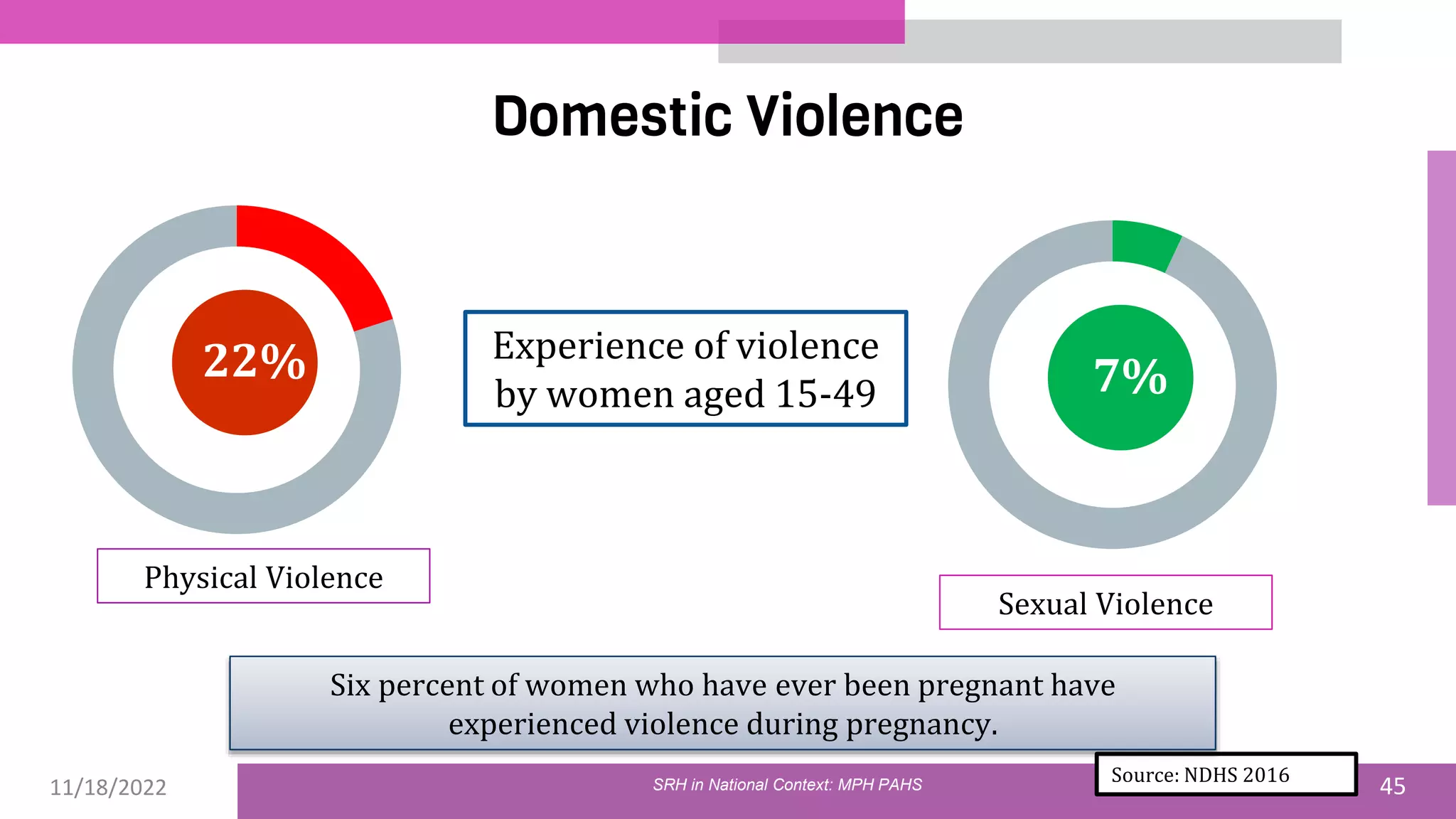
  • #46 Experience of violence: Twenty-two percent of women in Nepal age 15-49 have experienced physical violence since age 15, and 7% have ever experienced sexual violence. Six percent of women who have ever been pregnant have experienced violence during pregnancy.
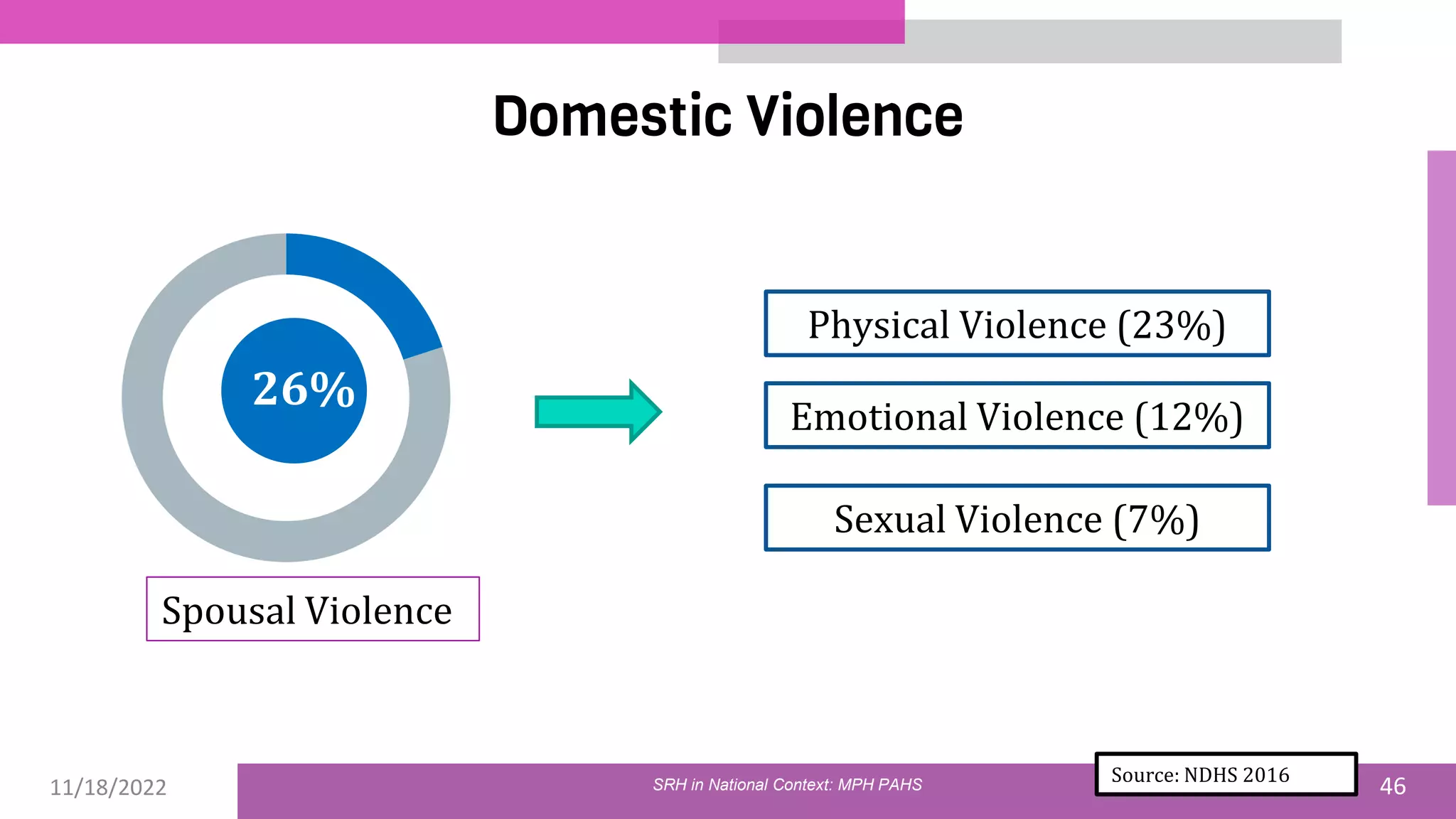
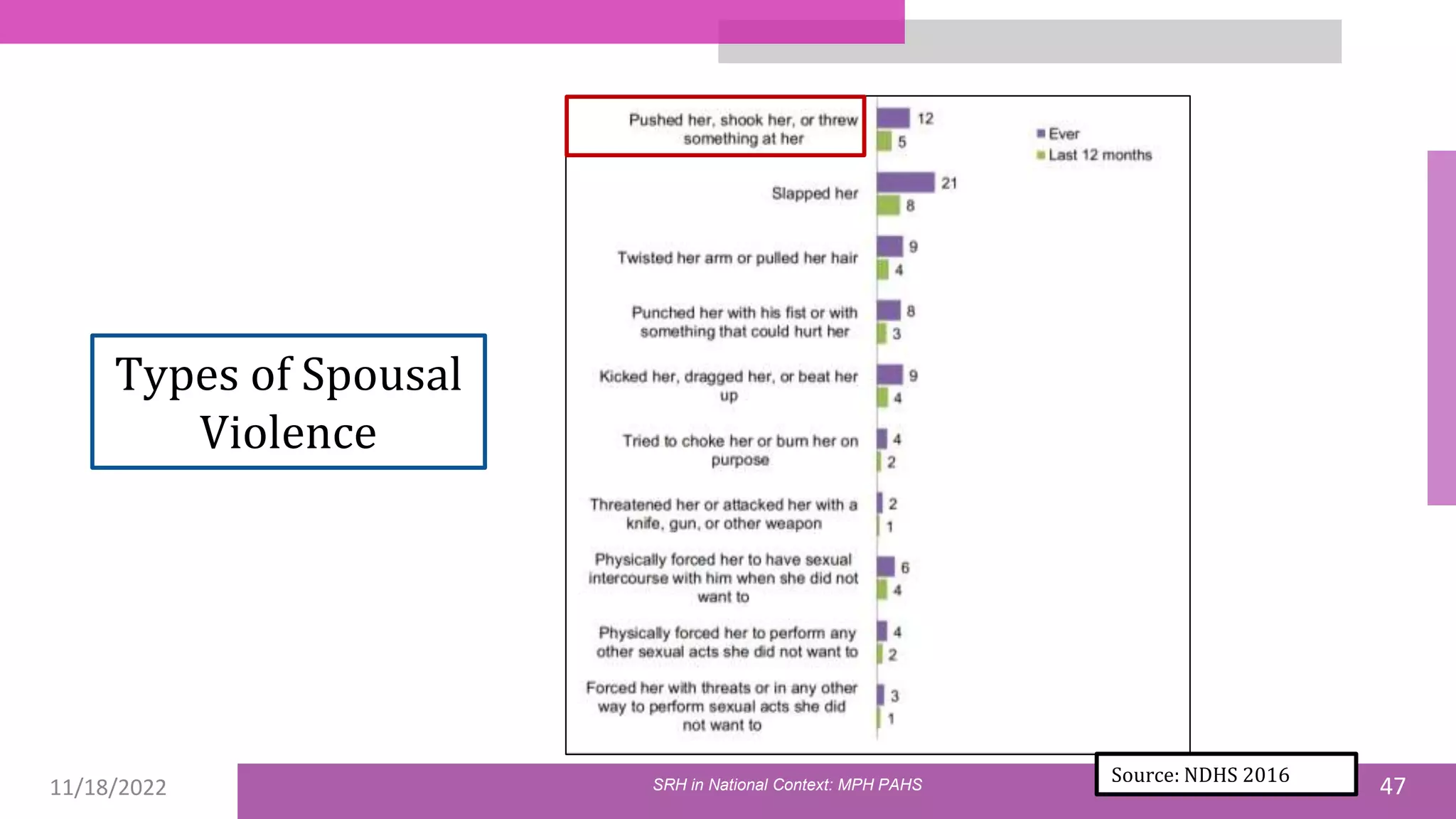
  • #47  Spousal violence: Twenty-six percent of ever-married women have ever experienced spousal physical, sexual, or emotional violence. The most common type of spousal violence is physical violence (23%), followed by emotional violence (12%). Seven percent of ever-married women have experienced spousal sexual violence
  • #49 Starting from a ‘low-level epidemic’ over the period of time HIV infection in Nepal evolved itself to become a ‘concentrated epidemic’ among key populations (KPs), notably with People who Inject Drugs (PWID), Female sex workers (FSW), Men who have Sex with Men (MSM) and Transgender (TG) People in Nepal. The trend of new infections is taking a descending trajectory, reaching its peak during 2002-2003. The epidemic that peaked in 2000 with almost 4,370 new cases in a calendar year has declined to 754 in 2020 (83% decrease). This declineis further accompanied by the decreasing trend of prevalence of HIV in Nepal, as shown in the figures below
  • #50 The adult HIV prevalence has dropped from 0.22% (highest level projected between 2005 and 2007) to 0.13% in 2020.