Set Theory Q7
Qn: Min and Max % of people
(a) 80% and 56% (b) 95% and 53%
(c) 80% and 49% (d) 80% and 51%
95% of the students in a class have taken Marketing, 80% have
chosen Finance, 84% have chosen operations (ops), and 90% have
chosen Human Resources (HR). What is the maximum and minimum
percentage of people who have chosen all of the four?
Soln: Min and Max % of people
Finding the maximum percentage is easy. If F  O  H  M, then the
percentage of people who have taken all 4 should be 80% and this is the
maximum value it can take.
For the value to be minimum, the numbers should be as far ‘apart´ as
possible. Let us do this iteratively. First, let us take Marketing and Finance,
and see if we can find the minimum percentage of students who should
have taken both.
95% of the students in a class have taken Marketing, 80% have
chosen Finance, 84% have chosen operations (ops), and 90% have
chosen Human Resources (HR). What is the maximum and minimum
percentage of people who have chosen all of the four?
Soln: Min and Max % of people
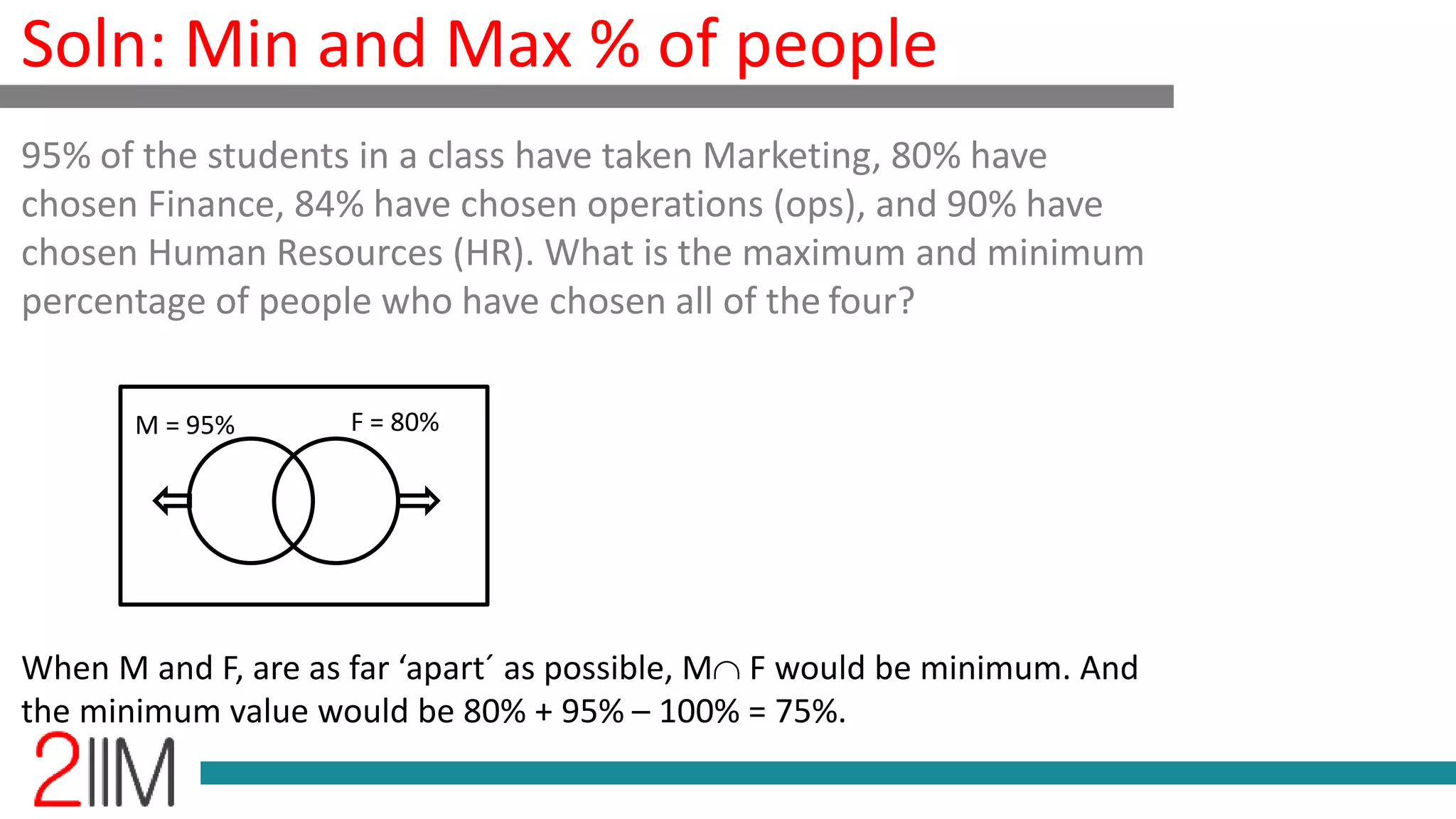
When M and F, are as far ‘apart´ as possible, M F would be minimum. And
the minimum value would be 80% + 95% – 100% = 75%.
95% of the students in a class have taken Marketing, 80% have
chosen Finance, 84% have chosen operations (ops), and 90% have
chosen Human Resources (HR). What is the maximum and minimum
percentage of people who have chosen all of the four?
M = 95% F = 80%
Soln: Min and Max % of people
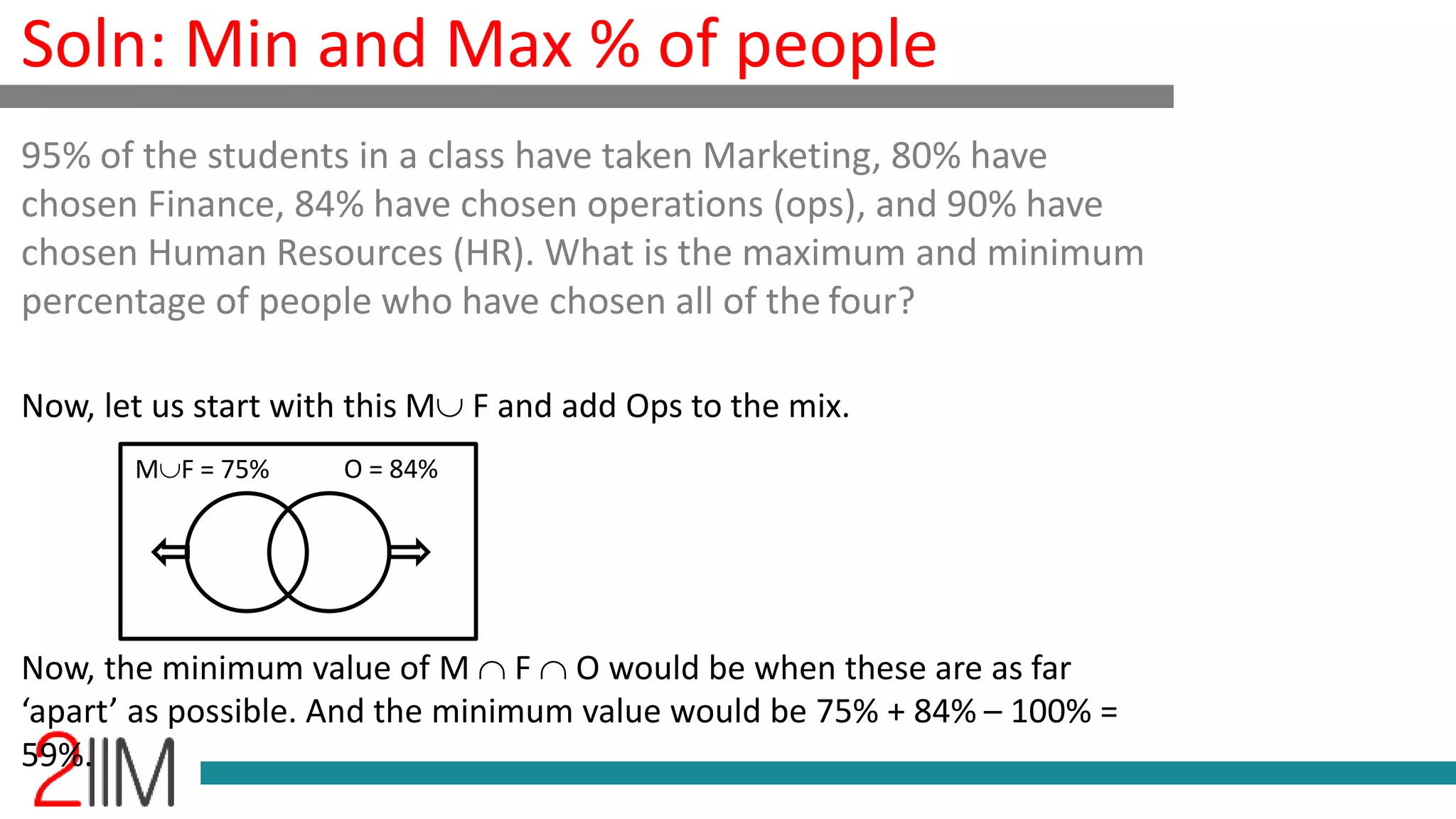
Now, let us start with this M F and add Ops to the mix.
Now, the minimum value of M  F  O would be when these are as far
‘apart’ as possible. And the minimum value would be 75% + 84% – 100% =
59%.
95% of the students in a class have taken Marketing, 80% have
chosen Finance, 84% have chosen operations (ops), and 90% have
chosen Human Resources (HR). What is the maximum and minimum
percentage of people who have chosen all of the four?
MF = 75% O = 84%
Soln: Min and Max % of people
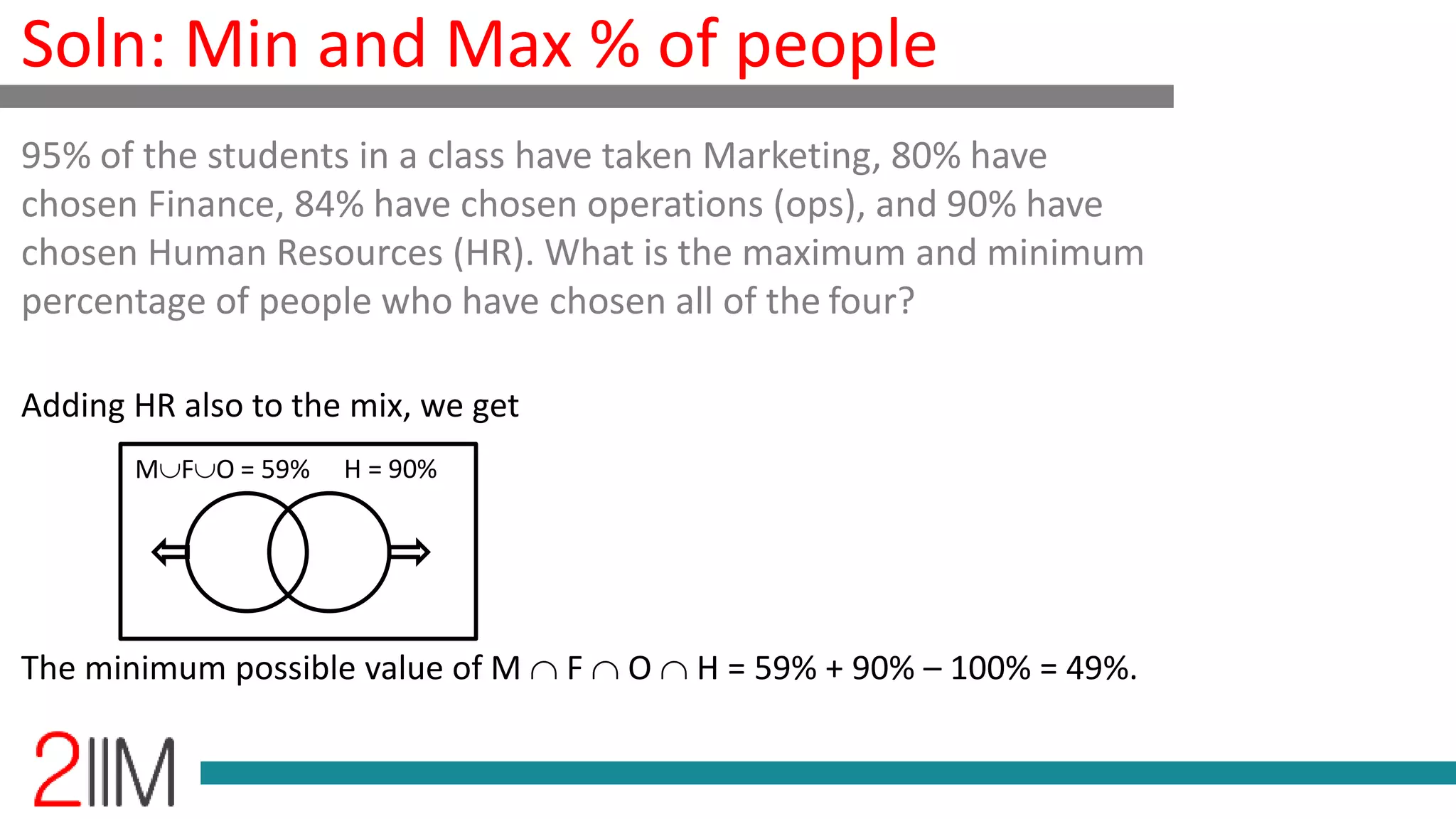
Adding HR also to the mix, we get
The minimum possible value of M  F  O  H = 59% + 90% – 100% = 49%.
95% of the students in a class have taken Marketing, 80% have
chosen Finance, 84% have chosen operations (ops), and 90% have
chosen Human Resources (HR). What is the maximum and minimum
percentage of people who have chosen all of the four?
MFO = 59% H = 90%
Soln: Min and Max % of people
As a formula, the minimum value is 100% – (100% – 95%) – (100% – 80%) –
(100% – 84%) – (100% – 90%).
= 100% – 5% – 20% – 16% – 10% = 100% – 51% = 49%.
Again, do not go with just the formula. See the trial and error iteration. The
trial and error iteration is far more useful than knowing the formula for a
template.
Answer choice (c)
95% of the students in a class have taken Marketing, 80% have
chosen Finance, 84% have chosen operations (ops), and 90% have
chosen Human Resources (HR). What is the maximum and minimum
percentage of people who have chosen all of the four?

Set Theory - Min and Max % of people

  • 1.
  • 2.
    Qn: Min andMax % of people (a) 80% and 56% (b) 95% and 53% (c) 80% and 49% (d) 80% and 51% 95% of the students in a class have taken Marketing, 80% have chosen Finance, 84% have chosen operations (ops), and 90% have chosen Human Resources (HR). What is the maximum and minimum percentage of people who have chosen all of the four?
  • 3.
    Soln: Min andMax % of people Finding the maximum percentage is easy. If F  O  H  M, then the percentage of people who have taken all 4 should be 80% and this is the maximum value it can take. For the value to be minimum, the numbers should be as far ‘apart´ as possible. Let us do this iteratively. First, let us take Marketing and Finance, and see if we can find the minimum percentage of students who should have taken both. 95% of the students in a class have taken Marketing, 80% have chosen Finance, 84% have chosen operations (ops), and 90% have chosen Human Resources (HR). What is the maximum and minimum percentage of people who have chosen all of the four?
  • 4.
    Soln: Min andMax % of people When M and F, are as far ‘apart´ as possible, M F would be minimum. And the minimum value would be 80% + 95% – 100% = 75%. 95% of the students in a class have taken Marketing, 80% have chosen Finance, 84% have chosen operations (ops), and 90% have chosen Human Resources (HR). What is the maximum and minimum percentage of people who have chosen all of the four? M = 95% F = 80%
  • 5.
    Soln: Min andMax % of people Now, let us start with this M F and add Ops to the mix. Now, the minimum value of M  F  O would be when these are as far ‘apart’ as possible. And the minimum value would be 75% + 84% – 100% = 59%. 95% of the students in a class have taken Marketing, 80% have chosen Finance, 84% have chosen operations (ops), and 90% have chosen Human Resources (HR). What is the maximum and minimum percentage of people who have chosen all of the four? MF = 75% O = 84%
  • 6.
    Soln: Min andMax % of people Adding HR also to the mix, we get The minimum possible value of M  F  O  H = 59% + 90% – 100% = 49%. 95% of the students in a class have taken Marketing, 80% have chosen Finance, 84% have chosen operations (ops), and 90% have chosen Human Resources (HR). What is the maximum and minimum percentage of people who have chosen all of the four? MFO = 59% H = 90%
  • 7.
    Soln: Min andMax % of people As a formula, the minimum value is 100% – (100% – 95%) – (100% – 80%) – (100% – 84%) – (100% – 90%). = 100% – 5% – 20% – 16% – 10% = 100% – 51% = 49%. Again, do not go with just the formula. See the trial and error iteration. The trial and error iteration is far more useful than knowing the formula for a template. Answer choice (c) 95% of the students in a class have taken Marketing, 80% have chosen Finance, 84% have chosen operations (ops), and 90% have chosen Human Resources (HR). What is the maximum and minimum percentage of people who have chosen all of the four?