OECD Paris Collaborative on Green Budgeting
18 April 2023
Strengthening climate and environmental considerations
in infrastructure and budget appraisal tools
Margaux Lelong, Public Management and Budgeting Division
Ana Maria Ruiz, Infrastructure and Public Procurement Division
Overview on budget appraisal
2
• The use of budget appraisal tools to include climate and
environmental considerations increase in OECD countries
• Budgetary tools are being adapted to include additional features
•Help identifying the
most cost-effective
measures for
mitigating the impacts
of climate change
Help assessing the
true costs and
benefits of projects,
programs and
policies
Help integrating
green tools with
existing decision-
making processes to
ensure that green
measures are
economically viable
and socially equitable
Help developing new
indicators to measure
progress and
effectiveness of
green policies and
programs
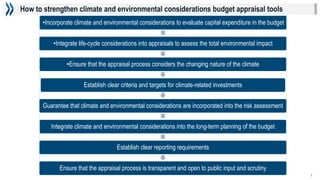
How to strengthen climate and environmental considerations budget appraisal tools
3
•Incorporate climate and environmental considerations to evaluate capital expenditure in the budget
•Integrate life-cycle considerations into appraisals to assess the total environmental impact
•Ensure that the appraisal process considers the changing nature of the climate
Establish clear criteria and targets for climate-related investments
Guarantee that climate and environmental considerations are incorporated into the risk assessment
Integrate climate and environmental considerations into the long-term planning of the budget
Establish clear reporting requirements
Ensure that the appraisal process is transparent and open to public input and scrutiny
Development of methods and tools
4
• Cost-benefit analysis
• Carbon footprint modelling
• Life Cycle Analysis
• Carbon Offsetting
• Carbon pricing
• Impact assessment
A focus on Cost-benefit Analysis
5
•Consider the costs associated with climate change and environmental degradation
•Reflect potential environmental benefits
•Include the cost of any additional environmental protection measures that would be required
Calculate the net present value of benefits considering the costs of climate change
Compare the net present value of the benefits with the estimated costs
Factor in the cost of any potential unforeseen consequences budget measures
Analyse the project over its lifetime
Consider the costs of inaction
6
Governance for green, resilient, and clean infrastructure
6
Measuring and collecting good
practices to enable green, resilient,
and clean infrastructure in OECD
countries
7
7
Enabling green, resilient, and clean infrastructure
Note: The score for Belgium (Flanders) is not included in the OECD average.
8
More can be done to integrate environmental and climate considerations into the project selection and prioritisation
OECD International good practices
OECD good practices
Impact Assessment Act
“one project, one assessment”
Scoring Mechanism for
Sustainable Infrastructure
(SIMS)
Green Budgeting & New
Methodological Approach to quantify
emissions impact
Biodiversity Points Method in CBA
Green Book’ supplementary guidance
1. Long-term strategic planning in Ireland
2. Public investments appraisal in Ireland
3. Budgeting practices in Ireland
4. International/OECD best practices to integrate environmental
and climate considerations in budgeting and project
appraisal
5. Methodological approach to assess the environmental
impacts of infrastructure projects [carbon mitigation]
6. Methodological approach to evaluate climate uncertainty and
risks of infrastructure projects [climate adaptation]
7. Integration of the proposed approach in the appraisal of
public investments in Ireland
The case of Ireland: Main outputs
Detailed overview of the Irish framework for
planning, appraisal and budgeting of
infrastructure projects to identify the main
challenges and opportunities for integrating
environmental and climate considerations
Proposed methdological approach to
integrate climate chage mitigation and
adaptation in infrastructure planning and
appraisal in Ireland
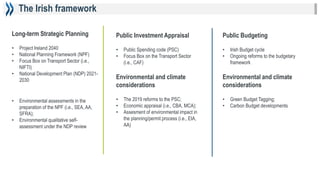
The Irish framework
Long-term Strategic Planning
• Project Ireland 2040
• National Planning Framework (NPF)
• Focus Box on Transport Sector (i.e.,
NIFTI)
• National Development Plan (NDP) 2021-
2030
• Environmental assessments in the
preparation of the NPF (i.e., SEA, AA,
SFRA);
• Environmental qualitative self-
assessment under the NDP review
Public Investment Appraisal
• Public Spending code (PSC)
• Focus Box on the Transport Sector
(i.e., CAF)
Environmental and climate
considerations
• The 2019 reforms to the PSC;
• Economic appraisal (i.e., CBA, MCA);
• Assesment of environmental impact in
the planning/permit process (i.e., EIA,
AA)
Public Budgeting
• Irish Budget cycle
• Ongoing reforms to the budgetary
framework
Environmental and climate
considerations
• Green Budget Tagging;
• Carbon Budget developments
Methodology to assess the
environmental impact of infrastructure
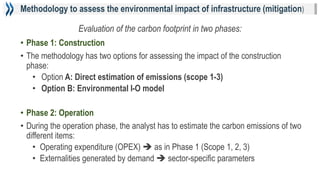
Methodology to assess the environmental impact of infrastructure (mitigation)
• Phase 1: Construction
• The methodology has two options for assessing the impact of the construction
phase:
• Option A: Direct estimation of emissions (scope 1-3)
• Option B: Environmental I-O model
• Phase 2: Operation
• During the operation phase, the analyst has to estimate the carbon emissions of two
different items:
• Operating expenditure (OPEX)  as in Phase 1 (Scope 1, 2, 3)
• Externalities generated by demand  sector-specific parameters
Evaluation of the carbon footprint in two phases:
The carbon footprint of the construction phase
Emissions of the building site
Scope 1 Direct emissions generated by the building site
Scope 2 Indirect emissions generated by the production of the energy used
Scope 3 Indirect emissions generated by suppliers of the site
General evaluation of climate mitigation phase
- Extension of the standard Cost-Benefit Analysis to include (direct and
indirect) externalities from the construction phase:
• 𝑁𝑃𝑉 = 𝑡=0
𝑁 𝐵𝑡−𝐶𝑡
(1+𝑟)𝑡
- Assessment of mitigation policies in terms of “sensitivity analysis”, that is
altering the costs (e.g. for installing solar panels), observing the benefits
and the relative change in NPV (social welfare change)
Methodology to assess the environmental impact of infrastructure (adaptation)
Step 1: Vulnerability analysis
• The sensitivity of the project (in terms of on-site assets, inputs, outputs, access and
transport links) to specific climate hazards;
• The exposure of the investment project to such events.
Step 2: Impact analysis and adaptation strategies.
• Assessment of the likelihood of an even to occur;
• Assessment of the impact of the extreme event in terms of asset damages, safety and
health, environment, cultural heritage, social, financial, reputation.
Step 3: Adaptation strategies
• For projects ranked from “medium” to “extreme” impact, strategies and measures for
adaptation should be identified.
Evaluation of climate adaptation in three phases
www.oecd.org/environment/green-budgeting/
www.oecd.org/gov/infrastructure-governance/
Thank you

Session-7-OECD-Strengthening-climate.pptx

  • 1.
    OECD Paris Collaborativeon Green Budgeting 18 April 2023 Strengthening climate and environmental considerations in infrastructure and budget appraisal tools Margaux Lelong, Public Management and Budgeting Division Ana Maria Ruiz, Infrastructure and Public Procurement Division
  • 2.
    Overview on budgetappraisal 2 • The use of budget appraisal tools to include climate and environmental considerations increase in OECD countries • Budgetary tools are being adapted to include additional features •Help identifying the most cost-effective measures for mitigating the impacts of climate change Help assessing the true costs and benefits of projects, programs and policies Help integrating green tools with existing decision- making processes to ensure that green measures are economically viable and socially equitable Help developing new indicators to measure progress and effectiveness of green policies and programs
  • 3.
    How to strengthenclimate and environmental considerations budget appraisal tools 3 •Incorporate climate and environmental considerations to evaluate capital expenditure in the budget •Integrate life-cycle considerations into appraisals to assess the total environmental impact •Ensure that the appraisal process considers the changing nature of the climate Establish clear criteria and targets for climate-related investments Guarantee that climate and environmental considerations are incorporated into the risk assessment Integrate climate and environmental considerations into the long-term planning of the budget Establish clear reporting requirements Ensure that the appraisal process is transparent and open to public input and scrutiny
  • 4.
    Development of methodsand tools 4 • Cost-benefit analysis • Carbon footprint modelling • Life Cycle Analysis • Carbon Offsetting • Carbon pricing • Impact assessment
  • 5.
    A focus onCost-benefit Analysis 5 •Consider the costs associated with climate change and environmental degradation •Reflect potential environmental benefits •Include the cost of any additional environmental protection measures that would be required Calculate the net present value of benefits considering the costs of climate change Compare the net present value of the benefits with the estimated costs Factor in the cost of any potential unforeseen consequences budget measures Analyse the project over its lifetime Consider the costs of inaction
  • 6.
    6 Governance for green,resilient, and clean infrastructure 6 Measuring and collecting good practices to enable green, resilient, and clean infrastructure in OECD countries
  • 7.
    7 7 Enabling green, resilient,and clean infrastructure Note: The score for Belgium (Flanders) is not included in the OECD average.
  • 8.
    8 More can bedone to integrate environmental and climate considerations into the project selection and prioritisation
  • 9.
  • 10.
    OECD good practices ImpactAssessment Act “one project, one assessment” Scoring Mechanism for Sustainable Infrastructure (SIMS) Green Budgeting & New Methodological Approach to quantify emissions impact Biodiversity Points Method in CBA Green Book’ supplementary guidance
  • 11.
    1. Long-term strategicplanning in Ireland 2. Public investments appraisal in Ireland 3. Budgeting practices in Ireland 4. International/OECD best practices to integrate environmental and climate considerations in budgeting and project appraisal 5. Methodological approach to assess the environmental impacts of infrastructure projects [carbon mitigation] 6. Methodological approach to evaluate climate uncertainty and risks of infrastructure projects [climate adaptation] 7. Integration of the proposed approach in the appraisal of public investments in Ireland The case of Ireland: Main outputs Detailed overview of the Irish framework for planning, appraisal and budgeting of infrastructure projects to identify the main challenges and opportunities for integrating environmental and climate considerations Proposed methdological approach to integrate climate chage mitigation and adaptation in infrastructure planning and appraisal in Ireland
  • 12.
    The Irish framework Long-termStrategic Planning • Project Ireland 2040 • National Planning Framework (NPF) • Focus Box on Transport Sector (i.e., NIFTI) • National Development Plan (NDP) 2021- 2030 • Environmental assessments in the preparation of the NPF (i.e., SEA, AA, SFRA); • Environmental qualitative self- assessment under the NDP review Public Investment Appraisal • Public Spending code (PSC) • Focus Box on the Transport Sector (i.e., CAF) Environmental and climate considerations • The 2019 reforms to the PSC; • Economic appraisal (i.e., CBA, MCA); • Assesment of environmental impact in the planning/permit process (i.e., EIA, AA) Public Budgeting • Irish Budget cycle • Ongoing reforms to the budgetary framework Environmental and climate considerations • Green Budget Tagging; • Carbon Budget developments
  • 13.
    Methodology to assessthe environmental impact of infrastructure
  • 14.
    Methodology to assessthe environmental impact of infrastructure (mitigation) • Phase 1: Construction • The methodology has two options for assessing the impact of the construction phase: • Option A: Direct estimation of emissions (scope 1-3) • Option B: Environmental I-O model • Phase 2: Operation • During the operation phase, the analyst has to estimate the carbon emissions of two different items: • Operating expenditure (OPEX)  as in Phase 1 (Scope 1, 2, 3) • Externalities generated by demand  sector-specific parameters Evaluation of the carbon footprint in two phases:
  • 15.
    The carbon footprintof the construction phase Emissions of the building site Scope 1 Direct emissions generated by the building site Scope 2 Indirect emissions generated by the production of the energy used Scope 3 Indirect emissions generated by suppliers of the site
  • 16.
    General evaluation ofclimate mitigation phase - Extension of the standard Cost-Benefit Analysis to include (direct and indirect) externalities from the construction phase: • 𝑁𝑃𝑉 = 𝑡=0 𝑁 𝐵𝑡−𝐶𝑡 (1+𝑟)𝑡 - Assessment of mitigation policies in terms of “sensitivity analysis”, that is altering the costs (e.g. for installing solar panels), observing the benefits and the relative change in NPV (social welfare change)
  • 17.
    Methodology to assessthe environmental impact of infrastructure (adaptation) Step 1: Vulnerability analysis • The sensitivity of the project (in terms of on-site assets, inputs, outputs, access and transport links) to specific climate hazards; • The exposure of the investment project to such events. Step 2: Impact analysis and adaptation strategies. • Assessment of the likelihood of an even to occur; • Assessment of the impact of the extreme event in terms of asset damages, safety and health, environment, cultural heritage, social, financial, reputation. Step 3: Adaptation strategies • For projects ranked from “medium” to “extreme” impact, strategies and measures for adaptation should be identified. Evaluation of climate adaptation in three phases
  • 18.

Editor's Notes

  • #18 The aim of the vulnerability analysis is to identify the most relevant climate and environmental hazards in terms of potential impacts on the investment. The analyst is required to assess: The sensitivity of the project (in terms of on-site assets, inputs, outputs, access and transport links) to specific climate hazards; The exposure of the investment project to such events