Green Budgeting in France
Vincent MARCUS
Deputy Director of Department of
Economics and Policy Evaluation
Ministry of Ecological and Inclusive
Transition
OECD workshop
March 17th 2020
2
Green Budgeting in France
1. Foreword
2. Methodological insights
3. Main results
4. Challenges
3
1. Foreword
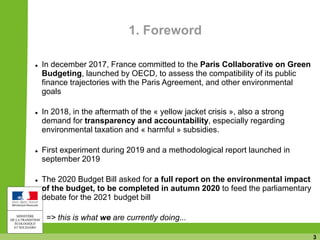
 In december 2017, France committed to the Paris Collaborative on Green
Budgeting, launched by OECD, to assess the compatibility of its public
finance trajectories with the Paris Agreement, and other environmental
goals
 In 2018, in the aftermath of the « yellow jacket crisis », also a strong
demand for transparency and accountability, especially regarding
environmental taxation and « harmful » subsidies.
 First experiment during 2019 and a methodological report launched in
september 2019
 The 2020 Budget Bill asked for a full report on the environmental impact
of the budget, to be completed in autumn 2020 to feed the parliamentary
debate for the 2021 budget bill
=> this is what we are currently doing...
4
2. Methodology (1/3)
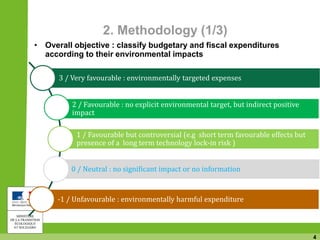
• Overall objective : classify budgetary and fiscal expenditures
according to their environmental impacts
3 / Very favourable : environmentally targeted expenses
2 / Favourable : no explicit environmental target, but indirect positive
impact
1 / Favourable but controversial (e.g short term favourable effects but
presence of a long term technology lock-in risk )
0 / Neutral : no significant impact or no information
-1 / Unfavourable : environmentally harmful expenditure
5
2. Methodology (2/3)
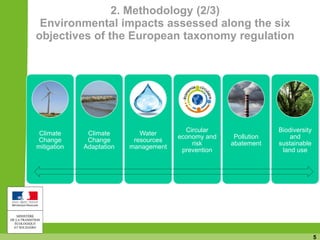
Environmental impacts assessed along the six
objectives of the European taxonomy regulation
Climate
Change
mitigation
Climate
Change
Adaptation
Water
resources
management
Circular
economy and
risk
prevention
Pollution
abatement
Biodiversity
and
sustainable
land use
6
2. Methodology (3/3)
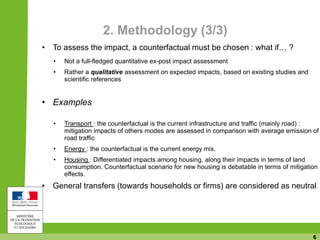
• To assess the impact, a counterfactual must be chosen : what if… ?
• Not a full-fledged quantitative ex-post impact assessment
• Rather a qualitative assessment on expected impacts, based on existing studies and
scientific references
• Examples
• Transport : the counterfactual is the current infrastructure and traffic (mainly road) :
mitigation impacts of others modes are assessed in comparison with average emission of
road traffic
• Energy : the counterfactual is the current energy mix.
• Housing : Differentiated impacts among housing, along their impacts in terms of land
consumption. Counterfactual scenario for new housing is debatable in terms of mitigation
effects.
• General transfers (towards households or firms) are considered as neutral
7
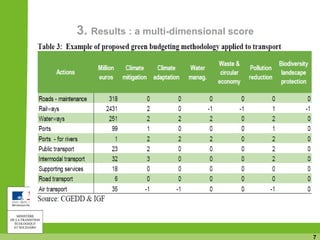
3. Results : a multi-dimensional score
8
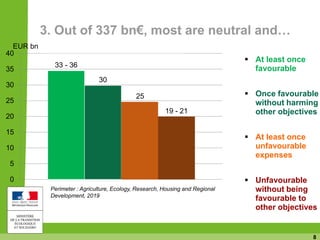
3. Out of 337 bn€, most are neutral and…
33 - 36
30
25
19 - 21
0
5
10
15
20
25
30
35
40
Dépenses – Mds € PLF 2019EUR bn
 At least once
favourable
 Once favourable
without harming
other objectives
 At least once
unfavourable
expenses
 Unfavourable
without being
favourable to
other objectives
Perimeter : Agriculture, Ecology, Research, Housing and Regional
Development, 2019
9
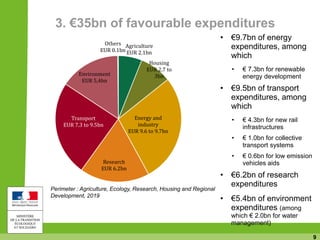
3. €35bn of favourable expenditures
• €9.7bn of energy
expenditures, among
which
• € 7.3bn for renewable
energy development
• €9.5bn of transport
expenditures, among
which
• € 4.3bn for new rail
infrastructures
• € 1.0bn for collective
transport systems
• € 0.6bn for low emission
vehicles aids
• €6.2bn of research
expenditures
• €5.4bn of environment
expenditures (among
which € 2.0bn for water
management)
Perimeter : Agriculture, Ecology, Research, Housing and Regional
Development, 2019
Agriculture
EUR 2.1bn
Housing
EUR 2.7 to
3bn
Energy and
industry
EUR 9.6 to 9.7bn
Research
EUR 6.2bn
Transport
EUR 7.3 to 9.5bn
Environment
EUR 5,4bn
Others
EUR 0.1bn
10
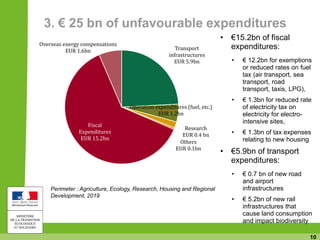
3. € 25 bn of unfavourable expenditures
• €15.2bn of fiscal
expenditures:
• € 12.2bn for exemptions
or reduced rates on fuel
tax (air transport, sea
transport, road
transport, taxis, LPG),
• € 1.3bn for reduced rate
of electricity tax on
electricity for electro-
intensive sites,
• € 1.3bn of tax expenses
relating to new housing
• €5.9bn of transport
expenditures:
• € 0.7 bn of new road
and airport
infrastructures
• € 5.2bn of new rail
infrastructures that
cause land consumption
and impact biodiversity
Perimeter : Agriculture, Ecology, Research, Housing and Regional
Development, 2019
Transport
infrastructures
EUR 5.9bn
Operation expenditures (fuel, etc.)
EUR 1.2bn
Research
EUR 0.4 bn
Others
EUR 0.1bn
Fiscal
Expenditures
EUR 15.2bn
Overseas energy compensations
EUR 1.6bn
11
4. Challenges ahead
• Governance and stakeholders involvement
• The sole analysis of the budget bill is not sufficient to evaluate the
compliance of national policy with international climate and
environment commitments
• Environmental regulations are not included in the scope of the budget bill
• To fulfill the ecological transition, not only government expenses, but also private
sector and local authorities expenses must be made compatible with
environmental and climate commitments
• Impacts assessment :
• Scoring must be regularly updated with better impact evaluation=> work in progress
• The green budget does not evaluate the efficiency of environmental expenses =>
long-term additional work needed
• International comparisons are a challenge and may not be feasible
• Counterfactual scenarios are very technology-dependant or nationally-driven
• Fiscal expenditures, as defined in budgetary documents (“standard” tax level), can
be very misleading in terms of international comparisons
Thank you !

Session 2 - Vincent Marcus

  • 1.
    Green Budgeting inFrance Vincent MARCUS Deputy Director of Department of Economics and Policy Evaluation Ministry of Ecological and Inclusive Transition OECD workshop March 17th 2020
  • 2.
    2 Green Budgeting inFrance 1. Foreword 2. Methodological insights 3. Main results 4. Challenges
  • 3.
    3 1. Foreword  Indecember 2017, France committed to the Paris Collaborative on Green Budgeting, launched by OECD, to assess the compatibility of its public finance trajectories with the Paris Agreement, and other environmental goals  In 2018, in the aftermath of the « yellow jacket crisis », also a strong demand for transparency and accountability, especially regarding environmental taxation and « harmful » subsidies.  First experiment during 2019 and a methodological report launched in september 2019  The 2020 Budget Bill asked for a full report on the environmental impact of the budget, to be completed in autumn 2020 to feed the parliamentary debate for the 2021 budget bill => this is what we are currently doing...
  • 4.
    4 2. Methodology (1/3) •Overall objective : classify budgetary and fiscal expenditures according to their environmental impacts 3 / Very favourable : environmentally targeted expenses 2 / Favourable : no explicit environmental target, but indirect positive impact 1 / Favourable but controversial (e.g short term favourable effects but presence of a long term technology lock-in risk ) 0 / Neutral : no significant impact or no information -1 / Unfavourable : environmentally harmful expenditure
  • 5.
    5 2. Methodology (2/3) Environmentalimpacts assessed along the six objectives of the European taxonomy regulation Climate Change mitigation Climate Change Adaptation Water resources management Circular economy and risk prevention Pollution abatement Biodiversity and sustainable land use
  • 6.
    6 2. Methodology (3/3) •To assess the impact, a counterfactual must be chosen : what if… ? • Not a full-fledged quantitative ex-post impact assessment • Rather a qualitative assessment on expected impacts, based on existing studies and scientific references • Examples • Transport : the counterfactual is the current infrastructure and traffic (mainly road) : mitigation impacts of others modes are assessed in comparison with average emission of road traffic • Energy : the counterfactual is the current energy mix. • Housing : Differentiated impacts among housing, along their impacts in terms of land consumption. Counterfactual scenario for new housing is debatable in terms of mitigation effects. • General transfers (towards households or firms) are considered as neutral
  • 7.
    7 3. Results :a multi-dimensional score
  • 8.
    8 3. Out of337 bn€, most are neutral and… 33 - 36 30 25 19 - 21 0 5 10 15 20 25 30 35 40 Dépenses – Mds € PLF 2019EUR bn  At least once favourable  Once favourable without harming other objectives  At least once unfavourable expenses  Unfavourable without being favourable to other objectives Perimeter : Agriculture, Ecology, Research, Housing and Regional Development, 2019
  • 9.
    9 3. €35bn offavourable expenditures • €9.7bn of energy expenditures, among which • € 7.3bn for renewable energy development • €9.5bn of transport expenditures, among which • € 4.3bn for new rail infrastructures • € 1.0bn for collective transport systems • € 0.6bn for low emission vehicles aids • €6.2bn of research expenditures • €5.4bn of environment expenditures (among which € 2.0bn for water management) Perimeter : Agriculture, Ecology, Research, Housing and Regional Development, 2019 Agriculture EUR 2.1bn Housing EUR 2.7 to 3bn Energy and industry EUR 9.6 to 9.7bn Research EUR 6.2bn Transport EUR 7.3 to 9.5bn Environment EUR 5,4bn Others EUR 0.1bn
  • 10.
    10 3. € 25bn of unfavourable expenditures • €15.2bn of fiscal expenditures: • € 12.2bn for exemptions or reduced rates on fuel tax (air transport, sea transport, road transport, taxis, LPG), • € 1.3bn for reduced rate of electricity tax on electricity for electro- intensive sites, • € 1.3bn of tax expenses relating to new housing • €5.9bn of transport expenditures: • € 0.7 bn of new road and airport infrastructures • € 5.2bn of new rail infrastructures that cause land consumption and impact biodiversity Perimeter : Agriculture, Ecology, Research, Housing and Regional Development, 2019 Transport infrastructures EUR 5.9bn Operation expenditures (fuel, etc.) EUR 1.2bn Research EUR 0.4 bn Others EUR 0.1bn Fiscal Expenditures EUR 15.2bn Overseas energy compensations EUR 1.6bn
  • 11.
    11 4. Challenges ahead •Governance and stakeholders involvement • The sole analysis of the budget bill is not sufficient to evaluate the compliance of national policy with international climate and environment commitments • Environmental regulations are not included in the scope of the budget bill • To fulfill the ecological transition, not only government expenses, but also private sector and local authorities expenses must be made compatible with environmental and climate commitments • Impacts assessment : • Scoring must be regularly updated with better impact evaluation=> work in progress • The green budget does not evaluate the efficiency of environmental expenses => long-term additional work needed • International comparisons are a challenge and may not be feasible • Counterfactual scenarios are very technology-dependant or nationally-driven • Fiscal expenditures, as defined in budgetary documents (“standard” tax level), can be very misleading in terms of international comparisons
  • 12.