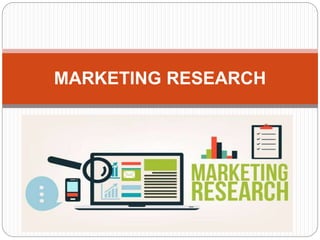
MARKETING RESEARCH
Marketing Research
 American Marketing Association formally defines
marketing research as the following:
‘ Marketing research is the function that links the
consumer, customer, and public to the marketer
through information- information used to identify and
define marketing opportunities and problems; generate,
refine, and evaluate marketing actions; monitor
marketing performance; improve understanding of
marketing as a process’.
 For the purpose of our discussion which emphasizes
the need for information for decision making, marketing
research is defined as follows:
‘ Marketing research is the systematic and objective
identification, collection, analysis. Dissemination, and
use of information for the purpose of improving decision
making related to the identification and solution of
Classification of Marketing
research
When Pepsi expanded their market to China, they launched with the
slogan, "Pepsi brings you back to life." What they did not realize is that the
phrase translated to “Pepsi brings your ancestors back from the grave.”
This may seem like a funny mistake ... but to Pepsi this was a huge mistake,
especially when you are trying to build a brand on a global level.
Coca-cola also had little success marketing a product in Chile. When
the company attempted to introduce a new grape-flavored drink, it
soon discovered that the Chileans were not interested. Apparently,
the Chileans prefer wine as their grape drink.
Warner encountered difficulties when it tried to sell a cinnamon
flavored FRESHEN-UP gum in Chile. Because the gum’s taste was
unacceptable there, the product fared poorly in the marketplace.
Report preparation and presentation
Step 1: Problem definition
 Problem definition involves discussion with decision makers,
interviews with industry experts, analysis of secondary data, and
perhaps, some qualitative research, such as focus groups.
Guideline for selecting a problem:
 Subject which is overdone should not be chosen
 Too narrow or too vague problems must be avoided
 The chosen subject should be familiar and feasible
 Cost and time factor must be kept in mind
Necessity for defining a problem: the problem to be
investigated must be clearly defined in order to
 Discriminate relevant data from irrelevant data
 Formulate objectives
 Choose an appropriate design
Step 2: Development of an approach to the
problem
The components of an approach consists of
 objective/theoretical framework,
 analytical models,
 research questions,
 hypotheses,
 specification of information needed.
 It is necessary that the approach developed be
based on objective or empirical evidence and be
grounded in theory
 The relevant variables and their interrelationships
may be neatly summarized via an analytical model
 The research questions are refined statements of
the specific components of the problem
 Research questions may be further refined into
Step 3: Research Design Formulation
 A research design is a framework or blueprint for
conducting the marketing research project.
 Formulating research design involves
1. Definition of the information needed
2. Secondary data analysis
3. Qualitative research
4. Methods of collecting quantitative data ( survey,
observation etc.)
5. Measurement and scaling procedures
6. Questionnaire design
7. Sampling process and sample size
8. Plan of data analysis
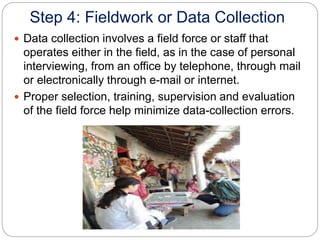
Step 4: Fieldwork or Data Collection
 Data collection involves a field force or staff that
operates either in the field, as in the case of personal
interviewing, from an office by telephone, through mail
or electronically through e-mail or internet.
 Proper selection, training, supervision and evaluation
of the field force help minimize data-collection errors.
Step 5:Data preparation and
analysis
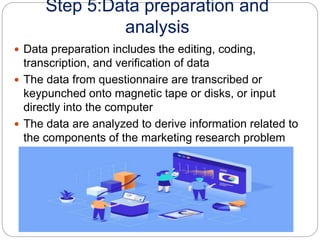
 Data preparation includes the editing, coding,
transcription, and verification of data
 The data from questionnaire are transcribed or
keypunched onto magnetic tape or disks, or input
directly into the computer
 The data are analyzed to derive information related to
the components of the marketing research problem
and, thus, to provide input into the management
decision problem.
Step 6: Report preparation and
presentation
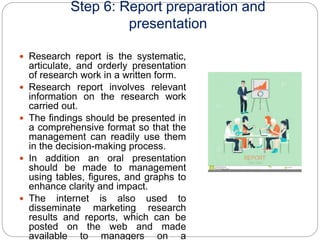
 Research report is the systematic,
articulate, and orderly presentation
of research work in a written form.
 Research report involves relevant
information on the research work
carried out.
 The findings should be presented in
a comprehensive format so that the
management can readily use them
in the decision-making process.
 In addition an oral presentation
should be made to management
using tables, figures, and graphs to
enhance clarity and impact.
 The internet is also used to
disseminate marketing research
results and reports, which can be
posted on the web and made
available to managers on a
Case study: Johnson & Johnson Gentleness could not
handle pain
 J&J is considered to be the world’s most broadly based
manufacturer of health care products with more than 250
operating companies in 57 countries.
 Despite its success in the industry, J&J baby products
attempt to use its company name on baby aspirin proved
to be unsuccessful.
 Johnson & Johnson baby products are perceived as
gentle, but gentleness is not what people want in a baby
aspirin.
 Although baby aspirin should be safe , gentleness per se
is not a desirable feature.
 Rather, some people perceived that a gentle aspirin
might not be effective enough
 This is an example of what intuitively seemed to be
natural move but without proper marketing research
turned out to be an incorrect decision.
 The task of marketing research is to assess the
information needs and provide management with
relevant , accurate , reliable , valid , current and
actionable information
 Sound decisions are not based on gut feeling,
intuition, or even pure judgment.
 Marketing managers make numerous strategies and
tactical decisions in the process of identifying and
satisfying customer needs. These decision are
complicated by interactions among the controllable
marketing variables and uncontrollable environmental
factors.
 Marketing research helps the marketing manager link
the marketing programs provide information on
controllable and uncontrollable , factors and
Role of marketing research in marketing decision-
making
Power decisions is a market research company focused on
marketing strategy. Using market research and decision
clarification tolls, they help clients benefit from the right
marketing research information for uncovering marketing
strategy solutions that work.
Power Decisions Research company
 IBM - Data Cap, Custom Research Engagement
Customer satisfaction assessment employing online
survey tools, data analysis and recommendations
 Progressive Insurance ,Naming Process & Research
Engagement
As project partner, conducted primary quantitative
research to screen top priority potential corporate &
business division naming options.
 Maverick Capital VC , Acquisition Research
Engagement
Employing primary quantitative research, we assessed
marketing dynamics of Mavericks name brand target.
Multistage survey research and advisory
recommendations made to acquisition partners.
Step 1: Defining the
problem
Managem
ent
Decision
problem
Marketing
research
problem
Step 2 : Developing an
approach to the
problem
Theory
Hypothesi
s
Informatio
n needed
Research
questions
Models
Step 3: Formulating a
research design
Step 4: Doing
Fieldwork/collection
Data
Step 5: Preparing and
Analyzing Data
Step 6: Preparing and
Presenting the report
Explorator
y
Descriptiv
e
Causal
Selection
Training
Evaluation
Supervisio
n
Report
Presentati
on
Assisting
client
Data
Presentaio
n
Research
Follow up
Evaluating
research project

Research process.pptx

  • 1.
  • 2.
    Marketing Research  AmericanMarketing Association formally defines marketing research as the following: ‘ Marketing research is the function that links the consumer, customer, and public to the marketer through information- information used to identify and define marketing opportunities and problems; generate, refine, and evaluate marketing actions; monitor marketing performance; improve understanding of marketing as a process’.  For the purpose of our discussion which emphasizes the need for information for decision making, marketing research is defined as follows: ‘ Marketing research is the systematic and objective identification, collection, analysis. Dissemination, and use of information for the purpose of improving decision making related to the identification and solution of
  • 3.
  • 5.
    When Pepsi expandedtheir market to China, they launched with the slogan, "Pepsi brings you back to life." What they did not realize is that the phrase translated to “Pepsi brings your ancestors back from the grave.” This may seem like a funny mistake ... but to Pepsi this was a huge mistake, especially when you are trying to build a brand on a global level. Coca-cola also had little success marketing a product in Chile. When the company attempted to introduce a new grape-flavored drink, it soon discovered that the Chileans were not interested. Apparently, the Chileans prefer wine as their grape drink. Warner encountered difficulties when it tried to sell a cinnamon flavored FRESHEN-UP gum in Chile. Because the gum’s taste was unacceptable there, the product fared poorly in the marketplace.
  • 6.
  • 7.
    Step 1: Problemdefinition  Problem definition involves discussion with decision makers, interviews with industry experts, analysis of secondary data, and perhaps, some qualitative research, such as focus groups. Guideline for selecting a problem:  Subject which is overdone should not be chosen  Too narrow or too vague problems must be avoided  The chosen subject should be familiar and feasible  Cost and time factor must be kept in mind Necessity for defining a problem: the problem to be investigated must be clearly defined in order to  Discriminate relevant data from irrelevant data  Formulate objectives  Choose an appropriate design
  • 8.
    Step 2: Developmentof an approach to the problem The components of an approach consists of  objective/theoretical framework,  analytical models,  research questions,  hypotheses,  specification of information needed.  It is necessary that the approach developed be based on objective or empirical evidence and be grounded in theory  The relevant variables and their interrelationships may be neatly summarized via an analytical model  The research questions are refined statements of the specific components of the problem  Research questions may be further refined into
  • 9.
    Step 3: ResearchDesign Formulation  A research design is a framework or blueprint for conducting the marketing research project.  Formulating research design involves 1. Definition of the information needed 2. Secondary data analysis 3. Qualitative research 4. Methods of collecting quantitative data ( survey, observation etc.) 5. Measurement and scaling procedures 6. Questionnaire design 7. Sampling process and sample size 8. Plan of data analysis
  • 10.
    Step 4: Fieldworkor Data Collection  Data collection involves a field force or staff that operates either in the field, as in the case of personal interviewing, from an office by telephone, through mail or electronically through e-mail or internet.  Proper selection, training, supervision and evaluation of the field force help minimize data-collection errors.
  • 11.
    Step 5:Data preparationand analysis  Data preparation includes the editing, coding, transcription, and verification of data  The data from questionnaire are transcribed or keypunched onto magnetic tape or disks, or input directly into the computer  The data are analyzed to derive information related to the components of the marketing research problem and, thus, to provide input into the management decision problem.
  • 12.
    Step 6: Reportpreparation and presentation  Research report is the systematic, articulate, and orderly presentation of research work in a written form.  Research report involves relevant information on the research work carried out.  The findings should be presented in a comprehensive format so that the management can readily use them in the decision-making process.  In addition an oral presentation should be made to management using tables, figures, and graphs to enhance clarity and impact.  The internet is also used to disseminate marketing research results and reports, which can be posted on the web and made available to managers on a
  • 13.
    Case study: Johnson& Johnson Gentleness could not handle pain  J&J is considered to be the world’s most broadly based manufacturer of health care products with more than 250 operating companies in 57 countries.  Despite its success in the industry, J&J baby products attempt to use its company name on baby aspirin proved to be unsuccessful.  Johnson & Johnson baby products are perceived as gentle, but gentleness is not what people want in a baby aspirin.  Although baby aspirin should be safe , gentleness per se is not a desirable feature.  Rather, some people perceived that a gentle aspirin might not be effective enough  This is an example of what intuitively seemed to be natural move but without proper marketing research turned out to be an incorrect decision.
  • 15.
     The taskof marketing research is to assess the information needs and provide management with relevant , accurate , reliable , valid , current and actionable information  Sound decisions are not based on gut feeling, intuition, or even pure judgment.  Marketing managers make numerous strategies and tactical decisions in the process of identifying and satisfying customer needs. These decision are complicated by interactions among the controllable marketing variables and uncontrollable environmental factors.  Marketing research helps the marketing manager link the marketing programs provide information on controllable and uncontrollable , factors and Role of marketing research in marketing decision- making
  • 16.
    Power decisions isa market research company focused on marketing strategy. Using market research and decision clarification tolls, they help clients benefit from the right marketing research information for uncovering marketing strategy solutions that work.
  • 17.
    Power Decisions Researchcompany  IBM - Data Cap, Custom Research Engagement Customer satisfaction assessment employing online survey tools, data analysis and recommendations  Progressive Insurance ,Naming Process & Research Engagement As project partner, conducted primary quantitative research to screen top priority potential corporate & business division naming options.  Maverick Capital VC , Acquisition Research Engagement Employing primary quantitative research, we assessed marketing dynamics of Mavericks name brand target. Multistage survey research and advisory recommendations made to acquisition partners.
  • 18.
    Step 1: Definingthe problem Managem ent Decision problem Marketing research problem Step 2 : Developing an approach to the problem Theory Hypothesi s Informatio n needed Research questions Models Step 3: Formulating a research design Step 4: Doing Fieldwork/collection Data Step 5: Preparing and Analyzing Data Step 6: Preparing and Presenting the report Explorator y Descriptiv e Causal Selection Training Evaluation Supervisio n Report Presentati on Assisting client Data Presentaio n Research Follow up Evaluating research project