NUTRITIONAL
DISORDERS
SESSION 7
DR.TETY
PROTEIN ENERGY MALNUTRITION
INTRODUCTION
Protein energy malnutrition is a range of pathological conditions
arising from a deficiency of energy and protein.
The deficiency eventually results in body wasting, primarily of lean
tissue, and an increased susceptibility to infection.
It occurs more frequently in infants and young children but is also
observed in adolescents and adults, mostly lactating women,
especially during periods of famine or other emergencies.
Classification of Protein Energy
Malnutrition
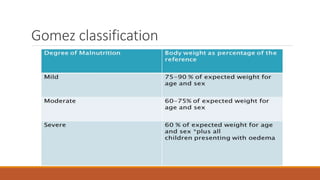
Gomez classification: Based on weight deficit for age but not the
type or duration of the condition.
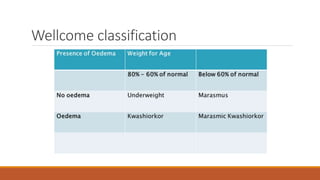
Wellcome classification: Based on presence or absent of oedema
and a minimum body weight above or below 60 percent of the
Harvard standard weight for age (fiftieth percentile).
Waterlow: Based on duration of malnutrition.
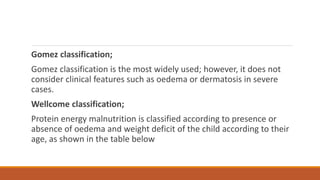
Gomez classification;
Gomez classification is the most widely used; however, it does not
consider clinical features such as oedema or dermatosis in severe
cases.
Wellcome classification;
Protein energy malnutrition is classified according to presence or
absence of oedema and weight deficit of the child according to their
age, as shown in the table below
Gomez classification
Wellcome classification
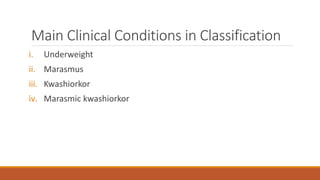
Main Clinical Conditions in Classification
i. Underweight
ii. Marasmus
iii. Kwashiorkor
iv. Marasmic kwashiorkor
UNDERWEIGHT
Underweight is the mildest form of PEM and can be detected only by
checking the weight of the child and by plotting it on the special
weight for age chart.
The child’s body weight is only 60 to 80 percent of the reference
weight.
That is, of what one would expect for a healthy child of the same
age.
These children need special attention because;
There are many underweight children.
Most are between one and three years and up to 30 % of all children in
this age group may be underweight.
Underweight children grow and develop more slowly than well
nourished children.
They are at risk of picking up infection very easily.
More severe forms of malnutrition often develop if they are not treated
in time
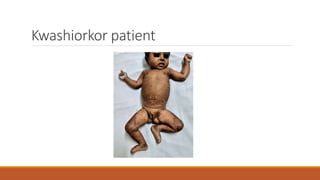
KWASHIORKOR
It occurs due to deficiency of protein nutrient
Kwashiorkor and Marasmus both are severe forms of PEM.
A child with Kwashiorkor displays the following signs and symptoms:
There is failure of growth but the child is not as severely wasted, as
in marasmus
Signs and symptoms of kwashiorkor
The body weight is 60-80 percent of the standard
The abdomen is swollen (liver enlargement due to fatty infiltration)
The child shows hair changes (hair becomes brown, straight and soft)
Skin rashes (called ‘flaky paint dermatosis’)
The child becomes inactive, apathetic, irritable and is difficult to feed
The child has oedema of lower limbs and other parts of the body
Moonfaced face
Kwashiorkor patient
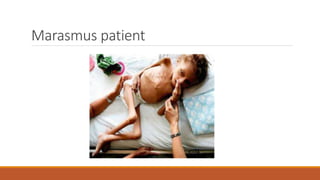
MARASMUS
It is commonly due to deficiency in calories/ energy, as a result patient will
become fat and protein deficient
Signs and symptoms;
Remarkable failure of growth –which can be considered the deterioration of
the underweight condition
The body weight is less than 60 percent of the standard
Severe muscle wasting with flaccid, wrinkled skin and bony prominence
The child looks awake and hungry and displays what is referred to as ‘old
person’s face.’
Oedema is absent.
Marasmus patient
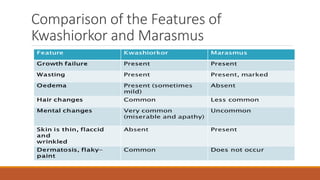
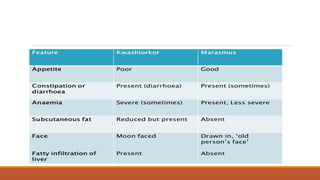
Comparison of the Features of
Kwashiorkor and Marasmus
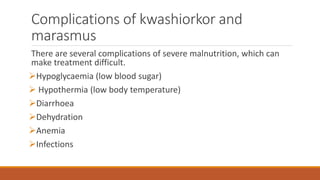
Complications of kwashiorkor and
marasmus
There are several complications of severe malnutrition, which can
make treatment difficult.
Hypoglycaemia (low blood sugar)
 Hypothermia (low body temperature)
Diarrhoea
Dehydration
Anemia
Infections
Marasmic kwashiorkor
Patients presents with weight for height less than 60% of the
expected with oedema and other symptoms of kwashiorkor
WATERLOW CLASSIFICATIONS
Waterlow emphasizes measuring nutritional status of children using
weight and height in addition to age.
Protein energy malnutrition based on weight and height
measurement of children can be explained in the following
categories:
i. Wasting
ii. Stunting
iii. Wasting and stunting
Wasting: Weight for age and weight for height are low. It is a rapid
decline of weight while height has remained unchanged.
Wasting is a manifestation of acute under-nutrition and a reflection
of inadequate dietary intake or acute infection in recent weeks.
Stunting: Low height for age. The child has failed to gain height that
would correspond with his age. Stunting is caused by chronic under-
nutrition (long illness and/or semistarvation) that being a reflection
of adverse socio-economic condition.
Wasting and stunting are acute and chronic or current long duration
malnutrition, where weight for age and weight for height are all low.
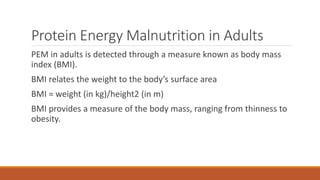
Protein Energy Malnutrition in Adults
PEM in adults is detected through a measure known as body mass
index (BMI).
BMI relates the weight to the body’s surface area
BMI = weight (in kg)/height2 (in m)
BMI provides a measure of the body mass, ranging from thinness to
obesity.
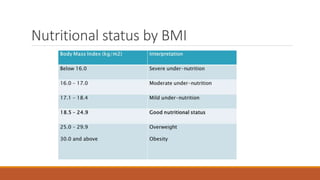
Nutritional status by BMI
Prevention of PEM
There is no single universal, low-cost, and sustainable strategy that
can be applied everywhere to reduce the prevalence or severity of
PEM because the underlying and basic causes are often numerous
and complex.
The different strategies may include:
Incorporating nutrition objectives into development of policies and
programmes
Improving household food security
Protection and promotion of good health
Improving the quality and safety of foods
Protect and promote breastfeeding and complementary feeding
Early treatment of common diseases
Immunization
Growth monitoring
Promoting appropriate diets and healthy lifestyles
OBESITY
INTRODUCTION
Obesity is characterized by the accumulation of excess body fat.
In common practice, it is viewed as ‘overweight.’
When energy intake from food and drink exceed an individual’s
immediate energy requirements, the excess energy is converted to
fat and stored in the adipose tissue to be used as a source of energy
at a later date.
The stored energy can be beneficial.
 For example, the extra fat stored to meet the energy requirements
of lactation confers an advantage in survival when there is a food
shortage.
The stored energy can also be harmful.
The extra energy stored is a disadvantage because of the
development of obesity and its associated health risks.
Obesity or overweight is common to both children and adults.
Causes of Obesity
Sedentary lifestyle
Tendency to take less exercise and do less energetic physical work.
Lack of information on healthy eating habits
Energy expenditure is reduced by physical incapacity (e.g. back
injury).
Psychological factors
Many people tend to eat a lot when they are lonely, worried or
depressed.
Social pressure and behavioral factors
Slight changes in behavior, such as an increase in the number of
snacks between meals or change of employment which leads to
more eating in a social setting
Other underlying causes;
Genetic makeup
Children may inherit the genetic makeup of their obese parents.
Endocrine disorders
The hypothalamus exerts some control over appetite and in rare
conditions damage to the hypothalamus can lead to an increase in
appetite and over-eating( conditions such as head trauma, tumor
etc...)normally the hormones from hypothalamus govern
physiological functions such as temperature, hunger, mood etc..
Certain drug treatments
Some drugs may increase appetite (for example oral contraceptives,
cyproheptidine-appetite stimulant).
Classification of Obesity
There are two ways of classifying obesity:
i. By fat distribution
ii. Using body weight
Classification of Obesity Based on Distribution of Fat
Upper body obesity
Fat is stored primarily in the abdominal area.
Closely associated with a high risk of heart disease, hypertension and
type II diabetes.
Whereas other fat cells empty fat directly into general circulation,
the fat content of abdominal fat cells go straight to the liver, by way
of portal vein, before being circulated to the muscles
This process interferes with the liver’s ability to clear insulin and
alters lipoprotein metabolism by the liver.
Lower body obesity:
Fat storage is primarily located in the buttocks and thigh area.
Oestrogen and progesterone encourage lower body fat storage.
After menopause, blood Oestrogen falls, encouraging upper body fat
distribution
Symptoms and Signs
When BMI is above 30 a person is considered to be obese
Limitations of BMI
As a measure of health and nutritional status, BMI has many
limitations.
BMI classifications do not apply generally to all people.
Some factors that may limit the usefulness of BMI include:
Muscles:
If a person is very muscular, they may have a BMI over 25 but very
little body fat.
Similarly, if a person has very little muscle, they may still have too
much body fat, even though their BMI is in the healthy range
Pregnancy:
BMI is important for women who are trying to get pregnant.
Pregnant women should not use BMI as a measure of healthy
weight.
Children:
BMI is not useful for monitoring the weight of children because their
bodies change a great deal as they grow. (For example, infants
naturally have much more body fat than toddlers 12-36 month old).
When a child is weighed, their weight will be plotted on growth chart
which takes into account gender and age. The location of a child’s
weight on this graph will show if they are a healthy weight or not.
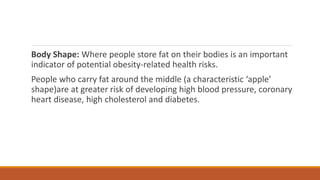
Body Shape: Where people store fat on their bodies is an important
indicator of potential obesity-related health risks.
People who carry fat around the middle (a characteristic ‘apple’
shape)are at greater risk of developing high blood pressure, coronary
heart disease, high cholesterol and diabetes.
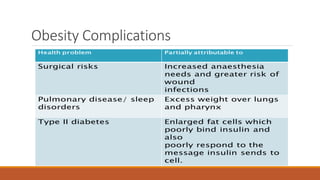
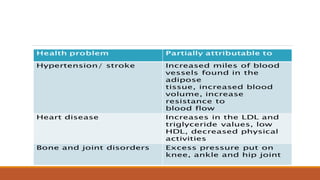
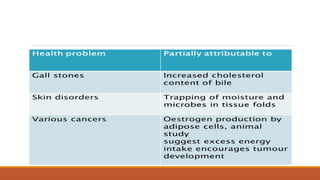
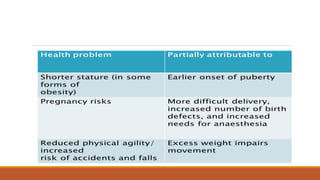
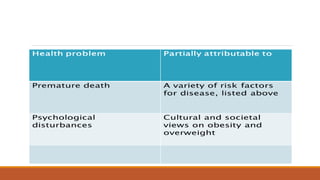
Obesity Complications
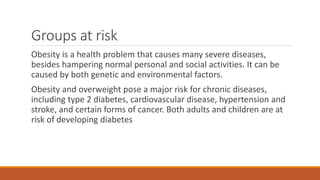
Groups at risk
Obesity is a health problem that causes many severe diseases,
besides hampering normal personal and social activities. It can be
caused by both genetic and environmental factors.
Obesity and overweight pose a major risk for chronic diseases,
including type 2 diabetes, cardiovascular disease, hypertension and
stroke, and certain forms of cancer. Both adults and children are at
risk of developing diabetes
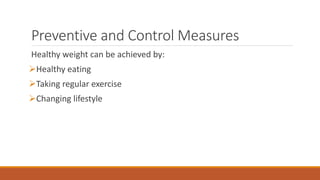
Preventive and Control Measures
Healthy weight can be achieved by:
Healthy eating
Taking regular exercise
Changing lifestyle
THE END

SESSION 7; NUTRITIONAL DISORDERS.pptx

  • 1.
  • 2.
  • 3.
    INTRODUCTION Protein energy malnutritionis a range of pathological conditions arising from a deficiency of energy and protein. The deficiency eventually results in body wasting, primarily of lean tissue, and an increased susceptibility to infection. It occurs more frequently in infants and young children but is also observed in adolescents and adults, mostly lactating women, especially during periods of famine or other emergencies.
  • 4.
    Classification of ProteinEnergy Malnutrition Gomez classification: Based on weight deficit for age but not the type or duration of the condition. Wellcome classification: Based on presence or absent of oedema and a minimum body weight above or below 60 percent of the Harvard standard weight for age (fiftieth percentile). Waterlow: Based on duration of malnutrition.
  • 5.
    Gomez classification; Gomez classificationis the most widely used; however, it does not consider clinical features such as oedema or dermatosis in severe cases. Wellcome classification; Protein energy malnutrition is classified according to presence or absence of oedema and weight deficit of the child according to their age, as shown in the table below
  • 6.
  • 7.
  • 8.
    Main Clinical Conditionsin Classification i. Underweight ii. Marasmus iii. Kwashiorkor iv. Marasmic kwashiorkor
  • 9.
    UNDERWEIGHT Underweight is themildest form of PEM and can be detected only by checking the weight of the child and by plotting it on the special weight for age chart. The child’s body weight is only 60 to 80 percent of the reference weight. That is, of what one would expect for a healthy child of the same age.
  • 10.
    These children needspecial attention because; There are many underweight children. Most are between one and three years and up to 30 % of all children in this age group may be underweight. Underweight children grow and develop more slowly than well nourished children. They are at risk of picking up infection very easily. More severe forms of malnutrition often develop if they are not treated in time
  • 11.
    KWASHIORKOR It occurs dueto deficiency of protein nutrient Kwashiorkor and Marasmus both are severe forms of PEM. A child with Kwashiorkor displays the following signs and symptoms: There is failure of growth but the child is not as severely wasted, as in marasmus
  • 12.
    Signs and symptomsof kwashiorkor The body weight is 60-80 percent of the standard The abdomen is swollen (liver enlargement due to fatty infiltration) The child shows hair changes (hair becomes brown, straight and soft) Skin rashes (called ‘flaky paint dermatosis’) The child becomes inactive, apathetic, irritable and is difficult to feed The child has oedema of lower limbs and other parts of the body Moonfaced face
  • 13.
  • 14.
    MARASMUS It is commonlydue to deficiency in calories/ energy, as a result patient will become fat and protein deficient Signs and symptoms; Remarkable failure of growth –which can be considered the deterioration of the underweight condition The body weight is less than 60 percent of the standard Severe muscle wasting with flaccid, wrinkled skin and bony prominence The child looks awake and hungry and displays what is referred to as ‘old person’s face.’ Oedema is absent.
  • 15.
  • 16.
    Comparison of theFeatures of Kwashiorkor and Marasmus
  • 18.
    Complications of kwashiorkorand marasmus There are several complications of severe malnutrition, which can make treatment difficult. Hypoglycaemia (low blood sugar)  Hypothermia (low body temperature) Diarrhoea Dehydration Anemia Infections
  • 19.
    Marasmic kwashiorkor Patients presentswith weight for height less than 60% of the expected with oedema and other symptoms of kwashiorkor
  • 20.
    WATERLOW CLASSIFICATIONS Waterlow emphasizesmeasuring nutritional status of children using weight and height in addition to age. Protein energy malnutrition based on weight and height measurement of children can be explained in the following categories: i. Wasting ii. Stunting iii. Wasting and stunting
  • 21.
    Wasting: Weight forage and weight for height are low. It is a rapid decline of weight while height has remained unchanged. Wasting is a manifestation of acute under-nutrition and a reflection of inadequate dietary intake or acute infection in recent weeks. Stunting: Low height for age. The child has failed to gain height that would correspond with his age. Stunting is caused by chronic under- nutrition (long illness and/or semistarvation) that being a reflection of adverse socio-economic condition.
  • 22.
    Wasting and stuntingare acute and chronic or current long duration malnutrition, where weight for age and weight for height are all low.
  • 23.
    Protein Energy Malnutritionin Adults PEM in adults is detected through a measure known as body mass index (BMI). BMI relates the weight to the body’s surface area BMI = weight (in kg)/height2 (in m) BMI provides a measure of the body mass, ranging from thinness to obesity.
  • 24.
  • 25.
    Prevention of PEM Thereis no single universal, low-cost, and sustainable strategy that can be applied everywhere to reduce the prevalence or severity of PEM because the underlying and basic causes are often numerous and complex. The different strategies may include: Incorporating nutrition objectives into development of policies and programmes Improving household food security Protection and promotion of good health
  • 26.
    Improving the qualityand safety of foods Protect and promote breastfeeding and complementary feeding Early treatment of common diseases Immunization Growth monitoring Promoting appropriate diets and healthy lifestyles
  • 27.
  • 28.
    INTRODUCTION Obesity is characterizedby the accumulation of excess body fat. In common practice, it is viewed as ‘overweight.’ When energy intake from food and drink exceed an individual’s immediate energy requirements, the excess energy is converted to fat and stored in the adipose tissue to be used as a source of energy at a later date.
  • 29.
    The stored energycan be beneficial.  For example, the extra fat stored to meet the energy requirements of lactation confers an advantage in survival when there is a food shortage. The stored energy can also be harmful. The extra energy stored is a disadvantage because of the development of obesity and its associated health risks. Obesity or overweight is common to both children and adults.
  • 30.
    Causes of Obesity Sedentarylifestyle Tendency to take less exercise and do less energetic physical work. Lack of information on healthy eating habits Energy expenditure is reduced by physical incapacity (e.g. back injury). Psychological factors Many people tend to eat a lot when they are lonely, worried or depressed.
  • 31.
    Social pressure andbehavioral factors Slight changes in behavior, such as an increase in the number of snacks between meals or change of employment which leads to more eating in a social setting Other underlying causes; Genetic makeup Children may inherit the genetic makeup of their obese parents.
  • 32.
    Endocrine disorders The hypothalamusexerts some control over appetite and in rare conditions damage to the hypothalamus can lead to an increase in appetite and over-eating( conditions such as head trauma, tumor etc...)normally the hormones from hypothalamus govern physiological functions such as temperature, hunger, mood etc..
  • 33.
    Certain drug treatments Somedrugs may increase appetite (for example oral contraceptives, cyproheptidine-appetite stimulant).
  • 34.
    Classification of Obesity Thereare two ways of classifying obesity: i. By fat distribution ii. Using body weight
  • 35.
    Classification of ObesityBased on Distribution of Fat Upper body obesity Fat is stored primarily in the abdominal area. Closely associated with a high risk of heart disease, hypertension and type II diabetes. Whereas other fat cells empty fat directly into general circulation, the fat content of abdominal fat cells go straight to the liver, by way of portal vein, before being circulated to the muscles
  • 36.
    This process interfereswith the liver’s ability to clear insulin and alters lipoprotein metabolism by the liver. Lower body obesity: Fat storage is primarily located in the buttocks and thigh area. Oestrogen and progesterone encourage lower body fat storage. After menopause, blood Oestrogen falls, encouraging upper body fat distribution
  • 37.
    Symptoms and Signs WhenBMI is above 30 a person is considered to be obese Limitations of BMI As a measure of health and nutritional status, BMI has many limitations. BMI classifications do not apply generally to all people.
  • 38.
    Some factors thatmay limit the usefulness of BMI include: Muscles: If a person is very muscular, they may have a BMI over 25 but very little body fat. Similarly, if a person has very little muscle, they may still have too much body fat, even though their BMI is in the healthy range
  • 39.
    Pregnancy: BMI is importantfor women who are trying to get pregnant. Pregnant women should not use BMI as a measure of healthy weight.
  • 40.
    Children: BMI is notuseful for monitoring the weight of children because their bodies change a great deal as they grow. (For example, infants naturally have much more body fat than toddlers 12-36 month old). When a child is weighed, their weight will be plotted on growth chart which takes into account gender and age. The location of a child’s weight on this graph will show if they are a healthy weight or not.
  • 41.
    Body Shape: Wherepeople store fat on their bodies is an important indicator of potential obesity-related health risks. People who carry fat around the middle (a characteristic ‘apple’ shape)are at greater risk of developing high blood pressure, coronary heart disease, high cholesterol and diabetes.
  • 42.
  • 47.
    Groups at risk Obesityis a health problem that causes many severe diseases, besides hampering normal personal and social activities. It can be caused by both genetic and environmental factors. Obesity and overweight pose a major risk for chronic diseases, including type 2 diabetes, cardiovascular disease, hypertension and stroke, and certain forms of cancer. Both adults and children are at risk of developing diabetes
  • 48.
    Preventive and ControlMeasures Healthy weight can be achieved by: Healthy eating Taking regular exercise Changing lifestyle
  • 49.