Balance Sheet Management
The NZ Treasury Investment Statement
Ken Warren
Chief Accounting Advisor
New Zealand Treasury
Date
The context …
• Treasury’s vision is to raise living standards for New Zealanders
• The Public Finance Act requires the NZ Treasury to produce an
Investment Statement to increase transparency over the
investment taxpayers have made in the Crown’s balance sheet.
• GAAP balance sheets do not provide a full expression of value
• Previous investment statements examined principles for efficient
balance sheet management, and Crown performance against
these standards.
The context (continued) …
• Investment Statement ’18 focuses on how to extract the highest
value from New Zealanders’ investments
• The full value of assets and liabilities can be represented by the
health of the four capitals in our living standards framework
• Understanding the value of the health of the capitals, and how it
is constructed, helps investment decision makers
The context (continued) …
• The scope of issues raised by combining investment
management and capitals is wide ranging and challenging
• There is no established and accepted framework
• The development of Income Statement ’18 is intended to
stimulate discourse about the challenges facing a capitals
approach to wellbeing
• Starting with a focus on natural capital
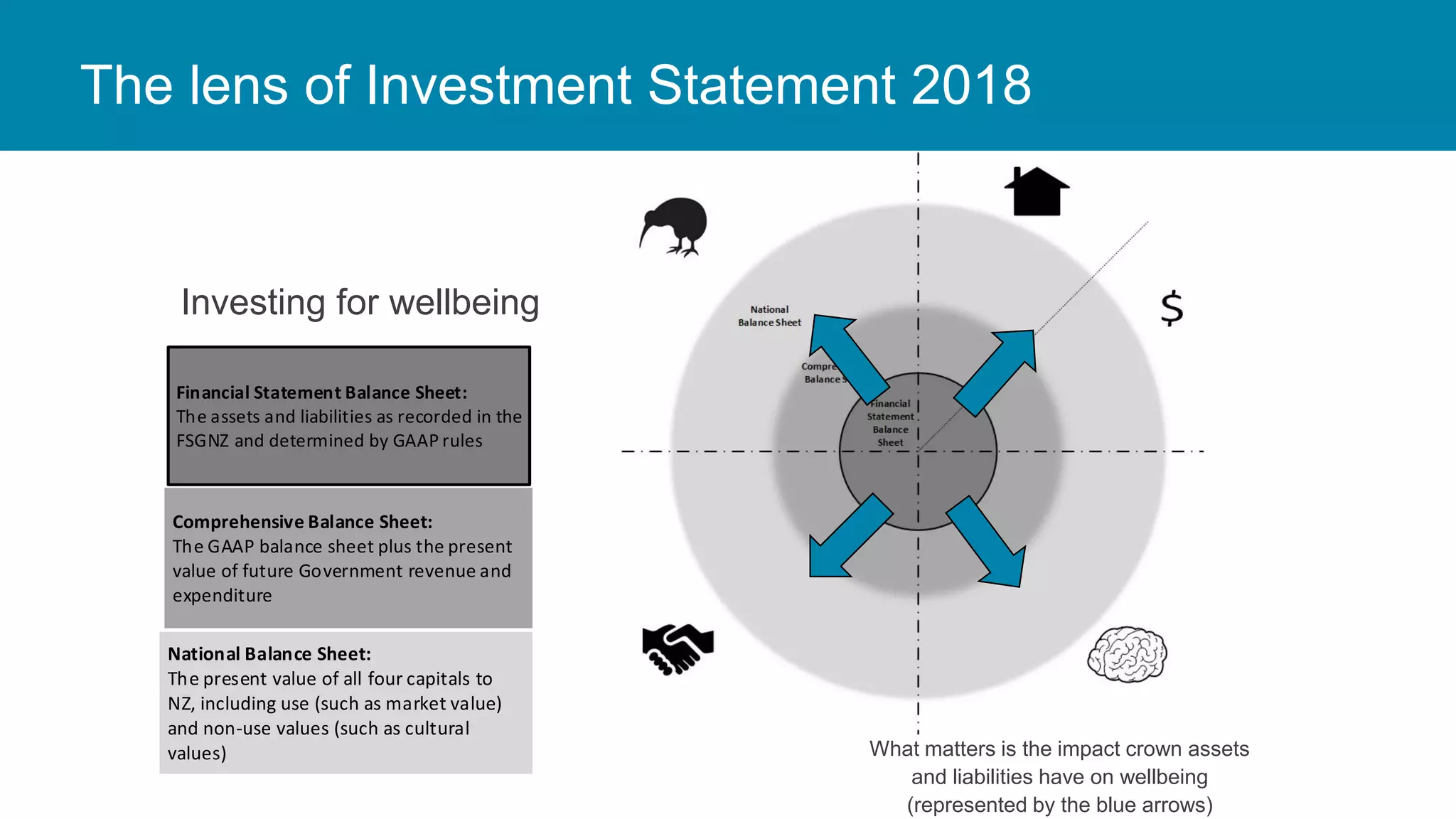
The lens of Investment Statement 2018
Investing for wellbeing
Financial Statement Balance Sheet:
The assets and liabilities as recorded in the
FSGNZ and determined by GAAP rules
Comprehensive Balance Sheet:
The GAAP balance sheet plus the present
value of future Government revenue and
expenditure
National Balance Sheet:
The present value of all four capitals to
NZ, including use (such as market value)
and non-use values (such as cultural
values) What matters is the impact crown assets
and liabilities have on wellbeing
(represented by the blue arrows)
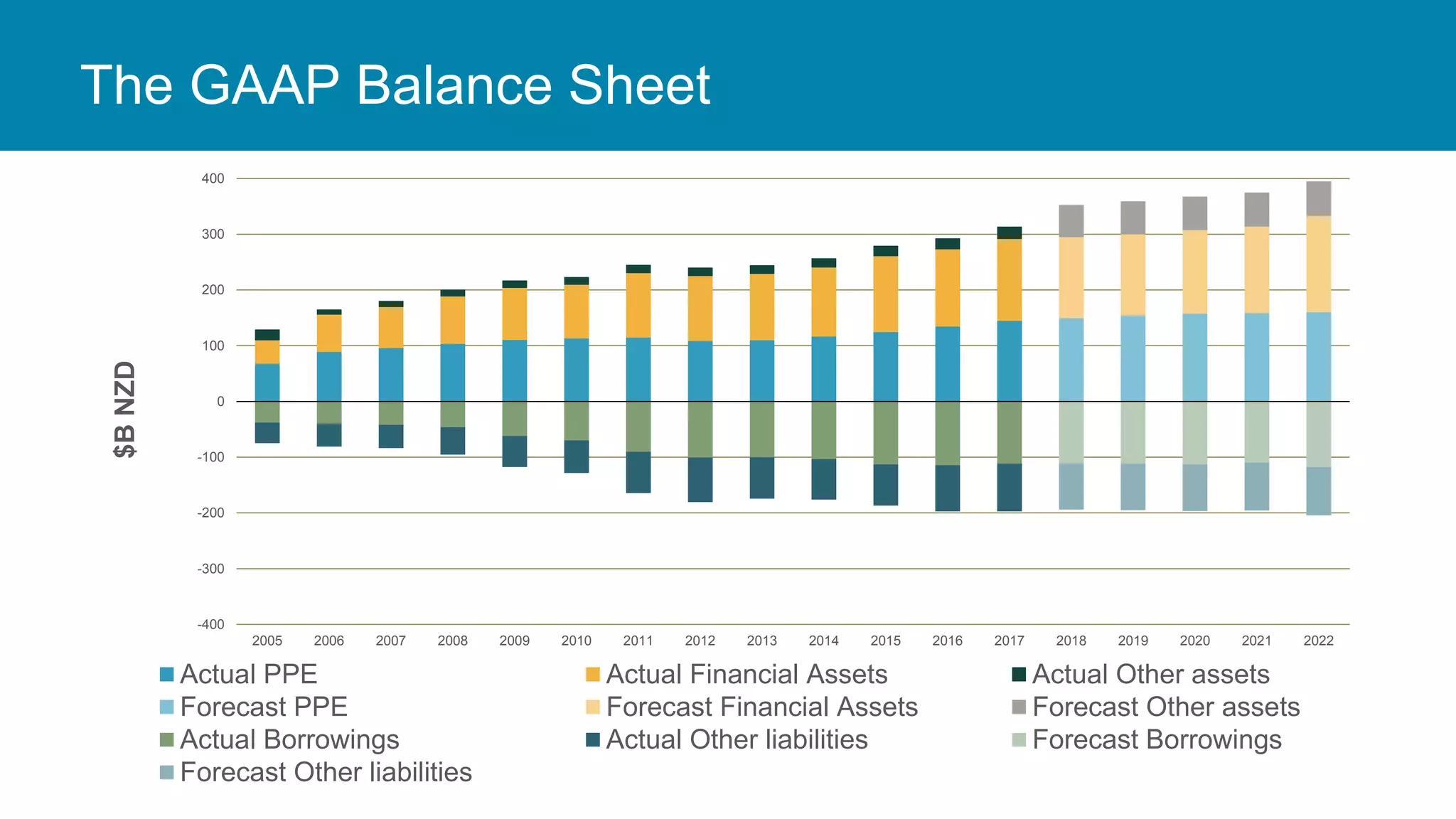
The GAAP Balance Sheet
-400
-300
-200
-100
0
100
200
300
400
2005 2006 2007 2008 2009 2010 2011 2012 2013 2014 2015 2016 2017 2018 2019 2020 2021 2022
$BNZD
Actual PPE Actual Financial Assets Actual Other assets
Forecast PPE Forecast Financial Assets Forecast Other assets
Actual Borrowings Actual Other liabilities Forecast Borrowings
Forecast Other liabilities
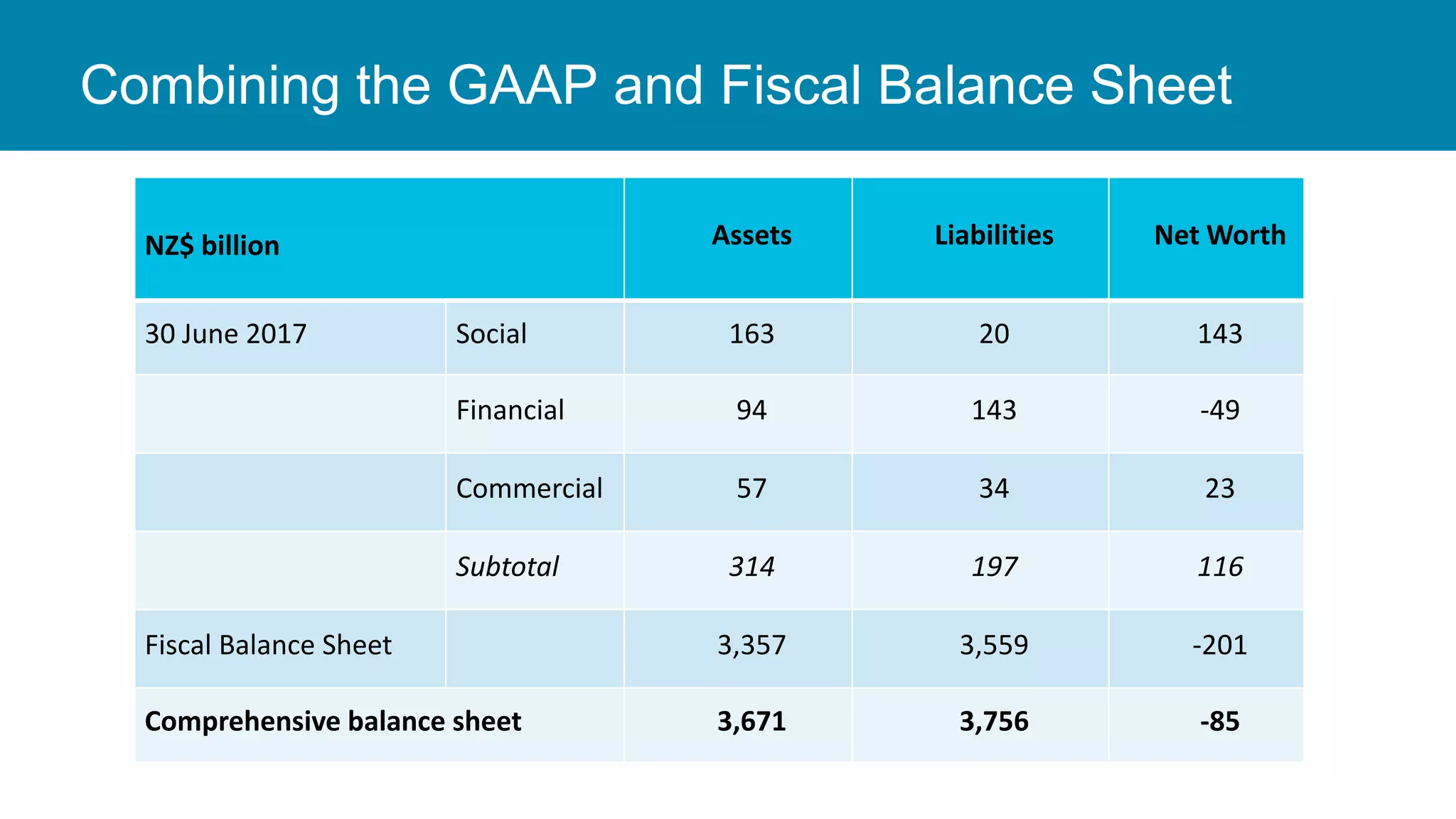
NZ$ billion Assets Liabilities Net Worth
30 June 2017 Social 163 20 143
Financial 94 143 -49
Commercial 57 34 23
Subtotal 314 197 116
Fiscal Balance Sheet 3,357 3,559 -201
Comprehensive balance sheet 3,671 3,756 -85
Combining the GAAP and Fiscal Balance Sheet
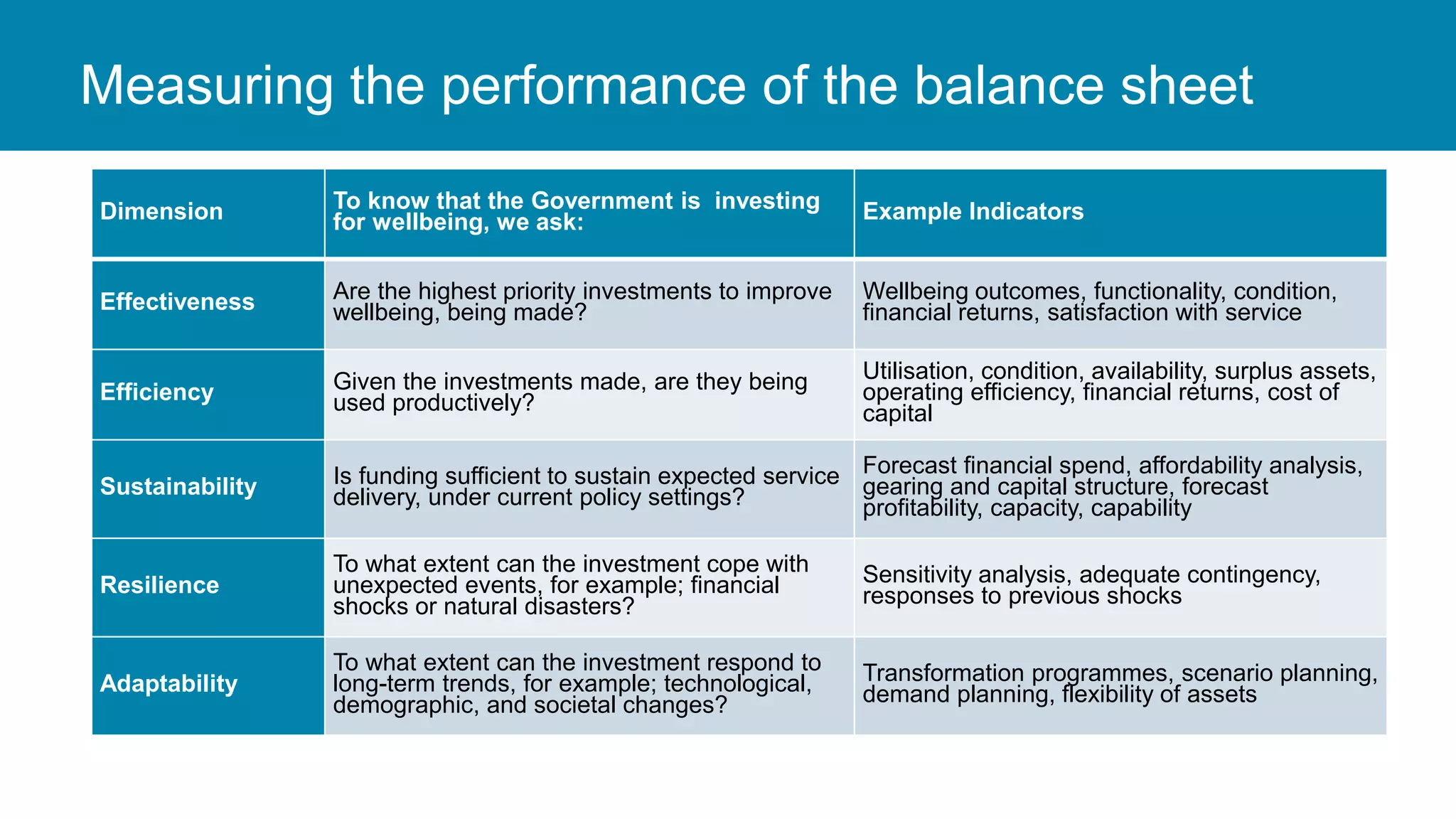
Dimension To know that the Government is investing
for wellbeing, we ask: Example Indicators
Effectiveness Are the highest priority investments to improve
wellbeing, being made?
Wellbeing outcomes, functionality, condition,
financial returns, satisfaction with service
Efficiency Given the investments made, are they being
used productively?
Utilisation, condition, availability, surplus assets,
operating efficiency, financial returns, cost of
capital
Sustainability Is funding sufficient to sustain expected service
delivery, under current policy settings?
Forecast financial spend, affordability analysis,
gearing and capital structure, forecast
profitability, capacity, capability
Resilience
To what extent can the investment cope with
unexpected events, for example; financial
shocks or natural disasters?
Sensitivity analysis, adequate contingency,
responses to previous shocks
Adaptability
To what extent can the investment respond to
long-term trends, for example; technological,
demographic, and societal changes?
Transformation programmes, scenario planning,
demand planning, flexibility of assets
Measuring the performance of the balance sheet
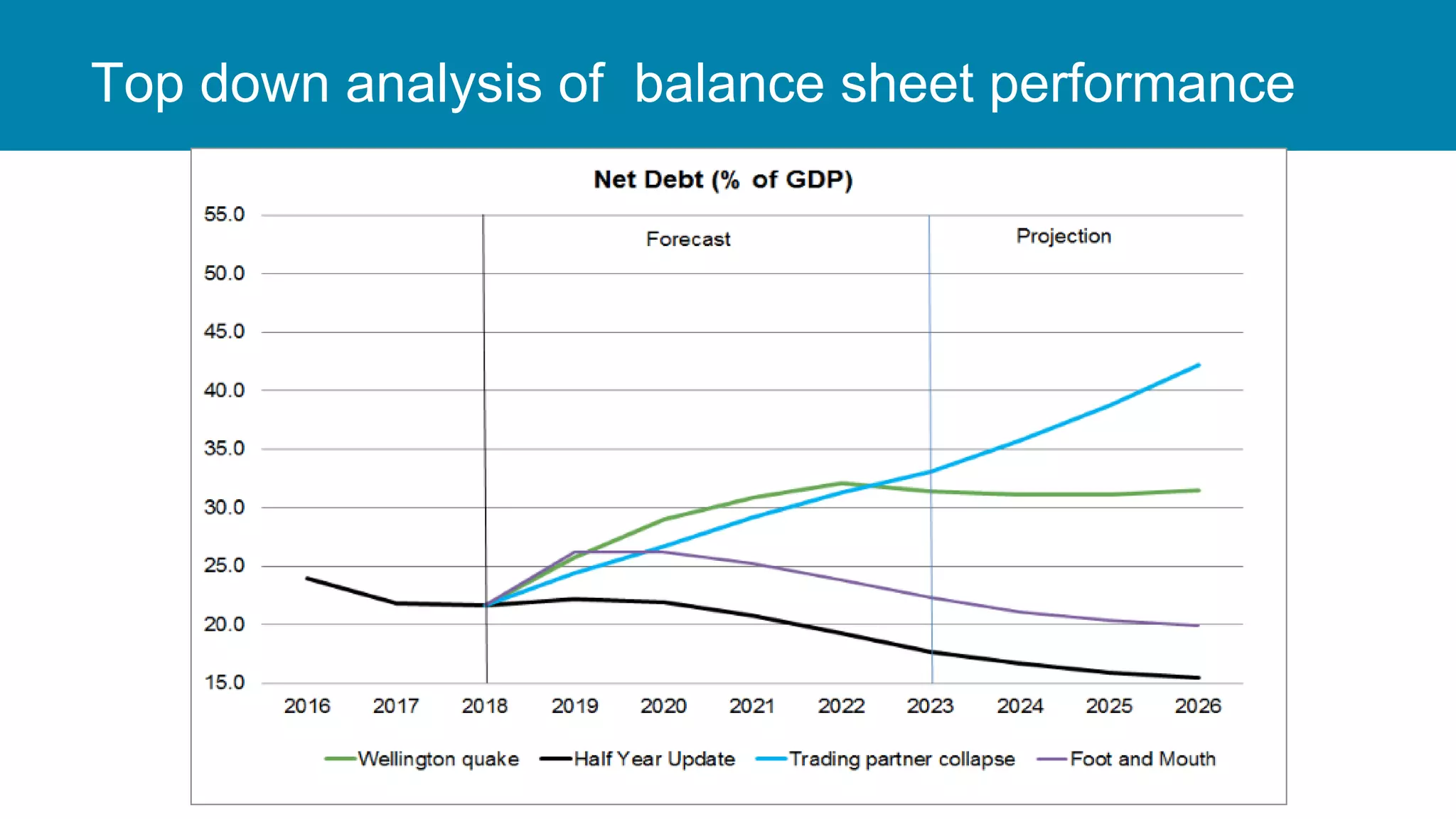
Top down analysis of balance sheet performance
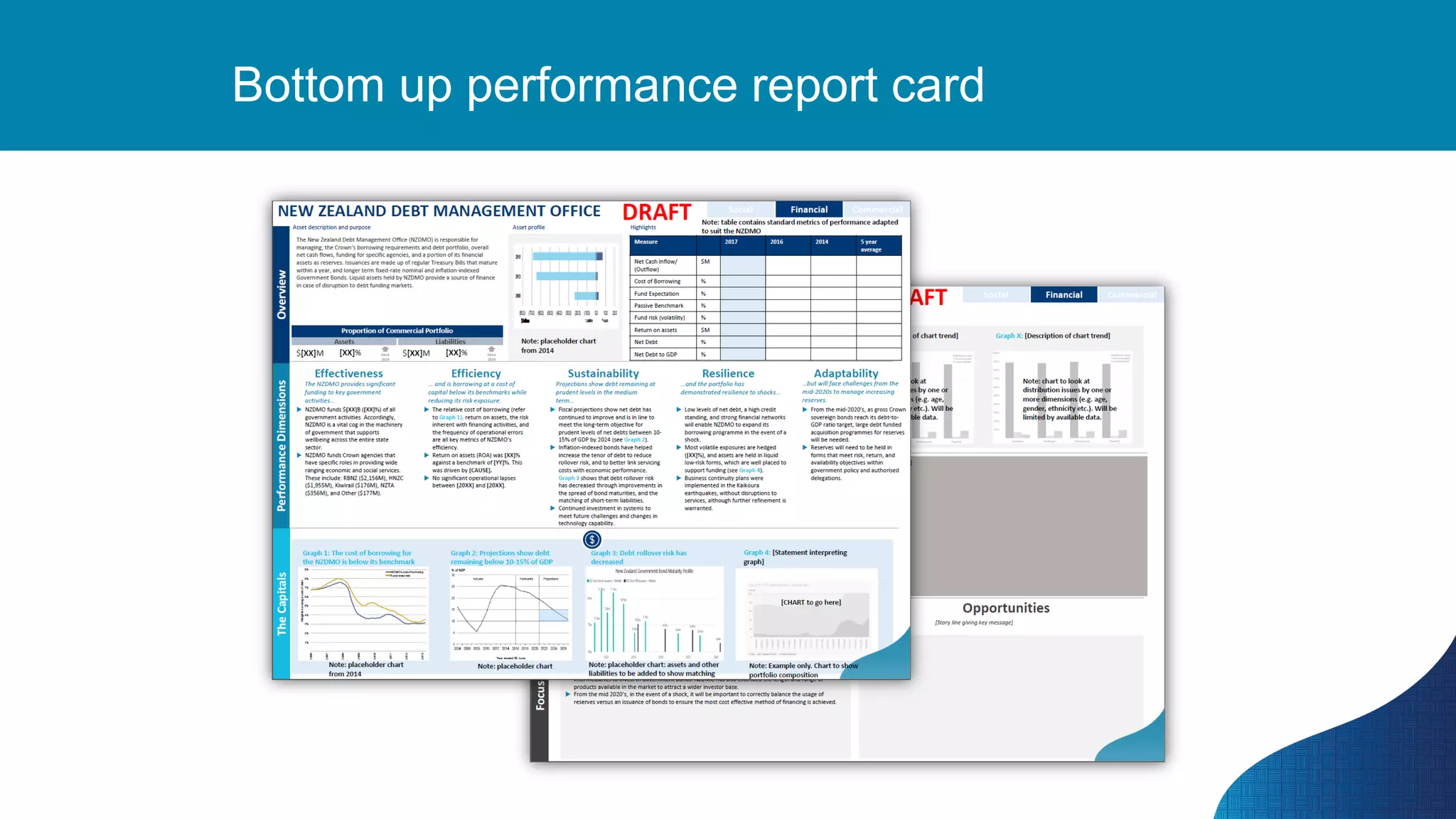
Bottom up performance report card
0
2000
4000
6000
BookValue(NZD
Millions)
Financial Year ended 30 June
Assets (NZD Millions)
from FY to FY21F
Other
Intangible
Assets
Plant,
Property,
Equipment
Effectiveness Efficiency Sustainability Resilience Adaptability
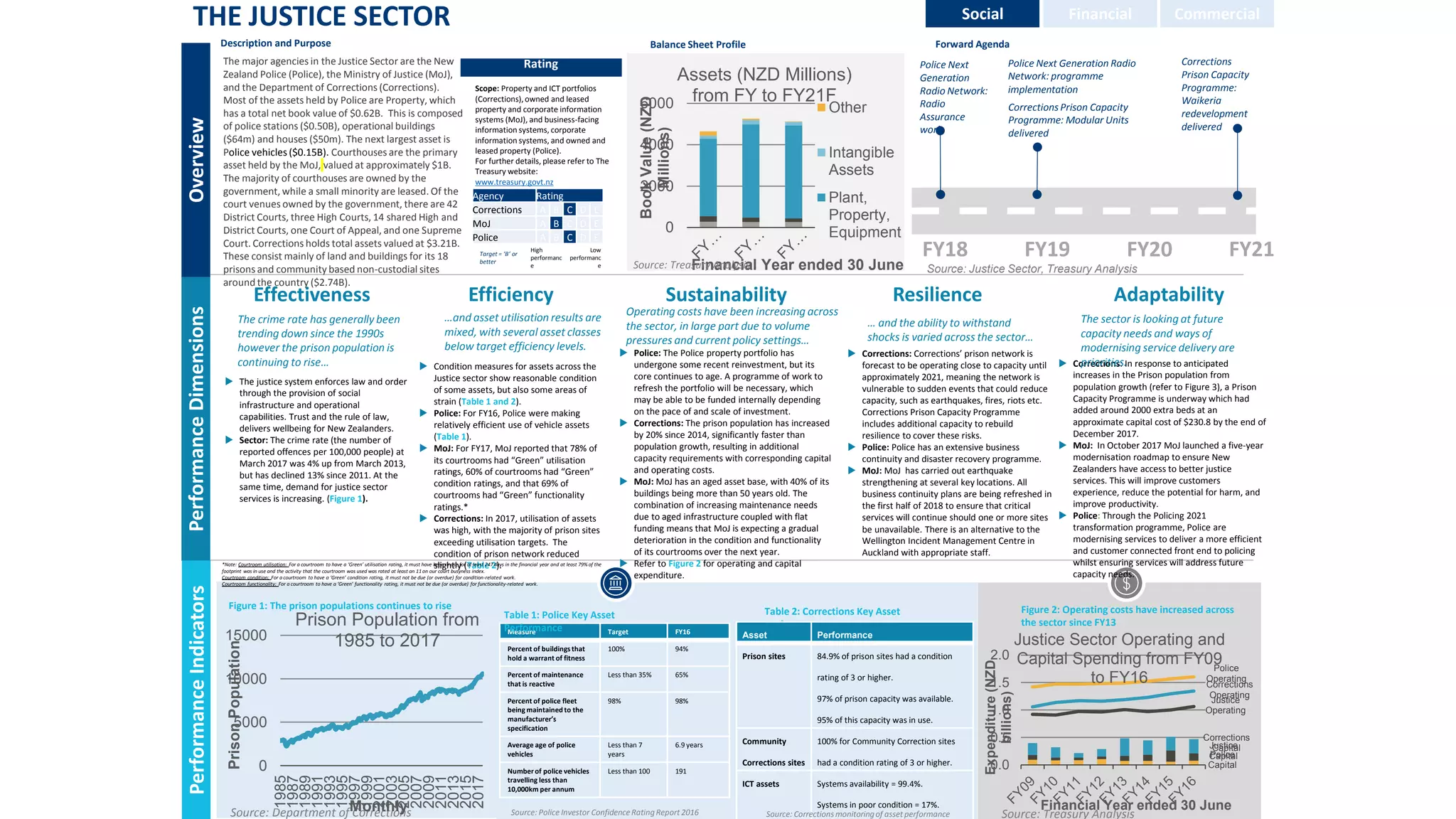
 The justice system enforces law and order
through the provision of social
infrastructure and operational
capabilities. Trust and the rule of law,
delivers wellbeing for New Zealanders.
 Sector: The crime rate (the number of
reported offences per 100,000 people) at
March 2017 was 4% up from March 2013,
but has declined 13% since 2011. At the
same time, demand for justice sector
services is increasing. (Figure 1).
 Condition measures for assets across the
Justice sector show reasonable condition
of some assets, but also some areas of
strain (Table 1 and 2).
 Police: For FY16, Police were making
relatively efficient use of vehicle assets
(Table 1).
 MoJ: For FY17, MoJ reported that 78% of
its courtrooms had “Green” utilisation
ratings, 60% of courtrooms had “Green”
condition ratings, and that 69% of
courtrooms had “Green” functionality
ratings.*
 Corrections: In 2017, utilisation of assets
was high, with the majority of prison sites
exceeding utilisation targets. The
condition of prison network reduced
slightly (Table 2).
 Corrections: Corrections’ prison network is
forecast to be operating close to capacity until
approximately 2021, meaning the network is
vulnerable to sudden events that could reduce
capacity, such as earthquakes, fires, riots etc.
Corrections Prison Capacity Programme
includes additional capacity to rebuild
resilience to cover these risks.
 Police: Police has an extensive business
continuity and disaster recovery programme..
 MoJ: MoJ has carried out earthquake
strengthening at several key locations. All
business continuity plans are being refreshed in
the first half of 2018 to ensure that critical
services will continue should one or more sites
be unavailable. There is an alternative to the
Wellington Incident Management Centre in
Auckland with appropriate staff.
Social Financial Commercial
…and asset utilisation results are
mixed, with several asset classes
below target efficiency levels.
Table 2: Corrections Key Asset
Performance
The major agencies in the Justice Sector are the New
Zealand Police (Police), the Ministry of Justice (MoJ),
and the Department of Corrections (Corrections).
Most of the assets held by Police are Property, which
has a total net book value of $0.62B. This is composed
of police stations ($0.50B), operational buildings
($64m) and houses ($50m). The next largest asset is
Police vehicles ($0.15B). Courthouses are the primary
asset held by the MoJ, valued at approximately $1B.
The majority of courthouses are owned by the
government, while a small minority are leased. Of the
court venues owned by the government, there are 42
District Courts, three High Courts, 14 shared High and
District Courts, one Court of Appeal, and one Supreme
Court. Corrections holds total assets valued at $3.21B.
These consist mainly of land and buildings for its 18
prisons and community based non-custodial sites
around the country ($2.74B).
PerformanceDimensionsOverviewPerformanceIndicators
THE JUSTICE SECTOR
Asset Performance
Prison sites 84.9% of prison sites had a condition
rating of 3 or higher.
97% of prison capacity was available.
95% of this capacity was in use.
Community
Corrections sites
100% for Community Correction sites
had a condition rating of 3 or higher.
ICT assets Systems availability = 99.4%.
Systems in poor condition = 17%.
Figure 1: The prison populations continues to rise
Measure Target FY16
Percent of buildings that
hold a warrant of fitness
100% 94%
Percent of maintenance
that is reactive
Less than 35% 65%
Percent of police fleet
being maintained to the
manufacturer’s
specification
98% 98%
Average age of police
vehicles
Less than 7
years
6.9 years
Numberof police vehicles
travelling less than
10,000km per annum
Less than 100 191
Table 1: Police Key Asset
Performance
Source: Police Investor ConfidenceRating Report 2016 Source: Corrections monitoringof asset performance Source: Treasury AnalysisSource: Department of Corrections
FY18 FY21FY19 FY20
Police Next
Generation
Radio Network:
Radio
Assurance
work
Description and Purpose Balance Sheet Profile Forward Agenda
 Police: The Police property portfolio has
undergone some recent reinvestment, but its
core continues to age. A programme of work to
refresh the portfolio will be necessary, which
may be able to be funded internally depending
on the pace of and scale of investment.
 Corrections: The prison population has increased
by 20% since 2014, significantly faster than
population growth, resulting in additional
capacity requirements with corresponding capital
and operating costs.
 MoJ: MoJ has an aged asset base, with 40% of its
buildings being more than 50 years old. The
combination of increasing maintenance needs
due to aged infrastructure coupled with flat
funding means that MoJ is expecting a gradual
deterioration in the condition and functionality
of its courtrooms over the next year.
 Refer to Figure 2 for operating and capital
expenditure.
 Corrections: In response to anticipated
increases in the Prison population from
population growth (refer to Figure 3), a Prison
Capacity Programme is underway which had
added around 2000 extra beds at an
approximate capital cost of $230.8 by the end of
December 2017.
 MoJ: In October 2017 MoJ launched a five-year
modernisation roadmap to ensure New
Zealanders have access to better justice
services. This will improve customers
experience, reduce the potential for harm, and
improve productivity.
 Police: Through the Policing 2021
transformation programme, Police are
modernising services to deliver a more efficient
and customer connected front end to policing
whilst ensuring services will address future
capacity needs.
Police Next Generation Radio
Network: programme
implementation
Figure 2: Operating costs have increased across
the sector since FY13
… and the ability to withstand
shocks is varied across the sector…
The sector is looking at future
capacity needs and ways of
modernising service delivery are
priorities.
The crime rate has generally been
trending down since the 1990s
however the prison population is
continuing to rise…
Operating costs have been increasing across
the sector, in large part due to volume
pressures and current policy settings…
Corrections
Prison Capacity
Programme:
Waikeria
redevelopment
delivered
Corrections Prison Capacity
Programme: Modular Units
delivered
Investor Confidence
Rating
Scope: Property and ICT portfolios
(Corrections), owned and leased
property and corporate information
systems (MoJ), and business-facing
information systems, corporate
information systems, and owned and
leased property (Police).
For further details, please refer to The
Treasury website:
www.treasury.govt.nz
Agency Rating
Corrections A B C D E
MoJ A B C D E
Police A B C D E
Target = ‘B’ or
better
High
performanc
e
Low
performanc
e Source: Treasury Analysis
0
5000
10000
15000
1985
1987
1989
1991
1993
1995
1997
1999
2001
2003
2005
2007
2009
2011
2013
2015
2017
PrisonPopulation
Monthly
Prison Population from
1985 to 2017
Police
Capital
Justice
Capital
Corrections
Capital
Police
Operating
Justice
Operating
Corrections
Operating
0.0
0.5
1.0
1.5
2.0
Expenditure(NZD
billions)
Financial Year ended 30 June
Justice Sector Operating and
Capital Spending from FY09
to FY16
Source: Justice Sector, Treasury Analysis
*Note: Courtroom utilisation: For a courtroom to have a ‘Green’ utilisation rating, it must have been in use for at least 247 days in the financial year and at least 79% of the
footprint was in use and the activity that the courtroom was used was rated at least an 11 on our court busyness index.
Courtroom condition: For a courtroom to have a ‘Green’ condition rating, it must not be due (or overdue) for condition-related work.
Courtroom functionality: For a courtroom to have a ‘Green’ functionality rating, it must not be due (or overdue) for functionality-related work.
 A forecast increase in the number of serious cases and an increasing prison population
presents risks to resource allocation across the sector:
 There will be a need to balance modernisation of court venues and property consolidation
against increasing demand. There are a number of possible options, including: 1)
consolidating the number of multi-purpose courthouses in main centres and 2) harnessing
alternative facilities and technology to meet the needs of those outside of the main urban
areas.
 The increasing prison population creates operational risks for Corrections, such as
matching capacity to demand, operating at high levels of utilisation, and effectively
delivering rehabilitation programmes. High utilisation also has the potential to impact on
the condition and sustainability of Corrections’ sites.
 There is a risk of operational scope creep for policing services. Increasingly, the public expects
Police to participate in a wider range of public safety and prevention activities and respond to
larger volumes of non-criminal calls for service.
 There is an opportunity to better leverage current and emergent technologies to help improve performance
across the justice sector:
 Modern policing is becoming less reliant on providing physical Police presence through police stations. There
may be opportunities to provide physical presenceand communication with the public through a variety of
methods, such as mobile police stations and interactive technology, which would change the composition of
police assets, and future capital expenditure. Police’s Long-Term Investment Plan identifies further
opportunities to enhance productivity and realise efficiencies, particularly in the intelligence area, through
investment in ICT capability.
 MoJ is investing in ICT capability, including audio-visual technology. Audio-visual links not only facilitate
greater collaboration across the justice sector, but also support MoJ’s objectives of reducing case resolution
time and to reduce dependence on physical location.
 New prison capacity presents opportunities to use design to support cheaper and more effective operating
models.
 Modern prison design focuses on prison estate layout to support employee and prisoner safety and
rehabilitative qualities (such as the use of green and open spaces). Combined with the use of technology,
effective prison design can allow for enhancements to staff to prisoner operating ratios.
THE JUSTICE SECTOR
PerformanceDimensionsFocusAreasCaseStudy
Distribution
There are indications that the justice sector may deliver different outcomes for different groups
Social Financial Commercial
Threats Opportunities
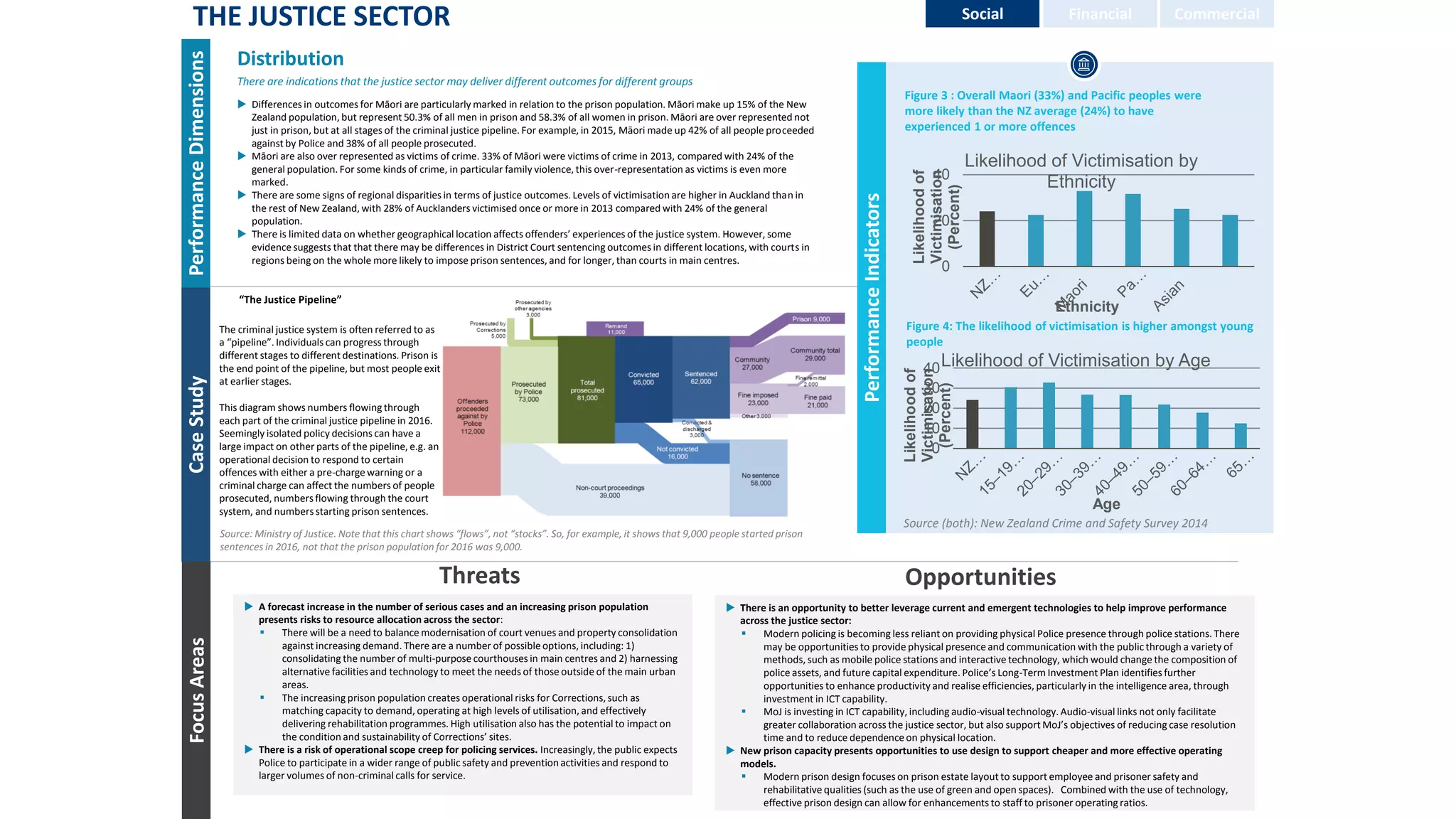
Figure 3 : Overall Maori (33%) and Pacific peoples were
more likely than the NZ average (24%) to have
experienced 1 or more offences
 Differences in outcomes for Māori are particularly marked in relation to the prison population. Māori make up 15% of the New
Zealand population, but represent 50.3% of all men in prison and 58.3% of all women in prison. Māori are over represented not
just in prison, but at all stages of the criminal justice pipeline. For example, in 2015, Māori made up 42% of all people proceeded
against by Police and 38% of all people prosecuted.
 Māori are also over represented as victims of crime. 33% of Māori were victims of crime in 2013, compared with 24% of the
general population. For some kinds of crime, in particular family violence, this over-representation as victims is even more
marked.
 There are some signs of regional disparities in terms of justice outcomes. Levels of victimisation are higher in Auckland than in
the rest of New Zealand, with 28% of Aucklanders victimised once or more in 2013 compared with 24% of the general
population.
 There is limited data on whether geographical location affects offenders’ experiences of the justice system. However, some
evidence suggests that that there may be differences in District Court sentencing outcomes in different locations, with courts in
regions being on the whole more likely to impose prison sentences, and for longer, than courts in main centres.
Source (both): New Zealand Crime and Safety Survey 2014
PerformanceIndicators
Source: Ministry of Justice. Note that this chart shows “flows”, not “stocks”. So, for example, it shows that 9,000 people started prison
sentences in 2016, not that the prison population for 2016 was 9,000.
“The Justice Pipeline”
The criminal justice system is often referred to as
a “pipeline”. Individuals can progress through
different stages to different destinations. Prison is
the end point of the pipeline, but most people exit
at earlier stages.
This diagram shows numbers flowing through
each part of the criminal justice pipeline in 2016.
Seemingly isolated policy decisions can have a
large impact on other parts of the pipeline, e.g. an
operational decision to respond to certain
offences with either a pre-charge warning or a
criminal charge can affect the numbers of people
prosecuted, numbers flowing through the court
system, and numbers starting prison sentences.
Figure 4: The likelihood of victimisation is higher amongst young
people
0
20
40
Likelihoodof
Victimisation
(Percent)
Ethnicity
Likelihood of Victimisation by
Ethnicity
0
10
20
30
40
Likelihoodof
Victimisation
(Percent)
Age
Likelihood of Victimisation by Age
• Use of stress tests in setting fiscal targets
• An increasing focus on resilience and adaptability
• More evidence based information in debates about actual and desired
capability within sectors
• Need to revisit some system settings
• Recognising the challenges in connecting the government’s balance sheet to
wellbeing
Improving the discourse
Watch for release: 26 March 2018
www.treasury.govt.nz

Session 5.2 - Ken Warren, New Zealand

  • 1.
    Balance Sheet Management TheNZ Treasury Investment Statement Ken Warren Chief Accounting Advisor New Zealand Treasury Date
  • 2.
    The context … •Treasury’s vision is to raise living standards for New Zealanders • The Public Finance Act requires the NZ Treasury to produce an Investment Statement to increase transparency over the investment taxpayers have made in the Crown’s balance sheet. • GAAP balance sheets do not provide a full expression of value • Previous investment statements examined principles for efficient balance sheet management, and Crown performance against these standards.
  • 3.
    The context (continued)… • Investment Statement ’18 focuses on how to extract the highest value from New Zealanders’ investments • The full value of assets and liabilities can be represented by the health of the four capitals in our living standards framework • Understanding the value of the health of the capitals, and how it is constructed, helps investment decision makers
  • 4.
    The context (continued)… • The scope of issues raised by combining investment management and capitals is wide ranging and challenging • There is no established and accepted framework • The development of Income Statement ’18 is intended to stimulate discourse about the challenges facing a capitals approach to wellbeing • Starting with a focus on natural capital
  • 5.
    The lens ofInvestment Statement 2018 Investing for wellbeing Financial Statement Balance Sheet: The assets and liabilities as recorded in the FSGNZ and determined by GAAP rules Comprehensive Balance Sheet: The GAAP balance sheet plus the present value of future Government revenue and expenditure National Balance Sheet: The present value of all four capitals to NZ, including use (such as market value) and non-use values (such as cultural values) What matters is the impact crown assets and liabilities have on wellbeing (represented by the blue arrows)
  • 6.
    The GAAP BalanceSheet -400 -300 -200 -100 0 100 200 300 400 2005 2006 2007 2008 2009 2010 2011 2012 2013 2014 2015 2016 2017 2018 2019 2020 2021 2022 $BNZD Actual PPE Actual Financial Assets Actual Other assets Forecast PPE Forecast Financial Assets Forecast Other assets Actual Borrowings Actual Other liabilities Forecast Borrowings Forecast Other liabilities
  • 7.
    NZ$ billion AssetsLiabilities Net Worth 30 June 2017 Social 163 20 143 Financial 94 143 -49 Commercial 57 34 23 Subtotal 314 197 116 Fiscal Balance Sheet 3,357 3,559 -201 Comprehensive balance sheet 3,671 3,756 -85 Combining the GAAP and Fiscal Balance Sheet
  • 8.
    Dimension To knowthat the Government is investing for wellbeing, we ask: Example Indicators Effectiveness Are the highest priority investments to improve wellbeing, being made? Wellbeing outcomes, functionality, condition, financial returns, satisfaction with service Efficiency Given the investments made, are they being used productively? Utilisation, condition, availability, surplus assets, operating efficiency, financial returns, cost of capital Sustainability Is funding sufficient to sustain expected service delivery, under current policy settings? Forecast financial spend, affordability analysis, gearing and capital structure, forecast profitability, capacity, capability Resilience To what extent can the investment cope with unexpected events, for example; financial shocks or natural disasters? Sensitivity analysis, adequate contingency, responses to previous shocks Adaptability To what extent can the investment respond to long-term trends, for example; technological, demographic, and societal changes? Transformation programmes, scenario planning, demand planning, flexibility of assets Measuring the performance of the balance sheet
  • 9.
    Top down analysisof balance sheet performance
  • 10.
  • 11.
    0 2000 4000 6000 BookValue(NZD Millions) Financial Year ended30 June Assets (NZD Millions) from FY to FY21F Other Intangible Assets Plant, Property, Equipment Effectiveness Efficiency Sustainability Resilience Adaptability  The justice system enforces law and order through the provision of social infrastructure and operational capabilities. Trust and the rule of law, delivers wellbeing for New Zealanders.  Sector: The crime rate (the number of reported offences per 100,000 people) at March 2017 was 4% up from March 2013, but has declined 13% since 2011. At the same time, demand for justice sector services is increasing. (Figure 1).  Condition measures for assets across the Justice sector show reasonable condition of some assets, but also some areas of strain (Table 1 and 2).  Police: For FY16, Police were making relatively efficient use of vehicle assets (Table 1).  MoJ: For FY17, MoJ reported that 78% of its courtrooms had “Green” utilisation ratings, 60% of courtrooms had “Green” condition ratings, and that 69% of courtrooms had “Green” functionality ratings.*  Corrections: In 2017, utilisation of assets was high, with the majority of prison sites exceeding utilisation targets. The condition of prison network reduced slightly (Table 2).  Corrections: Corrections’ prison network is forecast to be operating close to capacity until approximately 2021, meaning the network is vulnerable to sudden events that could reduce capacity, such as earthquakes, fires, riots etc. Corrections Prison Capacity Programme includes additional capacity to rebuild resilience to cover these risks.  Police: Police has an extensive business continuity and disaster recovery programme..  MoJ: MoJ has carried out earthquake strengthening at several key locations. All business continuity plans are being refreshed in the first half of 2018 to ensure that critical services will continue should one or more sites be unavailable. There is an alternative to the Wellington Incident Management Centre in Auckland with appropriate staff. Social Financial Commercial …and asset utilisation results are mixed, with several asset classes below target efficiency levels. Table 2: Corrections Key Asset Performance The major agencies in the Justice Sector are the New Zealand Police (Police), the Ministry of Justice (MoJ), and the Department of Corrections (Corrections). Most of the assets held by Police are Property, which has a total net book value of $0.62B. This is composed of police stations ($0.50B), operational buildings ($64m) and houses ($50m). The next largest asset is Police vehicles ($0.15B). Courthouses are the primary asset held by the MoJ, valued at approximately $1B. The majority of courthouses are owned by the government, while a small minority are leased. Of the court venues owned by the government, there are 42 District Courts, three High Courts, 14 shared High and District Courts, one Court of Appeal, and one Supreme Court. Corrections holds total assets valued at $3.21B. These consist mainly of land and buildings for its 18 prisons and community based non-custodial sites around the country ($2.74B). PerformanceDimensionsOverviewPerformanceIndicators THE JUSTICE SECTOR Asset Performance Prison sites 84.9% of prison sites had a condition rating of 3 or higher. 97% of prison capacity was available. 95% of this capacity was in use. Community Corrections sites 100% for Community Correction sites had a condition rating of 3 or higher. ICT assets Systems availability = 99.4%. Systems in poor condition = 17%. Figure 1: The prison populations continues to rise Measure Target FY16 Percent of buildings that hold a warrant of fitness 100% 94% Percent of maintenance that is reactive Less than 35% 65% Percent of police fleet being maintained to the manufacturer’s specification 98% 98% Average age of police vehicles Less than 7 years 6.9 years Numberof police vehicles travelling less than 10,000km per annum Less than 100 191 Table 1: Police Key Asset Performance Source: Police Investor ConfidenceRating Report 2016 Source: Corrections monitoringof asset performance Source: Treasury AnalysisSource: Department of Corrections FY18 FY21FY19 FY20 Police Next Generation Radio Network: Radio Assurance work Description and Purpose Balance Sheet Profile Forward Agenda  Police: The Police property portfolio has undergone some recent reinvestment, but its core continues to age. A programme of work to refresh the portfolio will be necessary, which may be able to be funded internally depending on the pace of and scale of investment.  Corrections: The prison population has increased by 20% since 2014, significantly faster than population growth, resulting in additional capacity requirements with corresponding capital and operating costs.  MoJ: MoJ has an aged asset base, with 40% of its buildings being more than 50 years old. The combination of increasing maintenance needs due to aged infrastructure coupled with flat funding means that MoJ is expecting a gradual deterioration in the condition and functionality of its courtrooms over the next year.  Refer to Figure 2 for operating and capital expenditure.  Corrections: In response to anticipated increases in the Prison population from population growth (refer to Figure 3), a Prison Capacity Programme is underway which had added around 2000 extra beds at an approximate capital cost of $230.8 by the end of December 2017.  MoJ: In October 2017 MoJ launched a five-year modernisation roadmap to ensure New Zealanders have access to better justice services. This will improve customers experience, reduce the potential for harm, and improve productivity.  Police: Through the Policing 2021 transformation programme, Police are modernising services to deliver a more efficient and customer connected front end to policing whilst ensuring services will address future capacity needs. Police Next Generation Radio Network: programme implementation Figure 2: Operating costs have increased across the sector since FY13 … and the ability to withstand shocks is varied across the sector… The sector is looking at future capacity needs and ways of modernising service delivery are priorities. The crime rate has generally been trending down since the 1990s however the prison population is continuing to rise… Operating costs have been increasing across the sector, in large part due to volume pressures and current policy settings… Corrections Prison Capacity Programme: Waikeria redevelopment delivered Corrections Prison Capacity Programme: Modular Units delivered Investor Confidence Rating Scope: Property and ICT portfolios (Corrections), owned and leased property and corporate information systems (MoJ), and business-facing information systems, corporate information systems, and owned and leased property (Police). For further details, please refer to The Treasury website: www.treasury.govt.nz Agency Rating Corrections A B C D E MoJ A B C D E Police A B C D E Target = ‘B’ or better High performanc e Low performanc e Source: Treasury Analysis 0 5000 10000 15000 1985 1987 1989 1991 1993 1995 1997 1999 2001 2003 2005 2007 2009 2011 2013 2015 2017 PrisonPopulation Monthly Prison Population from 1985 to 2017 Police Capital Justice Capital Corrections Capital Police Operating Justice Operating Corrections Operating 0.0 0.5 1.0 1.5 2.0 Expenditure(NZD billions) Financial Year ended 30 June Justice Sector Operating and Capital Spending from FY09 to FY16 Source: Justice Sector, Treasury Analysis *Note: Courtroom utilisation: For a courtroom to have a ‘Green’ utilisation rating, it must have been in use for at least 247 days in the financial year and at least 79% of the footprint was in use and the activity that the courtroom was used was rated at least an 11 on our court busyness index. Courtroom condition: For a courtroom to have a ‘Green’ condition rating, it must not be due (or overdue) for condition-related work. Courtroom functionality: For a courtroom to have a ‘Green’ functionality rating, it must not be due (or overdue) for functionality-related work.
  • 12.
     A forecastincrease in the number of serious cases and an increasing prison population presents risks to resource allocation across the sector:  There will be a need to balance modernisation of court venues and property consolidation against increasing demand. There are a number of possible options, including: 1) consolidating the number of multi-purpose courthouses in main centres and 2) harnessing alternative facilities and technology to meet the needs of those outside of the main urban areas.  The increasing prison population creates operational risks for Corrections, such as matching capacity to demand, operating at high levels of utilisation, and effectively delivering rehabilitation programmes. High utilisation also has the potential to impact on the condition and sustainability of Corrections’ sites.  There is a risk of operational scope creep for policing services. Increasingly, the public expects Police to participate in a wider range of public safety and prevention activities and respond to larger volumes of non-criminal calls for service.  There is an opportunity to better leverage current and emergent technologies to help improve performance across the justice sector:  Modern policing is becoming less reliant on providing physical Police presence through police stations. There may be opportunities to provide physical presenceand communication with the public through a variety of methods, such as mobile police stations and interactive technology, which would change the composition of police assets, and future capital expenditure. Police’s Long-Term Investment Plan identifies further opportunities to enhance productivity and realise efficiencies, particularly in the intelligence area, through investment in ICT capability.  MoJ is investing in ICT capability, including audio-visual technology. Audio-visual links not only facilitate greater collaboration across the justice sector, but also support MoJ’s objectives of reducing case resolution time and to reduce dependence on physical location.  New prison capacity presents opportunities to use design to support cheaper and more effective operating models.  Modern prison design focuses on prison estate layout to support employee and prisoner safety and rehabilitative qualities (such as the use of green and open spaces). Combined with the use of technology, effective prison design can allow for enhancements to staff to prisoner operating ratios. THE JUSTICE SECTOR PerformanceDimensionsFocusAreasCaseStudy Distribution There are indications that the justice sector may deliver different outcomes for different groups Social Financial Commercial Threats Opportunities Figure 3 : Overall Maori (33%) and Pacific peoples were more likely than the NZ average (24%) to have experienced 1 or more offences  Differences in outcomes for Māori are particularly marked in relation to the prison population. Māori make up 15% of the New Zealand population, but represent 50.3% of all men in prison and 58.3% of all women in prison. Māori are over represented not just in prison, but at all stages of the criminal justice pipeline. For example, in 2015, Māori made up 42% of all people proceeded against by Police and 38% of all people prosecuted.  Māori are also over represented as victims of crime. 33% of Māori were victims of crime in 2013, compared with 24% of the general population. For some kinds of crime, in particular family violence, this over-representation as victims is even more marked.  There are some signs of regional disparities in terms of justice outcomes. Levels of victimisation are higher in Auckland than in the rest of New Zealand, with 28% of Aucklanders victimised once or more in 2013 compared with 24% of the general population.  There is limited data on whether geographical location affects offenders’ experiences of the justice system. However, some evidence suggests that that there may be differences in District Court sentencing outcomes in different locations, with courts in regions being on the whole more likely to impose prison sentences, and for longer, than courts in main centres. Source (both): New Zealand Crime and Safety Survey 2014 PerformanceIndicators Source: Ministry of Justice. Note that this chart shows “flows”, not “stocks”. So, for example, it shows that 9,000 people started prison sentences in 2016, not that the prison population for 2016 was 9,000. “The Justice Pipeline” The criminal justice system is often referred to as a “pipeline”. Individuals can progress through different stages to different destinations. Prison is the end point of the pipeline, but most people exit at earlier stages. This diagram shows numbers flowing through each part of the criminal justice pipeline in 2016. Seemingly isolated policy decisions can have a large impact on other parts of the pipeline, e.g. an operational decision to respond to certain offences with either a pre-charge warning or a criminal charge can affect the numbers of people prosecuted, numbers flowing through the court system, and numbers starting prison sentences. Figure 4: The likelihood of victimisation is higher amongst young people 0 20 40 Likelihoodof Victimisation (Percent) Ethnicity Likelihood of Victimisation by Ethnicity 0 10 20 30 40 Likelihoodof Victimisation (Percent) Age Likelihood of Victimisation by Age
  • 13.
    • Use ofstress tests in setting fiscal targets • An increasing focus on resilience and adaptability • More evidence based information in debates about actual and desired capability within sectors • Need to revisit some system settings • Recognising the challenges in connecting the government’s balance sheet to wellbeing Improving the discourse
  • 14.
    Watch for release:26 March 2018 www.treasury.govt.nz