September 2016 | AdvancedManufacturing.org 33
ttech front
THE LATEST RESEARCH AND DEVELOPMENT NEWS IN MANUFACTURING AND TECHNOLOGY
Design Tool Transforms Flat Materials into 3D
A
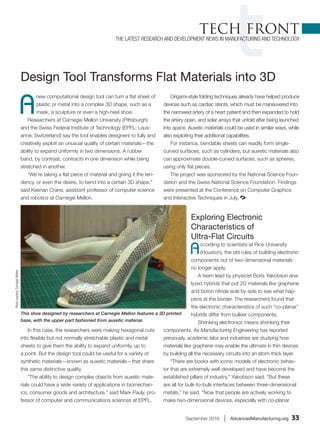
new computational design tool can turn a flat sheet of
plastic or metal into a complex 3D shape, such as a
mask, a sculpture or even a high-heel shoe.
Researchers at Carnegie Mellon University (Pittsburgh)
and the Swiss Federal Institute of Technology (EPFL; Laus-
anne, Switzerland) say the tool enables designers to fully and
creatively exploit an unusual quality of certain materials—the
ability to expand uniformly in two dimensions. A rubber
band, by contrast, contracts in one dimension while being
stretched in another.
“We’re taking a flat piece of material and giving it the ten-
dency, or even the desire, to bend into a certain 3D shape,”
said Keenan Crane, assistant professor of computer science
and robotics at Carnegie Mellon.
In this case, the researchers were making hexagonal cuts
into flexible but not normally stretchable plastic and metal
sheets to give them the ability to expand uniformly, up to
a point. But the design tool could be useful for a variety of
synthetic materials—known as auxetic materials—that share
this same distinctive quality.
“The ability to design complex objects from auxetic mate-
rials could have a wide variety of applications in biomechan-
ics, consumer goods and architecture,” said Mark Pauly, pro-
fessor of computer and communications sciences at EPFL.
Origami-style folding techniques already have helped produce
devices such as cardiac stents, which must be maneuvered into
the narrowed artery of a heart patient and then expanded to hold
the artery open, and solar arrays that unfold after being launched
into space. Auxetic materials could be used in similar ways, while
also exploiting their additional capabilities.
For instance, bendable sheets can readily form single-
curved surfaces, such as cylinders, but auxetic materials also
can approximate double-curved surfaces, such as spheres,
using only flat pieces.
The project was sponsored by the National Science Foun-
dation and the Swiss National Science Foundation. Findings
were presented at the Conference on Computer Graphics
and Interactive Techniques in July.
Exploring Electronic
Characteristics of
Ultra-Flat Circuits
According to scientists at Rice University
(Houston), the old rules of building electronic
components out of two-dimensional materials
no longer apply.
A team lead by physicist Boris Yakobson ana-
lyzed hybrids that put 2D materials like graphene
and boron nitride side by side to see what hap-
pens at the border. The researchers found that
the electronic characteristics of such “co-planar”
hybrids differ from bulkier components.
Shrinking electronics means shrinking their
components. As Manufacturing Engineering has reported
previously, academic labs and industries are studying how
materials like graphene may enable the ultimate in thin devices
by building all the necessary circuits into an atom-thick layer.
“There are books with iconic models of electronic behav-
ior that are extremely well-developed and have become the
established pillars of industry,” Yakobson said. “But these
are all for bulk-to-bulk interfaces between three-dimensional
metals,” he said. “Now that people are actively working to
make two-dimensional devices, especially with co-planar
This shoe designed by researchers at Carnegie Mellon features a 3D printed
base, with the upper part fashioned from auxetic material.
PhotocourtesyCarnegieMellon
September 2016 | AdvancedManufacturing.org 35
electronics, we realized that the rules have to be reconsid-
ered. Many of the established models utilized in industry just
don’t apply.”
The team built computer simulations that analyze charge
transfer between atom-thick materials
and found that 2D interfaces created “a
highly nonlocalized charge transfer”—
and an electric field along with it—that
greatly increased the junction size.
That could give them an advantage in
photovoltaic applications like solar cells.
The lab built a simulation of a hybrid
of graphene and molybdenum disulfide
and also considered graphene-boron
nitride and graphene in which half was
doped to create a p/n junction. Their
calculations predicted the presence
of an electric field should make 2D
Schottky (one-way) devices like transis-
tors and diodes more tunable based on
the size of the device itself.
Yakobson said the principles put
forth by the new paper will apply to
patterned hybrids of two or more 2D
patches. “You can make something
special, but the basic effects are always
at the interfaces. If you want to have
many transistors in the same plane,
it’s fine, but you still have to consider
effects at the junctions.
Their results appear in the July edition
of the American Chemical Society journal
Nano Letters. The research was support-
ed by the Office of Naval Research.
Robot Earns its Shoes
Georgia Institute of Technology (At-
lanta) researchers have created
what they say is the most efficient-
walking humanoid ever created. While
most machines are hunched at the
waist and plod along on flat feet, Geor-
gia Tech’s Durus strolls like a person.
Its legs and chest are elongated and
upright, its motion is fluid as it lands
on the heel of its foot, rolls through the step and pushes off
its toe. Wearing size 13 shoes, Durus walks under its own
power on a treadmill in the team’s AMBER (Advanced Me-
chanical Bipedal Experimental Robotics) Lab.
tech front
“Our robot is able to take much longer, faster steps than
its flat-footed counterparts because it’s replicating human
locomotion,” said Aaron Ames, director of the Georgia Tech
lab and a professor in the George W. Woodruff School of Me-
chanical Engineering and School of Electrical and Computer
Engineering. “Multi-contact foot behavior also allows it to be
more dynamic, pushing us closer to our goal of allowing the
robot to walk outside in the real world.”
Ames explains the traditional approach to creating a
robotic walker as being like an upside-down pendulum.
Researchers typically use comparatively simple algorithms to
move the top of the machine forward while keeping its feet
flat and grounded. As it shuffles along, the waist stays at a
constant height, creating the distinctive hunched look. This
both prevents these robots from moving with the dynamic
grace present in human walking and prevents them from ef-
ficiently propelling themselves forward.
This natural gait makes Durus very efficient. Robot locomo-
tion efficiency is universally measured by a “cost of transport,”
or the amount of power it uses divided by the machine’s
weight and walking speed. Ames says the best humanoids
are approximately 3.0. Georgia Tech’s cost of transport is 1.4,
all while being self-powered. This new level of efficiency is
achieved in no small part through human-like foot behavior.
“Flat-footed robots demonstrated that walking was
possible,” said Ames. “But they’re a starting point, like a
propeller-powered airplane. It gets the job done, but it’s not
a jet engine. We want to build something better, something
that can walk up and down stairs or run across a field.”
tech front
Durus first hits the treadmill with its heel, rolls through the step
and pushes off with the ball of its foot.
PhotocourtesyGeorgiaInstituteofTechnology
He adds these advances have the potential to usher in the
next generation of robotic assistive devices like prostheses
and exoskeletons that can enable the mobility-impaired to
walk with ease.
The student team was led by graduate student Jake
Reher. The shoes were created by another graduate student,
Eric Ambrose. Durus was designed in collaboration with the
robotics division of SRI International (Menlo Park, CA) and the
project is supported by the National Science Foundation.
Improving Milling Performance
of Titanium Alloys
Ateam at the University of Illinois (Champaign, IL) has
presented new research exploring the effectiveness of
the atomization-based cutting fluid (ACF) spray system in
the end-milling of titanium alloys. In the first phase, experi-
ments were carried out to select suitable spray parameters.
A numerical model of the ACF spray system has also been
developed to gain a physics-based understanding of the cut-
ting-fluid film formation on a rotating tool surface and its role
in providing cooling and lubrication at the cutting interface.
In the second phase, experiments have been conducted to
compare the machinability of titanium for different cutting-
fluid application methods, viz., dry cutting, flood cooling and
the ACF spray system, on the basis of five machinability pa-
rameters, including, tool life, tool wear, cutting forces, surface
roughness and chip morphology. Experimental results show
that the application of the ACF spray system results in uni-
form tool flank wear, lower cutting forces and higher surface
finish and the tool life extends up to 75% over flood cooling.
Also, chip morphology analysis reveals that using the ACF
spray system leads to the formation of shorter, thinner chips,
as compared to those generated when flood cooling is used.
The paper, authored by Surojit Ganguli and Shiv G.
Kapoor, was published in SME’s Journal of Manufacturing
Processes and can be read online in its entirety here: http://
tinyurl.com/MachiningTitanium.

September-2016-Tech-Front

  • 1.
    September 2016 |AdvancedManufacturing.org 33 ttech front THE LATEST RESEARCH AND DEVELOPMENT NEWS IN MANUFACTURING AND TECHNOLOGY Design Tool Transforms Flat Materials into 3D A new computational design tool can turn a flat sheet of plastic or metal into a complex 3D shape, such as a mask, a sculpture or even a high-heel shoe. Researchers at Carnegie Mellon University (Pittsburgh) and the Swiss Federal Institute of Technology (EPFL; Laus- anne, Switzerland) say the tool enables designers to fully and creatively exploit an unusual quality of certain materials—the ability to expand uniformly in two dimensions. A rubber band, by contrast, contracts in one dimension while being stretched in another. “We’re taking a flat piece of material and giving it the ten- dency, or even the desire, to bend into a certain 3D shape,” said Keenan Crane, assistant professor of computer science and robotics at Carnegie Mellon. In this case, the researchers were making hexagonal cuts into flexible but not normally stretchable plastic and metal sheets to give them the ability to expand uniformly, up to a point. But the design tool could be useful for a variety of synthetic materials—known as auxetic materials—that share this same distinctive quality. “The ability to design complex objects from auxetic mate- rials could have a wide variety of applications in biomechan- ics, consumer goods and architecture,” said Mark Pauly, pro- fessor of computer and communications sciences at EPFL. Origami-style folding techniques already have helped produce devices such as cardiac stents, which must be maneuvered into the narrowed artery of a heart patient and then expanded to hold the artery open, and solar arrays that unfold after being launched into space. Auxetic materials could be used in similar ways, while also exploiting their additional capabilities. For instance, bendable sheets can readily form single- curved surfaces, such as cylinders, but auxetic materials also can approximate double-curved surfaces, such as spheres, using only flat pieces. The project was sponsored by the National Science Foun- dation and the Swiss National Science Foundation. Findings were presented at the Conference on Computer Graphics and Interactive Techniques in July. Exploring Electronic Characteristics of Ultra-Flat Circuits According to scientists at Rice University (Houston), the old rules of building electronic components out of two-dimensional materials no longer apply. A team lead by physicist Boris Yakobson ana- lyzed hybrids that put 2D materials like graphene and boron nitride side by side to see what hap- pens at the border. The researchers found that the electronic characteristics of such “co-planar” hybrids differ from bulkier components. Shrinking electronics means shrinking their components. As Manufacturing Engineering has reported previously, academic labs and industries are studying how materials like graphene may enable the ultimate in thin devices by building all the necessary circuits into an atom-thick layer. “There are books with iconic models of electronic behav- ior that are extremely well-developed and have become the established pillars of industry,” Yakobson said. “But these are all for bulk-to-bulk interfaces between three-dimensional metals,” he said. “Now that people are actively working to make two-dimensional devices, especially with co-planar This shoe designed by researchers at Carnegie Mellon features a 3D printed base, with the upper part fashioned from auxetic material. PhotocourtesyCarnegieMellon
  • 2.
    September 2016 |AdvancedManufacturing.org 35 electronics, we realized that the rules have to be reconsid- ered. Many of the established models utilized in industry just don’t apply.” The team built computer simulations that analyze charge transfer between atom-thick materials and found that 2D interfaces created “a highly nonlocalized charge transfer”— and an electric field along with it—that greatly increased the junction size. That could give them an advantage in photovoltaic applications like solar cells. The lab built a simulation of a hybrid of graphene and molybdenum disulfide and also considered graphene-boron nitride and graphene in which half was doped to create a p/n junction. Their calculations predicted the presence of an electric field should make 2D Schottky (one-way) devices like transis- tors and diodes more tunable based on the size of the device itself. Yakobson said the principles put forth by the new paper will apply to patterned hybrids of two or more 2D patches. “You can make something special, but the basic effects are always at the interfaces. If you want to have many transistors in the same plane, it’s fine, but you still have to consider effects at the junctions. Their results appear in the July edition of the American Chemical Society journal Nano Letters. The research was support- ed by the Office of Naval Research. Robot Earns its Shoes Georgia Institute of Technology (At- lanta) researchers have created what they say is the most efficient- walking humanoid ever created. While most machines are hunched at the waist and plod along on flat feet, Geor- gia Tech’s Durus strolls like a person. Its legs and chest are elongated and upright, its motion is fluid as it lands on the heel of its foot, rolls through the step and pushes off its toe. Wearing size 13 shoes, Durus walks under its own power on a treadmill in the team’s AMBER (Advanced Me- chanical Bipedal Experimental Robotics) Lab. tech front
  • 3.
    “Our robot isable to take much longer, faster steps than its flat-footed counterparts because it’s replicating human locomotion,” said Aaron Ames, director of the Georgia Tech lab and a professor in the George W. Woodruff School of Me- chanical Engineering and School of Electrical and Computer Engineering. “Multi-contact foot behavior also allows it to be more dynamic, pushing us closer to our goal of allowing the robot to walk outside in the real world.” Ames explains the traditional approach to creating a robotic walker as being like an upside-down pendulum. Researchers typically use comparatively simple algorithms to move the top of the machine forward while keeping its feet flat and grounded. As it shuffles along, the waist stays at a constant height, creating the distinctive hunched look. This both prevents these robots from moving with the dynamic grace present in human walking and prevents them from ef- ficiently propelling themselves forward. This natural gait makes Durus very efficient. Robot locomo- tion efficiency is universally measured by a “cost of transport,” or the amount of power it uses divided by the machine’s weight and walking speed. Ames says the best humanoids are approximately 3.0. Georgia Tech’s cost of transport is 1.4, all while being self-powered. This new level of efficiency is achieved in no small part through human-like foot behavior. “Flat-footed robots demonstrated that walking was possible,” said Ames. “But they’re a starting point, like a propeller-powered airplane. It gets the job done, but it’s not a jet engine. We want to build something better, something that can walk up and down stairs or run across a field.” tech front Durus first hits the treadmill with its heel, rolls through the step and pushes off with the ball of its foot. PhotocourtesyGeorgiaInstituteofTechnology
  • 4.
    He adds theseadvances have the potential to usher in the next generation of robotic assistive devices like prostheses and exoskeletons that can enable the mobility-impaired to walk with ease. The student team was led by graduate student Jake Reher. The shoes were created by another graduate student, Eric Ambrose. Durus was designed in collaboration with the robotics division of SRI International (Menlo Park, CA) and the project is supported by the National Science Foundation. Improving Milling Performance of Titanium Alloys Ateam at the University of Illinois (Champaign, IL) has presented new research exploring the effectiveness of the atomization-based cutting fluid (ACF) spray system in the end-milling of titanium alloys. In the first phase, experi- ments were carried out to select suitable spray parameters. A numerical model of the ACF spray system has also been developed to gain a physics-based understanding of the cut- ting-fluid film formation on a rotating tool surface and its role in providing cooling and lubrication at the cutting interface. In the second phase, experiments have been conducted to compare the machinability of titanium for different cutting- fluid application methods, viz., dry cutting, flood cooling and the ACF spray system, on the basis of five machinability pa- rameters, including, tool life, tool wear, cutting forces, surface roughness and chip morphology. Experimental results show that the application of the ACF spray system results in uni- form tool flank wear, lower cutting forces and higher surface finish and the tool life extends up to 75% over flood cooling. Also, chip morphology analysis reveals that using the ACF spray system leads to the formation of shorter, thinner chips, as compared to those generated when flood cooling is used. The paper, authored by Surojit Ganguli and Shiv G. Kapoor, was published in SME’s Journal of Manufacturing Processes and can be read online in its entirety here: http:// tinyurl.com/MachiningTitanium.