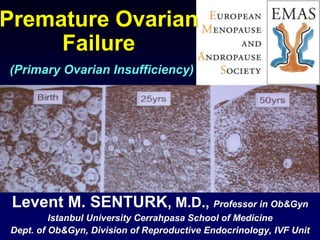
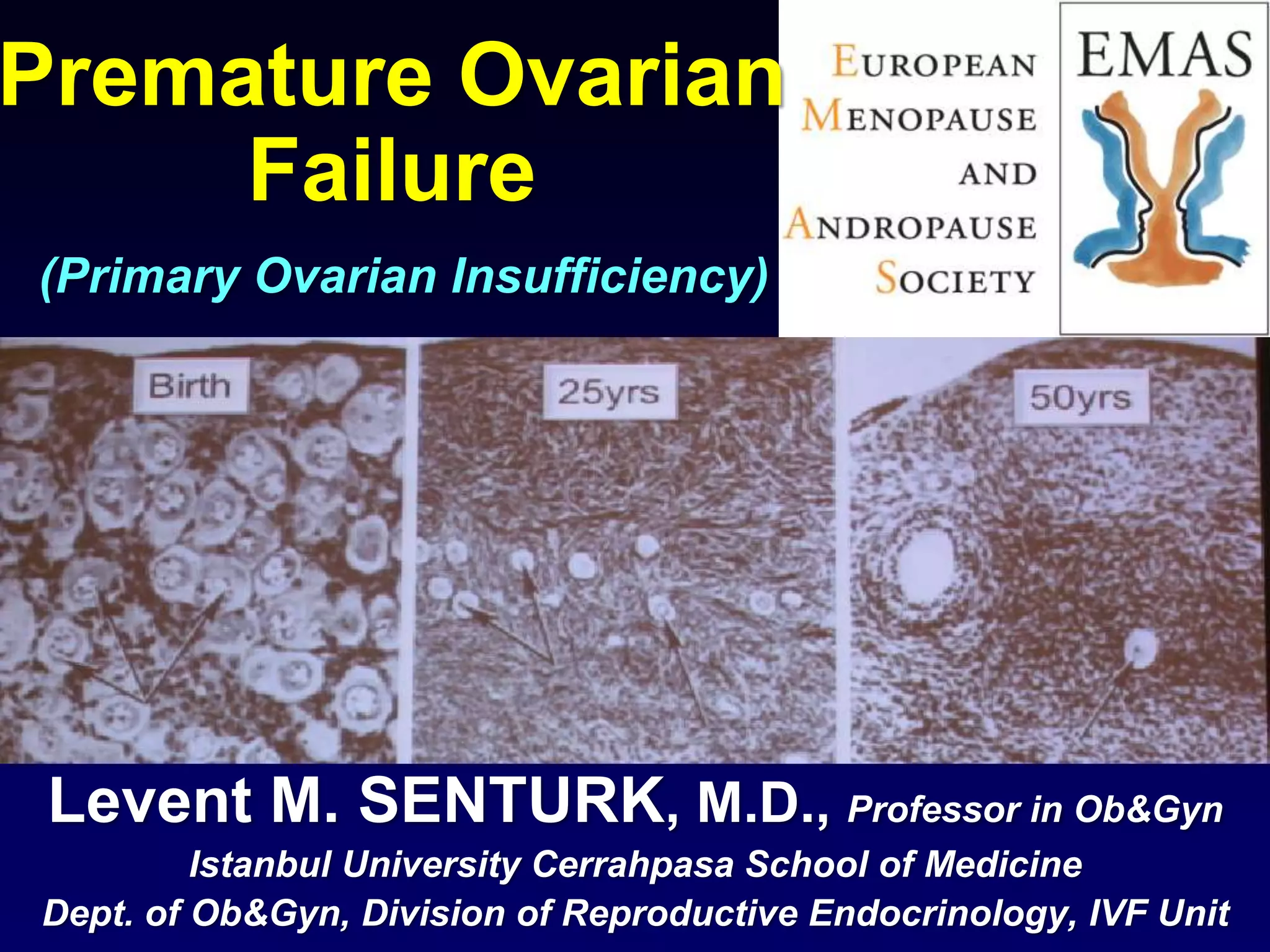
Premature Ovarian
Failure
(Primary Ovarian Insufficiency)
Levent M. SENTURK, M.D., Professor in Ob&Gyn
Istanbul University Cerrahpasa School of Medicine
Dept. of Ob&Gyn, Division of Reproductive Endocrinology, IVF Unit
Disclamer:
Any views or opinions expressed herein are
solely those of the author and do not
necessarily represent those of any company,
institution and/or organization with which the
presenter is employed or affiliated.
Primary Ovarian Insufficiency
“…A syndrome characterized by
primary ovarian insufficiency”
and decreased stature…”
Fuller Albright, et al.
American Journal of Medical Sciences 204, 625-648, 1942
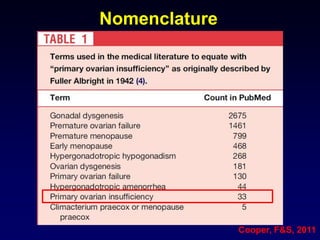
Cooper, F&S, 2011
Nomenclature
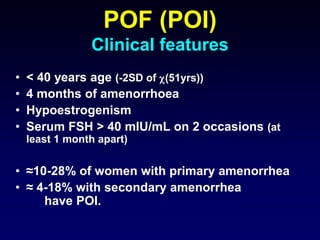
POF (POI)
Clinical features
• < 40 years age (-2SD of (51yrs))
• 4 months of amenorrhoea
• Hypoestrogenism
• Serum FSH > 40 mIU/mL on 2 occasions (at
least 1 month apart)
• ≈10-28% of women with primary amenorrhea
• ≈ 4-18% with secondary amenorrhea
have POI.
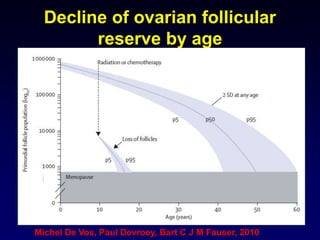
Decline of ovarian follicular
reserve by age
Michel De Vos, Paul Devroey, Bart C J M Fauser, 2010
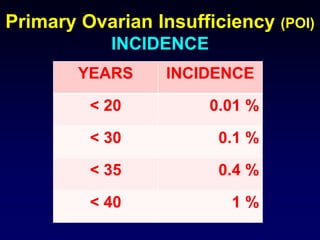
Primary Ovarian Insufficiency (POI)
INCIDENCE
YEARS INCIDENCE
< 20 0.01 %
< 30 0.1 %
< 35 0.4 %
< 40 1 %
• NO characteristic menstrual history
• 50 % oligomenorrhoea
• 25 % postpartum or following OC use
• Normal fertility
• 15-50 % ovulation
• 5-10 % spontaneous pregnancy
• Mortality
• All-cause mortality RR: 2.14 (1.15-3.99) (Snowdon 1989)
• Stroke mortality RR: 3.07 (1.34-7.03). (Snowdon 1989)
RR: 1.50 (0.97-2.34) (Cooper 1998)
POI
Clinical features
POI
Causes
• Ovarian follicle depletion
• Low initial follicle number
• Accelerated follicle loss
• Ovarian follicle dysfunction
• Signal defect
• Enzyme deficiency
• Autoimmunity
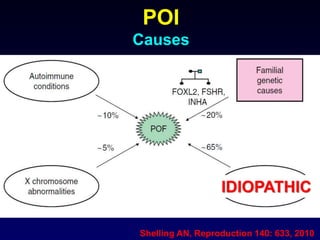
POI
Causes
IDIOPATHIC
Shelling AN, Reproduction 140: 633, 2010
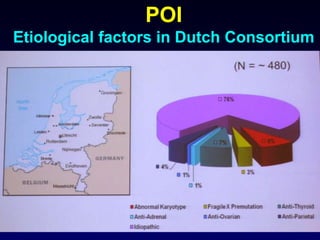
POI
Etiological factors in Dutch Consortium
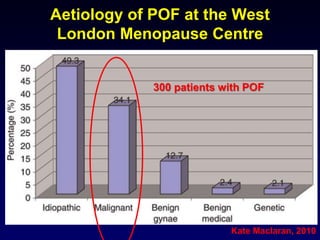
Aetiology of POF at the West
London Menopause Centre
Kate Maclaran, 2010
300 patients with POF
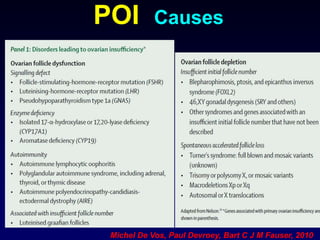
POI Causes
Michel De Vos, Paul Devroey, Bart C J M Fauser, 2010
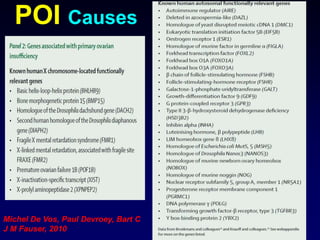
POI Causes
Michel De Vos, Paul Devroey, Bart C
J M Fauser, 2010
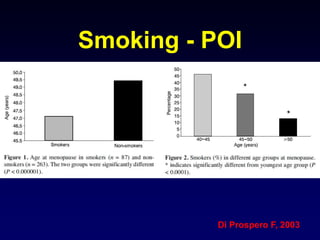
Smoking - POI
An exposure of mice to PAHs
(Polycyclic aromatic hydrocarbons)
induces the expression of Bax (pro-
apoptosis gene) in oocytes, followed by
apoptosis, thus, oocyte destruction and
ovarian failure occur
Matikainen T, Nature Genet, 2001
Di Prospero F, 2003
Smoking - POI
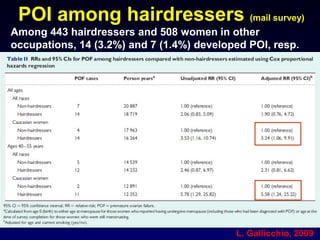
POI among hairdressers (mail survey)
L. Gallicchio, 2009
Among 443 hairdressers and 508 women in other
occupations, 14 (3.2%) and 7 (1.4%) developed POI, resp.
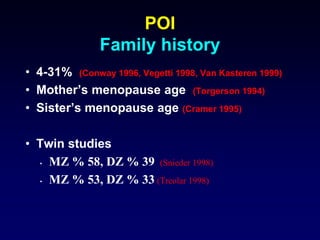
POI
Family history
• 4-31% (Conway 1996, Vegetti 1998, Van Kasteren 1999)
• Mother’s menopause age (Torgerson 1994)
• Sister’s menopause age (Cramer 1995)
• Twin studies
• MZ % 58, DZ % 39 (Snieder 1998)
• MZ % 53, DZ % 33 (Treolar 1998)
Early menopause
Family history
• 129 early menopause cases (<46 years old)
• Overall 129 (37.5%) of the early menopause
cases reported a family history of
menopause before age 46 years in a mother,
sister, aunt, or grandmother compared to 31
(9.0%) of controls yielding an odds ratio
(OR) of 6.1 (95% [CI] of 3.9 to 9.4) after
adjustment for smoking history, education,
parity, and body mass index.
Cramer DW, 1995
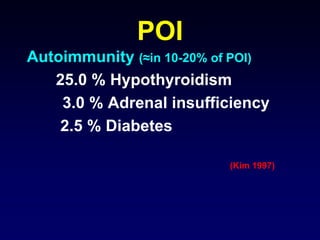
POI
Autoimmunity (≈in 10-20% of POI)
25.0 % Hypothyroidism
3.0 % Adrenal insufficiency
2.5 % Diabetes
(Kim 1997)
• POI in up to 60% (39% at the age of 15 years and 72% at 40 years)
of women with the autoimmune polyglandular
syndrome (APS) type 1 (hypoparathyroidism, adrenal
insufficiency, and chronic mucocutaneous
candidiasis)
Ahonen P, 1988; Wheatcroft N, 1997
• APS type 2 (adrenal insufficiency, insulin dependent
diabetes mellitus, and hypothyroidism) is less
frequently associated with POI (10%)
Wheatcroft N, 1997
POI
Autoimmune
• Antibodies against parietal cells and
acetylcholine receptors, which cause
pernicious anemia and myasthenia gravis,
respectively, are also found more frequently
among women with POI than in the general
population
Kim TJ, 1997
POI
Autoimmune
POI
Chromosome abnormalities
• Rare in secondary amenorrhea (13%)
Rebar, 1982
• 50% in women with primary amenorrhea
Rebar, 2009
• It is nevertheless useful to obtain a karyotype
in all women with POI, to reveal a Y
chromosome or chromosomal fragment,
mandating the need for gonadectomy given
the known association with subsequent
malignancy Manuel, 1976
POI
X chromosome abnormalities
• 5-40%
• X-mosaicisms (45 XO, 45,XO/46,XX,
46,XX/47,XXX)
• X chromosome deletions
• X chromosome balanced translocations
• Xq13-q26 (Critical region for normal ovarian
function) (Sarto 1973)
• POF1 Xq21.3-q27 Xq26.1-q27 (24–39 yrs)
(Krauss 1987)
• POF2 Xq13.3-q21.1 (16–21 yrs)
(Powell 1994)
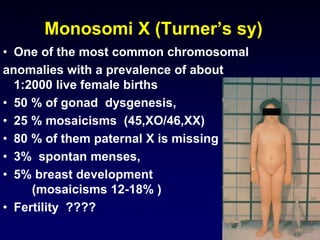
Monosomi X (Turner’s sy)
• One of the most common chromosomal
anomalies with a prevalence of about
1:2000 live female births
• 50 % of gonad dysgenesis,
• 25 % mosaicisms (45,XO/46,XX)
• 80 % of them paternal X is missing
• 3% spontan menses,
• 5% breast development
(mosaicisms 12-18% )
• Fertility ????
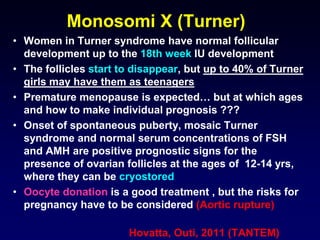
Monosomi X (Turner)
• Women in Turner syndrome have normal follicular
development up to the 18th week IU development
• The follicles start to disappear, but up to 40% of Turner
girls may have them as teenagers
• Premature menopause is expected… but at which ages
and how to make individual prognosis ???
• Onset of spontaneous puberty, mosaic Turner
syndrome and normal serum concentrations of FSH
and AMH are positive prognostic signs for the
presence of ovarian follicles at the ages of 12-14 yrs,
where they can be cryostored
• Oocyte donation is a good treatment , but the risks for
pregnancy have to be considered (Aortic rupture)
Hovatta, Outi, 2011 (TANTEM)
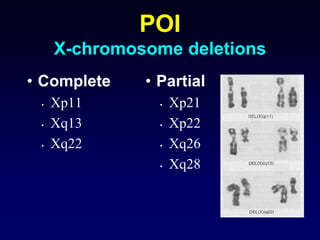
POI
X-chromosome deletions
• Complete
• Xp11
• Xq13
• Xq22
• Partial
• Xp21
• Xp22
• Xq26
• Xq28
Prevalence of the Triple X syndrome in
phenotypically normal women with POI
• In the general population, the syndrome affects
1 in 900 women
• its relative prevalence among women with POI
is not known
• High prevalence of psychological disturbances
but normal phenotype and reproductive
competence in the majority of cases.
Ravinder Goswami, 2003
POI
Fragile X syndrome (FRAXA)
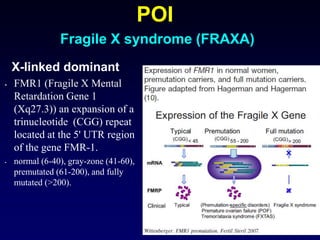
X-linked dominant
• FMR1 (Fragile X Mental
Retardation Gene 1
(Xq27.3)) an expansion of a
trinucleotide (CGG) repeat
located at the 5' UTR region
of the gene FMR-1.
• normal (6-40), gray-zone (41-60),
premutated (61-200), and fully
mutated (>200).
POI
Fragile X syndrome (FRAXA)
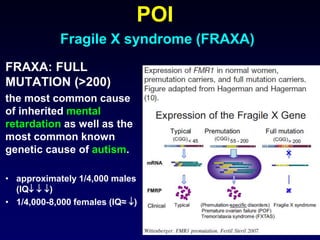
FRAXA: FULL
MUTATION (>200)
the most common cause
of inherited mental
retardation as well as the
most common known
genetic cause of autism.
• approximately 1/4,000 males
(IQ  )
• 1/4,000-8,000 females (IQ≈ )
POI
Fragile X syndrome (FRAXA)
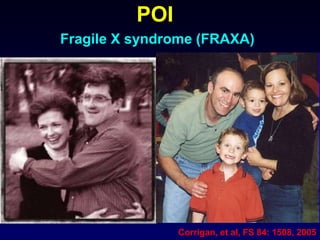
Corrigan, et al, FS 84: 1508, 2005
POI
FXTAS / POI
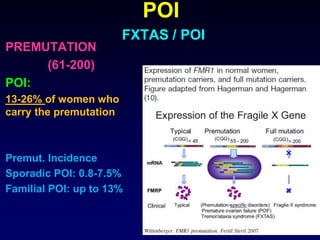
PREMUTATION
(61-200)
POI:
13-26% of women who
carry the premutation
Premut. Incidence
Sporadic POI: 0.8-7.5%
Familial POI: up to 13%
POI
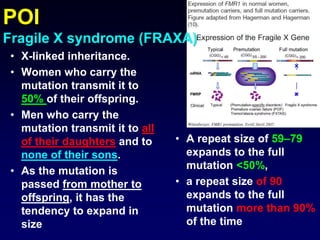
Fragile X syndrome (FRAXA)
• X-linked inheritance.
• Women who carry the
mutation transmit it to
50% of their offspring.
• Men who carry the
mutation transmit it to all
of their daughters and to
none of their sons.
• As the mutation is
passed from mother to
offspring, it has the
tendency to expand in
size
• A repeat size of 59–79
expands to the full
mutation <50%,
• a repeat size of 90
expands to the full
mutation more than 90%
of the time
Recommendation for FRM1 genes
• The American College of Obstetricians and
Gynecologists(ACOG) (2006) in their most recent
committee opinion on the subject stated, “If a
woman has ovarian failure or an elevated follicle-
stimulating hormone level before the age 40 years
without a known cause, fragile X carrier screening
should be considered to determine whether she
has a premutation”
• The European Societ for Human Genetics and the
European Society of Human Reproduction and
Embryology (2006) suggest that testing FMR1 as
part of the diagnostic workup of female infertility
may be relevant, but specific recommendations
were not provided
POI
Galactosemia
• Autosomal recessive disorder due to an impairment in
galactose 1-phosphate uridyltransferase (GALT) gene
mutation (9p chromosome)
Beutler et al., 1965; Segal and Berry, 1995)
• 1/60,000 newborns. Early mental retardation,
hepatomegaly, cataracts, and POI.
• 47 women with galactosemia (81 % POI)
Waggoner 1990
• Ovarian damage has been attributed to a toxic effect
of galactose, or one of its metabolites, on follicular
structures during fetal life
Levy et al., 1984; Fraser et al., 1986
• Individuals heterozygous for GALT Q188R mutations
are not at increased risk of developing ovarian
dysfunction Kaufman 1993
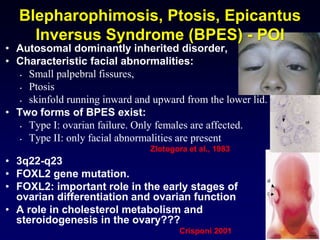
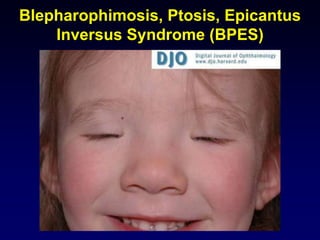
• Autosomal dominantly inherited disorder,
• Characteristic facial abnormalities:
• Small palpebral fissures,
• Ptosis
• skinfold running inward and upward from the lower lid.
• Two forms of BPES exist:
• Type I: ovarian failure. Only females are affected.
• Type II: only facial abnormalities are present
Zlotogora et al., 1983
• 3q22-q23
• FOXL2 gene mutation.
• FOXL2: important role in the early stages of
ovarian differentiation and ovarian function
• A role in cholesterol metabolism and
steroidogenesis in the ovary???
Crisponi 2001
Blepharophimosis, Ptosis, Epicantus
Inversus Syndrome (BPES) - POI
Blepharophimosis, Ptosis, Epicantus
Inversus Syndrome (BPES)
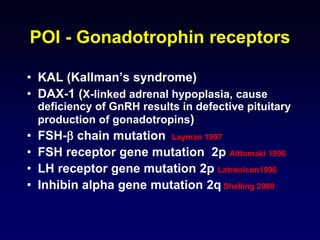
POI - Gonadotrophin receptors
• KAL (Kallman’s syndrome)
• DAX-1 (X-linked adrenal hypoplasia, cause
deficiency of GnRH results in defective pituitary
production of gonadotropins)
• FSH- chain mutation Layman 1997
• FSH receptor gene mutation 2p Aittomaki 1996
• LH receptor gene mutation 2p Latronicon1996
• Inhibin alpha gene mutation 2q Shelling 2000
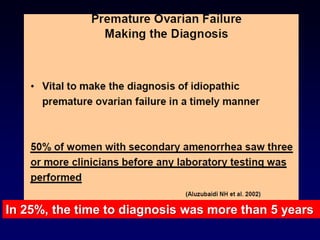
In 25%, the time to diagnosis was more than 5 years
POI
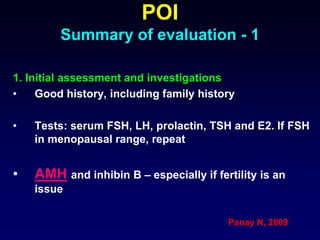
Summary of evaluation - 1
1. Initial assessment and investigations
• Good history, including family history
• Tests: serum FSH, LH, prolactin, TSH and E2. If FSH
in menopausal range, repeat
• AMH and inhibin B – especially if fertility is an
issue
Panay N, 2009
POI
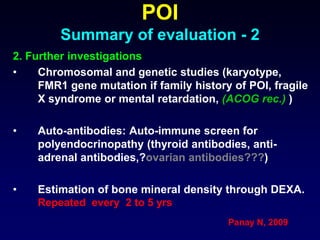
Summary of evaluation - 2
2. Further investigations
• Chromosomal and genetic studies (karyotype,
FMR1 gene mutation if family history of POI, fragile
X syndrome or mental retardation, (ACOG rec.) )
• Auto-antibodies: Auto-immune screen for
polyendocrinopathy (thyroid antibodies, anti-
adrenal antibodies,?ovarian antibodies???)
• Estimation of bone mineral density through DEXA.
Repeated every 2 to 5 yrs
Panay N, 2009
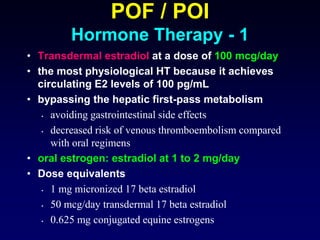
POF / POI
Hormone Therapy - 1
• Transdermal estradiol at a dose of 100 mcg/day
• the most physiological HT because it achieves
circulating E2 levels of 100 pg/mL
• bypassing the hepatic first-pass metabolism
• avoiding gastrointestinal side effects
• decreased risk of venous thromboembolism compared
with oral regimens
• oral estrogen: estradiol at 1 to 2 mg/day
• Dose equivalents
• 1 mg micronized 17 beta estradiol
• 50 mcg/day transdermal 17 beta estradiol
• 0.625 mg conjugated equine estrogens
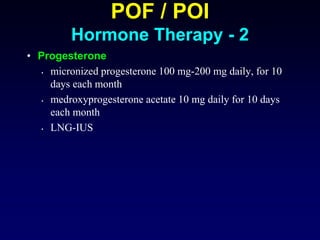
POF / POI
Hormone Therapy - 2
• Progesterone
• micronized progesterone 100 mg-200 mg daily, for 10
days each month
• medroxyprogesterone acetate 10 mg daily for 10 days
each month
• LNG-IUS
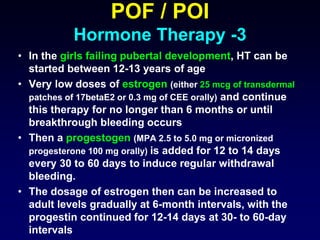
POF / POI
Hormone Therapy -3
• In the girls failing pubertal development, HT can be
started between 12-13 years of age
• Very low doses of estrogen (either 25 mcg of transdermal
patches of 17betaE2 or 0.3 mg of CEE orally) and continue
this therapy for no longer than 6 months or until
breakthrough bleeding occurs
• Then a progestogen (MPA 2.5 to 5.0 mg or micronized
progesterone 100 mg orally) is added for 12 to 14 days
every 30 to 60 days to induce regular withdrawal
bleeding.
• The dosage of estrogen then can be increased to
adult levels gradually at 6-month intervals, with the
progestin continued for 12-14 days at 30- to 60-day
intervals
POF / POI
Hormone Therapy -4
• Women with POF have higher risk of
cardiovascular disease and stroke,
osteoporosis and arthralgias,
cognitive decline (Alzheimer’s disease, etc.),
mood disorders, insomnia, sexual disorders,
macular degeneration, glaucomatous changes (eye)
and premature death.
• Duration of treatment (HT): until the age of natural
menopause
• Irrespectively of the presence of menopausal symptoms
POF / POI
Hormone Therapy - 5
Androgen replacement ??? (symptomatic despite estrogen
replacement )
•oral methyl testosterone,
•oral dehydroepiandrosterone,
•testosterone sprays, creams, gels, and testosterone patch.
•Combined esterified estrogen-methyl testosterone tablets
Osteoporosis - fracture risk
•weight bearing exercise
•smoking cessation
•daily intake of 1200 mg of calcium + 800 to 1000 IU Vit D3
POF / POI
The emotional impact
• Grief at the prospect of not having children
• Fear of growing old before her time
• Fears that her partner will not find her
sexually attractive any more…
Decreased androgen concentrations and
diminished general and sexual well-being
in women with POF / POI
Women with POI
• were less satisfied with their sexual life.
• had fewer sexual fantasies and masturbated less
frequently.
• Sexual contact was associated with less sexual
arousal, reduced lubrication, and increased genital
pain.
However, the frequency of desire to have sexual
contact and the frequency of actual sexual contact
with the partner did not differ between women with
POF and control women.
• Women with POF had lower levels of estradiol, total
testosterone, and androstenedione.
Jolande G. van der Stege, 2007
POF / POI
Hormone Therapy - 6 - contraception
• Combined hormonal contraception, does not reliably
prevent ovulation and pregnancy related to the
extremely elevated Gn levels in POI, which are not
fully suppressed by COCs and may allow for
breakthrough ovulation on occasion.
• Because of the small risk of spontaneous pregnancy,
cyclic COC use (as opposed to continuous) is
preferable because an unexpected spontaneous
pregnancy may go unrecognized for longer
• Barrier contraception should be recommended
• LNG-IUS
POF / POI
Hormone Therapy – 7- fertility
• Although there is a 5-10% chance of spontaneous
conception among women with POF, in vitro
fertilization using donated oocytes or embryos
represents the best chance for fertility.
• In those women with POF due to Turner’s syndrome
or Turner’s mosaics, pregnancy can be particularly
dangerous due to structural abnormalities of the
aortic root, predisposing these patients to aortic
rupture during pregnancy.
• There is a risk of fetal and maternal morbidity and
mortality in the setting of undiagnosed adrenal
insufficiency, particularly in the postpartum period!!!
POF / POI
Summary -1
• POF (POI or premature menopause) is defined as
menopause before the age of 40. It may be either
primary or secondary. In the majority of cases of
POF the cause is unknown.
• Diagnosis is confirmed with an elevated FSH >40
IU/L and an estradiol level below 50 pmol/L.
• Untreated early ovarian failure increases the risk of
osteoporosis, cardiovascular disease, stroke,
dementia, cognitive decline, Parkinsonism, and
premature death
POF / POI
Summary - 2
• The mainstay of treatment is estrogen replacement
which needs to be continued until the average age of
the natural menopause.
• Hormone therapy is not contraceptive.
• In the absence of oophorectomy, POF is associated
with intermittent unpredictable ovarian function
resulting in menstrual bleeding or even pregnancy.
• Ideally women with POF should be seen in a
specialist unit able to deal with their multiple needs
(multidisciplinary approach) .
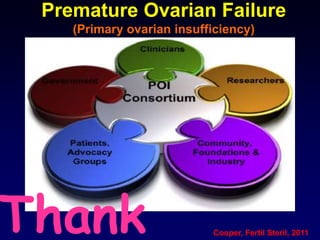
Premature Ovarian Failure
(Primary ovarian insufficiency)
Cooper, Fertil Steril, 2011
Thank
Senturk, lm emas webinar pof_20160127

Senturk, lm emas webinar pof_20160127

  • 1.
    Premature Ovarian Failure (Primary OvarianInsufficiency) Levent M. SENTURK, M.D., Professor in Ob&Gyn Istanbul University Cerrahpasa School of Medicine Dept. of Ob&Gyn, Division of Reproductive Endocrinology, IVF Unit
  • 2.
    Disclamer: Any views oropinions expressed herein are solely those of the author and do not necessarily represent those of any company, institution and/or organization with which the presenter is employed or affiliated.
  • 3.
    Primary Ovarian Insufficiency “…Asyndrome characterized by primary ovarian insufficiency” and decreased stature…” Fuller Albright, et al. American Journal of Medical Sciences 204, 625-648, 1942
  • 4.
  • 5.
    POF (POI) Clinical features •< 40 years age (-2SD of (51yrs)) • 4 months of amenorrhoea • Hypoestrogenism • Serum FSH > 40 mIU/mL on 2 occasions (at least 1 month apart) • ≈10-28% of women with primary amenorrhea • ≈ 4-18% with secondary amenorrhea have POI.
  • 6.
    Decline of ovarianfollicular reserve by age Michel De Vos, Paul Devroey, Bart C J M Fauser, 2010
  • 7.
    Primary Ovarian Insufficiency(POI) INCIDENCE YEARS INCIDENCE < 20 0.01 % < 30 0.1 % < 35 0.4 % < 40 1 %
  • 8.
    • NO characteristicmenstrual history • 50 % oligomenorrhoea • 25 % postpartum or following OC use • Normal fertility • 15-50 % ovulation • 5-10 % spontaneous pregnancy • Mortality • All-cause mortality RR: 2.14 (1.15-3.99) (Snowdon 1989) • Stroke mortality RR: 3.07 (1.34-7.03). (Snowdon 1989) RR: 1.50 (0.97-2.34) (Cooper 1998) POI Clinical features
  • 9.
    POI Causes • Ovarian follicledepletion • Low initial follicle number • Accelerated follicle loss • Ovarian follicle dysfunction • Signal defect • Enzyme deficiency • Autoimmunity
  • 10.
  • 11.
  • 12.
    Aetiology of POFat the West London Menopause Centre Kate Maclaran, 2010 300 patients with POF
  • 13.
    POI Causes Michel DeVos, Paul Devroey, Bart C J M Fauser, 2010
  • 14.
    POI Causes Michel DeVos, Paul Devroey, Bart C J M Fauser, 2010
  • 15.
    Smoking - POI Anexposure of mice to PAHs (Polycyclic aromatic hydrocarbons) induces the expression of Bax (pro- apoptosis gene) in oocytes, followed by apoptosis, thus, oocyte destruction and ovarian failure occur Matikainen T, Nature Genet, 2001
  • 16.
    Di Prospero F,2003 Smoking - POI
  • 17.
    POI among hairdressers(mail survey) L. Gallicchio, 2009 Among 443 hairdressers and 508 women in other occupations, 14 (3.2%) and 7 (1.4%) developed POI, resp.
  • 18.
    POI Family history • 4-31%(Conway 1996, Vegetti 1998, Van Kasteren 1999) • Mother’s menopause age (Torgerson 1994) • Sister’s menopause age (Cramer 1995) • Twin studies • MZ % 58, DZ % 39 (Snieder 1998) • MZ % 53, DZ % 33 (Treolar 1998)
  • 19.
    Early menopause Family history •129 early menopause cases (<46 years old) • Overall 129 (37.5%) of the early menopause cases reported a family history of menopause before age 46 years in a mother, sister, aunt, or grandmother compared to 31 (9.0%) of controls yielding an odds ratio (OR) of 6.1 (95% [CI] of 3.9 to 9.4) after adjustment for smoking history, education, parity, and body mass index. Cramer DW, 1995
  • 20.
    POI Autoimmunity (≈in 10-20%of POI) 25.0 % Hypothyroidism 3.0 % Adrenal insufficiency 2.5 % Diabetes (Kim 1997)
  • 21.
    • POI inup to 60% (39% at the age of 15 years and 72% at 40 years) of women with the autoimmune polyglandular syndrome (APS) type 1 (hypoparathyroidism, adrenal insufficiency, and chronic mucocutaneous candidiasis) Ahonen P, 1988; Wheatcroft N, 1997 • APS type 2 (adrenal insufficiency, insulin dependent diabetes mellitus, and hypothyroidism) is less frequently associated with POI (10%) Wheatcroft N, 1997 POI Autoimmune
  • 22.
    • Antibodies againstparietal cells and acetylcholine receptors, which cause pernicious anemia and myasthenia gravis, respectively, are also found more frequently among women with POI than in the general population Kim TJ, 1997 POI Autoimmune
  • 23.
    POI Chromosome abnormalities • Rarein secondary amenorrhea (13%) Rebar, 1982 • 50% in women with primary amenorrhea Rebar, 2009 • It is nevertheless useful to obtain a karyotype in all women with POI, to reveal a Y chromosome or chromosomal fragment, mandating the need for gonadectomy given the known association with subsequent malignancy Manuel, 1976
  • 24.
    POI X chromosome abnormalities •5-40% • X-mosaicisms (45 XO, 45,XO/46,XX, 46,XX/47,XXX) • X chromosome deletions • X chromosome balanced translocations • Xq13-q26 (Critical region for normal ovarian function) (Sarto 1973) • POF1 Xq21.3-q27 Xq26.1-q27 (24–39 yrs) (Krauss 1987) • POF2 Xq13.3-q21.1 (16–21 yrs) (Powell 1994)
  • 25.
    Monosomi X (Turner’ssy) • One of the most common chromosomal anomalies with a prevalence of about 1:2000 live female births • 50 % of gonad dysgenesis, • 25 % mosaicisms (45,XO/46,XX) • 80 % of them paternal X is missing • 3% spontan menses, • 5% breast development (mosaicisms 12-18% ) • Fertility ????
  • 26.
    Monosomi X (Turner) •Women in Turner syndrome have normal follicular development up to the 18th week IU development • The follicles start to disappear, but up to 40% of Turner girls may have them as teenagers • Premature menopause is expected… but at which ages and how to make individual prognosis ??? • Onset of spontaneous puberty, mosaic Turner syndrome and normal serum concentrations of FSH and AMH are positive prognostic signs for the presence of ovarian follicles at the ages of 12-14 yrs, where they can be cryostored • Oocyte donation is a good treatment , but the risks for pregnancy have to be considered (Aortic rupture) Hovatta, Outi, 2011 (TANTEM)
  • 27.
    POI X-chromosome deletions • Complete •Xp11 • Xq13 • Xq22 • Partial • Xp21 • Xp22 • Xq26 • Xq28
  • 28.
    Prevalence of theTriple X syndrome in phenotypically normal women with POI • In the general population, the syndrome affects 1 in 900 women • its relative prevalence among women with POI is not known • High prevalence of psychological disturbances but normal phenotype and reproductive competence in the majority of cases. Ravinder Goswami, 2003
  • 29.
    POI Fragile X syndrome(FRAXA) X-linked dominant • FMR1 (Fragile X Mental Retardation Gene 1 (Xq27.3)) an expansion of a trinucleotide (CGG) repeat located at the 5' UTR region of the gene FMR-1. • normal (6-40), gray-zone (41-60), premutated (61-200), and fully mutated (>200).
  • 30.
    POI Fragile X syndrome(FRAXA) FRAXA: FULL MUTATION (>200) the most common cause of inherited mental retardation as well as the most common known genetic cause of autism. • approximately 1/4,000 males (IQ  ) • 1/4,000-8,000 females (IQ≈ )
  • 31.
    POI Fragile X syndrome(FRAXA) Corrigan, et al, FS 84: 1508, 2005
  • 32.
    POI FXTAS / POI PREMUTATION (61-200) POI: 13-26%of women who carry the premutation Premut. Incidence Sporadic POI: 0.8-7.5% Familial POI: up to 13%
  • 33.
    POI Fragile X syndrome(FRAXA) • X-linked inheritance. • Women who carry the mutation transmit it to 50% of their offspring. • Men who carry the mutation transmit it to all of their daughters and to none of their sons. • As the mutation is passed from mother to offspring, it has the tendency to expand in size • A repeat size of 59–79 expands to the full mutation <50%, • a repeat size of 90 expands to the full mutation more than 90% of the time
  • 34.
    Recommendation for FRM1genes • The American College of Obstetricians and Gynecologists(ACOG) (2006) in their most recent committee opinion on the subject stated, “If a woman has ovarian failure or an elevated follicle- stimulating hormone level before the age 40 years without a known cause, fragile X carrier screening should be considered to determine whether she has a premutation” • The European Societ for Human Genetics and the European Society of Human Reproduction and Embryology (2006) suggest that testing FMR1 as part of the diagnostic workup of female infertility may be relevant, but specific recommendations were not provided
  • 35.
    POI Galactosemia • Autosomal recessivedisorder due to an impairment in galactose 1-phosphate uridyltransferase (GALT) gene mutation (9p chromosome) Beutler et al., 1965; Segal and Berry, 1995) • 1/60,000 newborns. Early mental retardation, hepatomegaly, cataracts, and POI. • 47 women with galactosemia (81 % POI) Waggoner 1990 • Ovarian damage has been attributed to a toxic effect of galactose, or one of its metabolites, on follicular structures during fetal life Levy et al., 1984; Fraser et al., 1986 • Individuals heterozygous for GALT Q188R mutations are not at increased risk of developing ovarian dysfunction Kaufman 1993
  • 36.
    • Autosomal dominantlyinherited disorder, • Characteristic facial abnormalities: • Small palpebral fissures, • Ptosis • skinfold running inward and upward from the lower lid. • Two forms of BPES exist: • Type I: ovarian failure. Only females are affected. • Type II: only facial abnormalities are present Zlotogora et al., 1983 • 3q22-q23 • FOXL2 gene mutation. • FOXL2: important role in the early stages of ovarian differentiation and ovarian function • A role in cholesterol metabolism and steroidogenesis in the ovary??? Crisponi 2001 Blepharophimosis, Ptosis, Epicantus Inversus Syndrome (BPES) - POI
  • 37.
  • 38.
    POI - Gonadotrophinreceptors • KAL (Kallman’s syndrome) • DAX-1 (X-linked adrenal hypoplasia, cause deficiency of GnRH results in defective pituitary production of gonadotropins) • FSH- chain mutation Layman 1997 • FSH receptor gene mutation 2p Aittomaki 1996 • LH receptor gene mutation 2p Latronicon1996 • Inhibin alpha gene mutation 2q Shelling 2000
  • 39.
    In 25%, thetime to diagnosis was more than 5 years
  • 40.
    POI Summary of evaluation- 1 1. Initial assessment and investigations • Good history, including family history • Tests: serum FSH, LH, prolactin, TSH and E2. If FSH in menopausal range, repeat • AMH and inhibin B – especially if fertility is an issue Panay N, 2009
  • 41.
    POI Summary of evaluation- 2 2. Further investigations • Chromosomal and genetic studies (karyotype, FMR1 gene mutation if family history of POI, fragile X syndrome or mental retardation, (ACOG rec.) ) • Auto-antibodies: Auto-immune screen for polyendocrinopathy (thyroid antibodies, anti- adrenal antibodies,?ovarian antibodies???) • Estimation of bone mineral density through DEXA. Repeated every 2 to 5 yrs Panay N, 2009
  • 42.
    POF / POI HormoneTherapy - 1 • Transdermal estradiol at a dose of 100 mcg/day • the most physiological HT because it achieves circulating E2 levels of 100 pg/mL • bypassing the hepatic first-pass metabolism • avoiding gastrointestinal side effects • decreased risk of venous thromboembolism compared with oral regimens • oral estrogen: estradiol at 1 to 2 mg/day • Dose equivalents • 1 mg micronized 17 beta estradiol • 50 mcg/day transdermal 17 beta estradiol • 0.625 mg conjugated equine estrogens
  • 43.
    POF / POI HormoneTherapy - 2 • Progesterone • micronized progesterone 100 mg-200 mg daily, for 10 days each month • medroxyprogesterone acetate 10 mg daily for 10 days each month • LNG-IUS
  • 44.
    POF / POI HormoneTherapy -3 • In the girls failing pubertal development, HT can be started between 12-13 years of age • Very low doses of estrogen (either 25 mcg of transdermal patches of 17betaE2 or 0.3 mg of CEE orally) and continue this therapy for no longer than 6 months or until breakthrough bleeding occurs • Then a progestogen (MPA 2.5 to 5.0 mg or micronized progesterone 100 mg orally) is added for 12 to 14 days every 30 to 60 days to induce regular withdrawal bleeding. • The dosage of estrogen then can be increased to adult levels gradually at 6-month intervals, with the progestin continued for 12-14 days at 30- to 60-day intervals
  • 45.
    POF / POI HormoneTherapy -4 • Women with POF have higher risk of cardiovascular disease and stroke, osteoporosis and arthralgias, cognitive decline (Alzheimer’s disease, etc.), mood disorders, insomnia, sexual disorders, macular degeneration, glaucomatous changes (eye) and premature death. • Duration of treatment (HT): until the age of natural menopause • Irrespectively of the presence of menopausal symptoms
  • 46.
    POF / POI HormoneTherapy - 5 Androgen replacement ??? (symptomatic despite estrogen replacement ) •oral methyl testosterone, •oral dehydroepiandrosterone, •testosterone sprays, creams, gels, and testosterone patch. •Combined esterified estrogen-methyl testosterone tablets Osteoporosis - fracture risk •weight bearing exercise •smoking cessation •daily intake of 1200 mg of calcium + 800 to 1000 IU Vit D3
  • 47.
    POF / POI Theemotional impact • Grief at the prospect of not having children • Fear of growing old before her time • Fears that her partner will not find her sexually attractive any more…
  • 48.
    Decreased androgen concentrationsand diminished general and sexual well-being in women with POF / POI Women with POI • were less satisfied with their sexual life. • had fewer sexual fantasies and masturbated less frequently. • Sexual contact was associated with less sexual arousal, reduced lubrication, and increased genital pain. However, the frequency of desire to have sexual contact and the frequency of actual sexual contact with the partner did not differ between women with POF and control women. • Women with POF had lower levels of estradiol, total testosterone, and androstenedione. Jolande G. van der Stege, 2007
  • 49.
    POF / POI HormoneTherapy - 6 - contraception • Combined hormonal contraception, does not reliably prevent ovulation and pregnancy related to the extremely elevated Gn levels in POI, which are not fully suppressed by COCs and may allow for breakthrough ovulation on occasion. • Because of the small risk of spontaneous pregnancy, cyclic COC use (as opposed to continuous) is preferable because an unexpected spontaneous pregnancy may go unrecognized for longer • Barrier contraception should be recommended • LNG-IUS
  • 50.
    POF / POI HormoneTherapy – 7- fertility • Although there is a 5-10% chance of spontaneous conception among women with POF, in vitro fertilization using donated oocytes or embryos represents the best chance for fertility. • In those women with POF due to Turner’s syndrome or Turner’s mosaics, pregnancy can be particularly dangerous due to structural abnormalities of the aortic root, predisposing these patients to aortic rupture during pregnancy. • There is a risk of fetal and maternal morbidity and mortality in the setting of undiagnosed adrenal insufficiency, particularly in the postpartum period!!!
  • 51.
    POF / POI Summary-1 • POF (POI or premature menopause) is defined as menopause before the age of 40. It may be either primary or secondary. In the majority of cases of POF the cause is unknown. • Diagnosis is confirmed with an elevated FSH >40 IU/L and an estradiol level below 50 pmol/L. • Untreated early ovarian failure increases the risk of osteoporosis, cardiovascular disease, stroke, dementia, cognitive decline, Parkinsonism, and premature death
  • 52.
    POF / POI Summary- 2 • The mainstay of treatment is estrogen replacement which needs to be continued until the average age of the natural menopause. • Hormone therapy is not contraceptive. • In the absence of oophorectomy, POF is associated with intermittent unpredictable ovarian function resulting in menstrual bleeding or even pregnancy. • Ideally women with POF should be seen in a specialist unit able to deal with their multiple needs (multidisciplinary approach) .
  • 53.
    Premature Ovarian Failure (Primaryovarian insufficiency) Cooper, Fertil Steril, 2011 Thank