Electricity smart meters: two use
cases
Maiki Ilves
Statistics Estonia
Seminar „Big Data Matters - Towards Smart Statistics“
27. September 2017, Heerlen
Overview
Smart meters situation in Estonia
Data hub
Use case 1: households’ electricity consumption
Use case 2: identifying vacant dwellings
Conclusions
Maiki Ilves27.09.2017
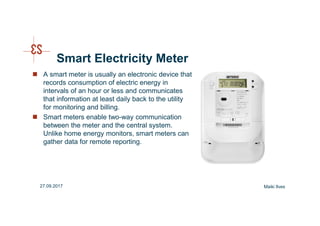
Smart Electricity Meter
Maiki Ilves27.09.2017
A smart meter is usually an electronic device that
records consumption of electric energy in
intervals of an hour or less and communicates
that information at least daily back to the utility
for monitoring and billing.
Smart meters enable two-way communication
between the meter and the central system.
Unlike home energy monitors, smart meters can
gather data for remote reporting.
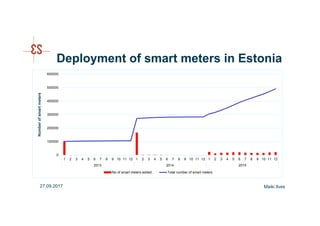
Deployment of smart meters in Estonia
Maiki Ilves27.09.2017
0
100000
200000
300000
400000
500000
600000
1 2 3 4 5 6 7 8 9 10 11 12 1 2 3 4 5 6 7 8 9 10 11 12 1 2 3 4 5 6 7 8 9 10 11 12
2013 2014 2015
Numberofsmartmeters
No of smart meters added Total number of smart meters
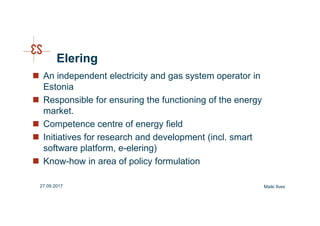
Elering
An independent electricity and gas system operator in
Estonia
Responsible for ensuring the functioning of the energy
market.
Competence centre of energy field
Initiatives for research and development (incl. smart
software platform, e-elering)
Know-how in area of policy formulation
Maiki Ilves27.09.2017
Data and IT environment in NSI
2013-2016 data from Elering
Data delivery on external hard disk
Data arrives as MySQL database files, transformed into
Hadoop file system.
IT tools for processing: Hive for Hadoop built-in tool for
SQL queries, Spark and Anaconda (Python) for
visualization, aggregated data analysis in SAS.
Maiki Ilves27.09.2017
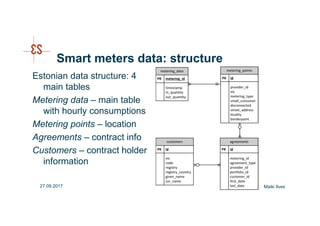
Smart meters data: structure
Estonian data structure: 4
main tables
Metering data – main table
with hourly consumptions
Metering points – location
Agreements – contract info
Customers – contract holder
information
Maiki Ilves27.09.2017
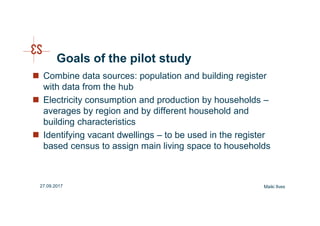
Goals of the pilot study
Combine data sources: population and building register
with data from the hub
Electricity consumption and production by households –
averages by region and by different household and
building characteristics
Identifying vacant dwellings – to be used in the register
based census to assign main living space to households
Maiki Ilves27.09.2017
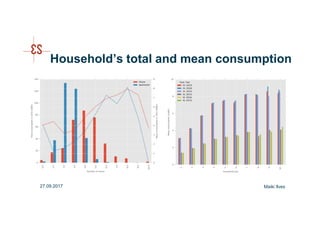
Household’s total and mean consumption
Maiki Ilves27.09.2017
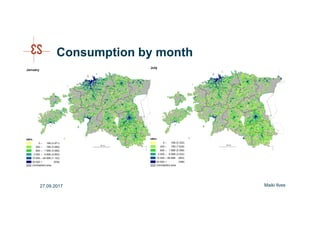
Consumption by month
Maiki Ilves27.09.2017
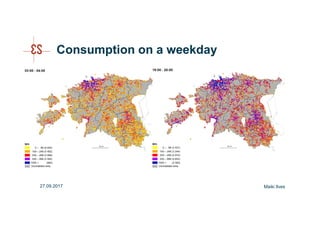
Consumption on a weekday
Maiki Ilves27.09.2017
Identifying vacant dwelling
List of the methods considered:
Using the R-function auto.arima to predict kWh usage.
Estimating the variance of the daily kWh usage.
Estimating the ratio between the mean kWh usage during day- and
night-time.
Using a volatility measure.
Using a cell wise outlier detection procedure to locate days with
'unusually' low kWh usage.
Using estimates from some of the listed methods as well as range,
mean and median of daily kWh usage in a random forest model.
Maiki Ilves27.09.2017
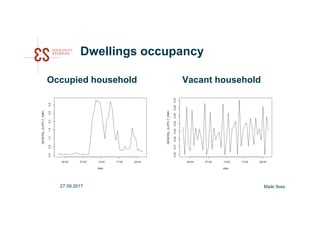
Dwellings occupancy
Occupied household Vacant household
Maiki Ilves27.09.2017
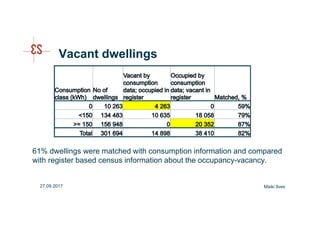
Vacant dwellings
61% dwellings were matched with consumption information and compared
with register based census information about the occupancy-vacancy.
Maiki Ilves27.09.2017
Advantages
Possibility to link it with other data sources and gain new
knowledge;
Data source can be used to validate or improve current
survey and register based statistics;
Data source could increase the quality of regional
statistics.
Maiki Ilves27.09.2017
Challenges
Address information is not standardized and geo-coding needs lots
of resources. Address is the key variable in the linking and the quality
of address information is crucial for the successful use of the data
source.
Lot of noise in the data (all energy flows)
One metering point can correspond to many consumers and one
needs to develop methodology to extract the consumption of the single
consumer.
Quality assessment is problematic with regard to precision and
coherence.
Maiki Ilves27.09.2017
Conclusions
Information about the average consumption by the household size,
type of dwelling or any other characteristics of the dwelling will be
made available to the public as experimental statistics.
Statistics Estonia plans to continue working with the electricity data and
find more ways to use vacancy indicator. In an ideal case data could
be used to not only to validate the results but to improve the main
residence address information in the register based census.
Future areas of study: production of energy by the source of renewable
energy, energy consumption as an indicator for the economic trends.
Maiki Ilves27.09.2017
Useful links
ESSnet project on Big Data homepage:
http://bit.ly/2weY7o5
Report about data access and data handling in case of
metering data (http://bit.ly/2kPqtyL)
Report about producing statistics with smart meters data
(http://bit.ly/2hcoqZg)
Elering: https://elering.ee/en/
27.09.2017 Maiki Ilves
Maiki Ilves27.09.2017
Thank you
for your
attention!
maiki.ilves@stat.ee

Sensors by Maiki Ilves

  • 1.
    Electricity smart meters:two use cases Maiki Ilves Statistics Estonia Seminar „Big Data Matters - Towards Smart Statistics“ 27. September 2017, Heerlen
  • 2.
    Overview Smart meters situationin Estonia Data hub Use case 1: households’ electricity consumption Use case 2: identifying vacant dwellings Conclusions Maiki Ilves27.09.2017
  • 3.
    Smart Electricity Meter MaikiIlves27.09.2017 A smart meter is usually an electronic device that records consumption of electric energy in intervals of an hour or less and communicates that information at least daily back to the utility for monitoring and billing. Smart meters enable two-way communication between the meter and the central system. Unlike home energy monitors, smart meters can gather data for remote reporting.
  • 4.
    Deployment of smartmeters in Estonia Maiki Ilves27.09.2017 0 100000 200000 300000 400000 500000 600000 1 2 3 4 5 6 7 8 9 10 11 12 1 2 3 4 5 6 7 8 9 10 11 12 1 2 3 4 5 6 7 8 9 10 11 12 2013 2014 2015 Numberofsmartmeters No of smart meters added Total number of smart meters
  • 5.
    Elering An independent electricityand gas system operator in Estonia Responsible for ensuring the functioning of the energy market. Competence centre of energy field Initiatives for research and development (incl. smart software platform, e-elering) Know-how in area of policy formulation Maiki Ilves27.09.2017
  • 6.
    Data and ITenvironment in NSI 2013-2016 data from Elering Data delivery on external hard disk Data arrives as MySQL database files, transformed into Hadoop file system. IT tools for processing: Hive for Hadoop built-in tool for SQL queries, Spark and Anaconda (Python) for visualization, aggregated data analysis in SAS. Maiki Ilves27.09.2017
  • 7.
    Smart meters data:structure Estonian data structure: 4 main tables Metering data – main table with hourly consumptions Metering points – location Agreements – contract info Customers – contract holder information Maiki Ilves27.09.2017
  • 8.
    Goals of thepilot study Combine data sources: population and building register with data from the hub Electricity consumption and production by households – averages by region and by different household and building characteristics Identifying vacant dwellings – to be used in the register based census to assign main living space to households Maiki Ilves27.09.2017
  • 9.
    Household’s total andmean consumption Maiki Ilves27.09.2017
  • 10.
  • 11.
    Consumption on aweekday Maiki Ilves27.09.2017
  • 12.
    Identifying vacant dwelling Listof the methods considered: Using the R-function auto.arima to predict kWh usage. Estimating the variance of the daily kWh usage. Estimating the ratio between the mean kWh usage during day- and night-time. Using a volatility measure. Using a cell wise outlier detection procedure to locate days with 'unusually' low kWh usage. Using estimates from some of the listed methods as well as range, mean and median of daily kWh usage in a random forest model. Maiki Ilves27.09.2017
  • 13.
    Dwellings occupancy Occupied householdVacant household Maiki Ilves27.09.2017
  • 14.
    Vacant dwellings 61% dwellingswere matched with consumption information and compared with register based census information about the occupancy-vacancy. Maiki Ilves27.09.2017
  • 15.
    Advantages Possibility to linkit with other data sources and gain new knowledge; Data source can be used to validate or improve current survey and register based statistics; Data source could increase the quality of regional statistics. Maiki Ilves27.09.2017
  • 16.
    Challenges Address information isnot standardized and geo-coding needs lots of resources. Address is the key variable in the linking and the quality of address information is crucial for the successful use of the data source. Lot of noise in the data (all energy flows) One metering point can correspond to many consumers and one needs to develop methodology to extract the consumption of the single consumer. Quality assessment is problematic with regard to precision and coherence. Maiki Ilves27.09.2017
  • 17.
    Conclusions Information about theaverage consumption by the household size, type of dwelling or any other characteristics of the dwelling will be made available to the public as experimental statistics. Statistics Estonia plans to continue working with the electricity data and find more ways to use vacancy indicator. In an ideal case data could be used to not only to validate the results but to improve the main residence address information in the register based census. Future areas of study: production of energy by the source of renewable energy, energy consumption as an indicator for the economic trends. Maiki Ilves27.09.2017
  • 18.
    Useful links ESSnet projecton Big Data homepage: http://bit.ly/2weY7o5 Report about data access and data handling in case of metering data (http://bit.ly/2kPqtyL) Report about producing statistics with smart meters data (http://bit.ly/2hcoqZg) Elering: https://elering.ee/en/ 27.09.2017 Maiki Ilves
  • 19.
    Maiki Ilves27.09.2017 Thank you foryour attention! maiki.ilves@stat.ee