Who Wants To Be
 A Millionaire?

   Nutrition
       I
Question 1
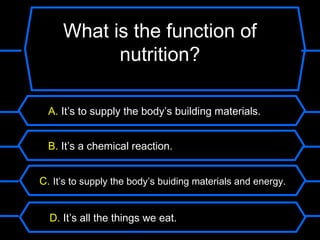
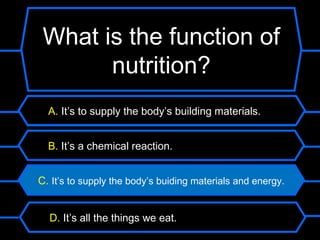
What is the function of
           nutrition?

  A. It’s to supply the body’s building materials.


  B. It’s a chemical reaction.

C. It’s to supply the body’s buiding materials and energy.


  D. It’s all the things we eat.
What is the function of
       nutrition?
  A. It’s to supply the body’s building materials.


  B. It’s a chemical reaction.

C. It’s to supply the body’s buiding materials and energy.


  D. It’s all the things we eat.
100 points
Question 2
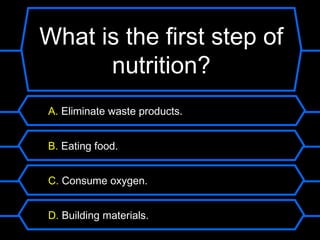
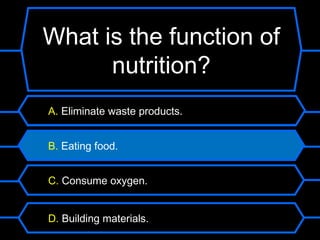
What is the first step of
      nutrition?
A. Eliminate waste products.


B. Eating food.


C. Consume oxygen.


D. Building materials.
What is the function of
      nutrition?
A. Eliminate waste products.


B. Eating food.


C. Consume oxygen.


D. Building materials.
200 points
Question 3
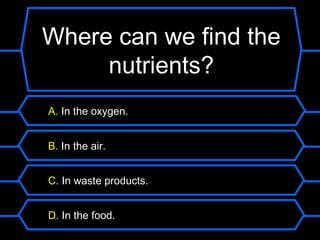
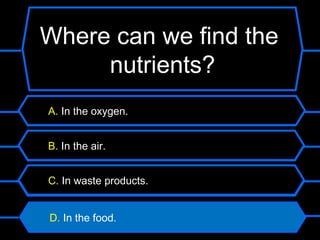
Where can we find the
     nutrients?
A. In the oxygen.


B. In the air.


C. In waste products.


D. In the food.
Where can we find the
     nutrients?
A. In the oxygen.


B. In the air.


C. In waste products.


D. In the food.
300 points
Question 4
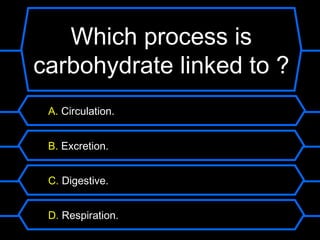
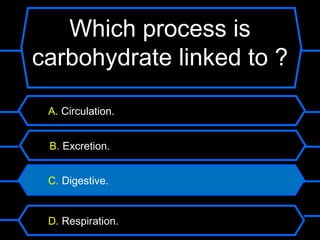
Which process is
carbohydrate linked to ?
 A. Circulation.

 B. Excretion.

 C. Digestive.

 D. Respiration.
Which process is
carbohydrate linked to ?

 A. Circulation.


 B. Excretion.


 C. Digestive.


 D. Respiration.
400 points
Question 5
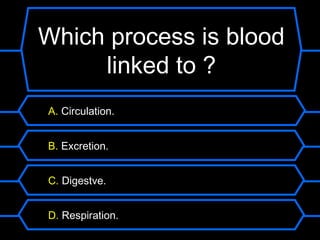
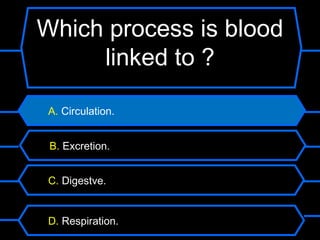
Which process is blood
     linked to ?
A. Circulation.


B. Excretion.


C. Digestve.


D. Respiration.
Which process is blood
     linked to ?

 A. Circulation.


 B. Excretion.


 C. Digestve.


 D. Respiration.
400 points
Question 6
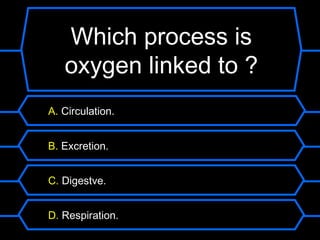
Which process is
   oxygen linked to ?
A. Circulation.


B. Excretion.


C. Digestve.


D. Respiration.
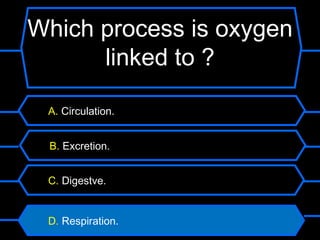
Which process is oxygen
      linked to ?

 A. Circulation.


 B. Excretion.


 C. Digestve.


 D. Respiration.
4   400 points
Question 7
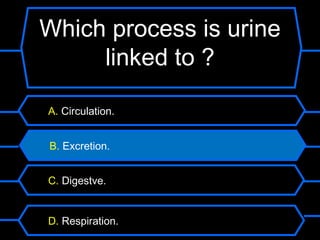
Which process is urine
     linked to ?
A. Circulation.


B. Excretion.


C. Digestve.


D. Respiration.
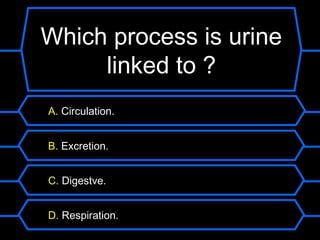
Which process is urine
     linked to ?

A. Circulation.


B. Excretion.


C. Digestve.


D. Respiration.
400 points
Question 8
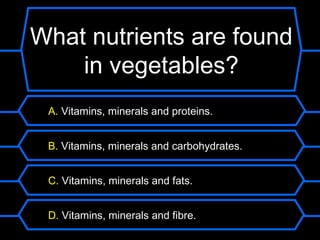
What nutrients are found
    in vegetables?
 A. Vitamins, minerals and proteins.


 B. Vitamins, minerals and carbohydrates.


 C. Vitamins, minerals and fats.


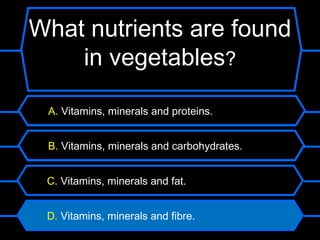
 D. Vitamins, minerals and fibre.
What nutrients are found
    in vegetables?

 A. Vitamins, minerals and proteins.


 B. Vitamins, minerals and carbohydrates.


 C. Vitamins, minerals and fat.


 D. Vitamins, minerals and fibre.
500 points
Question 9
What nutrients are
What nutrients are found
found in bacon, oil and
    in vegetables?
        butter?
 A. Proteins.


 B. Carbohydrates.


 C. Fat.


 D. Fibre.
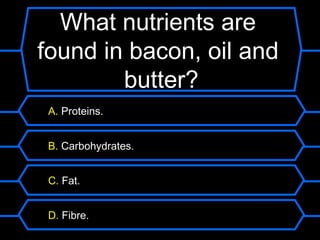
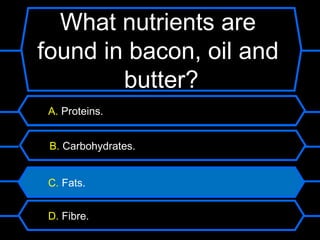
What nutrients are
found in bacon, oil and
        butter?
 A. Proteins.


 B. Carbohydrates.


 C. Fats.


 D. Fibre.
500 points
Question 10
What nutrients are
What nutrients are found
  found in meat, fish
    in vegetables?
      and eggs?
 A. Proteins and fibre.


 B. Carbohydrates and fats.


 C. Fats and proteins.


 D. Fibre and fats.
What nutrients are
  found in meat, fish
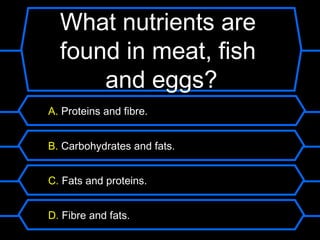
      and eggs?
A. Proteins and fibre.


B. Carbohydrates and fats.


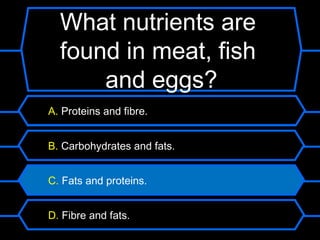
C. Fats and proteins.


D. Fibre and fats.
500 points
Question 11
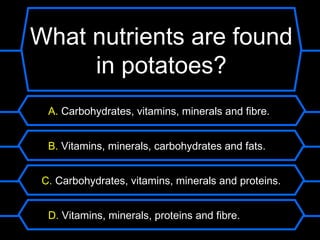
What nutrients are found
     in potatoes?
  A. Carbohydrates, vitamins, minerals and fibre.


  B. Vitamins, minerals, carbohydrates and fats.


 C. Carbohydrates, vitamins, minerals and proteins.


  D. Vitamins, minerals, proteins and fibre.
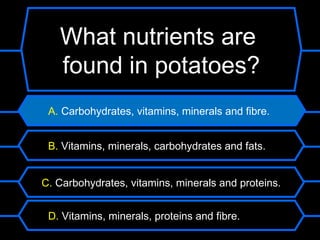
What nutrients are
   found in potatoes?
 A. Carbohydrates, vitamins, minerals and fibre.


 B. Vitamins, minerals, carbohydrates and fats.


C. Carbohydrates, vitamins, minerals and proteins.


 D. Vitamins, minerals, proteins and fibre.
500 points
Question 12
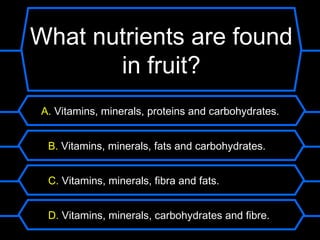
What nutrients are found
       in fruit?
 A. Vitamins, minerals, proteins and carbohydrates.


  B. Vitamins, minerals, fats and carbohydrates.


  C. Vitamins, minerals, fibra and fats.


  D. Vitamins, minerals, carbohydrates and fibre.
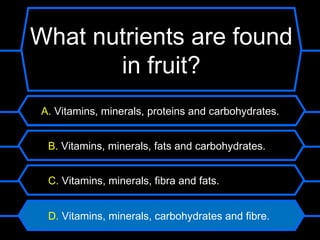
What nutrients are found
       in fruit?
 A. Vitamins, minerals, proteins and carbohydrates.


  B. Vitamins, minerals, fats and carbohydrates.


  C. Vitamins, minerals, fibra and fats.


  D. Vitamins, minerals, carbohydrates and fibre.
500 points
Question 13
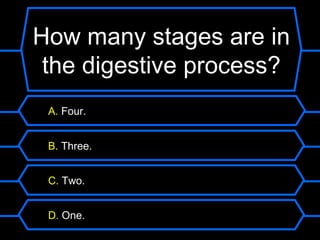
How many stages are in
 the digestive process?
 A. Four.


 B. Three.


 C. Two.


 D. One.
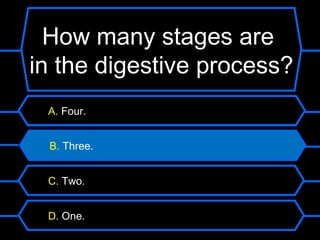
How many stages are
in the digestive process?
 A. Four.


 B. Three.


 C. Two.


 D. One.
600 points
Question 14
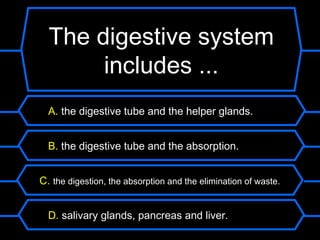
The digestive system
       includes ...
  A. the digestive tube and the helper glands.


  B. the digestive tube and the absorption.


C. the digestion, the absorption and the elimination of waste.


  D. salivary glands, pancreas and liver.
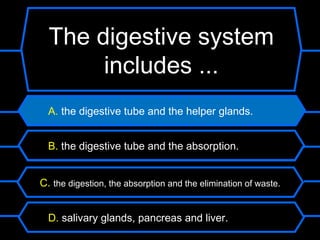
The digestive system
       includes ...
  A. the digestive tube and the helper glands.


  B. the digestive tube and the absorption.


C. the digestion, the absorption and the elimination of waste.


  D. salivary glands, pancreas and liver.
700 points
Question 15
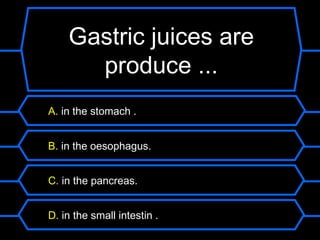
Gastric juices are
      produce ...
A. in the stomach .


B. in the oesophagus.


C. in the pancreas.


D. in the small intestin .
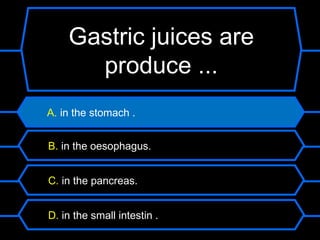
Gastric juices are
      produce ...
A. in the stomach .


B. in the oesophagus.


C. in the pancreas.


D. in the small intestin .
800 points
Question 16
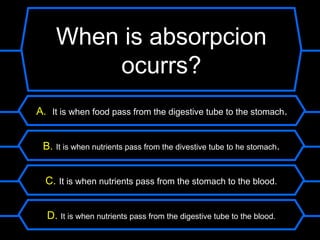
When is absorpcion
        ocurrs?
A. It is when food pass from the digestive tube to the stomach.


 B. It is when nutrients pass from the divestive tube to he stomach.


  C. It is when nutrients pass from the stomach to the blood.


  D. It is when nutrients pass from the digestive tube to the blood.
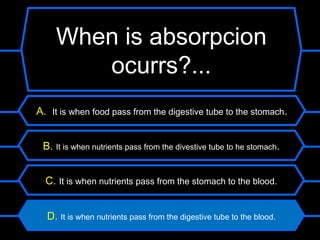
When is absorpcion
       ocurrs?...
A. It is when food pass from the digestive tube to the stomach.


 B. It is when nutrients pass from the divestive tube to he stomach.


  C. It is when nutrients pass from the stomach to the blood.


  D. It is when nutrients pass from the digestive tube to the blood.
900 points
Question 17
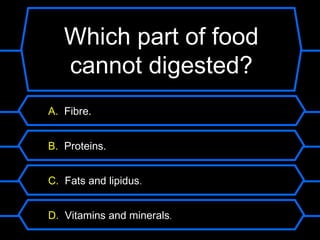
Which part of food
   cannot digested?
A. Fibre.


B. Proteins.


C. Fats and lipidus.


D. Vitamins and minerals.
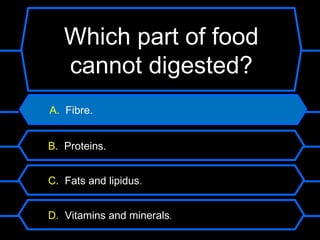
Which part of food
   cannot digested?
A. Fibre.


B. Proteins.


C. Fats and lipidus.


D. Vitamins and minerals.
1.000 points
And the winner is …?

Nutrition I

  • 1.
    Who Wants ToBe A Millionaire? Nutrition I
  • 2.
  • 3.
    What is thefunction of nutrition? A. It’s to supply the body’s building materials. B. It’s a chemical reaction. C. It’s to supply the body’s buiding materials and energy. D. It’s all the things we eat.
  • 4.
    What is thefunction of nutrition? A. It’s to supply the body’s building materials. B. It’s a chemical reaction. C. It’s to supply the body’s buiding materials and energy. D. It’s all the things we eat.
  • 5.
  • 6.
  • 7.
    What is thefirst step of nutrition? A. Eliminate waste products. B. Eating food. C. Consume oxygen. D. Building materials.
  • 8.
    What is thefunction of nutrition? A. Eliminate waste products. B. Eating food. C. Consume oxygen. D. Building materials.
  • 9.
  • 10.
  • 11.
    Where can wefind the nutrients? A. In the oxygen. B. In the air. C. In waste products. D. In the food.
  • 12.
    Where can wefind the nutrients? A. In the oxygen. B. In the air. C. In waste products. D. In the food.
  • 13.
  • 14.
  • 15.
    Which process is carbohydratelinked to ? A. Circulation. B. Excretion. C. Digestive. D. Respiration.
  • 16.
    Which process is carbohydratelinked to ? A. Circulation. B. Excretion. C. Digestive. D. Respiration.
  • 17.
  • 18.
  • 19.
    Which process isblood linked to ? A. Circulation. B. Excretion. C. Digestve. D. Respiration.
  • 20.
    Which process isblood linked to ? A. Circulation. B. Excretion. C. Digestve. D. Respiration.
  • 21.
  • 22.
  • 23.
    Which process is oxygen linked to ? A. Circulation. B. Excretion. C. Digestve. D. Respiration.
  • 24.
    Which process isoxygen linked to ? A. Circulation. B. Excretion. C. Digestve. D. Respiration.
  • 25.
    4 400 points
  • 26.
  • 27.
    Which process isurine linked to ? A. Circulation. B. Excretion. C. Digestve. D. Respiration.
  • 28.
    Which process isurine linked to ? A. Circulation. B. Excretion. C. Digestve. D. Respiration.
  • 29.
  • 30.
  • 31.
    What nutrients arefound in vegetables? A. Vitamins, minerals and proteins. B. Vitamins, minerals and carbohydrates. C. Vitamins, minerals and fats. D. Vitamins, minerals and fibre.
  • 32.
    What nutrients arefound in vegetables? A. Vitamins, minerals and proteins. B. Vitamins, minerals and carbohydrates. C. Vitamins, minerals and fat. D. Vitamins, minerals and fibre.
  • 33.
  • 34.
  • 35.
    What nutrients are Whatnutrients are found found in bacon, oil and in vegetables? butter? A. Proteins. B. Carbohydrates. C. Fat. D. Fibre.
  • 36.
    What nutrients are foundin bacon, oil and butter? A. Proteins. B. Carbohydrates. C. Fats. D. Fibre.
  • 37.
  • 38.
  • 39.
    What nutrients are Whatnutrients are found found in meat, fish in vegetables? and eggs? A. Proteins and fibre. B. Carbohydrates and fats. C. Fats and proteins. D. Fibre and fats.
  • 40.
    What nutrients are found in meat, fish and eggs? A. Proteins and fibre. B. Carbohydrates and fats. C. Fats and proteins. D. Fibre and fats.
  • 41.
  • 42.
  • 43.
    What nutrients arefound in potatoes? A. Carbohydrates, vitamins, minerals and fibre. B. Vitamins, minerals, carbohydrates and fats. C. Carbohydrates, vitamins, minerals and proteins. D. Vitamins, minerals, proteins and fibre.
  • 44.
    What nutrients are found in potatoes? A. Carbohydrates, vitamins, minerals and fibre. B. Vitamins, minerals, carbohydrates and fats. C. Carbohydrates, vitamins, minerals and proteins. D. Vitamins, minerals, proteins and fibre.
  • 45.
  • 46.
  • 47.
    What nutrients arefound in fruit? A. Vitamins, minerals, proteins and carbohydrates. B. Vitamins, minerals, fats and carbohydrates. C. Vitamins, minerals, fibra and fats. D. Vitamins, minerals, carbohydrates and fibre.
  • 48.
    What nutrients arefound in fruit? A. Vitamins, minerals, proteins and carbohydrates. B. Vitamins, minerals, fats and carbohydrates. C. Vitamins, minerals, fibra and fats. D. Vitamins, minerals, carbohydrates and fibre.
  • 49.
  • 50.
  • 51.
    How many stagesare in the digestive process? A. Four. B. Three. C. Two. D. One.
  • 52.
    How many stagesare in the digestive process? A. Four. B. Three. C. Two. D. One.
  • 53.
  • 54.
  • 55.
    The digestive system includes ... A. the digestive tube and the helper glands. B. the digestive tube and the absorption. C. the digestion, the absorption and the elimination of waste. D. salivary glands, pancreas and liver.
  • 56.
    The digestive system includes ... A. the digestive tube and the helper glands. B. the digestive tube and the absorption. C. the digestion, the absorption and the elimination of waste. D. salivary glands, pancreas and liver.
  • 57.
  • 58.
  • 59.
    Gastric juices are produce ... A. in the stomach . B. in the oesophagus. C. in the pancreas. D. in the small intestin .
  • 60.
    Gastric juices are produce ... A. in the stomach . B. in the oesophagus. C. in the pancreas. D. in the small intestin .
  • 61.
  • 62.
  • 63.
    When is absorpcion ocurrs? A. It is when food pass from the digestive tube to the stomach. B. It is when nutrients pass from the divestive tube to he stomach. C. It is when nutrients pass from the stomach to the blood. D. It is when nutrients pass from the digestive tube to the blood.
  • 64.
    When is absorpcion ocurrs?... A. It is when food pass from the digestive tube to the stomach. B. It is when nutrients pass from the divestive tube to he stomach. C. It is when nutrients pass from the stomach to the blood. D. It is when nutrients pass from the digestive tube to the blood.
  • 65.
  • 66.
  • 67.
    Which part offood cannot digested? A. Fibre. B. Proteins. C. Fats and lipidus. D. Vitamins and minerals.
  • 68.
    Which part offood cannot digested? A. Fibre. B. Proteins. C. Fats and lipidus. D. Vitamins and minerals.
  • 69.
  • 70.