Sense Groups /
Thought Groups and
Emphasis Markers
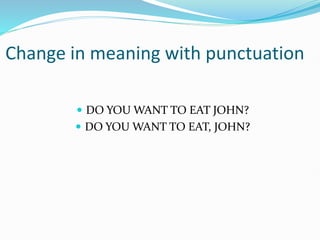
Change in meaning with punctuation
 DO YOU WANT TO EAT JOHN?
 DO YOU WANT TO EAT, JOHN?
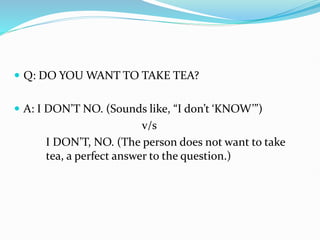
 Q: DO YOU WANT TO TAKE TEA?
 A: I DON’T NO. (Sounds like, “I don’t ‘KNOW’”)
v/s
I DON’T, NO. (The person does not want to take
tea, a perfect answer to the question.)
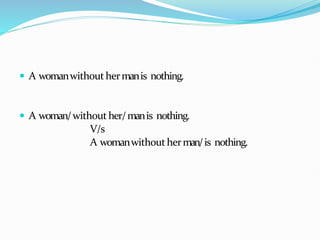
 A womanwithouthermanis nothing.
 A woman/withouther/manis nothing.
V/s
A womanwithoutherman/is nothing.
What are THOUGHT GROUPS?
 A group of words that express a meaningful idea or
thought.
 GROUPS OF WORDS that make sense together.
I’m sorry but/I have a/conflict and I/can’t make
the coffee.
OR,
I’m sorry/but I have a conflict/and I can’t make
the coffee.
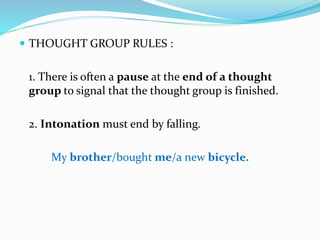
 THOUGHT GROUP RULES :
1. There is often a pause at the end of a thought
group to signal that the thought group is finished.
2. Intonation must end by falling.
My brother/bought me/a new bicycle.
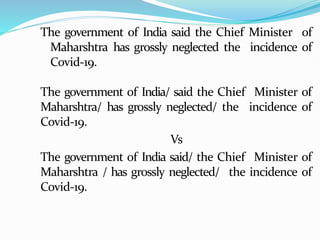
The government of India said the Chief Minister of
Maharshtra has grossly neglected the incidence of
Covid-19.
The government of India/ said the Chief Minister of
Maharshtra/ has grossly neglected/ the incidence of
Covid-19.
Vs
The government of India said/ the Chief Minister of
Maharshtra / has grossly neglected/ the incidence of
Covid-19.
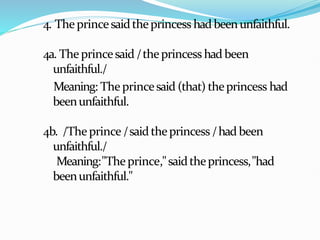
4. Theprincesaidtheprincess hadbeenunfaithful.
4a. Theprincesaid/theprincess had been
unfaithful./
Meaning: The princesaid (that) theprincess had
beenunfaithful.
4b. /Theprince /saidtheprincess/had been
unfaithful./
Meaning:"Theprince,"saidtheprincess,"had
beenunfaithful."
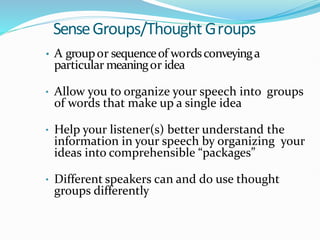
SenseGroups/Thought Groups
• A groupor sequenceof wordsconveyinga
particular meaningor idea
• Allow you to organize your speech into groups
of words that make up a single idea
• Help your listener(s) better understand the
information in your speech by organizing your
ideas into comprehensible “packages”
• Different speakers can and do use thought
groups differently
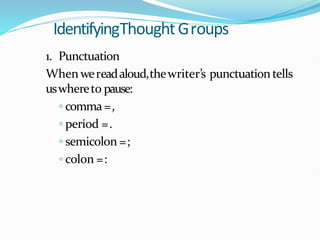
IdentifyingThoughtGroups
1. Punctuation
When wereadaloud,thewriter’s punctuationtells
uswhereto pause:
◦ comma=,
◦ period =.
◦ semicolon =;
◦ colon =:
Cont…
2. Grammar
⚫ Identificationof grammatical unitsina sentence
⚫ Pausingbetweenlargergrammatical units creates
naturalrhythm
Grammatical Units
⚫ Noun phrases
◦ the blue-eyed girl
⚫ Verb phrases
◦ have been studying
⚫ Prepositional phrases
◦ on the table
⚫ Clauses
◦ When I was astudent, I studied for hours.
Read
⚫ A blue-eyed girl/ entered the
classroom.//
⚫ A blue-eyed girl/ and her best friend/
entered the room.//
⚫ The blue-eyed girl/ is playing with her
brother.//
⚫ The teacher,/ whom I loved most,/
has resigned.//
Avoid breakingupshort sentences
I came.
Vs
I came,I saw,I conquered.
I danced.
Vs
I danced in the auditorium.
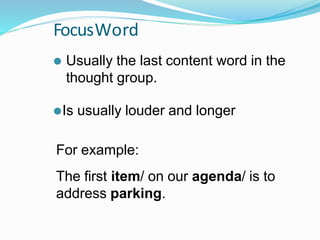
FocusWord
⚫ Usually the last content word in the
thought group.
⚫Is usually louder and longer
For example:
The first item/ on our agenda/ is to
address parking.
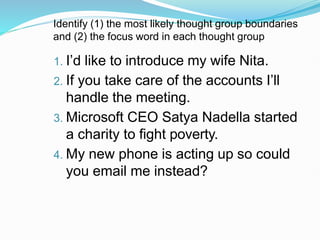
Identify (1) the most likely thought group boundaries
and (2) the focus word in each thought group
1. I’d like to introduce my wife Nita.
2. If you take care of the accounts I’ll
handle the meeting.
3. Microsoft CEO Satya Nadella started
a charity to fight poverty.
4. My new phone is acting up so could
you email me instead?
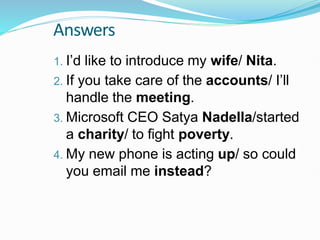
Answers
1. I’d like to introduce my wife/ Nita.
2. If you take care of the accounts/ I’ll
handle the meeting.
3. Microsoft CEO Satya Nadella/started
a charity/ to fight poverty.
4. My new phone is acting up/ so could
you email me instead?
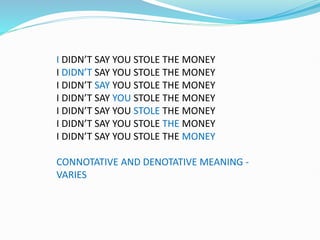
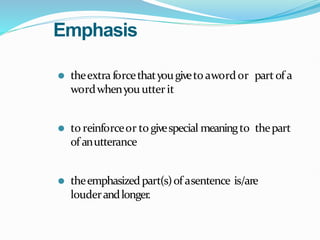
Emphasis(inReadingandWriting)
I DIDN’T SAY YOU STOLE THE MONEY
CONNOTATIVE AND DENOTATIVE MEANING -
VARIES
Emphasis
⚫ theextra forcethatyougiveto awordor part of a
wordwhenyouutterit
⚫ to reinforceor to givespecial meaningto thepart
of anutterance
⚫ theemphasizedpart(s)of asentence is/are
louderandlonger.
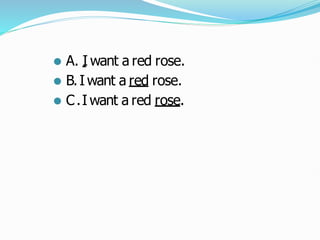
⚫ A. I want a red rose.
⚫ B.I want a red rose.
⚫ C.I want a red rose.
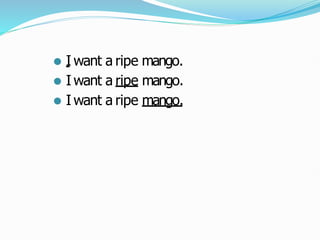
⚫ I want a ripe mango.

Sense groups ( thought groups) and emphasis markers.pptx

  • 1.
    Sense Groups / ThoughtGroups and Emphasis Markers
  • 2.
    Change in meaningwith punctuation  DO YOU WANT TO EAT JOHN?  DO YOU WANT TO EAT, JOHN?
  • 3.
     Q: DOYOU WANT TO TAKE TEA?  A: I DON’T NO. (Sounds like, “I don’t ‘KNOW’”) v/s I DON’T, NO. (The person does not want to take tea, a perfect answer to the question.)
  • 4.
     A womanwithouthermanisnothing.  A woman/withouther/manis nothing. V/s A womanwithoutherman/is nothing.
  • 5.
    What are THOUGHTGROUPS?  A group of words that express a meaningful idea or thought.  GROUPS OF WORDS that make sense together. I’m sorry but/I have a/conflict and I/can’t make the coffee. OR, I’m sorry/but I have a conflict/and I can’t make the coffee.
  • 8.
     THOUGHT GROUPRULES : 1. There is often a pause at the end of a thought group to signal that the thought group is finished. 2. Intonation must end by falling. My brother/bought me/a new bicycle.
  • 9.
    The government ofIndia said the Chief Minister of Maharshtra has grossly neglected the incidence of Covid-19. The government of India/ said the Chief Minister of Maharshtra/ has grossly neglected/ the incidence of Covid-19. Vs The government of India said/ the Chief Minister of Maharshtra / has grossly neglected/ the incidence of Covid-19.
  • 10.
    4. Theprincesaidtheprincess hadbeenunfaithful. 4a.Theprincesaid/theprincess had been unfaithful./ Meaning: The princesaid (that) theprincess had beenunfaithful. 4b. /Theprince /saidtheprincess/had been unfaithful./ Meaning:"Theprince,"saidtheprincess,"had beenunfaithful."
  • 12.
    SenseGroups/Thought Groups • Agroupor sequenceof wordsconveyinga particular meaningor idea • Allow you to organize your speech into groups of words that make up a single idea • Help your listener(s) better understand the information in your speech by organizing your ideas into comprehensible “packages” • Different speakers can and do use thought groups differently
  • 13.
    IdentifyingThoughtGroups 1. Punctuation When wereadaloud,thewriter’spunctuationtells uswhereto pause: ◦ comma=, ◦ period =. ◦ semicolon =; ◦ colon =:
  • 14.
    Cont… 2. Grammar ⚫ Identificationofgrammatical unitsina sentence ⚫ Pausingbetweenlargergrammatical units creates naturalrhythm
  • 15.
    Grammatical Units ⚫ Nounphrases ◦ the blue-eyed girl ⚫ Verb phrases ◦ have been studying ⚫ Prepositional phrases ◦ on the table ⚫ Clauses ◦ When I was astudent, I studied for hours.
  • 16.
    Read ⚫ A blue-eyedgirl/ entered the classroom.// ⚫ A blue-eyed girl/ and her best friend/ entered the room.// ⚫ The blue-eyed girl/ is playing with her brother.// ⚫ The teacher,/ whom I loved most,/ has resigned.//
  • 17.
    Avoid breakingupshort sentences Icame. Vs I came,I saw,I conquered. I danced. Vs I danced in the auditorium.
  • 18.
    FocusWord ⚫ Usually thelast content word in the thought group. ⚫Is usually louder and longer For example: The first item/ on our agenda/ is to address parking.
  • 19.
    Identify (1) themost likely thought group boundaries and (2) the focus word in each thought group 1. I’d like to introduce my wife Nita. 2. If you take care of the accounts I’ll handle the meeting. 3. Microsoft CEO Satya Nadella started a charity to fight poverty. 4. My new phone is acting up so could you email me instead?
  • 20.
    Answers 1. I’d liketo introduce my wife/ Nita. 2. If you take care of the accounts/ I’ll handle the meeting. 3. Microsoft CEO Satya Nadella/started a charity/ to fight poverty. 4. My new phone is acting up/ so could you email me instead?
  • 21.
  • 22.
    I DIDN’T SAYYOU STOLE THE MONEY I DIDN’T SAY YOU STOLE THE MONEY I DIDN’T SAY YOU STOLE THE MONEY I DIDN’T SAY YOU STOLE THE MONEY I DIDN’T SAY YOU STOLE THE MONEY I DIDN’T SAY YOU STOLE THE MONEY I DIDN’T SAY YOU STOLE THE MONEY CONNOTATIVE AND DENOTATIVE MEANING - VARIES
  • 23.
    Emphasis ⚫ theextra forcethatyougivetoawordor part of a wordwhenyouutterit ⚫ to reinforceor to givespecial meaningto thepart of anutterance ⚫ theemphasizedpart(s)of asentence is/are louderandlonger.
  • 24.
    ⚫ A. Iwant a red rose. ⚫ B.I want a red rose. ⚫ C.I want a red rose.
  • 25.
    ⚫ I wanta ripe mango. ⚫ I want a ripe mango. ⚫ I want a ripe mango.