Sinhgad Technical Education Society’s
SINHGAD COLLEGE OF ENGINEERING, Pune-41
Department of Information Technology
 The Publisher was supposed to know HTML
and FTP
 There was no central user interface to edit and
publish content.
 In built search functionality was not available.
 No templating system.
 A Content Management System (CMS) is a
computer program that allows publishing,
editing and modifying content as well as its
maintenance from a central interface.
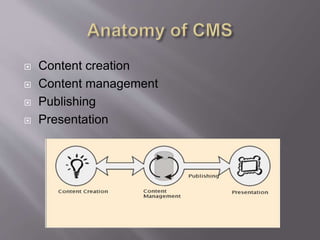
 Content creation
 Content management
 Publishing
 Presentation
 Functional Classification
 Classification by License Model
 Classification by Technical Aspects
 Enterprise CMS
 Editorial systems
 Groupware-Solutions
 Agency Solutions and Tools with CMS-
capabilities
 Open Source CMS
 Commercial CMS
 Differentiating Factors:
 Costs
 Support
 Security and Performance
 Flat file-CMS
 Database-managed system
 WYSIWYG editing
 Workflow, automation of tasks
 Version Control and Versioning
 Multichannel Delivery (Desktop, Smartphone
etc.)
 Personalization
 Faster page development
 Easier changes on "common parts" of the
pages
 Time to market
 Cost reduction
 Automation
 For each client request a new web page is
generated by the server, thus performance
decreases as multiple page requests occur.
 Need for sufficient caching mechanism.
 Wordpress
 Joomla
 Drupal
 CMS can be a good solution to a project if the
required core functionalities are already built
into it.
 Enterprises choose CMS based solutions
based on their functional requirements,
customer support offered and analysis of data
gathered from current trends.
 “Introduction to Content Management Systems” white paper by
Hannon Hill
 Prof.Yogesh Vedpathak, “Research Paper on Content
Management System”, NCI 2 TM: 2014, Sinhgad Institute of
Management and Computer Application (SIMCA)
 Bob Boiko, “Understanding Content Management A CM Domain
White Paper”, Copyright 2002 Metatorial Services Inc. &
HungryMinds Inc.
Seminar on Content Management Systems

Seminar on Content Management Systems

  • 1.
    Sinhgad Technical EducationSociety’s SINHGAD COLLEGE OF ENGINEERING, Pune-41 Department of Information Technology
  • 3.
     The Publisherwas supposed to know HTML and FTP  There was no central user interface to edit and publish content.  In built search functionality was not available.  No templating system.
  • 4.
     A ContentManagement System (CMS) is a computer program that allows publishing, editing and modifying content as well as its maintenance from a central interface.
  • 5.
     Content creation Content management  Publishing  Presentation
  • 6.
     Functional Classification Classification by License Model  Classification by Technical Aspects
  • 7.
     Enterprise CMS Editorial systems  Groupware-Solutions  Agency Solutions and Tools with CMS- capabilities
  • 8.
     Open SourceCMS  Commercial CMS  Differentiating Factors:  Costs  Support  Security and Performance
  • 9.
     Flat file-CMS Database-managed system
  • 10.
     WYSIWYG editing Workflow, automation of tasks  Version Control and Versioning  Multichannel Delivery (Desktop, Smartphone etc.)  Personalization
  • 11.
     Faster pagedevelopment  Easier changes on "common parts" of the pages  Time to market  Cost reduction  Automation
  • 12.
     For eachclient request a new web page is generated by the server, thus performance decreases as multiple page requests occur.  Need for sufficient caching mechanism.
  • 13.
  • 14.
     CMS canbe a good solution to a project if the required core functionalities are already built into it.  Enterprises choose CMS based solutions based on their functional requirements, customer support offered and analysis of data gathered from current trends.
  • 15.
     “Introduction toContent Management Systems” white paper by Hannon Hill  Prof.Yogesh Vedpathak, “Research Paper on Content Management System”, NCI 2 TM: 2014, Sinhgad Institute of Management and Computer Application (SIMCA)  Bob Boiko, “Understanding Content Management A CM Domain White Paper”, Copyright 2002 Metatorial Services Inc. & HungryMinds Inc.