INTRODUCTION
Cloud computing provides us a means by
which we can access the application as
utilites, over the internet. It allows us to
ocreate configure and customize applicatin.
WHAT IS CLOUD COMPUTING
• Cloud computing refers to manipulating
configuring, and accessing the application onliine.
It offers online data storage, infrastructure and
application.
• Cloud compution is both a combination of
software and hardware based computing
resourses delivered as a network service.
BASIC CONCEPTS
• There are certain srvices and models working
behind the scene making the cloud computing
feasible and accessible to end users.
• Following are the working models for cloud
computing:-
1. Deployment models
2. Service models
DEPLOYMENT MODEL
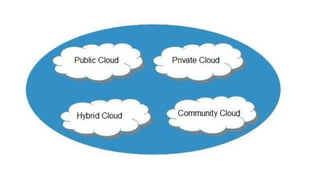
Deployment model define the type of
accesss to the cloud, i.e., how the cloud is
located? Cloud can have any of the four types
of access: public, private, hybrid and
commmunity.
PUBLIC CLOUD
• The private cloud allows system and sevices to be
accesible within an organzation.
COMMUNITY CLOUD
• The community cloud allows systems and
services to be accessible by grroup of
organizations.
HYBRID CLOUD
• The hybrid cloud is mixture of public and private
cloud.
SERVICE MODEL
Service models are the reference models on
which the cloud compution is based. These
can be categorized into three basic service
models as listed below:
1. Infrastructure as a service
2. Platform as a service
3. Software as a service
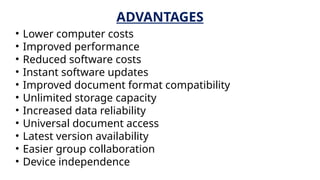
ADVANTAGES
• Lower computer costs
• Improved performance
• Reduced software costs
• Instant software updates
• Improved document format compatibility
• Unlimited storage capacity
• Increased data reliability
• Universal document access
• Latest version availability
• Easier group collaboration
• Device independence
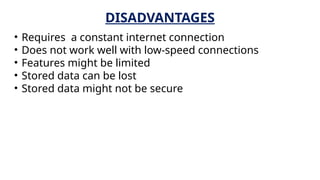
DISADVANTAGES
• Requires a constant internet connection
• Does not work well with low-speed connections
• Features might be limited
• Stored data can be lost
• Stored data might not be secure
THANK
YOU

SEMINAR1Cloud computing.pptx cloud computing for diploma

  • 2.
    INTRODUCTION Cloud computing providesus a means by which we can access the application as utilites, over the internet. It allows us to ocreate configure and customize applicatin.
  • 3.
    WHAT IS CLOUDCOMPUTING • Cloud computing refers to manipulating configuring, and accessing the application onliine. It offers online data storage, infrastructure and application. • Cloud compution is both a combination of software and hardware based computing resourses delivered as a network service.
  • 5.
    BASIC CONCEPTS • Thereare certain srvices and models working behind the scene making the cloud computing feasible and accessible to end users. • Following are the working models for cloud computing:- 1. Deployment models 2. Service models
  • 6.
    DEPLOYMENT MODEL Deployment modeldefine the type of accesss to the cloud, i.e., how the cloud is located? Cloud can have any of the four types of access: public, private, hybrid and commmunity.
  • 8.
    PUBLIC CLOUD • Theprivate cloud allows system and sevices to be accesible within an organzation. COMMUNITY CLOUD • The community cloud allows systems and services to be accessible by grroup of organizations. HYBRID CLOUD • The hybrid cloud is mixture of public and private cloud.
  • 9.
    SERVICE MODEL Service modelsare the reference models on which the cloud compution is based. These can be categorized into three basic service models as listed below: 1. Infrastructure as a service 2. Platform as a service 3. Software as a service
  • 10.
    ADVANTAGES • Lower computercosts • Improved performance • Reduced software costs • Instant software updates • Improved document format compatibility • Unlimited storage capacity • Increased data reliability • Universal document access • Latest version availability • Easier group collaboration • Device independence
  • 11.
    DISADVANTAGES • Requires aconstant internet connection • Does not work well with low-speed connections • Features might be limited • Stored data can be lost • Stored data might not be secure

  • 12.