SEMINAR ON
SOLAR SAIL
BY
K.VISHNU
10427029
Introduction
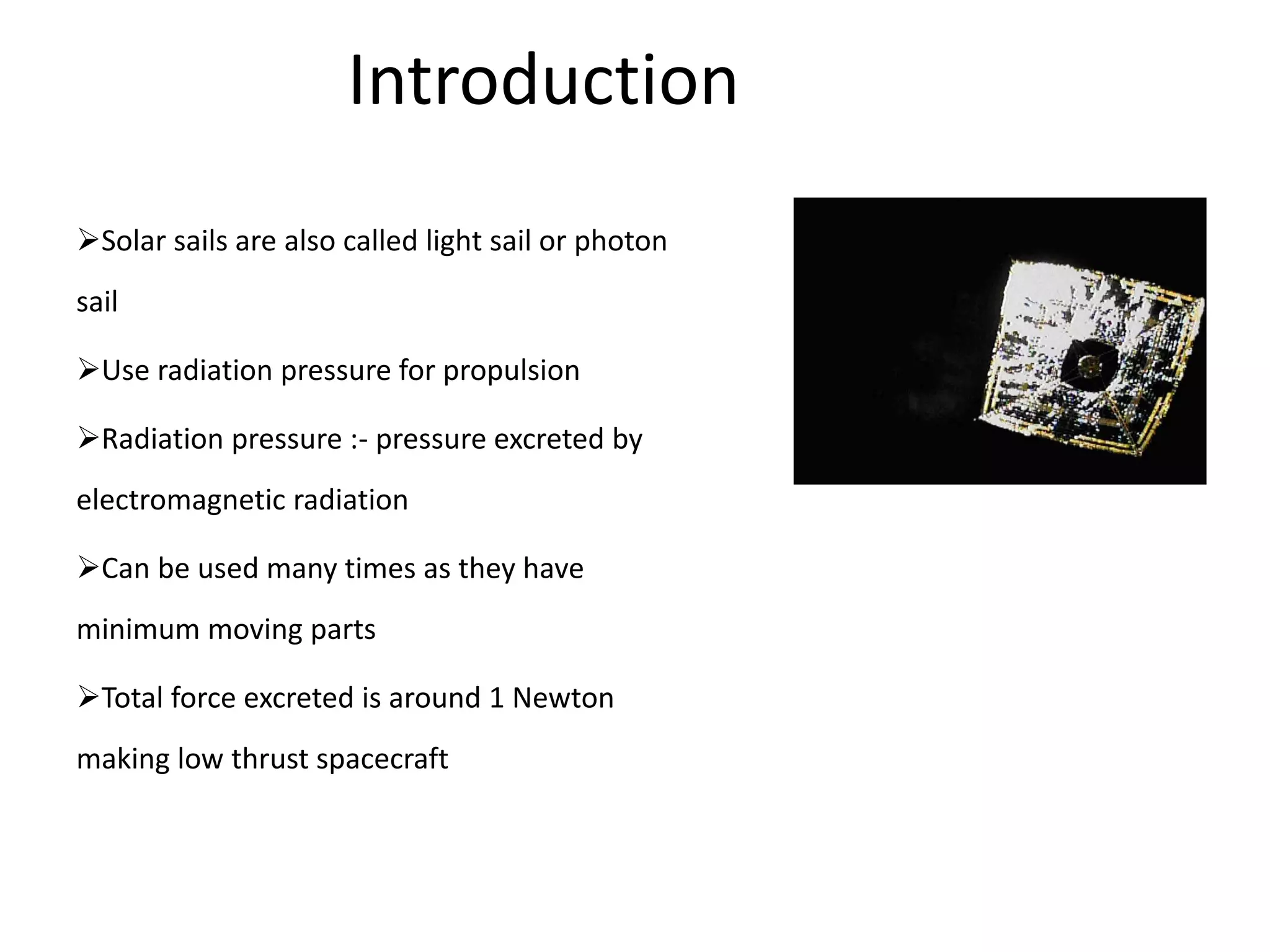
Solar sails are also called light sail or photon
sail
Use radiation pressure for propulsion
Radiation pressure :- pressure excreted by
electromagnetic radiation
Can be used many times as they have
minimum moving parts
Total force excreted is around 1 Newton
making low thrust spacecraft
Physical principles
Solar radiation pressure
 Pressure on the sail due to reflection and small fraction is absorbed.
 Momentum of a photon is given by Einstein’s equation as p= E/c
where p  momentum, E  photon , c  speed of light
 Perfect sail perfect absorbance F= 4.54 μN/m2 , perfect reflectance
F=9.08μN/m2 and 100% specular reflectance.
 Due to wrinkles , absorbance ,curvature ,normal sail will have efficiency of 90%.
 Force on a sail is given by F = F0 cos2 θ / R2 (ideal sail)
θ angle bw sail force vector and radial from sun.
R distance from sun in AU.
 But for an actual sail ,force is F = F0 (0.349 + 0.662 cos 2θ − 0.011 cos 4θ) / R2
 Force and acceleration approach zero as θ nears 60o .
Attitude control
 Attitude  behavior of craft towards various force acting on it .
 It is maintained by ATTITUDE CONTROL UNIT (ACS) .
 Control is by changing crafts centre of pressure and centre of mass.
 achieved with control vanes, moments of individual sail etc.
 Along trajectory :- total force and torque changes.
 Sail temperature also changes with solar distance.
 ACS must be able support these changes.
Constraints
 Testing on earth is carried out at an altitude of 800km.
 Only at this height does solar pressure and drag pressure are typically equal.
Applications
 Solar sails can be used in space ships for both manned and unmanned voyages
(statite) .
 Solar sails can be used in satellites for trajectory corrections .
 thereby saving large amount of propellants.
 statite can go closer to sun ( up to distance were radiation pressure is equal to
gravity) .
Sail configurations
 Many sail configurations have been proposed like
 parachutes ; failed as it tends to collapse due to absence of rigid structure .
 square type.
 disk sail.
 In most cases angular momentum is used to stiffen the structures.
thereby eliminating the need for struts.
 In all cases , large amount of tensile stress is needed.
 weaker sails would ripple and cause structural damage .
 Latest developments include the use of electric and magnetic fields for
propulsion.
 Electric solar wind sail
electric solar wind sail use electric field generated by electrically charged wires
to deflect solar electron in light rays.
electric field is generated by straightened conducting wires placed around the
craft.
 Magnetic sail
 magnetic sail use magnetic field to deflect electrically charged particles.
 in both sails , maneuvering is achieved by changing the size and shape of their
respective fields.
Sail making
 Sails have been developed from many materials .
 Drexler developed a solar sail with thin aluminum film of .1mm thickness.
 The most common material used is aluminized 2µm kapton film.
 Solar sails made from alumina , carbon fiber , is found to be superior to aluminum,
or kapton films.
 New carbon fiber material is over 200 times thicker than conventional solar ail but
has the same mass.
 Lithium can also be used for sail making.
 In all cases , sail should be manufactured in space to avoid tearing during folding
and deployment and to reduce weight.
 Sails are mostly fabricated using vapor deposition and molecular manufacturing
techniques.
 Magnesium and beryllium can also be used for sail making.
 Reflection of light is preferred over absorption.
absorption exerts a force directed straight from sun which is not useful for high
performance sails.
absorption raises the equilibrium temperature in proportion to the fourth rot of
its absorptivity.
Projects operating or completed
 Until 2010, no solar sails had been successfully deployed in space as primary
propulsion system.
 In may 2010, Japanese space agency (JAXA) successfully launched IKAROS .
 IKAROS (Inter - planetary Kite – craft Accelerated by Radiation of Sun)
has a polyimide sheet of 200 m2
is diagonal spinning square sail 20m.
Conclusion
Though concept solar sail has developed for
many years , it is still in its infancy stage .
Reference
Wikipedia
space.com
seminarsonly.com

Seminar on solar sail

  • 1.
  • 2.
    Introduction Solar sails arealso called light sail or photon sail Use radiation pressure for propulsion Radiation pressure :- pressure excreted by electromagnetic radiation Can be used many times as they have minimum moving parts Total force excreted is around 1 Newton making low thrust spacecraft
  • 3.
    Physical principles Solar radiationpressure  Pressure on the sail due to reflection and small fraction is absorbed.  Momentum of a photon is given by Einstein’s equation as p= E/c where p  momentum, E  photon , c  speed of light  Perfect sail perfect absorbance F= 4.54 μN/m2 , perfect reflectance F=9.08μN/m2 and 100% specular reflectance.  Due to wrinkles , absorbance ,curvature ,normal sail will have efficiency of 90%.  Force on a sail is given by F = F0 cos2 θ / R2 (ideal sail) θ angle bw sail force vector and radial from sun. R distance from sun in AU.  But for an actual sail ,force is F = F0 (0.349 + 0.662 cos 2θ − 0.011 cos 4θ) / R2  Force and acceleration approach zero as θ nears 60o .
  • 4.
    Attitude control  Attitude behavior of craft towards various force acting on it .  It is maintained by ATTITUDE CONTROL UNIT (ACS) .  Control is by changing crafts centre of pressure and centre of mass.  achieved with control vanes, moments of individual sail etc.  Along trajectory :- total force and torque changes.  Sail temperature also changes with solar distance.  ACS must be able support these changes.
  • 5.
    Constraints  Testing onearth is carried out at an altitude of 800km.  Only at this height does solar pressure and drag pressure are typically equal. Applications  Solar sails can be used in space ships for both manned and unmanned voyages (statite) .  Solar sails can be used in satellites for trajectory corrections .  thereby saving large amount of propellants.  statite can go closer to sun ( up to distance were radiation pressure is equal to gravity) .
  • 6.
    Sail configurations  Manysail configurations have been proposed like  parachutes ; failed as it tends to collapse due to absence of rigid structure .  square type.  disk sail.  In most cases angular momentum is used to stiffen the structures. thereby eliminating the need for struts.  In all cases , large amount of tensile stress is needed.  weaker sails would ripple and cause structural damage .
  • 7.
     Latest developmentsinclude the use of electric and magnetic fields for propulsion.  Electric solar wind sail electric solar wind sail use electric field generated by electrically charged wires to deflect solar electron in light rays. electric field is generated by straightened conducting wires placed around the craft.  Magnetic sail  magnetic sail use magnetic field to deflect electrically charged particles.  in both sails , maneuvering is achieved by changing the size and shape of their respective fields.
  • 8.
    Sail making  Sailshave been developed from many materials .  Drexler developed a solar sail with thin aluminum film of .1mm thickness.  The most common material used is aluminized 2µm kapton film.  Solar sails made from alumina , carbon fiber , is found to be superior to aluminum, or kapton films.  New carbon fiber material is over 200 times thicker than conventional solar ail but has the same mass.  Lithium can also be used for sail making.  In all cases , sail should be manufactured in space to avoid tearing during folding and deployment and to reduce weight.
  • 9.
     Sails aremostly fabricated using vapor deposition and molecular manufacturing techniques.  Magnesium and beryllium can also be used for sail making.  Reflection of light is preferred over absorption. absorption exerts a force directed straight from sun which is not useful for high performance sails. absorption raises the equilibrium temperature in proportion to the fourth rot of its absorptivity.
  • 10.
    Projects operating orcompleted  Until 2010, no solar sails had been successfully deployed in space as primary propulsion system.  In may 2010, Japanese space agency (JAXA) successfully launched IKAROS .  IKAROS (Inter - planetary Kite – craft Accelerated by Radiation of Sun) has a polyimide sheet of 200 m2 is diagonal spinning square sail 20m.
  • 13.
    Conclusion Though concept solarsail has developed for many years , it is still in its infancy stage .
  • 14.