SEMESTER 1
MULTI-MEDIA
PRESENTATION
1
WHY MULTI-MEDIA PRESENTATION
• Develop confidence in language skills.
• Develop public speaking skills
• Develop persuasive speaking skills
• Challenge students to think creatively.
• Prepare you for life skills.
TASK:
3
Create a MULTI-MEDIA PRESENTATION on a topic of
interest within your FIELD OF STUDY.
This is part of your Final Summative
Assessment (100 marks)
TOPIC
4
Choose an EXCITING topic within your subject field.
Think of cutting-edge ideas and problems facing the industry that you would like to
create awareness of.
• Having the right choice of presentation topics can help meet the Sincerity,
Enthusiasm, Confidence, and Simplicity (SECS) public speaking elements due to these
reasons:
• A good topic can make you sincere in communicating with your audience.
• Fun topics for presentations can also increase the audience’s enthusiasm.
• Fun topics for presentations also give you confidence as it lessens awkwardness.
• The right topic makes your presentation concise, straightforward, and informative at the
same time.
Create a sub-topic from:
5
any ONE of the following areas:
• Health
• Gender inequality
• Racial Inequality
• Social stratification
• Commercialization
• Sponsorship
• Globalization
• Technology
• Social Media
Or choose a broad topic from the list below and REFINE
it:
6
• How Media Affects Gender Stereotypes Portrayal
• How Beauty Contests Affects Women’s Self-esteem
• Differences Between Religion and Cult
• Best Apps to Improve Academic Performance
• Airport First-timers: Step-by-step Instructions
• Easy-to-make Breakfast Recipes
• How to Avoid Procrastination
• Making Money During Holidays
• How Social Media Lowers Self-esteem
• Working Remotely: Pros and Cons
MORE TOPICS
7
• Best Online Business and Professions
• Why Trust Your Intuition
• Reasons to Learn Foreign Languages
• Secrets of a Healthy Relationship
• Benefits of Art Therapy
• How Journalists and Bloggers Differ from Each Other?
• The Origin of Languages
• Evolution of Artificial Intelligence
• Adverse Effects of GMOs on Health and Life
• Effective Ways to Improve Old People’s Health System
MORE TOPICS
8
• Most Iconic Censorship on Social Media
• Most Prominent Female Political Leaders of All Time
• How to Avoid Being Late
• Globalization and Its Effects on World Population
• Smiling Therapy Positive Effects on Mental Health
• Advancement of 3D Printing and Its Benefits
• How Music Helps in Learning New Languages
• Dealing with Child Prodigies
• LGBTQ Rights
• Abortion: Pro-Choice vs. Pro-Life
MORE TOPICS
9
• Benefits of Multiculturalism in a Society
• Gun Control Laws and Limits
• Journalism Ethics and Corruption
• Euthanasia Vs. Right to Live
• Death Penalty Pros and Cons
• Is World Peace Possible?
• Same-sex union
• Banning Animal Experimentation
• Freedom of Speech and Its Restrictions
• Tobacco Regulation
• Hook-up Culture and Its Impact on youth
MORE TOPICS
10
• Bullying and Cyberbullying
• Causes of Depression and Other Mental Illness
• Dealing with Eating Disorders
• Advantages and Disadvantages of Online Education
• Health Impacts of Fast-Food for Youth
• Possibility of Living on Mars
• Why Media Literacy is Important for Youth
• How Youth Can Fight Top Environmental Problems
• Dealing with Diversity at university
• Taking a Break from the Internet
• History Connects with Culture
MORE TOPICS
11
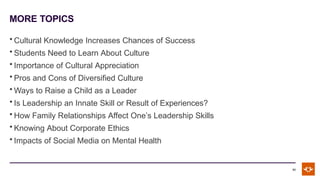
• Cultural Knowledge Increases Chances of Success
• Students Need to Learn About Culture
• Importance of Cultural Appreciation
• Pros and Cons of Diversified Culture
• Ways to Raise a Child as a Leader
• Is Leadership an Innate Skill or Result of Experiences?
• How Family Relationships Affect One’s Leadership Skills
• Knowing About Corporate Ethics
• Impacts of Social Media on Mental Health
MORE TOPICS
12
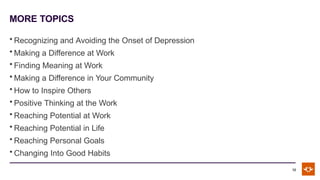
• Recognizing and Avoiding the Onset of Depression
• Making a Difference at Work
• Finding Meaning at Work
• Making a Difference in Your Community
• How to Inspire Others
• Positive Thinking at the Work
• Reaching Potential at Work
• Reaching Potential in Life
• Reaching Personal Goals
• Changing Into Good Habits
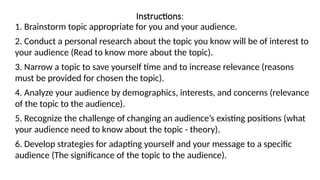
Instructions:
1. Brainstorm topic appropriate for you and your audience.
2. Conduct a personal research about the topic you know will be of interest to
your audience (Read to know more about the topic).
3. Narrow a topic to save yourself time and to increase relevance (reasons
must be provided for chosen the topic).
4. Analyze your audience by demographics, interests, and concerns (relevance
of the topic to the audience).
5. Recognize the challenge of changing an audience’s existing positions (what
your audience need to know about the topic - theory).
6. Develop strategies for adapting yourself and your message to a specific
audience (The significance of the topic to the audience).
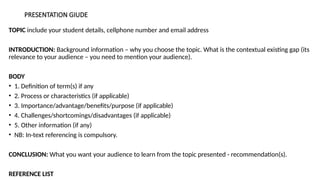
PRESENTATION GIUDE
TOPIC include your student details, cellphone number and email address
INTRODUCTION: Background information – why you choose the topic. What is the contextual existing gap (its
relevance to your audience – you need to mention your audience).
BODY
• 1. Definition of term(s) if any
• 2. Process or characteristics (if applicable)
• 3. Importance/advantage/benefits/purpose (if applicable)
• 4. Challenges/shortcomings/disadvantages (if applicable)
• 5. Other information (if any)
• NB: In-text referencing is compulsory.
CONCLUSION: What you want your audience to learn from the topic presented - recommendation(s).
REFERENCE LIST
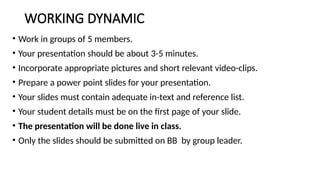
WORKING DYNAMIC
• Work in groups of 5 members.
• Your presentation should be about 3-5 minutes.
• Incorporate appropriate pictures and short relevant video-clips.
• Prepare a power point slides for your presentation.
• Your slides must contain adequate in-text and reference list.
• Your student details must be on the first page of your slide.
• The presentation will be done live in class.
• Only the slides should be submitted on BB by group leader.
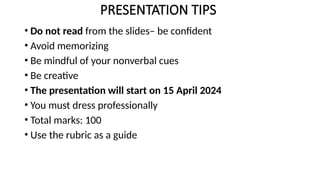
PRESENTATION TIPS
• Do not read from the slides– be confident
• Avoid memorizing
• Be mindful of your nonverbal cues
• Be creative
• The presentation will start on 15 April 2024
• You must dress professionally
• Total marks: 100
• Use the rubric as a guide
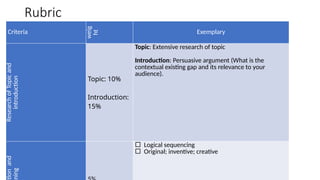
Rubric
Criteria
weig
ht
Exemplary
Research
of
Topic
and
introduction
Topic: 10%
Introduction:
15%
Topic: Extensive research of topic
Introduction: Persuasive argument (What is the
contextual existing gap and its relevance to your
audience).
tion
and
ning
 Logical sequencing
 Original; inventive; creative
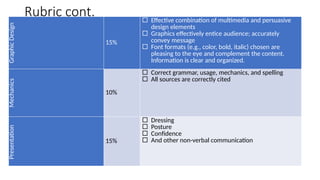
Rubric cont.
Graphic
Design
15%
 Effective combination of multimedia and persuasive
design elements
 Graphics effectively entice audience; accurately
convey message
 Font formats (e.g., color, bold, italic) chosen are
pleasing to the eye and complement the content.
Information is clear and organized.
Mechanics
10%
 Correct grammar, usage, mechanics, and spelling
 All sources are correctly cited
Presentation
15%
 Dressing
 Posture
 Confidence
 And other non-verbal communication
Semester 1 Multimedia Presentation Task and Rubric.pptx

  • 1.
  • 2.
    WHY MULTI-MEDIA PRESENTATION •Develop confidence in language skills. • Develop public speaking skills • Develop persuasive speaking skills • Challenge students to think creatively. • Prepare you for life skills.
  • 3.
    TASK: 3 Create a MULTI-MEDIAPRESENTATION on a topic of interest within your FIELD OF STUDY. This is part of your Final Summative Assessment (100 marks)
  • 4.
    TOPIC 4 Choose an EXCITINGtopic within your subject field. Think of cutting-edge ideas and problems facing the industry that you would like to create awareness of. • Having the right choice of presentation topics can help meet the Sincerity, Enthusiasm, Confidence, and Simplicity (SECS) public speaking elements due to these reasons: • A good topic can make you sincere in communicating with your audience. • Fun topics for presentations can also increase the audience’s enthusiasm. • Fun topics for presentations also give you confidence as it lessens awkwardness. • The right topic makes your presentation concise, straightforward, and informative at the same time.
  • 5.
    Create a sub-topicfrom: 5 any ONE of the following areas: • Health • Gender inequality • Racial Inequality • Social stratification • Commercialization • Sponsorship • Globalization • Technology • Social Media
  • 6.
    Or choose abroad topic from the list below and REFINE it: 6 • How Media Affects Gender Stereotypes Portrayal • How Beauty Contests Affects Women’s Self-esteem • Differences Between Religion and Cult • Best Apps to Improve Academic Performance • Airport First-timers: Step-by-step Instructions • Easy-to-make Breakfast Recipes • How to Avoid Procrastination • Making Money During Holidays • How Social Media Lowers Self-esteem • Working Remotely: Pros and Cons
  • 7.
    MORE TOPICS 7 • BestOnline Business and Professions • Why Trust Your Intuition • Reasons to Learn Foreign Languages • Secrets of a Healthy Relationship • Benefits of Art Therapy • How Journalists and Bloggers Differ from Each Other? • The Origin of Languages • Evolution of Artificial Intelligence • Adverse Effects of GMOs on Health and Life • Effective Ways to Improve Old People’s Health System
  • 8.
    MORE TOPICS 8 • MostIconic Censorship on Social Media • Most Prominent Female Political Leaders of All Time • How to Avoid Being Late • Globalization and Its Effects on World Population • Smiling Therapy Positive Effects on Mental Health • Advancement of 3D Printing and Its Benefits • How Music Helps in Learning New Languages • Dealing with Child Prodigies • LGBTQ Rights • Abortion: Pro-Choice vs. Pro-Life
  • 9.
    MORE TOPICS 9 • Benefitsof Multiculturalism in a Society • Gun Control Laws and Limits • Journalism Ethics and Corruption • Euthanasia Vs. Right to Live • Death Penalty Pros and Cons • Is World Peace Possible? • Same-sex union • Banning Animal Experimentation • Freedom of Speech and Its Restrictions • Tobacco Regulation • Hook-up Culture and Its Impact on youth
  • 10.
    MORE TOPICS 10 • Bullyingand Cyberbullying • Causes of Depression and Other Mental Illness • Dealing with Eating Disorders • Advantages and Disadvantages of Online Education • Health Impacts of Fast-Food for Youth • Possibility of Living on Mars • Why Media Literacy is Important for Youth • How Youth Can Fight Top Environmental Problems • Dealing with Diversity at university • Taking a Break from the Internet • History Connects with Culture
  • 11.
    MORE TOPICS 11 • CulturalKnowledge Increases Chances of Success • Students Need to Learn About Culture • Importance of Cultural Appreciation • Pros and Cons of Diversified Culture • Ways to Raise a Child as a Leader • Is Leadership an Innate Skill or Result of Experiences? • How Family Relationships Affect One’s Leadership Skills • Knowing About Corporate Ethics • Impacts of Social Media on Mental Health
  • 12.
    MORE TOPICS 12 • Recognizingand Avoiding the Onset of Depression • Making a Difference at Work • Finding Meaning at Work • Making a Difference in Your Community • How to Inspire Others • Positive Thinking at the Work • Reaching Potential at Work • Reaching Potential in Life • Reaching Personal Goals • Changing Into Good Habits
  • 13.
    Instructions: 1. Brainstorm topicappropriate for you and your audience. 2. Conduct a personal research about the topic you know will be of interest to your audience (Read to know more about the topic). 3. Narrow a topic to save yourself time and to increase relevance (reasons must be provided for chosen the topic). 4. Analyze your audience by demographics, interests, and concerns (relevance of the topic to the audience). 5. Recognize the challenge of changing an audience’s existing positions (what your audience need to know about the topic - theory). 6. Develop strategies for adapting yourself and your message to a specific audience (The significance of the topic to the audience).
  • 14.
    PRESENTATION GIUDE TOPIC includeyour student details, cellphone number and email address INTRODUCTION: Background information – why you choose the topic. What is the contextual existing gap (its relevance to your audience – you need to mention your audience). BODY • 1. Definition of term(s) if any • 2. Process or characteristics (if applicable) • 3. Importance/advantage/benefits/purpose (if applicable) • 4. Challenges/shortcomings/disadvantages (if applicable) • 5. Other information (if any) • NB: In-text referencing is compulsory. CONCLUSION: What you want your audience to learn from the topic presented - recommendation(s). REFERENCE LIST
  • 15.
    WORKING DYNAMIC • Workin groups of 5 members. • Your presentation should be about 3-5 minutes. • Incorporate appropriate pictures and short relevant video-clips. • Prepare a power point slides for your presentation. • Your slides must contain adequate in-text and reference list. • Your student details must be on the first page of your slide. • The presentation will be done live in class. • Only the slides should be submitted on BB by group leader.
  • 16.
    PRESENTATION TIPS • Donot read from the slides– be confident • Avoid memorizing • Be mindful of your nonverbal cues • Be creative • The presentation will start on 15 April 2024 • You must dress professionally • Total marks: 100 • Use the rubric as a guide
  • 17.
    Rubric Criteria weig ht Exemplary Research of Topic and introduction Topic: 10% Introduction: 15% Topic: Extensiveresearch of topic Introduction: Persuasive argument (What is the contextual existing gap and its relevance to your audience). tion and ning  Logical sequencing  Original; inventive; creative
  • 18.
    Rubric cont. Graphic Design 15%  Effectivecombination of multimedia and persuasive design elements  Graphics effectively entice audience; accurately convey message  Font formats (e.g., color, bold, italic) chosen are pleasing to the eye and complement the content. Information is clear and organized. Mechanics 10%  Correct grammar, usage, mechanics, and spelling  All sources are correctly cited Presentation 15%  Dressing  Posture  Confidence  And other non-verbal communication